Volume 2007, Article ID 60839,9pages doi:10.1155/2007/60839
Research Article
Improving a Power Line Communications Standard
with LDPC Codes
Christine Hsu,1Neng Wang,1, 2Wai-Yip Chan,1and Praveen Jain1
1Department of Electrical and Computer Engineering, Queen’s University, Kingston, ON, Canada K7L 3N6 2Nortel Networks, Richardson, TX 75082-4399, USA
Received 31 October 2006; Revised 7 March 2007; Accepted 4 May 2007
Recommended by Lutz Lampe
We investigate a power line communications (PLC) scheme that could be used to enhance the HomePlug 1.0 standard, specifically its ROBO mode which provides modest throughput for the worst case PLC channel. The scheme is based on using a low-density parity-check (LDPC) code, in lieu of the concatenated Reed-Solomon and convolutional codes in ROBO mode. The PLC channel is modeled with multipath fading and Middleton’s class A noise. Clipping is introduced to mitigate the effect of impulsive noise. A simple and effective method is devised to estimate the variance of the clipped noise for LDPC decoding. Simulation results show that the proposed scheme outperforms the HomePlug 1.0 ROBO mode and has lower computational complexity. The proposed scheme also dispenses with the repetition of information bits in ROBO mode to gain time diversity, resulting in 4-fold increase in physical layer throughput.
Copyright © 2007 Christine Hsu et al. This is an open access article distributed under the Creative Commons Attribution License, which permits unrestricted use, distribution, and reproduction in any medium, provided the original work is properly cited.
1. INTRODUCTION
Power line communications (PLC) have received increasing attention due to the wide availability of power lines, even though PLC face the challenge of harsh and noisy trans-mission channels. HomePlug 1.0 is a current industry
stan-dard for PLC in North America [1]. It uses concatenated
Reed-Solomon (RS) and convolutional forward error correc-tion (FEC) with interleaving for coding payload data and or-thogonal frequency division multiplexing (OFDM) for mod-ulation. HomePlug guarantees rates from 1–14 Mbps for the physical layer (PHY) throughput. The low-end 1 Mbps throughput is obtained when operating the robust-OFDM (ROBO) mode over severely degraded channels. The goal of this paper is to improve the low-end throughput. As we de-scribe below, the throughput can be increased considerably with no increase in complexity.
The convolutional decoder in ROBO mode performs hard decision decoding. Recently, various studies have been carried out to investigate the application of various powerful FEC techniques with soft decision decoding, such as turbo codes and low-density parity-check (LDPC) codes, to PLC
and reported promising results [2–4]. Ardakani et al. [2]
model the PLC channel by the concatenation of an addi-tive white Gaussian noise (AWGN) channel with an erasure
channel. Umehara et al. [3] and Nakagawa et al. [4] use the
Middleton class A noise (AWCN) model [5] to simulate the
impulsive noise for the PLC channel. The Middleton class A noise model has been shown in the literature to be valid
for impulsive noise in PLC (see, e.g, H¨aring and Vinck [6]).
However, most of the existing studies involving AWCN fo-cus on investigating single carrier cases and/or do not
con-sider the effect of multipath fading. Multipath fading occurs
when a propagating signal is corrupted by reflections caused
by impedance mismatches. Ma et al. [7] examine the effects
of impulsive noise and multipath fading on OFDM for un-coded signals. Most of these investigations are compartmen-talized by looking at only selected aspects of PLC schemes.
Towards our aim of improving the HomePlug standard ROBO mode, we take a more comprehensive approach by studying the overall performance of OFDM with LDPC codes over PLC channels modeled by both AWCN and mul-tipath fading. We first assess the performance of OFDM over the AWCN channel. It is observed that the time-frequency transformation of OFDM spreads the AWCN across
subcar-riers, effectively transforming the AWCN into additive white
Gaussian noise (AWGN). In channels with severe impulsive noise, however, noise clipping is used to improve error rate
performance. A simple and efficient method is devised to
RS encoder Convolutionalencoder Puncturing Interleaver FEC
Cyclic prefix preambleInsert IFFT Mapping OFDM modulator
Power line
Demodulator FFT OFDM demodulator
De-interleaving puncturingDe- decoderViterbi RS decoder FEC decoder
Figure1: The HomePlug 1.0 Standard [1].
The method works remarkably well for highly impulsive noises. We compare the performance of our proposed ap-proach to that of HomePlug 1.0 by computer simulation. The results show that our proposed approach outperforms the HomePlug 1.0 ROBO mode, while the computational com-plexity per decoded bit is reduced. Moreover, our approach does not involve the repeated transmission of information that is done in ROBO mode to gain time diversity; thus, in-formation throughput in the physical layer is increased.
In Section 2, we provide a brief background on the
HomePlug 1.0 standard, LDPC codes, and AWCN.Section 3
examines the performance of various LDPC codes over an
AWCN channel. In Section 4, the performance of OFDM
over the AWCN channel is analyzed, a noise clipping rule is described and a simple theoretical approximation of the post-OFDM variance of the clipped noise is proposed. Section 5compares the simulation results of our proposed approach and the HomePlug 1.0 ROBO mode, and discusses
issues of complexity, implementation and efficiency.
2. BACKGROUND
In this section, we provide a brief description of the Home-Plug 1.0 standard, the encoding and decoding procedures for LDPC codes, as well as the AWCN model for impulsive noise.
2.1. HomePlug 1.0 standard
In HomePlug 1.0, the PHY layer employs OFDM transmis-sion. An overall block diagram of the HomePlug 1.0
stan-dard is given inFigure 1. OFDM transmits information over
a number of subcarriers in parallel. It has the benefit of ro-bustness to multipath and low-complexity equalization. In cases where the channel is severely degraded, or where chan-nel estimation has not been performed, the ROBO mode
is used. All 84 carriers are used for this mode. Differential
binary phase shift keying (DBPSK) modulation and con-catenated RS and convolutional coding with interleaving are
applied. The RS code-rate ranges from 31/39 to 43/51 and supports transmission blocks of 40 OFDM symbols. A block interleaver is employed with the number of columns equal to half the number of OFDM symbols. Convolutionally, en-coded data is written by rows and read by columns with a shift in starting row for each successive column read. The in-terleaver is read four times to provide a copy code, with each
copy shifted in frequency by 21 (= 84/4) OFDM carriers.
This extensive time and frequency diversity enables robust operation under hostile channel conditions. The bit repeti-tion introduces extra redundancy that reduces the data rate
to 1/4 bit per carrier per OFDM symbol for the ROBO
mod-ulation.
2.2. LDPC codes
LDPC codes were originally introduced by Gallager in 1963
[8]. Gallager defines LDPC codes as those specified by a
sparse parity-check matrixHcontaining mostly 0’s and
rela-tively few 1’s, satisfying
x·HT =0, (1)
wherex=(x0,x1,x2,. . .,xL−1) is the codeword vector. Each
column of Hcorresponds to a coded bit and each row of H
represents a parity-check sum. The location of a “1” in the
(i, j) position of H indicates that the jth coded bit is
re-quired for theith parity check sum. The sparse matrix
struc-ture is especially suitable for iterative decoding algorithms. It has been reported that, among various decoding methods for LDPC codes, the sum-product algorithm (SPA) based on
probability propagation offers capacity-approaching
perfor-mance close to the more complex turbo codes [9]. SPA
per-forms iterative decoding through the passing of soft messages in terms of likelihood ratios between the coded bits and the check sums. The likelihood ratio is initialized as
LR=P
rn|xn=1
Prn|xn=0, (2)
wherernandxndenote received sample and transmitted bit,
respectively. Equation (2) represents a channel reliability
fac-tor influenced by channel characteristics. SPA decoding al-lows implementation for high data rates using fully parallel processing, in which all code-bit messages or all check-sum messages are computed concurrently. The selection of a
suit-able LDPC code for PLC is addressed below inSection 3. In
our simulation, an efficient MacKay’s algorithm for LDPC
decoding based on LR is adopted. In practice, a more nu-merically stable algorithm using log likelihood ratio (LLR)
for LPDC decoding, such as [4], may be preferred.
2.3. AWCN
The received signal in single carrier systems is modeled as
rn=xn+zn, (3)
wherexnis the transmitted signal andznis the channel noise.
−15 −10 −5 0 5 10 15 Real component of AWCN
0 0.1 0.2 0.3 0.4 0.5 0.6 0.7 0.8 0.9 1
P
robabilit
y
d
ensit
y
Class A noise pdf Gaussian approximation
Figure2: Probability density function of real component of AWCN (A=0.1, GIR=0.1,σ2=1.3095).
noise, zn has the probability density function (pdf) given
by [5]
pzzn=
∞
m=0 e−AAm
m! ·
1
2πσ2
mexp
−zn
2
2σ2
m
, (4)
with
σ2 m=σ2
m/A
+Γ
1 +Γ
, (5)
whereAis the impulsive index which measures the average
number of impulses over the signal period, Γ(=σ2
G/σI2) is the Gaussian-to-impulsive power ratio (GIR) with Gaussian
noise varianceσ2
G, impulsive noise power (variance)σI2, and
total varianceσ2=σ2
G+σI2. The Gaussian variance is
deter-mined by
σ2
G=2RE1
bN0, (6)
where Ris the code rate and Eb/No is the input
signal-to-noise ratio (SNR). In our simulation, a third-order approx-imate pdf of a normalized complex AWCN is adopted (i.e.,
m=0, 1, 2, 3) as an adequate representation of the
theoret-ical pdf. For highly impulsive channels (A < 1), the
third-order approximate pdf accounts for more than 99% of the
probability mass of the pdf in (4). Increasingmbeyond 3 has
little impact on the results reported below. Equation (4) can
then be approximated by
pz(z)= 3
m=0 e−AAm
m! ·
1
2πσ2
mexp
−|z|2
2σ2
m
. (7)
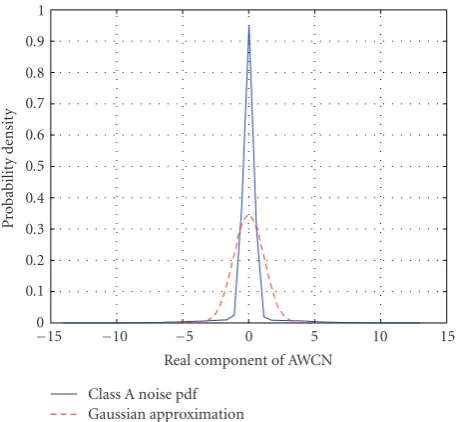
Figure 2shows the pdf of the real part of a typical AWCN. A
Gaussian pdf with the same total varianceσ2is also given. It
can be seen that the AWCN pdf has a narrower and higher peak around zero and longer tails, as compared to the Gaus-sian pdf with the same variance.
For most of the simulations presented in this paper,A
and GIR are both set to 0.1. These parameters correspond to a “heavily disturbed environment” from field measurements
(see Ma et al. [7] and Zimmermann and Dostert [10]) and
commensurate with our goal of improving the ROBO mode which is used in the hostile channel condition.
3. SELECTION OF LDPC CODE
To select an LDPC code for PLC, we compare the
perfor-mance of different LDPC coding schemes. Six LDPC
cod-ing schemes are compared, namely, Euclidean geometry (EG)
code [11], random regular code (MacKay) [12], array code
[13], random irregular code (MacKay) [12], modified array
code [14], and optimized irregular code [15]. To assess the
robustness of these codes under severe impulsive noise
con-ditions, the candidate codes with a low code rate (≈0.51) and
a moderate length (2000) are assessed for single carrier
sys-tem over an AWCN channel withA=0.1 and GIR=0.001.
The initial likelihood ratio (2) for SPA decoding of a BPSK
signal, after incorporating (7), becomes
LR= P
rn|xn=+1 Prn|xn= −1
=
3 m=0
e−AAm/m!·1/√2πσmexp−rn−12/
2σ2
m 3
m=0
e−AAm/m!·1/√2πσmexp−rn+ 12 /2σ2
m ,
(8)
wherernis the real component of the received signal. The
re-sults for a single carrier system are presented inFigure 3, as
bit error-rate (BER) versus signal-to-noise ratio (SNR) per-formance. (The background Gaussian noise power is used to calculate the SNR.)
It can be seen that the two random codes, regular and irregular MacKay codes, and the irregular optimized codes outperform others. This could be attributed to the more random-like structure of the random codes and the opti-mized code. Further, the random MacKay codes have the least numbers of short cycles (of length 4, 6, and 8), which are detrimental to proper decoding of an LDPC code. Among
these three codes, the regular MacKay code offers the best
performance, while the irregular optimized code shows an error floor with increasing SNR. Consequently, most of the results in the rest of this paper are for employing the regular MacKay code.
4. IMPULSIVE NOISE ANALYSIS
4.1. OFDM over AWCN
1 2 3 4 5 6 7 8 9 10 SNR (dB)
10−6 10−5 10−4 10−3 10−2 10−1 100
BER
Shortened type-II EG (2046, 1054) Regular MacKay (2209, 1127) Array code (2209, 1127) Irregular MacKay (2209, 1127) Modified array code (2209, 1128) Optimized (2209, 1127)
Figure3: BER versus SNR for a single carrier system with LDPC codes (code rate≈0.51) over an AWCN channel (A=0.1, GIR=
0.001).
section, we consider clipping the received OFDM signal as a means to improve performance over AWCN channels. The results in this section are for OFDM over AWCN channels with no multipath fading.
The OFDM receiver’s FFT operation sums and spreads impulses evenly over the range of frequencies. With a suf-ficiently large FFT length, the FFT-transformed noise
ap-proaches a Gaussian distribution [16]. It should be noted
that, for N-point FFT, each frequency bin has noise due to time-domain impulsive noise, which is a summation of N-phase-modulated version of the original time-domain AWCN. Therefore, in frequency-domain, it is still AWCN but not as impulsive as the original time-domain AWCN. Its be-havior is between AWGN and AWCN. While we have chosen an encoder best suitable for AWCN, the above property
al-lows us to approximate decoding for an effective AWGN to
simplify the decoder. Simulation results justify this
simplifi-cation. The pdf of the frequency-domain noiseZcan be
ap-proximated by a Gaussian distributionN(0,σZ2) with
vari-ance
σ2 Z= N1
N−1
n=0 σ2
zn=σ 2 G
1 + 1
Γ
, (9)
whereNis the FFT length. The subsequent LDPC decoding
then amounts simply to a straightforward LDPC-AWGN de-coding. The channel likelihood ratio can be obtained as
LR=exp
2rn
σ2 Z
=exp
2rn
σ2
G(1 + 1/Γ)
. (10)
0 5 10 15
SNR (dB) 10−6
10−5 10−4 10−3 10−2 10−1 100
BER
Single carrier (no clipping) OFDM (no clipping)
OFDM (clipping-theoretical variance) OFDM (clipping-measured variance)
Figure4: BER versus SNR for single carrier and OFDM systems with LDPC (3312, 1397) coding over AWCN channel (A = 0.1, GIR=0.1).
According to our simulations, this works well for moderate-to-high GIR. In channels with severe impulsive noise, how-ever, the BER performance is not satisfactory as the frequency domain noise inherits the pre-FFT high noise variance in the
time domain. This effect is illustrated by the BER versus SNR
curve given inFigure 4. It can be seen that the conventional
OFDM does not perform well over a noisy AWCN channel, compared to the single carrier case. In order to alleviate the
effect of impulsive noise, the spreading effect of OFDM is
ad-vantageously exploited through time-domain noise clipping: the detection and elimination of possible impulsive noise can be performed in the time domain without suppressing the information bit in the frequency domain.
4.2. OFDM over AWCN with clipping
Various impulse noise mitigation techniques have been stud-ied for uncoded OFDM systems. Notably, H¨aring and Vinck
[17] proposes an efficient OFDM demodulation and
detec-tion scheme that can suppress the effect of impulsive noise.
As we are dealing with an LDPC coded OFDM system, a simpler method based on impulse clipping is adopted from
Suraweera et al. [18]:
rn= ⎧ ⎨ ⎩rn
ifrn≤Amp,
0 ifrn>Amp, (11)
whereAmpis a threshold amplitude set to some multiple of
Since AWCN noise can be considered as a mixture of Gaussian noises, the above clipping procedure will result in a mixture of doubly-truncated Gaussian noises with a
normal-ized variance adjustment factorVgiven in [19] as follows:
V=1 +xLf
xL−xRfxR FxR−FxL −
fx
L−fxR FxR−FxL
2
,
(12)
where f(·) andF(·) denote the pdf and cumulative
distribu-tion funcdistribu-tion (cdf) of the untruncated standard normal
dis-tributionN(0,1), andxLandxRthe left and right truncating
points, respectively.
The resulting noise variance of the clipped signals can be estimated as follows. Using Bussgang’s theorem (see Dardari
et al. [20]) which relates the input and output of a
memory-less nonlinearity, the output of the clipper mapping in (11)
can be expressed as
rn=krn+zc=kxn+kzn+zc, (13)
wherek, 0 < k < 1, is a constant “shrinking factor” andzc
is the clipping noise. Readers are referred to [18,20] for a
discussion of clipping and shrinking factor. The net effect is
thatzc acts to null the large impulses but also distorts the
signal. The effect on the resulting variance of the clipped
sig-nal can be implicitly estimated through a simple probabil-ity approach. The resulting variance has two components: a reduced noise variance due to clipping of the impulsive noise and an additional noise variance introduced by
clip-ping the signal, denoted byΔ−andΔ+, respectively. BothΔ−
andΔ+can be approximated by a weighted sum ofΔ−
m and
Δ+
mfrom individual impulse noise components
correspond-ing tom=0, 1, 2, 3 as given in (7).
From (12) with symmetrical truncation, it can be shown
that
Δ−
m=V2σm2
=
1 +−amf
−am−amfam Fam−F−am
2σ2
m,
(14)
wheream =Amp/(√2σm). The variance introduced by
clip-ping of the signals corresponds to lost power of the clipped signals, which is given by
Δ+ m=2
1−Fam. (15)
The total noise variance due to clipping can be obtained as
σ2
z =Δ−+Δ+
=
3
m=0 e−AAm
m!
Δ−
m+Δ+m.
(16)
The noise variance in the frequency domain isσ2
Z =σz2. The
decoding can again be carried out simply as LDPC-AWGN decoding but with a significantly reduced noise variance as a
result of impulse clipping in the time domain. From (13) and
(14), it can be seen that the total variance of clipped noise
de-pends on the choice of the clipping thresholdAmp. There is
0 2 4 6 8 10 12 14 16 18 20
Amp 0
2 4 6 8 10 12 14 16 18 20 22
SNR
(dB)
A=1
A=0.1
A=0.01
A=0.005
A=0.001
Figure5: SNR versusAmpfor variousAvalues (rate=1.0, GIR=
0.1,σ2=0.05).
no closed-form estimate of an optimalAmpbased on (16).
A properAmpthat provides the best BER performance for a
given LDPC code can be found empirically through simula-tion.
We have performed simulations to investigate the post-clipping SNR (in terms of the variance of clipped noise)
ver-susAmprelationship for various values of A, GIR and,σ2
(total variance of unclipped noise) for uncoded systems. The
results are shown in Figures5,6,7.
We see that withAmpchosen judiciously, the
postclip-ping SNR value is increased and reaches a maximum. The gain is greater for more impulsive noise. Overclipping due
to using a smallAmpvalue degrades performance. AnAmp
value that is too large effects no clipping and hence no
re-duction in noise variance and improvement of post-clipping
SNR. The optimal Amp value appears to fall between 2.5
and 4. Further simulations were carried out for coded
sys-tems with code rate =0.42,A = 0.1, and GIR = 0.1. The
preliminary simulation results seem to indicate that the
op-timalAmpvalue, resulting in a minimum preclipping SNR
(Eb/No) required to achieve a BER of 0.0001, is around 3.7
(seeFigure 8). In practice, the values ofAand GIR can be
es-timated by the receiver, and the optimal value ofAmpchosen
accordingly. In a stable environment, these parameters can be predetermined by the receiver location and time.
Further tests have been carried out to compare the mea-sured and theoretical post-FFT variances of clipped-noise,
which are very close as shown in Figure 9. Figure 4 also
presents the BER versus SNR curves for OFDM with noise clipping. A significant improvement is observed when
clip-ping (withAmp=3.7) is applied. This confirms that
0 2 4 6 8 10 12 14 16 18 20 Amp
0 2 4 6 8 10 12 14 16
SNR
(dB)
GIR=1 GIR=0.1 GIR=0.01
GIR=0.005 GIR=0.001
Figure6: SNR versusAmpfor various GIR values (rate=1.0,A=
0.1,σ2=0.05).
For a high code rate, say 0.84, we observe (based on simula-tions not shown in this paper) that the single carrier system does not perform better than OFDM without clipping due to
insufficient redundant parity bits to correct the errors caused
by the impulsive noise.
5. COMPARISON WITH HOMEPLUG 1.0 ROBO MODE
5.1. Performance comparison
In this section, we compare the BER performances be-tween the proposed LDPC-coded system and HomePlug 1.0 ROBO mode. We have carried out computer simulations for both systems using AWCN and a multipath channel with perfect channel-state information (CSI) at the receiver. The proposed LDPC-coded system applies clipping and uses frequency-domain equalization (FEQ) before decoding. The
ROBO mode simulation is carried out according to [1]. To
make a meaningful comparison with the ROBO mode, we adjust the LDPC code rate such that it equals the rate of the concatenated RS and convolutional code, which is 0.42 with individual rate of 0.84 and 0.5, respectively. The length of the LDPC code is chosen to be 3312 comparable to the trans-mission block size used in the ROBO mode. The proposed scheme follows ROBO mode to use 84 evenly spaced carriers in a band from 4.49 to 20.7 MHz.
For the impulsive noise, we use the third-order
approx-imation of the AWCN pdf given in (7). The impulsive noise
factorAis set to 0.1 and the GIR=0.1, both of which have
been used in most studies for the highly impaired
transmis-sion environment [4,7].
For the multipath channel, we have adopted the four-tap
multipath fading model used in [7], assuming the relative
0 2 4 6 8 10 12 14 16 18 20
Amp −5
0 5 10 15 20
SNR
(dB)
σ2=1
σ2=0.1
σ2=0.05
σ2=0.025
σ2=0.01
Figure7: SNR versusAmpfor variousσ2values (rate=1.0,A=
0.1, GIR=0.1).
2.4 2.6 2.8 3 3.2 3.4 3.6 3.8 4 Amp
2.5 3 3.5 4 4.5 5
SNR
(dB)
Figure8: SNR @ BER=0.0001 versusAmp(rate=0.42,A=0.1, GIR=0.1).
delayτmequal to a multiple of the sample durationTs
with-out loss of generality. The multipath channel with-output is
yn=xn∗hn
=
3
m=0
αmexpjθmxn−τm/Ts,
(17)
whereTs = 0.05μs,τm = 0, 8Ts, 12Ts, 14Ts,αm = 0.2, 0.1,
0.02, 0.01 form=0, 1, 2, 3, andθmis uniformly distributed
in [0, 2π). With this channel, the received signal power is
0 5 10 15 20 25 30 SNR (dB)
0 0.2 0.4 0.6 0.8 1 1.2 1.4
Va
ri
an
ce
Measured Theoretical
Figure9: Measured and theoretical post-FFT variance of clipped noise over AWCN channel (A=0.1, GIR=0.1).
channel impulse response is implicitly normalized by mea-suring SNR at the receiver.
Simulations are carried out to compare the BER
perfor-mances over an AWCN channel (no multipath) withA=0.1
and GIR =0.1. It can be seen fromFigure 10that the
pro-posed system achieves a BER of 10−6 at about 3 dB SNR,
compared with 14 dB needed by ROBO mode; the proposed system achieves a performance gain of more than 10 dB at this BER. The performances of the two systems are also com-pared over the multipath channel with AWGN (no
impul-sive noise). As shown in Figure 10, with perfect CSI, both
systems reach a waterfall performance at SNR between 2– 4 dB. However, the LDPC-coded system still achieves a gain
of 1 dB at BER of 10−6. The gain of the LDPC-coded
sys-tem over ROBO mode is largely attributed to clipping. When clipping is also applied to ROBO mode, the SNR gain of the
LDPC-coded system is 1 dB at BER=0.0001 (not shown in
Figure 10). Nevertheless, the LDPC-coded system also
pro-vides a 4-fold throughput gain (seeSection 5.D).
As a final comparison, simulations are performed for both systems over a combined multipath and AWCN chan-nel.Figure 11shows that the proposed LDPC-coded system outperforms the ROBO mode by approximately 10 dB at a
BER of 10−6without resorting to interleaving and extensive
time and frequency diversity.Figure 11also includes the BER
curves for two shortened improper array codes (IAC) [21] to
be described in detail later.
5.2. Computational complexity
Decoding complexity is considered in this subsection, as SPA decoding may be computation intensive when many itera-tions are used. The computational complexity per decoded
0 2 4 6 8 10 12 14 16 18
SNR (dB) 10−6
10−5 10−4 10−3 10−2 10−1 100
BER
ROBO mode AWCN Multipath
LDPC (3312, 1397) AWCN Multipath
Figure10: BER versus SNR for LDPC (3312, 1397) coded system and ROBO mode over an AWCN (A=0.1, GIR=0.1) channel and a multipath channel.
0 5 10 15
SNR (dB) 10−6
10−5 10−4 10−3 10−2 10−1 100
BER
ROBO mode LDPC (3312, 1397) IAC-LDPC (3295, 1320) IAC-LDPC (3342, 1673)
Figure11: BER versus SNR for various LDPC coded systems and ROBO mode over a channel with both AWCN (A=0.1, GIR=0.1) and multipath impairments.
bit is defined as the total number of addition, multiplica-tion and division operamultiplica-tions. The LDPC code using SPA decoding requires a maximum of 8 iterations to achieve a
BER of 10−5. This amounts to a total of 111 operations
complexity of the trellis-based Viterbi algorithm for de-coding the inner convolutional code; doing so flavours the
ROBO mode. To achieve the same level of BER of 10−5in
the ROBO mode, the trellis-based Viterbi decoding for a (2,1,6) convolutional code requires 256 operations per de-coded bit for each repeated transmission. Thus, a significant reduction in the computational complexity is obtained using LDPC coding.
5.3. Implementation issues
Although SPA allows fast decoding through a parallel-processing architecture, the MacKay code does not readily lend itself to regular implementation due to its random in-terconnect patterns between variable and check nodes. It is
reported in [22] that the deterministically constructed array
code is well suited for parallel implementation of SPA with less memory requirement. The array code is also appealing because of the guaranteed absence of cycles of length four
[13]. In [21], shortened array codes are proposed, in which
cycles of length 2kcan be further eliminated. Two shortened
improper array codes are adopted from [21] at code rates
of approximately 0.4 and 0.5, respectively. From Figure 11,
it can be seen that at BER of 10−6the shortened array code
only suffers a performance loss of 0.5–2.5 dB compared to
the MacKay code. Nonetheless, the shortened codes still out-perform the ROBO mode by more than 8 dB. The shortened array codes thus serve as a good alternative to the MacKay code.
5.4. Throughput efficiency
As described inSection 2.1, the HomePlug 1.0 ROBO mode
is usually employed over severely degraded channels. The ROBO mode uses a block interleaver, which is read four times to provide extensive time and frequency diversity and achieve robust operation under hostile conditions. The
repe-tition reduces the data rate to 1/4 bits per carrier per symbol.
Consequently, the ROBO mode delivers reliability at the ex-pense of throughput. In the proposed LDPC-coded system, the variable bits are randomly assigned to the check nodes to perform parity-check sum operations, so that interleav-ing is implicitly incorporated in the random-like structure of the encoding scheme. Not needing repeated transmission,
the proposed scheme offers a 4-fold increase in throughput
over ROBO mode.
6. CONCLUSION
We have investigated the performance of OFDM with LDPC codes over channels with impulsive noise and multipath fad-ing, as a candidate for improvement over HomePlug 1.0 ROBO mode. First, we establish that noise clipping is advan-tageous in PLC with severe impulsive noise. A simple and
effective scheme is proposed to estimate the variance of the
clipped noise for LDPC decoding. We have compared the BER of the proposed LDPC-coded system and the HomePlug 1.0 ROBO mode over an AWCN and multipath channel. The
results show that the proposed scheme outperforms Home-Plug 1.0 ROBO mode while reducing the decoder
computa-tional complexity. In addition, the proposed scheme offers
4-fold increase in throughput over ROBO mode.
ACKNOWLEDGMENT
The authors would like to thank the Editor Dr. Lutz Lampe and the reviewers for their valuable comments that helped to improve this paper.
REFERENCES
[1] M. K. Lee, R. E. Newman, H. A. Latchman, S. Katar, and L. Yonge, “HomePlug 1.0 powerline communication LANs - pro-tocol description and performance results,”International Jour-nal of Communication Systems, vol. 16, no. 5, pp. 447–473, 2003.
[2] M. Ardakani, F. R. Kschischang, and W. Yu, “Low-density parity-check coding for impulse noise correction on power-line channels,” inProceedings of the 9th International Sympo-sium on Power Line Communications and Its Applications (IS-PLC ’05), pp. 90–94, Vancouver, Canada, April 2005. [3] D. Umehara, H. Yamaguchi, and Y. Morihiro, “Turbo
decod-ing over impulsive noise channel,” inProceedings of the 8th In-ternational Symposium on Power Line Communications and Its Applications (ISPLC ’04), pp. 51–56, Zaragoza, Spain, March-April 2004.
[4] H. Nakagawa, D. Umehara, S. Denno, and Y. Morihiro, “A de-coding for low density parity check codes over impulsive noise channels,” inProceedings of the 9th International Symposium on Power Line Communications and Its Applications (ISPLC ’05), pp. 85–89, Vancouver, Canada, April 2005.
[5] A. D. Spaulding and D. Middleton, “Optimum reception in an impulsive interference environment—part I: coherent de-tection,”IEEE Transactions on Communications, vol. 25, no. 9, pp. 910–923, 1977.
[6] J. H¨aring and A. J. Han Vinck, “Performance bounds for op-timum and subopop-timum reception under Class-A impulsive noise,”IEEE Transactions on Communications, vol. 50, no. 7, pp. 1130–1136, 2002.
[7] Y. H. Ma, P. L. So, and E. Gunawan, “Performance analysis of OFDM systems for broadband power line communications under impulsive noise and multipath effects,”IEEE Transac-tions on Power Delivery, vol. 20, no. 2, part 1, pp. 674–682, 2005.
[8] R. G. Gallager,Low Density Parity Check Codes, MIT Press, Cambridge, Mass, USA, 1963.
[9] S. Lin and D. J. Costello,Error Control Coding, Prentice-Hall, Upper Saddle River, NJ, USA, 2nd edition, 2003.
[10] M. Zimmermann and K. Dostert, “Analysis and modeling of impulsive noise in broad-band powerline communications,”
IEEE Transactions on Electromagnetic Compatibility, vol. 44, no. 1, pp. 249–258, 2002.
[11] Y. Kou, S. Lin, and M. P. C. Fossorier, “Low-density parity-check codes based on finite geometries: a rediscovery and new results,”IEEE Transactions on Information Theory, vol. 47, no. 7, pp. 2711–2736, 2001.
[13] J. L. Fan, “Array codes as low-density parity-check codes,” in
Proceedings of the 2nd International Symposium on Turbo Codes and Related Topics (ISTC ’00), pp. 543–546, Brest, France, September 2000.
[14] E. Eleftheriou and S. ¨Olc¸er, “Low-density parity-check codes for digital subscriber lines,” inProceedings of IEEE Interna-tional Conference on Communications (ICC ’02), vol. 3, pp. 1752–1757, New York, NY, USA, April-May 2002.
[15] T. J. Richardson and R. L. Urbanke, “Efficient encoding of low-density parity-check codes,”IEEE Transactions on Information Theory, vol. 47, no. 2, pp. 638–656, 2001.
[16] D. Umehara, M. Kawai, and Y. Morihiro, “An iterative detec-tion for M-ary SS system over impulsive noise channel,” in
Proceedings of the 6th International Symposium on Power-Line Communications and Its Applications (ISPLC ’02), pp. 203– 207, Athens, Greece, March 2002.
[17] J. H¨aring and A. J. Han Vinck, “Iterative decoding of codes over complex numbers for impulsive noise channels,”IEEE Transactions on Information Theory, vol. 49, no. 5, pp. 1251– 1260, 2003.
[18] H. Suraweera, C. Chai, J. Shentu, and J. Armstrong, “Analysis of impulsive noise mitigation techniques for digital television systems,” Research Paper, Department of Electronic Engineer-ing, La Trobe Univeristy, Melbourne, Australia, 2003. [19] A. Johnson and N. Thomopoulos, “Characteristics and tables
of the doubly-truncated normal distribution,” Faculty Work-ing Paper, Stuart Graduate School of Business, Illinois Insti-tute of Technology, Chicago, Ill, USA, 2001.
[20] D. Dardari, V. Tralli, and A. Vaccari, “A theoretical characteri-zation of nonlinear distortion effects in OFDM systems,”IEEE Transactions on Communications, vol. 48, no. 10, pp. 1755– 1764, 2000.
[21] O. Milenkovic, N. Kashyap, and D. Leyba, “Shortened array codes of large girth,”IEEE Transactions on Information Theory, vol. 52, no. 8, pp. 3707–3722, 2006.
[22] S. ¨Olc¸er, “Decoder architecture for array-code-based LDPC codes,” inProceedings of IEEE Global Telecommunications Con-ference (GLOBECOM ’03), vol. 4, pp. 2046–2050, San Fran-cisco, Calif, USA, December 2003.
Christine Hsuwas born in Ottawa, Canada, in 1980. She graduated with a B.S. degree in Applied Sciences (Electrical Engineering) from the University of Ottawa in May 2003. She received her M.S. degree (Engineer-ing) from the Department of Electrical and Computer Engineering, Queen’s University, Kingston, Ontario, Canada, in May 2006. Since June 2006, she has been a Spectrum Engineer with the Canada Department of Industry, Ottawa, Canada.
Neng Wangreceived the B.Eng. degree from Shanghai Jiao Tong University, Shanghai, China, in 1994, the M.Eng. degree from Nanjing University of Posts and Telecom-munications (NUPT), Nanjing, China, in 1999, and the Ph.D. degree from Queen’s University, Kingston, Ontario, Canada in 2005, all in Electrical Engineering. He was an Electronics Engineer in Suzhou Lam-beau High-Tech Enterprise Group, Suzhou,
China, from 1994 to 1996. He has been Research and Teaching
Assistant in the Department of Information Engineering, NUPT from 1996–1999, and the Department of Electrical and Com-puter Engineering, Queen’s University from 2000–2005. He was a Research Scientist at the Communications Research Centre, Ot-tawa, ON, in 2006. Since 2007, he has been with Nortel Networks, Richardson, TX, as a Wireless Access Standards Engineer. His re-search interests lie in general areas of wireless communications and signal processing.
Wai-Yip Chan, also known as Geoffrey Chan, received his B.Eng. and M.Eng. de-grees from Carleton University, Ottawa, and his Ph.D. degree from University of Cali-fornia, Santa Barbara, all in Electrical En-gineering. He is currently with the Depart-ment of Electrical and Computer Engineer-ing, Queens University. He has held po-sitions in academia and industry, namely McGill University, Illinois Institute of
Tech-nology, Bell Northern Research, and Communications Research Centre. His research interests are in multimedia signal coding and communications. He is an associate editor of EURASIP Journal on Audio, Speech, and Music Processing. He has helped to organize IEEE sponsored conferences in speech coding, image processing, and communications. He held a CAREER Award from the National Science Foundation.
Praveen Jainreceived the B.E. degree with honors from the University of Allahabad, India, the M.A.S. and Ph.D. degrees from the University of Toronto, Canada, in 1980, 1984, and 1987, respectively, all in electrical engineering. Presently, he is a Professor and Canada Research Chair in Power Electron-ics at Queen’s University in Kingston, On-tario, Canada. From 1994 to 2000, he was a Professor at Concordia University,