Volume 2007, Article ID 79821,23pages doi:10.1155/2007/79821
Research Article
Application of the Evidence Procedure to
the Estimation of Wireless Channels
Dmitriy Shutin,1Gernot Kubin,1and Bernard H. Fleury2, 3
1Signal Processing and Speech Communication Laboratory, Graz University of Technology, 8010 Graz, Austria 2Institute of Electronic Systems, Aalborg University, Fredrik Bajers Vej 7A, 9220 Aalborg, Denmark
3Forschungszentrum Telekommunikation Wien (ftw.), Donau City Strasse 1, 1220 Wien, Austria
Received 5 November 2006; Accepted 8 March 2007
Recommended by Sven Nordholm
We address the application of the Bayesian evidence procedure to the estimation of wireless channels. The proposed scheme is based on relevance vector machines (RVM) originally proposed by M. Tipping. RVMs allow to estimate channel parameters as well as to assess the number of multipath components constituting the channel within the Bayesian framework by locally maximizing the evidence integral. We show that, in the case of channel sounding using pulse-compression techniques, it is possible to cast the channel model as a general linear model, thus allowing RVM methods to be applied. We extend the original RVM algorithm to the multiple-observation/multiple-sensor scenario by proposing a new graphical model to represent multipath components. Through the analysis of the evidence procedure we develop a thresholding algorithm that is used in estimating the number of components. We also discuss the relationship of the evidence procedure to the standard minimum description length (MDL) criterion. We show that the maximum of the evidence corresponds to the minimum of the MDL criterion. The applicability of the proposed scheme is demonstrated with synthetic as well as real-world channel measurements, and a performance increase over the conventional MDL criterion applied to maximum-likelihood estimates of the channel parameters is observed.
Copyright © 2007 Dmitriy Shutin et al. This is an open access article distributed under the Creative Commons Attribution License, which permits unrestricted use, distribution, and reproduction in any medium, provided the original work is properly cited.
1. INTRODUCTION
Deep understanding of wireless channels is an essential pre-requisite to satisfy the ever-growing demand for fast infor-mation access over wireless systems. A wireless channel con-tains explicitly or implicitly all the information about the propagation environment. To ensure reliable communica-tion, the transceiver should be constantly aware of the nel state. In order to make this task feasible, accurate nel models, which reproduce in a realistic manner the chan-nel behavior, are required. However, efficient joint estima-tion of the channel parameters, for example, number of the multipath components (model order), their relative delays, Doppler frequencies, directions of the impinging wavefronts, and polarizations, is a particularly difficult task. It often leads to analytically intractable and computationally very ex-pensive optimization procedures. The problem is often re-laxed by assuming that the number of multipath compo-nents is fixed, which simplifies optimization in many cases [1,2]. However, both underspecifying and overspecifying the model order leads to significant performance degradation: residual intersymbol interference impairs the performance
of the decoder in the former case, while additive noise is injected in the channel equalizer in the latter: the excessive components amount only to the random fluctuations of the background noise. To amend this situation, empirical meth-ods like cross-validation can be employed (see, e.g., [3]). Cross-validation selects the optimal model by measuring its performance over a validation data set and selecting the one that performs the best. In case of practical multipath chan-nels, such data sets are often unavailable due to the time-variability of the channel impulse responses. Alternatively, one can employ model selection schemes in the spirit of Ock-ham’s razor principle: simple models (in terms of the num-ber of parameters involved) are preferred over more complex ones. Examples are the Akaike information criterion (AIC) and minimum description length (MDL) [4,5]. In this pa-per, we show how the Ockham principle can be effectively used to perform estimation of the channel parameters cou-pled with estimating the model order, that is, the number of wavefronts.
Consider a certain class of parametric models (hypothe-ses)Hidefined as the collection of prior distributionsp(wi|
dataZ and a family of conditional distributions p(Z | wi,
Hi), our goal is to infer the hypothesisH and the
corre-sponding parametersw that maximize the posterior
{w,H} =arg max wi,Hi
pwi,Hi|Z
. (1)
The key to solving (1) lies in inferring the correspond-ing parameters wi andHi from the dataZ, which is
of-ten a nontrivial task. As far as the Bayesian methodol-ogy is concerned, there are two ways this inference prob-lem can be solved [6, Section 5]. In the joint estimation method, p(wi,Hi | Z) is maximized directly with respect
to the quantities of interest wi andHi. This often leads to
computationally-intractable optimization algorithms. Alter-natively, one can rewrite the posteriorp(wi,Hi|Z) as
pwi,Hi|Z
=pwi|Z,Hi
pHi|Z
(2)
and maximize each term on the right-hand side sequentially from right to left. This approach is known as themarginal
es-timation method. Marginal estimation methods (MEM) are
well exemplified by expectation-maximization (EM) algo-rithms and used in many different signal processing appli-cations (see [2,3,7]). MEMs are usually easier to compute, however they are prone to land in a local rather than global optimum. We recognize the first factor on the right-hand side of (2) as a parameter posterior, while the other one is a posterior for different model hypotheses. It is the maximiza-tion ofp(Hi|Z) that guides our model selection decision.
Then, the data analysis consists of two steps [8, Chapter 28], [9]:
(1) inferring the parameters under the hypothesisHi
pwi|Z,Hi
= p
Z|wi,Hi
pwi|Hi
pZ|Hi
≡Likelihood×Prior
Evidence ,
(3)
(2) comparing different model hypotheses using the mod-el posterior
pHi|Z
∝pZ|Hi
pHi
≡Evidence×Hypothesis Prior. (4)
In the second stage,p(Hi) measures our subjective prior over
different hypotheses before the data is observed. In many cases it is reasonable to assign equal probabilities to diff er-ent hypotheses, thus reducing the hypothesis selection to se-lecting the model with the highest evidencep(Z|Hi).1The
evidence can be expressed as the following integral:
pZ|Hi
=
pZ|wi,Hi
pwi|Hi
dwi. (5)
1In the Bayesian literature, the evidence is also known as the likelihood for the hypothesisHi.
s(t) h(t)= L
l=1
alcl(φl)ej2πνltδ(t−τl)
y(t) η(t) MF
Channel
Tx Rx
u∗(−t)
z(t) z[n] t=nTs
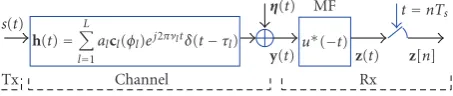
Figure1: An equivalent baseband model of the radio channel with receiver matched filter (MF) front-end.
The evidence integral (5) plays a crucial role in the develop-ment of Schwarz’s approach to model order estimation [10] (Bayesian information criterion), as well as in a Bayesian in-terpretation of Rissanen’s MDL principle and its variations [5, 11,12]. Maximizing (5) with respect to the unknown modelHiis known as the evidence maximization procedure,
or evidence procedure (EP) [13,14].
Equations (3), (4), and (5) form the theoretical frame-work for our joint model and parameter estimation. The esti-mation algorithm is based on relevance vector machines. Rel-evance vector machines (RVM), originally proposed by Tip-ping [15], are an example of the marginal estimation method that, for a set of hypothesesHi, iteratively approximates (1)
by alternating between the model selection, that is, maxi-mizing (5) with respect toHi, and inferring the
correspond-ing model parameters from maximization of (3). RVMs have been initially proposed to find sparse solutions to general lin-ear problems. However, they can be quite effectively adapted to the estimation of the impulse response of wireless chan-nels, thus resulting in an effective channel parameter estima-tion and model selecestima-tion scheme within the Bayesian frame-work.
The material presented in the paper is organized as fol-lows: Section 2 introduces the signal model of the wire-less channel and the used notation; Section 3 explains the framework of the EP in the context of wireless channels. In
Section 4 we explain how model selection is implemented within the presented framework and discuss the relation-ship between the EP and the MDL criterion for model se-lection. Finally,Section 5presents some application results illustrating the performance of the RVM-based estimator in synthetic as well as in actual wireless environments.
2. CHANNEL ESTIMATION USING PULSE-COMPRESSION TECHNIQUE
s(t)
t · · ·
Tp
Tu=MTp
Tf
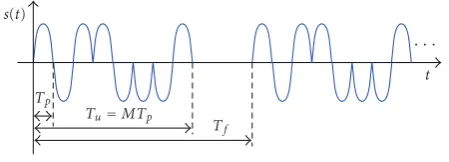
Figure2: Sounding sequences(t).
motivates the application of algorithms capable of recover-ing this sparse structure from the measurement data.
Let us consider an equivalent baseband channel sound-ing scheme shown in Figure 1. The sounding signal s(t) (Figure 2) consists of periodically repeated burst waveforms u(t), that is,s(t)=∞i=−∞u(t−iTf), whereu(t) has duration
Tu≤Tf and is formed asu(t)= M−1
m=0bmp(t−mTp). The
sequenceb0· · ·bM−1is the known sounding sequence
con-sisting ofMchips, andp(t) is the shaping pulse of duration Tp,MTp = Tu. Furthermore, we assume that the receiver
(Rx) is equipped with a planar antenna array consisting ofP sensors located at positionss1,. . .,sP∈R2with respect to an
arbitrary reference point. Let us now assume that the maxi-mum absolute Doppler frequency of the impinging waves is much smaller than the inverse of a single burst duration 1/Tu.
This low Doppler frequency assumption is equivalent to as-suming that, within a single observation window equivalent to the period of the sounding sequence, we can safely neglect the influence of the Doppler shifts.
The received signal vectory(t)∈CP×1for a single burst
waveform is given as [2]
y(t)=
L
l=1
alc
φl
ej2πνltut−τl
+η(t). (6)
Here, al, τl, and νl are respectively the complex gain,
the delay, and the Doppler shift of the lth multipath component. The P-dimensional complex vector c(φl) =
[c1(φl),. . .,cP(φl)]T is the steering vector of the
ar-ray. Provided the coupling between the elements can be neglected, its components are given as cp(φl) =
fp(φl) exp(j2πλ−1e(φl),sp ) withλ,e(φl) and fp(φl)
denot-ing the wavelength, the unit vector in R2 pointing in the
direction of the incoming wavefront determined by the az-imuthφl, and the complex electric field pattern of the pth
sensor, respectively. The additive term η(t) ∈ CP×1 is a
vector-valued complex white Gaussian noise process, that is, the components ofη(t) are independent complex Gaussian processes with double-sided spectral densityN0.
The receiver front-end consists of a matched filter (MF) matched to the transmitted sequence u(t). Under the low Doppler frequency assumption the term ej2πνlt stays
time-invariant within a single burst duration, that is, equal to a complex constant that can be incorporated in the complex gainal. The signalz(t) at the output of the MF is then given
as
z(t)=
L
l=1
alc
φl
Ruu
t−τl
+ξ(t), (7)
where Ruu(t) =
u(t)u∗(t+t)dt is the autocorrelation function of the burst waveformu(t) andξ(t)=η(t)u∗(t+ t)dtis a spatially whiteP-dimensional vector with each ele-ment being a zero-mean wide-sense stationary (WSS) Gaus-sian noise with autocorrelation function
Rξξ(t)=E
ξp(t)ξ∗p(t+t)
=N0Ruu(t),
Eξp(t)ξp(t+t)
=0. (8)
Here E{·}denotes the expectation operator. Equation (7) states that the MF output is a linear combination ofLscaled and delayed kernel functionsRuu(t−τl), weighted across
sen-sors as given by the components ofc(φl) and observed in the
presence of the colored noiseξ(t).
In practice, however, the output of the MF is sampled with the sampling periodTs≤Tp, resulting inPN-tuples of
the MF output, whereNis the number of MF output sam-ples. By collecting the output of each sensor into a vector, we can rewrite (7) in a vector form:
zp=Kwp+ξp, p=1· · ·P, (9)
where we have defined
zp=
zp[0],zp[1],. . .,zp[N−1] T
,
wp=
a1cp
φ1
,. . .,aLcp
φL T
, ξp=
ξp[0],ξp[1],. . .,ξp[N−1] T
.
(10)
The additive noise vectorsξp, p = 1· · ·P, possess the following properties that will be exploited later:
Eξp
=0, EξmξHk
=0, form /=k, (11) EξpξHp
=Σ=N0Λ, whereΛi,j=Ruu
(i−j)Ts
. (12)
Note that (12) follows directly from (8). The matrix K, also called the design matrix, accumulates the shifted and sampled versions of the kernel function Ruu(t). It is
con-structed as K = [r1,. . .,rL], withrl = [Ruu(−τl),Ruu(Ts−
τl),. . .,Ruu((N−1)Ts−τl)]T.
In general, the channel estimation problem is posed as follows: given the measured sampled signalszp,p=1· · ·P,
determine the orderLof the model and estimate optimally (with respect to some quality criterion) all multipath param-etersal,τl, andφl, forl=1· · ·L. In this contribution, we
re-strict ourselves to the estimation of the model orderLalong with the vectorwp, rather than of the constituting
parame-tersτl,φl, andal. We will also quantize, although arbitrarily
fine,2 the search space for the multipath delaysτ
l. Thus, we
do not try to estimate the path delays with infinite resolu-tion, but rather fix the delay values to be located on a grid with a given mesh determining the quantization error. The size of the delay search spaceL0and the resulting quantized
delaysT = {T1,. . .,TL0}form the initial model hypothesis H0, which would manifest itself in theL0columns of the
de-sign matrixK. This allows to formulate the channel estima-tion problem as a standard linear problem to which the RVM algorithm can be applied.
As it can be seen, our idea lies in finding the closest approximation of the continuous-time model (7) with the discrete-time equivalent (9). By incorporating the model se-lection in the analysis, we also strive to find the most com-pact representation (in terms of the number of components), while preserving good approximation quality. Thus, our goal is to estimate the channel parameterswpas well as to
deter-mine how many multipath componentsL≤L0are present in
the measured impulse response. The application of the RVM framework to solve this problem follows in the next section.
3. EVIDENCE MAXIMIZATION, RELEVANCE VECTOR MACHINES, AND WIRELESS CHANNELS
We begin our analysis following the steps outlined in
Section 1. In order to ease the algorithm description we first assume thatP =1, that is, only a single sensor is used. Ex-tensions to the caseP >1 are carried out later inSection 3.2. To simplify the notations we also drop the subscript indexp in our further notations.
From (9) it follows that the observation vectorzis a lin-ear combination of the vectors from the column-space ofK, weighted according to the parameters w and embedded in the correlated noiseξ. In order to correctly assess the order of the model, it is imperative to take the noise process into account. It follows from (12) that the covariance matrix of the noise is proportional to the unknown spectral heightN0,
which should therefore be estimated from the data. Thus, the model hypotheses Hi should include the term N0. In
the following analysis we assume thatβ =N−1
0 is
Gamma-distributed [15], with the corresponding probability density function (pdf) given as
p(β|κ,υ)= κ
υ Γ(υ)β
υ−1exp(−κβ), (13)
with parametersκandυpredefined so that (13) accurately reflects our a priori information aboutN0. In the absence of
any a priori knowledge one can make use of a noninforma-tive (i.e., flat in the logarithmic domain) prior by fixing the parameters to small valuesκ=υ=10−4[15]. Furthermore,
to steer the model selection mechanism, we introduce an ex-tra parameter (hyperparameter) αl,l = 1· · ·L0, for each
column inK. This parameter measures the contribution or relevance of the corresponding weightwl in explaining the
datazfrom the likelihoodp(z|wi,Hi). This is achieved by
specifying the priorp(w|α) for the model weights:
p(w|α)= L0
l=1
αl
π exp
−wl2αl
. (14)
High values of αl will render the contribution of the
cor-responding column in the matrixK “irrelevant,” since the weight wl is likely to have a very small value (hence they
are termedrelevance hyperparameters). This will enable us to prune the model by setting the corresponding weightwl
to zero, thus effectively removing the corresponding column from the matrix and the corresponding delayTlfrom the
de-lay search spaceT. We also see thatα−1
l is nothing else as
the prior variance of the model weightwl. Also note that the
prior (14) implicitly assumes statistical independence of the multipath contributions.
To complete the Bayesian framework, we also specify the prior over the hyperparameters. Similarly to the noise con-tribution, we assume the hyperparametersαlto be
Gamma-distributed with the corresponding pdf
p(α|ζ,)= L
l=1
ζ
Γ()α
−1
l exp
−ζαl
, (15)
whereζ and are fixed at some values that ensure an ap-propriate form of the prior. Again, we can make this prior noninformative by fixingζandto small values, for exam-ple,=ζ=10−4.
Now, let us define the hypothesisHimore formally. Let
P(S) be a power set consisting of all possible subsets of basis vector indicesS = {1· · ·L0}, andi→P(i) the indexing of P(S) such thatP(0) =S. Then for each index valueithe hypothesisHiis the setHi= {β;αj, j∈P(i)}. Clearly, the
initial hypothesisH0 = {β;αj, j ∈S}includes all possible
potential basis functions.
Now we are ready to outline the learning algorithm that estimates the model parametersw,β, and hyperparametersα from the measurement dataz.
3.1. Learning algorithm
Basically, learning consists of inferring the values ofwiand
the hypothesisHithat maximize the posterior (2):p(wi,Hi|
Z) ≡ p(wi,αi,β | z). Hereαidenotes the vector of all
ev-idence hyperparameters associated with theith hypothesis. The latter expression can also be rewritten as
p(w,α,β|z)=p(w|z,α,β)p(α,β|z). (16) The explicit dependence on the hypothesis indexihas been dropped to simplify the notation. We recognize that the first term p(w | z,α,β) in (16) is the weight posterior and the other one p(α,β | z) is the hypothesis posterior. From this point we can start with the Bayesian two-step analysis as has been indicated before.
Assuming the parametersαandβare known, estimation of model parameters consists of finding valueswthat max-imize p(w | z,α,β). Using Bayes’ rule we can rewrite this posterior as
α1 α2 αL
w1 w2 wL
z[0] z[N−1] β
· · ·
· · ·
· · ·
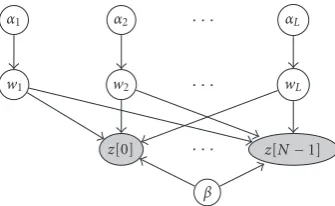
Figure3: Graph representing the discrete-time model of the wire-less channel.
order to factor the joint density function into contributing marginals.
It immediately follows from the structure of the graph in
Figure 3thatp(z|w,α,β)= p(z|w,β) and p(w|α,β)= p(w|α), that is,zandαare conditionally independent given wandβ, andwandβare conditionally independent givenα. Thus, (17) is equivalent to
p(w|z,α,β)∝p(z|w,β)p(w|α), (18)
where the second factor on the right-hand side is given in (14). The first term is the likelihood ofw andβgiven the data. From (9) it follows that
p(z|w,β)=exp
−(z−Kw)HβΛ−1(z−Kw)
πNβ−1Λ . (19)
Since both right-hand factors in (18) are Gaussian densities, p(w | z,α,β) is also a Gaussian density with the covariance matrixΦand meanμgiven as
Φ=A+βKHΛ−1K−1, (20)
μ=βΦKHΛ−1z. (21)
The matrixA = diag(α) is a diagonal matrix that contains the evidence parametersαlon its main diagonal. Clearly,μ
is a maximum a-posteriori (MAP) estimate of the parame-ter vectorwunder the hypothesisHi, withΦbeing the
co-variance matrix of the resulting estimates. This completes the model fitting step.
Our next step is to find parametersαandβthat maxi-mize the hypothesis posterior p(α,β|z) in (16). This den-sity function can be represented as p(α,β | z) ∝ p(z |
α,β)p(α,β), where p(z | α,β) is the evidence term and p(α,β) = p(α)p(β) is the hypothesis prior. As it was men-tioned earlier, it is quite reasonable to choose noninformative priors since we would like to give all possible hypothesesHi an equal chance of being valid. This can be achieved by set-tingζ,,κ, andυto very small values. In fact, it can be easily concluded (see derivations in the appendix) that maximum of the evidence p(z| α,β) coincides with the maximum of p(z|α,β)p(α,β) whenζ==κ=υ=0, which effectively results in the noninformative hyperpriors forαandβ.
This formulation of prior distributions is related to au-tomatic relevance determination (ARD) [14,18]. As a con-sequence of this assumption, the maximization of the model
posterior is equivalent to the maximization of the evidence, which is known as the evidence procedure [13].
The evidence termp(z|α,β) can be expressed as
p(z|α,β)=
p(z|w,β)p(w|α)dw
=exp
−zHβ−1Λ+KA−1KH−1z
πNβ−1Λ+KA−1KH ,
(22)
which is equivalent to (5), where conditional independencies between variables have been used to simplify the integrands. In the Bayesian literature this quantity is known asmarginal
likelihoodand its maximization with respect to the unknown
hyperparameters α and β is a type-II maximum likelihood method [19]. To ease the optimization, several terms in (22) can be expressed as a function of the weight posterior param-etersμandΦas given by (20) and (21). Then, by taking the derivatives of the logarithm of (22) with respect toαandβ and by setting them to zero, we obtain its maximizing values as (see also the appendix)
αl= 1 Φll+μl2
, (23)
β−1= tr
ΦKHΛ−1K+ (z−Kμ)HΛ−1(z−Kμ)
N . (24)
In (23)μlandΦlldenote thelth element of, respectively, the
vectorμ, and the main diagonal of the matrixΦ. Unlike the maximizing values obtained in the original RVM paper [15, equation (18)], (24) is derived for the extended, more gen-eral case of colored additive noiseξwith the corresponding covariance matrixβ−1Λarising due to the MF processing at
the receiver. Clearly, if the noise is assumed to be white, ex-pressions (23) and (24) coincide with those derived in [15]. Also note thatαandβare dependent as it can be seen from (23) and (24).
Thus, for a particular hypothesisHi the learning
algo-rithm proceeds by repeated application of (20) and (21), al-ternated with the update of the corresponding evidence pa-rametersαiandβfrom (23) and (24), as depicted inFigure 4,
until some suitable convergence criterion has been satisfied. Provided a good initialization ofα[0]i andβ[0]is chosen,3the
scheme inFigure 4converges afterjiterations to the station-ary point of the system of coupled equations (20), (21), (23), and (24). Then, the maximization (1) is performed by select-ing the hypothesis that results in the highest posterior (2).
In practice, however, we will observe that during the rees-timation some of the hyperparametersαldiverge, or, in fact,
become numerically indistinguishable from infinity given the computer accuracy.4 The divergence of some of the
hyper-parameters enables us to approximate (1) by performing an
3Later inSection 5we consider several rules for initializing the hyperpa-rameters.
4In the finite sample size case, however, this will only happen in the high SNR regime. Otherwise,αlwill take large but still finite values. In
HypothesisHi Parameter posteriors Eq. (20), (21)
Hypothesis update Eq. (23), (24) α[0]
i ,β[0]
Φ[j]
i ,μ
[j]
i
α[j]
i ,β[j]
Figure4: Iterative learning of the parameters; the superscript [j] denotes the iteration index.
on-line model selection: starting from the initial hypothesis H0, we prune the hyperparameters that become larger than
a certain threshold as the iterations proceed by setting them to infinity. In turn, this sets the corresponding coefficientwl
to zero, thus “switching off” the lth column in the kernel matrixKand removing the delayTlfrom the search space
T. This effectively implements the model selection by cre-ating smaller hypothesesHi < H0 (with fewer basis
func-tions) without performing an exhaustive search over all the possibilities. The choice of the threshold will be discussed in
Section 4.
3.2. Extensions to multiple channel observations
In this subsection we extend the above analysis to multiple channel observations or multiple antenna systems. When de-tecting multipath components any additional channel mea-surement (either in time, by observing several periods of the sounding sequenceu(t), or in space, by using multiple sen-sor antenna) can be used to increase detection quality. Of course, it is important to make sure that the multipath com-ponents are time-invariant within the observation interval. The basic idea how to incorporate several channel observa-tions is quite simple: in the original formulation each hyper-parameterαlwas used to control a single weightwland thus
the single component. Having several channel observations, a single hyperparameterαlnow controls weights
represent-ing contribution ofthe samephysical multipath component, but present in the different channel observations.
Usage of a single parameter in this case expresses the channel coherence property in the Bayesian framework. The corresponding graphical model that illustrates this idea for a single hyperparameterαlis depicted inFigure 5. It is
inter-esting to note that similar ideas, though in a totally different context, were adapted to train neural networks by allowing a single hyperparameter to control a group of weights [18]. Note that it is also possible to introduce an individual hyper-parameterαp,lfor each weightwp,l, but this eventually
decou-ples the problem intoPseparate one-dimensional problems and, as the result, any dependency between the consecutive channels is ignored.
Now, let us return to (9). It can be seen that the weights wp capture the structure induced by multiple antennas.
However, for the moment we ignore this structure and treat the components of wp as a wide-sense stationary (WSS)
αl
w2,l
w1,l
z1[n] z2[n]
β
wP,l
zP[n]
Figure5: Usage ofαlin a multiple-observation discrete-time
wire-less channel model to representPcoherent channel measurements.
process over the individual channels, p = 1· · ·P. We will also allow each sensor to have a different MF. This might not necessarily be the case for wireless channel sounding, but thus a more general situation can be considered. Diff er-ent matched filters result in different design matricesKp, and
thus different noise covariance matricesΣp,p=1· · ·P. We will however require that the variance of the input noise re-mains the same and equalsN0=β−1for all channels, so that
Σp=N0Λp, and the noise components are statistically
inde-pendent among the channels. Then, by defining
Σ=β−1 ⎡ ⎢ ⎢ ⎣
Λ1 0
. ..
0 ΛP
⎤ ⎥ ⎥
⎦, A= ⎡ ⎢ ⎢ ⎣
A 0
. ..
0 A
⎤ ⎥ ⎥ ⎦
P×Pblock matrix
,
K=
⎡ ⎢ ⎢ ⎣
K1 0
. ..
0 KP
⎤ ⎥ ⎥
⎦, z= ⎡ ⎢ ⎢ ⎣
z1
.. . zP
⎤ ⎥ ⎥
⎦, w= ⎡ ⎢ ⎢ ⎣
w1
.. . wP
⎤ ⎥ ⎥ ⎦,
(25)
we rewrite (9) as
z=Kw+ξ. (26)
A crucial point of this system representation is that the hy-perparametersαlare shared byPchannels as it can be seen
in the structure of the matrixA. This will have a correspond-ing effect on the hyperparameter reestimation algorithm.
From the structural equivalence of (9) and (26) we can easily infer that (20) and (21) are modified as follows:
Φp=
A+βKH pΛ−p1Kp
−1
, (27)
The expressions for the hyperparameter updates become a bit more complicated but are still straight-forward to com-pute. It is shown in the appendix that
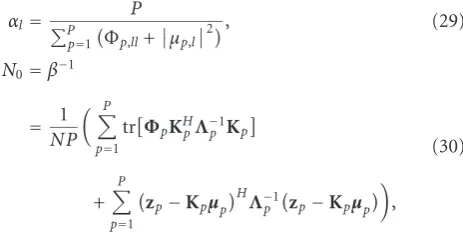
αl=P P p=1
Φp,ll+μp,l2
, (29)
N0=β−1
= 1
NP
P
p=1
trΦpKHpΛ−p1Kp
+
P
p=1
zp−Kpμp HΛ−1
p
zp−Kpμp
,
(30)
whereμp,lis thelth element of the MAP estimate of the
pa-rameter vectorwpgiven by (28), andΦp,llis thelth element
on the main diagonal ofΦpfrom (27). Comparing the latter
expressions with those developed for the single channel case, we observe that (29) and (30) use multiple channels to im-prove the estimates of the noise spectral height and channel weight hyperparameters. They also offer more insight into the physical meaning of the hyperparametersα. On the one hand, the hyperparameters are used to regularize the matrix inversion (27), needed to obtain the MAP estimates of the parameterswp,land their corresponding variances. On the
other hand, they act as the inverse of the second noncentral moments of the coefficientswp,l, as can be seen from (29).
4. MODEL SELECTION AND BASIS PRUNING
The ability to select the best model to represent the mea-sured data is an important feature of the proposed scheme, and thus it is paramount to consider in more detail how the model selection is effectively achieved. InSection 3.1we have briefly mentioned that during the learning phase many of the hyperparametersαl’s tend to large values, meaning that
the corresponding weightswl’s will cluster around zero
ac-cording to the prior (14). This will allow us to set these co-efficients to zero, thus effectively pruning the corresponding basis function from the design matrix. However the question how large a hyperparameter has to grow in order to prune its corresponding basis function has not yet been discussed. In the original RVM paper [15], the author suggests using a thresholdαthto prune the model. The empirical evidence
collected by the author suggests setting the threshold to “a sufficiently large number” (e.g.,αth = 1012). However, our
theoretical analysis presented in the following section will show that such high thresholds are only meaningful in very high SNR regimes, or if the number of channel observations Pis sufficiently large. In more general, and often more realis-tic, scenarios such high thresholds are absolutely impractical. Thus, there is a need to study the model selection problem in the context of the presented approach more rigorously.
Below, we present two methods for implementing model selection within the proposed algorithm. The first method relies on the statistical properties of the hyperparametersαl,
when the update equations (27), (28), (29), and (30) con-verge to a stationary point. The second method exploits the
relationship that we will establish between the proposed scheme and the minimum description length principle [4,8,
20,21], thus linking the EP to this classical model selection approach.
4.1. Statistical analysis of the hyperparameters in the stationary point
The decision to keep or to prune a basis function from the de-sign matrix is based purely on the value of the corresponding hyperparameterαl. In the following we analyze the
conver-gence properties of the iterative learning scheme depicted in
Figure 4using expressions (27), (28), (29), and (30), and the resulting distribution of the hyperparameters once conver-gence is achieved.
We start our analysis of the evidence parameters αl
by making some simplifications to make the derivations tractable.
(i) Pchannels are assumed.
(ii) The same MF is used to process each of thePsensor output signals, that is,Kp =KandΣp =Σ =β−1Λ,
p=1· · ·P.
(iii) The noise covariance matrixΣis known, andB=Σ−1.
(iv) We assume the presence of a single multipath compo-nent, that is,L = 1, with known delay τ. Thus, the design matrix is given asK = [r(τ)], where r(τ) =
[Ruu(−τ),Ruu(Ts−τ),. . .,Ruu((N−1)Ts−τ)]Tis the
associated basis function.
(v) The hyperparameter associated with this component is denoted asα.
Our goal is to consider the steady-state solutionα∞ for
hyperparameterαin this simplified scenario. In this case (27) and (28) simplify to
φ=α+r(τ)HBr(τ)−1,
μp=φKHBzp=
r(τ)HBz p
α+r(τ)HBr(τ), p=1· · ·P.
(31)
Inserting these two expressions into (29) yields
α−1= 1
α+r(τ)HBr(τ)
+
pr(τ)HBzp/
α+r(τ)HBr(τ)2
P .
(32)
From (32) the solutionα∞is easily found to be
α∞=
r(τ)HBr(τ)2
(1/P)pr(τ)HBzp2−r(τ)HBr(τ). (33)
A closer look at (33) reveals that the right-hand side ex-pression might not always be positive since the denominator can be negative for some values ofzp. This contradicts the
assumption that the hyperparameterαis positive.5A further
analysis of (32) reveals that (29) converges to (33) if and only if the denominator of (33) is positive:
1
P p r(τ)
HBz p
2
>r(τ)HBr(τ). (34)
Otherwise, the iterative learning scheme depicted inFigure 4
diverges, that is,α∞= ∞. This can be inferred by interpreting
(29) as a nonlinear dynamic system that, at iterationj, maps α[j−1]into the updated valueα[j]. The nonlinear mapping is
given by the right-hand side of (29), where the quantitiesΦp
andμp depend on the values of the hyperparameters at it-eration j−1. InFigure 6we show several iterations of this mapping that illustrate how the solution trajectories evolve. If condition (34) is satisfied, the sequence of solutions{α[j]}
converges to a stationary point (Figure 6(a)) given by (33). Otherwise,{α[j]}diverges (Figure 6(b)). Thus, (32) is a
sta-tionary point only provided the condition (34) is satisfied: α∞
= ⎧ ⎪ ⎪ ⎨ ⎪ ⎪ ⎩
r(τ)HBr(τ)2
pr(τ)HBzp2/P−r(τ)HBr(τ)
; cond. (34) is satisfied,
∞; otherwise.
(35)
Practically, this means that for a given measurementzp, and
known noise matrixB, we can immediately decide whether a given basis functionr(τ) should be included in the basis by simply checking if (34) is satisfied or not.
A similar analysis is performed in [22], where the behav-ior of the likelihood function with respect to a single parame-ter is studied. The obtained convergence results coincide with ours when P = 1. Expression (34) is, however, more gen-eral and accounts for multiple channel observations and col-ored noise. In [22] the authors also suggest that testing (34) for a given basis function r(τ) is sufficient to find a sparse representation and no further pruning is necessary. In other words, each basis function in the design matrixKis subject to the test (34) and, if the test fails, that is, (34) does not hold for the basis function under test, the basis function is pruned. In case of wireless channels, however, we have exper-imentally observed that even in simulated high-SNR sce-narios such pruning results in a significantly overestimated number of multipath components. Moreover, it can be in-ferred from (34) that, as the SNR increases, the number of functions pruned with this approach decreases, resulting in less and less sparse representations. This motivates us to per-form a more detailed analysis of (35).
Let us slightly modify the assumptions we made earlier. We now assume that the multipath delayτis unknown. The design matrix is constructed similarly but this timeK=[rl],
where
rl=
Ruu
−Tl
,. . .,Ruu
(N−1)Ts−Tl T
(36)
is the basis function associated with the delayTl∈T used in
our discrete-time model. Under these assumptions the input signalzp is nothing else but the basis functionr(τ) scaled
1.03 1.04 1.05 1.06 1.07 1.08 1.09 1.1 1.11 1.12
α
[
j
]
1 1.05 1.1 1.15
α[j−1]
Nonlinear mapping α[j]=α[j−1]
Iteration trajectory 1 Iteration trajectory 2 (a)
0 10 20 30 40 50 60 70 80
α
[
j
]
0 10 20 30 40 50 60 70
α[j−1]
Nonlinear mapping α[j]=α[j−1]
Iteration trajectory 1 Iteration trajectory 2 (b)
Figure6: Evolution of the two representative solution trajectories for two cases: (a){α[j]}converges, (b){α[j]}diverges.
and embedded in the additive complex zero-mean Gaussian noise with covariance matrixΣ, that is,
zp=wpr(τ) +ξp. (37)
Let us further assume that wp ∈ C, p = 1· · ·P, are
into (33) and rearranging the result with respect toα−1
∞ we
arrive at
α−1
∞ =
rH l Br(τ)
2 pwp2
PrH l Brl2
+2
pRe
wprHl Br(τ)ξHpBrl
PrHl Brl2
+r
H
l B pξpξHp
Brl
PrHl Brl2
− 1
rH l Brl.
(38)
Now, we consider two scenarios. In the first scenario τ =
Tl ∈ T, that is, the discrete-time model matches the
ob-served signal. Although unrealistic, this allows to study the properties ofα−1
∞ more closely. In the second scenario, we
study what happens if the discrete-time model does not match perfectly the measured signal. This case helps us to define how the model selection rules have to be adjusted to consider possible misalignment of the path component de-lays in the model.
4.1.1. Model match:τ=Tl
In this situation,rl=r(τ), and thus (38) can be further
sim-plified according to
α−1
∞ =
pwp
2
P +
2pRewpξpBrl
PrH l Brl
+r
H
l B pξpξHp
Brl
PrHl Brl
2 −
1 rHl Brl
,
(39)
where the only random quantity is the additive noise termξp. This allows us to study the statistical properties of the finite stationary point in (35).
Equation (39) shows how the noise and multipath com-ponent contribute toα−1
∞. If allwpare set to be zero, that is,
there is no multipath component, thenα−1
∞ = α−n1 reflects
only the noise contribution:
α−1 n =
rHl B pξpξHpBrl
PrH l Brl
2 −
1 rHl Brl.
(40)
On the other hand, in the absence of noise, that is, in the infinite SNR case, the corresponding hyperparameterα−1
∞
in-cludes the contribution of the multipath component6α−1 s :
α−1 s =
pwp2
P +
2pRewpξHpBrl
PrH l Brl
. (41)
In a realistic case, both noise and multipath component are present, and α−1
∞ consists of the sum of two contributions
6Actually, the second term in the resulting expression vanishes in a per-fectly noise-free case, and thenα−1
s =
p|wp|2/P.
α−1
∞ =α−s1+α−n1. Both quantitiesα−s1andα−n1are random
variables with pdf ’s depending on the number of channel ob-servationsP, the basis functionrl, and the noise covariance
matrixΣ. In the sequel we analyze their statistical properties. We first considerα−1
s . The first term on the right-hand
side of (41) is a deterministic quantity that equals the average power of the multipath component. The second one, on the other hand, is random. The product Re{wpξHpBrl}in (41)
is recognized as the cross-correlation between the additive noise term and the basis functionrl. It is Gaussian distributed
with expectation and variance given as
E
#
2pRewpξHpBrl
PrH l Brl
$
=0,
E
#%
2pRewpξHpBrl
PrH l Brl
&2$ =2
pwp
2
P2rH l Brl
,
(42)
respectively, where E{·} denotes the expectation operator. Thus,α−1
s is distributed as
α−s1∼N %
pwp2
P ,
2pwp2
P2rH l Brl
&
, (43)
which is a normal distribution with the mean given by the av-erage power of the multipath component and variance pro-portional to this power.
Now, let us consider the termα−1
n . In (40) the only
ran-dom element isPp=1ξpξHp. This random matrix is known to have a complex Wishart distribution [23,24] with the scale matrixΣandPdegrees of freedom. Let us denote
c=√ Brl
PrHl Brl
, x=cH
P
p=1
ξpξHpc. (44)
It can be shown thatxis Gamma-distributed, that is, x ∼
G(P,σ2
c), with the shape parameterPand the scale parameter
σ2
c given as
σ2
c =cHΣc=
1 PrH
l Brl
. (45)
The pdf ofxreads
px|P,σ2 c
= xP−1 Γ(P)σ2
c Pe−x/σ
2
c. (46)
The mean and the variance ofxare easily computed to be
E{x} =Pσ2 c =
1 rH
l Brl
,
Var{x} =Pσ2 c
2
= 1
PrHl Brl 2.
(47)
Taking the term−1/(rHl Brl) in (40) into account, we
intro-duce a variableα−1
n : a zero mean random variable with the
pα−1 n
x|P,σ2 c
=
x−E{x}P−1 Γ(P)σ2
c
P e−(x−E{x})/σ
2
which is equivalent to (46), but shifted so as to correspond to a zero-mean distribution. However, it is known that only positive values ofα−1
n occur in practice. The probability mass
of the negative part of (48) equals the probability that the condition (34) is not satisfied and the resultingα∞eventually
diverges to infinity and is pruned. Taking this into account the pdf ofα−1
n reads
pα−1
n (x)=Pnδ(x) +
1−Pn
I+(x)p
α−1 n
x|P,σ2 c
, (49)
whereδ(·) denotes a Dirac delta function,Pnis defined as
Pn= 0
−1/(rH lBrl)
pα−1 n
x|P,σc2
dx, (50)
andI+(·) is the indicator function of the set of positive real
numbers:
I+(
x)= ⎧ ⎨ ⎩
0 x≤0,
1 x >0. (51)
A closer look at (49) shows that asPincreases the variance of the Gamma distribution decreases, withα−1
n concentrating
at zero. In the limiting case asP → ∞, (49) converges to a Dirac delta function localized at zero, that is,αn = ∞. This
allows natural pruning of the corresponding basis function. This situation is equivalent to averaging out the noise, as the number of channel observations grows. Practically, however, Pstays always finite, which means that (43) and (49) have a certain finite variance.
The pruning problem can now be approached from the perspective of classical detection theory. To prune a basis function, we have to decide if the corresponding value of α−1has been generated by the noise distribution (49), that
is, thenull hypothesis, or by the pdf ofα−1
s +α−n1, that is, the
alternative hypothesis. Computing the latter is difficult. The problem might be somewhat relaxed by taking the assump-tion thatα−1
s andα−n1are statistically independent. However
proving the plausibility of this assumption is difficult. Even if we were successful in finding the analytical expression for the pdf of the alternative hypothesis, such model selection approach is hampered by our inability to evaluate (43) since the gainswp’s are not known a priori. However, we can still
use (49) to select a threshold.
Recall that the presented algorithm allows to learn (esti-mate) the noise spectral heightN0=β−1from the
measure-ments. Assuming that we knowβ, and, as a consequence, the whole matrixBthen, for any basis functionrlin the design
matrixKand the corresponding hyperparameterαl, we can
decide with a priori specified probabilityρthatαlis
gener-ated by the distribution (49). Indeed, letα−1
th be aρ-quantile
of (49) such that the probabilityP(α−1 ≤ α−1
th) = ρ. Since
(49) is known exactly, we can easily computeα−1
th and prune
all the basis functions for whichα−1 l ≤α−th1. 4.1.2. Model mismatch:τ /=Tl
The analysis performed above relies on the knowledge that the true multipath delayτ belongs toT. Unfortunately,
this is often unrealistic and the model mismatch τ /∈ T must be considered. To be able to study how the model mis-match influences the value of the hyperparameters we have to make a few more assumptions. Let us for simplicity select the model delayTlto be a multiple of the chip periodTp. We will
also need to assume a certain shape of the correlation func-tion Ruu(t) to make the whole analysis tractable. It may be
convenient to assume that the main lobe ofRuu(t) can be
ap-proximated by a raised cosine function with period 2Tp. This
approximation makes sense if the sounding pulse p(t) de-fined inSection 2is a square root raised cosine pulse. Clearly, this approximation can also be applied for other shapes of the main lobe, but the analysis of quality of such approximation remains outside the scope of this paper.
Just as in the previous case, we can split the expression (38) into the multipath component contributionα−1
s
α−1 s =
γ(τ)2 pwp2
P +
2pRewpγ(τ)ξHpBrl
PrHl Brl
,
(52)
where
γ(τ)=rHl Br(τ)
rHl Brl
, (53)
and the same noise contributionα−1
n defined in (40). It can
be seen that theγ(τ) makes (52) differ from (41), and as such it is the key to the analysis of the model mismatch. Note that this function is bounded as|γ(τ)| ≤1, with equality follow-ing only ifτ=Tl. Note also that in our case for|τ−Tl|< Tp
the correlationγ(τ) is strictly positive.
Due to the properties of the sounding sequenceu(t), the magnitude ofRuu(t) for|t|> Tp is sufficiently small and in
our analysis of model mismatch can be safely assumed to be zero. Furthermore, ifrlis chosen to coincide with the
mul-tiple of the sampling periodTl = lTs, then it follows from
(12) that the productrH
l B =rHl Σ−1 =βeHl is a vector with
all elements being zero except thelth element, which is equal toβ. Thus, the productrHl Br(τ) for|τ−Tl|< Tpmust have
a form identical to that of the correlation functionRuu(t) for |t|< Tp. It follows that when|τ−Tl| ≥Tp the correlation
γ(τ) can be assumed to be zero, and it makes sense to ana-lyze (52) only when|τ −Tl| < Tp. InFigure 7we plot the
correlation functionsRuu(t) andγ(τ) for this case.
Since the true value ofτis unknown, we assume this pa-rameter to be random, uniformly distributed in the interval [Tl−Tp,Tl+Tp]. This in turn induces corresponding
distri-butions for the random variablesγ(τ) andγ(τ)2, which enter,
respectively, the second and first terms on the right-hand side of (52).
It can be shown that in this case γ(τ) ∼ B(0.5, 0.5), whereB(0.5, 0.5) is a Beta distribution [25] with both distri-bution parameters equal to 1/2. The corresponding pdfpγ(x)
is given in this case as
pγ(x)=
1 B(0.5, 0.5)x
−1/2(1−x)−1/2, (54)
−0.2 0 0.2 0.4 0.6 0.8 1 1.2
−3Tp −2Tp −Tp 0 Tp 2Tp 3Tp
Delay,τ Ruu(t)
SampledRuu(t)
(a)
−0.2 0 0.2 0.4 0.6 0.8 1 1.2
γ
(
τ
)
−Tp 0 Tp
Delay,τ (b)
Figure7: Evaluated correlation functions (a)Ruu(t) and (b)γ(τ).
It is also straight-forward to compute the pdf of the term γ(τ)2:
pγ2(x)= 1 πx
−3/4(1−√x)−1/2. (55)
The corresponding empirical and theoretical pdf ’s of γ(τ) andγ(τ)2are shown inFigure 8.
Now we have to find out how this information can be uti-lized to design an appropriate threshold. In the case of a per-fectly matched model the threshold is selected based on the noise distribution (49). In the case of a model mismatch, the term (52) measures the amount of the interference resulting from the model imperfection.
Indeed, if|τ −Tl| ≥ Tp, then the resulting γ(τ) = 0,
and thusα−1
s = 0. The corresponding evidence parameter
α−1
∞ is then equal to the noise contributionα−n1only and will
be pruned using the method we described for the matched
0 0.5 1 1.5 2 2.5 3 3.5
0 0.2 0.4 0.6 0.8 1
Empiricalγ(x) pγ(x)
(a)
0 1 2 3 4 5 6
0 0.2 0.4 0.6 0.8 1
Empiricalγ(x)2 pγ2(x)
(b)
Figure8: Comparison between the empirical and theoretical pdf ’s of (a)γ(τ) and (b)γ(τ)2for the cosine approximation case. To com-pute the histogramN=5000 samples were used.
model case. If however,|τ−Tl|< Tp, then a certain fraction
ofα−1
s will be added to the noise contributionα−n1, thus
caus-ing the interference. In order to be able to take this interfer-ence into account and adjust the threshold accordingly, we propose the following approach.
The amount of interference added is measured by the magnitude ofα−1
s in (52). It consists of two terms: the first
one is the multipath power, scaled by the factorγ(τ)2:
γ(τ)2
pwp2
The second term is a cross product between the multi-path component and the additive noise, scaled byγ(τ):
γ(τ)2
pRe
wpξHpBrl
PrH l Brl
. (57)
Both terms have the same physical interpretation as in (41), but with scaling factorsγ(τ) depending on the true value ofτ. We see that in (52) there are quite a few unknowns: we do not know the true multipath delayτ, the multipath gains wp, as well as the instantaneous noise valueξ. To be able to
circumvent these uncertainties, we consider the large sample size case, that is,P→ ∞and invoke the law of large numbers to approximate (56) and (57) by their expectations.
First of all, using (42) it is easy to see that
E
'
γ(τ)2
pRe
wpξHpBrl
PrHl Brl
(=0. (58)
The other term (56) converges toγ(τ)2E{|wp|2}asPgrows.
So, even in the high SNR regime and infinite number of channel observations P the term (56) does not go to zero. In order to assess how large it is, we approximate the gains of the multipath componentwpby the corresponding MAP
estimateμpobtained with (28).
The correlation functionγ(τ) can also be taken into ac-count. Since we know the distributions of both γ(τ) and γ(τ)2, we can summarize these by the corresponding mean
values. In fact, we will need the mean only forγ(τ)2since it
enters the irreducible part ofα−1 s .
In our case it is computed as
Eγ(τ)2= 1
0
x πx
−3/4(1−√x)−1/2dx=3
8. (59)
Having obtained the mean, we can approximate the in-terferenceα−1
s due to the model mismatch as
α−1 s =
3 8×
P−1 p=0μp2
P . (60)
The final threshold that accounts for the model mismatch is then obtained as
α−1
th =α−s1+α−th1, (61)
whereα−1
th is the threshold developed earlier for the matched
model case.
4.2. Improving the learning algorithm to cope with the model selection
In the light of the model selection strategy considered here, we anticipate two major problems arising with the learning algorithm discussed inSection 3. The first one is the estima-tion of the channel parameters that requires computaestima-tion of the posterior (27). Even for the modest sizes of the hypothe-sisHi(from 100 to 200 basis functions), the matrix
inver-sion is computationally very intensive. This issue becomes even more critical if we consider a hardware implementa-tion of the estimaimplementa-tion algorithm. The second problem arises
due to the nonvanishing correlation between the basis vec-torsrl constituting the design matrixK. A very undesirable
consequence of this correlation is that the evidence parame-tersαlassociated with these vectors become also correlated,
and thus no longer represent the contribution of a single ba-sis function. As a consequence the developed model selection rules are no longer applicable.
It is, however, possible to circumvent these two diffi cul-ties by modifying the learning algorithm as discussed below. The basic idea consists of estimating the channel parameters for each basis independently. In other words, instead of solv-ing (27), (28), (29), and (30) jointly for allLbasis functions, we find a solution for each basis vector separately. First, the new data vectorxp,lfor thelth basis is computed as
xp,l=zp− L
k=1,k /=l
rkμp,l. (62)
This new data vectorxp,lnow contains the information
rel-evant to the basisrlonly. It is then used to update the
cor-responding posterior statistics as well as evidence parameters exclusively for thelth basis as follows:
Φl=
αl+βrHl Λ−1rl −1
,
μp,l=βΦlrHl Λ−1xp,l, p=1· · ·P.
(63)
Note that expressions (63) are now scalars, unlike their matrix counterparts (27) and (28). Similarly, we update the evidence parameters as
αl=P P p=1
Φl+μp,l2
. (64)
Updates (63) and (64) are performed for allL compo-nents sequentially. Once all compocompo-nents are updated, we up-date the noise hyperparameterN0:
N0=
β−1
= 1
NP
% P
p=1
trΦ(K)HΛ−1K
+
P
p=1
zp−Kμp H
Λ−1z p−Kμp
&
. (65)
The above updating procedures constitute a single itera-tion of the modified learning algorithm. This iteraitera-tion is re-peated until some suitable convergence criterion is satisfied. Note that the procedure described here is an instance of the SAGE algorithm. This opens a potential to unite both SAGE and evidence procedure, allowing to implement simultane-ous parameter and model order estimation within the SAGE framework.
![Figure 6: Evolution of the two representative solution trajectoriesfor two cases: (a) {α[j]} converges, (b) {α[j]} diverges.](https://thumb-us.123doks.com/thumbv2/123dok_us/1155313.1145200/8.600.315.544.68.545/figure-evolution-representative-solution-trajectoriesfor-cases-converges-diverges.webp)