An integrated methodology for a sustainable two-stage supplier selection and order allocation problem
Abstract
Supplier selection and order allocation are two of the most important stages in supply chain management. In recent years, these decisions have become major challenges since it has been increasingly important to consider the sustainability of the supply chain. This research presents an integrated methodology to solve a sustainable two-stage supplier selection and order allocation problem for a meat supply chain, considering economic, environmental and social criteria. The proposed integrated methodology includes four phases: (1) the fuzzy analytical hierarchy process (AHP) was used to assign the relative weights for sustainable criteria; (2) the fuzzy technique for order of preference by similarity to ideal solution (TOPSIS) was used to rate suppliers vis-à-vis their sustainable performance; (3) a multi-objective programming model (MOPM) was formulated to obtain the optimal order allocations of quantity in order to minimise the costs of transportation, purchasing and administration, as well as environmental impact (particularly CO2 emissions) and the travel
time of products, while maximising social impact and total purchasing value; and (4) TOPSIS was used to reveal the final solution in a set of Pareto solutions. In industry, many parameters are not known precisely. Therefore, the MOPM was reformulated into a fuzzy MOPM (FMOPM) to handle uncertainty. Afterward, the ε-constraint method and LP-metrics method were employed to optimise the developed FMOPM in terms of obtaining Pareto solutions. Finally, a case study was implemented to examine the applicability of the proposed methodology.
Keywords: sustainability, fuzzy multi-objective optimisation, multi-criteria decision-making, supplier selection, evaluation criteria.
1. Introduction
Notwithstanding the importance of the supply chain’s cost impacts, sustainability is becoming an increasing concern in terms of the environmental impacts (e.g., CO2 emissions)
and social impacts of business activities (Gallego-Álvarez et al., 2015; Mani et al., 2016). The World Summit of Sustainable Development described sustainability as a set of scales between economic benefits, environmental protection and social improvements. The two
terms of sustainable development and supply chain management have recently come to be known as ‘sustainable supply chain management’ (Zailani et al., 2012). Sustainable supply chain management includes the management of streams of assets, data, human resources and merchandise between and among all levels of the supply chain to gain the optimal compromise among economic, environmental and social aspects. Sharma and Ruud (2003) define the social pillar as the ‘ethical code of conduct for human survival and outgrowth that needs to be accomplished in a mutually inclusive and prudent way’. McCarthy et al. (2010) argue that there is a need to consider the social pillar in supply chain activities in order to increase the awareness of supply chain managers about not merely ‘where’ the merchandises were manufactured but also ‘how’ and ‘in what circumstances’ they were manufactured. However, the awareness of the social pillar has received less attention from both academics and practitioners (Gallego-Álvarez et al., 2015; Mani et al., 2016).
Many input data, such as cost and potential market demands, are normally varied in industry. Therefore, issues of uncertainty need also to be considered in activities of supply chain management (Fattahi et al., 2015). Fuzzy logic is one of the main approaches that can be used to come closer to reality. Several researchers apply fuzzy methods to tackle the uncertainty of input data for supply chain management (Mohammed et al., 2017a,b; Gholamiana et al., 2015; Dukil et al., 2018). Zadeh (1965) initially introduced the fuzzy set theory to model and analyse uncertain and vague data. In fuzzy logic, the uncertainties of fuzzy sets are characterised through the establishment of membership functions. The membership function values vary between 0 and 1. A membership value of 1 means that the elements are in the centre of the fuzzy set. A membership value of 0 means that the element is outside the fuzzy set. Finally, a membership value between 0 and 1 means the elements construct the frontier of the fuzzy set.
because of different aspects related to the food sector and ecological consumption (Maloni and Brown, 2006; Matos and Hall, 2007). Furthermore, the safety and quality of food products have become major concerns for customers, in addition to environmental and social issues (Mohammed et al., 2016). Consequently, decision makers have been motivated to enable tracking of materials and ingredients in food supply chains (Mohammed et al., 2016). For example, food safety and traceability standards by the European Union require every ingredient to be traceable (EU, 2002). This indicates the need to effectively consider the three pillars of sustainability within food supply chain management (Büyüközkan and Çapan, 2007; Grimm et al., 2014).
Interest in environmentalism has forced supply chain managers to consider environmental issues. The social aspect, which is highlighted infrequently in the literature (Pagell and Wu, 2009; Mani et al., 2016), includes aspects, such as increasing employment prospects and cost-effective development for local societies. In the last few years, governments have considered these social impacts, particularly in developing countries. Decision makers believe that to be more competitive in today’s globalised business, sustainability concerns should be considered within supply chain activities. The supplier selection and order allocation problem includes performance evaluation of a set of suppliers with respect to a number of criteria in order to purchase the material from the right supplier and with the right quantity, thus aiming to enhance the efficiency of a supply chain system. Meanwhile, an impropriate selection may compromise the financial and operational status of the enterprise.
Supplier selection can be divided into two main types: (1) single-sourcing, where one supplier can fulfil the entire enterprise’s demands and decision makers need to make only one decision, i.e., which supplier is the best; and (2) multiple-sourcing, is the more common type, where multiple suppliers need to be selected because no single supplier can fulfil all of the company’s demands. Consequently, decision makers need to select the best suppliers and allocate the quantity to be purchased from them to create a stabilised environment of competitiveness (Alyanak and Armaneri, 2009). However, multiple sourcing is preferred because it affords the guarantee of timely delivery and order flexibility due to the diversity of the firm’s total orders (Aissaoui et al., 2007; Jolai et al., 2011). Supplier selection is a complex, multi-criteria decision-making process because different and conflicting criteria should be considered and assessed in order to find consistent suppliers (Kannan et al., 2013). Kilic (2013) justify this complexity based on the changeable key-factors that may be uncertain and conflict with each other, such as cost, delivery time, service level and product
quality. Several researches consider various criteria for the conventional supplier selection process (Dickson, 1966). A similar study shows that the most popular three criteria are net price, delivery and quality (Weber, 1991). Meanwhile, Ho et al. (2010) argue that the most popular supplier selection criteria are quality, delivery and price. Therefore, selection criteria are not the same in all studies. In the past decade, sustainability concerns grown among stakeholders and academics (Amindoust et al., 2012). This has forced companies to change their suppliers’ evaluation criteria in terms of considering sustainability aspects in their supply chain management to improve their overall sustainability levels and to satisfy increasing environmental and social regulations (Govindan et al., 2013). It can be said that evaluation criteria have evolved from conventional criteria into sustainable criteria. In the food industry, decision makers select suppliers based on price, flavour or the supplier’s location, in addition to the travel time, which is a key factor for food quality. As governments and industry place a stronger emphasis on qualitative and quantitative criteria, such as food safety and quality, the evaluation and selection of the supplier has become more complex (Prusak et al., 2013).
Several empirical studies have investigated the supplier selection problem by considering economic and environmental aspects (e.g. Kuo et al., 2010; Buyukozkan and Cifci, 2011; Tseng and Chiu, 2013; Govindan et al., 2013; Scott et al., 2015). So far, little research has addressed the supplier selection problem by considering economic, environmental and social aspects. Furthermore, none of the reviewed studies have formulated the maximisation of the value of sustainable purchasing as an objective function considering the three pillars of sustainability. In other words, the emphasis on the three pillars of sustainability in the supplier selection and order allocation problem is at an early stage. In the context of the food supply chain, this is the first study to address a two-stage supplier selection and order allocation problem by considering economic, environmental and social aspects in addition to the travel time.
This study makes a significant contribution to the body of knowledge by developing a four-phase methodology that can solve a sustainable supplier selection and order allocation problem in a meat supply chain under multiple uncertainties, such as costs, demands, CO2
products from suppliers with respect to their sustainable performance. In this first phase, the fuzzy analytical hierarchy process (AHP) was used to assign importance weights to sub-criteria for each of the three sets of sub-criteria. In the second phase, the fuzzy technique for order of preference by similarity to ideal solution (fuzzy TOPSIS) was used to rate the potential suppliers based on three sets of criteria: conventional, green and social. In the third phase, a multi-objective programming model (MOPM) was developed to simultaneously optimise the three pillars of sustainability (i.e., economic, environmental and social) in addition to the travel time of products throughout the supply chain and the total purchasing value. Furthermore, to handle the dynamic nature of the input date, the MOPM was developed into a fuzzy multi-objective programming model (FMOPM). The ε-constraint method and LP-metrics method were used to reveal the Pareto optimal solutions. In the fourth phase, TOPSIS was used to select the final Pareto solution based on the developed FMOPM. A real-life case study was used to examine the applicability of the proposed methodology. Finally, the potential wider managerial implications were discussed in terms of adopting the developed methodology to solve similar problems in different sectors.
The rest of this article is organised as follows: Section 2 presents the literature review on supplier selection and order allocation regarding the green and sustainable aspects. Section 3 describes the employed multi-criteria decision-making techniques. Section 4 illustrates the proposed integrated methodology and Section 5 presents the development of the fuzzy multi-objective model. Section 6 shows an application of the proposed methodology in a case study and Section 7 concludes and suggests avenues for future work.
2.Literature review
A number of literature reviews have been conducted on supplier selection techniques (Aissaoui et al., 2007; Chai et al., 2013; Ha and Krishnan, 2008). Furthermore, many studies have used different mathematical optimisation approaches and integrated techniques (e.g., TOPSIS, elimination and choice expressing reality (ELECTRE), AHP, analytic network process (ANP), visekriterijumska optimizacija i kompromisno resenje (VIKOR) and
preference ranking organization method for enrichment of evaluations (PROMETHEE) to solve
supplier selection and order allocation problem (e.g. Zouggari and Benyoucef, 2012; Türk et al., 2017; Erginel and Gecer, 2016; Hlioui et al., 2017). However, Chai et al. (2013) and Govindan et al. (2015) show that AHP, VIKOR, TOPSIS and multi-objective programming are the most commonly used techniques. This study reviews empirical studies that use
mathematical approaches and decision-making techniques in green and sustainable supplier selection and order allocation studies, which effectively positions this study within the literature set.
2.1. Green supplier selection
Sarkis (1999) defines green supply chain management as the process of purchasing, producing, marketing and performing various packaging and logistical activities while considering the ecological balance. Arguably, green supply chain management is based on considering environmental impacts throughout the network. It incorporates environmental issues into the organisation’s buying decisions and encourages companies to form consistent relationships with green suppliers (Sheu et al., 2005).
Govindan et al. (2015) and Nielsen et al. (2014) review the limited literature on multi-criterion decision-making techniques used for green supplier selection problem and Walton et al. (1998) assess five furniture companies considering green criteria in their supply chains. Handfield et al. (2002) propose a supplier selection approach using the analytic hierarchy process, which rates the alternatives based on their environmental performance. Lee et al. (2009) examine a green supplier selection problem by considering green products and green competencies. Awasthi et al. (2010) propose a fuzzy TOPSIS algorithm to solve a supplier selection problem by considering environmental performance. Shaw et al. (2012) propose a model to analyse supplier selection decisions by considering CO2 emissions and Akman
(2015) suggests a two-step supplier-assessment framework to evaluate green suppliers. Büyükozkan and Çifçi (2011) outline service quality, financial performance, organisation, technology and social responsibility and environmental competencies in proposing a decision-making model for a sustainable supplier ranking. Hsu et al. (2013) employ a decision-making trial and evaluation laboratory approach to assign the influential criteria of carbon management in green supply chains for improving the overall performance of suppliers. Kannan et al. (2015) investigate a green supplier selection problem in a plastic company using a fuzzy axiomatic design approach. Govindan and Sivakumar (2016) develop an integrated multi-criteria decision-making and multi-objective linear programming approach as an aid to select the best green supplier. Finally, Trapp and Sarkis (2016) propose a programming model that concurrently considers supplier selection with respect to sustainability concerns.
Sustainability is fundamentally understood as a combination of economic, environmental and social aspects, which is the triple-pillar approach (Dai and Blackhurst 2011; Gauthier 2005). It is recognised that managing supply chains with a focus on sustainability is a significant concern for business firms (Seuring, 2013; Grimm et al., 2014; Kumar et al., 2016). Sarkis (1999) argues that selecting the best suppliers is a key factor for improving sustainable supply chain partnerships. This section reviews the studies that consider the three sustainability pillars in their multi-criteria optimisation models, excluding studies that mention sustainability via economic and environmental aspects only, as reviewed in the previous section. However, very little research has been presented in this context. Bai and Sarkis (2010) assess supplier selection decisions by incorporating social and environmental concerns in their model. Amindoust et al. (2012) rate supplier selection in a sustainable supply chain context, but their study does not consider all of the applicable sub-criteria for sustainable supplier selection. Govindan et al. (2013) propose a fuzzy TOPSIS approach to rate suppliers based on their adherence to sustainability criteria.
2.3 Supplier selection in the food supply chain
Kumar et al. (2011) propose a supplier selection methodology for cost modelling that enables the selection of the best global supplier by considering low-cost packaging materials used in large quantities for processed food products. Grimm et al. (2014) explore the management of sub-suppliers’ compliance with respect to sustainability aspects. The authors propose that the participation of strategic business partners has a positive effect on managing sustainable supplier selection. Wang et al. (2016) highlight and assess the key-hurdles in barring the employment of green supply chain management in food packaging sectors, which are paramount to decreasing environmental impacts. Govindan et al. (2017) solve a supplier selection problem in the food supply chain using a hybrid approach that includes the revised Simos procedure, PROMETHEE methods for constructing a group compromise ranking and robustness analysis. Banaeian et al. (2017) compare TOPSIS, VIKOR and GRA methods to rank suppliers in the agri-food industry by considering economic and environmental criteria. Magdalena (2012) proposes an approach to select the best supplier in a food industry using the Taguchi loss function and fuzzy AHP. Banaeian et al. (2015) propose a management methodology to rank green supplier selection in the food industry. Amorim et al. (2016) propose an integrated framework to solve supplier selection problems in the processed food industry. Amorim et al. (2016) also develop a multi-objective model to simultaneously optimise the minimisation of risk for low customer service and maximisation of profit.
To summarise, previous studies show the importance of incorporating sustainability when evaluating the performance of suppliers. However, there is a gap in this body of knowledge in terms of addressing the three pillars of sustainability in conjunction with maximizing the value of sustainable purchasing in order to solve a supplier selection and order allocation problem. This requires substantial improvement in supplier selection research to improve social performance rather than focusing on economic and environmental aspects. Furthermore, this study aims to integrate the relative weight of sustainability criteria and suppliers into the order allocation plan. This further support decision makers to order products from suppliers considering their sustainable performance with respect to the importance of each sustainability criterion from decision makers’ perspective. In the context of food supply chain management, no research has been presented to improve the sustainable supplier selection and order allocation problem by considering the objectives considered in this work.
3. Preliminaries
3.1 Supplier rating
The supplier rating includes two steps: alternatives ranking and criteria ranking. Alternatives ranking refers to a group of suppliers that need to be rated. Criteria ranking refers to the main factors that are used to rate the alternatives. The weight given to each criterion refers to its relative significance. In this paper, linguistic variables are used to cope with the vagueness in the decision-making process. These variables are transformed into numbers using the form of x = (a, n, m) (Dubois and Prade, 1978) where a, n and m are the three prominent points (the most likely, the most pessimistic and the most optimistic values). For instance, an important weight of an aspect can be defined using this form and referred as (0.7, 0.9, 1). This form can also be applied to present the quantitative terms. For instance, ‘≅40’ can be denoted as (39, 40, 41) and ‘≅between 60 and 90’ can be denoted as (60, 75, 90).
3.2 TOPSIS
from optimising the developed fuzzy multi-objective model. The steps applied in this study are as follows (Ramesh et al., 2012):
Assume
r
efers the decision matrix, where PR is the performance rating of alternative Pareto solutions with respect to criterion function values. Thus, the normalised selection formula is presented as follows:
(1)
The amount of decision information can be measured by the entropy value as:
(2)
The degree of divergence Dp from the average intrinsic information under p = 1, 2, 3, 4 can be calculated as follows:
(3)
The weight for each criterion function value is given by:
(4)
Thus, the criterion-weighted normalised value is given by:
(5)
where wo refers to the weight of alternatives, which are normally assigned by the decision maker.
The positive ideal solution (AT+) and the negative ideal solution (AT-) are used to generate an overall performance matrix for each Pareto solution. These values can be expressed as:
(6)
A distance between alternative solutions can be measured by the n-dimensional Euclidean distance. Thus, the distance of each alternative from the positive and negative ideal solutions is given as:
(7)
(8)
The relative closeness of the values of solutions to the value of the ideal solution is expressed as follows:
(9)
where and . Therefore, .
The solution with the highest rco is selected as the final solution.
3.3 Fuzzy TOPSIS
This work uses Fuzzy TOPSIS to rank the suppliers based on conventional criteria, green criteria and social criteria. Table 1 presents the linguistic variables that are used to rank the alternatives considering each criterion. The fuzzy number listed in Table 1 correspond to the crisp evaluation number (Chen, 2000; 2006). For instance, the linguistic variable ‘‘Medium (M)’’ can be represented as (3, 5, 7). However, for simplicity, in this study we have used trapezoidal fuzzy numbers rather trapezoidal. Decision makers need to allocate a weight to every alternative with respect to each criterion in each of the three sets of criteria (i.e., conventional, green and social). Fuzzy TOPSIS was implemented as follows:
Eq. (11) is used to normalise the fuzzy decision matrix ( ) to get the normalised decision
matrix ( ) (Wang, 2014):
(11)
Where a, n and m correspond to the fuzzy number presented in Table 1. Also, I refers to the number of suppliers and J refers to the number of criteria.
The weights of the criteria ( ) need to be multiplied by the elements of the normalised decision matrix ( ) to form the weighted normalised decision matrix ( ).
(12)
where is obtained using the following equation:
(13)
The fuzzy positive and negative ideal solutions are determined using Eqs. 14 and 15 (Roy et al., 2004).
(14)
(15)
The distance of supplier ‘I’ from the fuzzy positive ideal solution ( ) and the fuzzy negative ideal solution ( ) are calculated as follows:
(16)
where and are fuzzy positive and negative ideal points for criterion ‘j’, respectively.
Based on , the fuzzy closeness coefficient (CC) for each supplier is then determined using Eq. 17 (Krohling et al., 2011). The supplier with the highest CC (varies between 0 and 1) is selected as the best alternative.
(17)
Table 1. Linguistic variables for rating alternatives
Linguistic Variable Crisp number Fuzzy number
Very low (VL) 1 (0, 1, 3)
Low (L) 3 (1, 3, 5)
Medium (M) 5 (3, 5, 7)
High (H) 7 (5, 7, 9)
Very high (VH) 9 (7, 9, 10)
3.4 Fuzzy AHP
Fuzzy AHP is a decision-making algorithm that incorporates Saaty’s (2000) AHP, which was developed in the 1970s using fuzzy set theory (Zimmermann, 2010). In this algorithm, fuzzy numbers are presented by a membership function that is a real number between 0 and 1. Several studies have proven its applicability in solving supplier selection problems (Lee, 2009; Kilincci and Onal, 2011; Shaw et al., 2012; Kannan et al., 2013; Li et al., 2013; Viswanadham and Samvedi, 2013; Junior et al., 2014). This paper uses fuzzy AHP to allocate the relative weights for each sub-criterion for each of the three sets of criteria (i.e., conventional, green and social). Table 2 presents the linguistic variables used to weight the criteria (Chen, 2000; 2006). The fuzzy number listed in Table 2 correspond to the crisp evaluation number defined by Saaty (Saaty, 2000). For instance, the linguistic variable ‘‘Weakly Important (WI)’’ can be represented as (0.1, 0.3, 0.5). Decision makers need to allocate a weight to every sub-criterion in each of the three sets of criteria. The fuzzy AHP was implemented in slight different steps, as mentioned in the literature review. This paper follows Wang et al.’s (2008) procedure:
where I and J refers to the criteria to perform the pairwise comparison among them. 2. Build the crisp matrix as follows:
Where a, n and m correspond to the fuzzy number presented in Table 2.
(18)
3. Use the crisp AHP to determine the consistency index.
4. Sum each row of
~
A as follows:
(19)
5. Normalise the rows by the row sums as follows:
(20)
6. Determine the degree of possibility of
(21)
7. Determine the degree of possibility of over all other fuzzy numbers as follows:
(22)
8. Construct the priority vector of the fuzzy comparison matrix as
follows:
(23)
Table 2. Linguistic variables for rating criteria and sub-criteria.
Linguistic variable Crisp number Fuzzy number (a, n, m)
Equally important (EI) 1 (0, 0.1, 0.3)
Weakly important (WI) 3 (0.1, 0.3, 0.5)
Strongly more important (SMI) 5 (0.3, 0.5, 0.7)
Very strongly important (VSI) 7 (0.5, 0.7, 0.9)
Extremely important (EI) 9 (0.7, 0.9, 0.10)
4. Methodology for sustainable performance evaluation
In this paper, the meat supply chain consists of three levels, including farms, abattoirs and retailers. Figure 1 shows the schematic illustration of the meat supply chain under investigation. Farms supply livestock of quantity of qij to abattoirs along a travel distance of dij to be slaughtered and then transported along a travel distance of dij with quantity of qjk to retailers as packed meat. This research proposes an integrated methodology that uses fuzzy TOPSIS, fuzzy AHP, a developed FMOPM and TOPSIS to help decision makers with two types of decisions: (1) strategically selecting sustainable suppliers of livestock suppliers (LSs) and meat packets suppliers (MPs); and (2) deciding on the optimal quantity of LSs and MPs at the relevant stage of the chain as tactical decisions. Figure 3 presents a flow chart for the proposed sustainable supplier selection and order allocation methodology which was developed as follows:
Phase 1: the fuzzy AHP was employed to assign relative weights to each supplier selection criteria. Figure 2 illustrates the related sub-criteria for each set. As shown in Figure 2, there are four economic criteria, three green criteria and three social criteria.
Phase 3: the calculated weights of the criteria and rates of suppliers were incorporated into a developed multi-objective model to allocate the optimal order quantity from each supplier (e.g., livestock from farms and meat packets from abattoirs) with respect to some resource constraints. The multi-objective aims to simultaneously minimise the expected cost (EC), travel time (TT) and environmental impacts (EI) while maximising the total purchasing value (TPV) and value of social impacts (SI). To come closer to reality, the uncertainties in some of the input data are treated in a fuzzy environment by transforming the multi-objective model into a FMOPM. The ε-constraint method and the LP-metrics method were used to reveal two sets of Pareto solutions.
Phase 4: TOPSIS was used to help decision makers select the final Pareto solution.
Figure 1. A schematic illustration of the three-level meat supply chain under study.
15 Ec o -e n vir o a n d so cia l c rit er ia an d re le va n t s u b -c rit er ia C C G C SC C o st s Liv es to ck h ea lth in es s o r m ea t f re sh n es s Te ch n o lo gy c ap ab ilit y D eli ve ry re lia b ilit y En vir o n n en t m an ag em en t s ys te m W as te m an ag em en t P o llu ti o n p ro d u cti o n Sa fe ty , r ig h ts a n d h ea lth o f e m p lo ye es St aff d ev elo p m en t In fo rm ati o n d is clo su re LS s M Ss 1 2 3 K Farm sites 1 2 3 I 1 2 3 J
Abattoir sites Retailer sites
Livestock Meat
Figure 2. Criteria and sub-criteria for a sustainable supplier selection.
Figure 3. Flow chart of the proposed methodology.
5. Developing the fuzzy multi-objective model
This section discusses the development of the MOPM that was used to solve the sustainable supplier selection and order allocation problem for the three-level chain that is under investigation. This model aims to allocate the quantities of products (e.g., livestock and meat packages) to be ordered from each supplier (e.g., farms and abattoirs). The MOPM includes
Rate the solutions using TOPSIS to select the final solution
Solve the model using LP-metrics Determine objective
weights
Use fuzzy AHP to rate the conventional, green and social criteria
Solve the model using the ε-constraint
Min EC Min EI Max SI Min TT Max TPV Start
Identify suppliers and sub-criteria for the three sets of criteria, e.g., conventional, green and social
Formulate the FMOPM
Use fuzzy TOPSIS to rate suppliers based on conventional, green and social criteria
Optimal sustainable supplier selection and order
five objectives, including minimisation of expected costs (EC), environmental impacts (EI), travel time (TT) and maximisation of total purchasing value (TPV) and value of social impact (SI).
The MOPM was formulated based on the following sets, parameters and decision variables.
Sets
set of livestock suppliers (farms) (1... ... )i I
set of meat packets suppliers (abattoirs) (1... ... )j J
set of retailers Parameters
purchasing cost per unit of livestock ordered from supplier i
purchasing cost per unit of meat packets ordered from supplier j
unit of transportation cost (GBP) per mile from supplier i to abattoir j
unit of transportation cost (GBP) per mile from supplier j to retailer k
administration cost per order from supplier i
administration cost per order from supplier j
dij transportation distance (mile) for livestock from supplier i to supplier j djk transportation distance (mile) for meat packets from supplier j to retailer k
transportation capacity (units) per lorry V velocity (m/h) of lorry
maximum supply capacity (units) of supplier i
maximum supply capacity (units) of supplier j
minimum quantity (units) of livestock to be ordered by supplier j
minimum quantity (units) of meat packets to be ordered by retailer k
CO2ij CO2 emission in grams per mile driven by each lorry travelling from supplier i to
supplier j
CO2jk CO2 emission in grams per mile driven by each lorry travelling from supplier j to
retailer k
weight of conventional set of criteria obtained from the fuzzy AHP from the perspective of decision makers at abattoirs
Weight of the set of conventional criteria obtained from the fuzzy AHP from the perspective of decision makers at retailers
Weight of the set of green criteria obtained from the fuzzy AHP from the perspective of decision makers at abattoirs
Weight of the set of green criteria obtained from fuzzy AHP from the perspective of decision makers at retailers
Weight of the set of social criteria obtained from the fuzzy AHP from the perspective of decision makers at retailers
Weight of the set of social criteria obtained from fuzzy AHP from the perspective of decision makers at abattoirs
Closeness coefficient for supplier i obtained from the fuzzy TOPSIS with respect to the conventional criteria under consideration
Closeness coefficient for supplier j obtained from the fuzzy TOPSIS with respect to the conventional criteria under consideration
Closeness coefficient for supplier i obtained from the fuzzy TOPSIS with respect to the green criteria under consideration
Closeness coefficient for supplier j obtained from the fuzzy TOPSIS with respect to the green criteria under consideration
Closeness coefficient for supplier i obtained from the fuzzy TOPSIS with respect to the social criteria under consideration
Closeness coefficient for supplier j obtained from the fuzzy TOPSIS with respect to the social criteria under consideration
Decision variables
quantity of meat packets ordered from supplier j to retailer k
Binary decision variables
1: if supplier i is selected
0: otherwise
1: if supplier j is selected
0: otherwise
Objective function 1: minimum EC
This objective function aims to minimise the sum of the purchasing cost, administration cost (e.g., ordering and documentation) and transportation cost. The minimisation of EC can be expressed as follows:
(24)
Objective function 2: minimum EI
This objective function aims to minimise the EI in terms of CO2 emissions throughout the
transportation process from farms to abattoirs and from abattoirs to retailers. The minimisation of EI can be expressed as follows:
(25)
Objective function 3: maximum SI
This objective function aims to maximise the value of the social impact of suppliers (e.g., farms and abattoirs). To achieve this aim, suppliers’ weights in social criteria obtained by the fuzzy AHP are used as a coefficient for all livestock ordered from farm i to abattoir j and for
all meat packages ordered from abattoir j to retailer k. The maximisation of SI can be expressed as follows:
(26)
Objective function 4: minimum TT
This objective function aims to minimise the travel time of all livestock from farms to abattoirs and of all meat packages from abattoirs to retailers. The minimisation of EI can be expressed as follows:
(27)
Objective function 5: maximum TPV
This objective function aims to maximise the weights of the conventional criteria, green criteria and sustainable criteria of all selected suppliers. To achieve this aim, the criteria weights obtained from the fuzzy AHP are multiplied by the weights (closeness coefficient) of the alternatives obtained from the fuzzy TOPSIS. To reflect the impact of the products ordered based on the performance of abattoirs and retailers, they are then multiplied by all products to be ordered from supplier i and suppliers j. The maximisation of TPV can be expressed as follows:
(28)
This five-objective model was optimised with respect to the following constraints:
Supply capacity constraints
These constraints ensure that all quantities of livestock ordered from supplier i and of meat packets ordered from supplier j should be equal to or lessthan the capacity of both farms and abattoirs. These constraints, which apply to suppliers i and j, can be expressed as follows:
(30)
Demand constraints
These constraints ensurethat the demands of abattoir j and retailer k are fulfilled by supplier i and supplier j, respectively. These constraints can be expressed as follows:
(31)
(32)
(33)
Non-negativity and binary constraints
These constraints ensure that (1) the quantity of all products throughout the meat supply chain is non-negative and (2) the decision variables ui and vj are binary. These constraints can be expressed as follows:
(34)
(35)
5.1 Treating uncertainty
As mentioned above, several parameters are subject to uncertainty in the real world. Therefore, to cope with the dynamic nature of the input data in transportation and purchase costs, demands, CO2 emissions and capacity levels, the MOPM formulated in the previous
section was re-formulated in FMOPM. The equivalent crisp model can be expressed as follows (Jiménez et al., 2007; Mohammed and Wang, 2017; Nujoom et al., 2017):
(36)
(37)
(38)
(39)
(40)
Subject to:
(41)
(42)
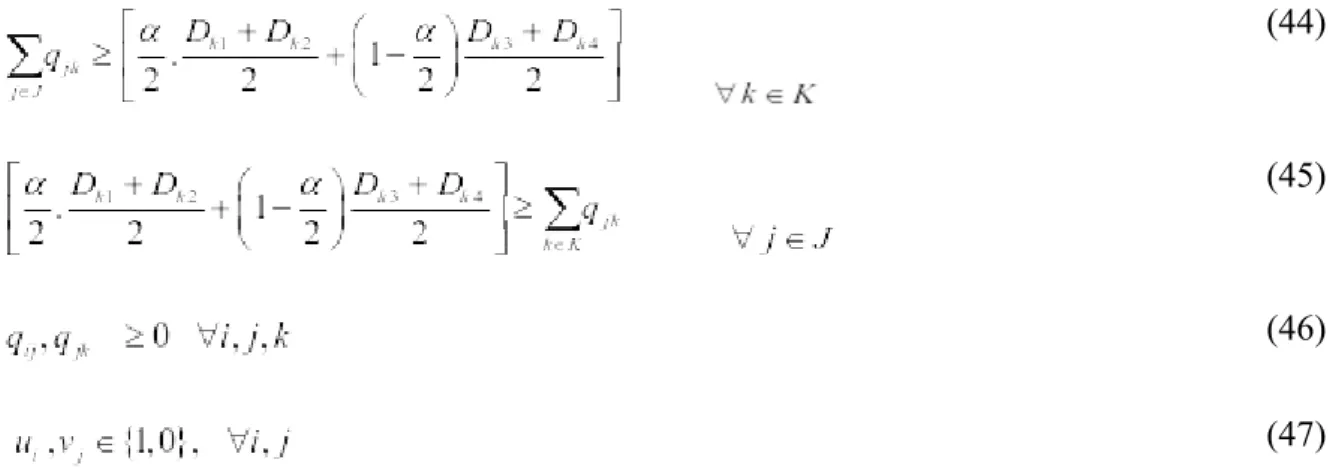
(44)
(45)
(46)
(47)
Based on this fuzzy formulation, the constraints in the MOPM should be satisfied with a confidence value that is denoted as α and is normally determined by decision makers. Furthermore, mos, pes and opt are the three prominent points (the most likely, most pessimistic and most optimistic values), respectively (Jiménez et al., 2007).
Each objective function (Eqs. 36–40) corresponds to an equivalent linear membership function, which can be determined using Eq. 48. Figure 4 further illustrates the membership functions for each objective.
(48)
where Ab represents the value of the bth objective function and Maxb and Minb represent the
maximum and minimum values of bth objective function, respectively.
Figure 4. Membership functions related to the five objectives: (a) EC, EI, TT, (b) SI and TPV.
23
µSI or TPV
1
0 0.5
(b)SIand TPV
µEC, EI or TT
1
0 0.5
The minimum (min) and maximum (max) values for each objective function can be obtained using the following individual optimisations:
For the minimum values:
(49)
(50)
(51)
(52)
(53)
For the maximum values:
(55)
(56)
(57)
(58)
5.2.1 Solution method: ɛ-constraint
Based on this method, the FMOPM was transformed into a mono-objective model by considering one of the objectives as an objective function and shifting the other objective functions to become a constraint that was subject to the ε-value (Ehrgott, 2005). The equivalent solution formula (Z) can be expressed as follows:
(59)
Subject to Eq. 41–47 and:
(60)
(6 1)
(62)
(63)
(64)
(65)
(66)
(67)
In this study, the minimisation of EC was kept as an objective function because Eq. 59 and the minimisation of EI and TT and the maximisation of SI and TPV were considered constraints (Eq. 60, 62, 64 and 66, respectively).
5.2.2 Solution method: LP-metrics
Based on this method, the individual optimisation for the five objective functions was applied
to reveal the ideal objective values ( ). The FMOPM was transformed into a mono-objective model using the following formula (Al-e-hashem et al., 2011):
(68)
Subject to equations 41–47.
6. Application and evaluation
current suppliers. The FMOPM was solved using LINGO11 software that ran on a personal
computer with a Corei5 2.5GHz processor and 4GB of RAM.
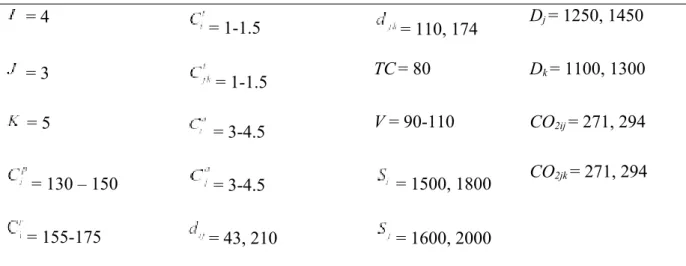
Table 3. Data. = 4
= 1-1.5 = 110, 174 Dj = 1250, 1450
= 3 = 1-1.5 TC= 80 Dk = 1100, 1300
= 5 = 3-4.5 V = 90-110 CO2ij= 271, 294
= 130 – 150 = 3-4.5 = 1500, 1800 CO2jk= 271, 294
= 155-175 = 43, 210 = 1600, 2000
6.1 Weighting sustainable criteria
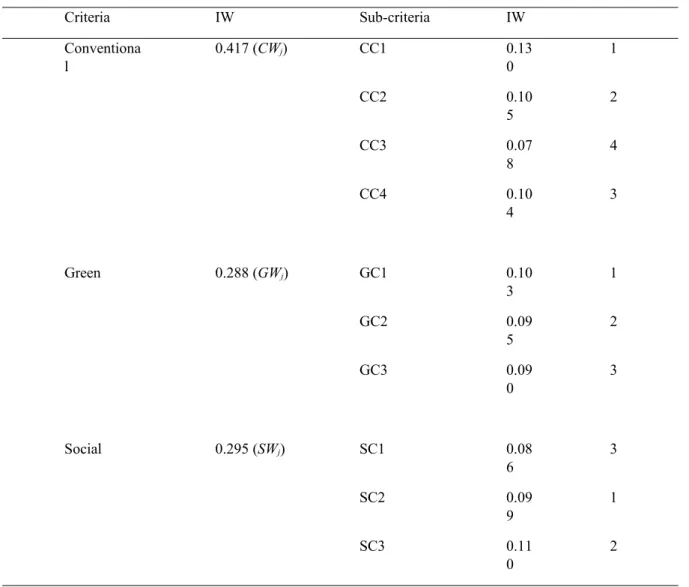
First, a fuzzy AHP was used to assign the importance weights to the three sets of criteria, including conventional, green and social criteria based on decision makers ‘experts. The same algorithm was then reapplied to all of the sub-criteria. Table 4 shows the importance weights for the main and sub-criteria. The rating of the three pillars of sustainability are presented as conventional>green>social for the DMs for assessing LSs perspectives compared to conventional>social>green from DMs for assessing MSs perspectives. Furthermore, according to the opinions of the DMs for assessing LSs, the criteria of cost, environment management systems, waste management and information disclosure are the most significant among the three sets of criteria. According to the opinions of DMs for assessing MPSs, the criteria of cost, environment management systems and staff development are the most
significant among the three sets of criteria. Consequently, the DMs for MPS selection appreciate the staff development criterion more than the DMs of LSs. This could result in DMs at the retailer level giving more attention to the development of staff at abattoirs so they can perform proper slaughtering and packaging processes.
Table 4. Weights for the criteria and sub-criteria of sustainable supplier selection using the fuzzy AHP.
LSs
Criteria IW Sub-criteria IW Rating
Conventiona l
0.433 (CWi) CC1 0.13
8
1
CC2 0.12
5
2
CC3 0.06
7
4
CC4 0.10
3
3
Green 0.319 (GWi) GC1 0.13
3
1
GC2 0.13
3
1
GC3 0.12
5
2
Social 0.248 (SWi) SC1 0.06
6
2
SC2 0.05
1
3
SC3 0.13
1
MSs
Criteria IW Sub-criteria IW
Conventiona l
0.417 (CWj) CC1 0.13
0 1 CC2 0.10 5 2 CC3 0.07 8 4 CC4 0.10 4 3
Green 0.288 (GWj) GC1 0.10
3 1 GC2 0.09 5 2 GC3 0.09 0 3
Social 0.295 (SWj) SC1 0.08
6 3 SC2 0.09 9 1 SC3 0.11 0 2
*NB: IW = importance weight.
6.2 Rating supplier
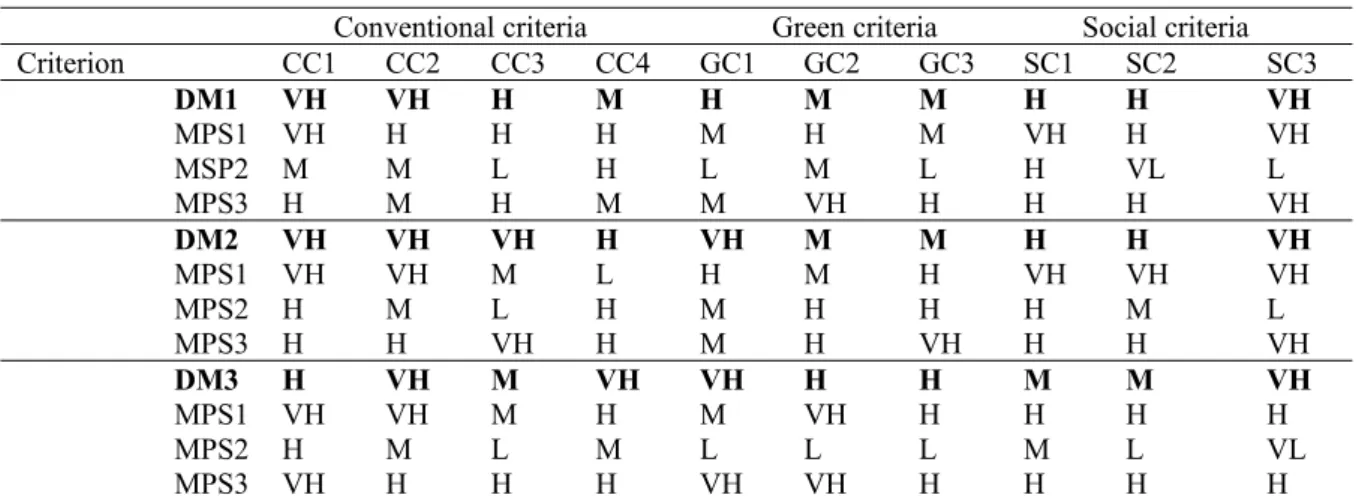
Second, a fuzzy TOPSIS was used to rate four potential LSs and three MSs based on the conventional, green and sustainable criteria to determine the importance weight for each LS and MS. Tables 5 and 6 illustrate the inputs used to rate LSs and MPSs based on assessments of the three sets of criteria, respectively. Two decision makers were asked to rate the potential LSs, while three decision makers were asked to rate the potential MPSs. The ratings for both stages were based on the conventional, green and sustainable criteria previously presented in Figure 3. For instance, the first conventional criterion is the cost.
Table 5. Inputs for ranking potential livestock suppliers.
Conventional criteria Green criteria Social criteria
Criterion CC1 CC2 CC3 CC4 GC1 GC2 GC3 SC1 SC2 SC3
DM1 H VH M H VH H H H M VH
LS1 H H M M H M M H VH M
LS2 VH VH H H H H M VH H VH
LS3 M H H H H H F M M H
LS4 L H VL L L M L M VL H
DM2 H VH L VH H VH M M M VH
LS1 VH H M M H M M M H H
LS2 H M H M M VH H H H VH
LS3 M H M VH M M M H M VH
LS4 M H VL M L M VL M L H
*NB: CC = conventional criteria; GC = green criteria; SC = social criteria; DM1 = decision maker 1; DM2 =
decision maker 2.
Table 6. Inputs for ranking potential meat packets suppliers.
Conventional criteria Green criteria Social criteria
Criterion CC1 CC2 CC3 CC4 GC1 GC2 GC3 SC1 SC2 SC3
DM1 VH VH H M H M M H H VH
MPS1 VH H H H M H M VH H VH
MSP2 M M L H L M L H VL L
MPS3 H M H M M VH H H H VH
DM2 VH VH VH H VH M M H H VH
MPS1 VH VH M L H M H VH VH VH
MPS2 H M L H M H H H M L
MPS3 H H VH H M H VH H H VH
DM3 H VH M VH VH H H M M VH
MPS1 VH VH M H M VH H H H H
MPS2 H M L M L L L M L VL
MPS3 VH H H H VH VH H H H H
*NB: CC = conventional criteria; GC = green criteria; SC = social criteria;DM1 = decision maker 1; DM2 =
decision maker 2; DM3 = decision maker 3.
Table 7 shows the following rating order based on the sustainability performance:
1. LS2>LS3>LS1>LS4 for the LSs.
2. MS1>MS3>MS2 for MPSs.
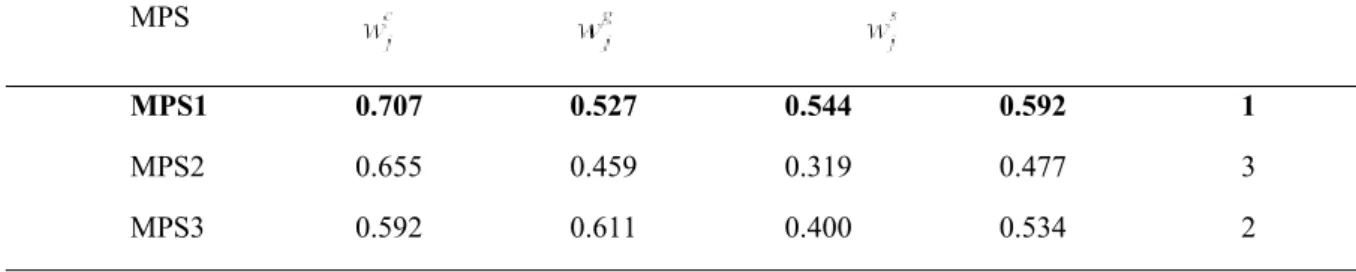
Thus, LS2 and MPS1 are the best sustainable suppliers because they showed the best sustainable performance based on the results from the fuzzy TOPSIS, as shown in Table 7.
Table 7. Rating sustainable suppliers using Fuzzy TOPSIS.
LS Average
CC
Average rating
LS1 0.450 0.566 0.588 0.534 3
LS2 0.676 0.791 0.718 0.728 1
LS3 0.525 0.603 0.577 0.568 2
MPS
MPS1 0.707 0.527 0.544 0.592 1
MPS2 0.655 0.459 0.319 0.477 3
MPS3 0.592 0.611 0.400 0.534 2
6.3 Optimal order allocation
Because of the multi-objective nature of the FMOPM developed in Section 5.1, the ε-constraint and LP-metrics methods were employed to optimise the five objectives simultaneously. First, the min and max values for the five objectives were determined using Eqs. (49–58). The values are ({Min, Max}) = ({334,438, 489,520}, {450814.39, 739901.27}, {1360.5, 1730}, {43.1, 203.7} and {807.37, 1383.02}). Accordingly, the ideal solutions ( ) are: EC* = 334,438, EI* = 450814.39, SI* = 1730, TT* = 43.1 and TPV* = 1383.02). Second, the values between min and max values for objectives 2, 3, 4 and 5 (i.e., related to EI, SI, TT and TPV) were divided into ten segments. The 10 segment values were assigned individually to ε1- ε4 (Table 8) presented in Eqs. (60, 62, 64 and 66) respectively. Subsequently, Eq. (59) was applied to reveal the Pareto solutions because the minimisation of the objective functions EI and TT and the maximisation of SI and TPV, were shifted to become constraints. As mentioned previously, the FMOPM was also optimised using the LP-metrics method for a comparison purpose. Subsequently, 10 different combinations of weights were allocated to the five objectives (Table 9).
Table 8. ε–values related to EI, SI, TT and TPV.
ε –value
# ε1 ε2 ε3 ε4
1 450814 1361 43 807
2 479934 1404 61 882
3 506044 1447 78 952
4 538088 1491 96 1022
5 567174 1524 114 1092
6 610174 1567 132 1162
7 630054 1611 150 1232
8 679174 1654 168 1287
9 691174 1697 186 1337
10 739901 1730 204 1383
Table 9. Assigned weights related to EC, EI, SI, TT and TPV.
Assigned weights
#
1 0.9, 0.02, 0.04, 0.02, 0.02
2 0.8, 0.025, 0.1, 0.025, 0.025
3 0.7, 0.05, 0.15, 0.05, 0.05
5 0.6, 0.06, 0.22, 0.06, 0.06
6 0.5, 0.025, 0.025, 0.025, 0.025
7 0.4, 0.2, 0.2, 0.1, 0.1
8 0.35, 0.25, 0.25, 0.15, 0.15
9 0.3, 0.28, 0.28, 0.12, 0.12
1 0
0.2, 0.28, 0.32, 0.1, 0.1
Tables 10 and 11 show the values for the five objectives based on ten ε-iteration and ten weight combinations, respectively. For instance, Solution 3 in Table 10 yields an expected cost of 363,001, an environmental impact of 505044, a social impact value of 1447, a travel time of 74 and a total purchasing value of 961. This solution was determined as follows: ε1 =
506044, ε2 = 1447, ε3 = 78 and ε4 = 952.
It is worth mentioning that 10 α-levels (0.1, 0.2, 0.3, 0.4, 0.5, 0.6, 0.7, 0.8, 0.9 and 1) with an incremental step of 0.1 were assigned to each solution. Finally, Eq. (48) was used to determine the respective membership degrees (µb) based on the objective values obtained
through the ε-constraint and LP-metrics methods, as shown in Tables 12 and 13, respectively.
Table 10. Values related to EC, EI, SI TT and TPV obtained using the ε-constraint method.
# α-level Min EC Min EI Max SI Min TT Max TPV Run time (s)
1 0.1 342,001 450814 1369 43 810 5
2 0.2 349,101 478001 1404 61 882 5
3 0.3 363,001 505044 1447 74 961 5
4 0.4 382,151 536000 1507 89 1022 6
5 0.5 405,151 567111 1540 114 1100 7
6 0.6 427,334 609971 1570 128 1171 8
7 0.7 432,329 629771 1611 144 1232 8
8 0.8 440,004 678121 1678 160 1287 12
9 0.9 459,800 690091 1706 185 1338 11
10 1 477,000 711490 1730 192 1383 13
Table 11. Values related to EC, EI, SI TT and TPV obtained using the LP-metrics method.
# α-level Min EC Min EI Max SI Min TT Max TPV Run time (s)
1 0.1 336,777 455652 1362 44 807 5
2 0.2 345,760 479871 1371 60 882 4
3 0.3 361,881 509998 1422 79 899 4
4 0.4 361,881 541771 1498 94 978 5
5 0.5 339,773 570228 1510 122 1091 6
6 0.6 411,009 622220 1523 128 1130 8
7 0.7 431,088 635871 1581 151 1199 8
8 0.8 438,000 685881 1622 161 1220 11
9 0.9 455,127 698666 1676 184 1289 12
10 1 469,998 735771 1700 201 1354 13
Table 12. Values of membership degree based on objective values obtained using the ε-constraint method.
µ(EC) 0.98 0.83 0.78 0.63 0.76 0.61 0.4 0.33 0.19 0.089
µ(EI) 0.95 0.89 0.73 0.68 0.52 0.43 0.36 0.3 0.17 0.9
µ(SI) 0.07 0.17 0.28 0.35 0.44 0.56 0.69 0.77 0.91 0.97
µ(TT) 0.95 0.82 0.77 0.66 0.57 0.47 0.35 0.28 0.16 0.08
)
Table 13. Values of membership degree based on objective values obtained using the LP-metrics method.
µ(EC) 0.97 0.83 0.77 0.62 0.75 0.59 0.39 0.28 0.15 0.066
µ(EI) 0.93 0.87 0.71 0.66 0.49 0.4 0.31 0.28 0.15 0.07
µ(SI) 0.06 0.15 0.26 0.33 0.44 0.56 0.67 0.77 0.91 0.96
µ(TT) 0.92 0.79 0.74 0.64 0.55 0.48 0.34 0.25 0.16 0.09
µ(TPV) 0.09 0.18 0.25 0.32 0.4 0.51 0.68 0.78 0.8 0.91
The optimisation results demonstrate that considering sustainability aspects in a supplier selection and order allocation problem can yield a higher cost for the enterprise. At the same time, this helps to improve the value of sustainable purchasing. It is worth noting that neither of the two solution methods (e.g., ε-constraint and LP-metrics methods) revealed an ideal solution by considering the five objectives simultaneously. Arguably, the two methods showed a reasonable performance by revealing Pareto solutions that were close enough to the
ideal solutions ( ). Arguably, computational complexity for multi-objective optimization is normally concerned with the time (e.g., CPUs) required to solve a problem within particular resources (e.g., computer specifications). In this study, the computational complexity analysis for the FMOM was evaluated based on the run time required to reveal the solutions using the two solution methods. As shown in Tables 10 and 11, the complexity analysis in terms of run time shows a reasonable and almost the same run time for revealing the solutions by using the two methods. Therefore, the developed FMOM is tractable time-wise model. However, it is expected to take longer run time to solve large-scaled problems. Finally, one solution should be selected to determine the optimal order allocation, as illustrated in the following section.
6.3.1 Selecting the final solution
DMs should select one solution to allocate the order for each LS and MPS. This selection can be accomplished according to the DM’s preferences or via a decision-making algorithm. However, the selection of the final solution, according to the DM’s preferences, is a challenge due to the little difference found among the values of the five objectives revealed
via the two methods. To help the DMs choose a solution, a TOPSIS algorithm was applied to determine a final solution that was closest to the ideal solution.
Table 14 rates the solutions based on their TOPSIS scores. Subsequently, Solution 4 was rated as the first solution because it obtained the highest rco (0.661). This solution was revealed via the ɛ-constraint method with assignments of ε1 = 538088, ε2 = 1491, ε3 = 96 and ε4 = 1022. This solution leads to an expected cost of 382,151, an environmental impact of 536000, a social impact value of 1507, a travel time of 89 and a total purchasing value of 1022. Based on the determined solution, Figure 5 illustrates the optimal order allocation of LSs and MPSs. For instance, LS1 is demanded to supply 200 livestock to abattoir 1, 160 livestock to abattoir 2 and 190 livestock to abattoir 3. Meanwhile, MPS2 is demanded to supply 130 meat packets to retailer 1 and 118 meat packets to retailer 4.
Unlike other similar methodologies, integrating the relative weight of sustainable criteria and rating of suppliers into the multi-objective model helps in (1) further expressing the importance of sustainability criteria from decision makers’ perspective and (2) ordering products from suppliers with respect to their sustainable performance. This illustrates the superiority of this study over similar supplier selection and order allocation methodologies with respect to sustainability responsibility.
Table 14. Rating solutions using TOPSIS.
Solutio n
Rate
LP-metrics ɛ-constraint
1 0.498 0.552
3 0.602 0.617
4 0.631 0.661
5 0.619 0.644
6 0.576 0.599
7 0.569 0.578
8 0.525 0.530
9 0.485 0.508
10 0.529 0.555
Figure 5. Optimal order allocation.
6.4 Managerial implications
The results demonstrate the following implications from the managerial perspective:
The methodology developed for solving the sustainable supplier selection and order allocation problem can be used as an aid for companies by implementing an integrated methodology to select the best sustainable suppliers with the optimal quantities of products to be ordered.
37
1
2
3
4
Farm sites I = 4
1
2
3
4
1
2
3
Abattoir sites J = 3 Retailer sites K = 5
200
130 130
160
127 149 250
190
106 143
121 150
117 195
50
130 155
144 150 150
Arguably, this methodology can also be used as a reference for livestock and processed meats suppliers for improving sustainability through an evaluation of their current criteria.
The three sets of criteria and their sub-criteria related to economic, environmental and social aspects, can be used in other applications that examine the sustainable supplier selection and order allocation problem.
The four-phase methodology can be used to solve other case studies that solve the sustainable supplier and order allocation problems in conjunction with the optimisation of several conflicting objectives.
The quality and safety of food are two major concerns for customers and decision makers in the food supply chain. In this context, suppliers with high product healthiness and freshness are preferred. Therefore, the results prove that decision makers place high value on the freshness of products delivered by LSs and MPSs.
7. Conclusions
Sustainable supplier selection and order allocation has become a key milestone in creating a robust and sustainable supply chain. Most empirical research considers conventional criteria and green criteria when aiming to create a sustainable supply chain, thus neglecting the third pillar of sustainability, which is the social criterion. This paper presents a four-phase methodology for a two-stage supplier selection and order allocation problem in a meat supply chain by considering the three pillars of sustainability: economic, environmental and social. In the first phase, a fuzzy TOPSIS was used to rate the suppliers based on three sets of criteria: conventional, green and sustainable criteria. Subsequently, the LSs were rated in a high level based on the conventional criteria and green criteria and in a medium very level based on the social criterion. On the other hand, the MPSs were rated in a high level based on all three sets of criteria. In the second phase, the fuzzy AHP was used to assign importance weights to the sub-criteria within the three sets of criteria. The results showed that the decision makers of MPSs place higher importance on the social criterion compared to the decision makers of LSs. In the third phase, a MOPM was developed to obtain the optimal solutions for the order allocation in quantity. The objectives were to minimise the expected costs of transportation, purchasing and administration, as well as environmental impact (particularly CO2 emissions) and the travel time of products and maximising the social impact
(e.g., transportation and purchase costs, demands, CO2 emissions and capacity levels), the
MOPM was redeveloped into a fuzzy multi-objective programming model. Two solution methods were used to reveal solutions and the results were compared. The results proved that both methods were useful for obtaining solutions. In the fourth phase, the TOPSIS method was used to help decision makers select the final solution to determine the optimal order allocation. TOPSIS revealed that the ɛ-constraint method outperformed the LP-metrics method because its solution obtained the highest rate. The results showed that the proposed four-phase methodology could be used as an effective integrated framework for supplier stakeholders based on a sustainable supplier assessment and selection in the food industry.
This research has been focused on meat supply chain. Similar study conducted in different sector such as manufacturing industry or chemical industry may need some bit different criteria such as turnover and lead time. This would also further prove the applicability of the developed approach in solving similar supplier selection and order allocation problems. Also, this study is limited in considering equal weight for buyers’ opinions. Thus, it was suggested to the decision makers to consider different weights considering seniority of decision makers into the upcoming evaluation.
Future work should focus on improving the proposed methodology by considering a multi-period and multi-product food supply chain and its ability to solve a supplier selection and order allocation problem for a large-sized case study. The latter would also help in investigating the computational complexity of the FMOM in terms of run time required to solve a large-sized problem.
Acknowledgements
The authors would like to thank the anonymous referees whose thorough reviews and insightful comments made a valuable contribution to this article.
References
Aissaoui, N., Haouari, M., Hassini, E., 2007. Supplier selection and order lot sizing modeling: a review. Com. Oper. Res. 34, 3516–3540.
Akman, G., 2015. Evaluating suppliers to include green supplier development programs via fuzzy c-means and VIKOR methods. Comput. Ind. Eng. 86, 69–82.
Al-e-hashem, M.S.M.J., Malekly, H., Aryanezhad, M.B., 2011. A multi-objective robust optimization model for multi-product multi-site aggregate production planning in a supply chain under uncertainty. Int. J. Prod. Econ. 134, 28–42.
Alyanak, G., Armaneri, O., 2009. An integrated supplier selection and order allocation approach in a battery company. Makine Mühendisleri Odasi. 19(4), 2–19.
Amindoust, A., S. Ahmed, A., Saghafinia, Bahreininejad, A., 2012. Sustainable Supplier Selection: A Ranking Model Based on Fuzzy Inference System. App Soft Comp. 12(6), 1668–1677.
Amorim, P., et al., 2016. Supplier selection in the processed food industry under uncertainty. Eur. J. Oper. Res. 252(3), 801–814.
Apaiaha, R.K., Linnemanna, A.R., Van der Kooi, H.J., 2006. Exergy analysis: a tool to study the sustainability of food supply chains. Food Res. Int. 39(1), 1–11.
Awasthi, A., Chauhan, S.S., Goyal, S.K., 2010. A fuzzy multi criteria approach for evaluating environmental performance of suppliers. Int. J. Prod. Econ. 126, 370–378.
Bai, C., Sarkis, J., 2010. Integrating sustainability into supplier selection with grey system and rough set methodologies. Int. J. Prod. Econ. 124(1), 252–264.
Banaeian, N., et al., 2016. Green Supplier Selection Using Fuzzy Group Decision Making Methods: A Case Study from the Agri-Food Industry. Comp. Ope. Res. 1–11.
Banaeian, N., Mobli, H., Nielsen, I.E., Omid, M., 2015. A Methodology for Green Supplier Selection in Food Industries. technology Management for Sustainable Production and Logistics Part of the series. Eco Production. 3–23. Springer Berlin Heidelberg.
Büyüközkan, G., Çapan, A., 2007. Improving green supply chain management practices: a case study. In: International logistic and supply chain management congress; 8–9 November, 597–605.
Buyukozkan, G., Cifci, G., 2011. A novel fuzzy multi-criteria decision framework for sustainable supplier selection with incomplete information. Comp. in Ind. 62, 164–174. Chai, J., Liu, J.N.K., Ngai, E.W.T., 2013. Application of decision-making techniques in supplier selection: a systematic review of literature. Expert Syst. Appl. 40, 3872–85.
Chen, C.T., 2000. Extensions of the TOPSIS for group decision-making under fuzzy environment. Fuzzy Sets and Systems 114, 1–9.
Chen, C.T., Lin, C.T., Huang, S.F., 2006. A fuzzy approach for supplier evaluation and selection in supply chain management. Int. J. Prod. Econ. 102, 289–301.
Dai, J., Blackhurst. J., 2011. A Four-phase AHP–QFD Approach for Supplier Assessment: A Sustainability Perspective. Int. J. Prod. Resh. 50(19), 5474–5490.
Dickson, G., 1966. An analysis of vendor selection systems and decisions, J. Purch. 2(1), 5– 17.
Dubois D., Prade H., 1978. Operations on fuzzy numbers.Int. J. Systems Sci., 9, 613.
Dukil, A., Mohammed A. and Darweesh M. 2018. A cost-effective design of an RFID-enabled document location tracking system. Computation Design And Engineering. Journal of Computational Design and Engineering 5 (1), 94-103.
Ehrgott, M., 2005. Multicriteria Optimization. 2nd ed., Springer, New York.
EU, 2002. Regulation (EC) no 178/2002 of the European parliament and of the council of 28 January 2002. Off. J. Eur. Communities. L31, 1–24.
Fattahi, M., Mahootchi, M., Govindan, k., 2015. Dynamic supply chain network design with capacity planning and multi-period pricing. Transport. Res. Part E: Logist. Transport Rev. 81, 169–202.
Gallego-Álvarez, I., Galindo-Villardón, M.P., Rodríguez-Rosa, M., 2015. Evolution of sustainability indicator worldwide: a study from the economic perspective based on the X-STATICO method. Ecol. Indic. 58, 139–151.
Gauthier, C., 2005. Measuring Corporate Social and Environmental Performance: The Extended Life-cycle Assessment. J. Bus. Eth. 59(1–2), 199–206.
Gholamiana, N., Mahdavia, I., Tavakkoli-Moghaddamb, R., Mahdavi-Amiric, N., 2015. Comprehensive fuzzy multi-objective multi-product multi-site aggregate production planning decisions in a supply chain under uncertainty. Applied soft computing. 37, 585–607.
Govindan, K., Kadziński, M. & Sivakumar, R., 2016. Application of a novel PROMETHEE-based method for construction of a group compromise ranking to prioritization of green
suppliers in food supply chain.
http://www.sciencedirect.com/science/article/pii/S0305048316308027 (accessed 2017.02.12). Govindan, K., Khodaverdi, R., Jafarian, A., 2013. A Fuzzy Multi criteria approach for measuring sustainability performance of a Supplier based on triple bottom line approach. J. Clean. Prod. 47, 345–354.
Govindan, K., Rajendran, S., Sarkis, J., Murugesan, P., 2015. Multi criteria decision making approaches for green supplier evaluation and selection: a literature review. J. Clean. Prod. 98, 66–83.
Govindan, K., Sivakumar, R., 2016. Green supplier selection and order allocation in a low-carbon paper industry: integrated criteria heterogeneous decision making and multi-objective linear programming approaches. Ann. Oper. Res. 238, 243–276.
Grimm, J.H., Hofstetter, J.S., Sarkis, J., 2014. Critical factors for sub-supplier management: a sustainable food supply chains perspective. Int. J. Prod. Econ. 152, 159–173.
Ha, S.H., Krishnan, R., 2008. A hybrid approach to supplier selection for the maintenance of a competitive supply chain. Expe. Sys. with Appl. 34, 1303–1311.
Handfield, R., Walton, S.V., Sroufe, R., Melnyk, S.A., 2002. Applying environmental criteria to supplier assessment: a study in the application of the analytical hierarchy process. Eur. J. Oper. Res. 141, 70–87.
Hlioui, R., Gharbi, A. & Hajji, A., 2017. Joint supplier selection, production and replenishment of an unreliable manufacturing-oriented supply chain. Int. J. Prod. Econ. 187(February), 53–67.
HMC UK, 2010. https://halalhmc.org/ (accessed 2016.10.26).
Ho, W., Xu, X.D., Prasanta, K., 2010. Multi-criteria decision making approaches for supplier evaluation and selection: a literature review. Eur. J. Oper. Res. 202(1), 16–24.
Hsu, C.W., Kuo, T.C., Chen, S.H., Hu, A.H., 2013. Using dematel to develop a carbon management model of supplier selection in green supply chain management. J. Clean. Prod. 56, 164–172.
Hwang, C.L, Yoon, K., 1981. Multiple attribute decision making: methods and applications. New York: Springer-Verlag.
Jolai, F., Yazdian, S.A., Shahanaghi, K., AzariKhojasteh, M., 2011. Integrating fuzzy TOPSIS and multi-period goal programming for purchasing multiple products from multiple suppliers. J. of Pur. Supply Mana. 17(1), 42–53.
Junior, R.L., Osiro, L., Carpinetti, C.R, 2014. A comparison between fuzzy AHP and fuzzy TOPSIS methods to supplier selection. Appl. Soft. Comp. 21,194–209.
Kannan, D., Govindan, K., Rajendran, S., 2015. Fuzzy axiomatic design approach based green supplier selection: a case study from singapore. J. Clean. Prod. 96, 194–208.
Kannan, D., Khodaverdi, R., Olfat, L., Jafarian, A., Diabat, A., 2013. Integrated fuzzy multi criteria decision making method and multi-objective programming approach for supplier selection and order allocation in a green supply chain. J. Clean. Prod. 47, 55–67.
Kilic, H.S., 2013. An integrated approach for supplier selection in multi-item/multi- supplier environment. Appl. Math. Model. 37, 7752–63.
Kilincci, O., Onal, S.A., 2011. Fuzzy AHP approach for supplier selection in a washing machine company. Expert Syst. Appl. 38, 9656–9664.
Krohling, R.A., Vinicius, C., Campanharo, C., 2011. Fuzzy TOPSIS for group decision making: a case study for accidents with oil spilling these. Expert. Syst. Appl. 38(4), 4190–7. Kumar, S., Luthra, S., Govindan, K., Kumar, N., Haleem, A., 2016. Barriers in green lean six sigma product development process: an ISM approach. Prod. Plan. Control. 27(78), 604–620. Kumar, S., Qui, S., Linae, H., Haggerty, N., 2011.A global supplier selection process for food packaging. J. Man. Tech. Man. 22(2), 241–260.
Kuo, R.J., Wang, Y.C., Tien, F.C., 2010. Integration of artificial neural network and MADA methods for green supplier selection. J. Cleaner. Prod. 18, 1161–1170.
Lee, A.H.I., 2009. A fuzzy supplier selection model with consideration of benefits, opportunities, costs and risks. Expert. Syst. Appl. 36, 2879–2893.
Lee, A.H.I., Kang, H.Y., Hsu, C.F., Hung, H.C., 2009. A green supplier selection model for high-tech industry. Expert. Syst. Appl. 36, 7917–7927.
Li, Z., Wong, W.K., Kwong, C.K., 2013. An integrated model of material supplier selection and order allocation using fuzzy extended AHP and multi-objective programming. Math. Probl. Eng. 363–718.
Magdalena, R., 2012. Supplier Selection for Food Industry: A Combination of Taguchi Loss Function and Fuzzy Analytical Hierarchy Process. The 3rd International Conference on Technology and Operations Management. Bandung – Indonesia, July 4-6, 2012.
Maloni, M.J., Brown, M.E., 2006. Corporate social responsibility in the supply chain: an application in the food industry. J. Bus. Eth. 68(1), 35–52.
Matos, S., Hall. J., 2007. Integrating sustainable development in the supply chain: the case of life cycle assessment in oil and gas and agricultural biotechnology. J. Oper. Manag. 25(6), 1083–102.
McCarthy, I.P., Lawrence, T.B., Wixted, B., Gordon, B.G., 2010. A multidimensional conceptualization of environmental velocity. Acad. Manage. Rev. 35 (4), 604–626.
Mohammed A., Wang Q. and Li X. 2017a. Developing a meat supply chain network design using a multi-objective possibilistic programming approach. British Food Journal, 119, 3, 690-706.
Mohammed, A., Wang, Q., 2017. The fuzzy multi-objective distribution planner for a green meat supply chain. International J. Pro Eco., 184, 47–58.
Mohammed, A., Wang, Q., Alyahya, S. and Binnette, N. 2017b. Design and optimization of an RFID-enabled automated warehousing system under uncertainties: A multi-criterion fuzzy programming approach. The International Journal of Advanced Manufacturing Technology. 91(5), 1661-1670.
Mohammed, A., Wang, Q., Li, X., 2016. A study in integrity of an RFID-monitoring HMSC. Int. J Food Prop. 20 (5), 1145-1158.
Nielsen, I.E., Banaeian, N., Golinska, P., Mobli, H., Omid, M., 2014. Green supplier selection criteria: from a litreture review to a flexible framework for determination of suitable criteria. In: Golinska P, editor. Eco production book series: logistic operations, supply chain management and sustainability. Springer, 79–100.
Nujoom R., Mohammed A., Wang Q. and Bennett N. 2017. A sustainable manufacturing system design: A fuzzy multi-objective optimization model. Environmental Science and Pollution Research. https://doi.org/10.1007/s11356-017-9787-6
Pagell, M., Wu, Z., 2009. Building a more complete theory of sustainable supply chain management using case studies of 10 exemplars. J. Supply. Chain. Manag. 45, 37–56.
Prusak, A., Stefanów, P., Niewczas, M., Sikora, T., 2013. Application of the AHP