A longitudinal study of 340 young people with or without a
visible difference: The impact of teasing on self-perceptions of
appearance and depressive symptoms
Abstract
Previous research in both the general population and in those with a visible facial
difference has identified potential associations between teasing, dissatisfaction with
appearance and emotional distress. However, most studies are based on cross-sectional and
retrospective methodology, restricting the interpretation of findings. The present study
explored the longitudinal impact of perceived teasing on satisfaction with appearance and
depressive symptoms in young people with and without a visible congenital condition.
Routine psychological assessments were conducted at age 10 and 16 years (N = 340). Experiences of teasing after the age of 10 significantly impacted on appearance evaluations
and depressive symptoms in adolescent females. The impact of teasing on adolescent males
was possibly counteracted by reports of more positive social experiences. Early identification
of perceived teasing in all children to prevent the development of emotional problems and
dissatisfaction with appearance is of vital importance.
Introduction
Within the general population, appearance concerns are deemed to be ‘normative’
(Cash & Pruzinsky, 2004; Grogan, 2007). Adolescence in particular is known to be a
challenging time, in which ‘blending in’ and belonging to a social group is central to
psychological wellbeing, and in which a key component of evaluating social and
psychological adjustment is appearance (Frisén, Lunde, & Berg, 2015). Adolescence is also a
key time for appearance-related comments, teasing and bullying to occur (Lovegrove &
Rumsey, 2005), which are thought to impact further on subjective appearance evaluations
(Menzel et al., 2010; Smolak, 2004). Concurrently, potential associations between teasing,
dissatisfaction with appearance and psychological distress have been proposed (Bellmore &
Cillessen, 2006; Juvonen, Nishina, & Graham, 2000; Lunde & Frisen, 2011; Menzel et al.,
2010).
One group of young people who may be particularly vulnerable to feeling dissatisfied
with their appearance, and to the associated social challenges, are those born with a visible
facial difference (Rumsey & Stock, 2013). Research has identified a number of psychosocial
challenges for this group (Rumsey, 2002), including staring, questions, comments and
aversive behaviours from their peers. However, more recent studies in the field of visible
difference have highlighted findings which show levels of adjustment to be in line with, or
better than those of their peers (Berger & Dalton, 2009; Feragen, Kvalem, Rumsey, & Borge,
2010). While conflicting research findings may partly be explained by the complex,
multifaceted and fluctuating nature of adjustment, differences in findings also reflect
methodological problems. One major methodological problem, both in the general appearance
literature, and regarding research on visible conditions, is the lack of longitudinal datasets. In
between negative social experiences, dissatisfaction with appearance, and emotional distress
are severely limited.
The Challenges of a Visible Facial Difference
The prevalence of young people with a ‘significant’ visible facial difference has been
calculated to be between one in fifty and one in a hundred (Changing Faces, 2010; Partridge
& Julian, 2008). A large proportion of such visible differences are present from birth, such as
the most frequent craniofacial condition observed in humans (Cox, 2004), cleft lip and/or
palate (CL/P). In spite of surgical and other interventional procedures from birth through to
adulthood, young people with a cleft may feel that they differ from others in their facial
appearance and/or speech. Psychological adjustment to a visible difference such as CL/P is
multifaceted, and research investigating how affected individuals fare in relation to their peers
without a visible difference has thus far been largely inconclusive (Rumsey & Stock, 2013).
However, some areas of emerging consensus have been identified, specifically highlighting
potential difficulties in relation to subjective satisfaction with appearance, social interactions
and symptoms of anxiety and depression (Hunt, Burden, Hepper, & Johnston, 2005), in
addition to potential appearance-related teasing (Hunt, Burden, Hepper, Stevenson, &
Johnston, 2006, 2007; Shavel-Jessop & Shearer, 2013; Turner, Thomas, Dowell, Rumsey, &
Sandy, 1997). Traditionally, it has been assumed that young people with CL/P and other
visible conditions would experience more teasing and poorer self-perceptions as a result of
their visible difference. However, the literature offers conflicting perspectives, with some
studies reporting more positive social experiences and a comparable or higher level of
appearance satisfaction in young people with a cleft than has been demonstrated in the general
population (Berger & Dalton, 2009; Feragen et al., 2010), suggesting that this relationship is
cross-sectional designs, due to a lack of longitudinal datasets. Some of these contradictory
findings could also be explained by differences in the choice of measurements (Stock,
Hammond et al., in press), such as whether appearance satisfaction is based on
self-perceptions or is evaluated by other people. Psychological perspectives of adjustment to a
visible difference have clearly demonstrated the centrality of subjective evaluations,
compared to those based on more objective measures of visibility (Appearance Research
Collaboration, 2009; Moss, 2005; Ong et al., 2007). Conflicting findings may also be related
to sample characteristic, such as representativeness, gender distribution and age (Rumsey &
Stock, 2013).
Teasing, Appearance, and Emotional Adjustment: Directionality of Associations
Evidence that negative social interactions and peer harassment can impact on
self-perceptions of appearance and emotional adjustment has been reported in both the general
population (Bellmore & Cillessen, 2006; Lunde & Frisen, 2011; McDougall & Vaillancourt,
2015; Menzel et al., 2010) and in young people with a visible condition (Feragen & Borge,
2010; Hunt et al., 2006, 2007). More specifically, factors such as the timing and duration
(Rueger, Malecki, & Demaray, 2011) and the intensity of the emotional reaction to
experiences of peer victimisation (Kvalem, von Soest, Roald, & Skolleborg, 2006) have been
shown to play an important role for the impact of negative social experience on emotional
adjustment. Again, the cross-sectional and retrospective nature of most studies on congenital
visible conditions to date has prevented a comprehensive understanding of the direction of
these associations and of how these relationships may change over time (Smolak, 2004).
Teasing and peer harassment may be a cause or a consequence of psychological problems, or
a combination of both (McDougall & Vaillancourt, 2015; Reijntjes, Kamphuis, Prinzie, &
1996; Lunde & Frisen, 2011; Webb, Zimmer-Gembeck, & Donovan, 2014), teasing and
bullying in young people with visible conditions could be expected to trigger or exacerbate
dissatisfaction with appearance (Feragen & Borge, 2010). However, emotional difficulties
may also precede subsequent teasing. Individuals with a low appearance self-concept or a
high level of social anxiety are more likely to perceive ambiguous social experiences as
threatening, and to interpret these experiences as appearance-based rejection (Frisén, Lunde,
& Hwang, 2009; Lavell, Zimmer-Gembeck, Farrell, & Webb, 2014; Rosser, Moss, &
Rumsey, 2010). In parallel, positive social experiences, such as peer acceptance, have been
shown to protect against emotional distress in a longitudinal study from the general
population (Holsen, Kraft, & Roysamb, 2001). Interestingly, more positive self-perceptions of
social acceptance have been found in the CL/P population compared to reference groups
(Feragen & Stock, 2015; Feragen, Stock, & Kvalem, 2015), which could affect the pathways
between experiences of teasing and satisfaction with appearance in this population. However,
in order to untangle the directionality of these associations, and to inform prevention and
intervention more generally, longitudinal approaches are needed. Further, given the
prospective contributions of satisfaction with appearance to emotional adjustment, an
important research priority should be to investigate the development of appearance
dissatisfaction from childhood to adolescence and to examine the impact of social
experiences, positive as well as negative, on this central variable.
The Significance of Gender and Conditions Additional to the Cleft
A number of additional factors may also impact upon the relationships between
teasing, appearance concerns and emotional adjustment. In the general population, the nature
of appearance evaluations, in addition to its risk factors, outcomes and developmental course,
Neumark-Sztainer, 2013; Smolak, 2004). Females from the general population have been
shown to report higher levels, and earlier onset, of emotional distress (Twenge &
Nolen-Hoeksema, 2002; Wichstrom, 1999), and to be less satisfied with their appearance over time
than their male peers (Eisenberg, Neumark-Sztainer, & Paxton, 2006; Frisen & Anneheden,
2014). Similar gender differences have been demonstrated in young people with a cleft
(Feragen et al., 2015). Gender-wise comparisons between clinical samples and the general
population do not suggest any differential processes that would strengthen or reduce expected
differences between males and females with CL/P (Feragen & Stock, 2015; Feragen et al.,
2015). Regarding the impact of negative social experiences such as teasing, females from the
general population, in comparison to males, have demonstrated residual effects of peer
victimisation, even after the cessation of teasing and bullying (Rueger et al., 2011). Less
evidence is available, however, for gender differences in the impact of teasing and peer
victimisation on emotional adjustment (Rueger et al., 2011). One study found that the risk for
depression and emotional problems was related to the frequency of teasing in males, while
this association was present in females irrespective of the frequency of teasing (Brunstein
Klomek, Marrocco, Kleinman, Schonfeld, & Gould, 2007). To the present authors’
knowledge, no studies have investigated the residual effects of teasing on emotional
adjustment, or differential consequences of teasing on appearance satisfaction in young
people with a visible difference, based on a longitudinal dataset.
A second contributory factor in the relationship between teasing, appearance
satisfaction and emotional symptoms in cleft samples could be the presence of an additional
condition, such as a genetic syndrome, developmental delay, or learning difficulties. These
conditions are prevalent in young people with CL/P (Sivertsen et al., 2008), and are known to
their presence, particularly in cleft samples, should be accounted for and controlled when
possible (Feragen et al., 2014).
The Present Study
based on previous studies investigating general adjustment in a similar sample of young
children with a cleft (Feragen & Stock, 2015), the present study hypothesised that low
satisfaction with appearance or emotional problems would not precede or explain experiences
of teasing. Perceived teasing at a younger age, however, was expected to have consequences
on future emotional adjustment and satisfaction with appearance.
The aim of the present study was to investigate the impact of self-reported teasing on
appearance satisfaction and depressive symptoms in young females and males with a visible
or non-visible congenital condition using a longitudinal perspective. More specifically, the
present study: (a) Investigated the frequency of teasing reported by young people with and
without a visible condition, across gender and age; (b) Investigated longitudinal changes in
self-reported positive and negative social experiences, appearance satisfaction, and depressive
symptoms measured at age 10 and again at 16 years; (c) Investigated the impact of teasing on
self-reported appearance satisfaction and depressive symptoms over time; (d) Explored the
potential impact of key background characteristics (gender, cleft visibility, and additional
conditions) in participants at high risk for dissatisfaction with appearance and with high levels
of depressive symptoms.
Method Participants and Procedure
The present study was based on a retrospective review of case records of young people
with CL/P. Norway offers a centralised treatment setting, divided between two regional
(geographical location). The Oslo-team is responsible for treating 2/3 of the total cleft
population, including patients from all parts of the country except for the region close to the
second team. Due to the centralisation of treatment, the sample can be expected to be highly
representative of the population under study.
The longitudinal data consists of measures administered during routine psychological
assessments at age 10, and follow-up assessments at age 16. The team’s clinical psychologist
conducted the psychological assessments. Assessment at age 10 consists of a semi-structured
interview and self-completed questionnaires, while assessments at age 16 are based on a short
individual meeting with each patient and a self-completed questionnaire. At both ages, the
assessments also include a meeting with the participant’s parent(s) and completion of a
parent-rated questionnaire.
The Regional Committee for Medical Research Ethics granted ethical approval for the
study. All participants born from 1992 to 1998 who attended the routine 10 and 16-year-old
assessments (n = 443) from August 2002 to 2009 (assessments at age 10) and from January 2008 to June 2015 (assessments at age 16) were eligible for inclusion in the study. Due to
severe developmental problems, some participants (n = 20) were not able to complete the questionnaires and were therefore not included in the sample. Further, assessment at one time
point was missing for 40 participants. The reason for this could be that the family had moved
into or out of the team, the case records were not found, or the child was unable to fill out the
questionnaire at one age point due to a medical or psychological condition other than the cleft.
Consent was therefore sought for the remaining 383 participants. Among those, 340 gave
their consent to participate (88.8%).
submucuous cleft palate (SMCP, n= 20; 5.9%). Participants were categorized into two groups: children with ‘visible’ clefts (CLP and CLA, n = 216; 63.5%) and ‘non-visible’ clefts (CP/SMCP, n = 124; 36.5%). There were 135 female (39.7%) and 205 male participants (60.3%). Gender distribution varied across cleft type, 46.8% males among those with a
non-visible cleft, and 68.1% males among those with a non-visible cleft. These figures are in line with
expected prevalence rates for this population (Sivertsen et al., 2008).
Additional Conditions. Information was gathered about additional diagnoses or conditions with the potential to affect cognitive and/or psychological functioning in the
participating sample. A total of 13 participants had a diagnosed syndrome (3.8%), such as
22Q11, Treacher Collins, Goldenhar or Sticklers. Furthermore, 90 participants (10 of these
with a diagnosed syndrome), had one or several conditions additional to the cleft (26.5%),
such as developmental delay, learning difficulties, dyslexia, autism spectrum disorders and
attention deficit and/or hyperactivity disorders (AD/HD). Information about additional
conditions was found in the participants’ case records, discussed during the routine
assessment, and/or was given by the parents.
Measures
Social experiences (Ages 10 and 16). The Child Experience Questionnaire, CEQ (Pertschuk & Whitaker, 1982) reflects the child’s self-reporting of positive and negative
social experiences on a 5-point Likert scale. The questions in the scale relate to topics such as
relationships with friends (“I play with friends at school”), social isolation (“I try to hide from
people”), and negative peer experiences (“People stare at me”). Both positively and
negatively worded items are included, to avoid systematic response bias. Scores are
converted so that high scores on the CEQ reflect positive social experiences. The scale has
and medium to high associations with other measures of social functioning (r = .50-.67) in two large, representative Norwegian samples among children with CL/P (Feragen & Stock,
2015; Feragen et al., 2015).
Self-reported teasing (Ages 10 and 16). Information about the experience of previous and current teasing and/or bullying was provided by the participants at age 10 and
16. At both time points, the participants were asked whether they experienced current and/or
previous teasing or bullying (dichotomous variable). Hence, information was gathered about
teasing before and at age 10, in addition to before and at age 16, providing a present and a
retrospective measure of teasing/bullying for both time points. Information about previous
teasing at age 16 did not contain details about the timing of the teasing. Therefore, some of
the retrospective registration of teasing at age 16 could potentially overlap with the teasing
registered at age 10.
Satisfaction with appearance (Ages 10 and 16). The Cleft Hearing, Appearance and Speech Questionnaire (CHASQ, previously called SWA, developed by the Psychology
Special Interest Group of the Craniofacial Society of Great Britain and Ireland) reflects
satisfaction with cleft-related and non-cleft-related features of the face, as well as satisfaction
with speech, overall appearance and the perceived visibility of the cleft. Each rating is made
on an interval scale of 0 to 10 where a score of 10 indicates high levels of satisfaction with
appearance. The mean total score of a 12-item version of the scale was used in the present
study in the child group (range 0-10), while four items were used at age 16, measuring
satisfaction with general appearance and the face, in addition to subjective evaluations of cleft
visibility and the cleft’s effect on social relationships. The CHASQ has been reported to
satisfactory to good validity in two large and representative Norwegian samples (Feragen &
Stock, 2015; Feragen et al., 2015).
Depressive symptoms (Age 10). The Personality Inventory for Children, PIC (Wirt, Lachar, Klinedinst, & Seat, 1984) is a multidimensional personality inventory consisting of
280 true-false items. It provides good coverage of psychosocial adjustment through various
behavioural, cognitive, emotional and interpersonal domains, using the child’s mother as the
informant. The PIC provides an empirical classification based on 12 clinical scales, placing a
T-value within normal limits, or within the category of mild, moderate or severe problems. In
the current study, the clinical scale “Depression” was utilised. A Norwegian version of the
instrument was used (Troland, 1988). Internal consistency (α = .59-.86; M = 0.74), test-retest reliability (r = .46-.94; M = 0.86), and validity have been extensively evaluated and found to be satisfactory (Wirt et al., 1984). Internal consistency was high (α = .83) in a similar
Norwegian sample of 10-year-olds with a cleft (Feragen & Stock, 2015).
Depressive symptoms (Age 16). The shortened version of the Hopkins Symptom Checklist, HSCL-25 (Kandel & Davies, 1982) measures depressive symptoms through seven
items (HSCL-7) and was administered at age 16. Tambs and Moum (1993) have demonstrated
that this strongly abbreviated version of the instrument correlates well (r = .92) with the original HSCL-25. Each item, such as ‘‘Feeling unhappy, sad, or depressed’’ and ‘‘Feeling
hopeless about the future,’’ was rated on a frequency of occurrence over the preceding 14
days, ranging from never (1) to very much (4). Mean scores falling between the clinical
cut-off score of 1.75 and 2.00 on the HSCL-7 are interpreted as moderate levels of depressive
symptoms, while mean scores above 2.00 are indicative of severe levels of depressive
Statistical Analysis
Statistical analyses were performed using SPSS 22 (IBM Corp, Armonk, NY). Most
analyses were performed separately for gender and across the two time points. For categorical
variables, group differences were tested using Pearson’s chi-square, while paired t-tests, as well as ANOVA, were used for continuous variables. Satisfaction with appearance and social
experiences were measured with the same instrument at age 10 and 16, and scores could
therefore be compared accordingly. Two different measures were used when investigating
depressive symptoms in childhood and in adolescence. Therefore, z-scores were calculated and used when comparing scores across the two time points.
Paired sample t-tests were used when comparing outcome measures across the two age groups. In cases of significant differences between means, Cohen’s d effect sizes were
calculated. When calculating effect sizes, dependence among means was controlled for by
entering the correlation between the two means, so that Morris and DeShon (2002) equation 8
could be applied.
In order to control for the impact of cleft visibility and the presence of an additional
condition on the two outcome variables, a preliminary regression analysis was conducted.
Explained variance (R²) and standardised beta-values are only provided in cases of statistically significant results.
Differences in means on satisfaction with appearance and levels of depressive
symptoms between groups reporting teasing at different time points were subsequently tested
with ANOVA. A dummy variable was created so that satisfaction with appearance and
depressive symptoms could be compared across each time point. Due to well-known gender
differences during adolescence, all analyses were run separately for females and males. Eta
square: a small effect is 0.01; a medium effect is 0.059; a large effect is 0.138. Effect sizes
were notcalculated in cases of statistically non-significant results.
In the last section of the results, potential risk groups that were identified through the
ANOVA (clinically high dissatisfaction with appearance and high levels of depressive
symptoms) were explored, comparing the distribution of cleft type and the presence or
absence of an additional condition across groups.
Results Frequency of Teasing
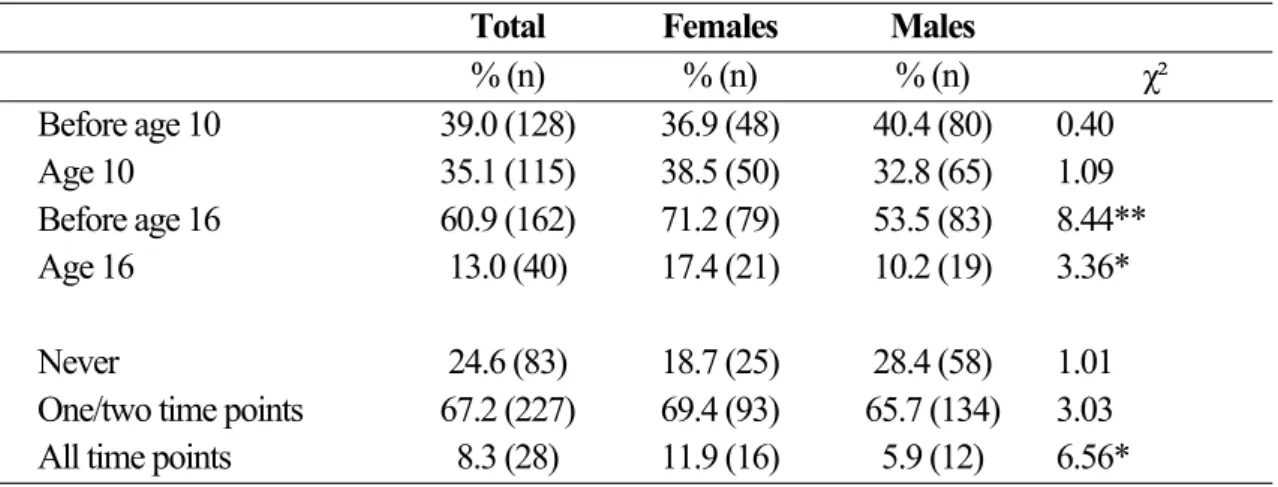
The frequency of reported teasing is presented in Table 1
Approximately 25% of the total sample reported no experiences of teasing at any time
point, with significantly more males than females having never experienced teasing (χ² = 4.17, p < .05). Two thirds of the sample reported teasing at one or two time points (67.2%, n = 227), while 8.3% had experienced ongoing teasing from early childhood, through early
adolescence, and were still experiencing teasing at age 16 (n = 28). As can be seen in Table 1, twice as many females reported teasing through all time points than males (11.9%, n = 16 vs. 5.9%, n = 12; χ² = 6.56, p < .05).
Among the children reporting teasing at age 10, as many as 80.6% (n = 29) had also been teased before the age of 10. as Additionally, 97.5% (n = 39) of those reporting teasing at age 16 had been teased at one or several time points before the age of 16. Approximately
20% of those reporting previous teasing at age 16, irrespective of gender, did not report any
teasing at or before the age of 10, indicating that the teasing happened between the ages of 10
and 16.
There were no statistical differences at any point in time in the frequency of reported
Similarly, there were no statistical differences in the frequency of teasing at any time point
between young people with or without a condition additional to the cleft (χ² = 5.56, p > .05). The exception was that more children with a cleft without an additional condition reported
never having been teased (27.3%, n = 68) compared to 16.9% (n = 15) of the children with a cleft and an additional condition (χ² = 3.87, p < .05).
Longitudinal Changes From Childhood to Adolescence
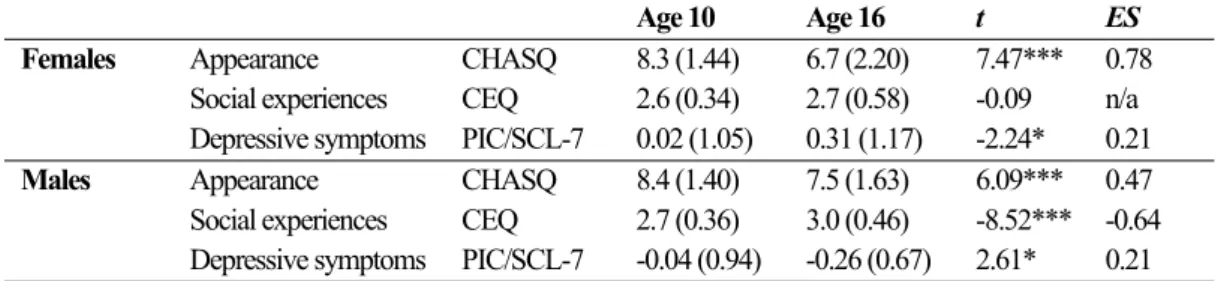
Longitudinal comparisons across the two age groups, using paired sample t-tests are
presented in Table 2. Satisfaction with appearance decreased significantly over time in
females, t(110) = 7.47, p < .001, d = 0.73, and in males, t(161) = 6.09, p < .001, d = 0.47. Interestingly, a longitudinal change in social experiences and depressive symptoms varied
across gender. Females reported the same level of social experiences at both age 10 and age
16, t(94) = -0.09, p > .05, while males reported more positive social experiences at age 16, t(148) = -8.52, p < .001, d = -0.64, than at age 10. Further, depressive symptoms significantly increased from childhood to adolescence in females, t(105) = -2.24, p < .05, while
significantly decreasing over the same time period in males, t(156) = 2.61, p < .05. However, effect sizes for the change in depressive symptoms were small in both genders (Females: d = -0.22; Males: d = 0.21).
The Impact of Teasing on Satisfaction With Appearance
A regression analysis was run to test the potential impact of cleft visibility and the
presence of an additional condition on satisfaction with appearance. The presence of an
additional condition did not impact on satisfaction with appearance at age 10 or 16. There was
no effect of cleft visibility on females at age 10, F(2,121) = 0.94, p > .05, while a non-visible cleft accounted for 4% of the variance in satisfaction with appearance in young males (ß =
satisfaction with appearance females, ß = -.39, F(2, 117) = 10.26, p < .001, and 18% of the variance in males, ß = -.43, F(2, 176) = 19.66, p < .001.
Analyses investigating the impact of teasing on appearance satisfaction were based on
subgroups of participants who did or did not report teasing at different time points.
Satisfaction with appearance was calculated for all subgroups and is presented in Figure 1.
Differences between subgroups were calculated with ANOVA and showed that no significant
differences were found in satisfaction with appearance between females reporting and those
not reporting teasing before the age of 10, F(1, 122) = 0.04, p > .05, or at age 10, F(1, 122) = 0.29, p > .05. Females who reported teasing before the age of 16, however, were significantly less satisfied with appearance than those who did not report any teasing during adolescence,
F(1, 106) = 9.79, p < .01; η² = 0.09. The same applied for females reporting teasing at age 16, F(1, 116) = 5.16, p < .05; η² = 0.04. Males reporting teasing also had lower satisfaction with appearance at most time points than those who reported no teasing, but these differences were
only statistically significant for those reporting teasing before the age of 16, F(1, 145) = 4.25; p < .05; η² = 0.03, while being non-significant at age 10, F(1, 183) = 1.77; p > .05, and age 16, F(1, 176) = 1.16; p > .05. Males reporting teasing before the age of 10 were actually more satisfied with appearance than those who did not report experiences of teasing, F(1, 183) = 5.57; p < .05, η² = 0.03. However, effect sizes were small for differences found in the group of males, compared to medium to large effect sizes in the effect of teasing on appearance for
females.
One-way ANOVAs were conducted to investigate differences in satisfaction with
appearance across time points of teasing, and confirmed that there were no statistically
significant differences in satisfaction with appearance for the children reporting teasing before
appearance was significantly lower in males who reported teasing before the age of 16, F(1, 88) = 11.25, p = .001, η² = 0.11, and at age 16, F(1, 43) = 9.38, p < .01, η² = 0.18, than when teasing had been reported to happen before the age of 10, in both cases with large effect sizes.
Satisfaction with appearance was significantly higher at age 10 in females reporting teasing
before the age of 10 and those reporting teasing before the age of 16, F(1, 67) = 5.79, p < .05, η² = 0.08, or at age 16, F(1, 29) = 14.84, p < .01, η² = 0.34, again with large effect sizes. Similarly, satisfaction with appearance was significantly higher, with large effect sizes, for the
group reporting teasing at age 10 and before the age of 16, F(1, 72) = 8.84, p < .01, η² = 0.11, or at age 16, F(1, 34) = 19.61, p < .001, η² = 0.37. Females reporting ongoing teasing at age 16 were less satisfied with appearance than those reporting teasing before the age of 16.
However, this difference was not statistically significant, F(1, 78) = 3.15, p = .08.
The Impact of Teasing on Depressive Symptoms
The regression analyses showed no impact of cleft visibility on depressive symptoms
at age 10 nor 16, except in the adolescent sample of males, where a visible cleft was
associated with less depressive symptoms (R² = .03, ß = -.17, p < .05; F(2, 192) = 2.72, p > .05). The presence of an additional condition explained 9% of the variance in depression in
young females at age 10, ß = .27, F(2,107) = 5.50, p < .01, and 5% of the variance in young males (ß = .23; F(2,164) = 4.72, p < .01). At age 16, the presence of an additional condition had become non-significant in females, F(2, 126) = 0.16, p > .05, and in males F(2, 192) = 2.72, p > .05.
Analyses investigating the impact of teasing on emotional distress were based on
subgroups of participants who did or did not report teasing at different time points. Levels of
depressive symptoms were calculated through ANOVA for all subgroups who reported
(Age 10: PIC; Age 16: HSCL-7), and are presented in Figure 2. There were no significant
differences in levels of depressive symptoms between females reporting teasing before the
age of 10, F(1, 123) = 2.82, p > .05, or at age 10, F(1, 123) = 2.77, p > .05. Females who reported teasing before the age of 16, F(1, 108) = 10.69, p < .01; η² = 0.09, or still as ongoing at age 16, F(1, 118) = 12.53, p = .001; η² = 0.10, had significantly higher levels of depressive symptoms than those who did not report teasing. Differences between those reporting teasing
and those who did not were also found in the group of males. Males reporting teasing before
the age of 16 had significantly higher levels of depressive symptoms, F(1, 153) = 6.59, p < .05, effect size being small to moderate (η² = 0.04). The difference in levels of depressive symptoms was stronger in males who reported teasing at age 16, F(1, 184) = 8.96, p < .01; η² = 0.05. There were no differences in levels of depressive symptoms between those reporting
teasing before the age of 10, F(1, 187) = 0.11, p > .05, at age 10, F(1, 187) = 0.59, p > .05, and those who did not report teasing.
One-way ANOVAs were calculated in order to investigate the effect of teasing on
levels of depressive symptoms across the different time points of reported teasing.
Calculations revealed no differences in levels of depressive symptoms whether teasing was
reported to happen before the age of 10, or was still ongoing at age 10, in females, F(1, 20) = 3.77, p = .067, as in males, F(1, 43) = 0.33, p > .05. None of the differences in levels of depressive symptoms in males reporting teasing at different time points were statistically
significant (Before 10 vs <16: F(1, 89) = 0.24, p > .05; Before 10 vs Age 16: F(1, 39) = 1.06, p > .05; Age 10 vs <16: F(1, 90) = 3.47, p = .066; Age 10 vs Age 16: F(1, 40) = 0.02, p > .05; Ages <16 vs Age 16: F(1, 86) = 3.52, p = .064). As can be seen from Figure 2, levels of depressive symptoms increased over time in females who reported teasing. Females who
reported teasing before the age of 16 had more depressive symptoms than those reporting
statistically significant. Females reporting ongoing teasing at age 16 had significantly more
depressive symptoms than if teasing had stopped before the age of 10, F(1, 28) = 12.77, p = .001, a finding that was strengthened by a powerful effect size (η² = 0.31). Similarly, females reporting ongoing teasing at age 16 had significantly higher levels of depressive
symptoms than females teased only at age 10, F(1, 32) = 7.52, p = .01, again with a large effect size (η² = 0.19). The difference in levels of depressive symptoms between females reporting teasing before the age of 16, and those still experiencing teasing at age 16 was also
statistically significant, F(1, 79) = 5.64, p < .05, η² = 0.07. There were no statistically significant differences in timing of teasing and depressive symptoms in the group of males.
Characteristics of the High Risk Group
As can be seen from Figure 1 and 2, and supported by statistical analyses, females
who reported ongoing teasing at age 16 were significantly less satisfied with appearance and
had higher levels of depressive symptoms than females who did not report teasing. This
subgroup consisted of 16% (n = 21) of the all females within the sample. Within this group, 24% were “only” teased at age 16, while the remaining 76% (n = 16) reported teasing at all time points.
For clinical purposes, the mean score of the HSCL-7 was calculated for the high risk
group, and revealed that females who reported teasing until before the age of 16 had clinically
significant levels of depressive symptoms within the moderate range (M = 1.79, SD = 0.68), while females reporting ongoing teasing at age 16 had depressive symptoms within the severe
range (M = 2.10, SD = 0.69). All mean scores for males, regardless of whether they reported teasing or not, were within the normal range.
the high risk group had a cleft only (no associated additional condition), compared to 70.4%
(n = 95) in the total sample. Hence, potential contributing factors such as cleft visibility or the presence of an additional condition could not explain psychological risk on any of the
study variables.
Discussion
The current study is, to the authors’ knowledge, the first longitudinal study to examine
the development of (dis)satisfaction with appearance and emotional distress in relation to
positive and negative social experiences reported by young people with a congenital visible
and non-visible facial difference. The results provide evidence that teasing during the
adolescent years can impact on self-perceptions of physical appearance and levels of
depressive symptoms, most notably in females. No residual effects of teasing were found in
those who “only” experienced teasing around the age of 10, while initial emotional
adjustment and appearance evaluations did not explain the development of problems during
adolescence. Gender differences were found to appear during adolescence. However, despite
both genders reporting an increased frequency of teasing from childhood to adolescence,
males also reported more positive social experiences over time.
Frequency of Self-reported Teasing
Within the current sample, approximately 80% of females and 70% of males had
experienced teasing at least once by the age of 16. Previous studies investigating the
prevalence of teasing among young people with CL/P have reported frequencies between 50%
and 75% (Feragen & Borge, 2010; Hunt et al., 2006; Lorot-Marchand et al., 2015; Noor &
Musa, 2007; Shaw et al., 2005; Turner et al., 1997). The frequency of teasing and bullying
among the general population seem to report significantly lower figures, with frequencies
et al., 2004), with prevalence numbers for Scandinavian samples being significantly lower
than for most other European countries (Craig et al., 2009; Undheim & Sund, 2010). Within
research on visible differences, a methodological problem is that samples often include a wide
age range and hence do not investigate frequencies of teasing in accordance with specific
developmental time points. Semb et al. (2005), on the other hand, did discuss teasing in
young people with CL/P according to age, with the highest frequencies of teasing reported
between the ages of 8-11 (59%) and 12-15 years (37%), and with slightly raised frequencies
among females. While these frequencies are higher than the current study up to the age of 10
(Present study: 39%), the opposite is the case for those reporting teasing up to the age of 16
(Present study: 60.9%). In Lorot-Marchand et al. (2015), teasing was reported to start in early
primary school, with a peak frequency in middle school, as in the present study. Discrepancies
between studies are probably related to the methodology used, such as the choice of measures
and the definition of teasing utilised, and thus it is difficult to conclude whether or not young
people with CL/P experience comparable, higher or lower levels of appearance-related teasing
than same-aged samples from the general population. The current study registered
subjectively perceived teasing irrespective of frequency, hence including occasional teasing as
well as more severe bullying in the same variable. This inclusive and subjective
patient-centred approach will likely lead to higher figures of teasing than studies based on a more
restrictive definition. Irrespective of the frequency of reported teasing in this specific sample,
and as described in more detail below, an important specification was that factors other than
cleft visibility explained the occurrence of teasing.
The Longitudinal Impact of Teasing
In previous research, both within the general population and among young people with
a visible difference, the directionality of the relationship between teasing, satisfaction with
nature of the data. The longitudinal approach utilised by the present study found that
appearance dissatisfaction and emotional distress were similar and within the normal range
for all subgroups at age 10 (also see Feragen & Stock, 2015), and were not indicative of
appearance evaluations and emotional distress six years later. These findings suggest that
emotional difficulties do not precede the starting point for teasing in most young people with
a cleft; rather that it is the subjective experience of teasing which can prompt an increase in
emotional symptoms and appearance dissatisfaction. The results of the present study
therefore strongly indicate the need to identify those at risk due to self-perceived incidences
of peer harassment.
The results of the present study also lend support to the suggestion that the timing of
negative experiences is an important factor in adjustment (Rueger et al., 2011). Among the
young people included in this sample, the most significant effect of teasing was found in those
reporting teasing until and at the age of 16. Adolescence is considered a key time for
appearance-related teasing to occur, and is an age at which subjective evaluations of
appearance contribute significantly to overall self-perceptions and emotional wellbeing
(Frisen & Anneheden, 2014; Lovegrove & Rumsey, 2005). Thus, the findings are in
accordance with what is known from studies conducted within the general population, and
point to clear associations between social experiences, appearance evaluations and emotional
adjustment in adolescents (Feragen et al., 2015). In contrast, the present study did not
replicate previous findings that emotional distress from teasing does not dissipate over time
with the cessation of victimisation (Kochenderfer & Ladd, 1996). Rather than indicate
residual effects, the results of the current study demonstrated that those who were not teased
after the age of 10 reported few or no negative effects of teasing when measured six years
later. This could indicate that repeated experiences of teasing are most harmful, particularly
between the timing of teasing and its duration. Nevertheless, the present findings highlight the
need to intervene during the adolescent years, when peer relationships and appearance
evaluations are taking on increasing importance.
Contributing Factors: Gender, Additional Conditions, and Cleft Visibility
Within the general population, the frequency of experienced teasing, satisfaction with
appearance and emotional symptoms are known to vary according to gender (Brunstein
Klomek et al., 2007; Craig et al., 2009; Eisenberg et al., 2006; Frisen & Anneheden, 2014;
Smolak, 2004; Twenge & Nolen-Hoeksema, 2002). This was confirmed by the findings of
the present study, where satisfaction with appearance and emotional distress was significantly
affected by teasing in females, while the impact of teasing on males was characterised by few
significant findings and low effect sizes. Furthermore, mean scores for all measures werel
within the normal range for males. These results seem to be in line with a large American
study (Brunstein Klomek et al., 2007) which found that only frequent victimisation increased
the risk for depressive reactions in males, while teasing was associated with emotional
symptoms in females irrespective of frequency. Unfortunately, the present study was not able
to differentiate between those reporting frequent teasing and those reporting single and less
severe episodes of teasing. Findings may therefore have demonstrated a more significant
impact of teasing within subgroups of males had the frequency of teasing been examined in
quantity and frequency of experienced teasing, and their influence on psychological
well-being in young people with and without a visible difference.
Additional conditions, such as a genetic syndrome, developmental delay, or learning
difficulties are prevalent in children with CL/P and may affect psychological adjustment
(Feragen et al., 2014). However, the presence of an additional condition was not significantly
associated with levels of teasing, satisfaction with appearance or with depressive symptoms in
the present study. These findings are in line with a recent CL/P study, where the effect of an
additional condition was less prevailing on self-perceptions of appearance and emotional
distress in an adolescent sample (Feragen et al., 2015), compared to younger children
(Feragen & Stock, 2015). This difference could be explained by developmental changes,
suggesting that the adolescents learn to cope with other diagnosed conditions over time, and
hence adjust to challenges that otherwise may have affected psychological functioning.
Although young peoples’ subjective evaluations of cleft visibility have been shown to
strongly surpass the impact of more objective evaluations of visibility (Feragen et al., 2010;
Moss, 2005; Ong et al., 2007), a measure of objective visibility, such as the type of cleft, is
often included in studies examining the psychological impact of CL/P. Among cleft samples,
a visible cleft is approximately twice as prevalent in males than in females, while a
non-visible cleft is more equally distributed among females and males (Sivertsen et al., 2008). In
the present study, males’ reports of appearance dissatisfaction and emotional distress were
lower than females’ reports and were within, or better than, the normal range, in spite of the
fact that 66% of the males had a visible cleft, thus suggesting no overall effect of cleft
visibility. Additionally, regression analyses revealed that cleft visibility explained 15-18% of
the variance in satisfaction with appearance at age 16, while reducing depressive symptoms in
group for both appearance dissatisfaction and depressive symptoms were investigated. Again,
no effects of visibility were found, strengthening the conclusion that the present study does
not support cleft visibility as a major risk factor. Instead, the findings of the current study
point to teasing as a key risk factor, regardless of the presence of a visible difference, as
suggested by previous studies in the field of CL/P (Feragen & Borge, 2010; Hunt et al., 2006).
Protective Factors
Recent studies in CL/P have begun to investigate factors which may protect young
people from the potential psychological impact of their condition. In the present study, both
genders reported an increased frequency of teasing over time. However, males also reported
more positive social experiences over time. Relationships with peers and perceptions of
positive social experiences play an important role in the development of self-concepts and
appearance satisfaction in the general population (Bellmore & Cillessen, 2006; Holsen et al.,
2001; Keefe & Berndt, 1996), a relationship which has also been demonstrated in young
people with a congenital visible difference (Feragen et al., 2010; Kapp-Simon et al., 2005;
Slifer et al., 2006). Thus, positive social experiences may counteract the negative impact of
teasing and act as a buffer against emotional distress. This could explain the reduced impact
of teasing in young males on satisfaction with appearance and emotional distress of the
present study, and should be investigated further.
Clinical Implications
The present study supports a developmental model whereby teasing and other negative
social experiences in young people with a visible difference precede the development of
negative self-perceptions, as has been demonstrated in the general literature (Bellmore &
Cillessen, 2006). The results therefore suggest that in order to prevent appearance concerns
School-based prevention and intervention efforts should aim to reduce the incidence and impact of
peer harassment and bullying in order to protect young people from the negative
consequences of victimisation (Frances, 2003; Olweus, 1993, 2001). In parallel, school-based
prevention and clinical interventions should be directed towards strengthening social skills
and resilience in vulnerable children (Kapp-Simon et al., 2005). Studies have already
demonstrated the potential of such interventions in young people within the general
population (Lovegrove & Rumsey, 2005), as well as for young people with a visible
difference (Maddern, Cadogan, & Emerson, 2006). Additional interventions, such as those
aimed at promoting appearance diversity more generally (Halliwell & Diedrichs, 2014), as
well as campaigns designed to raise awareness of conditions affecting appearance
(https://www.changingfaces.org.uk) may also contribute to these aims.
Nevertheless, a meta-analysis of longitudinal studies on the relationship between
teasing and emotional adjustment (Reijntjes et al., 2010), suggests a reciprocal and
bidirectional relation between these variables. Therefore, clinicians should be aware that
young people presenting with initial psychological problems, such as dissatisfaction with
appearance or emotional difficulties, could possibly become the targets of teasing and
bullying.
Strengths and Limitations
The majority of longitudinal studies within the general population to date have used
time frames of 12 months or less. The recommendations of these studies have included the
need to employ more extended age ranges and to explore changes appearing in both childhood
and adolescence (Reijntjes et al., 2010). Reviews of the literature (Hunt et al., 2005; Rumsey
& Stock, 2013) also confirm the need for more longitudinal studies within the research field
a sample of 340 young people with a cleft who had attended two routine psychological
assessments over a period of six years. The longitudinal approach used in this study has
added valuable insight into the directionality and nature of associations between important
factors in this field of work. Further, the sample was based on seven consecutive birth
cohorts, with a participation rate of 88.8% and low rates of attrition. Participants were drawn
from a centralised treatment setting, suggesting the sample was highly representative of the
population under study. This study has demonstrated that although large longitudinal samples
are challenging and time-consuming to collate, they are necessary if we are to address some
of the central unanswered research questions in the field of appearance and in the field of
psychological adjustment to a visible difference.
Despite the importance of the present findings, results must also be considered in light
of the study limitations. First, psychological assessments were only carried out at two time
points, and the inclusion of one or more additional points of assessment would have provided
more detailed information on the pattern of change over time. Second, reports of teasing
‘before the age of 10’ and ‘before the age of 16’ were collected retrospectively, potentially
affecting reliability. The weakest “time point” was the variable related to teasing that was
retrospectively reported to have happened before the age of 16. Most participants had not
specified the timing of this teasing, and it was therefore difficult in most cases to confirm
whether teasing reported ‘before the age of 16’ possibly overlapped with the reports collected
at age 10. However, explorative analyses suggested that overlapping subgroups probably
were small and hence are not expected to have impacted on the results. In addition, the
strongest effect sizes were found for results based on teasing reported at age 16.
Another limitation was that a measurement of the level, intensity, or frequency? or
also a need for more clarity and consensus on the conceptualisation of teasing and bullying,
and in the choice of measurements of these constructs (Reijntjes et al., 2010; Rueger et al.,
2011), to allow for better comparisons between studies. Third, despite the relative importance
of subjective experiences in comparison to more objective or third party reports of adjustment
(Moss, 2005; Moss, Lawson, & White, 2014; Ong et al., 2007; Rosser et al., 2010), previous
studies have suggested that multiple informants are advised in order to capture a more
comprehensive understanding (De Los Reyes & Kazdin, 2005). Differences between self-
and parent reports have been found in cross-sectional studies (Berger & Dalton, 2009), while
little is known about the possible discrepancies in relation to teasing. The inclusion of parent
reports was beyond the scope of the current study, but could have added insight into the
impact of teasing on appearance satisfaction and emotional distress. Finally, although the
present study confirmed that teasing was likely to precede dissatisfaction with appearance and
emotional distress, the possibility of other factors being associated with the variables over
time and influencing the outcome variables cannot be ruled out. Previous research has
pointed to attributions, personality characteristics and dispositional style, social competence,
and objective and subjective evaluations of speech as important factors for the development of
satisfaction with appearance and emotional distress (Frederickson, Chapman, & Hardin-Jones,
2006; Kvalem et al., 2006; Slifer et al., 2006; Stock, Feragen, & Rumsey, 2015), which were
not measured in the present study. The interpretation of the present study also needs to take
into account that measures of social anxiety and fear of negative evaluations were not
included, factors that may contribute in explaining the relationship between negative social
experiences and psychological adjustment (Berger & Dalton, 2009; Frisén et al., 2009). Other
adverse life events, such as parental divorce or illness, were not registered in the present
study. These events could have occurred between the two time points of measurement and/or
socio-economic status is also a limitation. However, the potential impact of such
demographic information on the results was considered to be low, given that SES and
educational level are expected to have a reduced impact in Scandinavian samples than in
many other Western societies (Heiervang, Goodman, & Goodman, 2008). Nevertheless,
future research should aim to include more detailed and comprehensive demographic
information.
Conclusions
The results of this study provide compelling evidence that experiences of teasing are
salient to the development of young people’s self-perceptions of satisfaction with appearance
and emotional distress, whether a visible difference is present or not. The present study calls
for clinicians and researchers within the field of congenital conditions to move from the
paradigm of a visible difference as predicting social difficulties and emotional distress per se,
and toward an understanding of the central factors impacting on the individual’s
self-perceptions, such as positive and negative social experiences and subjective appearance
evaluations. An early identification of those at risk for distress because of experiences of
teasing is therefore crucial for positive psychosocial adjustment. Clinicians and researchers
need to identify those who feel that their congenital visible difference contributes to negative
social interactions and offer appropriate support. Given the known impact of social
experiences on psychological well-being, identifying positive as well as negative social
experiences and understanding how they may strengthen subjective appearance evaluations
and emotional adjustment should be a primary goal of future clinical interventions and
Acknowledgements: This project was partly financed by funds from the Norwegian
Foundation for Health and Rehabilitation, project number 2011/0198.
References
Appearance Research Collaboration (2009). Identifying factors and processes contributing to successful adjustment to disfiguring conditions. Final report, Centre for Appearance Research, University of the West of England, Bristol, UK.
Bellmore, A. D., & Cillessen, A. H. N. (2006). Reciprocal influences of victimization, perceived social preference, and self-concept in adolescence. Self and Identity, 5(3), 209-229. doi:
10.1080/15298860600636647
Berger, Z. E., & Dalton, L. J. (2009). Coping with a cleft: psychosocial adjustment of adolescents with a cleft lip and palate and their parents. Cleft Palate Craniofac J, 46(4), 435-443. doi:
10.1597/08-093.1
Brunstein Klomek, A., Marrocco, F., Kleinman, M., Schonfeld, I. S., & Gould, M. S. (2007). Bullying, depression, and suicidality in adolescents. J Am Acad Child Adolesc Psychiatry, 46(1), 40-49. doi: 10.1097/01.chi.0000242237.84925.18
Bucchianeri, M. M., Arikian, A. J., Hannan, P. J., Eisenberg, M. E., & Neumark-Sztainer, D. (2013). Body dissatisfaction from adolescence to young adulthood: findings from a 10-year longitudinal study. Body Image, 10(1), 1-7. doi: 10.1016/j.bodyim.2012.09.001
Cash, T. F., & Pruzinsky, T. (2004). Body Image: A Handbook of Theory, Research, and Clinical Practice: Guilford Press.
Changing Faces (2010). Prevalence of disfigurement. Retrived from:
http://admin.changingsfaces.org.uk/downloads/FE%20Campaign,%20Epidemiology%202%20 pages.pdf .
Cohen, J. (1988). Statistical power analysis for the behavioral sciences. Hillsdale, N.J.: L. Erlbaum Associates.
Cox, T. C. (2004). Taking it to the max: the genetic and developmental mechanisms coordinating midfacial morphogenesis and dysmorphology. Clin Genet, 65(3), 163-176.
Craig, W., Harel-Fisch, Y., Fogel-Grinvald, H., Dostaler, S., Hetland, J., Simons-Morton, B., . . . Pickett, W. (2009). A cross-national profile of bullying and victimization among adolescents in 40 countries. Int J Public Health, 54 Suppl 2, 216-224. doi: 10.1007/s00038-009-5413-9 De Los Reyes, A., & Kazdin, A. E. (2005). Informant discrepancies in the assessment of childhood
psychopathology: a critical review, theoretical framework, and recommendations for further study. Psychol Bull, 131(4), 483-509. doi: 10.1037/0033-2909.131.4.483
Eisenberg, M. E., Neumark-Sztainer, D., & Paxton, S. J. (2006). Five-year change in body satisfaction among adolescents. J Psychosom Res, 61(4), 521-527. doi: 10.1016/j.jpsychores.2006.05.007 Eslea, M., Menesini, E., Morita, Y., O'Moore, M., Mora-Merchán, J. A., Pereira, B., & Smith, P. K.
(2004). Friendship and loneliness among bullies and victims: Data from seven countries.
Aggress Behav, 30(1), 71-83. doi: 10.1002/ab.20006
Feragen, K. B., & Borge, A. I. (2010). Peer harassment and satisfaction with appearance in children with and without a facial difference. Body Image, 7(2), 97-105. doi:
10.1016/j.bodyim.2009.12.001
Feragen, K. B., & Stock, N. M. (2015). Risk and Protective Factors at Age 10: Psychological Adjustment in Children With a Cleft Lip and/or Palate. Cleft Palate Craniofac J. doi: 10.1597/14-062 Feragen, K. B., Stock, N. M., & Kvalem, I. L. (2015). Risk and Protective Factors at Age 16:
Psychological Adjustment in Children With a Cleft Lip and/or Palate. Cleft Palate Craniofac J, 52(5), 555-573. doi: 10.1597/14-063
Feragen, K. B., Stock, N. M., & Rumsey, N. (2014). Toward a reconsideration of inclusion and exclusion criteria in cleft lip and palate: implications for psychological research. Cleft Palate Craniofac J, 51(5), 569-578. doi: 10.1597/12-326
Frederickson, M. S., Chapman, K. L., & Hardin-Jones, M. (2006). Conversational skills of children with cleft lip and palate: a replication and extension. Cleft Palate Craniofac J, 43(2), 179-188. doi: 10.1597/04-086.1
Frisen, A., & Anneheden, L. (2014). Changes in 10-year-old children's body esteem: a time-lag study between 2000 and 2010. Scand J Psychol, 55(2), 123-129. doi: 10.1111/sjop.12110
Frisén, A., Lunde, C., & Berg, A. I. (2015). Developmental patterns in body esteem from late childhood to young adulthood: A growth curve analysis. European Journal of Developmental
Psychology, 12(1), 99-115. doi: 10.1080/17405629.2014.951033
Frisén, A., Lunde, C., & Hwang, P. (2009). Peer victimisation and its relationships with perceptions of body composition. Educational Studies, 35(3), 337-348. doi: 10.1080/03055690802648200 Gerner, B., & Wilson, P. H. (2005). The relationship between friendship factors and adolescent girls'
body image concern, body dissatisfaction, and restrained eating. Int J Eat Disord, 37(4), 313-320. doi: 10.1002/eat.20094
Grogan, S. (2007). Body Image: Understanding Body Dissatisfaction in Men, Women and Children: Taylor & Francis.
Halliwell, E., & Diedrichs, P. C. (2014). Testing a dissonance body image intervention among young girls. Health Psychol, 33(2), 201-204. doi: 10.1037/a0032585
Harter, S., Stocker, C., & Robinson, N. S. (1996). The perceived directionality of the link between approval and self-worth: The liabilities of a looking gladd self-orientation among young adolescents. Journal of Research on Adolescence, 6(3), 285-308.
Heiervang, E., Goodman, A., & Goodman, R. (2008). The Nordic advantage in child mental health: separating health differences from reporting style in a cross-cultural comparison of psychopathology. J Child Psychol Psychiatry, 49(6), 678-685. doi: 10.1111/j.1469-7610.2008.01882.x
Holsen, I., Kraft, P., & Roysamb, E. (2001). The Relationship between Body Image and Depressed Mood in Adolescence: A 5-year Longitudinal Panel Study. J Health Psychol, 6(6), 613-627. doi: 10.1177/135910530100600601
Hunt, O., Burden, D., Hepper, P., & Johnston, C. (2005). The psychosocial effects of cleft lip and palate: a systematic review. Eur J Orthod, 27(3), 274-285. doi: 10.1093/ejo/cji004
Hunt, O., Burden, D., Hepper, P., Stevenson, M., & Johnston, C. (2006). Self-reports of psychosocial functioning among children and young adults with cleft lip and palate. Cleft Palate Craniofac J, 43(5), 598-605. doi: 10.1597/05-080
Hunt, O., Burden, D., Hepper, P., Stevenson, M., & Johnston, C. (2007). Parent reports of the psychosocial functioning of children with cleft lip and/or palate. Cleft Palate Craniofac J, 44(3), 304-311. doi: 10.1597/05-205
Julian D, and Partridge J (2008). The Incidence and Prevalence of Disfigurement. Changing Faces. London
Juvonen, J., Nishina, A., & Graham, S. (2000). Peer harassment, psychological adjustment, and school functioning in early adolescence. Journal of Educational Psychology, 92(2), 349-359. doi: 10.1037/0022-0663.92.2.349
Kapp-Simon, K. A., McGuire, D. E., Long, B. C., & Simon, D. J. (2005). Addressing quality of life issues in adolescents: social skills interventions. Cleft Palate Craniofac J, 42(1), 45-50. doi:
10.1597/03-0976.1
Keefe, K., & Berndt, T. J. (1996). Relations of Friendship Quality to Self-Esteem in Early Adolescence.
The Journal of Early Adolescence, 16(1), 110-129. doi: 10.1177/0272431696016001007 Kochenderfer, B. J., & Ladd, G. W. (1996). Peer victimization: cause or consequence of school
maladjustment? Child Dev, 67(4), 1305-1317.
Kvalem, I. L., von Soest, T., Roald, H. E., & Skolleborg, K. C. (2006). The interplay of personality and negative comments about appearance in predicting body image. Body Image, 3(3), 263-273. doi: 10.1016/j.bodyim.2006.04.002
La Greca, A. M., & Bearman, K. J. (2000). Children with pediatric conditions: can peers' impressions be managed? And what about their friends? J Pediatr Psychol, 25(3), 147-149.
La Greca, A. M., Bearman, K. J., & Moore, H. (2002). Peer relations of youth with pediatric conditions and health risks: promoting social support and healthy lifestyles. J Dev Behav Pediatr, 23(4), 271-280.
Lavell, C. H., Zimmer-Gembeck, M. J., Farrell, L. J., & Webb, H. (2014). Victimization, social anxiety, and body dysmorphic concerns: appearance-based rejection sensitivity as a mediator. Body Image, 11(4), 391-395. doi: 10.1016/j.bodyim.2014.06.008
Lorot-Marchand, A., Guerreschi, P., Pellerin, P., Martinot, V., Gbaguidi, C. C., Neiva, C., . . . Francois-Fiquet, C. (2015). Frequency and socio-psychological impact of taunting in school-age patients with cleft lip-palate surgical repair. Int J Pediatr Otorhinolaryngol, 79(7), 1041-1048. doi: 10.1016/j.ijporl.2015.04.024
Lovegrove, E., & Rumsey, N. (2005). Ignoring it doesn't make it stop: adolescents, appearance, and bullying. Cleft Palate Craniofac J, 42(1), 33-44. doi: 10.1597/03-097.5.1
Lunde, C., & Frisen, A. (2011). On being victimized by peers in the advent of adolescence: prospective relationships to objectified body consciousness. Body Image, 8(4), 309-314. doi:
10.1016/j.bodyim.2011.04.010
Maddern, L. H., Cadogan, J. C., & Emerson, M. P. (2006). 'Outlook': A psychological service for children with a different appearance. Clin Child Psychol Psychiatry, 11(3), 431-443.
McDougall, P., & Vaillancourt, T. (2015). Long-term adult outcomes of peer victimization in childhood and adolescence: Pathways to adjustment and maladjustment. Am Psychol, 70(4), 300-310. doi: 10.1037/a0039174
Menzel, J. E., Schaefer, L. M., Burke, N. L., Mayhew, L. L., Brannick, M. T., & Thompson, J. K. (2010). Appearance-related teasing, body dissatisfaction, and disordered eating: A meta-analysis.
Body Image, 7(4), 261-270. doi: 10.1016/j.bodyim.2010.05.004
Morris, S. B., & DeShon, R. P. (2002). Combining effect size estimates in meta-analysis with repeated measures and independent-groups designs. Psychol Methods, 7(1), 105-125.
Moss, T. P. (2005). The relationships between objective and subjective ratings of disfigurement severity, and psychological adjustment. Body Image, 2(2), 151-159. doi:
10.1016/j.bodyim.2005.03.004
Moss, T. P., Lawson, V., & White, P. (2014). Salience and valence of appearance in a population with a visible difference of appearance: direct and moderated relationships with self-consciousness, anxiety and depression. PLoS One, 9(2), e88435. doi: 10.1371/journal.pone.0088435
Noor, S. N., & Musa, S. (2007). Assessment of patients' level of satisfaction with cleft treatment using the Cleft Evaluation Profile. Cleft Palate Craniofac J, 44(3), 292-303. doi: 10.1597/05-151 Olweus, D. (1993). Victimization by peers: Antecedents and long-term outcomes. In K. H. Rubin & J. B.
Asendorpf (Eds.), Social withdrawal, inhibition, and shyness in childhood (pp. 315-341). Hillsdale, NJ: Erlbaum: Psychology Press.
Ong, J., Clarke, A., White, P., Johnson, M., Withey, S., & Butler, P. E. (2007). Does severity predict distress? The relationship between subjective and objective measures of appearance and psychological adjustment, during treatment for facial lipoatrophy. Body Image, 4(3), 239-248. doi: 10.1016/j.bodyim.2007.05.003
Pertschuk, M. J., & Whitaker, L. A. (1982). Social and psychological effects of craniofacial deformity and surgical reconstruction. Clin Plast Surg, 9(3), 297-306.
Reijntjes, A., Kamphuis, J. H., Prinzie, P., & Telch, M. J. (2010). Peer victimization and internalizing problems in children: a meta-analysis of longitudinal studies. Child Abuse Negl, 34(4), 244-252. doi: 10.1016/j.chiabu.2009.07.009
Rognerud, M., Strand, B. H., & Dalgard, O. S. (2002). Psykisk helse i Helse- og levekårsundersøkelsen i 1998. 1. Sosioøkonomiske forskjeller i psykisk helse og livsstil (Mental health in Norway 1998. Socioeconomic differences in mental health and lifestyle). Norsk Epidemiologi, 12, 239-248. Rosser, B. A., Moss, T., & Rumsey, N. (2010). Attentional and interpretative biases in appearance
concern: An investigation of biases in appearance-related information processing. Body Image, 7(3), 251-254. doi: 10.1016/j.bodyim.2010.02.007
Rueger, S. Y., Malecki, C. K., & Demaray, M. K. (2011). Stability of peer victimization in early adolescence: effects of timing and duration. J Sch Psychol, 49(4), 443-464. doi: 10.1016/j.jsp.2011.04.005
Rumsey, N. (2002). Body image and congenital conditions with visible differences. In T. F. Cash & T. Pruzinsky (Eds.), Body image. A handbook of theory, research, and clinical practice (pp. 226-233). New York, USA: The Guilford Press.
Rumsey, N., & Harcourt, D. (2004). Body image and disfigurement: issues and interventions. Body Image, 1(1), 83-97. doi: 10.1016/s1740-1445(03)00005-6
Rumsey, N., & Stock, N. M. (2013). Living with a cleft: Psychological challenges, support and
intervention. In S. Berkowitz (Ed.), Cleft lip and palate. Diagnosis and management (pp. 907-915). Chicago, IL, USA: Springer Berlin Heidelberg.
Semb, G., Brattstrom, V., Molsted, K., Prahl-Andersen, B., Zuurbier, P., Rumsey, N., & Shaw, W. C. (2005). The Eurocleft study: intercenter study of treatment outcome in patients with
complete cleft lip and palate. Part 4: relationship among treatment outcome, patient/parent satisfaction, and the burden of care. Cleft Palate Craniofac J, 42(1), 83-92. doi: 10.1597/02-119.4.1
Shavel-Jessop, S., & Shearer, J. (2013). Managing teasing and bullying In S. Berkowitz (Ed.), Cleft lip and palate. Diagnosis and management (pp. 917-926). Chicago, IL, USA: Springer Berlin Heidelberg.
Shaw, W. C., Brattstrom, V., Molsted, K., Prahl-Andersen, B., Roberts, C. T., & Semb, G. (2005). The Eurocleft study: intercenter study of treatment outcome in patients with complete cleft lip and palate. Part 5: discussion and conclusions. Cleft Palate Craniofac J, 42(1), 93-98. doi: 10.1597/02-119.5.1
Sivertsen, A., Wilcox, A., Johnson, G. E., Abyholm, F., Vindenes, H. A., & Lie, R. T. (2008). Prevalence of major anatomic variations in oral clefts. Plast Reconstr Surg, 121(2), 587-595. doi: 10.1097/01.prs.0000297839.78179.f5
Slifer, K. J., Pulbrook, V., Amari, A., Vona-Messersmith, N., Cohn, J. F., Ambadar, Z., . . . Piszczor, R. (2006). Social acceptance and facial behavior in children with oral clefts. Cleft Palate Craniofac J, 43(2), 226-236. doi: 10.1597/05-018.1
Smolak, L. (2004). Body image in children and adolescents: where do we go from here? Body Image, 1(1), 15-28. doi: 10.1016/s1740-1445(03)00008-1