Supporting Information
S1. Search Strategy
Indicative search strategy as used for Medline via OVID
Search set
number Search terms Search hits (citationsreturned by search
database)
1 Mortality/ 38996
2 Death/ 16195
3 death*.mp. 707909
4 mortalit*.mp. 590939
5 dead*.mp. 55927
6 1 or 2 or 3 or 4 or 5 1188133
7 drunk*.mp. 3737
8 alcoholi*.mp. 131625
9 7 or 8 133558
10 alcohol.mp. 335685
11 9 and 10 61889
12 6 and 11 4676
13 dependen*.mp. 1383596
14 abus*.mp. 150878
15 misus*.mp. 18529
16 heavy.mp. 135203
17 harmful.mp. 39770
18 hazardous.mp. 27659
19 excessiv*.mp. 100509
20 exceed*.mp. 124068
21 risky or riski* or "high-risk").mp. 217299
22 problem*.mp. 825089
23 intoxica*.mp. 51172
24 (binge* or binging).mp. 10416
25 addict*.mp. 50850
26 13 or 14 or 15 or 16 or 17 or 18 or 19 or 20 or 21 or 22 or 23 or 24 or 25 2878721
27 exp Alcohol Drinking/mo 827
28 26 and 27 359
29 alcohol*.mp. 335685
30 drink*.mp. 155715
31 (26 adj3 (29 or 30)).mp. 66852
32 6 and 31 5901
33 exp Binge Drinking/mo 11
34 exp Alcoholism/mo 1039
35 exp Alcoholic Intoxication/mo 380
36 exp Alcohol-Related Disorders/mo 2446
37 33 or 34 or 35 or 36 2446
Applied Field limits:
Limited to or included only Does not include
Humans, and (case reports, or classical article, or clinical conference, or clinical trial, all, or clinical trial, phase I, or clinical trial, phase ii, or clinical trial, phase iii, or clinical trial, phase iv, or clinical trial, or
congresses, or
consensus development conference, or consensus development conference, nih, or comparative study, or
controlled clinical trial, or
"corrected and republished article", or Dataset, or
duplicate publication, or English abstract, or evaluation studies, or festschrift, or
government publications, or guideline, or
introductory journal article, or journal article, or
meta analysis, or multicenter study, or observational study, or pragmatic clinical trial, or published erratum, or
randomized controlled trial, or
"research support, american recovery and reinvestment act", or
research support, nih, extramural, or research support, nih, intramural, or research support, non us gov't, or research support, us gov't, non phs, or research support, us gov't, phs, or "review", or
"scientific integrity review", or systematic reviews, or technical report, or twin study, or validation studies)
Addresses, or Autobiography, or Bibliography, or Biography, or Comment, or Dictionary, or Directory, or Editorial, or historical article, or in vitro, or
interactive tutorial, or interview, or
lectures, or legal cases, or legislation, or letter, or news, or
newspaper article, or overall, or
patient education handout, or periodical index, or
portraits, or
S2. Table: Quality appraisal framework
Question item Corresponding response options Points to be
allocated
Maximum points allowed
representativeness of the exposed (patients with Alcohol Use Disroder) cohort in this study
truly representative of the alcohol misuse patients receiving treatment at the facility somewhat representative
not representative
the representativeness of the cohort is not described/reported
1 or 1
1
ascertainment of alcohol misuse status secure or clinical records (e.g. patient's records) structured interview of cohort member
written self-report
not described or can't make out
1 1
demonstration that outcome of interest not present at start of study
yes no
1 1
ascertainment of death independent blind assessment record linkage
mortality status ascertainment not described
1 or 1
1
Was follow up long enough for outcomes to occur?
yes no
1 1
percent of cohort members analysed Complete follow up
Incomplete follow up, but loss to follow up less than 20% Incomplete follow up, and loss to follow up is 20% or more Loss to follow up not reported
1 or 1
S3. Transformation formulae used to generate person-year data
Scenarios
Equations
1. When mean person years are provided
PY = N * PY
mean(1)
2. When all study subjects are accounted for and the total
study follow-up period (i.e. the start and end of the whole
study) is the same for all survivors
PY = T*((0.5*( d
obs+ n
ltfu)) + n
s)
(2)
3. When the excess death rate and observed/expected death
ratio is provided
PY = (O/E * Ex)*1000
(3)
4. When the data is given as a life table and the numbers of
subjects at risk at a certain time period, and the numbers
who die or are lost to follow up, are provided.
PY =
∑
i=1 l
❑
(N
i-(0.5*( d
obsi+n
ltfui))
(4)
where,
N
= number of subjects at risk
PY
mean= mean person-years
T
= total study follow-up period
d
obs= number of subjects who die
n
ltfu= number of subjects lost to follow up
n
s= number of subjects who survive
O/E = observed deaths/expected deaths
Ex
= excess death rate/1000
i
= subscript refers to a particular time period
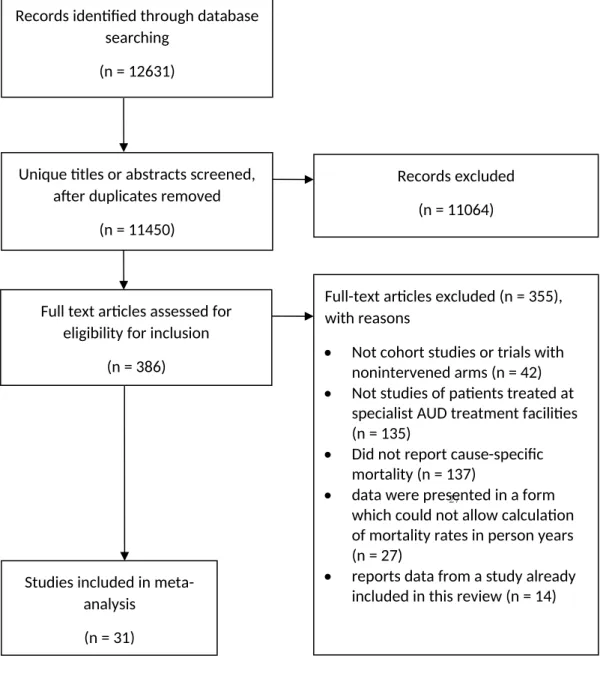
S4. Figure: Flow Chart of Included Studies
Figure 1 Flowchart of studies as they progressed through the stages of the review
11 Adapted from Moher D, Liberati A, Tetzlaff J, Altman DG, The PRISMA Group: Preferred reporting items for systematic reviews and meta-analyses: the PRISMA statement. PLoS Med. 2009, 6
Records identified through database searching
(n = 12631)
23
23
27
Records excluded
(n = 11064) Unique titles or abstracts screened,
after duplicates removed
(n = 11450)
Full-text articles excluded (n = 355), with reasons
Not cohort studies or trials with nonintervened arms (n = 42) Not studies of patients treated at
specialist AUD treatment facilities (n = 135)
Did not report cause-specific mortality (n = 137)
data were presented in a form which could not allow calculation of mortality rates in person years (n = 27)
reports data from a study already included in this review (n = 14) Full text articles assessed for
eligibility for inclusion
(n = 386)
Studies included in meta-analysis
S5. Bibliography of papers excluded after full text evaluation
1) Not a right study (n= 42) (1-42)
2) Not the right population (n= 135) (43-177)
3) No cause-specific mortality data of AUD patients (n= 137) (178-314)
4) No usable person-time rate data (n= 27) (315-341)
5) Duplicated data (n= 14) (342-355)
Bibliography
1) Anderson, P. (1998) ‘Early death and alcohol’, World Health, (5), pp. 24–25.
2) Anonymous (1977a) ‘Higher mortality rates for alcoholics, drug addicts.’, Employee benefit plan review, 31(11), p. 34.
3) Anonymous (1977b) ‘Mortality from alcoholism.’, Statistical bulletin (Metropolitan Life Insurance Company), 58, pp. 2–5.
4) Anonymous (1984) ‘Sudden death mechanisms in the alcoholic’, Medico-legal bulletin, 33(5), pp. 1–7. 5) Bakim, B., Karamustafalioglu, K. O. and Akpinar, A. (2007) ‘Suicides and attempted suicides in alcohol and
other substance use disorders’, Bagimlik Dergisi, 8(2), pp. 91–96.
6) Bauer, U. and Hasenohrl, A. (2000) ‘A comparison of an alcohol withdrawal treatment program with short medical detoxification (follow-up results from 28 months)’, Sucht: Zeitschrift fur Wissenschaft und Praxis, 46(4), pp. 250–259.
7) Bradley, K. A. et al. (1998) ‘Medical risks for women who drink alcohol’, Journal of General Internal Medicine, 13(9), pp. 627–639.
8) Bradvik, L. et al. (2010) ‘Mental disorders in suicide and undetermined death in the Lundby Study. The contribution of severe depression and alcohol dependence’, Archives of Suicide Research, 14(3), pp. 266– 275.
9) Cai, S. et al. (2014) ‘Alcohol drinking and the risk of colorectal cancer death’, European Journal of Cancer Prevention, 23(6), pp. 532–539. doi: 10.1097/CEJ.0000000000000076.
10) Di Castelnuovo, A. et al. (2006) ‘Alcohol dosing and total mortality in men and women: an updated meta-analysis of 34 prospective studies’, Archives of Internal Medicine, 166(22), pp. 2437–2445.
11) Cleophas, T. J. (1999) ‘Wine, beer and spirits and the risk of myocardial infarction: a systematic review’,
Biomedicine & Pharmacotherapy, 53(9), pp. 417–423.
12) Costanzo, S. et al. (2011) ‘Wine, beer or spirit drinking in relation to fatal and non-fatal cardiovascular events: A meta-analysis’, European Journal of Epidemiology, 26(11), pp. 833–850.
13) Cuijpers, P., Riper, H. and Lemmers, L. (2004) ‘The effects on mortality of brief interventions for problem drinking: a meta-analysis’, Addiction, 99(7), pp. 839–845.
14) Friberg, L. et al. (1973) ‘Mortality in twins in relation to smoking habits and alcohol problems.’, Archives of environmental health, 27(5), pp. 294–304. doi: 10.1080/00039896.1973.10666384.
15) Holman, C. D. et al. (1996) ‘Meta-analysis of alcohol and all-cause mortality: a validation of NHMRC recommendations’, Medical Journal of Australia, 164(3), pp. 141–145.
16) Jayasekara, H. et al. (2014) ‘Alcohol consumption over time and risk of death: A systematic review and meta-analysis’, American Journal of Epidemiology, 179(9), pp. 1049–1059. doi: 10.1093/aje/kwu028. 17) Jin, M. et al. (2013) ‘Alcohol drinking and all cancer mortality: A meta-analysis’, Annals of Oncology,
24(3), pp. 807–816. doi: 10.1093/annonc/mds508.
18) Kaye, S. (1975) ‘Alcohol and traffic deaths’, Medical Times, 103(6), pp. 88–89.
20) Li, Y. et al. (2014) ‘Alcohol drinking and upper aerodigestive tract cancer mortality: A systematic review and meta-analysis’, Oral Oncology, 50(4), pp. 269–275. doi: 10.1016/j.oraloncology.2013.12.015. 21) Liu, P. M. et al. (2011) ‘Alcohol consumption and risk of stroke and coronary heart disease in eastern
Asian men: A meta-analysis of prospective cohort studies’, Heart, Conference, p. A91.
22) Marshall, E. J. (2014) ‘Adolescent alcohol use: Risks and consequences’, Alcohol and Alcoholism, 49(2), pp. 160–164. doi: 10.1093/alcalc/agt180.
23) Mellor, C. S. (1975) ‘The epidemiology of alcoholism’, in Contemporary Psychiatry. British Journal of Psychiatry, pp. 252–262.
24) Murphy, G. E. and Wetzel, R. D. (1990) ‘The lifetime risk of suicide in alcoholism’, Archives of General Psychiatry, 47(4), pp. 383–392.
25) Norton, R. N. and Morgan, M. Y. (1989) ‘The role of alcohol in mortality and morbidity from interpersonal violence’, Alcohol & Alcoholism, 24(6), pp. 565–576.
26) Perper, J. A. (1974) ‘Sudden, unexpected death in alcoholics.’, Legal medicine annual, 0(0), pp. 101–110. 27) Peterson, B. et al. (1980) ‘Alcohol consumption and premature death in middle-aged men’, British
Medical Journal, 280(6229), pp. 1403–1406.
28) Rehm, J., Greenfield, T. K. and Kerr, W. (2006) ‘Patterns of drinking and mortality from different
diseases--an overview’, Contemporary Drug Problems: An Interdisciplinary Quarterly, 33(2), pp. 205–235. 29) Reid, M. C. et al. (2002) ‘The health-related effects of alcohol use in older persons: a systematic review’,
Substance Abuse, 23(3), pp. 149–164.
30) Roerecke, M., Gual, A. and Rehm, J. (2013) ‘Reduction of alcohol consumption and subsequent mortality in alcohol use disorders: systematic review and meta-analyses’, The Journal of Clinical Psychiatry, 74(12), pp. e1181–e1189. doi: 10.4088/JCP.13r08379.
31) Roerecke, M. and Rehm, J. (2010) ‘Irregular heavy drinking occasions and risk of ischemic heart disease: a systematic review and meta-analysis’, American Journal of Epidemiology, 171(6), pp. 633–644.
32) Roerecke, M. and Rehm, J. (2013) ‘Alcohol use disorders and mortality: a systematic review and meta-analysis’, Addiction, 108(9), pp. 1562–1578.
33) Roerecke, M. and Rehm, J. (2014) ‘Cause-specific mortality risk in alcohol use disorder treatment patients: a systematic review and meta-analysis’, International Journal of Epidemiology, 43(3), pp. 906– 919.
34) Ronksley, P. E. et al. (2011) ‘Association of alcohol consumption with selected cardiovascular disease outcomes: a systematic review and meta-analysis.’, BMJ (Clinical research ed.), 342(7795), p. d671. doi: 10.1136/bmj.d671.
35) Shaper, A. G. (1990) ‘Alcohol and mortality: a review of prospective studies’, Addiction, 85(7), pp. 837– 847. doi: 10.1111/j.1360-0443.1990.tb03710.x.
36) Shield, K. D. et al. (2013) ‘Alcohol consumption, alcohol dependence, and related mortality in Italy in 2004: effects of treatment-based interventions on alcohol dependence’, Substance Abuse Treatment, Prevention, and Policy. BioMed Central, 8(1), p. 21. doi: 10.1186/1747-597X-8-21.
37) Svardsudd, K. and Svärdsudd, K. (1998) ‘Moderate alcohol consumption and cardiovascular disease: is there evidence for a preventive effect?’, Alcoholism, clinical and experimental research, 22(7 Suppl), p. 307S–314S.
38) Szabo, E. L. (1991) ‘Mortality related to alcohol use among the status Indian population of Saskatchewan.’, Arctic medical research, Suppl, pp. 267–270.
39) Turati, F. et al. (2014) ‘Alcohol and liver cancer: A systematic review and meta-analysis of prospective studies’, Annals of Oncology, 25(8), pp. 1526–1535.
40) Waern, A. U., Lidell, C. and Hellsing, K. (1982) ‘Alcohol intake, serum beta 2-microglobulin and
ventricular extrasystoles. Factors related to death in five-year follow up of middle-aged men.’, Upsala journal of medical sciences, 87(2), pp. 119–125.
42) Wilcox, H. C., Conner, K. R. and Caine, E. D. (2004) ‘Association of alcohol and drug use disorders and completed suicide: an empirical review of cohort studies’, Drug & Alcohol Dependence, 76 Suppl, pp. S11-9.
43) Akechi, T. et al. (2006) ‘Alcohol consumption and suicide among middle-aged men in Japan’, British Journal of Psychiatry, 188(MAR.), pp. 231–236. doi: 10.1192/bjp.188.3.231.
44) Andreasson, S., Allebeck, P. and Romelsjö, A. (1988) ‘Alcohol and mortality among young men:
longitudinal study of Swedish conscripts.’, British medical journal (Clinical research ed.), 296(6628), pp. 1021–1025. doi: 10.1136/bmj.296.6628.1021.
45) ANDREASSON, S., ROMELSJO, A. and ALLEBECK, P. (1991) ‘Alcohol, social factors and mortality among young men’, British Journal of Addiction, 86(7), pp. 877–887. doi: 10.1111/j.1360-0443.1991.tb01843.x. 46) Baer, H. J. et al. (2011) ‘Risk factors for mortality in the nurses’ health study: A competing risks analysis’,
American Journal of Epidemiology, 173(3), pp. 319–329. doi: 10.1093/aje/kwq368.
47) Baglietto, L. et al. (2006) ‘Alcohol consumption and prostate cancer risk: results from the Melbourne collaborative cohort study’, International Journal of Cancer, 119(6), pp. 1501–1504.
48) Batty, G. D. et al. (2009) ‘Internationally recognized guidelines for “sensible” alcohol consumption: is exceeding them actually detrimental to health and social circumstances? Evidence from a population-based cohort study’, Journal of Public Health, 31(3), pp. 360–365. doi: 10.1093/pubmed/fdp063. 49) Bazzano, L. A. et al. (2007) ‘Alcohol consumption and risk for stroke among Chinese men’, Annals of
Neurology, 62(6), pp. 569–578.
50) Bazzano, L. A. et al. (2009) ‘Alcohol consumption and risk of coronary heart disease among Chinese men’, International Journal of Cardiology, 135(1), pp. 78–85.
51) Bellavia, A. et al. (2014) ‘Alcohol consumption and mortality: a dose-response analysis in terms of time’,
Annals of Epidemiology, 24(4), pp. 291–296. doi: 10.1016/j.annepidem.2013.12.012.
52) Berberian, K. M. et al. (1994) ‘Alcohol and mortality. Results from the EPOZ (Epidemiologic Study of Cardiovascular Risk Indicators) follow-up study’, European Journal of Epidemiology, 10(5), pp. 587–593. 53) Bergmann, M. M. et al. (2013) ‘The association of pattern of lifetime alcohol use and cause of death in
the European prospective investigation into cancer and nutrition (EPIC) study’, International Journal of Epidemiology, 42(6), pp. 1772–1790. doi: 10.1093/ije/dyt154.
54) Bertoia, M. L. et al. (2013) ‘Long-term alcohol and caffeine intake and risk of sudden cardiac death in women’, American Journal of Clinical Nutrition, 97(6), pp. 1356–1363. doi: 10.3945/ajcn.112.044248. 55) Blackwelder, W. C. et al. (1980) ‘Alcohol and mortality: the Honolulu Heart Study.’, The American journal
of medicine, 68(2), pp. 164–169. doi: 10.1016/0002-9343(80)90350-2.
56) Bourgkard, E. et al. (2008) ‘Association of physical job demands, smoking and alcohol abuse with subsequent premature mortality: a 9-year follow-up population-based study’, Journal of Occupational Health, 50(1), pp. 31–40.
57) Breslow, R. A. et al. (2011) ‘Prospective Study of Alcohol Consumption Quantity and Frequency and Cancer-Specific Mortality in the US Population’, American Journal of Epidemiology, 174(9), pp. 1044– 1053. doi: 10.1093/aje/kwr210.
58) Breslow, R. A. and Graubard, B. I. (2008) ‘Prospective study of alcohol consumption in the United States: Quantity, frequency, and cause-specific mortality’, Alcoholism: Clinical and Experimental Research, 32(3), pp. 513–521. doi: 10.1111/j.1530-0277.2007.00595.x.
59) Camacho, T. C., Kaplan, G. A. and Cohen, R. D. (1987) ‘Alcohol consumption and mortality in Alameda County’, Journal of Chronic Diseases, 40(3), pp. 229–236.
60) Camargo Jr., C. A. et al. (1997) ‘Prospective study of moderate alcohol consumption and mortality in US male physicians.’, Archives of internal medicine, 157(1), pp. 79–85. doi:
10.1001/archinte.1997.00440220083011.
61) Chiuve, S. E. et al. (2010) ‘Light-to-moderate alcohol consumption and risk of sudden cardiac death in women’, Heart Rhythm, 7(10), pp. 1374–1380.
Australia’, American Journal of Epidemiology, 137(2), pp. 242–248.
63) Deev, A. et al. (1998) ‘Association of alcohol consumption to mortality in middle-aged U.S. and Russian men and women’, Annals of Epidemiology, 8(3), pp. 147–153.
64) Doll, R. et al. (1994) ‘Mortality in relation to consumption of alcohol: 13 years’ observations on male British doctors’, BMJ, 309(6959), pp. 911–918.
65) Dyer, A. R. et al. (1977) ‘Alcohol consumption, cardiovascular risk factors, and mortality in two Chicago epidemiologic studies.’, Circulation, 56(6), pp. 1067–1074. doi: 10.1161/01.CIR.56.6.1067.
66) Dyer, A. R. et al. (1981) ‘Alcohol, cardiovascular risk factors and mortality: the Chicago experience’,
Circulation, 64(3 Pt 2), p. III 20-7.
67) Farchi, G. et al. (1992) ‘Alcohol and mortality in the Italian rural cohorts of the Seven Countries Study’,
International Journal of Epidemiology, 21(1), pp. 74–81.
68) Fuchs, C. S. et al. (1995) ‘Alcohol consumption and mortality among women.’, The New England journal of medicine, 332(19), pp. 1245–1250. doi: 10.1056/NEJM199505113321901.
69) Gaziano, J. M. M. et al. (2000) ‘Light-to-moderate alcohol consumption and mortality in the physicians’ health study enrollment cohort’, Journal of the American College of Cardiology. Elsevier, 35(1), pp. 96– 105. doi: 10.1016/S0735-1097(99)00531-8.
70) Goh, G. B. et al. (2014) ‘Coffee, alcohol and other beverages in relation to cirrhosis mortality: the Singapore Chinese Health Study’, Hepatology, 60(2), pp. 661–669.
71) Goldberg, R. J. et al. (1994) ‘A prospective study of the health effects of alcohol consumption in middle-aged and elderly men. The Honolulu Heart Program.’, Circulation, 89(2), pp. 651–659. doi:
10.1161/01.CIR.89.2.651.
72) Gordon, T. and Kannel, W. B. (1984) ‘Drinking and mortality. The Framingham Study’, American Journal of Epidemiology, 120(1), pp. 97–107.
73) Graff-Iversen, S. et al. (2013) ‘Divergent associations of drinking frequency and binge consumption of alcohol with mortality within the same cohort’, Journal of Epidemiology & Community Health, 67(4), pp. 350–357.
74) Gronbaek, M. et al. (1995) ‘Mortality associated with moderate intakes of wine, beer, or spirits’, BMJ, 310(6988), pp. 1165–1169.
75) Gronbaek, M. et al. (2000) ‘Type of alcohol consumed and mortality from all causes, coronary heart disease, and cancer’, Annals of Internal Medicine, 133(6), pp. 411–419.
76) Gronbaek, M. et al. (2004) ‘Changes in alcohol intake and mortality: a longitudinal population-based study’, Epidemiology, 15(2), pp. 222–228.
77) Hansagi, H. et al. (1995) ‘Alcohol consumption and stroke mortality: 20-year follow-up of 15 077 men and women’, Stroke (00392499), 26(10), pp. 1768–1773. doi: 10.1161/01.STR.26.10.1768.
78) Harriss, L. R. et al. (2007) ‘Alcohol consumption and cardiovascular mortality accounting for possible misclassification of intake: 11-year follow-up of the Melbourne Collaborative Cohort Study’, Addiction, 102(10), pp. 1574–1585.
79) Hart, C. L. et al. (2010) ‘The combined effect of smoking tobacco and drinking alcohol on cause-specific mortality: a 30 year cohort study’, BMC Public Health, 10, p. 789.
80) Hart, C. L. and Smith, G. D. (2008) ‘Alcohol consumption and mortality and hospital admissions in men from the Midspan collaborative cohort study’, Addiction, 103(12), pp. 1979–1986.
81) Ikehara, S. et al. (2008) ‘Alcohol consumption and mortality from stroke and coronary heart disease among Japanese men and women: the Japan collaborative cohort study’, Stroke, 39(11), pp. 2936–2942. 82) Inoue, M. et al. (2012) ‘Impact of alcohol intake on total mortality and mortality from major causes in
Japan: a pooled analysis of six large-scale cohort studies’, Journal of Epidemiology & Community Health, 66(5), pp. 448–456. doi: 10.1136/jech.2010.121830.
Croatian Medical Journal, 45(6), pp. 764–768.
85) Jung, E. J. et al. (2012) ‘Alcohol consumption and mortality in the Korean Multi-Center Cancer Cohort Study’, Journal of Preventive Medicine & Public Health / Yebang Uihakhoe Chi, 45(5), pp. 301–308. 86) Jung, S. H. et al. (2014) ‘Population based study of the association between binge drinking and mortality
from cancer of oropharynx and esophagus in Korean men: the Kangwha cohort study’, Asian Pacific Journal of Cancer Prevention: Apjcp, 15(8), pp. 3675–3679.
87) Kamphuis, C. B. M. et al. (2012) ‘Socioeconomic inequalities in cardiovascular mortality and the role of childhood socioeconomic conditions and adulthood risk factors: a prospective cohort study with 17-years of follow up.’, BMC public health, 12, p. 1045. doi: 10.1186/1471-2458-12-1045.
88) Kauhanen, J., Kaplan, G. A., Goldberg, D. E., et al. (1997) ‘Beer binging and mortality: results from the Kuopio ischaemic heart disease risk factor study, a prospective population based study’, BMJ, 315(7112), pp. 846–851.
89) Kauhanen, J., Kaplan, G. A., Goldberg, D. D., et al. (1997) ‘Frequent hangovers and cardiovascular mortality in middle-aged men’, Epidemiology, 8(3), pp. 310–314.
90) Kendler, K. S. et al. (2016) ‘Alcohol Use Disorder and Mortality Across the Lifespan: A Longitudinal Cohort and Co-relative Analysis’, JAMA Psychiatry, 73(6), pp. 575–581. doi:
https://dx.doi.org/10.1001/jamapsychiatry.2016.0360.
91) Kim, M. K., Ko, M. J. and Han, J. T. (2010) ‘Alcohol consumption and mortality from all-cause and cancers among 1.34 million Koreans: the results from the Korea national health insurance corporation’s health examinee cohort in 2000’, Cancer Causes & Control, 21(12), pp. 2295–2302.
92) Klatsky, A. L. et al. (2003) ‘Wine, liquor, beer, and mortality’, American Journal of Epidemiology, 158(6), pp. 585–595. doi: 10.1093/aje/kwg184.
93) Klatsky, A. L. and Armstrong, M. A. (1993) ‘Alcohol use, other traits, and risk of unnatural death: a prospective study’, Alcoholism: Clinical & Experimental Research, 17(6), pp. 1156–1162. doi: 10.1111/j.1530-0277.1993.tb05221.x.
94) Klatsky, A. L., Armstrong, M. A. and Friedman, G. D. (1990) ‘Risk of cardiovascular mortality in alcohol drinkers, ex-drinkers and nondrinkers’, American Journal of Cardiology, 66(17), pp. 1237–1242. doi: 10.1016/0002-9149(90)91107-H.
95) Klatsky, A. L., Armstrong, M. A. and Friedman, G. D. (1992) ‘Alcohol and mortality’, Annals of Internal Medicine, 117(8), pp. 646–654. doi: 10.1016/S0140-6736(81)92326-6.
96) Klatsky, A. L., Friedman, G. D. and Siegelaub, A. B. (1981) ‘Alcohol and mortality. A ten-year Kaiser-Permanente experience’, Annals of Internal Medicine, 95(2), pp. 139–145.
97) Kozararevic, D. et al. (1980) ‘Frequency of alcohol consumption and morbidity and mortality: The Yugoslavia Cardiovascular Disease Study’, Lancet, 1(8169), pp. 613–616.
98) Kozarevic, D. et al. (1982) ‘Drinking habits and coronary heart disease: the Yugoslavia cardiovascular disease study’, American Journal of Epidemiology, 116(5), pp. 748–758.
99) Kozarevic, D. et al. (1983) ‘Drinking habits and death. The Yugoslavia cardiovascular disease study’,
International Journal of Epidemiology, 12(2), pp. 145–150.
100) Kristenson, H. et al. (2002) ‘Prevention of alcohol-related deaths in middle-aged heavy drinkers’, Alcoholism: Clinical & Experimental Research, 26(4), pp. 478–484.
101) Kvaavik, E. et al. (2010) ‘Influence of individual and combined health behaviors on total and cause-specific mortality in men and women: the United Kingdom health and lifestyle survey.’, Archives of internal medicine, 170(8), pp. 711–718. doi: 10.1001/archinternmed.2010.76.
102) Laatikainen, T. et al. (2003) ‘Increased mortality related to heavy alcohol intake pattern’, Journal of Epidemiology & Community Health, 57(5), pp. 379–384.
103) de Labry, L. O. et al. (1992) ‘Alcohol consumption and mortality in an American male population: recovering the U-shaped curve--findings from the normative Aging Study’, Journal of Studies on Alcohol, 53(1), pp. 25–32.
and women’, Annals of Epidemiology, 15(8), pp. 590–597.
105) Makela, P., Paljarvi, T. and Poikolainen, K. (2005) ‘Heavy and nonheavy drinking occasions, all-cause and cardiovascular mortality and hospitalizations: a follow-up study in a population with a low consumption level’, Journal of Studies on Alcohol, 66(6), pp. 722–728.
106) Malyutina, S. et al. (2002) ‘Relation between heavy and binge drinking and all-cause and cardiovascular morbidity in Novosibirsk, Russia: A prospective cohort study’, The Lancet, 360(9344), pp. 1448–1454. doi: 10.1016/S0140-6736(02)11470-X.
107) Markkula, N. et al. (2012) ‘Mortality in people with depressive, anxiety and alcohol use disorders in Finland’, British Journal of Psychiatry, 200(2), pp. 143–149.
108) Marmot, M. G. G. et al. (1981) ‘ALCOHOL AND MORTALITY: A U-SHAPED CURVE’, The Lancet. Elsevier, 317(8220), pp. 580–583. doi: 10.1016/S0140-6736(81)92032-8.
109) Marques-Vidal, P. et al. (2004) ‘Alcohol consumption and cardiovascular disease: differential effects in France and Northern Ireland. The PRIME study’, European Journal of Cardiovascular Prevention & Rehabilitation, 11(4), pp. 336–343.
110) Mattisson, C. et al. (2011) ‘Mortality in alcohol use disorder in the Lundby Community Cohort--a 50 year follow-up’, Drug & Alcohol Dependence, 118(2–3), pp. 141–147.
111) McCaul, K. A. et al. (2010) ‘Alcohol use and mortality in older men and women’, Addiction, 105(8), pp. 1391–1400.
112) Mørch, L. S. et al. (2008) ‘Drinking pattern and mortality in Danish nurses.’, European journal of clinical nutrition, 62(6), pp. 817–822. doi: 10.1038/sj.ejcn.1602799.
113) Mukamal, K. J. et al. (2006) ‘Alcohol consumption and risk of coronary heart disease in older adults: the Cardiovascular Health Study’, Journal of the American Geriatrics Society, 54(1), pp. 30–37.
114) Mukamal, K. J. et al. (2007) ‘Drinking frequency and quantity and risk of suicide among men’, Social Psychiatry & Psychiatric Epidemiology, 42(2), pp. 153–160.
115) Mukamal, K. J. et al. (2010) ‘Alcohol consumption and cardiovascular mortality among U.S. adults, 1987 to 2002’, Journal of the American College of Cardiology, 55(13), pp. 1328–1335.
116) Murray, R. P. et al. (1999) ‘Does social integration confound the relation between alcohol consumption and mortality in the Multiple Risk Factor Intervention Trial (MRFIT)?’, Journal of Studies on Alcohol, 60(6), pp. 740–745.
117) Nadkarni, A. et al. (2016) ‘The six-year outcome of alcohol use disorders in men: A population based study from India’, Drug & Alcohol Dependence, 162, pp. 107–115. doi:
https://dx.doi.org/10.1016/j.drugalcdep.2016.02.039.
118) Nakaya, N. et al. (2007) ‘Alcohol consumption and suicide mortality among Japanese men: the Ohsaki Study’, Alcohol, 41(7), pp. 503–510. doi: 10.1016/j.alcohol.2007.08.001.
119) Nielsen, N. R. et al. (2005) ‘The influence of duration of follow-up on the association between alcohol and cause-specific mortality in a prospective cohort study’, Annals of Epidemiology, 15(1), pp. 44–55. 120) Nishino, Y. et al. (2006) ‘Alcohol consumption and lung cancer mortality in Japanese men: results from
Japan collaborative cohort (JACC) study’, Journal of Epidemiology, 16(2), pp. 49–56.
121) Ojesjo, L., Hagnell, O. and Otterbeck, L. (1998) ‘Mortality in alcoholism among men in the Lundby Community Cohort, Sweden: a forty-year follow-up’, Journal of Studies on Alcohol, 59(2), pp. 140–145. 122) Orholm, M. et al. (1985) ‘Mortality of alcohol abusing men prospectively assessed in relation to history
of abuse and degree of liver injury’, Liver, 5(5), pp. 253–260.
123) Ozasa, K. and Japan Collaborative Cohort Study for Evaluation of, C. (2007) ‘Alcohol use and mortality in the Japan Collaborative Cohort Study for Evaluation of Cancer (JACC)’, Asian Pacific Journal of Cancer Prevention: Apjcp, 8 Suppl, pp. 81–88.
124) Paganini-Hill, A. (2011) ‘Lifestyle practices and cardiovascular disease mortality in the elderly: the leisure world cohort study.’, Cardiology research and practice, 2011, p. 983764. doi: 10.4061/2011/983764. 125) Paljarvi, T., Makela, P. and Poikolainen, K. (2005) ‘Pattern of drinking and fatal injury: a population-based
126) Pell, S. and D’Alonzo, C. A. (1973) ‘A five-year mortality study of alcoholics.’, Journal of occupational medicine. : official publication of the Industrial Medical Association, 15(2), pp. 120–125.
127) Persson, E. C. et al. (2013) ‘Alcohol consumption, folate intake, hepatocellular carcinoma, and liver disease mortality.’, Cancer epidemiology, biomarkers & prevention : a publication of the American Association for Cancer Research, cosponsored by the American Society of Preventive Oncology, 22(3), pp. 415–21. doi: 10.1158/1055-9965.EPI-12-1169.
128) Poikolainen, K. (1983) ‘Inebriation and mortality’, International Journal of Epidemiology, 12(2), pp. 151– 155.
129) Poikolainen, K., Paljarvi, T. and Makela, P. (2007) ‘Alcohol and the preventive paradox: serious harms and drinking patterns’, Addiction, 102(4), pp. 571–578.
130) Poikolainen, K. and Simpura, J. (1983) ‘One-year drinking history and mortality.’, Preventive medicine, 12(5), pp. 709–714. doi: 10.1016/0091-7435(83)90228-1.
131) Rehm, J. T. et al. (1997) ‘Alcohol consumption and coronary heart disease morbidity and mortality’,
American Journal of Epidemiology, 146(6), pp. 495–501.
132) Renaud, S. C. et al. (1999) ‘Wine, Beer, and Mortality in Middle-aged Men From Eastern France’, Archives of Internal Medicine, 159(16), pp. 1865–1870. doi: 10.1001/archinte.159.16.1865.
133) Roerecke, M. et al. (2011) ‘Heavy drinking occasions in relation to ischaemic heart disease mortality-- an 11-22 year follow-up of the 1984 and 1995 US National Alcohol Surveys’, International Journal of Epidemiology, 40(5), pp. 1401–1410.
134) Romelsjo, A. et al. (2012) ‘Alcohol, mortality and cardiovascular events in a 35 year follow-up of a nationwide representative cohort of 50,000 Swedish conscripts up to age 55’, Alcohol & Alcoholism, 47(3), pp. 322–327.
135) Rosengren, A. et al. (1987) ‘Alcoholic intemperance, coronary heart disease and mortality in middle-aged Swedish men’, Acta Medica Scandinavica, 222(3), pp. 201–213. doi:
10.1111/j.0954-6820.1987.tb10661.x.
136) Rosengren, A., WILHELMSEN, L. and Wedel, H. (2009) ‘Separate and Combined Effects of Smoking and Alcohol Abuse in Middle-aged Men’, Acta Medica Scandinavica, 223(2), pp. 111–118. doi:
10.1111/j.0954-6820.1988.tb15774.x.
137) Ryu, M. et al. (2014) ‘Modifying effects of resting heart rate on the association of binge drinking with all-cause and cardiovascular mortality in older Korean men: the Kangwha Cohort Study’, Journal of
Epidemiology, 24(4), pp. 274–280.
138) Schatzkin, A. et al. (1987) ‘Alcohol Consumption and Breast Cancer in the Epidemiologic Follow-up Study of the First National Health and Nutrition Examination Survey’, New England Journal of Medicine, 316(19), pp. 1169–1173. doi: 10.1056/NEJM198705073161901.
139) Schneider, B. et al. (2011) ‘The effect of risky alcohol use and smoking on suicide risk: findings from the German MONICA/KORA-Augsburg Cohort Study’, Social Psychiatry & Psychiatric Epidemiology, 46(11), pp. 1127–1132.
140) Schoenborn, C. A., Stommel, M. and Ward, B. W. (2014) ‘Mortality risks associated with average drinking level and episodic heavy drinking’, Substance Use & Misuse, 49(10), pp. 1250–1258.
141) Schuckit, M. A. et al. (1980) ‘A three year follow-up of elderly alcoholics’, Journal of Clinical Psychiatry, 41(12 Pt 1), pp. 412–416.
142) Schuckit, M. A. and Gunderson, E. K. (1974) ‘Deaths among young alcoholics in the U.S. Naval Service’,
Quarterly Journal of Studies on Alcohol, 35(3), pp. 856–862.
143) Serdula, M. K. et al. (1995) ‘Alcohol intake and subsequent mortality: findings from the NHANES I Follow-up Study.’, Journal of studies on alcohol, 56(2), pp. 233–239.
144) Shaper, A. G. G., Wannamethee, G. and Walker, M. (1988) ‘Alcohol and mortality in British men: explaining the U-shaped curve’, The Lancet, 332(8623), pp. 1267–1273. doi: 10.1016/S0140-6736(88)92890-5.
perspective from the British Regional Heart Study’, International Journal of Epidemiology, 23(3), pp. 482– 494.
146) Shen, C., Schooling, C. M., et al. (2013) ‘Alcohol intake and death from cancer in a prospective Chinese elderly cohort study in Hong Kong.’, Journal of epidemiology and community health, 67(10), pp. 813– 820. doi: 10.1136/jech-2013-202684.
147) Shen, C., Ni, M. Y., et al. (2013) ‘Alcohol use and death from respiratory disease in a prospective Chinese elderly cohort study in Hong Kong’, Preventive Medicine, 57(6), pp. 819–823. doi:
10.1016/j.ypmed.2013.09.011.
148) Shuval, K. et al. (2012) ‘Cardiorespiratory fitness, alcohol, and mortality in men: the Cooper Center longitudinal study’, American Journal of Preventive Medicine, 42(5), pp. 460–467.
149) Sidorenkov, O., Nilssen, O. and Grjibovski, A. M. (2012) ‘Determinants of cardiovascular and all-cause mortality in northwest Russia: a 10-year follow-up study’, Annals of Epidemiology, 22(1), pp. 57–65. 150) Skov-Ettrup, L. S. et al. (2011) ‘Binge drinking, drinking frequency, and risk of ischaemic heart disease: a
population-based cohort study’, Scandinavian Journal of Public Health, 39(8), pp. 880–887.
151) Smith, G. D. and Hart, C. (2002) ‘Life-course socioeconomic and behavioral influences on cardiovascular disease mortality: The collaborative study’, American Journal of Public Health, 92(8), pp. 1295–1298. doi: 10.2105/AJPH.92.8.1295.
152) Soedamah-Muthu, S. S. et al. (2013) ‘Joint associations of alcohol consumption and physical activity with all-cause and cardiovascular mortality’, American Journal of Cardiology, 112(3), pp. 380–386.
153) Strandberg, A. Y. et al. (2004) ‘Alcohol consumption, 29-y total mortality, and quality of life in men in old age’, American Journal of Clinical Nutrition, 80(5), pp. 1366–1371.
154) Streppel, M. T. et al. (2009) ‘Long-term wine consumption is related to cardiovascular mortality and life expectancy independently of moderate alcohol intake: the Zutphen Study’, Journal of Epidemiology & Community Health, 63(7), pp. 534–540.
155) Suadicani, P., Hein, H. O. and Gyntelberg, F. (2008) ‘Wine intake, ABO phenotype, and risk of ischemic heart disease and all-cause mortality: the Copenhagen Male Study--a 16-year follow-up’, Alcohol, 42(7), pp. 575–582.
156) Suhonen, O. et al. (1987) ‘Alcohol consumption and sudden coronary death in middle-aged Finnish men.’, Acta medica Scandinavica, 221(4), pp. 335–341.
157) Sull, J. W. et al. (2009) ‘Binge drinking and mortality from all causes and cerebrovascular diseases in korean men and women: a Kangwha cohort study’, Stroke, 40(9), pp. 2953–2958.
158) Sull, J. W. et al. (2010) ‘Binge drinking and hypertension on cardiovascular disease mortality in Korean men and women: a Kangwha cohort study’, Stroke, 41(10), pp. 2157–2162.
159) Tanskanen, A. et al. (2000) ‘Joint heavy use of alcohol, cigarettes and coffee and the risk of suicide’,
Addiction, 95(11), pp. 1699–1704.
160) Theobald, H. et al. (2001) ‘The effects of alcohol consumption on mortality and morbidity: a 26-year follow-up study’, Journal of Studies on Alcohol, 62(6), pp. 783–789.
161) Thun, M. J. et al. (1997) ‘Alcohol consumption and mortality among middle-aged and elderly U.S. adults’,
New England Journal of Medicine, 337(24), pp. 1705–1714.
162) Tofler, O. B. and Woodings, T. L. (1981) ‘A 13-year follow-up of social drinkers’, Medical Journal of Australia, 2(9), pp. 479–481.
163) Trevisan, M. et al. (2001) ‘Drinking pattern and mortality: the Italian Risk Factor and Life Expectancy Pooling Project’, Annals of Epidemiology, 11(5), pp. 312–319.
164) Tsubono, Y. et al. (2004) ‘Health practices and mortality in Japan: combined effects of smoking, drinking, walking and body mass index in the Miyagi Cohort Study’, Journal of Epidemiology, 14 Suppl 1, pp. S39-45.
166) Vaillant, G. E. (2003) ‘A 60-year follow-up of alcoholic men’, Addiction, 98(8), pp. 1043–1051.
167) Wannamethee, G. and Shaper, A. G. (1992) ‘Alcohol and sudden cardiac death’, British Heart Journal, 68(5), pp. 443–448.
168) Wannamethee, S. G. and Shaper, A. G. (2002) ‘Taking up regular drinking in middle age: effect on major coronary heart disease events and mortality.’, Heart (British Cardiac Society), 87(1), pp. 32–36. doi: 10.1136/heart.87.1.32.
169) Washio, M. et al. (2014) ‘Cigarette smoking and other risk factors for kidney cancer death in a Japanese population: Japan Collaborative Cohort Study for evaluation of cancer risk (JACC study)’, Asian Pacific Journal of Cancer Prevention: Apjcp, 14(11), pp. 6523–6528.
170) Wedegaertner, F. et al. (2013) ‘Alcohol use disorder-related sick leave and mortality: a cohort study’,
Addiction Science & Clinical Practice, 8, p. 3.
171) White, S. R. et al. (2015) ‘Drugs-Related Death Soon after Hospital-Discharge among Drug Treatment Clients in Scotland: Record Linkage, Validation, and Investigation of Risk-Factors’, PLoS ONE [Electronic Resource], 10(11), p. e0141073. doi: https://dx.doi.org/10.1371/journal.pone.0141073.
172) Wutzke, S. E. et al. (2002) ‘The long-term effectiveness of brief interventions for unsafe alcohol consumption: a 10-year follow-up’, Addiction, 97(6), pp. 665–675.
173) Xu, W.-H. H. et al. (2007) ‘Joint effect of cigarette smoking and alcohol consumption on mortality’,
Preventive Medicine: An International Journal Devoted to Practice and Theory, 45(4), pp. 313–319. 174) Yi, S. W. et al. (2010) ‘Alcohol consumption and digestive cancer mortality in Koreans: the Kangwha
Cohort Study’, Journal of Epidemiology, 20(3), pp. 204–211.
175) Yuan, J. M. et al. (1997) ‘Follow up study of moderate alcohol intake and mortality among middle aged men in Shanghai, China’, BMJ, 314(7073), pp. 18–23.
176) Zaridze, D. et al. (2014) ‘Alcohol and mortality in Russia: prospective observational study of 151,000 adults.[Erratum appears in Lancet. 2014 Apr 26;383(9927):1464]’, Lancet, 383(9927), pp. 1465–1473. 177) Zheng, W. et al. (1993) ‘A cohort study of smoking, alcohol consumption, and dietary factors for
pancreatic cancer (United States)’, Cancer Causes & Control, 4(5), pp. 477–482.
178) Accurso, A. J. et al. (2015) ‘Impact of hepatitis C status on 20-year mortality of patients with substance use disorders’, Addiction Science & Clinical Practice, 10, p. 20. doi: https://dx.doi.org/10.1186/s13722-015-0041-6.
179) Andreasson, S. and Brandt, L. (1997) ‘Mortality and morbidity related to alcohol’, Alcohol & Alcoholism, 32(2), pp. 173–178.
180) Anonymous (1977) ‘Mortality experience of alcoholics and drug addicts under SSI, January 1974-April 1975.’, Research and statistics note - Social Security Administration, Office of Research and Statistics, (1), pp. 1–5.
181) Arndt, V. et al. (2004) ‘Age, alcohol consumption, and all-cause mortality’, Annals of Epidemiology, 14(10), pp. 750–753.
182) Askgaard, G. et al. (2016) ‘Phenobarbital compared to benzodiazepines in alcohol withdrawal treatment: A register-based cohort study of subsequent benzodiazepine use, alcohol recidivism and mortality’, Drug & Alcohol Dependence, 161, pp. 258–264. doi: https://dx.doi.org/10.1016/j.drugalcdep.2016.02.016. 183) Baglietto, L. et al. (2006) ‘Average volume of alcohol consumed, type of beverage, drinking pattern and
the risk of death from all causes’, Alcohol & Alcoholism, 41(6), pp. 664–671.
184) Banks, S. M. et al. (2000) ‘Age and mortality among white male problem drinkers’, Addiction, 95(8), pp. 1249–1254.
185) Batty, G. D. et al. (2009) ‘Alcohol problems and all-cause mortality in men and women: Predictive capacity of a clinical screening tool in a 21-year follow-up of a large, UK-wide, general population-based survey’, Journal of Psychosomatic Research, 66(4), pp. 317–321. doi: 10.1016/j.jpsychores.2008.09.021. 186) Berggren, U. et al. (2010) ‘Dopamine D2 receptor genotype is associated with increased mortality at a
188) Brenner, H. et al. (1997) ‘The association between alcohol consumption and all-cause mortality in a cohort of male employees in the German construction industry’, International Journal of Epidemiology, 26(1), pp. 85–91.
189) Britton, A., Marmot, M. G. and Shipley, M. J. (2010) ‘How does variability in alcohol consumption over time affect the relationship with mortality and coronary heart disease?’, Addiction, 105(4), pp. 639–645. doi: 10.1111/j.1360-0443.2009.02832.x.
190) Britton, A., Mormot, M. and Marmot, M. (2004) ‘Different measures of alcohol consumption and risk of coronary heart disease and all-cause mortality: 11-year follow-up of the Whitehall II Cohort Study’,
Addiction, 99(1), pp. 109–116.
191) Bunn, J. Y. et al. (1994) ‘The relationship between mortality and intensity of inpatient alcoholism treatment’, American Journal of Public Health, 84(2), pp. 211–214.
192) Burke, V. et al. (2007) ‘Health-related behaviours as predictors of mortality and morbidity in Australian Aborigines’, Preventive Medicine, 44(2), pp. 135–142.
193) Callahan, C. M. and Tierney, W. M. (1995) ‘Health services use and mortality among older primary care patients with alcoholism’, Journal of the American Geriatrics Society, 43(12), pp. 1378–1383.
194) Chyou, P.-H. H. et al. (1997) ‘Obesity, alcohol consumption, smoking, and mortality’, Annals of Epidemiology, 7(4), pp. 311–317. doi: 10.1016/S1047-2797(97)00019-7.
195) Colsher, P. L. and Wallace, R. B. (1990) ‘Elderly men with histories of heavy drinking: correlates and consequences’, Journal of Studies on Alcohol, 51(6), pp. 528–535.
196) Combs-Orme, T., Taylor, J. R. and Robins, L. N. (1985) ‘Occupational prestige and mortality in black and white alcoholics.’, Journal of studies on alcohol, 46(5), pp. 443–446. doi: 10.15288/jsa.1985.46.443. 197) Cross, G. M. et al. (1990) ‘Alcoholism treatment: a ten-year follow-up study’, Alcoholism: Clinical &
Experimental Research, 14(2), pp. 169–173.
198) Dawson, D. A. (2000) ‘Alcohol Consumption, Alcohol Dependence, and All-Cause Mortality’, Alcoholism: Clinical and Experimental Research, 24(1), pp. 72–81. doi: 10.1111/j.1530-0277.2000.tb04556.x.
199) Emberson, J. R. et al. (2005) ‘Alcohol intake in middle age and risk of cardiovascular disease and
mortality: Accounting for intake variation over time’, American Journal of Epidemiology, 161(9), pp. 856– 863. doi: 10.1093/aje/kwi111.
200) Farchi, G. et al. (2000) ‘Alcohol and survival in the Italian rural cohorts of the Seven Countries Study’,
International Journal of Epidemiology, 29(4), pp. 667–671.
201) Feigelman, W. and Gorman, B. S. (2010) ‘Prospective predictors of premature death: evidence from the National Longitudinal Study of Adolescent Health’, Journal of Psychoactive Drugs, 42(3), pp. 353–361. 202) Feuerlein, W., Kufner, H. and Flohrschutz, T. (1994) ‘Mortality in alcoholic patients given inpatient
treatment’, Addiction, 89(7), pp. 841–849.
203) Fichter, M. M., Quadflieg, N. and Fischer, U. C. (2011) ‘Severity of alcohol-related problems and mortality: results from a 20-year prospective epidemiological community study’, European Archives of Psychiatry & Clinical Neuroscience, 261(4), pp. 293–302.
204) Fillmore, K. M. et al. (1998) ‘Alcohol consumption and mortality. III. Studies of female populations’,
Addiction. Carfax Publishing Limited, 93(2), pp. 219–229. doi: 10.1046/j.1360-0443.1998.9322196.x. 205) Fitzgerald, B. J., Pasewark, R. A. and Clark, R. (1971) ‘Four-year follow-up of alcoholics treated at a rural
state hospital.’, Quarterly Journal of Studies on Alcohol, 32(3), pp. 636–642.
206) Fleming, M. F. et al. (2002) ‘Brief physician advice for problem drinkers: long-term efficacy and benefit-cost analysis’, Alcoholism: Clinical & Experimental Research, 26(1), pp. 36–43.
207) Friesema, I. H. et al. (2008) ‘The effect of alcohol intake on cardiovascular disease and mortality disappeared after taking lifetime drinking and covariates into account’, Alcoholism: Clinical & Experimental Research, 32(4), pp. 645–651.
208) Friesema, I. H. M. et al. (2007) ‘Alcohol intake and cardiovascular disease and mortality: the role of pre-existing disease.’, Journal of epidemiology and community health, 61(5), pp. 441–446. doi:
209) Gea, A. et al. (2014) ‘Mediterranean alcohol-drinking pattern and mortality in the SUN (Seguimiento Universidad de Navarra) Project: a prospective cohort study’, British Journal of Nutrition, 111(10), pp. 1871–1880.
210) GERARD, D. L., Saenger, G. and Wile, R. (1962) ‘The abstinent alcoholic’, Archives of General Psychiatry, 6(1), pp. 83–95. doi: 10.1001/archpsyc.1962.01710190085010.
211) Gjestad, R. et al. (2011) ‘Early Treatment for Women with Alcohol Addiction (EWA) reduces mortality: a randomized controlled trial with long-term register follow-up’, Alcohol & Alcoholism, 46(2), pp. 170–176. 212) Greenfield, T. K., Rehm, J. and Rogers, J. D. (2002) ‘Effects of depression and social integration on the
relationship between alcohol consumption and all-cause mortality’, Addiction, 97(1), pp. 29–38. 213) Gronbaek, M. et al. (1994) ‘Influence of sex, age, body mass index, and smoking on alcohol intake and
mortality’, BMJ, 308(6924), pp. 302–306.
214) Gronbaek, M. et al. (1998) ‘Alcohol and mortality: is there a U-shaped relation in elderly people?’, Age & Ageing, 27(6), pp. 739–744.
215) Gual, A. et al. (2009) ‘Treatment for alcohol dependence in Catalonia: health outcomes and stability of drinking patterns over 20 years in 850 patients’, Alcohol & Alcoholism, 44(4), pp. 409–415.
216) Halme, J. T. et al. (2010) ‘Alcohol consumption and all-cause mortality among elderly in Finland’, Drug & Alcohol Dependence, 106(2–3), pp. 212–218.
217) Harris, A. H. et al. (2010) ‘Associations between AUDIT-C and mortality vary by age and sex’, Population Health Management, 13(5), pp. 263–268.
218) Harris, A. H. et al. (2015) ‘Extended release naltrexone for alcohol use disorders: quasi-experimental effects on mortality and subsequent detoxification episodes’, Alcoholism: Clinical & Experimental Research, 39(1), pp. 79–83. doi: https://dx.doi.org/10.1111/acer.12597.
219) Hayward, R. D. and Krause, N. (2014) ‘The effect of belonging to an alcohol-proscribing religious group on the relationship between moderate alcohol consumption and mortality’, Social Science & Medicine, 101, pp. 1–8.
220) Holahan, C. K. J. et al. (2012) ‘Wine consumption and 20-year mortality among late-life moderate drinkers’, Journal of Studies on Alcohol & Drugs, 73(1), pp. 80–88.
221) Holahan, C. K. J. et al. (2014) ‘Episodic heavy drinking and 20-year total mortality among late-life moderate drinkers’, Alcoholism: Clinical & Experimental Research, 38(5), pp. 1432–1438.
222) Holahan, C. K. J. K. et al. (2010) ‘Late-life alcohol consumption and 20-year mortality’, Alcoholism: Clinical & Experimental Research, 34(11), pp. 1961–1971.
223) Jeong, H. G. et al. (2012) ‘Impact of alcohol use on mortality in the elderly: results from the Korean Longitudinal Study on Health and Aging’, Drug & Alcohol Dependence, 121(1–2), pp. 133–139. 224) John, U. et al. (2013) ‘Excess mortality of alcohol-dependent individuals after 14 years and mortality
predictors based on treatment participation and severity of alcohol dependence’, Alcoholism: Clinical and Experimental Research, 37(1), pp. 156–163. doi: 10.1111/j.1530-0277.2012.01863.x.
225) Johnson, B. and Langford, A. (2009) ‘Demographic, behavioural and socio-economic influences on the survival of retired people--evidence from a ten year follow up study of the General Household Survey, 1994.’, Health statistics quarterly / Office for National Statistics, (44), pp. 27–34. doi:
10.1057/hsq.2009.36.
226) Johnson, J. E., Finney, J. W. and Moos, R. H. (2005) ‘Predictors of 5-year mortality following
inpatient/residential group treatment for substance use disorders’, Addictive Behaviors, 30(7), pp. 1300– 1316.
227) Kerr, W. C. et al. (2011) ‘Racial and ethnic differences in all-cause mortality risk according to alcohol consumption patterns in the national alcohol surveys’, American Journal of Epidemiology, 174(7), pp. 769–778.
228) Khaw, K.-T. T. et al. (2008) ‘Combined impact of health behaviours and mortality in men and women: the EPIC-Norfolk prospective population study.’, PLoS medicine, 5(1), p. e12. doi:
229) Klatsky, A. L. and Armstrong, M. A. (1993) ‘Alcoholic beverage choice and risk of coronary artery disease mortality: Do red wine drinkers fare best?’, American Journal of Cardiology, 71(5), pp. 467–469. doi: 10.1016/0002-9149(93)90460-T.
230) Klatsky, A. L. and Udaltsova, N. (2007) ‘Alcohol Drinking and Total Mortality Risk’, Annals of Epidemiology, 17(5 SUPPL.), pp. S63-7. doi: 10.1016/j.annepidem.2007.01.014.
231) Laaksonen, M. et al. (2008) ‘Health behaviours as explanations for educational level differences in cardiovascular and all-cause mortality: a follow-up of 60 000 men and women over 23 years’, European Journal of Public Health, 18(1), pp. 38–43. doi: 10.1093/eurpub/ckm051.
232) Lang, I. et al. (2007) ‘What level of alcohol consumption is hazardous for older people? Functioning and mortality in U.S. and English national cohorts’, Journal of the American Geriatrics Society, 55(1), pp. 49– 57.
233) Lantz, P. M. et al. (1998) ‘Socioeconomic factors, health behaviors, and mortality: results from a nationally representative prospective study of US adults.’, JAMA : the journal of the American Medical Association, 279(21), pp. 1703–1708. doi: 10.1001/jama.279.21.1703.
234) Lapidus, L. et al. (2005) ‘Alcohol Intake Among Women and Its Relationship to Diabetes Incidence and All-Cause Mortality: The 32-year follow-up of a population study of women in Gothenburg, Sweden’,
Diabetes Care, 28(9), pp. 2230–2235. doi: 10.2337/diacare.28.9.2230.
235) Lee, C. D. et al. (2011) ‘Combined impact of lifestyle factors on cancer mortality in men’, Annals of Epidemiology, 21(10), pp. 749–754.
236) Leino, E. V. et al. (1998) ‘Alcohol consumption and mortality. II. Studies of male populations’, Addiction. Carfax Publishing Limited, 93(2), pp. 205–218. doi: 10.1046/j.1360-0443.1998.9322055.x.
237) Lloyd, B. et al. (2013) ‘Factors influencing mortality among alcohol and drug treatment clients in Victoria, Australia: the role of demographic and substance use characteristics’, Australian & New Zealand Journal of Psychiatry, 47(9), pp. 859–867.
238) Makela, P. and Paljarvi, T. (2008) ‘Do consequences of a given pattern of drinking vary by socioeconomic status? A mortality and hospitalisation follow-up for alcohol-related causes of the Finnish Drinking Habits Surveys’, Journal of Epidemiology & Community Health, 62(8), pp. 728–733.
239) Mann, K. et al. (2005) ‘The long-term course of alcoholism, 5, 10 and 16 years after treatment’,
Addiction, 100(6), pp. 797–805.
240) Maraldi, C. et al. (2006) ‘Impact of inflammation on the relationship among alcohol consumption, mortality, and cardiac events: the health, aging, and body composition study.’, Archives of internal medicine, 166(14), pp. 1490–1497. doi: 10.1001/archinte.166.14.1490.
241) Martin-Gonzalez, C. et al. (2011) ‘Prognostic value of changes in lean and fat mass in alcoholics’, Clinical Nutrition, 30(6), pp. 822–830.
242) Marugame, T. et al. (2007) ‘Patterns of alcohol drinking and all-cause mortality: results from a large-scale population-based cohort study in Japan’, American Journal of Epidemiology, 165(9), pp. 1039–1046. 243) McCabe, R. J. (1986) ‘Alcohol-dependent individuals sixteen years on’, Alcohol & Alcoholism, 21(1), pp.
85–91.
244) Mellstrom, D., Rundgren, A. and Svanborg, A. (1981) ‘Previous alcohol consumption and its
consequences of ageing, morbidity and mortality in men aged 70-75’, Age & Ageing, 10(4), pp. 277–286. 245) Merrall, E. L., Bird, S. M. and Hutchinson, S. J. (2012) ‘Mortality of those who attended drug services in
Scotland 1996-2006: record-linkage study’, International Journal of Drug Policy, 23(1), pp. 24–32. 246) Mertens, J. R., Moos, R. H. and Brennan, P. L. (1996) ‘Alcohol consumption, life context, and coping
predict mortality among late-middle-aged drinkers and former drinkers’, Alcoholism: Clinical and Experimental Research, 20(2), pp. 313–319. doi: 10.1111/j.1530-0277.1996.tb01645.x.
247) Miller, G. J. et al. (1990) ‘Alcohol consumption: protection against coronary heart disease and risks to health.’, International journal of epidemiology, 19(4), pp. 923–930.
249) Miyazaki, M. and Une, H. (2001) ‘Japanese alcoholic beverage and all cause mortality in Japanese adult men’, Journal of Epidemiology, 11(5), pp. 219–223.
250) Moore, A. A. et al. (2006) ‘Alcohol use, comorbidity, and mortality’, Journal of the American Geriatrics Society, 54(5), pp. 757–762.
251) Moos, R. H., Brennan, P. L. and Mertens, J. R. (1994) ‘Mortality rates and predictors of mortality among late-middle-aged and older substance abuse patients’, Alcoholism: Clinical & Experimental Research, 18(1), pp. 187–195.
252) Moraes, R. S. et al. (2003) ‘Risk factors for cardiovascular disease in a Brazilian population-based cohort study’, International Journal of Cardiology, 90(2–3), pp. 205–211.
253) Murray, R. P. et al. (2002) ‘Alcohol volume, drinking pattern, and cardiovascular disease morbidity and mortality: is there a U-shaped function?’, American Journal of Epidemiology, 155(3), pp. 242–248. 254) Murray, R. P. et al. (2010) ‘Exploring the boundary between health protective and hazardous drinking in
a community cohort’, Addictive Behaviors, 35(3), pp. 278–281.
255) Murray, R. P., Ekuma, O. and Barnes, G. E. (2006) ‘Drinking pattern as a predictor of cardiovascular harm: a longitudinal study using alternative drinking pattern measures’, Journal of Substance Use, 11(5), pp. 359–368.
256) Neumark, Y. D., Van Etten, M. L. and Anthony, J. C. (2000) ‘Alcohol dependence and death: survival analysis of the Baltimore ECA sample from 1981 to 1995.’, Substance use & misuse, 35(4), pp. 533–549. doi: 10.3109/10826080009147699.
257) Nicholson, A. et al. (2005) ‘Alcohol consumption and increased mortality in Russian men and women: a cohort study based on the mortality of relatives’, Bulletin of the World Health Organization, 83(11), pp. 812–819.
258) Niedhammer, I. et al. (2011) ‘Occupational and behavioural factors in the explanation of social
inequalities in premature and total mortality: a 12.5-year follow-up in the Lorhandicap study’, European Journal of Epidemiology, 26(1), pp. 1–12.
259) Nielsen, N. R. et al. (2004) ‘Is the relationship between type of alcohol and mortality influenced by socio-economic status?’, Journal of Internal Medicine, 255(2), pp. 280–288.
260) Ojesjo, L., Hagnell, O. and Otterbeck, L. (2000) ‘The course of alcoholism among men in the Lundby Longitudinal Study, Sweden’, Journal of Studies on Alcohol, 61(2), pp. 320–322.
261) Onat, A. et al. (2009) ‘Moderate and heavy alcohol consumption among Turks: long-term impact on mortality and cardiometabolic risk’, Turk Kardiyoloji Dernegi Arsivi, 37(2), pp. 83–90.
262) van Oort, F. V, van Lenthe, F. J. and Mackenbach, J. P. (2004) ‘Cooccurrence of lifestyle risk factors and the explanation of education inequalities in mortality: results from the GLOBE study’, Preventive Medicine, 39(6), pp. 1126–1134.
263) Osler, M. et al. (2001) ‘Dietary patterns and mortality in Danish men and women: a prospective observational study.’, The British journal of nutrition, 85(2), pp. 219–225. doi: 10.1079/BJN2000240. 264) Paganini-Hill, A., Kawas, C. H. and Corrada, M. M. (2007) ‘Type of alcohol consumed, changes in intake
over time and mortality: the Leisure World Cohort Study’, Age & Ageing, 36(2), pp. 203–209. 265) Pahor, M. et al. (1996) ‘Alcohol consumption and risk of deep venous thrombosis and pulmonary
embolism in older persons’, Journal of the American Geriatrics Society, 44(9), pp. 1030–1037. 266) Paljarvi, T. et al. (2012) ‘Subjective measures of binge drinking and alcohol-specific adverse health
outcomes: a prospective cohort study’, Addiction, 107(2), pp. 323–330.
267) Pedersen, J. O. et al. (2008) ‘The combined influence of leisure-time physical activity and weekly alcohol intake on fatal ischaemic heart disease and all-cause mortality’, European Heart Journal, 29(2), pp. 204– 212.
268) Pednekar, M. S., Sansone, G. and Gupta, P. C. (2012) ‘Association of alcohol, alcohol and tobacco with mortality: Findings from a prospective cohort study in Mumbai (Bombay), India’, Alcohol, 46(2), pp. 139– 146.
posttransition Russia: a prospective population study’, Annals of Epidemiology, 18(2), pp. 92–100. 270) Perreira, K. M. and Sloan, F. A. (2002) ‘Excess alcohol consumption and health outcomes: a 6-year
follow-up of men over age 50 from the health and retirement study’, Addiction, 97(3), pp. 301–310. 271) Pettinati, H. M. et al. (1983) ‘A four-year history of alcoholics after treatment’, Digest of Alcoholism
Theory & Application, 2(2), pp. 30–39.
272) Pittman, D. J. and Tate, R. L. (1972) ‘A Comparison of Two Treatment Programs for Alcoholics’,
International Journal of Social Psychiatry, 18(3), pp. 183–193. doi: 10.1177/002076407201800304. 273) Plunk, A. D. et al. (2014) ‘Alcohol Consumption, Heavy Drinking, and Mortality: Rethinking the J-Shaped
Curve’, Alcoholism: Clinical and Experimental Research, 38(2), pp. 471–478. doi: 10.1111/acer.12250. 274) Pokorny, A. D., Miller, B. A. and Cleveland, S. E. (1968) ‘Response to treatment of alcoholism. A follow-up
study.’, Quarterly Journal of Studies on Alcohol, 29(2), pp. 364–381.
275) Polich, J. M., Armor, D. J. and Braiker, H. B. (1980) ‘Patterns of alcoholism over four years’, Journal of Studies on Alcohol, 41(5), pp. 397–416.
276) Powell, B. J. et al. (1998) ‘Prediction of drinking outcomes for male alcoholics after 10 to 14 years’,
Alcoholism: Clinical & Experimental Research, 22(3), pp. 559–566.
277) Quintero-Platt, G. et al. (2015) ‘Vitamin D, vascular calcification and mortality among alcoholics’, Alcohol & Alcoholism, 50(1), pp. 18–23. doi: https://dx.doi.org/10.1093/alcalc/agu076.
278) Ramadas, K. et al. (2010) ‘Effect of tobacco chewing, tobacco smoking and alcohol on all-cause and cancer mortality: a cohort study from Trivandrum, India’, Cancer Epidemiology, 34(4), pp. 405–412. 279) Rehm, J. et al. (2005) ‘The effect of smoking on the relationship between alcohol consumption and
all-cause mortality in Canadian women’, Contemporary Drug Problems: An Interdisciplinary Quarterly, 32(3), pp. 373–386.
280) Rehm, J., Fichter, M. M. and Elton, M. (1993) ‘Effects on mortality of alcohol consumption, smoking, physical activity, and close personal relationships’, Addiction, 88(1), pp. 101–112.
281) Rehm, J., Greenfield, T. K. and Rogers, J. D. (2001) ‘Average volume of alcohol consumption, patterns of drinking, and all-cause mortality: results from the US National Alcohol Survey’, American Journal of Epidemiology, 153(1), pp. 64–71.
282) REHM, J. and SEMPOS, C. T. (1995) ‘Alcohol consumption and all-cause mortality’, Addiction, 90(4), pp. 471–480. doi: 10.1046/j.1360-0443.1995.9044712.x.
283) Renaud, S. C. et al. (2004) ‘Moderate wine drinkers have lower hypertension-related mortality: a prospective cohort study in French men’, American Journal of Clinical Nutrition, 80(3), pp. 621–625. 284) Reynolds, K. et al. (2008) ‘Alcohol consumption and the risk of end-stage renal disease among Chinese
men.’, Kidney international, 73(7), pp. 870–876. doi: 10.1038/sj.ki.5002774.
285) Rossow, I. and Amundsen, A. (1996) ‘The disadvantage of being advantaged?--on a social gradient in excess mortality among alcohol abusers’, Addiction, 91(12), pp. 1821–1829.
286) Rozzini, R., Ranhoff, A. and Trabucchi, M. (2007) ‘Alcoholic beverage and long-term mortality in elderly people living at home.’, The journals of gerontology. Series A, Biological sciences and medical sciences, pp. 1313–1314.
287) Rundberg, J. et al. (2014) ‘Alcohol use and early mortality in Swedish middle-aged women: Nine-year follow-up of the Women’s Health in Lund Area study’, Scandinavian Journal of Public Health, 42(4), pp. 344–348. doi: 10.1177/1403494814523343.
288) Sadakane, A. et al. (2009) ‘Amount and frequency of alcohol consumption and all-cause mortality in a Japanese population: the JMS Cohort Study’, Journal of Epidemiology, 19(3), pp. 107–115.
289) Schnohr, C. et al. (2004) ‘Does educational level influence the effects of smoking, alcohol, physical activity, and obesity on mortality? A prospective population study’, Scandinavian Journal of Public Health, 32(4), pp. 250–256.
healthy elderly and young alcoholics’, Neuroendocrinology Letters, 27(5), pp. 651–657.
292) Shaw, B. A. and Agahi, N. (2012) ‘A prospective cohort study of health behavior profiles after age 50 and mortality risk’, BMC Public Health, 12(1), p. 803. doi: 10.1186/1471-2458-12-803.
293) Smigielski, J., Bielecki, W. and Drygas, W. (2013) ‘Health and life style-related determinants of survival rate in the male residents of the city of ódz’, International Journal of Occupational Medicine &
Environmental Health, 26(3), pp. 337–348. doi: 10.2478/s13382-013-0104-4.
294) Smith, E. M. and Cloninger, C. R. (1984) ‘A prospective twelve-year follow-up of alcoholic women: a prognostic scale for long-term outcome’, NIDA Research Monograph, 55, pp. 245–251.
295) Starr, J. M., Deary, I. J. and Whalley, L. J. (2008) ‘All-cause mortality in the Aberdeen 1921 birth cohort: effects of socio-demographic, physical and cognitive factors.’, BMC public health, 8, p. 307. doi: 10.1186/1471-2458-8-307.
296) Strandberg, T. E. et al. (2007) ‘Alcoholic beverage preference, 29-year mortality, and quality of life in men in old age’, Journals of Gerontology Series A-Biological Sciences & Medical Sciences, 62(2), pp. 213– 218.
297) Straus, R. (1973) ‘The life record of an alcoholic’, Quarterly Journal of Studies on Alcohol, 34(4–A), pp. 1212–1219.
298) Sun, W. et al. (2009) ‘Moderate alcohol use, health status, and mortality in a prospective Chinese elderly cohort’, Annals of Epidemiology, 19(6), pp. 396–403. doi: 10.1016/j.annepidem.2009.01.011.
299) Tabak, C. et al. (2001) ‘Alcohol consumption in relation to 20-year COPD mortality and pulmonary function in middle-aged men from three European countries.’, Epidemiology (Cambridge, Mass.), 12(2), pp. 239–245. doi: 10.1097/00001648-200103000-00018.
300) Tamakoshi, A. et al. (2009) ‘Healthy lifestyle and preventable death: findings from the Japan Collaborative Cohort (JACC) Study’, Preventive Medicine, 48(5), pp. 486–492. doi:
10.1016/j.ypmed.2009.02.017.
301) Temple, M. T. and Leino, E. V (1989) ‘Long-term outcomes of drinking: a 20-year longitudinal study of men’, British Journal of Addiction, 84(8), pp. 889–899.
302) Thomas, V. S. and Rockwood, K. J. (2001) ‘Alcohol abuse, cognitive impairment, and mortality among older people’, Journal of the American Geriatrics Society, 49(4), pp. 415–420. doi: 10.1046/j.1532-5415.2001.49085.x.
303) Thygesen, L. C. et al. (2008) ‘Effects of sample attrition in a longitudinal study of the association between alcohol intake and all-cause mortality’, Addiction, 103(7), pp. 1149–1159.
304) Timko, C. et al. (2006) ‘Predictors of 16-year mortality among individuals initiating help-seeking for an alcoholic use disorder’, Alcoholism: Clinical & Experimental Research, 30(10), pp. 1711–1720.
305) Tolstrup, J. S. et al. (2004) ‘Drinking pattern and mortality in middle-aged men and women’, Addiction, 99(3), pp. 323–330.
306) Tomkins, S. et al. (2012) ‘Hazardous alcohol consumption is a major factor in male premature mortality in a typical Russian city: prospective cohort study 2003-2009’, PLoS ONE [Electronic Resource], 7(2), p. e30274.
307) Turvey, C. L., Schultz, S. K. and Klein, D. M. (2006) ‘Alcohol use and health outcomes in the oldest old’,
Substance Abuse Treatment, Prevention, and Policy, 1, p. 8.
308) Vaillant, G. E. (1996) ‘A long-term follow-up of male alcohol abuse’, Archives of General Psychiatry, 53(3), pp. 243–249. doi: 10.1001/archpsyc.1996.01830030065010.
309) Wannamethee, S. G. and Shaper, A. G. (1999) ‘Type of alcoholic drink and risk of major coronary heart disease events and all-cause mortality’, American Journal of Public Health, 89(5), pp. 685–690.
310) White, I. R. (1999) ‘The level of alcohol consumption at which all-cause mortality is least’, Journal of Clinical Epidemiology, 52(10), pp. 967–975.