Syntactic and Semantic Analysis of Urdu Modal Verbs
using XLE Parser
Qaiser Abbas
Department of Computer Science & IT
University of Sargodha, 40100, Sargodha, Pakistan
Tehseen Zia
Department of Computer Science & IT
University of Sargodha, 40100, Sargodha, Pakistan
Ahsan Nabi Khan
Data Scientist @Teradata Teradata Alumni of UET and
NUCES, Lahore, Pakistan
ABSTRACT
In this extended work, a syntactic and semantic analysis of Urdu Modal verbs is presented using lexical functional grammar encoded in an environment of the XLE parser. This grammar is developed to understand the syntactic and semantic structure of Urdu modal verbs taken from the sentences of a corpus. Based on this analysis, Urdu modal verbs are finally classified. The corpus is analyzed and sentences including modal verbs like اناپ رک (kar pAnA) ‘can do’, انکس رک (kar saknA) ‘can do’, اڑپ انرک (karnA paRA) ‘must/obliged to do’, etc., are extracted from the corpus. Rules are studied, analyzed and encoded for these particular sentences in the form of lexical functional grammar which provides us finally the syntactic and semantic structure of different classifications.
General Terms
Computational Linguistics, Natural Language Processing, Language Engineering, Linguistics
Keywords
Lexical Functional Grammar; Urdu Modal Verbs; XLE Parser; Classification; C-Structure; F-Structure;
1.
INTRODUCTION
The types of modal verbs include andative and venitive, anticausative, captive, catenative, ditransitive, frequentative, germanic, intensive, intransitive, light, momentane, predictive, transitive, copula, etc. A detail discussion on these types can be seen in [9, 16] or in the initial version of this work [15].
Modal verbs provide additional information about the main verb (predicate) of the sentence. It has a scale ranging from possibility (can) to necessity (must) which is further divided into two functional divisions. One is freedom to act which includes ability, permission and duty. Other includes likelihood or certainty e.g. must is used in sentences where absolute obligation, order, requirement and necessity, etc., are demanded, can/could represents physical or mental ability, may/might represents permission, option or choice. Similarly, will demonstrates intention in 1st person, volition in 2nd and 3rd person, shall/should is objective in 1st person though not moral obligation. In 2nd and 3rd person, shall imply an obligation imposed by the speaker. However, shall/will misleads us in future tense auxiliary verbs where shall is used for 1st person and will is used for 2nd and 3rd person or shall and will are interchangeable in modern English. Modal auxiliary verbs are classified in two distinct interpretations. One is epistemic claiming how certain the factual status of the embedded proposition is while the other is deontic included notions of permission and obligation [3, 7].
Modal verbs have been categorized into many different forms. Their simple forms are self-explanatory and their discussion can be seen in [4]. For example, I could swim at the beach (Modal Simple), I could be swimming at the beach right now (Modal Continuous), I could have swum at the beach yesterday (Modal Perfect). Similarly, had better can be used to represents recommendation, desperate, or warn in many cases. For example, You had better take your luggage with you is the recommendation, That girl had better get here soon! is the case of desperate hope, while You had better watch the way you talk to me in the future! is a warning to some person. Similarly, have to is used to express certainty, necessity and obligation while have got to is used to express necessity and obligation. Ought to, is used when advice or recommendation is required e.g. you ought to stop smoking (Recommendation) etc. It also represents assumption or expectation as strong probability, Ought not without to is also used to advise something. Many other modal verbs with examples are discussed in [4]. A similar study was performed by Abbas et. al, but on Urdu copula verbs with a little different approach which can be seen in [10].
In Urdu, the verb has four divisions in major e.g. root, imperfective participle, perfective participle and infinitive. Detailed divisions of verbs can be seen in [11, 12,]. Auxiliaries and suffixes transfer it into a complex system of verb tense and aspect described in [13]. The information of verbs and auxiliaries can also be encoded at part of speech (POS) level discussed in [14]. The verb root can be used with modal verbs e.g. انکس (saknA) ‘to be able’ to show ability and انکچ (cuknA) ‘to be finished’ to show completion. The preliminary work on Urdu modals was discussed in [15]. As انکس represents the ability to perform an action or possibility of an event occurring. It is intransitive and determines the grammar of the sentence. Its usage is always considered as modal verb like in (I). It is shown that in imperfective tenses,
کس
تا (saktA) agrees with the subject ‘My child’ and infinitive form ان (nA) is not been used even the root from of the verb belongs to a transitive verb.
(I). ۔ ےہ اتکس لچ ہچب اریم
Transliteration: mErA bacah cal saktA hE
Translation: ‘My child can walk’
The tense of انکس (saknA) can also determine the form of negatives as in (II).
(II). ۔اگ ےکس ٓا ںیہن ںیم توعد یک لک ےہ رامیب دیحو
vah2Id bEmAr hE kal kI davit mEN nahI A sakE gA
‘Wahid is sick, he won’t be able to come at tomorrow’s
Party’
negative aspect. The verb phrase has the structure as VERB ROOT + inflected form of اناپ while the verb phrase structure of انکس is VERB ROOT + inflected form of انکس. The example of phrase structure with اناپ is given in (III).
(III).اگ ٗےاپ ٓا ںیہن ںیم توعد یک لک ےہ فورصم دیحو
vah2Id mas2ruf hE kal kI davat mEN nahI A pAyE gA
‘Wahid is busy; he cannot manage to come at tomorrow’s party’.
In this sentence اناپ is used as modal and is intransitive. It agrees with the subject as advocated in [8]. In contrast, it can also be used as a non-modal verb with transitive valency when used as a sentence predicate like in (IV).
(IV). ٗےاپ ربمن ےھچا ںیم ناحتما ےن مجنا
anjum nE imtEh2An mEN acHE nambar pAyE
‘Anjum got good marks in the examination’.
The modal verb انکچ (cuknA) shows the completion of an action or event prior to a second action or event mostly used in perfective tenses. Its phrase structure is given as VERB ROOT + inflected form of انکچ. It is confusing because it remains intransitive even in the case of perfect tense and ان (na) cannot be used when the verb root form belongs to transitive verb like in (V).
(V).ایک تفایرد ےن بحاص کلم بج ےھت ےکچ چیب یڑاگ مہ
ham gARI bEc cukE tHE jab malik s2Ahib nE daryaft kiyA
‘We had already sold the car when Malik Sahib inquired about it’.
Modal infinitives are divided into personal and impersonal constructions. Its phrase structure is NOMINATIVE INFINITIVE + an inflected form of انہاچ (cAhnA) ‘to want (to)’. The subject is nominative, however if an infinitive form has an object, then it can also agree optionally with it like adjectives.
The impersonal infinitive has the structure NOMINATIVE INFINITIVE + IMPERSONAL VERB and the necessity ranging from advisability to lack of choice. Verb agrees with the object if present unless the object is followed by the postposition. The infinitive also agrees with it, but this agreement is weakened in longer sentences and it remains masculine singular. In place of ‘should to’ or ‘ought to’ of English modal verbs, the Urdu has NOMINATIVE INFINITIVE + ےی ٗہاچ (cAhiyE) represents advisability or wish or necessity. It agrees with the object of infinitive in number, unless the past auxiliary is added to the phrase as in (VI).
(VI).ےیٗہاچ ینرک ریس ےھجم
mujhE sEr karnI cAhiyE
‘I should go for a walk’
Where I-OBL-DAT (subject) should do-INF-f (~INF-m.sg) wished (sg) and a sentence in (VII).
(VII). ےیٗہاچ ےندیرخ ےڈنا ےسا
usE andE XarIdnE cahiyE
‘He should buy eggs’
Where he-obl.-DAT egg-pl. buy-INF-m.pl (~INF-m.sg) wished-pl. In (VI) and (VII), the modal verb ‘have to’ has a structure in Urdu as NOMINATIVE INFINITIVE + AUXILIARY shows necessity. Moreover, if the subject is inanimate then the dative case marking is not required as in (VIII).
(VIII). ےہ ینھڑپ باتک ہو ےھجم
mujHE voh kitAb paRHnI hE
‘I have to read that book’
Where I-OBL.-DAT that book read-INF-F.(~ INF-M-SG.) AUX-3SG. Some other auxiliaries are also used like یگ وہ (hO gI) and یھت (tHI) and much more like in (IX).
(IX). یگ وہ ینھڑپ باتک ہو ےھجم
mujHE voh kitAb paRHnI hO gI
‘I will have to read that book’
Where I –OBL.DAT that book read-INF-F.SG (~INF-M.SG) AUX-3SG. FUT-F.SG. There are issues in modal verbs like ‘telic aspect’ and ‘marker of sources’, which are clarified in [1] and [2]. Agha represents ن (n) in ینھڑپ (paRHnI) and ینٓا (AnI) as an aspectual marker called as TELIC aspect [5]. He argues that ان (nA) in ےہ انھڑپ (paRHnA hE) is homophonous with the infinitive marker ان but has a different morphological composition as in the reproduced version of (IX) as I –OBL.-DAT that book read-TEL-F. AUX-3SG. He also argues that split in case inflection (dative with [+animate] and nominative with [-animate] is aspectually driven and thus comparable to the split ergative of the perfective aspect. The تبیصم (mus2Ibat) being inanimate takes the nominative as in (X).
(X). ےہ ینٓا تبیصم
mus2Ibat AnI hE
‘Misfortune is bound to strike’
In misfortune come-TEL-F AUX-3SG, [1] does not call it the ‘telic participle’ but the agreement of infinitive with its object is a pattern usually associated with participles and not with infinitives, which are basically verbal nouns. Similarly, [2] gives NOMINATIVE INFINITIVE + AUXILIARY with ergative case marking by ےن (nE) of the subject in Urdu of Pakistan. He declared it as a marker of source in a generalized sense. In the sentence in (XI).
(XI). ےہ اناج رورض ےن ںیم جٓا
Aj mEN nE z2arUr jAnA hE
‘Today I am definitely going [+conscious choice]’
Where today I-ERG certainly go-INF AUX-3SG Volition is involved. By contrast, dative subject is usually unmarked for SOURCE, so the issue of volition does not arise in (XII).
(XII). ےہ اناج رورضےھجم
mujHE z2arUr jAnA hE
‘Today I definitely have to go [-conscious choice]’
(XIII). ےہ یناھک اود یوڑک ہی ےھجم
mujHE yE kaRvI davA kHanI hE
‘I must take this bitter medicine’
Where I-OBL.-DAT this bitter-F medicine eat-INF-F (~INF-M.SG) befall-PFV.-F AUX-3SG.
After presenting the introduction to categories of Urdu modal verbs, the method performed to analyze these proposed categories is discussed in Section 2 along with the grammar. The variations found in this study of modal verbs are discussion in Section 3. Finally, the discussion and conclusion in presented in Sections 4 and 5 respectively.
2.
METHODOLOGY
Methodology involves three steps. At first, we searched through the corpus keenly and identified those sentences which contained modal verbs. POS tagging was done using a tagger developed by Hassan [6]. Underlying structure was observed then by using the tags assigned to the verb phrases. Secondly, we determined the syntactic and semantic structure governing the varieties of modals and developed a LFG (lexical functional grammar) framework. Thirdly, we implemented the LFG using XLE Parser and analyzed the results.
A corpus of more than 114,000 words was used to find the modal verbs which contained text mostly from newspapers and 210 sentences containing modal verbs were tagged which were identified in the first step. The tag set and the technology used has been mentioned earlier. Variations in the modal verbs were recorded and shown in results. In order to streamline the steps solely for modal verb analysis, LFG vocabulary is limited to the words dependent on modals only. The rest of the words were substituted for the ease of comparison, thus parsing and testing was rendered easily. Simple past tense for implementing the LFG for most of the modal verbs was taken. Since our analysis was not on the tense, so we took these variations as constant in our analysis. We converted the verbs that differ in tense to the above form. The two exceptions are in the modal categories of ‘advised’ and ‘binding’ as can be seen in the results. They are always used in infinitive sense.
We chose different values of gender and case in order to observe the agreement in constituent structures. The rules discovered are mentioned in results. Two LFG files (grammar rules and lexicon) are created with a common lexicon. Grammar rules recognize Nominative Case sentences and the lexicon recognizes Ergative and Dative cases. These files of grammar rules and lexicon are given in Figure 1. Where the POS are m: modal, v: main verb, n: noun, cm: case marker
File1: Grammar Rules
S --> n: (^SUBJ) =! (^NUM)=(!NUM) (^GEND)=(!GEND);
NP: (^OBJ)=!;
VP: ^=! (^CASE)= NOMINATIVE. NP --> {n cm | n }.
VP --> v m.
File 2: Lexicon
S --> NP: (^SUBJ) =!;
NP: (^OBJ)=! (^CASE)=(!CASE) (^GEND)=(!GEND)(^NUM)=(!NUM); VP: ^=!(^CASE)=(!CASE).
NP --> {n cm | n). VP --> v m.
ker v * (^PRED)=Kerna<(^SUBJ)(^OBJ)>'. Sara n * (^PRED)='Sara (^NUM) =
sg(^GEND) = f.
kam n * (^PRED) = 'kam'(^NUM) = sg(^GEND) = m.
ne cm * (^CASE) = ERGATIVE. ko cm * (^CASE) = DATIVE. diya m * (^NUM)=sg (^GEND) = m
(^RELATIONSHIP) = INTERACTIVE. liya m * (^NUM)=sg (^GEND) = m
(^RELATIONSHIP) = PERSONAL. Chuki m * (^NUM)=sg(^GEND)=f (^PROCESS) =
COMPLETE.
kernay v * (^PRED) = 'Kerna < (^SUBJ) (^OBJ)>'.
lagi m * (^NUM) = sg (^GEND) = f (^PROCESS)=STARTING. baithi m * (^NUM) = sg (^GEND) = f
(^PROCESS) = LAPSED. Dikhaya m * (^NUM) = sg (^GEND) = m
(^PROCESS) = PERFORMED. gayi m * (^NUM) = sg (^GEND) = f
(^PROCESS) =SUCCESSFUL. saki m * (^NUM) = sg (^GEND) = f
(^ABILITY) = ABLE. payi m * (^NUM) = sg (^GEND) = f
(^ABILITY) =MARGINALLY_ABLE. pari m * (^NUM) = sg (^GEND) = f
(^ABILITY) =SPONTANEOUS. kerna v * (^PRED)='Kerna<(^SUBJ)
(^OBJ)>'.
para m * (^NUM) = sg (^GEND) = m (^ABILITY) =UNAVOIDABLE. hoga m * (^NUM) = sg (^GEND) = m
(^ABILITY) = BINDING. Chahiye m * (^ABILITY) = ADVISED. aayi m * (^NUM) = sg (^GEND) = f
(^MOBILITY) =APPROACHING. chali m * (^NUM) = sg (^GEND) = f
(^MOBILITY) = LEAVING. guzri m * (^NUM) = sg (^GEND) = f
(^MOBILITY) =LEAVING_FOR_GOOD. kerti v * (^PRED) = 'Kerna<(^SUBJ)
(^OBJ)>'.
hogi m * (^NUM) = sg (^GEND) = f (^LIKELIHOOD) =INDIFFERENT. saktiHai m * (^NUM) = sg (^GEND) = f
(^LIKELIHOOD) =SUGGESTIVE.
Figure 1: Grammar Rules
3.
RESULTS
the sub-categorization frames may differ. For example, in the sentence (XIV) as follows:
(XIV). ایٓا ےد باتک وک ملسا دمحا
Ah2mad Aslam kO kitAb dE AyA
‘Ahmed has given the book to Aslam [and returned]’
The modal verb ایٓا here does not determine the sub-categorization frame. This is not an exception but a rule.
The modal verbs do follow agreement rules. They inflect in gender and number with either subject or object. In case of verbs that have <SUBJ, OBJ, OBJ1> sub-categorization frame, if the modal verb has to agree with direct object, it agrees with OBJ. For example in the sentence in (XV) as follows:
(XV). ید ےد باتک وک ملسا ےن دمحا
Ah2mad nE Aslam kO kitAb dE dI
‘Ahmed has given the book to Aslam’
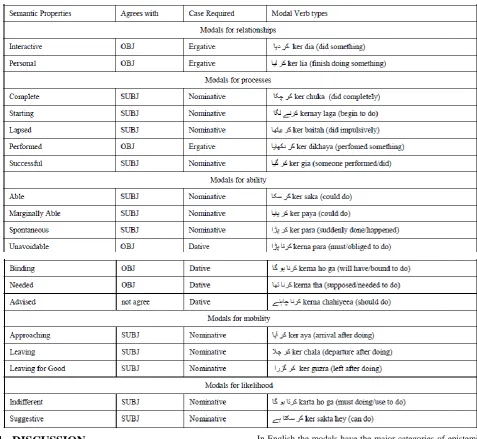
[image:4.595.58.536.254.693.2]The sub-categorization frame becomes <دمحا, باتک, ملسا>, then the modal verb ید agrees with باتک in gender. The modal verbs also agree with the case of the noun phrases. Hence they determine the case of the verb phrase. The case required by the modals must be provided by the noun phrase structure. Table 1 lists the case requirement with all the modal verbs mentioned. These rules have been taken care of in the implementation of LFG. The screen shots of the run are depicted in the Appendix.
Table 1: Modal variations with the verb
4.
DISCUSSION
Section 2 shows six different modal verbs with variations in meaning and case required. We have expanded the types to 19 different ones classified into five major categories of relationships, processes, ability, mobility and likelihood.
During this work, it was seen that modals can behave as verb and auxiliary in Urdu like اگ ںوہاچ ںیم (mEN cAhUN gA) ‘I will want’. Here ںوہاچ ‘want’ is behaving as modal verb with subjunctive morphological form. On the other hand, اناج ںیم
اتہاچ
اھت (mEN jAnA cAhtA thA) ‘I had wanted to go’. In this sentence اتہاچ ‘want’ is behaving as an aspectual modal auxiliary with imperfective morphology. This difference noted is quite interesting and plan to cover up in future work.
5.
CONCLUSION
Except the future work mentioned in Section 4, Modal verb expressions that have been shown are divided into five major categories of relationships, processes, ability, mobility and likelihood, which are further broke down into 19 different types. Modals govern the sentence case and agree with either subject or object which is demonstrated in this paper. In future, this work of Urdu modals will be extended into further categories according to their behavior as a verb or as an auxiliary.
6.
REFERENCES
[1] Agha, Asif. 1998, ‘Form and Function in Urdu-Hindi verb inflection’, The Yearbook of South Asian Languages and Linguistics, New Delhi, London. Sage Publications [2] Bashir, Elena. 1999. ‘The Urdu postposition ne: its
changing role in the grammar’, The Yearbook of South Asian Languages and Linguistics, New Delhi, London. Sage Publications
[3] Céline Roméro. 2005. The Syntactic Evolution of Modal Verbs in the History of English, Université Paris III - La Sorbonne Nouvelle, U.F.R. d´Anglais
[4] Englishpage.com - Free online English lessons & ESL / EFL resources, Modal Verb Tutorial, available at http://www.englishpage.com/modals/modalintro.html
[5] George Cardona, Dhanesh Jain. 2003. The Indo Aryan Languages. Routledge language family series, UK. [6] Hassan Sajid. 2007. Urdu Part of Speech Tagset, Center
for Research in Urdu Language Processing , National University of Computer & Emerging Sciences, Lahore Pakistan, available at www.crulp.org
[7] Ian Jacobs. 1995. English Modal Verbs, copyright ©Ian
Jacobs 1995-2000 at
http://www.w3.org/People/Jacobs/modals.ps.
[1] Ruth Laila Schmidt. 2004. Urdu: An Essential Grammar, Routledge, UK.
[2] Thomas Herbst. 1999. English Valency Structures-A First Sketch. Erfurt Electronic Studies in English (EESE Journal). Niedersächsische Staats- und Universitätsbibliothek Göttingen. ISSN 1430-6905.
[3] Abbas Q. and Raza G. 2014. A Computational Classification of Urdu Dynamic Copula Verb . International Journal of Computer Applications (IJCA), Vol. 85(10), P 1-12, ISSN 0975 - 8887. Published by Foundation of Computer Science, New York, USA.
[4] Abbas, Q. 2012. Building a Hierarchical Annotated Corpus of Urdu: The URDU.KON-TB Treebank. Lecture Notes in Computer Science (LNCS). Vol. 7181(1), P 66-79, ISSN 0302-9743, Springer-Verlag Berlin/Heidelberg.
[5] Abbas, Q. Karamat, N. Niazi,S. 2009. Development of Tree-bank based probabilistic grammar for Urdu Language. International Journal of Electrical & Computer Science (IJECS), Vol. 09(09), P 231-235, ISSN 2077-1231.
[6] Abbas Q. 2014. Exploiting Language Variants Via Grammar Parsing Having Morphologically Rich Information. In Proceedings of the EMNLP'2014 Workshop on Language Technology for Closely Related Languages and Language Variants, Association of Computational Linguistics, P 35-45, Qatar.
[7] Abbas Q. 2014. Semi-Semantic Part of Speech Annotation and Evaluation. In Proceedings of ACL 8th Linguistic Annotation Workshop (COLING), Association of Computational Linguistics, P 75-81, Ireland.
[8] Abbas, Q. Khan, N.A. 2009. Lexical functional grammar for Urdu modal verbs. In Proceedings of 5th IEEE International Conference on Engineering and Technology (ICET).
[9] Abbas, Q. 2014. Building Computational Resources: The URDU.KON-TB Treebank and the Urdu Parser, Doctoral Dissertation, University of Konstanz, Germany
APPENDIX
Sentences of Urdu are encoded in English alphabets. Only five and half out of nineteen screen shots of results mentioned in Table 1 are displayed in this paper to provide an idea about classification and their analysis through XLE parser. The C and F structure of a sentence in (XVI) is depicted in the following screen shots.
(XVI). اید رک ماک ےن ہراس
Sara ne kam ker diya
(XVII). ایل رک ماک ےن ہراس
Sara ne kam kar liya
‘Sara has done (personal modality) the work’
The sentence given in (XVII) has the following C and F structure produced in the analysis during parsing, which shows the personal ability of ‘Sara’ to finish the work.
(XVIII). یکچ رک ماک ہراس
Sara kam ker chuki
‘Sara has done (completion modality) the work’
(XIX). یگل ےنرک ماک ہراس
Sara kam karnay lagi
‘Sara is going to start (starting modality) the work’
The sentence in (XIX) shows the starting modality of an event by ‘Sara’, The screen shots are as follows.
(XX). یھٹیب رک ماک ہراس
Sara kam ker baithi
‘Sara has finished (lapsed modality) the work’
(XXI). ایاھکد رک ماک ےن ہراس
Sara ne kam ker dikhaya
‘Sara shows the ability of perform the work’
Similarly, the ability to perform analyzed through parsing the sentence (XXI) is depicted in the following screen shot.