CARPENTER, JAMES GIVENS V. Time Accurate Unstructured Grid Adaption in Two and Three Dimensions. (Under the direction of D. Scott McRae).
The adaption algorithm of Benson et al is extended to three dimensional unstructured
grids, building on the previous extension to two dimensional unstructured grids.
R-refinement grid adaption is performed using a center of mass equation constructed from a
weight function computed from solution gradients. Solution variables are updated using
a coupled approach where the flux interface for each cell face is adjusted by the local grid
velocity. Modifications to the integration scheme are incorporated to account for volume
changes due to grid adaption through the introduction of an unsteady residual term which
is resolved using sub-iterations at each timestep. The previous structured grid definition
of grid velocity is shown to be inadequate for unstructured grid motion, and a new
conservation based grid velocity equation is constructed from the local face displacement,
which is designed to capture the volume change and preserve geometric conservation.
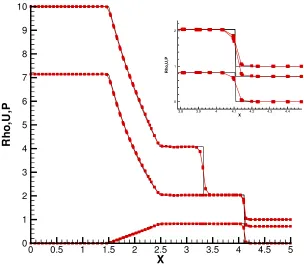
Time accuracy is demonstrated for two and three dimensions using a shock tube
simulation.
Implementation for three dimensions is accomplished using a parallel, point implicit
commercial flow solver. Incorporation of the gridspeed terms in the flux interface
equations is presented along with the modifications to the implicit integration scheme
required to account for the volume change as the grid is displaced. Extension to three
dimensions required development of smoothing routines designed to preserve or
definition. A wing section under a prescribed sinusoidal motion is presented as a
demonstration case to show the efficacy of the method. Computational results are
by
James Givens Carpenter V
A dissertation submitted to the Graduate Faculty of North Carolina State University
in partial fulfillment of the requirements for the Degree of
Doctor of Philosophy
Aerospace Engineering
Raleigh, NC
2007
Approved by:
Dr. J. R. Edwards Dr. H. A. Hassan
Dr. C. T. Kelley Dr. D. S. McRae
Biography
James Givens Carpenter V was born in Charleston, South Carolina on the 24th of
November, 1963. After graduating from Wren High School in 1982, James earned a
Bachelor of Science in Computer Science from Clemson University in 1985. During his
tenure at Clemson, he began working as a consultant to a textile mill in the Greenville,
South Carolina area in the information systems department. After graduation, he
assumed a lead role in the company’s information systems group for the next four years.
In 1989, he moved to the Raleigh-Durham area and continued working as a consultant to
several companies including IBM. In 1993 he began attending the graduate school at
North Carolina State University, completing his Master of Science thesis, Unstructured
Grid Adaption Using Node Movement, in 1997. Subsequently, James took a position in a
commercial software company as a developer, eventually rising to the position of VP of
Development, while working to complete the PhD program. James has been employed at
Corvid Technologies, Inc., an engineering consulting and software development
company, in Mooresville, North Carolina, since 2002, and will continue with Corvid
Acknowledgements
I would first like to thank my committee members, Dr. D. S. McRae, Dr. J. R.
Edwards, Dr. H. A. Hassan, and Dr. C. T. Kelley for their considerable patience and
assistance in the completion of the current research. A special thanks also to Dr. Stephen
Campbell for standing in for my defense. Dr. McRae has always been accommodating of
my work schedule and I cannot thank him enough for his encouragement and persistence.
Development of the methods at the foundation of this research benefited greatly from his
assistance. Dr. Edwards has been an invaluable resource over the course of this work,
and I owe him a debt of gratitude for the many times he has managed to point me in the
right direction. I could not have overcome many of the obstacles I faced in the course of
this research without his assistance. Dr. Hassan has taught me more engineering
fundamentals than I could ever hope to retain and has always been a source of
encouragement. I would also like to pay special thanks Dr. Robert Silber, who
challenged me early in my graduate career. I doubt he remembers me as a student in his
classes, but his straightforward criticisms and high expectations had a significant impact
on my graduate studies.
There were many reasons why I decided to branch out from computer science into
engineering, and it was probably with more enthusiasm than reason that I began my
graduate career. Balancing a job, family, and my graduate studies seemed overwhelming
at times, and I would have surely given up long ago had it not been for the support of
me that there would not be space to list them all. I have received so much beyond an
education out of my graduate experience through the friends I have made along the way
that the journey alone has made the whole experience invaluable.
There are a number of individuals who deserve special recognition. First I want to
thank Dr. Neal Frink at NASA Langley for providing me with a copy of his unstructured
flow solver TetCC. Although I ultimately used a code associated with my job, I cannot
thank Dr. Frink enough for his willingness to sort through the paperwork necessary to
provide me with a copy of his code. Special thanks are due to Dr. David Robinson for
providing substantially all the materials and resources used to complete the bulk of the
work contained herein. Through Dr. Robinson I have gained access to the three
dimensional flow solver RavenCFD, and access to abundant computational resources.
None of this work would have been completed without his support, and I am indebted to
him for his patience and support.
I want to thank Dr. Robert Nance for his support over the long course of this research,
and his willingness to listen to my ramblings and incoherent ideas. I have benefited
greatly from my many conversations with him discussing aspects of this research and I
cannot thank him enough his assistance. I also want to thank Dr. Mike Neaves for his
friendship and assistance over the course of my graduate career. Mike has been a
consistent source of encouragement and help through my graduate studies and as I
worked to complete my research. I would not have made it through most of the class
work without Mike as a study partner. Thanks also to Cameron Dempster for his
I would also like to pay tribute to three people who inspired me to go back to school,
but unfortunately did not live to see me complete this work. First to my grandmother,
Laverne Shaw Carpenter, and my grandfather, James Givens Carpenter III, I owe an
immeasurable debt of gratitude not only for encouraging my education, but all of the
many life lessons they provided along the way. Both grew up during the depression and
were never able to attend college. It was their greatest desire that I complete a college
education, and it is as much for them as for me that I pursued it as far as I have. Last, I
want to thank Cindy Erickson for her support during my graduate studies. Cindy
provided me with a job while attending graduate school, and showed great patience with
my studies and provided endless encouragement when the task seemed overwhelming. I
could not have completed this work without her help.
I also want to thank my parents, Jim and Jane Carpenter, for their support, and my
brother Bryan and sisters Angela and Amy for their support and encouragement. I know
my mother wondered if I would ever complete this degree, but she never gave up hope
and was always persistent that I finish.
Last, but certainly not least, I have to thank Pat Oliver. I cannot imagine what living
with me must have been like over the long years of working and going to school, not to
mention the insanity of leaving your job and home to move to another state to start
graduate school. I appreciate your patience through all the long nights as I studied, and
tolerating all of the times when I became frustrated or exhausted with trying to complete
this degree and work. I cannot thank you enough for your support, encouragement and
Table of Contents
List of Figures ... viii
List of Symbols ...x
1
Introduction ...1
2
Adaption Algorithm ...9
2.1 Unstructured r-Refinement Adaption ... 13
2.2 Weight Function ... 15
2.3 Node Movement and Restriction ... 22
3
Unstructured r-Refinement in Two Dimensions ... 24
3.1 Modified Integration Scheme ... 26
3.2 Flux Corrections ... 27
3.3 Deficiencies in Gridspeed Definition ... 30
3.4 New Gridspeed Definition ... 35
3.5 Movement Restriction ... 43
3.6 Time Accurate Validation... 45
4
Unstructured r-Refinement in Three Dimensions ... 50
4.1 Numerical Approach ... 51
4.2 Modified Integration Scheme ... 52
4.3 Flux Scheme Modifications ... 57
4.4 Implicit Jacobian Modifications ... 63
4.5 Time Accurate Validation... 65
5
Plunging Airfoil ... 78
5.1 Grid Resolution and Motion ... 79
5.2 Results Comparison ... 84
5.3 Three Dimensional and Modeling Effects ... 93
6
Conclusions ... 99
7
References ... 103
A Three Dimensional Grid Smoothing ... 109
A.1 Poor Tetrahedral Quality and the Quality Function ... 109
A.2 Laplacian Based Smoothing ... 113
List of Figures
Figure 1 - Definition of the Dual Grid. ... 25
Figure 2 - 2D Unstructured Grid Before Adaption. ... 31
Figure 3 - Adapted 2D Unstructured Grid without Weight Function. ... 31
Figure 4 - Density Contours of Perturbations After Adaption. ... 32
Figure 5 - Adapted Grid with Artificial Sink. ... 33
Figure 6 - Density Contours from Adapted Sink Grid. ... 33
Figure 7 - Definition of Medial Dual Grid. ... 36
Figure 8 - Volume Displacement from Adaption. ... 37
Figure 9 - Motion Vector to Define Face Displacement. ... 41
Figure 10 - Geometry of 2D Dual Grid with Motion Vector. ... 44
Figure 11 - Artificial Sink using New Gridspeed Definition. ... 46
Figure 12 - Adapted Shock Tube Grid. ... 46
Figure 13 - Adapted Solution Compared to Theory. ... 48
Figure 14 - Unadapted Grid Compared to Theory. ... 49
Figure 15 - Adapted 3D Sub-Volume. ... 59
Figure 16 - Volume change from 3D face displacement. ... 60
Figure 17 - Sub-Volume Calculation. ... 61
Figure 18 - Transient Grid Wave Moving in Positive X. ... 67
Figure 19 - Transient Grid Wave Moving in Negative X. ... 68
Figure 20 - Shock Tube Results for Starting, Middle, and Intermediate Solution. ... 73
Figure 21 - Unadapted Shock Tube Results. ... 74
Figure 22 - Adapted Shock Tube Results. ... 75
Figure 23 - Airfoil Surface and Volume Resolution. ... 80
Figure 24 - Near Body Resolution. ... 80
Figure 25 - Trailing Edge Resolution. ... 81
Figure 26 - Grid Motion Region. ... 82
Figure 27 - Grid Displacement for Top and Bottom of Cycle. ... 83
Figure 28 - Vertical and Horizontal Plot of Pressure Across Motion Region. ... 86
Figure 29 – PIV Velocity Data (Left) Compared to Laminar Results (Right). ... 87
Figure 30 – CFL3D Laminar Velocity (Left) Compared to Laminar Results (Right). ... 89
Figure 31 – PIV Velocity Data (Left) Compared to Spalart-Allmaras Results (Right). ... 91
Figure 32 – PIV Vorticity Data (Left) Compared to Laminar Vorticity (Right). ... 92
Figure 34 - Comparison of 2D (Left) and 3D (Right) Vorticity Results. ... 94
Figure 33 – Iso-Surface of Vorticity Magnitude. ... 96
Figure 35 - Comparison of 3D (Left) and Delta (3D-2D Right) Vorticity Results. ... 97
Figure 36 - Leading Edge Grid and Spanwise Facetization. ... 98
Figure 37 - Linear Forms of Poor Quality Tetrahedra. ... 110
Figure 38 - Planar Forms of Poor Quality Tetrahedra. ... 111
Figure 40 - Face Swap Example. ... 118
Figure 41 - Canonical Form for 4 and 5 Cell Configurations. ... 119
Figure 42 - Canonical Form for 6 Cell Configurations. ... 119
List of Symbols
a
Speed of Sound
f
A
Face Area
mm i A
A±,
Jacobean Matrices
c
Chord Length
e
Internal Energy
E
Split Flux
T
E
Total Energy
h g
f, ,
Inviscid Flux Vectors
p
f
Frequency for Plunging Airfoil
F
Total Flux
H
Total Enthalpy
h
Reduced Plunge Amplitude l/c
kj
iˆ, ˆ, ˆ
Direction Unit Normal Vectors
I
Identity Matrix
k
Coefficient of Thermal Conductivity
f
k
Reduced Frequency
l
Physical Plunge Amplitude
M
Mach Number
nˆ
Cell Face Unit Normal
i n N
N ,
Number of Neighbors of a Node and Cell
P
Point or Node Location or Pressure
QSolution Vector of Dependent Variables
t s
r, ,
Viscous Flux Vectors
r
rˆ,r
Direction Vectors for Movement or Interpolation
S
Cell Face Area
t
Time
T
Temperature
w v
u, ,
Velocity Components
n
U
Velocity Normal to a Face`
V
Volume
V r
Velocity
f
zˆ
Cell Face Motion Normal Vector
αIntegration Scheme Coefficient
∆
Difference Operator
ε
Small Number on the Order of Machine Zero
γ
Ratio of Specific Heats
2 1,η
η
First and Second Order Coefficients
φSolution Difference Vector
ρ
Density
σ
Weight Function Biasing Coefficient
θImplicit Operator
yy xy xx τ τ
τ , ,
Shear Stress Components
ωWeight Function
Subscripts
f
Face
k
Weight Function Variable, Runge-Kutta Weight
n
Node
m
Neighbor Node or Cell
n
Normal to a Cell Face
0Previous Time Level
i
Cell
r
Ratio
s
Sub-iteration
tTime Derivative
z y
x, ,
Coordinate Directions
maxmin,
Minimum or Maximum Value
cm
Center of Mass
Superscripts
0
Previous Time Level
C
Convective Flux Components
kNewton Sub-iteration Level
n
Time Level
P
Pressure Flux Components
m , , ,−±
Advances in unstructured flow solvers in recent years have enabled engineers to
obtain solutions on increasingly complex geometries, thereby moving unstructured
methods to the forefront of applied computational engineering. Advantages of
unstructured methods lie in the ability to generate grids of reasonable quality around
complex shapes, owing in large part to the lack of implicit ordering and connectivity.
Implicit in this advantage, however, is the need to explicitly define grid connectivity, thus
increasing the overhead of unstructured methods. Control of element count is therefore
desirable to reduce the resource requirements associated with the method for a given
solution, without sacrificing resolution and accuracy. Resolution can be addressed to a
limited degree in the grid generation process by pre-clustering elements in regions of
known interest, such as a body wake. In cases where a priori knowledge of the flowfield
is unavailable, adaption techniques can be used to resolve areas of interest dynamically as
the solution evolves. Adaption techniques can be grouped generally into two types:
enrichment and movement. Enrichment techniques add elements where resolution is
required and potentially remove elements where reduced resolution would not adversely
affect the solution. Aside from the complexity of implementing an enrichment scheme in
a general unstructured solver, enrichment carries the extra burden of increasing the
computational overhead as cells are added. In the case of transient flows, the increase in
cell count can be large if not coupled with a robust coarsening scheme. Movement
increased element count, and add only a modest overhead in computing the grid
movement. Although each method has advantages and disadvantages, movement
methods are generally easier to implement and result in less overhead.
One current shortcoming of both methods, however, is the inability to provide
accurate solutions to transient problems without introducing perturbations into the
solution as the grid is adapted. Development of a conservative, time accurate adaption
method for unstructured grids would expand the scope of solutions obtainable for
transient flows.
In a recent survey of applied CFD methods, Rumsey and Ying1 concluded that
numerical error was often the primary cause of inaccurate lift predictions for high lift
configurations, frequently exceeding modeling error. Venditti and Darmofal2 in their
work on adaption methods noted that the dominant reason for inaccurate predictions of
computational results has been identified as grid resolution. It is agreed generally that
sufficient grid resolution is necessary for the consistent and accurate prediction of flows
and forces on aerodynamic bodies. Unfortunately, grid resolution as viewed from the grid
generation process is analyst dependent, or at least dependent on the principles involved
in the grid generation process. At best it requires a priori information about the flowfield
to develop a grid of sufficient resolution. Resolution thus becomes more of a subjective
and less objective process by which the flowfield is resolved. Adaption has been
developed as a way to mitigate problems associated with resolution of the initial grid by
Unstructured adaption algorithms are often favored over structured grid approaches in
much of the current research because structured grid approaches cannot support the dual
needs of increased geometric complexity and localized resolution without upsetting the
natural ordering of the grid1. Any fully anisotropic adaption scheme for a structured grid
would require explicit ordering, and result in a method comparable in complexity and
overhead to unstructured methods. Unstructured methods, by definition, maintain data
structures to explicitly define grid connectivity which results in substantial overhead but
provides a method to generate a grid for most geometries of interest. These methods also
provide a framework whereby selected areas of the flow can be resolved independently of
the local topology to increase resolution and accuracy through the use of adaption.
The three methods available to adapt unstructured grids are r-refinement (movement),
h-refinement (enrichment), and p-refinement (reconnection)3,4,5. Most of the research in
unstructured grid adaption has focused on enrichment schemes represented primarily by
h-refinement approaches4,5,8,9,10,11,12. H-refinement enrichment schemes use an error
estimator to determine regions of the grid where the solution is under resolved, and add
elements locally to improve the resolution and (hopefully) the accuracy of the solution.
While enrichment schemes have demonstrated the ability to improve solution accuracy
through local refinement4, there is added overhead in the form of increased cell count.
For steady state solutions, the increased overhead is incidental assuming the resolution is
needed to provide the spatial accuracy required for convergence. For transient flows,
enrichment can increase the overhead unnecessarily unless coupled with a robust
Besides the obvious issues of increased overhead, there are more subtle issues of grid
quality that can arise from enrichment. Speares and Berzins13 have developed a time
dependent 3D unstructured adaption algorithm built strictly upon h-refinement. In their
approach, they subdivide selected tetrahedral elements by either edge bisection or
introduction of a new node at the center of the selected tetrahedral. A drawback of this
approach is that the grid quality, where quality in this case is defined only in terms of cell
geometry, will decay over time as a given element is repeatedly subdivided. Without a
smoothing algorithm to recover the grid quality, the number refinement iterations are
artificially restricted, limiting the amount of resolution which can be added to the grid.
Cavallo and Baker4 in the description of their edge splitting technique noted the need to
implement a p-refinement algorithm for edge and face swapping to remove elements
contributing to poor quality. In their approach, a locally constrained Delaunay approach
is implemented which effectively results in local mesh reconstruction to increase
resolution. Local reconstruction usually improves grid quality, but does not prohibit poor
quality.
Grid quality, both for grid generation and adaption algorithms, has proven to be a
difficult subject and one that has been the focus of much research. Freitag and Knupp5
outline nine independent tetrahedral cell configurations which can result in poor quality
cells and affect accuracy. Each of these cell types is a possible result of successive
iterations of enrichment algorithms if applied without mesh smoothing to improve
quality. Structured and 2D unstructured methods have typically used Laplacian
Laplacian smoothers may not only fail to improve poor quality cells, but can degrade
quality, especially in regions of varying connectivity. To improve cell quality, the use of
an optimized mesh smoother based on a quality function is necessary. Frietag and
Ollivier-Gooch6 have developed a best practices approach which incorporates
p-refinement in the form of edge and face swap, with r-p-refinement performed by a
Laplacian and an optimization based smoother to improve grid quality. Application of
these two methods in combination has demonstrated improved mesh quality on grids
where Laplacian based smoothers fail. In this context, however, it should be noted that
quality is measured in purely geometric terms, which may not describe the best structure
to resolve flow gradients, as shown by Laflin14.
Measures of grid quality are typically restricted to a geometric description of quality
based on quantities such as minimum angle or aspect ratio, for example. Viewed in a
broader context, quality is best described in terms of errors produced from the
discretization relative to the underlying solution. McRae and Bond15 have proposed an
alternate view of quality which includes elements of the underlying solution in
determining grid quality. The result is a universal grid quality metric based on an
equidistribution principle that defines quality in terms of cell face alignment with the
local gradient. By aligning the cell face with the local gradient, errors in the flux
calculation are reduced resulting in improved accuracy. In terms of this metric, the
typical aesthetic view of quality, where skewness and stretching are considered to result
high gradient, such as shock waves, actually benefit from skewness if face alignment with
the local Riemann problem is improved.
In order to maintain quality, research has shown that enrichment methods require
either a limited form of adaption or some form of smoothing algorithm to improve grid
quality after enrichment. Restricting adaption presents obvious issues of restricted
resolution and limited improvement in accuracy. Addition of a smoothing algorithm
incorporates r-refinement, and reintroduces the need to properly account for grid
movement in the flux terms to prevent perturbations to the flow16. Therefore, even when
using enrichment to perform adaption there is a need to develop a time accurate adaption
algorithm to solve transient flows accurately.
Adaption algorithms using r-refinement have received little research focus as noted by
Baker3. Zegeling17 presents development of a r-refinement algorithm for finite
differences, but the application was limited to 1D and 2D solutions. Baines et al18,19
demonstrated r-refinement methods for partial differential equations in 2D, and outlined
the steps necessary to implement a time accurate movement scheme through the
development of gridspeed terms and corrected velocities as applied to elliptic problems.
Movement algorithms generally operate through the equidistribution of a weight function.
The weight function, much the same as the error function, is designed to identify areas of
the grid where more resolution is required. Once the weight function is defined, the
weights are distributed throughout the grid resulting in higher resolution in areas
identified by the weight function. Areas where the weight function is small and evenly
clustered to increase resolution in areas where the weight function is large. Determining
an appropriate weight function distribution can be more problematic for 3D unstructured
grids.
Tezduyar20,21 has performed considerable research in the area of moving bodies, such
as a rotating propeller blade, where body surfaces are translated in the grid to simulate
movement. The focus of the approach is to simulate movement rather than to improve
accuracy, but the principles involved are the same in as much as the grid is deformed via
node movement as the body surface is moved, and a method to recover the solution after
movement is required. In this case, interpolation to the new grid was used to transform
the solution from the old grid to the new grid.
Research on methods to maintain accuracy and conservation of the solution during
node movement has primarily centered on structured grids, using either a coupled or
decoupled approach to advance the solution. Decoupled approaches require an
interpolation scheme to update the grid after adaption, and enjoy the advantage of being
independent of the integration scheme and the flow solver in general. A decoupled
approach was developed by Benson and McRae22,23 and expanded by Laflin14 where the
computational domain was utilized to perform movement, and the solution was then
interpolated to the new grid level. The algorithm proved to be very efficient, but use of
the computational domain precluded its use for any unstructured grid approach.
Moreover, the use of interpolation on unstructured grids is more problematic, and
involves the use of computationally expensive algorithms to determine the interpolation
A coupled approach was previously investigated by Klopfer and McRae24 for explicit
solvers and by Orkwis and McRae25 for implicit solvers. Neaves26 successfully
implemented the coupled approach in a 3D implicit structured code to analyze inlet
unstarts. In the coupled approach, the grid is moved using the standard node movement
algorithm, then the flux terms are adjusted to account for the node movement in the
interface velocity. The integration algorithm is modified to account for the resultant
volume change, and, in this case, the time accurate sub-iterations of Rai27 were used to
recover time accuracy at each timestep.
Despite the lack of portability, a coupled approach presents several advantages over
the decoupled approach for unstructured grids. Issues with defining a separate
interpolation method are avoided using the coupled approach, and the robustness of the
integration scheme is utilized to update the solution after each adaption step.
Development of appropriate gridspeed terms can ensure conservation and thereby prevent
additional perturbations to the flow. Once gridspeed terms have been defined,
incorporation of the terms into the flux scheme is straightforward. Modification of the
integration scheme to define an unsteady residual and sub-iterations to recover time
2
Adaption Algorithm
The goal of adaptive grid algorithms is to improve the accuracy of the solution and
reduce analyst dependence through the appropriate resolution of salient features in the
flowfield. Most adaption methods incorporate an error estimator to determine areas of
the solution where there are large values of the error function as defined by the integration
method. Determination of solution error is an ongoing field of research, but a common
approach is to approximate the error through the use of solution gradients. All numerical
approximations to governing equations result in some form of truncation error consisting
of solution derivatives multiplied by powers of the local grid spacing. Truncation error
can be used to estimate errors in the solution and identify regions of the flowfield that
require additional resolution. The goal of additional resolution by any means is to reduce
the local spacing and thereby reduce the local truncation error.
Several methods are available to estimate the location truncation error. A precise
approach would be to determine the exact form of the truncation error terms based on the
numerical method used in the flow solver. Although the first truncation error term is
generally sufficient to approximate the error, a more precise determination of the error
term would require determination of many truncation error terms, which must then be
approximated and evaluated locally to determine the local error. A drawback of this
approach is that it cannot be generalized as the truncation error is unique to each
numerical method and is thus restricted to the flow solver for which the error terms are
solution gradients formed from first order gradients in the flowfield. First order gradients
can be used to approximate higher order solution derivatives by taking the differences of
the first order terms, which vary at a rate proportional to the higher order terms28.
Increased computational efficiency and reduced round-off can be accomplished through
the use of undivided differences in the error estimator, and normalized by the local
values. Normalized undivided solution differences form the basis of the error estimator
used in the current work.
Once an error estimator is defined and implemented, a method to reduce the local
spacing based on the local error function is needed. Two general approaches to this
problem are enrichment and movement. As noted earlier, the typical approach is to use
enrichment to locally refine the grid where the solution error is large, however there are
many complications associated with enrichment algorithms that make their
implementation difficult for unstructured grids. One of the biggest obstacles is the local
data structure of the flow solver. Unlike structured grid methods, which generally employ
an explicit i,j,k ordering scheme, unstructured solvers must explicitly define connectivity
between each node and each cell in the grid. Unstructured grid generators and flow
solvers employ a number of different techniques to construct the grid and compute the
solution. For example, grid generators can use a hyperbolic advancing front technique, or
a top down octree type approach. Flow solvers can be cell centered, or vertex based with
a dual grid that can be defined a number of different ways, such as a median dual.
Differences in the grid generation and flow solver approaches results in a number of
each approach. An enrichment scheme can be developed for each of these methods, but
generalization is difficult and will require modification of the local data structure at some
level.
In addition to issues with the local data structure, parallelization can pose a number of
problems in the context of enrichment schemes. Implementation issues arise at
inter-zonal processor boundaries that are dependent on the enrichment scheme being employed.
Face splitting schemes can be the easiest to implement since the face split is independent
of information on each processor. Edge splitting is difficult because the order of
operations determines the resulting face geometry if the edges of a face are split more
than once during a cycle. Care must be taken to ensure the order of operation at the
inter-zonal boundary is consistent for each processor so that the same adapted grid structure is
produced on each processor. In addition to cell splitting issues, smoothing algorithms can
become complicated at the inter-zonal boundary. Laplacian and optimized smoothing
algorithms are node based methods which can be implemented with an acceptable amount
of overhead at an inter-zonal boundary. Edge swap techniques, however, become
increasingly complex at an inter-zonal boundary since they necessitate a new local
definition of the inter-zonal connections between processors, due to changes in the local
grid structured as a result of the swap.
An important limitation of enrichment schemes is the added computational overhead
incurred, especially for parallel implementations. Enrichment schemes by nature add
cells to the grid structure to provide increased resolution of the flowfield. In a parallel
resolved as a result of the adaption process, leading to an increased load on processors
where there are concentrations of enrichment, and leaving other processors idle while the
adaption cycle completes. If left unchecked, this can lead to a severe load imbalance and
requires rebalancing of the parallel problem. Some parallel distribution codes such as
ParMETIS29 contain routines designed to provide a new distribution to rebalance the
problem after enrichment, but rebalancing can require a substantial cost in
communications overhead, and thus increased solution time. For flows with transient
features, the need to adapt frequently can make enrichment schemes prohibitively
expensive and can require a robust coarsening scheme to prevent the cell count from
becoming unmanageable.
Node movement schemes, by contrast, can be generalized to accommodate multiple
flow solver variants and formed independent of the grid distribution across multiple
processors. Since no cells are added or removed from the domain, the parallel problem
never becomes unbalanced and there is no need to redistribute the grid as the adapted
solution evolves. Construction of a local mesh, including a node and its surrounding
cells, allows generalization of the node movement algorithm independent of the
underlying flow solver. The result of the node movement scheme is a new node location
based on the movement algorithm, which is updated independent of the flow solver and
does not require alteration of the underlying data structures. Some modifications are
most likely required to produce a local grid structure for a node, but these modifications
are in addition to the data structure native to the flow solver and do not require alteration
movement is dependent only on the local data structure of the movement algorithm,
which is true for inter-zonal nodes as well as nodes that lie within the grid domain of each
processor. The ability to define a generalized approach with low computational overhead
make movement schemes an attractive alternative to enrichment schemes for adaption
based algorithms. Therefore the current research is focused on an unstructured node
movement scheme which is both robust and preserves time accuracy.
2.1
Unstructured r-Refinement Adaption
Development of the current unstructured adaption algorithm is based on the structured
grid adaptive algorithm originally developed by Benson and McRae22,23,30,31,32. Extension
of the Benson and McRae method to unstructured grids required modification of the
original method for use in a generalized unstructured approach33. Specifically, the
original method applied grid motion to the computational domain, which was then
mapped onto to the physical domain. Solution variables from one grid level to the next
were interpolated based on the previous grid and solution applied to the new grid after
adaption. Since no computational space exists for an unstructured grid, the method is
modified to perform movement in physical space. In place of an interpolation scheme,
grid motion was coupled to the flow solver via gridspeed terms developed from the grid
motion. Coupling the grid motion to the flow solver allowed for development of an
adaption scheme which was both conservative and maintained the accuracy of the original
Most concepts of the original adaption algorithm, however, are maintained in the
current approach. As with the original method, node movement is based on a center of
mass calculation using a weight function developed from solution differences. Weight
function construction is based on solution differences by means of user supplied biasing
coefficient that select flow variables of interest to form the solution weights. Solution
differences are combined to form the weight function used to perform the center of mass
calculation, where the weight function is analogous to the monitor surfaces described by
Eiseman34. Changes are required to the original weight function and center of mass
definitions to account for the non uniform connectivity associated with unstructured
grids. Clipping operations described with the original method33 are maintained to provide
an even distribution of resolution to strong and weak features in the flowfield. A weight
function spreading operation is performed to determine how far a point is moved in each
adaption cycle. The result is a generalized movement algorithm which can be applied to
unstructured grids in two and three dimensions.
Application to three dimensional grids revealed limitations of the original 2D method
which must be addressed. The Laplacian operator used to perform the center of mass
calculations acted as a natural smoother for structured and two dimensional unstructured
grids. When applied to three dimensional grids, however, the Laplacian operator is
unable to detect many of the grid quality deficiencies, such as spikes, slivers, and spires,
associated with tetrahedral meshes and is therefore unable to provide adequate smoothing
in these regions and in many instances will invert cells if care is not taken. Motion
such as spikes and slivers are difficult to detect with an elliptical smoother, and there is as
yet no common approach which will identify and properly handle all of the geometrically
poor cell types6. Extension to three dimensions therefore necessitated the addition of an
optimization based smoother that can address all types of grid deficiencies in the
tetrahedral mesh, providing improved cell quality without inverting the grid. Details of
the smoother are included in Appendix A.
The following sections describe details of the new adaptive grid algorithm with the
modifications necessary for application to unstructured grids. Details of the weight
function are developed first, followed by development of the center of mass routine.
Node movement restriction routines are described in later sections pertaining to
implementation in two and three dimensions, since different techniques were required for
each application.
2.2
Weight Function
Formation of the weight function is based on solution differences which are used to
approximate solution error for each cell. In this instance, differences are the absolute
undivided differences of the flow quantities stored at each cell. Two dimensional
solutions for the current work are based on a cell vertex description of the flowfield,
meaning that the flow quantities are stored at the node locations. Difference equations
are formed by differences between a node and all the associated neighbor nodes based on
break the weight into component directions. The resulting difference equation is expressed as ) ( ˆ , 1 ) , ( , , ) , ( , , ε φ + − =
∑
= n k n N m y x m k n k y x n k Q N r Q Q n (1)where rˆ(x,y) represents a unit direction vector connecting the nodes, Q represents the
flow quantity of interest for the difference operator,Nn is the number of neighbors
associated with each node, andε is a small quantity to prevent divide by zero. The local
quantity of interest is included in the denominator to prevent overweighting of flow
quantities in regions where very large flow gradients are present35. Inclusion of the
neighbor node count in equation 1 is necessary to ensure that the weight function is not
biased by the local grid connectivity. Unlike structured grids, unstructured grids do not
contain uniform connectivity. Therefore the summation of difference terms must be
normalized to remove the influence of changes in grid topology that are not related to
actual solution differences. Division by the count of neighbor nodes will thereby reduce
biasing due to grid topology. Currently, undivided differences of density, pressure, Mach
number, and velocity components are used to form the weight function.
For three dimensional calculations, a different flow solver was used that required
storage of the solution variables at the cell centers instead of the cell vertices. In the three
defined by the local cell face connectivity, giving a new form of the difference equation as ) ( ˆ , 1 ) , , ( , , ) , , ( , , ε φ + − =
∑
= i k n N m z y x m k i k z y x i k Q N r Q Q i (2)where rˆ(x,y) now represents a unit direction vector connecting two cells through a
common face, and Ni is the number of cell neighbors associated with cell. Using cell
differences implies that solution variations are measured only through connecting cell
faces, and not through connecting nodes, potentially reducing the topology used for
constructing the difference equation. Use of node based differences, however, would
require averaging cell data to each of the nodes associated with a cell, and would contain
no more information than is contained in the cell centered definition of the grid. Basing
differences on the cell center data is more consistent with the definition of flow quantities
in the grid, and how the governing equations are solved for a given topology.
After the solution differences are formed, the initial raw weight function is formed
from a linear combination of the difference equations for each coordinate direction,
representing a maximal collapse in dimensionality36. Weights for each solution
difference equation are included through a user specified biasing coefficient. Biasing
coefficients select which flow quantities are used to define the unified weight function,
where the relative weight of each coefficient determines how strongly each flow variable
coefficients to resolve features of interest. The raw form of the weight function for two
and three dimensional flows is thus defined as
∑
=
=
Nv
k
z y x k z y x k z
y x
1
) , , ( , ) , , ( , )
, ,
( σ φ
ω (3)
where the z component is zero for two dimensional solutions. σkrepresents the user
defined biasing coefficient used to select solution differences of interest.
The raw formulation of the weight function does not generally provide balanced
resolution of all flow features in a given solution. Features such as shock waves have
very strong gradients, while features such as expansion waves have smaller cell to cell
gradients. Gradients in the vicinity of shock waves vary according to the local shock
strength, which can vary greatly throughout the domain33. Variations in solution
gradients require that a means to balance the weight function is needed if all features of
the flow solution are to be resolved evenly. Although this approach does not minimize
the error function defined from the solution gradients, it will tend to increase the accuracy
of all selected features of the flow solution, weak and strong, not just the strongest
features. Implicit in this assumption is the fact that the truncation error is not the only
determining factor in solution accuracy.
A clipping operation is performed on the raw weight function to enforce a balance
between strong and weak features in the flow. The purpose of the clipping operation is to
reduce the relative weight of stronger features in the flowfield, while increasing the
relative weight of weaker features. Two user specified input parameters are defined to
weight function values can vary from one solution to another, the maximum and
minimum values are specified as percentages of selected global measures of the current
solution. Percentages are applied to the global range of the current weight function, with
any values above the maximum percentage or below the minimum percentage eliminated.
Clipping the weight function can also eliminate some of the numerical noise associated
with the solution, and thereby focus the adaption on significant solution differences. Care
must be taken in selection of the percentages to not over damp the raw weight function.
Specifying a maximum that is too low will tend to eliminate adaption to any strong flow
features, while a high minimum value will treat weak features the same as regions with a
zero gradient. The equation for the clipping function is given as
) ),
,
min(max( ( , , ) min,( , ,) max,( , , ) )
, ,
(xyz ω xyz ω xyz ω xyz
ω = (4)
where the min and max values are defined from the user defined percentages applied to
the global weight function.
The resulting weight function contains discontinuous first derivatives throughout the
flowfield as a result of the clipping operation. These discontinuities are eliminated by
applying a Laplacian smoothing operator to the weight function. Smoothing also blends
the weight function so the grid motion is not localized to a feature, such as a shock wave,
resulting in a discontinuous change in the volume ratio between cells. Smoothing leads
to increased resolution of the feature over a wider region of the flowfield and provides
better blending to the unresolved portions of the flowfield. To ensure resolution of the
original values in the method defined by Laflin14, resulting in the following form of the
smoothing operator in two dimensions
n N m y x m y x n y x n N n + + =
∑
= 2 2 1 ) , ( , ) , ( , ) , ( , ω ω ω (5)with the three dimensional form given by
i N m z y x m z y x i z y x i N i + + =
∑
= 2 2 1 ) , , ( , ) , , ( , ) , , ( , ω ω ω (6)where summation occurs between a node and all neighbor nodes for two dimensional
solutions, and between a cell and all neighbor cells for three dimensional solutions.
After formation, the individual solution weights are clipped for balanced resolution,
smoothed and then combined in a linear fashion to form a unified weight function. This
scalar function is applied equally to each coordinate direction. While it is possible to
generate a weight function for each coordinate direction for a structured grid approach,
which can then be applied sequentially to promoted alignment of the structured grid with
strong features during the adaption process, the lack of preferred direction in an
unstructured grid makes this process inappropriate. Local grid adaption for unstructured
grids depends on the local grid connectivity, so no a priori prediction of a preferred
direction for the grid adaption can be made.
The last operation applied to the solution weights is a rescaling function. Grid motion
for the current algorithm is determined by a center of mass calculation described in a
central node based on the local weight function values. Overweighting one region of the
grid forces the node closer to the higher weighted regions of the grid while moving away
from regions with lower weights. Implicit in this calculation is that the displacement
distance experienced by each node will be a function of the weight distribution. Regions
with larger local variation of the weight function will experience more relative motion
compared to regions where the weights are nearly uniform. Rescaling the weight function
can take advantage of the center of mass calculation by changing the distribution of the
weight function to control how far a cell is displaced during each adaption cycle.
Ramping of the scale can add further robustness to the calculations by allowing the user
to control the amount of motion performed by the adapter as the solution develops. High
initial perturbations at solution startup can be damped by scaling down the weight
distribution initially, and ramping up to an increased distribution as the solution evolves.
The rescaling operation is defined as
1 ) 1 ( ) ( ) ( ) , , ( max, ) , , ( min, ) , , ( max, ) , , ( min, ) , , ( + − − −
= xyz
z y x z y x z y x z y x ω ω ω ω ω ω (7)
where here the min and max values represent the range of weight function values defined
by the rescaling operation, and the new range is defined as from 1 to the maximum
current value specified by the user. Equation 7 represents the final form of the weight
2.3
Node Movement and Restriction
Node movement is accomplished via a center of mass calculation analogous to the
form used for structured grids. For structured grids, node movement is performed for
each coordinate direction independently in computational space. Unstructured node
movement uses a unified, rescaled weight function defined in the previous section in the
center of mass calculation applied to physical space. New node locations are determined
by the sum of the product of the weight function with the coordinate locations for each
node and connecting node in two dimensions, and by each cell attached to a node in three
dimensions. In each case, the sum is normalized by the total weight function value of a
node and all neighbors. In two dimensions, the center of mass calculation is expressed as
∑
∑
= = + + = n n n N m m n N m m m n n cm P P P 1 1 ω ω ω ω (8)and the three dimensional form is given by
∑
∑
= = = i i i N m m N m m m cm P P 1 1 ω ω (9)where in the two dimensional case the summation is performed over a node and all the
connecting nodes, while the summation occurs over all of the cells incident on the node in
the three dimensional case. In the three dimensional case, weight values are assigned to
the cell centers and not to the nodes. Therefore the center of mass calculation relocates
current node. Additionally, since the weights are located at cell centers, a natural form of
motion restriction is implemented since the volume defined by the center of mass routine
is restricted to the region defined by the cell centers and not by the node locations.
Barring large distortions in the grid, such as sharp corners, application of the center of
mass calculation should not generate grid crossover. In practice, unfortunately, regions of
poor grid quality produce localized geometry that is similar in structure to sharp corners
or other types of problematic geometry. Issues related to poor grid quality and crossover
3
Unstructured r-Refinement in Two Dimensions
Initial development of the time accurate adaption scheme focused on two dimensional
flows using an explicit two dimensional flow solver for the Euler equations developed as
part of the current research. Development of the two dimensional flow solver begins with
the integral form of the Euler equations given by
∫∫
+∫∫
+ ⋅ = ∂ ∂ V S dS n j g i f QdVt ) ˆ 0
ˆ ˆ ( (10) where = T v u P Q + + = ) ( 2 P e u uv P u u f ρ ρ ρ ρ + + = ) ( 2 P e v P v uv v g ρ ρ ρ ρ
Integration of the flow solution is accomplished via a four stage Runge-Kutta method
defined as
) ( ~
1 1,
0 1 ,
1 n k
net k n k n Q F V t Q
Q + + = − ∆ +
α (11)
where F~net(Qn 1,k) +
represents the net flux evaluated at the kth stage of the Runge-Kutta
step, and V represents the volume of the cell. The coefficient α is defined by the
variables are stored at cell vertex locations, and an edge based implementation is used to
perform flux calculations and solution integration. In the cell volume context, this
implementation requires definition of a new volume cell based on the local grid
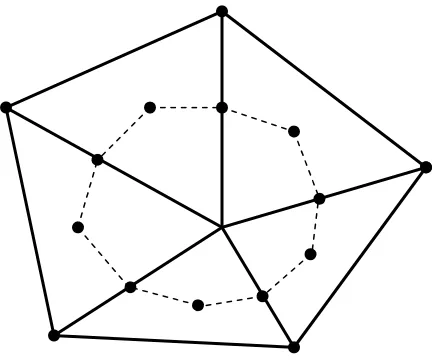
construction, called the dual grid37. Several options are available for the definition of the
dual grid, and the current implementation uses a median dual grid where cell faces are
formed from endpoints defined by the edge center between two nodes, and the cell center
(area center in two dimensions) of the associated cell. The median dual results in two
faces associated with each grid edge defined by the original grid connectivity, one face
connecting to each cell center to the left and right of the edge as shown in Figure 1.
--Figure 1 - Definition of the Dual Grid.
The solution is advanced in time to a steady state for steady state solutions, or to a
specified time or iteration count for time accurate solutions. In the initial solver, grid
motion was not accounted for in the solution evolution, and grid motion resulted in a
perturbation to the solution. Perturbations from grid motion are iterated out over time for
steady calculations, but these perturbations prevented accurate prediction of unsteady
flows. Extension to time accurate simulations required modification of cell face fluxes to
account for the motion of the grid. Flux calculations at the cell interface are updated to
account for the convective velocity relative to the cell face motion and the integration
scheme is updated to account for the unsteady residual resulting from the volume change
in each cell as the grid moves. The following sections outline the changes to the base two
dimensional flow solver required to produce time accurate predictions for transient flows.
3.1
Modified Integration Scheme
Adaption of two dimensional grids results in volume changes in each cell which must
be accounted for in the integration of the conservation law. The volume is usually
constant for the integral of equation 10, resulting in the form shown in equation 11.
When taken in the context of grid adaption the cell volume is no longer constant and must
be retained as such in the time integration. The result is a non-linear term consisting of
the volume multiplied by the solution vector represented as
) ( ~ )
( 1
1 1
+ +
+
− = ∆
− n
net n
n n n
Q F t
Q V Q V
(12)
Linearization is achieved by expanding the equation at the new time level and
defining an unsteady residual term which incorporates the variation of volume and the
solution as the equations are evolved in time. The resulting unsteady residual is solved
by incorporating sub-iterations to remove the effect of volume change as the solution
) ( ~ , 0 , , 1 1 k n net n n k n n
unsteady F Q
t Q V Q V R + ∆ − = + + (13)
which must be driven to zero to maintain time accuracy. The sub-iterations are
performed using the four stage Runge-Kutta method applied to the unsteady residual. The
modified Runge-Kutta33,38 is defined as
unsteady n n k n R V t Q
Q +1, +1 = 0 − 1 ∆+1
α (14)
where the flux value in equation 11 is replaced by the unsteady residual defined in
equation 13. A new sub-iteration time step has also been introduced. The new timestep is
a pseudo timestep introduced to perform sub-iterations to advance the solution from time
level n to time level n+1. The sub-iteration timestep is defined as
s s i t CFL t t ∆ + ∆ = ∆ 1 1 1 (15)
where CFLsrepresents the CFL value for the sub-iterations and ∆ti represents the pseudo
timestep for the sub-iterations. Converging the sub-iterations to a specified tolerance at
each time step regains the time accuracy after the grid movement.
3.2
Flux Corrections
The flowfields under consideration are governed by the unsteady two dimensional
Euler equations. The equations are modified to include the grid movement terms resulting
equations represent the governing equations for unsteady inviscid flow with grid
movement.
In the context finite volume solvers, the result of the above modification is an
adjustment to the inviscid interface flux to account for the cell face movement. The
modification of the cell face flux is easily made to any upwinding scheme which splits the
inviscid interface flux into convective and pressure contributions, such as AUSM39,
AUSMV40, and LDFSS41. For example consider the flux defined by
P f c f P c E P A E n V A E E
E= + = ρ int ⋅ˆ~ + ~ (16)
where the flux is split in convective and pressure contributions. Af represents the area of
the face and Vint is the convective velocity defined at the cell face based on the cell face
outward normal nˆ. The convective and pressure terms are defined as
= = 0 0 1 0 ~ ; 1 ~ P E H v u
Ec ρ P (17)
The convective velocity at the cell face must be adjusted to account for the movement
of the cell face after each adaption step. The first attempt to correct the cell face velocity
used the method developed for structured grids. First the cell face velocity is calculated
using a first order difference equation given by
for the x and y coordinate directions respectively. Values of xtand yt represent the
velocity of the cell face in the x and y coordinate directions respectively, while xf and
f
y represent the locations of the cell face midpoint at the n and n+1 timesteps. These
differences are calculated using the cell face centers of the median dual grid, instead of
the coordinate locations. This was found to give a more accurate representation of the
cell face movement for an unstructured grid. Modifying the cell face convective velocity
to account for the grid movement results in the cell interface flux velocity
(
t)
x f(
t)
y ff u x n A v y n A
A n
Vint ⋅ ˆ = − + − (20)
where nˆ =nxiˆ+nyˆj.
Using the interface velocity defined by equation 20 introduces an error in the energy
equation arising from the convection of enthalpy term in equation 17, where enthalpy is a
combination of energy and pressure defined as
(
)
ρ
P E
H T +
= (21)
The modified convective velocity produces a non-physical reduction in enthalpy due
to the pressure term in the convection of enthalpy equation in the flux calculation. A
modification to the enthalpy term in the flux calculation is needed to remove the pressure
correction26 by subtracting
(
t x t y)
f xn yn
PA + (22)
This single point definition of cell face velocity has been shown to give temporally
undergo pure translation during adaption. However, for unstructured grids, and
structured grids for more general problems, the cell faces will translate, rotate, and stretch
as a result of node movement. In this case, assuming pure translation of the cell face will
not give an accurate calculation of the cell volume change or the cell face flux. Therefore
a new gridspeed definition is needed which will account for all modes of motion.
3.3
Deficiencies in Gridspeed Definition
To illustrate the conservation problems observed using the previous method, a closed
volume with quiescent initial conditions will be examined. The domain is the same
domain used for the shock tube problems with the pressure ratio set to 1:1. When the 1:1
shock tube is started, there should be no perturbation of the quiescent conditions and all
state variables should remain constant. Using the adaption process in this situation causes
small movements in the grid as nodes are relocated by the center of mass algorithm as the
grid is effectively smoothed. This relaxes the grid to a more uniform distribution of areas.
It also results in small distortions and rotations of the cell faces.
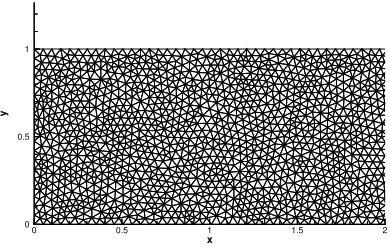
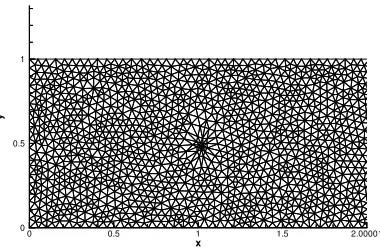
Figure 2 shows the unadapted initial grid. The distribution of cell area in the initial
grid is generally uniform and there are no significant distortions in the cell or node
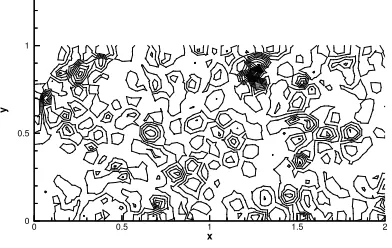
distributions. Figure 3 shows the same section of the domain after five iterations through
the adapter and flow solver, using the initial method of calculating the gridspeed terms
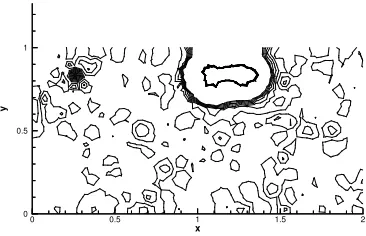
without the averaging process. Since the pressure ratio was 1:1, there are no features
within the flow for the adapter to resolve. To further eliminate any influence from the