Copyright 0 1984 by the Genetics Society of America
DOES
CHI
GIVE
OR TAKE?
FRANKLIN W. STAHL, M. LIEB’ AND MARY M. STAHL
Institute of Molecular Biology, University of Oregon, Eugene, Oregon 97403
Manuscript received May 14, 1984 Revised copy accepted Accepted August 20, 1984
ABSTRACT
In lytic cycle crosses with Red-Gam3 phage, particles were examined that had undergone an Int-mediated exchange. It was assumed that this exchange dimerized the circular A, making it packageable. Among these Int-mediated recombinants, particles were identified that had, in addition, enjoyed a close double exchange mediated by the RecBC pathway. Such close double ex- changes indicate localized negative interference and are analogous to eukar- yotic conversions that have retained parental configuration of flanking markers. These events are stimulated by Chi, a recombinator specific to the RecBC pathway. When Chi is present in only one parent in the cross, the complemen- tary double exchange recombinants are Chi stimulated to the same degree. This behavior of Chi contrasts with that of characterized eukaryotic recombi- nators.
LL current models for homologous genetic recombination hypothesize the
A
loss of DNA from one chromosome and its replacement by DNA copied from the other to account for the gene conversion that frequently accompanies crossing over. T h e conversion-crossing over model of HOLLIDAY (1 968) attrib- uted all losses of information to mismatch-stimulated excision of DNA in het- eroduplexes formed by swapping of chains of like polarity. T h e gain of allelic information results when the single-chain gaps are refilled by repair synthesis. T h e chain swapping itself was precisely reciprocal. T h e assumption of strict reciprocality of single-chain swapping has since been set aside (for eukaryotes) because of failures to find a variety of predicted symmetries in genetic data (see STAHL 1979 for an extended discussion.) T o accommodate those data better, alternate models were put forth in which conversion was not entirely dependent on mismatch correction. These models can be classified in the fol- lowing two ways:1. T h e first classification is according to whether there is or is not a hybrid DNA intermediate in the formation of a 6:2 tetrad. When a hybrid DNA intermediate is presumed, the formation of a 6:2 tetrad (“full conversion”) involves two kinds of DNA destruction and synthesis. T h e first kind is inde- pendent of genetic markers and involves the destruction of a single chain on one chromatid and its replacement by a single chain from its homologue. This
We dedicate this paper to the memory of our friend and colleague, George Streisinger.
’
Department of Microbiology, University of Southern California, Los Angeles, California 90033.796 F. W. STAHL, M. LIEB AND M. M. STAHL
event, which forms hybrid DNA on one chromatid only, will produce a 5:3 tetrad (“half-conversion”) if the event overlies a marked site and mismatch correction fails. If correction occurs, however, a 6:2 tetrad may result. If hybrid DNA is not presumed, then conversion must involve the loss of a duplex segment from one chromatid and its replacement by a duplex segment derived from the homologue. Hybrid DNA may bracket the event but will play a minor role in conversion if it is short compared to the donated duplex segment. We will call models of the first class “single-chain models” and those of the second class “double-chain models.”
2. T h e second classification is according to the relative timing of the syn- thesis and the destruction (of the noncorrection sort). In some models the initiating event is destructive; in others it is synthetic. Among familiar models, the Aviemore model (MESELSON and RADDINC 1975) is one in which the syn- thesis-destruction involves only one chain of each DNA duplex (a single-chain model) and the synthesis starts first. T h e sex-circle model (STAHL 1969, 1979) is a double-chain model in which the synthesis event, likewise, comes first. On the other hand, the double strand gap repair model (SZOSTAK et a l . 1983) is a double-chain model in which destruction precedes synthesis. In all of the models, intermediates are postulated that can be resolved with comparable probability to give or not to give crossing over of flanking markers.
In other places (STAHL 1979; SZOSTAK et a l . 1983) we have discussed criteria for testing the applicability of single-chain and double-chain models. In this paper we are concerned with the question of which component of conversion comes first, the destruction or the synthesis of DNA.
T h e impetus for these experiments comes from observations made on fungal recombinators (reviewed by MARKHAM and WHITEHOUSE 1982). Crosses in which only one parent carried the active recombinator were performed, and individual tetrads were analyzed for the recombinator and nearby markers whose conversion was demonstrably stimulated by the recombinator. These recombinators showed one or both of the following properties: ( 1 ) conversion to an excess of the inactive recombinator allele at a higher rate than conversion to an excess of the active allele or (2) preferential loss, through conversion, of alleles cis to the recombinator. Thus, these recombinators affect recombination through the loss of DNA linked to them. Their action is destructive. They “take” DNA from the homologue. [MARKHAM and WHITEHOUSE (1982) have interpreted these data to mean that recombinators invite the homologous chro- mosome to undertake a synthetic event that precedes the destruction cis to the recombinator. T h e recombinator invites the homologue to “give.” Of course, the genetic observations do not distinguish these possibilities; they ask only whether the recombinator-bearing chromosome tends to donate or receive information in a conversion event.] In this paper we investigate the behavior of Chi, an E. coli recombinator active in the RecBC pathway (for review, see STAHL 1979).
CHI GJVES AND TAKES 797
However, there are conversion-related aspects of recombination that are ac- cessible. A fraction of the exchange events in bacteria and phage are paired. In the Holliday and Aviemore models, these are the strand transfers that are completed without recombination of flanking markers (the “patches” of STAHL
1979). In the sex-circle and double-strand gap repair models these are the lengths of duplex that are transferred without accompanying recombination of flanking markers. Paired events have been shown to be Chi stimulated (STAHL et a l . 1982; KOBAYASHI et a l . 1983). If Chi is present on only one of the two interacting chromosomes, we can ask whether paired events (call them patches) arise equally often on the two chromosomes or whether, on the contrary, chromosomes with Chi give and take patches at unequal rates.
We have investigated that question using Chi in X that is mutated for its own recombination system and subject to recombination by E. coli’s RecBC pathway. T h e detection of patches in X particles under these conditions is complicated by the requirement that each chromosome must splice together with another chromosome to create a dimeric packaging precursor. T h e event that gives a patch does not result in dimeric X and will not be detected unless an avenue to packaging is provided. In the present study, the splice that ensures packageability is provided by the Int system operating on an especially reactive pair of attachment sites (att) (GOTTESMAN and WEISBERG 1971). T h e two parents differ by net deletions flanking att so that the Int-mediated cross- over particles can be detected by their buoyant density. One of these att-linked deletions along with a third deletion flank a marked site, or sites. Buoyant density allows the identification of particles that, although having enjoyed a crossover at att, are parental for the latter two deletions. Within these two complementary density-identified genotypes the patches of information trans- ferred from one parent to the other can be scored. When Chi is present in only one of the two parents, inequalities between these two classes will reveal whether Chi “gives” or “takes.”
MATERIALS AND METHODS
Phage mutations: The mutations employed are given in Table 1 (and see Figure 1). Revertant frequencies were less than for all Pam and Oam phage stocks. Revertant frequencies for clear mutants were likewise too low to intrude into the results reported here. Desired X genotypes were obtained by UV-stimulated in vivo crosses.
Bacterial strains: See Table 2.
Phage crosses: Cells in exponential phase (1 X 10⁸/ml) were mixed with phage at a ratio of one cell to seven of each of the two parents. Crosses with blocked DNA replication (in FA77) were not diluted following adsorption of phage to cells. Other crosses (in 594) were diluted five times after allowing 20 min for adsorption. The infected cultures were aerated for 90 min. Crosses in 594 were terminated with chloroform; FA77 crosses were terminated with chloroform plus egg white lysozyme.
Phage stocks: Phage were grown on plates from single plaques. The host was JC8679.
RESULTS
798 F. W. STAHL, M. LIEB AND M. M. STAHL
TABLE 1
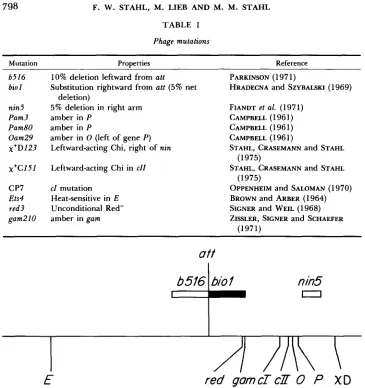
Phage mutations
Mutation Properties Reference
b516 bio I
nin5 Pam3 Pam80 Oam29 x+D I 2 3
x'C151
CP7 Ets4 red3 gam210
10% deletion leftward from att
Substitution rightward from att (5% net deletion)
5% deletion in right arm amber in P
amber in P
amber in 0 (left of gene P )
Leftward-acting Chi, right of nin
Leftward-acting Chi in c l l
c l mutation Heat-sensitive in E Unconditional Red- amber in gam
PARKINSON (1 97 1)
HRADECNA and SZYBALSKI (1 969)
FIANDT et al. (1 97 1) CAMPBELL ( 196 1) CAMPBELL ( 196 1) CAMPBELL (1 96 1)
STAHL, CRASEMANN and STAHL
STAHL, CRASEMANN and STAHL
OPPENHEIM and SALOMAN (1 970) BROWN and ARBER (1964) SIGNER and WEIL (1968) ZISSLER, SIGNER and SCHAEFER
(1 975)
(1 975)
(1971)
E
red gomcTcZT
0
P
X D
FIGURE 1.-Map of X showing the approximate locations of relevant genes, sites and markers (also see Table 1).
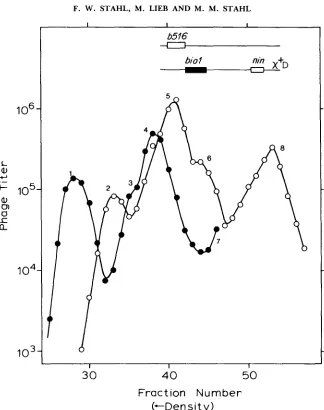
equilibrium density gradient. T h e Int-mediated recombinants are expected to be the most dense and the least dense types, banding separately from all other genotypes (Figure 3, peaks 1 and 8). Within these two peaks, patches are detected in either of two ways: (1) In some crosses, m l and m2 are mutant and wild type, respectively. In those crosses, patches are detected as m2 particles in the heavy peak and as m l particles in the light peak.
(2)
In other crosses, m land m2 are recombinable mutations in the same gene or adjacent genes. Patches are scored as m+ recombinants in the heavy and light peaks. Most crosses were accompanied by Chi- controls to verify that the patches scored were, in fact, Chi stimulated.
In Figure 3, the heights of the two Int-mediated recombinant peaks are seen
CHI GIVES AND TAKES 799
TABLE 2
Escherichia coli K 1 2 Strains
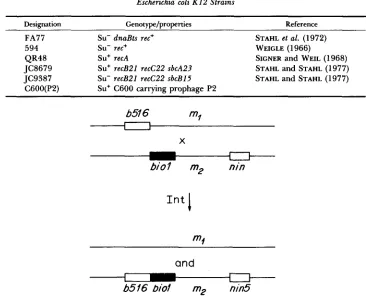
Designation ¬ ype/properties Reference
FA77 Su- dnaBts rec+ STAHL et al. (1972)
594 Su- rec+ WEIGLE (1966)
QR48 Su+ recA SIGNER and WEIL (1968)
JC8679 Su' recB21 recC22 sbcA23 STAHL and STAHL (1977) JC9387 Su- recB21 recC22 sbcB15 STAHL and STAHL (1977)
C600(P2) Su+ C600 carrying prophage P2
b516
X
and
b 5 f 6 bio? mz nin5
FIGURE 2.-Type of cross to ask whether Chi gives or takes patches. For a description of the markers, see Table 1 and Figure 1. Int-mediated exchange produces b516 biol and the comple- ment, b516+ biol'. Among each of these recombinants there is a class that is not recombinant for
biol and nin. These phages, b516 biol nin5 and b516+ b w l + nin5+ will be, respectively, the least and the most dense genotypes produced. They can be separated from all other types in a cesium formate equilibrium gradient (see Figure 3). The Red- Gam- conditions required for maximum Chi activity are achieved by the biol substitution in one parent and by red3 gam210 mutations in the other.
of one as of the other, and the difference is never more than two-fold. T h e differences may represent fluctuations in the efficiencies of plating of the bac- terial indicator strains used. They are not large enough to endanger our pri- mary conclusion.
T h e size of the Int-mediated recombinant peaks is expected to be independ- ent of the presence of an added Chi, since Chi stimulates only generalized recombination (via the RecBC pathway). T h e sizes of some of the other peaks are also likely to be insensitive to an added Chi, since
X biol
already contains a (leftward-acting) Chi in the bio substitution (HENDERSON and WEIL 1975; MCMILIN, STAHL and STAHL 1974; MALONE et al. 1978).Intragenic crosses to detect patches: Recombinants between markers in the same gene are frequently parental for flanking markers (see STAHL 1979 and WHITE-
800
IO6
L
Q,
._
I-
IO5
a,
0, cl
r
a
1 OL
10’
F. W . STAHL, M. LIEB AND M. M. STAHL
b5?6
i
.I
I 3 0
I 4 0
I 50
Fraction Number (-Den s i t y )
FIGURE 3.-The progeny from a cross like that in Figure 2 was centrifuged to near equilibrium in a cesium formate density gradient. The biol phages (0) were detected on a P2 lysogen, C600 (P2), which fails to plate bio+. The bio+ phages (0) were detected on a recA host (QR48), upon which the biol phages do not make plaques. Conditions for the cross are described in Figure 6b. The numbered peaks correspond to the following genotypes:
Peak no. Host Genotype
1 Q R 4 8 A+
2 C600(P2) biol
3 Q R 4 8 nin5
4 QR48 b516
5 C600( P2) biol nin5
6 C600(P2) b516 biol
7 Q R 4 8 b516 nin5
CHI GIVES AND TAKES 801
IO6 -
io5-
L a,
? !
a, 0
L
+ io4-
a
io3-
I O 2 -
I I I I
2 0 3 0 40 50
I I I I
10 2 0 3 0 40
Fraction d u m b e r
(-Density)
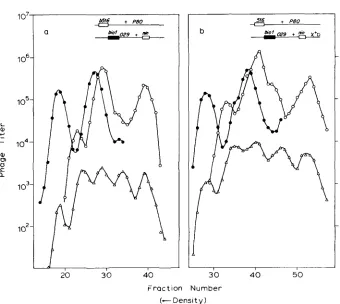
FIGURE 4.-Intragenic crosses to detect Chi-induced patches. The crosses were in FA77, so that DNA replication was blocked. Among total phage, genotypes are identified as described in Figure
3. The P+ recombinants (A) were detected on bacterial strain JC9387. a, xo; b, x+D.
from patches. When the patch covers one marked site only, then a duplex arises that is recombinant on at least one chain. If the patch involves the transfer of one chain across both marked sites, then mismatch correction at one site or the other may generate the scored recombinant. Our intragenic crosses involve two amber mutations in the P gene, located between biol and
nin5. Patches are conveniently scored by plating the density fractions on a host selective for am+ recombinants.
T h e results of such a cross, performed in the absence of Chi, are shown in Figure 4a. In that figure, those P+ phages (lower curve) that result from patches in Int-mediated recombinants are identifiable as the heaviest and light- est peaks. These recombinants are about 15% of all P+ recombinants and are, therefore, an even larger fraction of the P+ recombinants that have had an Int-mediated exchange. This high frequency of retention of parental flanking deletions among P+ phages justifies our designation of “patch.”
802
10'-
lo6-
io5-
L
?!
+ lo4- 0,
r a
lo3.
IO2
F. W. STAHL, M. LIEB AND M. M. STAHL
a
e
P3 +k
1I
2 0 3 0 40
P3 t
b
1 I 1
2 0 3 0 40
F r a c t i o n Number (-Density)
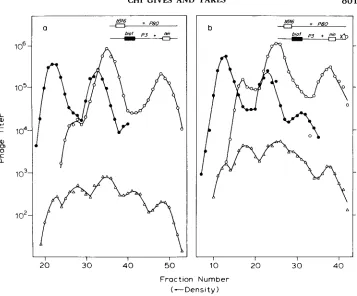
FIGURE 5.-Reversal of markers in intragenic replication-blocked crosses to detect Chi-induced
patches. T h e positions of the P markers are reversed from those in Figure 4. Key as in Figures 3
and 4. a, xo; b, x'D.
between x+D and the two P alleles. In one cross (Figure 4) the frequencies of patches in the lightest and heaviest peaks are each increased four- to five-fold by Chi. In the other (Figure 5 ) , they are each increased ten-fold. These results imply that the chromosome carrying Chi gives and receives patches with equal frequency.
Zntergenic crosses to detect patches: T h e intragenic crosses described were per- formed under conditions (P-, dnaB-) that block DNA replication (MCMILIN
and RUSSO 1972). We presume, therefore, that the progenies examined rep- resent immediate products of recombination. We varied the cross and condi- tions to test the generality of the results. In our intergenic crosses, m l and m 2
CHI GIVES AND TAKES 803
1 o7
IO6
io5
L
c a, -
t io4
8
0
.c
a
io3
IOZ
P
20 3 0 40
a
+ P80b
I
3 0 40 50
F r a c t i o n Number
(-Density)
FIGURE 6.--Intergenic crosses to detect Chi-induced patches. Crosses in 594, so that DNA
replication was normal. Key for total phage as in Figure 3. The O+P+ recombinants (A) were detected on JC9387. a, xo; b, x+D.
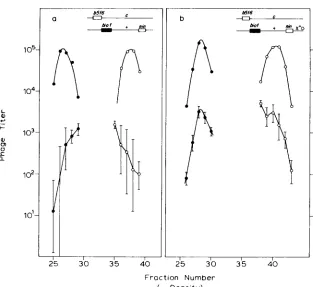
One-factor cross to detect patches: x + D increases splice formation as far away as the c l gene (LAM et a l . , 1974). Thus, we may expect to see stimulation of patches at cl by x+D. Our cross (Figure 8) had a c l mutation in one parent, whereas the other parent was cl+. We enumerated patches as clear plaques among a large majority of turbids in one Int-mediated peak and as turbids among a majority of clears in the other. Although the data are few, it is apparent that the t w o c l patches are stimulated by x+D and by about the same factor.
804
106
io5
b
e, lo4
c - +
0
c
a
1
o3
1 0 2
F. W. STAHL, M. LIEB AND M. M. STAHL
I I I I
2 0 3 0 40 50
b
,
3 0 40 50
4
3
Fraction Number
(-Density)
FIGURE 7.-Reversal of markers in intergenic crosses to detect Chi-induced patches. T h e posi- tions of the 0 and P markers are reversed from those in Figure 6. Key as in Figures 3 and 4. a,
xo; b, x+D.
DISCUSSION
L
QJ v
t
QJ m 0
.!z a .-
10"
io4
io3
102
10'-
CHI GIVES AND TAKES
I I I I
25 3 0 3 5 40 25 I 3 0 I 35 I 40 I
805
F r a c t i o n Number (-Dens1 t y )
806 F. W. STAHL, M. LIEB AND M. M. STAHL
.-
I-
lo4
x+c
b516
bi0 I nin
2 0
3 0
4’0F r a c t i o n Number
(+- D e n s i t y )
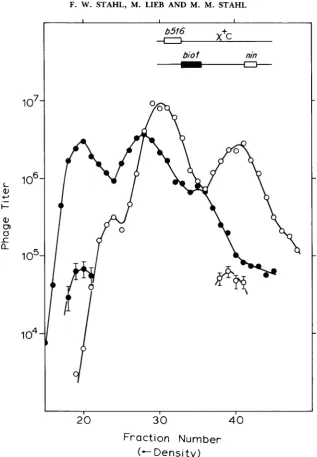
FIGURE 9.-A cross in which x+C is the marker, performed in 594. Scoring and key as in Figure 8.
recombination-Chi may facilitate the resolution of a recombinational inter- mediate, such as a Holliday junction. Any nonreciprocality in a given junction (such as “asymmetric hybrid DNA”) would bear no relation to which parent carried Chi. Thus, no matter what the mechanism by which Chi resolved the junction, Chi would be seen to give and take patches equally.
CHI GIVES AND TAKES 807
LITERATURE CITED
BROWN, A. and W. ARBER, 1964 Temperature-sensitive mutants of coliphage lambda. Virology 2 4 237-239.
CAMPBELL, A., 1961
FAULDS, D., N. DOWER, M. M. STAHL and AND F. W. STAHL, 1979
FIANDT, M., Z. HRADECNA, H. A. LOZERON and W. SZYBALSKI, 1971
Sensitive mutants of bacteriophage lambda. Virology 1 4 22-32.
Orientation-dependent re- combination hotspot activity in bacteriophage A. J. Mol. Biol. 131: 681-695.
Electron micrograph map- ping of deletions, insertions, inversions, and homologies in the DNAs of coliphages lambda and Phi 80. pp. 329-354. In: The Bacteriophage Lambda, Edited by A. D. HERSHEY. Cold Spring Harbor Laboratory, Cold Spring Harbor, New York.
Prophage insertion and excision. In: The Eacte- riophage Lambda, Edited by A. D. HERSHEY. Cold Spring Harbor Laboratory, Cold Spring Harbor, New York.
HENDERSON, D. and J. WEIL, 1975 Recombination deficient deletions in bacteriophage X and their interaction with chi mutations. Genetics 7 9 143-174.
HOLLIDAY, R., 1968 Genetic recombination in fungi. pp. 157-174. In: Replication and Recombi- nation of Genetic Material, Edited by W. J. PEACOCK and R. D. BROCK. Australian Academy of Science, Canberra.
Electron micrographic maps of deletions and substitutions in the genomes of transducing coliphages Xdg and Xbio. Virology 38: 473-477.
Coupling with packaging explains apparent nonreciprocality of Chi-stimulated recombination of bacteriophage lambda by RecA RecBC functions. Genetics 108: 773-794.
The interaction of cos with Chi is separable from DNA packaging in recA-recBC-mediated recombination of bacteriophage lambda. Genetics 1 0 4 540-570.
Rec-mediated recombinational hot spot activity in bacteriophage lambda. 11. A mutation which causes hot spot activity. Genetics 77: 425-433.
Hotspots for generalized recombination in the Escherichia coli chromosome. J. Mol. Biol. 121: 473-491.
A hypothesis for the initiation of genetic recom- bination in eukaryotes. Nature 295: 421-423.
Maturation and recombination of bacteriophage lambda DNA molecules in the absence of DNA duplication. J. Mol. Biol. 6 8 49-55.
Rec-mediated recombinational hotspot activity in bacteriophage lambda. I. Hotspot activity associated with Spi deletions and bio
substitutions. Genetics 77: 409-423.
MESELSON, M. S. and C. M. RADDING, 1975 A general model for genetic recombination. Proc. Natl. Acad. Sci. USA 7 2 358-361.
OPPENHEIM, A. B. and D. SALOMAN, 1970 Studies on partially virulent mutants of lambda bac-
PARKINSON, J. S., 1971 Deletion mutants of bacteriophage lambda. 11. Genetic properties of att-
SIGNER, E. R. and J. WEIL, 1968 Recombination in bacteriophage X. I. Mutants deficient in
One way to think about gene conversion. Genetics 61 (Suppl. 1 , Part 2): 1-
GOTTESMAN, M. E. and R. A. WEISBERG, 1971
HRADECNA, Z. and W. SZYBALSKI, 1969
KOBAYASHI, I., M. M. STAHL, F. R. FAIRFIELD and F. W. STAHL, 1984
KOBAYASHI, I., M. M. STAHL, D. LEACH and F. W. STAHL, 1983
LAM, S. T., M. M. STAHL, K. D. MCMILIN and F. W. STAHL, 1974
MALONE, R. E., D. K. CHATTORAJ, D. H. FAULDS, M. M. STAHL and F. W. STAHL, 1978
MARKHAM, P. and H. L. K. WHITEHOUSE, 1982
MCMILIN, K. D. and V. E. A. Russo, 1972
MCMILIN, K. D., M. M. STAHL and F. W. STAHL, 1974
teriophage. I. Isolation and general characterization. Virology 41: 15 1-1 59.
defective mutants. J. Mol. Biol. 5 6 385-401.
general recombination. J. Mol. Biol. 3 4 261-271.
13.
aoa
STAHL, F. W., 1979 Genetic Recombination. Thinking About It in Phage and Fungi. W. H. Freeman,
STAHL, F. W., J. M. CRASEMANN and M. M. STAHL, 1975 Rec-mediated recombinational hotspot activity in bacteriophage lambda. 111. Chi mutations are site-mutations stimulating Rec-medi- ated recombination. J. Mol. Biol. 9 4 203-212.
STAHL, F. W., K. D. MCMILIN, M. M. STAHL, R. E. MALONE, Y. Nozu and V. E. A. Russo, 1972 A role for recombination in the production of “free-loader” lambda bacteriophage particles. J. Mol. Biol. 6 8 57-67.
Rec-mediated recombinational hotspot activity in bacte- F. W. STAHL, M. LIEB AND M. M. STAHL
San Francisco.
STAHL, F. W. and M. M. STAHL, 1975
riophage A. IV. Effect of heterology in Chi-stimulated crossing over. Mol. Gen. Genet. 140 29-37.
STAHL, F. W. and M. M. STAHL, 1977
STAHL, F. W., M. M. STAHL, R. E. MALONE and J. M. CRASEMANN, 1980
STAHL, F. W., M. M. STAHL, L. YOUNG and I. KOBAYASHI, 1982
Recombination pathway specificity of Chi. Genetics 86:
Directionality and
Chi-stimulated recombination 715-725.
nonreciprocality of Chi-stimulated recombination in phage A. Genetics 94: 235-248.
between phage X and the plasmid Xdv. Genetics 102 599-613.
break repair model for recombination. Cell 33: 25-35.
SZOSTAK, J. W., T. L. ORR-WEAVER, R. J. ROTHSTEIN and F. W. STAHL, 1983
WEIGLE, J., 1966 Assembly of phage lambda in vitro. Proc. Natl. Acad. Sci. USA 55: 1462i1466.
WHITEHOUSE, H. L. K., 1982 Genetic Recombination: Understanding the Mechanisms. John Wiley and Sons, New York.
ZISSLER, J., E. SIGNER and F. SCHAEFER, 1971 The role of recombination in growth of bacteri- ophage lambda. I. The gamma gene. pp. 455-468. In: The Bacteriophage Lambda, Edited by A. D. HERSHEY. Cold Spring Harbor Laboratory, Cold Spring Harbor, New York.
The double strand