Efficient Statistical Asynchronous Verifiable
Secret Sharing and Multiparty Computation
with Optimal Resilience
IArpita Patra∗,1,2, Ashish Choudhury1,3, C. Pandu Rangan1,4
Abstract
Verifiable Secret Sharing (VSS) is a fundamental primitive used as a building block in many distributed cryptographic tasks, such as Secure Multiparty Com-putation (MPC) and Byzantine Agreement (BA). An important variant of VSS is Asynchronous VSS (AVSS) which is designed to work over asynchronous net-works. AVSS is a two phase (Sharing, Reconstruction) protocol carried out among𝑛 parties in the presence of acomputationally unbounded active adver-sary, who can corrupt up to𝑡parties. We assume that every two parties in the network are directly connected by a pairwise secure channel.
In this paper, we present a new statistical AVSS protocol with optimal resilience; i.e. with 𝑛 = 3𝑡 + 1. Our protocol privately communicates 5
𝒪((ℓ𝑛3+𝑛4log1
𝜖) log1𝜖) bits andA-casts6 𝒪(𝑛3log(𝑛)) bits to simultaneously
shareℓ≥1 elements from a finite field𝔽, where𝜖is the error parameter of our protocol.
There are only two known statistical AVSS protocols with𝑛= 3𝑡+1 reported in [22] and [61]. The AVSS protocol of [22] requires a private communication of 𝒪(𝑛9(log1
𝜖)4) bits and A-cast of 𝒪(𝑛9(log1𝜖)2log(𝑛)) bits to share a single
element from 𝔽. Thus our AVSS protocol shows a significant improvement in
IThis is an extended and elaborate version of [62] ∗Corresponding author
Email addresses: arpitapatra [email protected], [email protected](Arpita Patra),partho [email protected], [email protected](Ashish Choudhary),
[email protected], [email protected](C. Pandu Rangan)
1Department of Computer Science and Engineering, IIT Madras, Chennai India 600036. 2Financial support from Microsoft Research India acknowledged. The author would also
like to thank the organizing committee of ICITS 2009 for financial support to attend the conference, where a preliminary version of the paper was presented.
3Financial Support from Infosys Technology India Acknowledged. The author would also
like to thank IARCS for providing financial support to attend ICITS 2009, where a preliminary version of the paper was presented.
4Work Supported by Project No. CSE/05/06/076/DITX/CPAN on Protocols for Secure Computation and Communication, Sponsored by Department of Information Technology, Govt. of India.
5Communication over secure channels
6A-castis the asynchronous equivalent ofbroadcastin synchronous world. A-castallows a
communication complexity over the AVSS of [22]. The AVSS protocol of [61] requires a private communication andA-castof𝒪((ℓ𝑛3+𝑛4) log1
𝜖) bits to share
ℓ≥1 elements. However, the shared element(s) may be𝑁 𝑈 𝐿𝐿∕∈𝔽. Thus our AVSS is better than the AVSS of [61] due to the following reasons:
1. TheA-cast communication of our AVSS isindependentof the number of secrets i.e. ℓ;
2. Our AVSS makes sure that the shared value(s) always belong to𝔽. Using our AVSS, we design a new primitive called Asynchronous Complete Secret Sharing (ACSS) which acts as an important building block of asyn-chronous multiparty computation(AMPC). Using our ACSS scheme, we design a statistical AMPC protocol withoptimal resilience; i.e., with𝑛= 3𝑡+1, that pri-vately communicates𝒪(𝑛5log1
𝜖) bitsper multiplication gate. This significantly
improves the communication complexity of only known optimally resilient statis-tical AMPC of [15] that privately communicates Ω(𝑛11(log1
𝜖)4) bits andA-cast
Ω(𝑛11(log1
𝜖)2log(𝑛)) bits per multiplication gate. Both our ACSS and AVSS
employ several new techniques, which are of independent interest.
Key words: Asynchronous Networks, AVSS, Optimal Resilience, AMPC, Information Theoretic Security.
1. Introduction
VSS is one of the fundamental building blocks for many secure distributed computing tasks, such as multiparty computation (MPC) [2, 12, 3, 4, 5, 13, 9, 10, 11, 15, 7, 20, 23, 27, 28, 31, 42, 41, 45, 47, 49, 50, 65, 67, 69, 60], Byzantine Agreement (BA) [37, 22, 55, 1, 61], etc. Any VSS scheme consists of a pair of protocols (Sh, Rec). ProtocolSh5allows a special party called dealer(denoted
as𝐷), to share a secret𝑠∈𝔽(an element from a finite field𝔽) among a set of𝑛 parties in a way that allow for a unique reconstruction of𝑠by every party using protocolRec 6. Moreover, if 𝐷 ishonest, then the secrecy of 𝑠is preserved till
the end of Sh.
Over the last three decades, active research has been carried out in this area by several researchers, and many interesting and significant results have been obtained dealing with high efficiency, security against general adversaries, se-curity against mixed types of corruptions, long-term sese-curity, provable sese-curity, etc (see [24, 33, 53, 7, 42, 13, 23, 34, 35, 66, 27, 15, 22, 67, 38, 39, 41, 54, 59, 9, 11, 45, 60, 29, 26, 19, 43, 16, 64, 37, 36, 6, 21, 14, 32, 40, 58, 70, 18, 44] and their references). However, almost all of these solutions are for the synchronous model, where it is assumed that every message in the network is delayed at most by a given constant. This assumption is very strong because a single de-layed message would completely break down the overall security of the protocol.
Therefore, VSS protocols for the synchronous model are not suited for real world networks like the Internet.
Later, VSS protocols for the asynchronous network were developed [15, 22]. Here, messages are allowed to be delayed arbitrarily. However, in comparison to the VSS in synchronous settings, research in VSS in the asynchronous settings has attracted much less attention. Known asynchronous VSS protocols are of theoretical interest only and involve high communication complexity. Surpris-ingly, the techniques used for designing efficient VSS protocols in synchronous networks cannot be adapted directly to the asynchronous setting. This mo-tivated us to design asynchronous VSS protocols taking a fresh look at the problem.
1.1. Model
In this paper, we follow the network model of [19]. Specifically, we as-sume that an AVSS protocol is carried out among a set of 𝑛 parties, say 𝒫 ={𝑃1, . . . , 𝑃𝑛}, where every two parties are directly connected by a secure
channel and𝑡out of the𝑛parties can be under the influence of acomputationally unbounded Byzantine (active) adversary, denoted as𝒜𝑡. The Byzantine
adver-sary𝒜𝑡completely dictates the parties under its control and can force them to
deviate from a protocol, in any arbitrary manner. We assume𝒜𝑡to berushing
[59, 39, 27], who first listens all the messages sent to the corrupted parties by the honest parties, before allowing the corrupted parties to send their messages. The parties not under the influence of𝒜𝑡are calledhonest or uncorrupted. We
assume that there is a specific party in 𝒫, called the dealer 𝐷, who wants to share the secret in AVSS protocol.
The underlying network is asynchronous, where the communication channels between the parties have arbitrary, yet finite delay (i.e the messages are guar-anteed to reach eventually). To model this,𝒜𝑡 is given the power to schedule
the delivery ofallmessages in the network. However,𝒜𝑡can only schedule the
messages communicated between honest parties, without having any access to the contents of the message. In asynchronous network, the inherent difficulty in designing a protocol comes from the fact that when a party does not receive an expected message then he cannot decide whether the sender is corrupted (and did not send the message at all) or the message is just delayed. So a party can not wait to consider the values sent by all parties, as waiting for all of them could turn out to be endless. Hence the values of up to𝑡 (potentially honest) parties may have to be ignored. Due to this the protocols in asynchronous net-work are generally involved in nature and require new set of primitives. For an comprehensive introduction to asynchronous protocols, see [19].
1.2. Definitions
We now give the definition of primitives which are used in this article. For all these primitives, we assume a finite field𝔽=𝐺𝐹(2𝜅), where𝜖= 2−Ω(𝜅)and𝜖is
the error parameter. Also without loss of generality, we assume𝑛= poly(𝜅) = poly(log1
𝜖). Thus each field element can be represented by 𝒪(𝜅) = 𝒪(log1𝜖)
Definition 1 (Statistical Asynchronous Weak Secret Sharing (AWSS) [61]). Let (Sh, Rec) be a pair of protocols in which a dealer 𝐷 ∈ 𝒫 shares a secret𝑠
usingSh. We say that (Sh7, Rec8) is a𝑡-resilient statistical AWSS scheme if all the following hold:
∙ Termination: With probability at least 1−𝜖, the following requirements hold:
1. If 𝐷 is honest then each honest party will eventually terminate pro-tocol Sh.
2. If some honest party has terminated protocolSh, then irrespective of the behavior of𝐷, each honest party will eventually terminateSh.
3. If all honest parties have terminated Sh and invokedRec, then each honest party will eventually terminateRec.
∙ Correctness: With probability at least 1−𝜖, the following requirements hold:
1. Correctness 1 (AWSS): If𝐷is honest then each honest party upon terminatingRec, outputs the shared secret𝑠.
2. Correctness 2 (AWSS): If𝐷 is faulty and some honest party has terminated Sh, then there exists a unique 𝑠′ ∈ 𝔽∪ {𝑁 𝑈 𝐿𝐿}, such
that each honest party upon terminatingRec will output either 𝑠′ or 𝑁 𝑈 𝐿𝐿. This property is also called asweak-commitment.
∙ Secrecy: If𝐷 is honest and no honest party has begun executing protocol
Rec, then𝒜𝑡 has no information about𝑠.
Definition 2 (Statistical AVSS [12, 19]). It is same as statistical AWSS except thatCorrectness 2 (AWSS)property is strengthened as follows:
∙ Correctness 2 (AVSS): If 𝐷 is corrupted and some honest party has terminatedSh, then there exists a fixed𝑠′∈𝔽, such that each honest party
upon completing Rec, will output only𝑠′.
Definition 3 (𝑡-sharing [9, 11]). A value𝑠∈𝔽is said to be 𝑡-shared among the parties in𝒫 if there exists a random degree-𝑡 polynomial𝑓(𝑥) over𝔽, with
𝑓(0) = 𝑠 such that each (honest) party 𝑃𝑖 ∈ 𝒫 holds his share 𝑠𝑖 = 𝑓(𝑖) of
secret 𝑠. The vector of shares of𝑠corresponding to the honest parties is called
𝑡-sharing of 𝑠and is denoted by[𝑠]𝑡.
Typically, VSS is used as a tool for generating 𝑡-sharing of secret. That is, at the end of sharing phase, each honest party holds his share of the secret such that shares of all honest parties constitute distinct points on a degree-𝑡
polynomial. Such VSS protocols are reported in [13, 54]. On the other hand, there are VSS schemes that do not generate 𝑡-sharing of secret. They only ensure that a unique secret is shared / committed (during sharing phase) which will be uniquely reconstructed during reconstruction phase. Such schemes are presented in [38, 59, 22]. So we call a VSS scheme asComplete Secret Sharing
(CSS) scheme if it generates 𝑡-sharing of secret. More formally, we have the following definition:
Definition 4 (Statistical Asynchronous Complete Secret Sharing (ACSS)). Thetermination, correctnessandsecrecyproperty of ACSS are same as in AVSS. In addition, ACSS achieves the following completeness property at the end ofSh with probability at least(1−𝜖):
∙ Completeness: If some honest party terminates Sh, then there exists a random degree-𝑡 polynomial 𝑓(𝑥) over 𝔽, with 𝑓(0) = 𝑠′ such that each
(honest) party𝑃𝑖∈ 𝒫 will eventually hold his share𝑠𝑖 =𝑓(𝑖)of secret𝑠′.
Moreover, if 𝐷 is honest, then 𝑠′=𝑠.
The above definitions of AWSS, AVSS and ACSS can be extended for secret 𝑆 containing multiple elements (sayℓwithℓ >1) from𝔽.
Remark 1 (AWSS, AVSS and ACSS with Private Reconstruction). The definitions of AWSS, AVSS and ACSS as given above consider ”public recon-struction”, where all parties publicly reconstruct the secret in Rec. A common variant of these definitions consider ”private reconstruction”, where only some specific party, say𝑃𝛼 ∈ 𝒫, is allowed to reconstruct the secret in Rec. As per
our requirement in this paper, we present our AWSS and AVSS schemes with only private reconstruction. However, the protocols for public reconstruction for these schemes can be obtained by doing slight modification in the corresponding protocols for ”private reconstruction”.
In our protocols, we useA-castprimitive, which is formally defined as follows:
Definition 5 (A-cast [22]). A-castis an asynchronous broadcast primitive. It was introduced and elegantly implemented by Bracha [17] with𝑛= 3𝑡+1parties. LetΠbe an asynchronous protocol initiated by a special party (called the sender), having input𝑚(the message to be broadcast). We say that Π is a𝑡-resilient A-castprotocol if the following hold, for every possible behavior of𝒜𝑡:
∙ Termination:
1. If the sender is honest and all the honest parties participate in the protocol, then each honest party will eventually terminate the proto-col.
∙ Correctness: If the honest parties terminate the protocol then they do so with a common output 𝑚∗. Furthermore, if the sender is honest then 𝑚∗=𝑚.
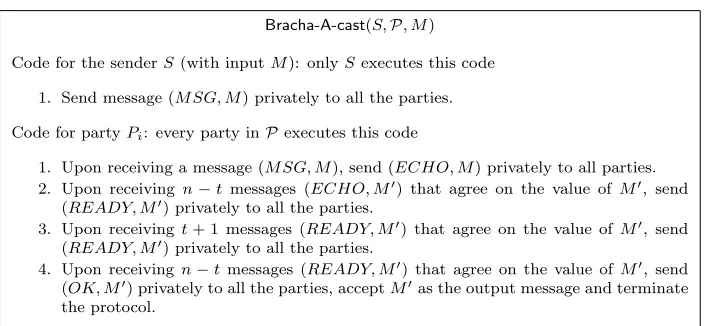
For the sake of completeness, we recall Bracha’s A-cast protocol from [19] and present it in Fig. 1.
Figure 1: Bracha’sA-castProtocol with𝑛= 3𝑡+ 1
Bracha-A-cast(𝑆,𝒫, 𝑀)
Code for the sender𝑆(with input𝑀): only𝑆executes this code
1. Send message (𝑀 𝑆𝐺, 𝑀) privately to all the parties.
Code for party𝑃𝑖: every party in𝒫executes this code
1. Upon receiving a message (𝑀 𝑆𝐺, 𝑀), send (𝐸𝐶𝐻𝑂, 𝑀) privately to all parties. 2. Upon receiving𝑛−𝑡messages (𝐸𝐶𝐻𝑂, 𝑀′) that agree on the value of𝑀′, send
(𝑅𝐸𝐴𝐷𝑌, 𝑀′) privately to all the parties.
3. Upon receiving𝑡+ 1 messages (𝑅𝐸𝐴𝐷𝑌, 𝑀′) that agree on the value of 𝑀′, send (𝑅𝐸𝐴𝐷𝑌, 𝑀′) privately to all the parties.
4. Upon receiving𝑛−𝑡messages (𝑅𝐸𝐴𝐷𝑌, 𝑀′) that agree on the value of𝑀′, send (𝑂𝐾, 𝑀′) privately to all the parties, accept𝑀′as the output message and terminate the protocol.
Theorem 1 ([19]). ProtocolA-castprivately communicates𝒪(ℓ𝑛2)bits for an
ℓbit message.
Notation 1 (Notation for Using A-cast). In the rest of the paper, we use the following convention: we say that 𝑃𝑗 receives 𝑚 from the A-cast of 𝑃𝑖, if
𝑃𝑗 completes the execution of 𝑃𝑖’s A-cast (the A-cast protocol where 𝑃𝑖 is the
sender), with𝑚 as the output.
Definition 6 (Online Error Correction (OEC)). Let 𝑠 be a secret which is 𝑡-shared among the parties in 𝒫 by a degree-𝑡 polynomial 𝑓(𝑥). So 𝑓(0) = 𝑠. Let 𝑃𝛼 ∈ 𝒫 be a specific party, who wants to reconstruct 𝑠. Towards this
every party𝑃𝑖 sends his share𝑠𝑖 of 𝑠to 𝑃𝛼. The shares may reach𝑃𝛼 in any
arbitrary order. Moreover, up to 𝑡 of the shares may be incorrect or missing. In such a situation, by applying OEC on the received𝑠𝑖’s, party𝑃𝛼can get the
interpolation polynomial 𝑓(𝑥) and reconstruct the secret 𝑠=𝑓(0) in an online fashion. The OEC method uses the properties of Reed-Solomon error correcting codes [56] and enables𝑃𝛼to recognize when the received shares define a unique
degree-𝑡 interpolation polynomial.
1.3. Existing Results for Statistical AVSS with Optimal Resilience
From [22], statistical AVSS tolerating𝒜𝑡is possible iff𝑛≥3𝑡+1. Therefore,
any statistical AVSS with𝑛= 3𝑡+ 1 parties is said to haveoptimal resilience. The known statistical AVSS protocols with optimal resilience are due to [22] and [61]. Both these AVSS schemes were designed to be used for construct-ingAsynchronous Byzantine Agreement(ABA) protocols. In the following, we summarize these two AVSS schemes.
1. The authors of [22] have presented a series of protocols for designing their AVSS scheme. They first designed a tool called Information Checking Protocol(ICP) which is used as a black box for another primitive Asyn-chronous Recoverable Sharing(A-RS). Subsequently, using A-RS, the au-thors have designed an AWSS scheme, which is further used to design a variation of AWSS called Two & Sum AWSS. Finally using their Two & Sum AWSS, an AVSS scheme was presented. Pictorially, the route taken by AVSS scheme of [22] is as follows: ICP→ A-RS → AWSS →
Two & Sum AWSS→AVSS. Since the AVSS scheme is designed on top of so many sub-protocols, it becomes highly communication intensive as well as very much involved. The scheme requires a private communication of𝒪(𝑛9(log1
𝜖)4) bits andA-cast𝒪(𝑛9(log1𝜖)2log(𝑛)) bits9to share a
sin-gleelement from𝔽. However, the AVSS scheme of [22] does not generate 𝑡-sharing of the secret. That is, the AVSS scheme of [22] is not an ACSS scheme and hence can not be used directly in AMPC.
2. The authors of [61] used the following simpler route to design their AVSS scheme: ICP → AWSS → AVSS. Moreover, due to the new design approach used in their ICP, AWSS and AVSS protocol, the AVSS of [61] provides much better communication complexity than the AVSS of [22]. So the AVSS protocol of [61] requires a private communication of 𝒪((ℓ𝑛3+𝑛4) log1
𝜖) bits and A-cast of 𝒪((ℓ𝑛3+𝑛4) log1𝜖) bits to share
ℓ≥1 elements. While the AVSS scheme of [61] is suitable for ABA prob-lem, it is not suitable for AMPC because:
(a) The AVSS scheme of [61] is not an ACSS scheme.
(b) In AVSS of [61], acorrupted𝐷may choose secrets from𝔽∪ {𝑁 𝑈 𝐿𝐿} rather than from𝔽only.
1.4. Our Contribution
We present a new statistical AVSS scheme with optimal resilience by fol-lowing the simple route of [61]. In the folfol-lowing table, we compare the com-munication complexity of our AVSS with the AVSS of [22, 61]. The table also shows the private communication complexity (CC) of the AVSS protocols after simulatingA-castusing the protocol of [17].
9The communication complexity analysis of the AVSS scheme of [22] was not done earlier
Ref. CC in bits CC in bits usingA-castof [17] # Secrets [22] Private–𝒪(𝑛9(log1
𝜖)4) 𝒪(𝑛9(log
1
𝜖)4+𝑛11(log
1
𝜖)2log𝑛) 1
A-cast–𝒪(𝑛9(log1
𝜖)2log(𝑛))
[61] Private–𝒪((ℓ𝑛3+𝑛4) log1
𝜖) 𝒪((ℓ𝑛5+𝑛6) log1𝜖) ℓ
A-cast–𝒪((ℓ𝑛3+𝑛4) log1
𝜖)
This Private–𝒪((ℓ𝑛3+𝑛4log1
𝜖) log
1
𝜖) 𝒪((ℓ𝑛3+𝑛4log
1
𝜖) log
1
𝜖+𝑛5log𝑛) ℓ
Article A-cast–𝒪(𝑛3log(𝑛))
As shown in the table, our AVSS attains significantly better communication complexity than the AVSS of [22] and [61] for any value ofℓ. As mentioned in the previous section, the AVSS of [61] has a weaker property than the AVSS of this article and [22]: A corrupted 𝐷 may choose secrets from 𝔽∪ {𝑁 𝑈 𝐿𝐿}. Such an AVSS is sufficient for designing ABA protocols. However, to be ap-plicable for AMPC, we require that AVSS should allow to share secret(s)only
from𝔽[15]. Our AVSS achieves this crucial property at a lesser communication cost. Using our AVSS, we design a new ACSS scheme, which is an essen-tial component ofasynchronous multiparty computation(AMPC) [15]. Though there are CSS schemes in synchronous settings, our ACSS scheme is first of its kind in asynchronous settings with 𝑛 = 3𝑡+ 1. In fact, using our ACSS, we construct an efficient statistical AMPC with optimal resilience; i.e., with 𝑛 = 3𝑡+ 1, which privately communicates 𝒪(𝑛5log1
𝜖) bits per multiplication
gate. This is a significant improvement over theonly known statistical AMPC of [15] with 𝑛 = 3𝑡+ 1 that privately communicates Ω(𝑛11(log1
𝜖)4) bits and A-castΩ(𝑛11(log1
𝜖)2log(𝑛)) bits per multiplication gate.
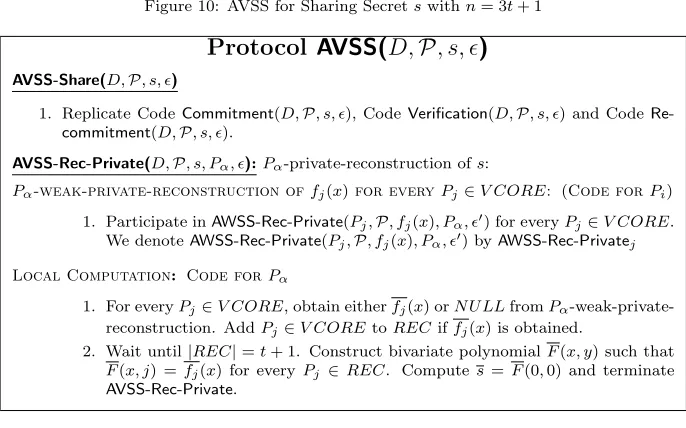
In order to design AVSS, we first propose a new Information Checking Pro-tocol (ICP) which significantly improves the communication complexity of the ICP of [61]. Using our ICP, we design an AWSS which is inspired by the AWSS of [61]. Finally our AWSS is used in constructing our new AVSS proto-col. The design approach of our AVSS and ACSS are the main essence of this article. In sum, our route for constructing the AMPC protocol is as follows: 𝐼𝐶𝑃 →𝐴𝑊 𝑆𝑆→𝐴𝑉 𝑆𝑆→𝐴𝐶𝑆𝑆→𝐴𝑀 𝑃 𝐶.
1.5. Organization of the Paper
2. Information Checking Protocol (ICP) and IC Signature
The Information Checking Protocol (ICP) is a tool for authenticating mes-sages in the presence of computationally unbounded corrupted parties. The notion of ICP was first introduced by Rabin et.al [67] who have designed an ICP insynchronoussettings. The ICP of Rabin et. al. was also used as a tool by Canetti et. al. [22] for designing their AVSS scheme.
As described in [67, 22, 27], an ICP is executed among three parties: adealer
𝐷, an intermediary 𝐼𝑁 𝑇 and a verifier 𝑅. The dealer 𝐷 hands over a secret value𝑠 to 𝐼𝑁 𝑇. At a later stage, 𝐼𝑁 𝑇 is required to hand over 𝑠 to 𝑅 and convince𝑅 that 𝑠is indeed the value which𝐼𝑁 𝑇 received from𝐷. The basic definition of ICP involves only asingleverifier 𝑅 [67, 27, 22]. We extend this notion to multipleverifiers, where all the𝑛 parties in𝒫 act as verifiers. Thus our ICP is executed among three entities: a dealer 𝐷 ∈ 𝒫, an intermediary 𝐼𝑁 𝑇 ∈ 𝒫 and the entire set 𝒫 acting as verifiers. This will be later helpful in using ICP as a tool in our AWSS protocol. Moreover, in contrast to the existing ICP protocols that deal with single secret, our ICP can deal withmultiplesecrets
concurrentlyand thus achieves better communication complexity than multiple execution of ICP dealing with single secret. Note that, as opposed to the case of a single verifier, when multiple verifierssimultaneouslyparticipate in ICP, we need to distinguish between synchronity and asynchronity of the network. Our ICP is executed in asynchronous settings and thus we refer it as AICP. As in [67, 22], our AICP is also structured into sequence of following three phases:
1. Generation Phase: This phase is initiated by𝐷. Here𝐷hands over the secret 𝑆 containingℓelements from 𝔽tointermediary𝐼𝑁 𝑇. In addition, 𝐷 sends some authentication information to 𝐼𝑁 𝑇 and some verification informationto individual verifiers in𝒫.
2. Verification Phase: This phase is initiated by 𝐼𝑁 𝑇 to acquire an IC Signature on𝑆 that will be later accepted by every honest verifiers in𝒫. Depending on the nature of 𝐷, 𝐼𝑁 𝑇 may or may not receive IC Signa-ture from 𝐷. When 𝐼𝑁 𝑇 receives IC Signature, he decides to continue AICP and later participate in Revelation Phase. On the other hand, when 𝐼𝑁 𝑇 does not receive IC Signature, he aborts AICP and does not participate in Revelation Phase later. The IC signature (when 𝐼𝑁 𝑇 receives it), denoted by 𝐼𝐶𝑆𝑖𝑔(𝐷, 𝐼𝑁 𝑇,𝒫, 𝑆) is nothing but the 𝑆 along with theauthentication informationwhich is/are held by𝐼𝑁 𝑇 at the end ofVerification Phase.
(b) 𝑃𝛼-private-revelation of 𝐼𝐶𝑆𝑖𝑔(𝐷, 𝐼𝑁 𝑇,𝒫, 𝑆): Here 𝐼𝑁 𝑇 privately
reveals𝐼𝐶𝑆𝑖𝑔(𝐷, 𝐼𝑁 𝑇,𝒫, 𝑆) toonly𝑃𝛼. After doing some checking,
if𝑃𝛼 believes that 𝐼𝑁 𝑇 indeed received IC signature on 𝑆 from 𝐷
then𝑃𝛼setsReveal𝛼=𝑆. Otherwise 𝑃𝛼 setsReveal𝛼=𝑁 𝑈 𝐿𝐿.
Any AICP should satisfy the following properties, assuming public revelation of signature (these properties are almost same as the properties of ICP defined in [22]). In the properties, 𝜖 denotes the error parameter of AICP. In order to bound the error probability by 𝜖, any AICP protocol operates over field 𝔽=𝐺𝐹(2𝜅), where𝜖= 2−Ω(𝜅). So𝜅=⌈log1
𝜖⌉.
1. AICP-Correctness1: If𝐷and𝐼𝑁 𝑇arehonest, then𝐼𝐶𝑆𝑖𝑔(𝐷, 𝐼𝑁 𝑇,𝒫, 𝑆) will be accepted inRevelation Phaseby every honestverifier.
2. AICP-Correctness2: If anhonest𝐼𝑁 𝑇 holds an 𝐼𝐶𝑆𝑖𝑔(𝐷, 𝐼𝑁 𝑇,𝒫, 𝑆) at the end ofVerification Phase, then𝐼𝐶𝑆𝑖𝑔(𝐷, 𝐼𝑁 𝑇,𝒫, 𝑆) will be ac-cepted inRevelation Phaseby every honest verifier, except with prob-ability𝜖.
3. AICP-Correctness3: If 𝐷 is honest, then duringRevelation Phase, with probability at least (1−𝜖), every𝐼𝐶𝑆𝑖𝑔(𝐷, 𝐼𝑁 𝑇,𝒫, 𝑆′) with𝑆′∕=𝑆 produced by acorrupted𝐼𝑁 𝑇 will not be accepted by anhonestverifier. 4. AICP-Secrecy: If 𝐷 and 𝐼𝑁 𝑇 are honest and 𝐼𝑁 𝑇 has not started
Revelation Phase, then𝒜𝑡will have no information about 𝑆.
For AICP with𝑃𝛼-private-revelation in Revelation Phase, the above
prop-erties can be modified by replacing ”every/any honest verifier” with ”honest 𝑃𝛼”.
In the following, we first present an informal idea of our novel AICP called
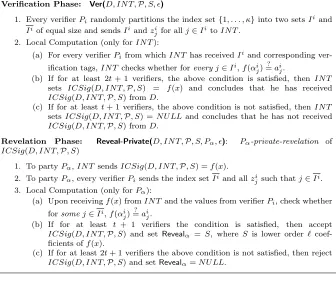
MVMS-AICPand then describe protocolMVMS-AICPin Fig. 2.
The Intuition behind Protocol MVMS-AICP: 𝐷 selects a random poly-nomial 𝑓(𝑥) of degree ℓ+𝑡𝜅, whose first ℓ coefficients are the elements of 𝑆 and delivers𝑓(𝑥) to𝐼𝑁 𝑇. In addition, to each individual verifier, 𝐷 privately gives the value of𝑓(𝑥) at 𝜅randomevaluation points. This distribution of in-formation by𝐷 helps to achieveAICP-Correctness3 property. Specifically, if𝐷 ishonest, then a corrupted𝐼𝑁 𝑇 cannot produce an incorrect𝑓′(𝑥)∕=𝑓(𝑥) duringRevelation Phasewithout being detected by anhonestverifier. This is because a corrupted𝐼𝑁 𝑇 will have no information about the evaluation points of an honest verifier and hence with very high probability,𝑓′(𝑥) will not match with the evaluation points held by an honest verifier.
The above distribution of information by𝐷also maintainsAICP-Secrecy
property. This is because the degree of𝑓(𝑥) isℓ+𝑡𝜅and𝒜𝑡will know the value
of𝑓(𝑥) at most at𝑡𝜅evaluation points.
However, a corrupted𝐷 might do the following: he may distribute𝑓(𝑥) to 𝐼𝑁 𝑇 and value of some other polynomial (different from 𝑓(𝑥)) to each honest verifier. To avoid this situation,𝐼𝑁 𝑇 and the verifiers interact inzero knowledge
values of𝑓(𝑥) held by individual verifier. The specific details of the cut-and-choose, along with other formal steps of protocolMVMS-AICPare given in Fig. 2.
Since in our AWSS, we require only𝑃𝛼-private-revelation of𝐼𝐶𝑆𝑖𝑔(𝐷, 𝐼𝑁 𝑇,𝒫, 𝑆),
we present protocolMVMS-AICPwithRevelation Phasedescribing𝑃𝛼
-private-revelation of𝐼𝐶𝑆𝑖𝑔(𝐷, 𝐼𝑁 𝑇,𝒫, 𝑆).
Figure 2:AICP with𝑛= 3𝑡+ 1. Here𝜅=⌈log1
𝜖⌉
ProtocolMVMS-AICP(𝐷, 𝐼𝑁 𝑇,𝒫, 𝑆, 𝜖) Generation Phase: Gen(𝐷, 𝐼𝑁 𝑇,𝒫, 𝑆, 𝜖)
1. 𝐷 selects a randomℓ+𝑡𝜅degree polynomial𝑓(𝑥) whose lower orderℓcoefficients are the secrets in 𝑆 = (𝑠1, . . . , 𝑠ℓ). 𝐷 also picks𝑛𝜅 random, non-zero, distinct
evaluation pointsfrom𝔽, denoted by𝛼𝑖
1, . . . , 𝛼𝑖𝜅, for𝑖= 1, . . . , 𝑛.
2. 𝐷 privately sends 𝑓(𝑥) to𝐼𝑁 𝑇 and the verification tags 𝑧𝑖
1 = (𝛼𝑖1, 𝑎𝑖1), . . . , 𝑧𝜅𝑖 =
(𝛼𝑖
𝜅, 𝑎𝑖𝜅) to party𝑃𝑖. Here𝑎𝑖𝑗=𝑓(𝛼𝑖𝑗), for𝑗= 1, . . . , 𝜅.
Verification Phase: Ver(𝐷, 𝐼𝑁 𝑇,𝒫, 𝑆, 𝜖)
1. Every verifier𝑃𝑖randomly partitions the index set{1, . . . , 𝜅}into two sets𝐼𝑖and
𝐼𝑖of equal size and sends𝐼𝑖and𝑧𝑖
𝑗for all𝑗∈𝐼𝑖to𝐼𝑁 𝑇.
2. Local Computation (only for𝐼𝑁 𝑇):
(a) For every verifier𝑃𝑖from which𝐼𝑁 𝑇 has received𝐼𝑖and corresponding
ver-ification tags,𝐼𝑁 𝑇 checks whether forevery𝑗∈𝐼𝑖,𝑓(𝛼𝑖 𝑗)
? =𝑎𝑖
𝑗.
(b) If for at least 2𝑡+ 1 verifiers, the above condition is satisfied, then 𝐼𝑁 𝑇
sets 𝐼𝐶𝑆𝑖𝑔(𝐷, 𝐼𝑁 𝑇,𝒫, 𝑆) = 𝑓(𝑥) and concludes that he has received
𝐼𝐶𝑆𝑖𝑔(𝐷, 𝐼𝑁 𝑇,𝒫, 𝑆) from𝐷.
(c) If for at least𝑡+ 1 verifiers, the above condition is not satisfied, then𝐼𝑁 𝑇
sets𝐼𝐶𝑆𝑖𝑔(𝐷, 𝐼𝑁 𝑇,𝒫, 𝑆) =𝑁 𝑈 𝐿𝐿and concludes that he has not received
𝐼𝐶𝑆𝑖𝑔(𝐷, 𝐼𝑁 𝑇,𝒫, 𝑆) from𝐷.
Revelation Phase: Reveal-Private(𝐷, 𝐼𝑁 𝑇,𝒫, 𝑆, 𝑃𝛼, 𝜖): 𝑃𝛼-private-revelation of
𝐼𝐶𝑆𝑖𝑔(𝐷, 𝐼𝑁 𝑇,𝒫, 𝑆)
1. To party𝑃𝛼,𝐼𝑁 𝑇 sends𝐼𝐶𝑆𝑖𝑔(𝐷, 𝐼𝑁 𝑇,𝒫, 𝑆) =𝑓(𝑥).
2. To party𝑃𝛼, every verifier𝑃𝑖sends the index set𝐼𝑖and all𝑧𝑗𝑖such that𝑗∈𝐼𝑖.
3. Local Computation (only for𝑃𝛼):
(a) Upon receiving𝑓(𝑥) from𝐼𝑁 𝑇 and the values from verifier𝑃𝑖, check whether
forsome𝑗∈𝐼𝑖,𝑓(𝛼𝑖 𝑗)
? =𝑎𝑖
𝑗.
(b) If for at least 𝑡 + 1 verifiers the condition is satisfied, then accept
𝐼𝐶𝑆𝑖𝑔(𝐷, 𝐼𝑁 𝑇,𝒫, 𝑆) and setReveal𝛼 = 𝑆, where 𝑆 is lower order ℓ
coef-ficients of𝑓(𝑥).
(c) If for at least 2𝑡+ 1 verifiers the above condition is not satisfied, then reject
𝐼𝐶𝑆𝑖𝑔(𝐷, 𝐼𝑁 𝑇,𝒫, 𝑆) and setReveal𝛼=𝑁 𝑈 𝐿𝐿.
We now prove the properties of protocolMVMS-AICP.
Lemma 1 (AICP-Correctness1). If𝐷,𝐼𝑁 𝑇 and𝑃𝛼are honest, then𝑆will
Proof: If𝐷 is honest then he will honestly deliver𝑓(𝑥) to 𝐼𝑁 𝑇 and its value at𝜅points to individual verifier. So eventually, the condition stated in step 2(a) ofVerification Phase will be satisfied for at least 2𝑡+ 1 verifiers and hence 𝐼𝑁 𝑇, who is honest in this case will set𝐼𝐶𝑆𝑖𝑔(𝐷, 𝐼𝑁 𝑇,𝒫, 𝑆) =𝑓(𝑥). Now it is easy to see that the condition stated in step 3(a) ofRevelation Phasewill be eventually satisfied, corresponding to the honest verifiers in𝒫 (there are at least 2𝑡+ 1 honest verifiers). Hence 𝑃𝛼, who is honest in this case, will eventually
accept𝐼𝐶𝑆𝑖𝑔(𝐷, 𝐼𝑁 𝑇,𝒫, 𝑆) at the end ofRevelation phase. □
Lemma 2 (AICP-Correctness2). If an honest𝐼𝑁 𝑇 holds an𝐼𝐶𝑆𝑖𝑔(𝐷, 𝐼𝑁 𝑇, 𝒫, 𝑆)at the end ofVerification Phase, then𝐼𝐶𝑆𝑖𝑔(𝐷, 𝐼𝑁 𝑇,𝒫, 𝑆)will be ac-cepted inRevelation Phaseby honest𝑃𝛼, except with probability𝜖.
Proof: We have to consider the case when𝐷is corruptedas otherwise the proof will follow from Lemma 1. Since𝐼𝑁 𝑇 is honest and it holds an𝐼𝐶𝑆𝑖𝑔(𝐷, 𝐼𝑁 𝑇,𝒫, 𝑆) at the end ofVerification phase,𝐼𝑁 𝑇 has ensured that for at least 2𝑡+ 1 verifiers the condition specified in step 2(a) of Verification phase has been satisfied. Letℋbe the set ofhonestverifiers among these 2𝑡+ 1 verifiers. Note that ∣ℋ∣ ≥ 𝑡+ 1. To prove the lemma, we prove that corresponding to each verifier in ℋ, the condition stated in step 3(a) ofRevelation Phase will be satisfied with very high probability. Note that corresponding to a verifier𝑃𝑖 in
ℋ, the condition stated in step 3(a) of Revelation Phase will fail if for all
𝑗∈𝐼𝑖,𝑓(𝛼𝑖
𝑗)∕=𝑎𝑖𝑗. This implies that (corrupted)𝐷 must have distributed𝑓(𝑥)
(to 𝐼𝑁 𝑇) and 𝑧𝑖
𝑗 (to 𝑃𝑖) inconsistently for all 𝑗 ∈ 𝐼𝑖 and it so happens that
𝑃𝑖 has partitioned {1, . . . , 𝜅} into𝐼𝑖 and𝐼𝑖 during Verification Phase, such
that𝐼𝑖contains only inconsistent tuples (𝑧𝑗𝑖’s). Thus corresponding to a verifier
𝑃𝑖 ∈ ℋ, the probability that the condition stated in step 3(a) of Revelation
Phase fails is same as the probability of 𝑃𝑖 selecting all consistent
(inconsis-tent) tuples in𝐼𝑖 (𝐼𝑖), which is 1
(𝜅/2)𝜅 ≈2−Ω(𝜅). Now as there are at least𝑡+ 1 parties inℋ, except with probability (𝑡+ 1)2−Ω(𝜅)≈𝜖,𝑃
𝛼will eventually find
step 3(a) ofRevelation Phaseto be true for all parties inℋand will accept
𝐼𝐶𝑆𝑖𝑔(𝐷, 𝐼𝑁 𝑇,𝒫, 𝑆). □
Lemma 3 (AICP-Correctness3). If 𝐷 is honest, then during Revelation Phase, with probability at least(1−𝜖), every𝐼𝐶𝑆𝑖𝑔(𝐷, 𝐼𝑁 𝑇,𝒫, 𝑆′)with𝑆′∕=𝑆
produced by a corrupted𝐼𝑁 𝑇 will be rejected by honest verifier𝑃𝛼.
Proof: It is easy to see that 𝑆′ ∕= 𝑆 produced by a corrupted 𝐼𝑁 𝑇 will be accepted by anhonest 𝑃𝛼, if the condition stated in step 3(a) ofRevelation
Phasegets satisfied corresponding toat least one honestverifier (for𝑡corrupted verifiers, the condition may always satisfy). However, the condition will be satisfied corresponding to honest verifier𝑃𝑖if corrupted𝐼𝑁 𝑇 cancorrectly guess
a verification tag 𝑧𝑖𝑗 for at least one 𝑗 ∈ 𝐼𝑖, which he can do with probability
1
∣𝔽∣ = 2−Ω(𝜅)=𝜖. □
Proof: If𝐷and𝐼𝑁 𝑇 are honest, then at the end ofVerification Phase,𝒜𝑡
will get𝑡𝜅distinct values on𝑓(𝑥). However,𝑓(𝑥) is of degreeℓ+𝑡𝜅and hence the lower order ℓ coefficients of𝑓(𝑥) which are the elements of 𝑆 will remain
information theoretically secure. □
Lemma 5 (AICP-Communication-Complexity). ProtocolGenprivately com-municates𝒪((ℓ+𝑛log1
𝜖) log1𝜖)bits. ProtocolVer privately communicates
𝒪((𝑛log1
𝜖) log1𝜖) bits. Protocol Reveal-Private privately communicates 𝒪((ℓ+
𝑛log1
𝜖) log1𝜖)bits.
Proof: In protocol Gen, 𝐷 privately gives ℓ +𝑡𝜅 field elements to 𝐼𝑁 𝑇 and 𝜅 field elements to each verifier. Since each field element can be repre-sented by 𝒪(𝜅) bits and 𝜅 = ⌈log1
𝜖⌉, protocol Gen incurs a private
commu-nication of 𝒪((ℓ+𝑛log1
𝜖) log1𝜖) bits. In protocolVer, every verifier privately
sends 𝜅
2 field elements to𝐼𝑁 𝑇, thus incurring a total private communication of
𝒪((𝑛log1
𝜖) log1𝜖) bits. In protocol Reveal-Private, 𝐼𝑁 𝑇 sends to 𝑃𝛼 the
poly-nomial𝑓(𝑥), consisting ofℓ+𝑡𝜅field elements, while each verifier sends𝐼𝑖 and
corresponding verification tags. SoReveal-Privateinvolves private communica-tion of𝒪((ℓ+𝑛log1
𝜖) log1𝜖) bits. □
Theorem 2. Protocol Multi-Verifier-AICPis an efficient AICP.
Proof: The theorem follows from Lemma 1, Lemma 2, Lemma 3 and Lemma 4.
Notation 2 (Notation for Using Multi-Verifier-AICP). Recall that 𝐷 and
𝐼𝑁 𝑇 can be any party from𝒫. In the sequel we use the following convention. We say that:
1. ”𝑃𝑖 sends 𝐼𝐶𝑆𝑖𝑔(𝑃𝑖, 𝑃𝑗,𝒫, 𝑆)to𝑃𝑗 with error parameter𝜖” to mean that
𝑃𝑖acting as dealer𝐷and considering𝑃𝑗as𝐼𝑁 𝑇, executesGen(𝑃𝑖, 𝑃𝑗,𝒫, 𝑆, 𝜖);
2. ”𝑃𝑖 receives𝐼𝐶𝑆𝑖𝑔(𝑃𝑗, 𝑃𝑖,𝒫, 𝑆)from𝑃𝑗 with error parameter𝜖” to mean
that𝑃𝑖as𝐼𝑁 𝑇 has received𝐼𝐶𝑆𝑖𝑔(𝑃𝑗, 𝑃𝑖,𝒫, 𝑆)after executingVer(𝑃𝑗, 𝑃𝑖,𝒫,
𝑆, 𝜖);
3. ”𝑃𝑖 reveals𝐼𝐶𝑆𝑖𝑔(𝑃𝑗, 𝑃𝑖,𝒫, 𝑆)to𝑃𝛼 with error parameter𝜖” to mean𝑃𝑖
as 𝐼𝑁 𝑇 executesReveal-Private(𝑃𝑗, 𝑃𝑖,𝒫, 𝑆, 𝑃𝛼, 𝜖)along with the
partici-pation of the verifiers in 𝒫;
4. ”𝑃𝛼 completes revelation of 𝐼𝐶𝑆𝑖𝑔(𝑃𝑗, 𝑃𝑖,𝒫, 𝑆) with Reveal𝛼 = 𝑆” to
mean that𝑃𝛼 has successfully completedReveal-Private(𝑃𝑗, 𝑃𝑖,𝒫, 𝑆, 𝑃𝛼, 𝜖)
withReveal𝛼=𝑆.
3. Statistical AWSS Scheme for Sharing a Single Secret
We now present an AWSS scheme, calledAWSSwith𝑛= 3𝑡+ 1, consisting of a pair of protocols (AWSS-Share, AWSS-Rec-Private). While AWSS-Share
reconstruction as 𝑃𝛼-weak-private-reconstruction. In AWSS-Share, a corrupted
𝐷 may commit to𝑠=𝑁 𝑈 𝐿𝐿instead of an element from𝔽(the meaning of it will be clear in the sequel).
Our AWSS-Share protocol is similar toAWSS-Share protocol given in [61]. However, instead of using the AICP of [61], we useMVMS-AICP presented in this paper inAWSS-Share. This leads to better communication complexity.
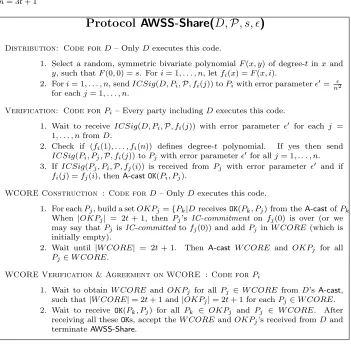
High Level Idea of AWSS-Share:We follow the general strategy used in [13, 27, 39, 38, 54] for synchronous settings for sharing the secret𝑠with a symmetric bivariate polynomial 𝐹(𝑥, 𝑦) of degree-𝑡 in 𝑥and 𝑦, where each party 𝑃𝑖 gets
the univariate polynomial𝑓𝑖(𝑥) =𝐹(𝑥, 𝑖). So inAWSS-Share,𝐷chooses a
sym-metric bivariate polynomial𝐹(𝑥, 𝑦) of degree-𝑡in𝑥and𝑦such that𝐹(0,0) =𝑠. 𝐷 then hands over𝐼𝐶𝑆𝑖𝑔(𝐷, 𝐼𝑁 𝑇,𝒫, 𝑓𝑖(𝑗)) for every𝑗 = 1, . . . , 𝑛 to𝑃𝑖. This
step implicitly implies that𝑃𝑖 will receive𝑓𝑖(𝑥) from𝐷. After receiving these
IC signatures from𝐷, the parties then exchange IC signature on their common values (a pair (𝑃𝑖, 𝑃𝑗) has one common value, namely𝐹(𝑖, 𝑗); 𝑃𝑖 has𝑓𝑖(𝑗) and
𝑃𝑗 has𝑓𝑗(𝑖) where 𝐹(𝑖, 𝑗) = 𝑓𝑖(𝑗) = 𝑓𝑗(𝑖)). Then 𝐷, in conjunction with all
other parties, perform a sequence of communication and computation. As a result of this, at the end of AWSS-Share, every party agrees on a set of 2𝑡+ 1 parties, called𝑊 𝐶𝑂𝑅𝐸, such that every party𝑃𝑗∈𝑊 𝐶𝑂𝑅𝐸isIC-committed
to𝑓𝑗(0) using𝑓𝑗(𝑥) to a set of 2𝑡+1 parties, called as𝑂𝐾𝑃𝑗. 𝑃𝑗isIC-committed
to𝑓𝑗(0) using𝑓𝑗(𝑥) among the parties in𝑂𝐾𝑃𝑗 only when every 𝑃𝑘 ∈𝑂𝐾𝑃𝑗
received (a)𝐼𝐶𝑆𝑖𝑔(𝐷, 𝑃𝑘,𝒫, 𝑓𝑘(𝑗)) and (b)𝐼𝐶𝑆𝑖𝑔(𝑃𝑗, 𝑃𝑘,𝒫, 𝑓𝑗(𝑘)) and ensures
𝑓𝑘(𝑗) =𝑓𝑗(𝑘) (this should ideally hold due to the selection and distribution of
symmetric bivariate polynomial). In some sense, we may view this as every 𝑃𝑗 ∈𝑊 𝐶𝑂𝑅𝐸is attempting to commit his received (from𝐷) polynomial𝑓𝑗(𝑥)
among the parties in𝑂𝐾𝑃𝑗 (by giving hisIC Signatureon one point of𝑓𝑗(𝑥)
to each party) and the parties in 𝑂𝐾𝑃𝑗 allowing him to do so after
verify-ing that they have got 𝐷’s IC signature on the same value of 𝑓𝑗(𝑥). We will
show that later in the reconstruction phase, every honest 𝑃𝑗’s (in 𝑊 𝐶𝑂𝑅𝐸)
IC-commitment will be reconstructed correctly irrespective of whether 𝐷 is honest or corrupted. Moreover, a corrupted 𝑃𝑗’s IC-commitment will be
re-constructed correctly when 𝐷 is honest. But on the other hand, a corrupted 𝑃𝑗’s IC-commitment can be reconstructed to any value when 𝐷 is corrupted.
These properties are at the heart of our AWSS protocol.
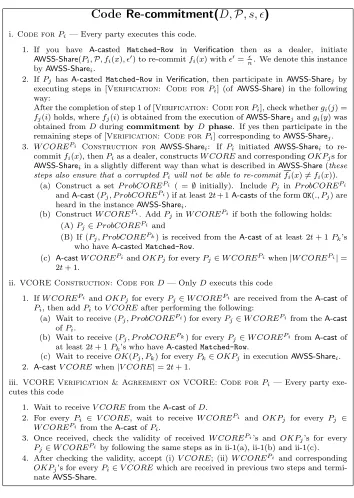
Achieving the agreement (among the parties) on𝑊 𝐶𝑂𝑅𝐸 and correspond-ing 𝑂𝐾𝑃𝑗s is a bit tricky in asynchronous network. Even though these sets
are constructed on the basis of information that areA-casted by parties, parties may end up with different versions of𝑊 𝐶𝑂𝑅𝐸 and𝑂𝐾𝑃𝑗’s while attempting
to generate them locally, due to the asynchronous nature of the network. We solve this problem by asking𝐷to construct𝑊 𝐶𝑂𝑅𝐸 and𝑂𝐾𝑃𝑗s based on A-casted information and then ask𝐷toA-castthe same. After receiving𝑊 𝐶𝑂𝑅𝐸 and𝑂𝐾𝑃𝑗s from theA-castof𝐷, individual parties ensure the validity of these
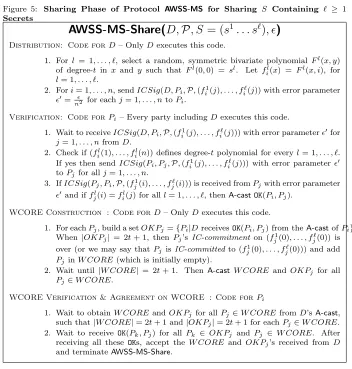
Figure 3: Sharing Phase of Protocol AWSS for Sharing a Single Secret 𝑠 with
𝑛= 3𝑡+ 1
Protocol
AWSS-Share(
𝐷,
𝒫
, 𝑠, 𝜖
)
Distribution: Code for𝐷– Only𝐷executes this code.
1. Select a random, symmetric bivariate polynomial𝐹(𝑥, 𝑦) of degree-𝑡in𝑥and
𝑦, such that𝐹(0,0) =𝑠. For𝑖= 1, . . . , 𝑛, let𝑓𝑖(𝑥) =𝐹(𝑥, 𝑖).
2. For𝑖= 1, . . . , 𝑛, send𝐼𝐶𝑆𝑖𝑔(𝐷, 𝑃𝑖,𝒫, 𝑓𝑖(𝑗)) to𝑃𝑖with error parameter𝜖′= 𝑛𝜖2
for each𝑗= 1, . . . , 𝑛.
Verification: Code for𝑃𝑖– Every party including𝐷executes this code.
1. Wait to receive 𝐼𝐶𝑆𝑖𝑔(𝐷, 𝑃𝑖,𝒫, 𝑓𝑖(𝑗)) with error parameter 𝜖′ for each 𝑗 =
1, . . . , 𝑛from𝐷.
2. Check if (𝑓𝑖(1), . . . , 𝑓𝑖(𝑛)) defines degree-𝑡 polynomial. If yes then send
𝐼𝐶𝑆𝑖𝑔(𝑃𝑖, 𝑃𝑗,𝒫, 𝑓𝑖(𝑗)) to𝑃𝑗with error parameter𝜖′for all𝑗= 1, . . . , 𝑛.
3. If 𝐼𝐶𝑆𝑖𝑔(𝑃𝑗, 𝑃𝑖,𝒫, 𝑓𝑗(𝑖)) is received from𝑃𝑗 with error parameter 𝜖′ and if
𝑓𝑖(𝑗) =𝑓𝑗(𝑖), thenA-castOK(𝑃𝑖, 𝑃𝑗).
WCORE Construction :Code for𝐷– Only𝐷executes this code.
1. For each𝑃𝑗, build a set𝑂𝐾𝑃𝑗={𝑃𝑘∣𝐷receivesOK(𝑃𝑘, 𝑃𝑗) from theA-castof𝑃𝑘}.
When ∣𝑂𝐾𝑃𝑗∣ = 2𝑡+ 1, then 𝑃𝑗’sIC-commitment on 𝑓𝑗(0) is over (or we
may say that𝑃𝑗 isIC-committedto𝑓𝑗(0)) and add𝑃𝑗 in𝑊 𝐶𝑂𝑅𝐸(which is
initially empty).
2. Wait until ∣𝑊 𝐶𝑂𝑅𝐸∣ = 2𝑡+ 1. Then A-cast 𝑊 𝐶𝑂𝑅𝐸 and 𝑂𝐾𝑃𝑗 for all
𝑃𝑗∈𝑊 𝐶𝑂𝑅𝐸.
WCORE Verification & Agreement on WCORE :Code for𝑃𝑖
1. Wait to obtain 𝑊 𝐶𝑂𝑅𝐸and 𝑂𝐾𝑃𝑗 for all𝑃𝑗 ∈ 𝑊 𝐶𝑂𝑅𝐸from𝐷’sA-cast,
such that∣𝑊 𝐶𝑂𝑅𝐸∣= 2𝑡+ 1 and∣𝑂𝐾𝑃𝑗∣= 2𝑡+ 1 for each𝑃𝑗∈𝑊 𝐶𝑂𝑅𝐸.
2. Wait to receive OK(𝑃𝑘, 𝑃𝑗) for all 𝑃𝑘 ∈ 𝑂𝐾𝑃𝑗 and 𝑃𝑗 ∈ 𝑊 𝐶𝑂𝑅𝐸. After
receiving all theseOKs, accept the𝑊 𝐶𝑂𝑅𝐸and𝑂𝐾𝑃𝑗’s received from𝐷and
terminateAWSS-Share.
Before moving into the discussion and description of AWSS-Rec-Private, we now define what we call as𝐷’s AWSS-commitment.
Remark 2 (𝐷’s AWSS-commitment). We say that 𝐷 is AWSS-committed to a secret𝑠∈𝔽 inAWSS-Shareif there is a unique degree-𝑡univariate polyno-mial𝑓(𝑥)such that𝑓(0) =𝑠and every honest𝑃𝑖 in𝑊 𝐶𝑂𝑅𝐸receives𝑓(𝑖)from
𝐷 and IC-commits to𝑓(𝑖)among the parties in 𝑂𝐾𝑃𝑖. Otherwise, we say that
𝐷has committed𝑁 𝑈 𝐿𝐿. An honest𝐷 always commits𝑠from𝔽as in this case
𝑓(𝑥) is 𝑓0(𝑥)(= 𝐹(𝑥,0)), where𝐹(𝑥, 𝑦) is the symmetric bivariate polynomial of degree-𝑡 in 𝑥 and 𝑦, chosen by honest 𝐷. Moreover, every honest party 𝑃𝑖
in𝑊 𝐶𝑂𝑅𝐸 will receive𝑓0(𝑖)which is same as𝑓𝑖(0)(this can be obtained from
𝑓𝑖(𝑥)). But AWSS-Sharecan not ensure that corrupted 𝐷 also commits𝑠∈ 𝔽.
that, polynomial𝑓0(𝑥) defined by the 𝑓0(𝑖)(=𝑓𝑖(0)) values possessed by honest
𝑃𝑖’s in 𝑊 𝐶𝑂𝑅𝐸 may not be a degree-𝑡 polynomial. In this case we say 𝐷 has
AWSS-committed𝑁 𝑈 𝐿𝐿.
Our discussion in the sequel will show that for a corrupted 𝐷, irrespective of the behavior of the corrupted parties, either𝐷’s AWSS-committed secret 𝑠 (which belongs to𝔽∪ {𝑁 𝑈 𝐿𝐿}) or NULL will be reconstructed by honest𝑃𝛼.
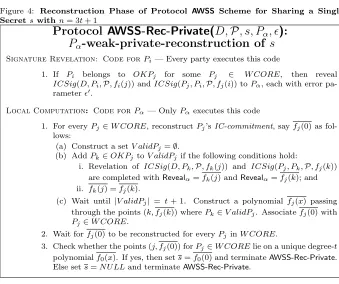
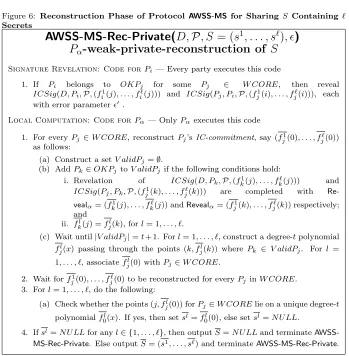
High Level Idea of AWSS-Rec-Private:InAWSS-Rec-Private, the parties in 𝑊 𝐶𝑂𝑅𝐸 and corresponding 𝑂𝐾𝑃𝑗’s are used in order to reconstruct 𝐷’s
AWSS-committed secret. Specifically, for every𝑃𝑗 ∈𝑊 𝐶𝑂𝑅𝐸,𝑃𝑗’s
IC-commit-ment (𝑓𝑗(0)) is reconstructed by asking every party 𝑃𝑘 ∈ 𝑂𝐾𝑃𝑗 to reveal
𝐼𝐶𝑆𝑖𝑔(𝐷, 𝑃𝑘,
𝒫, 𝑓𝑘(𝑗)) and 𝐼𝐶𝑆𝑖𝑔(𝑃𝑗, 𝑃𝑘,𝒫, 𝑓𝑗(𝑘)) such that𝑓𝑘(𝑖) =𝑓𝑗(𝑘). Since there are
at least𝑡+ 1 honest parties in 𝑂𝐾𝑃𝑗, eventually at least 𝑡+ 1𝑓𝑗(𝑘)’s will be
revealed with which 𝑓𝑗(𝑥) and thus𝑓𝑗(0) will be reconstructed. Then𝑓𝑗(0)’s
are used to construct the univariate polynomial𝑓0(𝑥) that is committed by𝐷
duringAWSS-Share.
Asking 𝑃𝑘 ∈𝑂𝐾𝑃𝑗 to reveal𝐷’s IC signature ensures that if𝐷 ishonest,
then even for acorrupted 𝑃𝑗 ∈ 𝑊 𝐶𝑂𝑅𝐸, the reconstructed polynomial𝑓𝑗(𝑥)
will be same as the one handed over by 𝐷 to 𝑃𝑗 in sharing phase (that is,
a corrupted 𝑃𝑗’s IC-commitment 𝑓𝑗(0) will be reconstructed correctly). This
helps our AWSS protocol to satisfy Correctness 1 property of AWSS. Now asking𝑃𝑘 in𝑂𝐾𝑃𝑗 to reveal𝑃𝑗’s signature ensures that even if𝐷 iscorrupted,
for anhonest𝑃𝑗 ∈𝑊 𝐶𝑂𝑅𝐸, the reconstructed polynomial𝑓𝑗(𝑥) will be same
as the one received by 𝑃𝑗 from 𝐷 in AWSS-Share(that is, an honest 𝑃𝑗’s
IC-commitment𝑓𝑗(0) will be reconstructed correctly even though𝐷is corrupted).
This helps to ensureCorrectness 2 property. Summing up, when at least one of𝐷and𝑃𝑗 is honest,𝑃𝑗’sIC-commitment(i.e𝑓𝑗(0)) will be revealed properly.
But when both𝐷and𝑃𝑗are corrupted,𝑃𝑗’sIC-commitmentcan be revealed as
any𝑓𝑗(0) which may or may not be equal to𝑓𝑗(0). It is the later property that
makes our protocol to qualify as a AWSS protocol rather than a AVSS protocol. ProtocolAWSS-Rec-Privateis formally given in Fig. 4.
The proof of the properties of our AWSS scheme follows using similar argu-ments as given for the AWSS scheme of [61]. However, for the sake of complete-ness we recall them here.
Lemma 6 (AWSS-Termination). Protocols (AWSS-Share,AWSS-Rec-Private) satisfy termination property of Definition 1.
Proof: Termination 1: When𝐷is honest then eventually all honest parties will receive desired IC signatures from𝐷 and will also eventually exchange IC signatures on their common values and will A-cast OK for each other. Hence every honest𝑃𝑗 will eventually complete hisIC-commitment on 𝑓𝑗(0) with at
least 2𝑡+ 1 honest parties in𝑂𝐾𝑃𝑗. So𝐷will eventually include 2𝑡+ 1 parties
Figure 4: Reconstruction Phase of Protocol AWSS Scheme for Sharing a Single Secret𝑠with𝑛= 3𝑡+ 1
Protocol
AWSS-Rec-Private(
𝐷,
𝒫
, 𝑠, 𝑃
𝛼, 𝜖
)
:
𝑃
𝛼-weak-private-reconstruction of
𝑠
Signature Revelation: Code for𝑃𝑖— Every party executes this code1. If 𝑃𝑖 belongs to 𝑂𝐾𝑃𝑗 for some 𝑃𝑗 ∈ 𝑊 𝐶𝑂𝑅𝐸, then reveal
𝐼𝐶𝑆𝑖𝑔(𝐷, 𝑃𝑖,𝒫, 𝑓𝑖(𝑗)) and𝐼𝐶𝑆𝑖𝑔(𝑃𝑗, 𝑃𝑖,𝒫, 𝑓𝑗(𝑖)) to𝑃𝛼, each with error
pa-rameter𝜖′.
Local Computation: Code for𝑃𝛼— Only𝑃𝛼 executes this code
1. For every𝑃𝑗∈𝑊 𝐶𝑂𝑅𝐸, reconstruct𝑃𝑗’sIC-commitment, say𝑓𝑗(0) as
fol-lows:
(a) Construct a set𝑉 𝑎𝑙𝑖𝑑𝑃𝑗=∅.
(b) Add𝑃𝑘∈𝑂𝐾𝑃𝑗to𝑉 𝑎𝑙𝑖𝑑𝑃𝑗if the following conditions hold:
i. Revelation of 𝐼𝐶𝑆𝑖𝑔(𝐷, 𝑃𝑘,𝒫, 𝑓𝑘(𝑗)) and 𝐼𝐶𝑆𝑖𝑔(𝑃𝑗, 𝑃𝑘,𝒫, 𝑓𝑗(𝑘))
are completed withReveal𝛼=𝑓𝑘(𝑗) andReveal𝛼=𝑓𝑗(𝑘); and
ii. 𝑓𝑘(𝑗) =𝑓𝑗(𝑘).
(c) Wait until ∣𝑉 𝑎𝑙𝑖𝑑𝑃𝑗∣ = 𝑡+ 1. Construct a polynomial 𝑓𝑗(𝑥) passing
through the points (𝑘, 𝑓𝑗(𝑘)) where𝑃𝑘∈𝑉 𝑎𝑙𝑖𝑑𝑃𝑗. Associate𝑓𝑗(0) with
𝑃𝑗∈𝑊 𝐶𝑂𝑅𝐸.
2. Wait for𝑓𝑗(0) to be reconstructed for every𝑃𝑗in𝑊 𝐶𝑂𝑅𝐸.
3. Check whether the points (𝑗, 𝑓𝑗(0)) for𝑃𝑗∈𝑊 𝐶𝑂𝑅𝐸lie on a unique degree-𝑡
polynomial𝑓0(𝑥). If yes, then set𝑠=𝑓0(0) and terminateAWSS-Rec-Private. Else set𝑠=𝑁 𝑈 𝐿𝐿and terminateAWSS-Rec-Private.
the property ofA-cast, each honest party will eventually receive𝑊 𝐶𝑂𝑅𝐸 from the A-cast of 𝐷. Finally, since honest 𝐷 had included 𝑃𝑗 in 𝑊 𝐶𝑂𝑅𝐸 after
receiving theOKsignals from the parties in𝑂𝐾𝑃𝑗’s, each honest party will also
receive the same and will eventually terminateAWSS-Share.
Termination 2: If an honest 𝑃𝑖 has terminated AWSS-Share, then he must
have received 𝑊 𝐶𝑂𝑅𝐸 and 𝑂𝐾𝑃𝑗’s from the A-cast of 𝐷 and verified their
validity by receiving the desiredA-casts. By properties of A-cast, each honest party will also receive the same and will eventually terminateAWSS-Share.
Termination 3: Since each of the IC signatures are given with an error pa-rameter𝜖′= 𝜖
𝑛2, if𝑃𝑖 (acting as𝐼𝑁 𝑇) is honest and has received an IC
signa-ture, then IC signature produced by𝑃𝑖 during Reveal-Privatewill be accepted
by honest 𝑃𝛼 without any error probability when 𝐷 is honest (by
AICP-Correctness1 i.e Lemma 1) and except with probability 𝜖′ when 𝐷 is cor-rupted (byAICP-Correctness2i.e Lemma 2). Since for every𝑃𝑗 ∈𝑊 𝐶𝑂𝑅𝐸,
∣𝑂𝐾𝑃𝑗∣ = 2𝑡+ 1, there are at least𝑡+ 1 honest parties in 𝑂𝐾𝑃𝑗 and each of
them may be present in𝑉 𝑎𝑙𝑖𝑑𝑃𝑗 except with probability 𝜖′. Thus except with
probability at most 𝑛2𝜖′ = 𝜖, 𝑃
all 𝑃𝑗 ∈ 𝑊 𝐶𝑂𝑅𝐸. So except with probability 𝜖, honest 𝑃𝛼 will terminate AWSS-Rec-Private after executing remaining steps of [Local Computation] (as specified in protocolAWSS-Rec-Private). □
Lemma 7 (AWSS-Secrecy). Protocol AWSS-Sharesatisfies secrecy property of Definition 1.
proof: We have to consider the case when𝐷 is honest. The proof follows from the secrecy of protocolMVMS-AICPand properties of symmetric bivariate poly-nomial of degree-𝑡in𝑥and𝑦[25]. Specifically, without loss of generality, assume that𝑃1, . . . , 𝑃𝑡are the parties under the control of𝒜𝑡. So during the execution
ofAWSS-Share,𝒜𝑡will know𝑓1(𝑥), . . . , 𝑓𝑡(𝑥) and𝑡points on𝑓𝑡+1(𝑥), . . . , 𝑓𝑛(𝑥).
However,𝒜𝑡 still lacks one more point to uniquely interpolate 𝐹(𝑥, 𝑦). Hence,
𝑠=𝐹(0,0) will be information theoretically secure. □
Lemma 8 (AWSS-Correctness). Protocols (AWSS-Share,AWSS-Rec-Private) satisfy correctness property of Definition 1.
Proof: Correctness 1: Here we have to consider the case when 𝐷 is hon-est. We show that 𝐷’s AWSS-commitment will be reconstructed correctly by honest 𝑃𝛼, except with probability 𝜖. We prove the lemma by showing that
when𝐷 ishonest,𝑃𝑗’sIC-commitment𝑓𝑗(0) will be correctly reconstructed for
𝑃𝑗 ∈ 𝑊 𝐶𝑂𝑅𝐸, except with probability 𝑛𝜖, irrespective of whether 𝑃𝑗 is
hon-est or corrupted. Consequently, as∣𝑊 𝐶𝑂𝑅𝐸∣= 2𝑡+ 1, all honest parties will reconstruct𝑓0(𝑥) =𝐹(𝑥,0) and hence the secret 𝑠=𝑓0(0) with probability at
least (1−(2𝑡+ 1)𝜖
𝑛)≈(1−𝜖). So we consider the following two cases:
1. Consider an honest𝑃𝑗in𝑊 𝐶𝑂𝑅𝐸. FromAICP-Correctness3(Lemma
3), a corrupted𝑃𝑘∈𝑂𝐾𝑃𝑗 will be able to successfully produce
𝐼𝐶𝑆𝑖𝑔(𝑃𝑗, 𝑃𝑘,𝒫, 𝑓𝑗(𝑘)) such that𝑓𝑗(𝑘)∕=𝑓𝑗(𝑘), with probability at most
𝜖′. As there can be at most 𝑡 corrupted parties in 𝑉 𝑎𝑙𝑖𝑑𝑃
𝑗, except with
probability𝑡𝜖′= 𝜖
𝑛, the value𝑓𝑗(𝑘) is same as𝑓𝑗(𝑘) for all𝑃𝑘∈𝑉 𝑎𝑙𝑖𝑑𝑃𝑗.
Hence honest 𝑃𝑗’s IC-commitment 𝑓𝑗(0) will be correctly reconstructed,
except with probability 𝜖 𝑛.
2. Consider a corrupted𝑃𝑗 in𝑊 𝐶𝑂𝑅𝐸. Now a corrupted𝑃𝑘 ∈𝑂𝐾𝑃𝑗 will
be able to produce𝐼𝐶𝑆𝑖𝑔(𝐷, 𝑃𝑘,𝒫, 𝑓𝑘(𝑗)) such that 𝑓𝑘(𝑗)∕=𝑓𝑘(𝑗), with
probability at most 𝜖′ according to AICP-Correctness3. Thus except with probability 𝑡𝜖′ = 𝜖
𝑛, corresponding to a corrupted 𝑃𝑗 ∈ 𝑊 𝐶𝑂𝑅𝐸,
the parties in𝑉 𝑎𝑙𝑖𝑑𝑃𝑗 have produced correct points on𝑓𝑗(𝑥).
Correctness 2: Here we consider the case, when𝐷 is corrupted. Now there are two cases: (a)𝐷’sAWSS-committed secret𝑠 belongs to𝔽; (b)𝐷’s AWSS-committedsecret𝑠is𝑁 𝑈 𝐿𝐿. Whatever may be case, we show that except with probability𝜖, honest𝑃𝛼 will either reconstruct𝑠or𝑁 𝑈 𝐿𝐿.
1. We first consider the case when𝑠∈𝔽. This implies that the𝑓𝑗(0) values
𝑓0(𝑥). Moreover every honest 𝑃𝑗 in 𝑊 𝐶𝑂𝑅𝐸 is IC-committed to 𝑓𝑗(0).
We now show that in AWSS-Rec-Private, IC-commitment of all honest parties in𝑊 𝐶𝑂𝑅𝐸 will be reconstructed correctly by𝑃𝛼 with
probabil-ity at least (1−𝜖). So let 𝑃𝑗 be an honest party in 𝑊 𝐶𝑂𝑅𝐸. Now
from AICP-Correctness3, a corrupted 𝑃𝑘 ∈ 𝑂𝐾𝑃𝑗 can not produce
𝐼𝐶𝑆𝑖𝑔(𝑃𝑗, 𝑃𝑘,𝒫, 𝑓𝑗(𝑘)) such that 𝑓𝑗(𝑘) ∕= 𝑓𝑗(𝑘) except with probability
𝜖′. Hence for honest 𝑃
𝑗 in 𝑊 𝐶𝑂𝑅𝐸, 𝑓𝑗(𝑥) and thus 𝑓𝑗(0) will be
re-constructed correctly, except with probability 𝑡𝜖′. As there are at least 𝑡+ 1 honest parties in 𝑊 𝐶𝑂𝑅𝐸, the probability that the above event happens for all honest parties in 𝑊 𝐶𝑂𝑅𝐸 is at most 𝑡(𝑡+ 1)𝜖′ ≈𝜖. So
IC-commitment of all honest parties in 𝑊 𝐶𝑂𝑅𝐸 will be reconstructed correctly by𝑃𝛼 with probability at least (1−𝜖).
However, for a corrupted 𝑃𝑗 in 𝑊 𝐶𝑂𝑅𝐸, 𝑃𝑗’s IC-commitment can be
revealed to any value𝑓𝑗(0). This is because a corrupted 𝑃𝑘 ∈𝑂𝐾𝑃𝑗 can
produce a valid signature of 𝑃𝑗 on any𝑓𝑗(𝑘) as well as a valid signature
of 𝐷 (who is corrupted as well) on 𝑓𝑘(𝑗) = 𝑓𝑗(𝑘). Also the adversary
can delay the messages such that the values of corrupted 𝑃𝑘 ∈ 𝑂𝐾𝑃𝑗
are revealed to 𝑃𝛼 before the values of honest parties in 𝑂𝐾𝑃𝑗. Now
if reconstructed 𝑓𝑗(0) = 𝑓𝑗(0) for all corrupted 𝑃𝑗 ∈ 𝑊 𝐶𝑂𝑅𝐸, then 𝑠
will be reconstructed by 𝑃𝛼. Otherwise, 𝑁 𝑈 𝐿𝐿 will be reconstructed.
However, since for all the honest parties of 𝑊 𝐶𝑂𝑅𝐸, IC-commitment
will be reconstructed correctly with probability at least (1−𝜖) (who in turn define𝑓0(𝑥)), no other secret (other than𝑠) can be reconstructed by
𝑃𝛼.
2. We next consider the second case when 𝐷’s AWSS-committed secret is 𝑁 𝑈 𝐿𝐿. This implies that the points (𝑗, 𝑓𝑗(0)) corresponding to honest
𝑃𝑗’s in𝑊 𝐶𝑂𝑅𝐸 do not define a unique degree-𝑡polynomial. It is easy to
see that in this case, irrespective of the behavior of the corrupted parties 𝑁 𝑈 𝐿𝐿will be reconstructed. This is because the points𝑓𝑗(0)
correspond-ing to all honest𝑃𝑗∈𝑊 𝐶𝑂𝑅𝐸will be reconstructed correctly except with
probability𝜖(following the argument given in previous case).
□
Lemma 9 (AWSS-Communication-Complexity). ProtocolAWSS-Share in-curs a private communication of 𝒪(𝑛3(log1
𝜖)2) bits and A-cast of 𝒪(𝑛2log𝑛)
bits. ProtocolAWSS-Rec-Privateprivately communicates 𝒪(𝑛3(log1
𝜖)2)bits.
Proof: In AWSS-Share, there are𝒪(𝑛2) instances of Gen andVer (of MVMS-AICP), each dealing with one value (substitutingℓ= 1) and executed with an error parameter of𝜖′ = 𝜖
𝑛2. From Theorem 5, this requires a private commu-nication of𝒪(𝑛3(log𝑛2
𝜖 )2) =𝒪(𝑛3(log𝜖1)2) bits, as𝑛= poly(log1𝜖). Moreover,
there areA-cast of 𝒪(𝑛2) OKsignals. In addition, there is A-castof 𝑊 𝐶𝑂𝑅𝐸
AWSS-Shareincurs a private communication of𝒪(𝑛3(log1
𝜖)2) bits andA-castof
𝒪(𝑛2log𝑛) bits.
In AWSS-Rec-Private, there are 𝒪(𝑛2) instances of Reveal-Private of our MVMS-AICP, each dealing with ℓ= 1 value. This requires a private communi-cation of𝒪(𝑛3(log1
𝜖)2) bits. □
Theorem 3. ProtocolAWSSconsisting of (AWSS-Share,AWSS-Rec-Private) con-stitutes a valid statistical AWSS scheme with 𝑛 = 3𝑡+ 1 parties with private reconstruction.
Proof: The proof follows from Lemma 6, Lemma 7 and Lemma 8. □
Notation 3 (Notation for Using AWSS-Share,AWSS-Rec-Private). In our AVSS scheme (that shares a single secret), we will invokeAWSS-Shareas AWSS-Share(𝐷,𝒫, 𝑓(𝑥), 𝜖) to mean that𝐷commits to𝑓(𝑥)inAWSS-Share. Essentially here 𝐷 is asked to choose a symmetric bivariate polynomial 𝐹(𝑥, 𝑦) of
degree-𝑡 in 𝑥 and 𝑦, where 𝐹(𝑥,0) = 𝑓(𝑥) holds. 𝐷 then tries to give 𝐹(𝑥, 𝑖) and hence𝐹(0, 𝑖) =𝑓(𝑖)to party𝑃𝑖. Similarly,AWSS-Rec-Privatewill be invoked as
AWSS-Rec-Private(𝐷,𝒫, 𝑓(𝑥), 𝑃𝛼, 𝜖) for𝑃𝛼-weak-private-reconstruction of𝑓(𝑥).
4. Statistical AWSS Scheme for Sharing Multiple Secrets
In this section, we extend protocol AWSS-Share and AWSS-Rec-Private to
AWSS-MS-ShareandAWSS-MS-Rec-Privaterespectively10. Now our new AWSS
scheme calledAWSS-MS consists of (AWSS-MS-Share, AWSS-MS-Rec-Private). Protocol AWSS-MS-Share allows 𝐷 ∈ 𝒫 to concurrently share a secret 𝑆 = (𝑠1. . . 𝑠ℓ), containing ℓ elements. On the other hand, protocol AWSS-MS-Rec-Privateallows a specific party𝑃𝛼∈ 𝒫 to reconstruct either𝑆 or𝑁 𝑈 𝐿𝐿.
Notice that we could have executed protocol AWSS-Shareℓ times parallely, each sharing individual elements of𝑆. However, from Lemma 9 this would in-cur a private communication of𝒪(ℓ𝑛3(log1
𝜖)2) bits and A-castof 𝒪(ℓ𝑛2log𝑛)
bits. On the other hand,AWSS-MS-Shareshares all elements of𝑆 concurrently, requiring a private communication of𝒪((ℓ𝑛2+𝑛3log1
𝜖) log1𝜖) bits and A-cast
of A-castof 𝒪(𝑛2log𝑛) bits. Thus for sufficiently large ℓ, the communication
complexity of AWSS-MS-Share is less than what would have been required by ℓparallel executions of AWSS-Share. Similarly, protocol AWSS-MS-Rec-Private
reconstructs all theℓsecrets simultaneously, incurring a private communication of𝒪((ℓ𝑛2+𝑛3log1
𝜖) log1𝜖) bits.
The Intuition: The high level idea of protocol AWSS-MS-Share is similar to
AWSS-Share. For each𝑠𝑙, 𝑙= 1, . . . , ℓ, the dealer𝐷selects a random symmetric
bivariate polynomial 𝐹𝑙(𝑥, 𝑦) of degree-𝑡 in 𝑥and 𝑦, where 𝐹𝑙(0,0) =𝑠𝑙 and
gives his IC signature on 𝑓𝑙
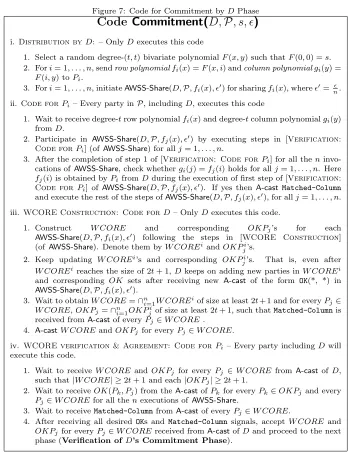
𝑖(1), . . . , 𝑓𝑖𝑙(𝑛) to party 𝑃𝑖, for 𝑖 = 1, . . . , 𝑛. For