This article has been peer reviewed.
Can Fam Physician 2012;58:637-42
Clinical Review
Practice-based small group learning programs
Systematic review
Eman Zaher MB BS Savithiri Ratnapalan MB BS MEd FRCPC FAAP
Abstract
Objective To identify the format, content, and effects of practice-based small group learning (PBSGL) programs involving FPs.
Data sources The Ovid MEDLINE, EMBASE, and ERIC databases were searched from inception to the second week of November 2011, yielding 99 articles.
Study selection Articles were included in the analysis if they described the format or content of or evaluated PBSGL programs among FPs. Thirteen articles were included in the analysis.
Synthesis Two main PBSGL formats exist. The first is self-directed learning, which includes review and discussion of troubling or challenging patient cases. The contents of such programs vary with different teaching styles. The second format targets specific problems from practice to improve certain knowledge or skills or implement new guidelines by using patient cases to stimulate discussion of the selected topic. Both formats are similar in their ultimate goal, equally important, and well accepted by learners and facilitators. Evaluations of learners’ perceptions and learning outcomes indicate that PBSGL constitutes a feasible and effective method of professional development.
Conclusion Current evidence suggests that PBSGL is a promising method of continuing professional development for FPs. Such programs can be adapted according to learning needs. Future studies that focus on the changes in practice effected by PBSGL will strengthen the evidence for this form of learning and motivate physicians and institutions to adopt it.
S
taying up to date with the current evidence is a challenge for physicians owing to the immense quantity ofnew knowledge produced every day.1 Small group learning can target knowledge relevant to the learners
and is being valued as an effective method of continuing medical education over traditional methods such as lectures.2-4 Small group learning also incorporates personal, social, and professional experiences in the
learn-ing process.5
The general approach of using real patient problems as a stimulus for dis-cussion in small learning groups was introduced by Michael and Enid Balint in England when they started small group seminars for GPs in the late 1950s.6
The focus of Balint seminars is on the physician-patient relationship. During Balint seminars the psychosocial aspects of a patient’s illness and the phys-ician’s role are discussed and analyzed with the goal of initiating an emo-tional change within the physician. Since their introduction, Balint groups have been started in numerous countries around the world.7 In some
coun-tries they are part of mandatory training for medical trainees and in others they are an important aspect of continuing professional development.7
In 1992 a practice-based small group learning (PBSGL) program was piloted as a collaborative effort between McMaster University in Hamilton, Ontario, and the Ontario College of Family Physicians. Their PBSGL pro-gram had 2 main objectives: to encourage physician members to reflect on their individual practices and to encourage the group to initiate relevant changes to patient care.4 The method is now used worldwide as a form
of continuing education among FPs.4 Participants are often guided by a
trained peer facilitator to reflect on the discussion and commit to appro-priate practice changes.4,8 These PBSGL seminars differ
from Balint group seminars as they do not focus only on
the physician-patient relationship. This article is eligible for credits, go to www.cfp.caMainpro-M1 and click on the credits. To earn Mainpro link.
This article is eligible for Mainpro-M1 credits. To earn credits, go to www.cfp.ca and click on the Mainpro link.
La traduction en français de cet article se trouve à www.cfp.ca dans la table des matières du numéro de juin 2012 à la page e310.
638
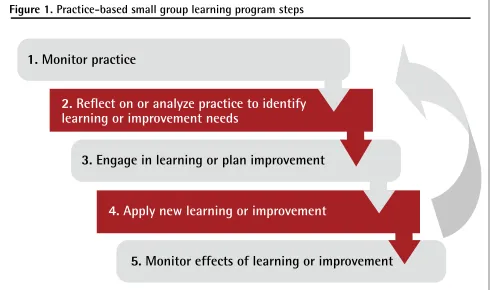
Small groups of health care professionals can use PBSGL to document, assess, and improve practice.9 This
is usually accomplished through the steps depicted in Figure 1.10,11 Effects on patient care have to be
evalu-ated in addition to learner knowledge and skills.11,12 This
review attempts to describe and evaluate the formats and content of and the effects on practice of PBSGL pro-grams involving FPs.
DATA SOURCES
The Ovid MEDLINE, EMBASE, and ERIC databases were searched (from inception to the second week of November 2011) using and combining the MeSH terms
continuing education, medical, professional, retrain-ing, group processes, small group, practice based small group, and teaching. The search was limited to English-language articles. The reference sections of identified articles were also reviewed.
Study selection
The initial search identified 99 articles. Titles and abstracts were reviewed to identify articles relevant to the study aim. Both investigators read the abstracts and selected articles that described the format or content of or evaluated PBSGL programs among FPs. For the purposes of this paper, FPs, GPs, and primary care
physicians [PCPs] were assumed to fall into the same category. Ten articles were identified. The reference sec-tions of these articles were reviewed, and 3 more arti-cles were added to the final review.1,4,13-23
SYNTHESIS
Format and content
Eleven studies had descriptive information about pro-gram design including format and content. The fre-quency of meetings ranged from once to twice monthly,1,4,19,22,23 with an average session duration
ran-ging from 1 to 2 hours.15,21,22 Other programs were
flex-ible and let groups decide the location, duration, and frequency of sessions.4,21,22
The most commonly described sessions were self-formed groups that discussed cases from daily clinical work. Case presentations were followed by topic review and discussion of the related evidence-based medicine arti-cles to identify implications for practice changes.1,4,14,16,19,23
The exact group size was mentioned in some studies and generally ranged from 4 to 11 members.1,4,14,16-21
Content of modules variously included case-based dis-cussions, videotaped consultations, practice visits, audits, and invited experts. Videoconferencing was used to facili-tate PBSGL in 2 studies.17,21 The format and content of
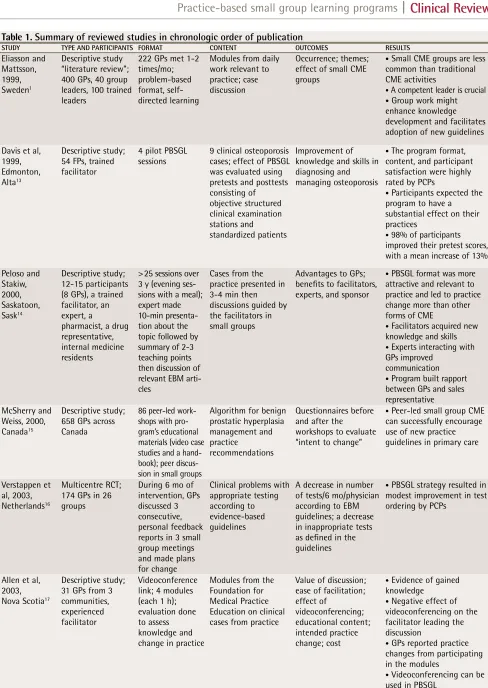
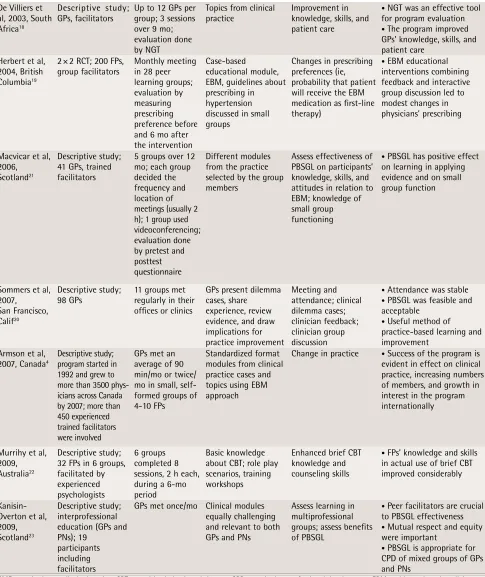
each reviewed program are summarized in Table 1.1,4,13-23
Figure 1. Practice-based small group learning program steps
1.
Monitor practice
2.
Reflect on or analyze practice to identify
learning or improvement needs
3.
Engage in learning or plan improvement
4.
Apply new learning or improvement
Table 1.
Summary of reviewed studies in chronologic order of publication
STudy TyPE And PARTiCiPAnTS FoRMAT ConTEnT ouTCoMES RESuLTS
Eliasson and Mattsson, 1999, Sweden1 Descriptive study “literature review”; 400 GPs, 40 group leaders, 100 trained leaders
222 GPs met 1-2 times/mo; problem-based format, self-directed learning
Modules from daily work relevant to practice; case discussion
Occurrence; themes; effect of small CME groups
• Small CME groups are less
common than traditional CME activities
• A competent leader is crucial • Group work might
enhance knowledge development and facilitates adoption of new guidelines
Davis et al, 1999, Edmonton, Alta13
Descriptive study; 54 FPs, trained facilitator
4 pilot PBSGL
sessions 9 clinical osteoporosis cases; effect of PBSGL was evaluated using pretests and posttests consisting of objective structured clinical examination stations and standardized patients Improvement of knowledge and skills in diagnosing and managing osteoporosis
• The program format,
content, and participant satisfaction were highly rated by PCPs
• Participants expected the
program to have a substantial effect on their practices
• 98% of participants
improved their pretest scores, with a mean increase of 13% Peloso and Stakiw, 2000, Saskatoon, Sask14 Descriptive study; 12-15 participants (8 GPs), a trained facilitator, an expert, a
pharmacist, a drug representative, internal medicine residents
> 25 sessions over 3 y (evening ses-sions with a meal); expert made 10-min presenta-tion about the topic followed by summary of 2-3 teaching points then discussion of relevant EBM arti-cles
Cases from the practice presented in 3-4 min then discussions guided by the facilitators in small groups
Advantages to GPs; benefits to facilitators, experts, and sponsor
• PBSGL format was more
attractive and relevant to practice and led to practice change more than other forms of CME
• Facilitators acquired new
knowledge and skills
• Experts interacting with GPs improved
communication
• Program built rapport
between GPs and sales representative McSherry and
Weiss, 2000, Canada15
Descriptive study; 658 GPs across Canada
86 peer-led work-shops with pro-gram’s educational materials (video case studies and a hand-book); peer discus-sion in small groups
Algorithm for benign prostatic hyperplasia management and practice
recommendations
Questionnaires before and after the workshops to evaluate “intent to change”
• Peer-led small group CME
can successfully encourage use of new practice guidelines in primary care
Verstappen et al, 2003, Netherlands16
Multicentre RCT; 174 GPs in 26 groups
During 6 mo of intervention, GPs discussed 3 consecutive, personal feedback reports in 3 small group meetings and made plans for change
Clinical problems with appropriate testing according to evidence-based guidelines
A decrease in number of tests/6 mo/physician according to EBM guidelines; a decrease in inappropriate tests as defined in the guidelines
• PBSGL strategy resulted in modest improvement in test ordering by PCPs
Allen et al, 2003, Nova Scotia17
Descriptive study; 31 GPs from 3 communities, experienced facilitator
Videoconference link; 4 modules (each 1 h); evaluation done to assess knowledge and change in practice
Modules from the Foundation for Medical Practice Education on clinical cases from practice
Value of discussion; ease of facilitation; effect of
videoconferencing; educational content; intended practice change; cost
• Evidence of gained
knowledge
• Negative effect of
videoconferencing on the facilitator leading the discussion
• GPs reported practice
changes from participating in the modules
• Videoconferencing can be
used in PBSGL
640
Most PBSGL modules consisted of only FPs; 2 studies evaluated interprofessional learning with PCPs and other health care professionals.14,23 All sessions
involved trained facilitators. Studies investigated method of delivery and topics such as osteoporosis diagnosis and management guidelines,13 and benign prostatic
De Villiers et al, 2003, South Africa18
Descriptive study;
GPs, facilitators Up to 12 GPs per group; 3 sessions over 9 mo; evaluation done by NGT
Topics from clinical
practice Improvement in knowledge, skills, and patient care
• NGT was an effective tool
for program evaluation
• The program improved GPs’ knowledge, skills, and patient care
Herbert et al, 2004, British Columbia19
2 × 2 RCT; 200 FPs,
group facilitators Monthly meeting in 28 peer learning groups; evaluation by measuring prescribing preference before and 6 mo after the intervention
Case-based educational module, EBM, guidelines about prescribing in hypertension discussed in small groups
Changes in prescribing preferences (ie, probability that patient will receive the EBM medication as first-line therapy)
• EBM educational
interventions combining feedback and interactive group discussion led to modest changes in physicians’ prescribing
Macvicar et al, 2006, Scotland21
Descriptive study; 41 GPs, trained facilitators
5 groups over 12 mo; each group decided the frequency and location of meetings (usually 2 h); 1 group used videoconferencing; evaluation done by pretest and posttest questionnaire
Different modules from the practice selected by the group members
Assess effectiveness of PBSGL on participants’ knowledge, skills, and attitudes in relation to EBM; knowledge of small group functioning
• PBSGL has positive effect on learning in applying evidence and on small group function
Sommers et al, 2007,
San Francisco, Calif20
Descriptive study;
98 GPs 11 groups met regularly in their offices or clinics
GPs present dilemma cases, share
experience, review evidence, and draw implications for practice improvement Meeting and attendance; clinical dilemma cases; clinician feedback; clinician group discussion
• Attendance was stable • PBSGL was feasible and acceptable
• Useful method of
practice-based learning and improvement
Armson et al, 2007, Canada4
Descriptive study; program started in 1992 and grew to more than 3500 phys-icians across Canada by 2007; more than 450 experienced trained facilitators were involved
GPs met an average of 90 min/mo or twice/ mo in small, self-formed groups of 4-10 FPs
Standardized format modules from clinical practice cases and topics using EBM approach
Change in practice • Success of the program is
evident in effect on clinical practice, increasing numbers of members, and growth in interest in the program internationally
Murrihy et al, 2009, Australia22
Descriptive study; 32 FPs in 6 groups, facilitated by experienced psychologists
6 groups completed 8 sessions, 2 h each, during a 6-mo period
Basic knowledge about CBT; role play scenarios, training workshops
Enhanced brief CBT knowledge and counseling skills
• FPs’ knowledge and skills
in actual use of brief CBT improved considerably
Kanisin-Overton et al, 2009, Scotland23
Descriptive study; interprofessional education (GPs and PNs); 19
participants including facilitators
GPs met once/mo Clinical modules equally challenging and relevant to both GPs and PNs
Assess learning in multiprofessional groups; assess benefits of PBSGL
• Peer facilitators are crucial
to PBSGL effectiveness
• Mutual respect and equity were important
• PBSGL is appropriate for
CPD of mixed groups of GPs and PNs
CME—continuing medical education, CBT—cognitive behavioural therapy, CPD—continuing professional development, EBM—evidence-based medicine, FP—family physician, GP—general practitioner, NGT—nominal group technique, PBSGL—practice-based small group learning, PCP—primary care provider, PN—practice nurse, RCT—randomized controlled trial.
hyperplasia algorithm management and practice rec-ommendations.15 One study used a PBSGL program to
train FPs in brief cognitive behavioural therapy,22 and in
2 studies PBSGL programs were used to assess changes in physician behaviour (in evidence-based prescribing for hypertension19 or in ordering of tests16). Small groups
were viewed by one study as prone to disintegration. Members have to ensure good attendance, deal with interpersonal issues, prioritize the group agenda, and re-emerge from periods of stagnation.1 Attendance was
seen as being influenced by personal, professional, and social forces.14
The role of facilitators with skills in group leadership seems to be very important in PBSGL programs. Most studies emphasized that their facilitators were trained before starting the program, although some studies did not elaborate on the role of the facilitator. In a study that used videoconferencing, the facilitator gave the program a negative rating because the technology made it diffi-cult to facilitate, compared with more traditional face-to-face formats.17
Evaluation of PBSGL programs
Evaluation of an educational program includes assessing the content, process, delivery, and outcomes.24,25 Testing
before and after participation in the programs was often used to evaluate knowledge gain17,22 and program
value.1,20,21 Objective structured clinical examinations
were used to assess changes in knowledge and skills when programs targeted specific tasks.13 Questionnaires
were used to evaluate participants’ intent to change practice.15,17 One study4 reviewed log sheets to describe
changes in practice and another23 used them to reflect
on the value and experience of the education. Two ran-domized controlled studies used quantitative methods to demonstrate the effect on practice changes after imple-menting the program.16,19 In one study, nominal group
technique was used to seek quantitative and qualitative information and was found to be an effective tool for program evaluation.18 Some participants reported that
the PBSGL groups were places of social support and pro-tection against burnout.1,16,17
DISCUSSION
This review identified 2 formats for PBSGL programs. The first focused on identifying learning needs by dis-cussing topics and cases relevant to daily work. This method gave learners more flexibility and allowed for autonomy in learning. The second format investigated a specific clinical problem or task. The problem was identified by the participants or consulting physicians as a topic for discussion. Both formats are important and each has its advantages. The first can be used as an
ongoing process tool for continuing medical education, as it helps with reflection on practice problems, sharing experience with colleagues, and facilitating knowledge and skill acquisition. The other format can be used to implement guidelines or to work on needs that partici-pants are not necessarily aware of. Both formats can use real patient cases and both are designed to stimulate reflection and to share experiences with colleagues.
One study21 considered the lack of formal needs
assessment as a relative weakness of the PBSGL approach; however, the primary goal of such programs is identification of issues in practice, and needs assess-ments thus become an integral part of PBSGL sessions.
The approach that targets specific tasks is useful for improving skills, such as patient-centred management of hypertension15 or familiarity with cognitive behavioural
therapy.22 Changes in practice are helped along as
partici-pants learn from their peers and by the social influence of peer interaction.16 This was shown in 2 randomized
controlled studies (better prescribing19 and test ordering
performance of PCPs16) when the interactive group
dis-cussion combined with personalized feedback led to improvement in physicians’ prescribing (11.5% improve-ment in ordering appropriate antihypertensive medica-tions according to guidelines19) and test ordering (3%, 8%,
and 12% reduction in test ordering after 3 interventions16).
The role of facilitators with skills in group leadership seems to be important in PBSGL programs, and most facilitators were trained before starting the program. As in other problem-based learning, the role of the facili-tator for PBSGL is also to direct the group.26 Although
one facilitator negatively rated videoconferencing tech-nology,17 videoconferencing does have the potential to
bring the benefits of PBSGL to many physicians and it might be the only alternative for physicians in remote areas and in solo practices. The study that examined the effect of interprofessional PBSGL by describing the experiences of GPs and practice nurses showed that par-ticipants were open about gaps in their knowledge and open to learning from the other profession.23
Although, many PBSGL programs overlap with problem-based learning in general, they are not the same as problem-based learning, which has specific cri-teria and varying formats.27,28 As such, this review only
addressed PBSGL and not problem-based learning in continuing education. In a review of 6 studies of prob-lem-based learning in continuing education, only one study used a PBSGL format.29 Our review of PBSGL could
642
organizational or financial incentives were combined with education.30 This raises the question of how to get
commitment from practitioners, as opposed to compli-ance, to enhance practice improvement. Facilitating practitioner interactivity seems to be one of the key components of bringing about positive change in com-munities of practice.31 Practice-based small group
learning establishes a community of practices, and pro-vides the resources for facilitators to improve practi-tioner interactivity and networking.32
Conclusion
Practice-based small group learning is a promising method of continuing professional development and can be adopted and adapted according to different learn-ing needs. Organizational commitment and incentives might sustain the practice changes effected by PBSGL. Future studies that focus on changes in practice that can be assessed through tracking and analysis of log sheets, critical incident journals, serial chart audits, or other quality improvement indicators will strengthen the evi-dence for this form of experiential learning.
Dr Zaher is Academic Fellow in the Department of Family and Community Medicine at the University of Toronto in Ontario. Dr Ratnapalan is Associate Professor in the Department of Paediatrics and the Dalla Lana School of Public Health at the University of Toronto and a staff physician in the Division of Emergency Medicine, Clinical Pharmacology, and Toxicology at the Hospital for Sick Children in Toronto.
Acknowledgment
We thank Ms Elizabeth M. Uleryk, Director of the Hospital for Sick Children’s library, and Ms Rita Shaughnessy, Librarian for the Department of Family and Community Medicine at the University of Toronto, for their kind support, cooperation, and help with literature searches.
Contributors
Dr Zaher designed the study, conducted the literature review, selected and ana-lyzed the studies, interpreted the analysis, and prepared the manuscript for sub-mission. Dr Ratnapalan provided support for the development of the concept and design of the study, and participated in the selection of studies, interpreta-tion of the analysis, and preparainterpreta-tion of the manuscript for submission. Competing interests
None declared Correspondence
Dr Savithiri Ratnapalan, Division of Emergency Medicine, Clinical Pharmacology, and Toxicology, Hospital for Sick Children, 555 University Ave, Toronto, ON M5G 1X8; telephone 416 813-7532; fax 416 813-5043; e-mail [email protected]
References
1. Eliasson G, Mattsson B. From teaching to learning: experiences of small CME group work in general practice in Sweden. Scand J Prim Health Care
1999;17(4):196-200.
2. Schön DA. The reflective practitioner. New York, NY: Basic Books; 1995. 3. Crosby J. AMEE medical education guides no. 8: learning in small groups.
Med Teach 1996;18(3):189-202.
4. Armson H, Kinzie S, Hawes D, Roder S, Wakefield J, Elmslie T. Translating learning into practice. Lessons from the practice-based small group learning program. Can Fam Physician 2007;53:1477-85.
5. Pereles L, Lockyer J, Fidler H. Permanent small groups: group dynamics, learning, and change. J Contin Educ Health Prof 2002;22(4):205-13.
6. Scheingold L. Balint work in England: lessons for American family medicine.
J Fam Pract 1988;26(3):315-20.
7. Salinsky J. The Balint movement worldwide: present state and future outlook: a brief history of Balint around the world. Am J Psychoanal 2002;62(4):327-35. 8. Premi J, Shannon S, Hartwick K, Lamb S, Wakefield J, Williams J.
Practice-based small-group CME. Acad Med 1994;69(10):800-2.
9. Ziegelstein RC, Fiebach NH. “The mirror” and “the village”: a new method for teaching practice-based learning and improvement and systems-based prac-tice. Acad Med 2004;79(1):83-8.
10. Lynch DC, Swing SR, Horowitz SD, Holt K, Messer JV. Assessing practice-based learning and improvement. Teach Learn Med 2004;16(1):85-92. 11. Accreditation Council for Graduate Medical Education. ACGME outcome
pro-ject. Chicago, IL: Accreditation Council for Graduate Medical Education; 2005. 12. Wu AW, Folkman S, McPhee SJ, Lo B. Do house officers learn from their
mis-takes? JAMA 1991;265(16):2089-94.
13. Davis P, Andrews E, Donen N, Fitzgerald A, Hughes S, Juby A, et al. Case studies in osteoporosis: a problem based learning intervention for family physicians. J Rheumatol 1999;26(11):2418-22.
14. Peloso PM, Stakiw KJ. Small-group format for continuing medical education: a report from the field. J Contin Educ Health Prof 2000;20(1):27-32.
15. McSherry J, Weiss R. Managing benign prostatic hyperplasia in primary care. Patient-centred approach. Can Fam Physician 2000;46:383-9.
16. Verstappen WH, van der Weijden T, Sijbrandij J, Smeele I, Hermsen J, Grimshaw J, et al. Effect of a practice-based strategy on test ordering performance of primary care physicians, a randomized trial. JAMA
2003;289(18):2407-12.
17. Allen M, Sargeant J, Mann K, Fleming M, Premi J. Videoconferencing for practice-based small-group continuing medical education: feasibility, accept-ability, effectiveness, and cost. J Contin Educ Health Prof 2003;23(1):38-47. 18. De Villiers M, Bresick G, Mash B. The value of small group learning: an
evaluation of an innovative CPD programme for primary care medical practi-tioners. Med Educ 2003;37(9):815-21.
19. Herbert CP, Wright JM, Maclure M, Wakefield J, Dormuth C, Brett-MacLean P, et al. Better Prescribing Project: a randomized controlled trial of the impact of case-based educational modules and personal prescribing feedback on pre-scribing for hypertension in primary care. Fam Pract 2004;21(5):575-81. 20. Sommers LS, Morgan L, Johnson L, Yatabe K. Practice inquiry: clinical
uncertainty as a focus for small-group learning and practice improvement. J Gen Intern Med 2007;22(2):246-52.
21. Macvicar R, Cunningham DE, Cassidy J, McCalister P, O’Rourke JG, Kelly DR. Applying evidence in practice through small group learning: a Scottish pilot of a Canadian programme. Educ Prim Care 2006;17(5):465-72.
22. Murrihy RC, Byrne MK, Gonsalvenz CJ. Testing an empirically derived men-tal health training model featuring small groups, distributed practice and patient discussion. Med Educ 2009;43(2):140-5.
23. Kanisin-Overton G, Mccalister P, Kelly D, Macvicar R. The Practice-based Small Group Learning Programme: experiences of learners in multi-professional groups. J Interprof Care 2009;23(3);262-72.
24. Morrison J. ABC of learning and teaching in medicine: evaluation. BMJ
2003;326:385-7.
25. Barr H, Freeth D, Hammick M, Koppel I, Reeves S. Evaluations of interprofes-sional education: a United Kingdom review for health and social care. London, UK: United Kingdom Centre for the Advancement of Interprofessional Education, British Educational Research Association; 2000.
26. Exley K. Dennick R. Small group teaching, tutorials, seminars and beyond.
New York, NY: Routledge Falmer; 2004.
27. Maudsley G. Do we all mean the same thing by problem-based learning? A review of the concepts and formulation of the ground rules. Acad Med
1999;74(2):178-85.
28. Barrows HS. A taxonomy of problem-based learning methods. Med Educ
1986;20(6):481-6.
29. Smits PB, Verbeek JH, de Buisonjé CD. Problem based learning in con-tinuing medical education: a review of controlled evaluation studies. BMJ
2002;324(7330):153-6.
30. Perry M, Draskovic I, Lucassen P, Vernooij-Dassen M, van Achterberg T, Rikkert MO. Effects of educational interventions on primary dementia care: a systematic review. Int J Geriatr Psychiatry 2011;26(1):1-11.
31. Parboosingh IJ, Reed VA, Caldwell Palmer J, Bernstein HH. Enhancing practice improvement by facilitating practitioner interactivity: new roles for providers of continuing medical education. J Contin Educ Health Prof
2011;31(2):122-7.