SELECTION A N D BIASED GENE CONVERSION I N
A
MULTIGENE FAMILY: CONSEQUENCES O F INTERALLELIC BIAS A N D THR ESH OLD SELECTION
JAMES BRUCE WALSH’
Department of Ecology and Evolutionary Biology, University of Arizona, Tucson, Arizona 85721
Manuscript received July 15, 1985 Revised copy accepted November 14, 1985
ABSTRACT
In a previous paper, I investigated t h e interactions in a gene family of additive selection and biased gene conversion in a finite population when conversion events a r e rare. H e r e 1 extend my “weak-conversion limit” model by allowing biased interallelic conversion (conversion between alleles a t t h e same locus) of arbitrary frequency a n d various threshold selection schemes f o r rare interlocus conversion events. I suggest that it is not unreasonable for gene families t o experience threshold fitness functions, a n d show that certain types of thresholds can greatly constrain the rate a t which advantageous alleles a r e fixed as com- pared t o other fitness schemes, such as additive selection. It is also shown that t h e double sampling process operating on a gene family in a finite population (sampling over t h e number of genes in t h e gene family and over t h e number of individuals in the population) can have interesting consequences. For selectively neutral alleles that experience interallelic bias, t h e probability of fixation a t each single locus may be essentially neutral, but the cumulative effects o n t h e entire gene family of small departures from neutrality can be significant, especially if t h e gene family is large. T h u s , in some situations, gene families can respond t o directional forces that a r e weak in comparison t o drift a t single loci.
general theme on genome structure that is emerging from molecular
A
biology is the ubiquity of multigene families. Genes that exist as multiple copies are subjected to additional evolutionary forces that d o not operate on single loci. Because of this, it is not surprising that much attention has been paid recently to theoretical population genetics models of the evolution of multigene families (e.g., OHTA 1981; NAGYLAKI 1984; WALSH 1985a; and ref- erences therein). This paper continues an examination of the joint interactions of biased gene conversion, selection, and genetic drift (WALSH 1985a). A key result from WALSH (1985a) was that even very small amounts of additive selection can overpower fairly strong interlocus conversion bias. Here, we pro- vide an extension of our earlier analysis by ( 1 ) examining the consequences of various threshold selection schemes and(2)
allowing for interallelic bias (bias in conversion between alleles at the same locus) in addition to interlocus bias.I Addi-ess before September 15, 1986: Department of Genetics, University o f California, Davis, California
9.5616.
700
Our main conclusions are that conversion bias can be quite important with threshold fitness functions, but that additive selection usually dominates con- version, even with fairly strong interallelic bias. For neutral alleles, however, even a very small amount of interallelic bias can be important. Finally, the specific form of the fitness function is of considerable evolutionary importance. Certain types of threshold fitness schemes are much less efficient than additive selection in fixing advantageous alleles.
To incorporate possible differences in intrallelic and interlocus bias, we start with our earlier weak-conversion limit model (WALSH 1985a), which allows only interlocus conversion events and further assumes that such events occur very infrequently. We shall keep this restriction on the rates of interlocus events, but shall place no such restriction on interallelic rates. Our motivation for building upon the weak-conversion limit model is that explicit analytic results are obtainable. Additionally, interallelic rates may be much higher than interlocus rates, although recent data from yeast (JINKS-ROBERTSON and PETES
1985) suggest that this may not always be true. In any event, the weak-con- version results provide a limiting case and suggest features that may hold in much more general models (i.e., high rates of interlocus conversion), which are currently intractable.
In what follows, we first discuss the molecular evidence pertaining to inter- allelic us. interlocus bias. Next, we formulate the generalized model for selec- tion and then refine our analysis for two cases: additive selection (with selec- tively neutral alleles as a special case) and various types of threshold selection. Finally, we discuss the basic conclusions and biological implications of both our models and other models addressing various aspects of multigene family evo- lution.
INTERALLELIC VS. INTERLOCUS CONVERSION
Previous evolutionary models of gene conversion often have failed to distin- guish between two fundamentally different types of conversion events: those between different alleles at the same locus (interallelic conversion) and those between alleles at different loci (interlocus conversion). Recent work suggests that key features in the enzymology of these reactions may be quite different. T h e general rule of thumb is that roughly 50% of all interallelic conversion events are associated with reciprocal recombination events (FINK and PETES 1984), although the two events may be partially separated for conversions occurring in the GI phase of mitosis (ROMAN and FARBE 1983). On the other hand, interlocus conversion events are apparently not associated with reciprocal recombination events (KLEIN and PETES 198 1 ; KLEIN 1984; KLAR and STRATH-
ERN 1984; JACKSON and FINK 1985). This is fortunate, for if interlocus events
and, hence, would be at a selective disadvantage, resulting in a decreased rate of homogenization.
Given differences in interlocus vs. interallelic conversion events, it would not be surprising if they had different biases. As noted earlier (WALSH 1983), the two currently competing classes of conversion models make opposite predic- tions about the direction of bias for an allele for which DNA sequence has a propensity to be nicked. In single-strand break models (MESELSON and RAD-
DING 1975) such alleles are at a conversion advantage, whereas in double-
strand break models (SZOSTAK et al. 1983) they are at a conversion disadvan- tage. Biases may also result from preferential resolution of the conversion heteroduplex, and recent data suggest that this may be the case for some interallelic events (KRAMER, KRAMER and FRITZ 1984; WHITE, LUSNAK and FOGEL 1985). Single-strand break models are expected to generate longer heteroduplexes than double-strand break models (WHITE, LUSNAK and FOGEL
1985). Thus, alleles that have a conversion bias due to preferential heterodu- plex resolution would have stronger biases in single-strand break models com- pared to double-strand break models. At least one class of interlocus conversion events (mating type switching) requires double-strand breaks (KOSTRIKEN et al.
1983; EGEL, BEACH and KLAR 1984), whereas the heteroduplex data of WHITE, LUSNAK and FOGEL favors single-strand breaks for at least some interallelic conversion. Finally, there have been recent suggestions that interlocus conver- sion might be RNA-mediated (BERNSTEIN, MOUNT and WEINER 1983; MOR- ZYCKA-WROBLEWSKA et al. 1985; DOOLITTLE 1985). All of this suggests that it is not unreasonable to assume different biases (including differences in sign) for the different classes of conversion events.
FORMULATION O F T H E GENERAL MODEL
Generations are discrete and nonoverlapping, the randomly mating diploid monoecious population is finite, with size characterized by its variance effective population size Ne and actual size N . T h e gene family has a fixed size of n loci, and we consider only two allelic states, A and a. T h e population is initially monomorphic for allelic state A, and we wish to compute the probability of fixation for allele a, given that we introduce a single copy. We proceed by a straightforward extension of a previous model (WALSH 1985a) by allowing interallelic gene conversion in addition to interlocus conversion. We assume that conversion between different loci occurs at a sufficiently low frequency that an allele introduced by interlocus conversion to a new locus is either lost or fixed by the joint interactions of genetic drift, selection and interallelic gene conversion before the next conversion event between loci occurs. We refer to this class of models as weak-conversion limit models, and WALSH (1985a) can be consulted for further discussion of this assumption.
As before, we model the locus-by-locus spreading of the new allele a by'a discrete time, discrete space Markov chain, with state space
{O,l,
.
- -
n). Statei
means that the population consists ofi
loci monomorphic for allele a and n-
i
loci monomorphic for allelic state A. In the weak-conversion limit, the population can only move from state i to either state i+
1 or state i-
1, andwe denote the transition probabilities into these states by Xi and pi, respectively. Denote by ~ ( 1 ) the probability of fixation at state n, given that we start in state 1. Since the associated probability transition matrix is a continuant, x( 1) is a standard result (EWENS 1979, pp. 73-74):
(1b) plp2 * " pk
P O = 1, Pk =
A I X 2
-
* hk'To compute A, and p,, note that two independent events are required for a successful state transition. First, a polymorphism must be introduced at a pre- viously monomorphic locus by interlocus gene conversion, and second, the introduced allele must become fixed at that locus through the joint interactions of genetic drift, selection and interallelic conversion. Given that we are in state
i,
let Xf"" be the per-generation probability that conversion introduces an a allele at a locus previously monomorphic for allele A, and let u1(1/2N) be the probability of fixation of the introduced allele, given that we start with a single copy. Define pp" and v1(1/2N) similarly. Thus, for 1 5i
5 n-
1;A, = Xp"u,(
1/2N)( 2 4
p, = pp"vt( 1/2N). (2b) Finally, if u0(1/2N) is the probability that the introduced single copy of the new allele a initially becomes fixed at a single locus, then the probability that the allele is eventually fixed throughout the entire gene family, which we denote by U ( l / Z N ) , is
U( 1/2N) = ug(1/2N)x( 1). (3)
T h e effects of bias and the underlying model of conversion for interlocus conversion events enter into our analysis only through
Ayn
and~ 7 .
In obtain- ing the probability of fixation, only the ratio of these terms (py/Xy) matters, and this ratio is an indication of the strength of interlocus conversion bias(NAGYLAKI and PETES 1982; WALSH 1985a). A conversion interaction between
A and a has several possible outcomes (MESELSON and RADDINC 1975), of which we need consider only unequal conversion events. In such events the interact- ing ( a / A ) pair is converted into either ( a l a ) or ( A I A ) . Let the probability that allele A is converted to allele a, given that an unequal conversion event oc- curred between loci, be (1/2
+
p),
and likewise, let this conditional probability that a is converted to A be (1/2 -p). p
measures the conversion bias for events between different loci. Using the NAGYLAKI-PETES model for conversion, we have (for 1 5 i 5 n-
1) p f " " / X y r = (1/2-
@)/(1/2+
p),
which is independent of bothi
and the rate of interlocus conversion events (which we denote by 7").drift and conversion bias (WALSH 1983; NAGYLAKI 1983). To apply these results, denote the fitness of an individual with i a alleles on one haploid set (gamete) and j a alleles on the other haploid set by w(i, j ) . Starting with the population in state
i, and introducing an
a allele into a locus that was mono- morphic for allele A gives the genotypes AA:Aa:aa at this segregating locus the fitnesses w(i, i):w(i+
1 , i):w(i+
1 ,i
+
1). This is our most general formulation for fitnesses. In many cases, however, we might expect the fitness of an indi- vidual to simply depend on the number of copies of allele a that it carries. In this case, let w ( x ) be the fitness of an individual that carries allele a at a fractionx of the total loci in the gene family. Further, if the number of loci is large, we might expect small changes in the total composition of allele a to produce only small changes in fitness. Under this assumption we use a first-order Taylor expansion to see that, for our segregating locus, the genotypes AA:Aa:aa have approximate fitnesses 1:l
+
sz:l+
2 sa, withsa = w '(i/n)/[2nw(i/n)] ( 4 4
and prime denoting differentiation.
It remains only to incorporate the effects of bias in interallelic conversion. Interallelic conversion parameters are defined as follows. Let
y
be the per- generation per-locus rate of unequal interallelic conversion events. When an unequal conversion event occurs, with probability(1/2
+
6), an allele A is converted to allele a , likewise with probability (1/2-
6), allele a is converted to allele A . It has already been shown (GUTZ and LESLIE 1976; LAMB andHELMI 1982; WALSH 1982, 1983; NACYLAKI 1983) that if the genotypes
AA:Aa:aa have fitnesses 1:l
+
h:l+
t and biased gene conversion parameters y and 6, then provided that h, t, and y6 are all sufficiently small so that we can ignore higher products, this locus behaves like one with no conversion bias but fitnesses 1:l+
h+
2y6:l+ t
+
476. From (4a), for the fitness function w ( x ) , we compute ut(1/2N) using fitnesses 1:l+
[,:1+
2f,, where5:
= 276+
w'(i/n)/[2nw(i/n)] (4b)where the prime denotes differentiation. Thus, we have reduced our system to an equivalent one with additive selection and can use standard results (KI- MURA 1957) to obtain
(sa)
u1(1/2N)
=
[1/2N][4Ne[,/(1-
exp{-4Nef,))] 0 5i
5 n-
1and likewise
~ , ( 1 / 2 N )
=
[1/2N][4Neft/(exp14Ne[,]
-
l)]Using (5) and ( 1 ) and recalling that pfOn/X? = r , we obtain
0 5
i
5 n-
1 . (5b)n- 1 k
a(l)-' = 1
+
r'exp(-ko)exp{- c x it) (6)k= 1 z= 1
where
704
Equation (6) shows the decomposition of the effects of interlocus conversion bias (r), interallelic conversion bias
(e)
and selection ( i i ) . From (6) we see that selection in the earlier states is given more weight than the same amount of selection occurring in later states. We shall see the implications of this when we examine threshold selection.RESULTS
Additive selection
We can further refine (6) by assuming additive selection, with neutrality as a special case. Define w ( x ) = 1
+
sx as the fitness of an individual with allelea at a fraction x of the total sites in the gene family. Provided I s (
<<
1, s,=
s / 2 n , and (6) reduces to
(7)
1 cs
+
e
1 - 6U( 1/2N)
=
-
2N 1
-
exp(-(cs+
e)]
1-
where
6
= r exp{-(cs+
e)),
and 0 and c as defined in (6).T h e case of additive selection and interlocus biased conversion has been examined elsewhere (WALSH 1985a), so we focus here on three cases: (1) selectively neutral alleles with only interallelic bias (s = @ = 0, 6 # 0); (2) selectively neutral alleles with both interallelic and interlocus bias (s = 0; 6,
,9 # 0); and (3) the general case of additive selection and both interallelic and interlocus bias (s, 6, @ # 0).
Case 1.1: Neutral alleles, no interlocus conversion bias: This case provides
a convenient starting point and also provides interesting insight into one of the more subtle features of the double-diffusion operating in gene family ev- olution (OHTA 1981). From
(7)
it follows that the probability of fixation of a single new mutant through the gene family isU(1/2N)
=
[1/2N][d/(l-
exp(-ne))] (8)U( 1/2N)
=
1/[2Nn] if Inel<<
1, ( 9 4U( 1/2N)
=
4y6[NC/N] if ne>>
1 , and (9b)U( 1/2N)
=
[-8/2N]exp{ne) if ne<<
-1. (9c) thus,These provide an interesting contrast to one-locus results (WALSH 1983; NAGYLAKI 1983). For single-locus fixation probabilities, 8 = 8Ne76 determines the behavior, whereas for the fixation probabilities for a gene family of size n,
ne is the critical parameter. At a single locus, allele a behaves essentially as a neutral allele if 10
I
<<
1. However, from (9a) we see that for fixation through- out a gene family, a behaves as a neutral allele only if nlel<<
1. Thus, if 101is a reflection of the nature of the double diffusion operating on the gene family, where sampling occurs both over the gene family (sampling over n,
gene family members) and the population (sampling over Ne individuals). Even in the weak-conversion limit where these two sampling processes are uncoupled (WALSH 1985a), we still see that, in some cases (such as interallelic bias), the total sampling process behaves as if it had size Nen, allowing for a much finer discrimination of deterministic forces than is obtained by either sampling proc- ess separately.
Case 1.2: Neutral alleles, both interlocus and interallelic bias: In this sec-
tion we examine the relative importance of interallelic us. interlocus bias for selectively neutral alleles when interlocus conversion rates are low. From
(7)
w e have that
(10)
1 8 1
-
r expi-8)2N 1
-
expi-8) 1-
r"exp{-nO)'U(1/2N)
=
-
If r expl-8)
<<
1 and 8>>
1,U( 1/2N)
=
4y6[Ne/N]U(1/2N)
=
[-8/2N]exp(O)[ l / r exp(-8)]"-',(1 la>
(lib) whereas if T exp(-8]
>>
1 and 8<<
-1,which is bounded above by [-8/2N]exp(8), for r expi-8)
>>
1. More generally, we see directly from (10) that since the effects of interallelic bias (8) enter as exponential terms, whereas interlocus bias enters as r=
(1-
28)/(1+
2P), very large amounts of interlocus biases(0
= 1/2+
E , 0<
-E<<
1; or0
= -1/2+
t , 0<
t << 1) are required to overcome interallelic biases when 8Nerl 6I
E 181>>
1. Thus, in the weak-conversion limit, the effects of conversion bias acting between alleles at the same locus are generally more important than the effects of bias acting between loci. T h e assumption of weak interlocus conver- sion rates implies 2Ny*<<
1, where N is the actual population size and -y* is the rate of interlocus conversion. When 181>>
1, for our weak conversion assumption to still hold, we require that y>>
y*, so our above result is intui- tively obvious. Suppose, however, that 18I
<<
1 and, further, that bias between loci is also weak (e.g.,I
PI
<<
l), then we haveU(1/2N)
=
[1/2N]4[P+
2Ney6] if exp(n(4P+
8))>>
1 (1 2 4(12b) U(1/2N)
=
[1/2N](-4)[P+
2Ney6]exp{n(4P+
8))if exp(n(4P
+
8 ) )<<
1,U(1/2N)
=
[1/2Nn] if n14P+
81<<
1. ( 1 2 4effects of interlocus bias are more important than the effects of interallelic bias in determining the fixation dynamics of selectively neutral alleles.
Case 1.3: General case: We see from direct examination of
(7)
that, ifI
cs+
0I
>>
1, then the joint effects of selection and interallelic bias overpowers all but the most extreme interlocus bias (when we are in the weak-conversion limit). For this case, additive selection dominates provided that1
s1
>
4nyI
6I,
whereas interallelic bias dominates if the inequality is reversed. Since is expected to be small for most nonfungal systems (<lop3, LAMB 1984), even very small amounts of additive selection can overpower fairly large interallelic biases (6). Further, for many structural RNA and protein-coding families, n is moderate, usually <lo00 and often <20 (e.g., LONG and DAWID 1980; OLD and WOODLAND 1984; KAFATOS 1983; MOORE, CONKLING and GOODMAN 1982; FYRBERG et al. 1980; PIATIGORSKY 1984). With the expectation of rDNA and histones in a few species, most gene families with large n (>>1000) have un- known function (reviewed by BOUCHARD 1982) and simply may be sequences generated and maintained by genomic-level processes. Selection acting on such families most likely acts directly on copy number and not on specific sequence variants, in which case the selection models of CHARLESWORTH and CHARLES-WORTH (1983) and LANGLEY, BROOKFIELD and KAPLAN (1983), and the non-
selective model of WALSH (1 985b), are more appropriate.
Suppose that both selection and interallelic bias are weak, i.e.,
I
csI
<<
1 and (01<<
1, and that interlocus bias is also fairly weak( I P I
<<
1). T h e critical parameter in this situation is 4[P+
Ne(2y6+
s/2n)], which we denote by A in what follows. If n lAl<<
1, then the probability of fixation for allele a is approximately that for a selectively neutral allele with no conversion bias (i.e.,1/[2Nn]). When nlAl
>>
1, the sign of A determines the behavior, withU(1/2N) [2Ne/N][2y6
+
P/N,+
s/2n] when exp(nA)>>
1 (13a)U(1/2N) z [1/2N][-A]exp{nA} when exp{nA)
<<
1. (13b)From (13) we find that selection dominates both forms of conversion bias provided
I ~ I
>
4ny161+
~ ~ I P I / N ~ . (14)From which we again see that a small amount of additive selection can be quite powerful in structuring a gene family, even in the face of fairly strong bias
(P
and 6). Equation (14) is also of interest for departures from the weak- conversion limit. Two features are introduced by such departures: segregation at multiple sites and bias from interlocus conversion events acting in addition to interallelic bias to influence the fixation probabilities at single loci. We have suggested elsewhere that the addition of segregation at multiple sites strength- ens the effects of additive selection, by providing the population with an in- creased variance in fitness upon which additive selection can act (WALSH1
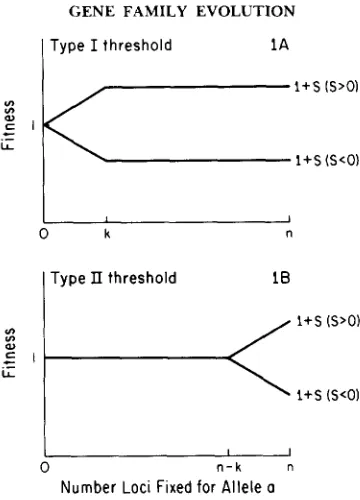
Type I threshold 1A0 k
1
Type II threshold 16I I I
0 n - k n
Number Loci Fixed for Allele a
FIGURE 1 .-The two types of threshold fitness functions that we consider here. T h e horizontal axis is the number of loci that are fixed for allele a, with TI loci total in the gene family, and the
vertical axis is the individual fitness as a function of number of loci fixed for a. A , a type I
threshold, where the allele a has fitness effect that increases with copy number until k of the loci are fixed for a, after which the fitness is unaltered by increased a copy number. B, a type I1 threshold, where, initially, a has no effect on fitness, and fitness effects are apparent only after
n
-
k of the loci are fixed for a. Under both schemes, in the linear part of each fitness function the substitution of an a allele at a single locus changes fitness by s / k . See the text for possible biochemical mechanisms that might generate these types of thresholds.to overpower even fairly strong interlocus bias. SLATKIN (1 985) has examined a deterministic model of the effects of conversion bias and selection, which can be regarded as the opposite case from the weak-conversion limit. In his analysis, the relative evolutionary forces (selection and interlocus conversion) enter in such a way that selection dominates (in our notation), provided I s 1
>
4 n y * l P I , which agrees with our above assertion, as can be seen by replacing y (the rate of interallelic conversions) by y* (the rate of interlocus conversions) in our equation (14).
Threshold selection
T h e motivation behind examining threshold selection is two-fold. First, pre- vious analysis has been limited to additive selection, and threshold selection provides an alternative formulation to investigate the effects of selection. Sec- ond, as we discuss below, we might expect that genes which exist in multiple copies may be kinetically buffered, resulting in threshold fitness functions. Formulation of different types of threshold schemes allows us to assess the evolutionary consequences of such buffering.
of the new allele a has a fitness effect that increases with a copy number until a threshold level is reached, beyond which addition of further copies of a does not effect fitness. As an example of a biochemical pathway that could generate such a threshold, imagine that the gene product from allele a alters a rate- limiting step. However, once the concentration of the gene product of a be- comes sufficiently high (relative to A ) , that step is no longer rate limiting. If the selectable difference is due to the effects of the rate-limiting step, this can generate a type I threshold.
Figure 1B illustrates the second type of threshold (type 11) considered. Here, allele a behaves as a selectively neutral allele until a critical number of loci containing a is reached, after which the fitness effects of a increase with a copy number. A gene family producing more product than is required can show this type of threshold. At low concentrations of the allele a product, the higher concentrations of the A product mitigates the effects of a, be they advantageous or deleterious. Only after the copy number of a reaches a critical threshold will the concentration of a product be sufficiently high to alter fitness. Genes which show dosage compensation (so that the same amount of product is made even though different number of genes may be involved) are likely to show this type of threshold. rDNA gene families (ENDOW 1980) and, more recently, U1 snRNA gene families (MANGIN, ARES and WEINER 1985) have been shown to be dosage compensated to some degree, so that compen- sation may be a general feature of many gene families.
It is of some interest to compare the evolutionary consequences of different patterns of selection (additive, type I/type
I1
thresholds) when the total amount of selection experienced by an allele going to fixation is the same for all three patterns. In the APPENDIX, we compute ~ ( 1 ) for both types of threshold schemes examined here. We can obtain the general conclusions by considering two cases separately. First, we examine the probability of fixation with no interallelic or interlocus bias; then we examine the interactions of conversion bias and threshold selection.Case 2.1: Threshold selection, no bias (6
=
B
=
0): For a type I thresholdfrom (A.l) and (A.5), we have
1 c *s
U,( 1 / 2 N )
=
-
(15)2N 1
-
exp{-c*sk]+
c*s(n-
k)exp{-c*sk)where c * = 2N,/k, and k is the inflection point of the threshold fitness function (see Figure 1 A). If
I
c *s1
>>
1, (1 5) simplifies further toU,(1/2N)
=
[s/k][N,/N]
for c * s>>
1 (164U,(1/2N) w [1/2N][l/(n
-
k)]exp{2Nes] for c * s<<
-1. (16b)For a type I1 threshold scheme (Figure lB), we set the inflection point at (n
-
k ) , so that the total amount of selection for fixed s is the same as for a type I threshold (with inflection point atk).
From (A.4)-(A.6) we obtain(17)
1 c *s
U,,( 1/2N) w
-
which simplifies further when
I
c *sI
>>
1 toUf1(1/2N) % [1/2N][l/(n
-
k)]
for c * s>>
1 ( 1 8 4Uff(1/2N) [1/2N][-c*s]exp{2Nj] for c*s
<<
-1.For c * s
>>
1, from (16a) and (18a) we have U1(1/2N)/U~(l/2N)=
2[N,s/k] [n-
k], so that for alleles at a selective advantage, the underlying threshold scheme makes a large difference, even though alleles becoming fixed experi- ence the same total amounts of selection under either scheme. More generally, it is easy to show from (15) and (17) that i f s>
0, fixation occurs with a higher probability under a type I threshold, whereas i f s<
0, fixation is easier under a type I1 threshold.It is also of interest to compare both
type
I andtype
I1 threshold schemes to additive selection. Assume that the fitness of a completely homozygous aaindividual (i.e., all n loci are aa) is 1
+
s for all three fitness schemes. T h e total amount of selection is the same under all three schemes, but different probabilities of fixation result. Denoting the probability of fixation under ad- ditive selection by UA(1/2N), for advantageous mutants (s>
0) we have thatThus, the form of fitness function can have important consequences for the probability of fixation. A
type
I threshold is slightly more efficient than addi- tive selection for fixing advantageous mutants, whereas compared to both ad- ditive selection and type I thresholds, type I1 thresholds have a much lower probability of fixation for advantageous alleles. This points out an important feature of gene family evolution: certain types of fitness functions may greatly reduce the ability of a gene family to respond to natural selection in the weak- conversion limit (that is, when interlocus conversion events are rare). T h e reason for this is that, under a type I1 threshold, the advantageous allele is fixed and maintained at the first (n-
k)
loci simply by drift. Under either a type I or additive model, however, the allele is initially under selection, re- sulting in a much higher probability of both becoming established and persist- ing at the first few loci, which then allows the allele to spread through the rest of the gene family.Case
2.2:
Conversion bias and threshold selection: T h e above analysis>>
1 in what follows). If allele a has a nontrivial conversion advantage (ie., ( n - 441P
+
2Ney6I
>>
l), thenU1,(1/2N) [1/2N]4[P
+
2N6y6]. (20)Comparing (20) with (18a) shows that, if the newly arising allele has a suffi- ciently strong conversion advantage, the constraining effects of the threshold can be partially overcome. However, if a is at a conversion disadvantage, so that ( n - k)4[P
+
2Ney6]<<
-1, then we can use the first term in (A.4) to place an upper limit on t h e probability of fixation (this limit being independentU1,(1/2N)
<
-[1/2N]4[@+
2Ney6]exp{4(n-
k ) [ P+
2Ney6]). (21)Comparing (2 1) and ( 1 Sa) shows that bias greatly increases the constraining effects of the threshold. NAGYLAKI and PETES (1982) have suggested that, on average, a newly arising allele is more likely to be at a conversion disadvantage than at a conversion advantage, so that (21) may be much more important than (20). If this is the case, then conversion bias generally reduces the ability of alleles experiencing certain threshold fitness functions to respond effectively to selection, further compounding the ineffectiveness of such alleles compared to alleles experiencing other types of fitness functions.
of s):
DISCUSSION
We have extended our previous analyses (WALSH 1985a) on the interaction of selection and biased gene conversion in a multigene family by including bias in conversion between alleles at the same locus and by examining the impli- cations of threshold fitness functions. It should be stressed that the analytic results presented hold exactly only in the weak-conversion limit case, where the rate of interlocus conversion events is very low (WALSH 1985a). However, as suggested below, we feel that the basic implications of the weak-conversion limit results are still valid in far more general settings.
variation in the total number of loci containing a that can be produced by purely nonselective forces (i.e., conversion and drift). If the processes gener- ating variation are such that individuals with a copy number above the selective threshold are routinely produced even when starting from a single new variant, then this constraint is unimportant. If, however, a considerable amount of genetic drift is required to cross the threshold, this constraint can be important even outside the weak-conversion limit.
Thus, the general form of the fitness function acting on a particular gene family can be as important as the total amount of selection. T h e type of gene families that experience the forms of selection considered here are most likely those families that exist because large amounts of their product are needed by the cell. What can we say about the relative likelihoods of additive us. type I us. type I1 thresholds for such families? If excess amounts of product are made, then we would expect type I1 thresholds. If rates are critical, but excess amounts of product are made, then we might see type I thresholds. If both amount and timing are critical, additive or nearly additive (i.e., strictly mono- tonic) selection can result. An important caveat for all cases is that, although we have assumed that the number of loci in the gene family remains constant, this is clearly not the case for many families. Genes existing in tandem arrays
( i . e . , histones, rRNA) are subjected to unequal crossing over, resulting in an amplification and deletion in the number of loci (TARTOF 1974; SMITH 1 9 7 4 ) . Such genes may simply just increase the number of loci containing functional copies to compensate for defective copies, and the analysis of such systems is an important area for future research.
Finally, we have found that the double diffusion operating on a gene family (sampling over gene family copy number n and population size N e ) can have interesting consequences. For selectively neutral alleles experiencing only in- terallelic conversion bias, the amount of bias may be sufficiently small that each single locus fixation event is essentially neutral, but the cumulative effects of very small departures from neutrality at each locus can provide potentially large departures from neutrality for fixation throughout the entire gene fam- ily. This is especially true for large gene families. T h e implication is that gene families can be more responsive to weaker deterministic forces than can single loci. Outside of the weak-conversion limit we expect this to be even more true, because the weak-conversion limit uncouples the two sampling processes, whereas in general they act simultaneously.
Examples of genomic level forces include interlocus gene conversion, unequal crossing over, gene amplification, transposition and insertion of reverse-tran- scribed cDNAs. At the population-level, the sampling occurs over Ne, the var- iance effective population size. Selection and interallelic conversion bias pro- vide examples of directional forces operating at the population level. Clearly, in large populations both levels of evolution are acting simultaneously. The importance of the sampling at both levels is that it leads to homogenization of gene family members without having to invoke any other forces such as selec- tion (SMITH 1974; BLACK and GIBSON 1974; OHTA 1981).
Many previous models of gene family evolution have examined the important case of the equilibrium produced by homogenization due to drift at both levels being opposed by the introduction of new variants by mutation, assuming that no directional forces (i.e., selection, conversion bias) are operating. The models treated here and elsewhere (NAGYLAKI and PETES 1982; WALSH 1985a) deal with the transient dynamics of gene families in the absence of mutation, but allow for directional forces in addition to drift. By examining probabilities of fixation of new alleles, we can obtain a feel for the importance of directional forces in structuring gene families, which complements the fuller equilibrium analysis of the neutral models. By introducing mutation into our models and by suitable diffusion approximations of the associated Markov chain [given by
(2)], we could examine the equilibrium properties of two-allele weak-conversion
limit models, but a multiple allele approach is preferred to allow comparisons with the strictly neutral models. Deterministic (i.e., infinite population size) equilibrium models with selection, bias and mutation are becoming available (WALSH 1984 and unpublished results; SLATKIN 1985), and these should fur- ther allow us to assess the importance of various evolutionary forces in struc- turing gene families.
T h e picture emerging from the theoretical models and molecular studies is that drift (at both levels), genomic-level directional forces and selection can all play important roles in shaping gene families. First, it appears that for many gene families extra gene copies are often generated by a variety of molecular events-gene amplification (SCHIMKE 1984), unequal crossing over (TARTOF
phenotypic evolution (DOVER 1982), such forces nevertheless play important, if not critical, roles in structuring the genome within the often weak constraints imposed by phenotypic evolution.
I thank SUE JINKS-ROBERTSON and TOM PETES for useful discussions on conversion; MICHAEL TURELLI, TOM NAGYLAKI, MONTY SLATKIN, BRUCE WEIR and TOMOKO OHTA for critical comments on earlier versions; and MONTY SLATKIN for sharing unpublished results. This work was supported by a National Institutes of Health postdoctoral fellowship.
LITERATURE CITED
BERNSTEIN, L. B., S. M. MOUNT and A. M. WEINER, 1983 Pseudogenes for human small nuclear RNA U 3 appear to arise by integration of self-primed reverse transcripts of the RNA into new chromosomal sites. Cell 32: 461-472.
Neutral evolution and immunoglobulin diversity. Nature 2 5 0
Moderately repetitive DNA in evolution. Int. Rev. Cytol. 76: 113-193.
T h e population dynamics of transposable ele- BLACK, J. A. and D. GIBSON, 1974
BOUCHARD, R. A., 1982
CHARLESWORTH, B. and D. CHARLESWORTH, 1983 327-328.
ments. Genet. Res. 42: 1-27.
DOOLITTLE, W. F., 1985
DOVER, G., 1982
EGEL, R., D. H. BEACH AND A. J. S. KLAR, 1984
ENDOW, S. A., 1980 O n ribosomal gene compensation in Drosophila. Cell 22: 149-155. EWENS, W. J., 1979 Mathematical Population Genetics. Springer-Verlag, New York. FINK, G. R. and T . D. PETES, 1984
RNA-mediated gene conversion? Trends Genet. 1: 64-65.
Molecular drive: a cohesive mode of species evolution. Nature 299: 1 1 1-1 17.
Genes required for initiation and resultion of mating-type switching in fission yeast. Proc. Natl. Acad. Sci. USA 81: 3481-3485.
Gene conversion in the absence of reciprocal recombination.
FYRBERG, E. A., K. L. KINDLE, N. DAVIDSON and A. SODJA, 1980 T h e actin genes of Drosophila:
GUTZ, H. and H. F. LESLIE, 1976 Gene conversion: a hitherto overlooked parameter in popula- tion genetics. Genetics 83: 861-866.
Meiotic recombination between duplicated elements in Saccharomyces cerevisiae. Genetics 109: 303-332.
High-frequency meiotic gene conversion between repeated genes on nonhomologous chromosomes in yeast. Proc. Natl. Acad. Sci. USA 82:
3350-3354.
KAFATOS, F. C., 1983 Structure, evolution, and developmental expression of the chorion multi- gene families in silkmoths and Drosophila. pp. 33-61. In: Gene Structure and Regulation in Development. Alan R. Liss, New York.
Some problems of stochastic processes in genetics. Ann. Math. Stat. 28: 882- 901.
Resolution of the recombination intermediates gen- erated during yeast mating type switching. Nature 310: 744-748.
Lack of association between intrachromosomal gene conversion and recip- rocal exchange. Nature 310: 748-753.
Nature 3 1 0 728-729.
a dispersed multigene family. Cell 19: 365-376.
JACKSON, J. A. and G. R. FINK, 1985
JINKS-ROBERTSON, S. and T. D. PETES, 1985
KIMURA, M., 1957
KLAR, A. J. S. and J. N. STRATHERN, 1984
KLEIN, H. L., 1984
KLEIN, H. L. and T . D. PETES, 1981 lntrachromosomal gene conversion in yeast. Nature 2 8 9
KOWRIKEN, R., J . N. STRATHERN, A. J. S. KLAR, J. B. HICKS and F. HERRON, 1983 A site-specific endonuclease essential for mating-type switching in Saccharomyces cerevisiae. Cell 35: 167-1 74.
Different base/base mismatches are corrected with different efficiencies by methyl-directed DNA mismatch-repair system of E. coli. Cell 38:
879-887.
LAMB, B. C., 1984
K R A M E R , B., U’. KRAMER and H.-J. FRITZ, 1984
T h e properties of meiotic gene conversion important in its effect on evolution. Heredity 53: 1 13-1 38.
LAMB, B. C. and S . HELMI, 1982 T h e extent to which gene conversion can change allele fre- quencies i n populations. Genet. Res. 3 9 199-21 7.
LANGLEY, C . H., J . F. Y. BROOKFIELD and N. KAPLAN, 1983 Transposable elements in inendelian populations. I . A theory. Genetics 104: 457-471.
LONG, E. 0. and I. B. DAWID, I980 Repeated genes in Eukaryotes. Annu. Rev. Biochem. 49:
U 1 small nuclear RNA genes are subjected to
A general model for genetic recombination. Proc.
Human growth hormone: a multi-
Con- certed evolution of dispersed Neurospora crassa 5 s RNA genes: pattern of sequence conser- vation between allelic and nonallelic genes. Mol. Cell. Biol. 5: 46-51,
727-764.
MANGIN, M., M. ARES A N D A. M. WEINER, 1985
dosage compensation in niouse cells. Science 229: 272-275.
Natl. Acad. Sci. USA 72: 358-361. MESELSON. M. S. and C . M. RADDING, 1975
MOORE, D. D., M. A. CONKLINC and H. M. GOODMAN, 1982 gene family. Cell 29: 285-2886,
MORZYCKA-WROBLEWSKA, E., E. U . SELKER, J. N . STEVENS and R. L. METZENBERG, 1985
NAGYLAKI. T., 1983 Evolution of a finite population under gene conversion. Proc. Natl. Acad. Sci. USA 8 0 6278-6281.
NAGYLAKI, I.., 1984 Evolution of multigene families under interchromosomal gene conversion. Proc. Natl. Acad. Sci. USA 81: 3796-3800.
NAGYLAKI, T. and T. D. PETES, 1982 Intrachromosomal gene conversion and the maintenance of sequence homogeneity among repeated genes. Genetics 100: 3 15-337.
OHTA, T., 198 1
OHTA, T., I985
Evolution and Variation in hlultigene Families. Springer-Verlag, New York.
A model for duplicative transposition and gene conversion for repetitive DNA families. Genetics 110: 5 13-524.
OLD, R. W. and H. R. WOODLAND, 1984 Histone genes: not so simple after all. Cell 38: 624- 626.
PIATICORSKY, J., 1984
SCHIMKE, R. I.., 1984
S L A T K I N , M., 1986
Lens crystallins and their gene families. Cell 38: 620-621.
Gene amplification in cultured animal cells. Cell 37: 705-713
Interchromosomal biased gene conversion, mutation and selection in a mul-
Unequal crossover and the evolution of multigene families. Cold Spring tigene family. Genetics 112: 681-698.
Harbor Symp. Quant. Biol. 38: 507-513.
gene niagnificatiori. Proc. Natl. Acad. Sci. USA 71: 1272-1276.
ments. Am. Nat. 120: 510-532. SMITH, G . P., 1974
TARTOF, K., 1974 Unequal mitotic sister chromatid exchange as the mechanism for ribosolnal
U’ALSH, J. H., 1982 Kate of accumulation of reproductive isolation by chromosome rearrange-
Role of biased gene conversion in one-locus neutral theory and genome
WALSH, J. B., I983
WALSH, J. E., 1984 How effective are selection and gene conversion in removing nonfunctional members of multigene families? Genetics 107 (Suppl): s l 1 2 .
WALSH, J. E., 1985a Interaction of selection and biased gene conversion in a multigene family.
How many processed pseudogenes are accumulated in a gene family? Ge-
Mismatch-specific post-meiotic segregation fre- Proc. Natl. Acad. Sci. USA 82: 152-157.
WALSH, J . E., 398513
WHITE, J. H., K. LUSNAK and S. FOGEL, 1985 netics 110: 345-364.
quency in yeast suggests a heteroduplex recombination intermediate. Nature 315: 350-352.
Communicating editor: E. S. WEIR
APPENDIX: CALCULATION OF T ( 1 ) FOR THRESHOLD SELECTION
O u r first o r d e r Taylor approximation leading t o (6) is not valid for threshold fitness functions, so we proceed directly from ( l b ) . Let the inflection point in the fitness curve occur a t state k for a type 1 threshold (Figure lA), and let it occur a t (n
-
k) for a type 11threshold. T h i s implies that for fixed s, both thresholds experience the same total amount of selection. W e assume 1s I << 1 . For a type I threshold, we define the fitness of a n individual that carries allele a a t a fraction x of its loci, w ( x ) , as
w ( x ) = 1
+
(x/k)snw ( x ) = 1
+
s0 5 x 5 k/n k/n 5 x 5 1,
which is plotted in Figure 1'4. From ( 5 ) , we have that for i # k that v,/u, = exp(-4N,P], where 4' = t;" for 1 5 i C k, and 5' = ( I for k < z 5 n
-
1, where5" = 278
+
s / 2 k , 5' = 276.For i = k, we use t h e above fitness function t o compute vi and ui directly:
Substitution of t h e above results into ( l b ) gives
T ( I ) - ' = 1
+
h- I
[ r exp{-4N,Eol]'
,=I
n-h-l
vh
+
-
r'exp(-4Ne(k - l)f'](1+
[ r exp{-4Ne(']]'),Uh I= I
which we can reduce to
where
For a type I1 threshold, w ( x ) is given by
w ( x ) = 1 0 I x 5 ( 1
-
k / n )which is plotted in Figure 1B. Proceeding in a n analogous fashion as the above analysis, w e find that we can express ~ ( 1 ) for a type I1 threshold by using (A.4) and (A.5), provided we replace k by (n - k ) and set