On Ciphertext Undetectability
Peter Gaˇzi and Martin Stanek ⋆ Dept. of Computer Science, Comenius University
Mlynsk´a dolina, 842 48 Bratislava, Slovakia {gazi,stanek}@dcs.fmph.uniba.sk
Abstract. We propose a novel security notion for public-key encryption schemes – ciphertext undetectability. Informally, an encryption scheme has the property of ciphertext undetectability, if the attacker is unable to distinguish between valid and invalid ciphertexts. We compare this notion with the established ones, such as indistinguishability of cipher-texts and plaintext awareness. We analyze the possibilities of construct-ing schemes with the property of ciphertext undetectability. Moreover, we prove that the Damg˚ard ElGamal, the Cramer-Shoup scheme and its lite variant achieve ciphertext undetectability under standard assump-tions.
Keywords:ciphertext undetectability, public-key encryption
1
Introduction
In the framework of provable security, there are various established security no-tions for public-key encryption schemes. The security nono-tions evolved, from sim-ple one-wayness into plaintext awareness, to reflect gradually increasing require-ments we impose on encryption schemes. Usually, a security notion is obtained by combining an adversarial goal, such as indistinguishability or non-malleability, and an attack model, such as chosen plaintext attack or (adaptive) chosen ci-phertext attack. Another approach is to require that the attacker is unable to produce a valid ciphertext without the knowledge of the corresponding plaintext (leading to various forms of plaintext awareness). For relations among standard security notions, see [3].
We propose a novel adversarial goal – ciphertext undetectability. Informally, an encryption scheme has the property of ciphertext undetectability, if the poly-nomial time probabilistic attacker is unable to distinguish between valid and invalid ciphertexts. The motivation behind this security notion is three-fold:
– In contrast to plaintext awareness, distinguishing valid ciphertexts might be, for the attacker, easier than actually producing them.
– Similar concepts were already studied and proved to be useful. Hall, Gold-berg, and Schneier [9] used an oracle for distinguishing valid ciphertexts (validity checking oracle) in the attack model (reaction attack). Dent [8] de-fined a much stronger notion of encryption simulatability in order to prove the plaintext awareness of the Cramer-Shoup system.
– Ciphertext undetectability can be an interesting property per-se. Besides purely theoretical view, it can be viewed as a “steganographic” property of an encryption scheme – inability to distinguish actual ciphertexts from some random elements.
Since ciphertext undetectability (CUD for short) describes an adversarial goal, we can pair it with the well-known attack models, namely chosen plaintext attack (CPA), (non-adaptive) chosen ciphertext attack (CCA1), and adaptive chosen ciphertext attack (CCA2).
Contribution. We give a formal definition of CUD, and analyze the properties of the resulting security notions. Namely:
– We prove a separation of CUD-CPA/CCA1/CCA2 classes. More impor-tantly, we show that CUD is an independent security notion for public-key encryption schemes by proving separation of CUD-atk and security notions IND-CPA/CCA1/CCA2 and PA. Since CUD-atk does not imply even IND-CPA, see Theorem 4, it can hardly provide any form of secrecy alone. How-ever, CUD can be viewed as an additional, non-trivial property for public-key encryption schemes. Since PA does not imply CUD-CPA, see Theorem 5, the CUD property is not guaranteed even for PA secure schemes.
– We prove a separation of CUD-atk and usual public-key steganographic se-curity notion of ciphertext pseudorandomness.
– We discuss and analyze various approaches to construct schemes with the CUD property, namely doubling technique, and padding. These techniques allow to turn ElGamal, Goldwasser-Micali, or other IND-CPA secure schemes into CUD-CPA secure variants.
– We prove the CUD-CPA security of Cramer-Shoup lite scheme, and DEG (Damg˚ard ElGamal) scheme under the DDH assumption. In addition, we prove CUD-CPA security of Cramer-Shoup scheme under the DDH assump-tion, and CUD-CCA1 security of Cramer-Shoup lite scheme and DEG scheme under the DDH and DHK1 assumptions.
the validity-checking as a goal of the attacker. We can look at the attacker as a “censor”, who knows your public key and tries to block all your ciphertexts (but not the invalid ciphertexts).
Steganographic properties of public-key encryption schemes were studied in [1, 2, 10]. The idea of ciphertext pseudorandomness (or “real-or-ideal” property) is that the attacker chooses a message and then is unable to distinguish some encryption of this message from a random string of the same length. This notion differs from our notion of CUD. In fact, they are incomparable, as we will prove later.
Dent defined similar, but much stronger notion of simulatable encryption [8], in order to prove the plaintext awareness of the Cramer-Shoup scheme in the standard model. Dent proved that each simulatable encryption scheme is IND-CCA2 secure. CUD can be viewed as a simpler and weaker version of simulatable encryption.
The paper is structured as follows. Section 2 contains notions and defini-tions used in the paper. In addition, we define the security notion of ciphertext undetectability. In Section 3 we prove the separation of the CUD-atk classes. The relations of CUD-atk to established security notions of IND-atk, PA and ciphertext pseudorandomness are analyzed in Section 4. We discuss the con-structions of CUD-atk secure schemes and CUD-properties of DEG scheme and Cramer-Shoup schemes in Section 5.
2
Preliminaries
Throughout the paper, we use the well-known notions, typical for the provable security framework. We call a function f:N → R negligible, if for every con-stantc≥0 there exists an integerkc such that f(k)≤k−c for allk≥kc. By a shorthandx←R M we denote assigning toxa random value from the setM. We call two families of sets{Xk}k∈Nand{Yk}k∈Ncomputationally indistinguishable
and denote this by a shorthand{Xk}k∈N≈c {Yk}k∈N (orX≈cY if the
param-eter kis obvious) if, for any probabilistic polynomial algorithmA, there exists a negligible functionε such that, for anyk:
Pr[x←R Xk;b←A(x) :b= 1]−Pr[y←R Yk;b←A(y) :b= 1]≤ε(k). We denote an asymmetric encryption scheme by the usual tripleS= (G, E, D), where Gis the randomized key generation algorithm,E is the randomized en-cryption algorithm and D is the deterministic decryption algorithm. The set of all plaintexts is denoted by P, so P =Dom(E). The symbolC denotes the set Dom(D) while it is required to holdE(P) ⊆ C and ∀p∈ P; D(E(p)) =p
for all random coins ofE. We denote by Cv the set of all valid ciphertexts, i.e. Cv={c∈ C |D(c)6=⊥}.
oracle (depending on the attack modelatk). As a result, it outputs some state informationsfor its second phase. Then a fair coin is tossed and depending on the result, either a valid or invalid ciphertext from the supersetCofCv is chosen as a challenge. This challenge is presented to the adversary and its task is to guess the result of the coin toss. The experiment is formalized as follows:
Experiment Exptcud−atk−b S,C,A (k) (pk, sk)←G(1k);
s←AD1(.)(ask,pk); if b= 1 theny← CvR
elsey← C \ CvR ;
b′
←AD2(.)(guess,y,s); returnb′
;
attack modelD1(.)D2(.)
CPA ⊥ ⊥
CCA1 D(.) ⊥ CCA2 D(.) D(.)
where b ∈ {0,1}, atk ∈ {CP A, CCA1, CCA2} and the oraclesD1 and D2 are instantiated – reflecting the attack model – according to the table. As usually, ifatk=CCA2 we do not allowA to try to decrypt the challengey. We define the advantage of an adversary to be
Advcud−atk
S,C,A (k) = Pr[Expt
cud−atk−1
S,C,A (k) = 1]−Pr[Expt
cud−atk−0
S,C,A (k) = 1] and the insecurity of the scheme (relative to a given setC) to be
InSeccud−atk
S,C (k) = maxA Adv
cud−atk S,C,A (k)
where A ranges through all polynomial time probabilistic adversaries. These notions are defined to correspond with analogous notions defined for indistin-guishability in [3]. We also refer to [3] for the definition of indistinindistin-guishability and plaintext awareness in the random oracle model.
Definition 1. An asymmetric encryption scheme S is CUD-atk secure (atk ∈ {CP A, CCA1, CCA2}) if there exists a set C such that:
1. Cv (C
2. there exists a deterministic polynomial algorithm, which accepts exactly the setC
3. the functionInSeccud−atk
S,C (.)is negligible.
Intuitively, an encryption scheme is CUD secure, if its valid ciphertexts can-not be distinguished from other members of some larger set, possibly even with a (limited) access to the decryption oracle. In the specific case of CUD-CPA, this corresponds to the well-known notion of computational indistinguishability of setsCv andC \ Cv with respect to the security parameter of the scheme.
Example 1. The setCv is easily recognizable for textbook versions of RSA, El-Gamal, or Goldwasser-Micali scheme, hence none of these schemes if CUD-atk secure.
3
Separation of the CUD-
atk
Classes
It trivially holds CUD-CCA2 ⇒CUD-CCA1⇒CUD-CPA. In this section, we shall prove the separations for the other direction.
Theorem 1 (CUD-CPA6⇒CUD-CCA1).If there exists a CUD-CPA secure scheme, then there exists a CUD-CPA secure scheme which is not CUD-CCA1 secure.
Proof. Let S = (G, E, D) be a CUD-CPA secure scheme. Let us consider the schemeS′
= (G′
, E′
, D′
):
AlgorithmG′(1k)
u← {R 0,1}k (pk, sk)←G(1k) return((pk, u), sk)
AlgorithmE′
pk,u(m) return0kEpk(m)
AlgorithmD′
sk(c
′
) parsec′
asbkc
if b= 0 returnD(c) else if c=u returnsk
else return⊥
S′
is obviously not CUD-CCA1 secure. Any adversary who asks the provided oracle to decrypt the ciphertext 1kuobtains the private keysk and can decide validity of arbitrary messages.
However,S′ remains CUD-CPA secure. LetCv be the set of valid ciphertexts
inS, letCbe the corresponding superset according to the definition of CUD-CPA forS. Then the set of valid ciphertexts inS′ is obviouslyC′
v= 0kCv∪ {1ku}. We shall show thatC′ = 0kC ∪ {1ku}can be used as the required set proving that
S′ is CUD-CPA secure. It is easy to see that C′
v andC
′
satisfy properties 1 and 2 of Definition 1. To prove the last property, suppose there exists an adversary
A′ capable of distinguishing valid ciphertexts ofS′ from the other members of
C′. Then the following adversary A would be capable of doing the same for S
and the setC.
AlgorithmA(ask, pk)
u← {R 0,1}k
s←A′(ask,(pk, u))
returns
AlgorithmA(guess, y, s)
b′←A′((guess,0ky, s)
returnb′
The valueuis random and therefore useless without access to the decryption oracle. A answers correctly whenever A′
does, so their advantage only differs according to the behavior of A′
on the input 1ku, but this minor difference is
clearly negligible. ⊓⊔
Proof. LetS= (G, E, D) be a CUD-CCA1 secure scheme. Let us considerS′=
(G, E′, D′):
AlgorithmE′
pk(m) return0kEpk(m)
AlgorithmD′
sk(c
′
) parsec′
asbkc
returnDsk(c)
S′
is obviously not CUD-CCA2 secure – an adversary can decide validity of any challenge 0kcby querying the decryption oracle for 1kc.
However,S′remains CUD-CCA1 secure. LetCvdenote the set of valid
cipher-texts ofSand letCbe the corresponding superset guaranteed by the CUD-CCA1 definition forS. Then the set of valid ciphertexts of S′ is{0,1}kCv, let us show
that{0,1}kCcan be used as the corresponding superset. Suppose there exists an adversaryA′
that can distinguish valid ciphertexts ofS′
from the other members of{0,1}kC. Then the following adversaryAcan do the same forS andC.
AlgorithmAD(.)(ask, pk)
s←A′D′(.)
(ask, pk) returns
AlgorithmA(guess, s, c)
d← {R 0,1}
b′
←A′
(guess, s, dkc) returnb′
ObviouslyAcan use the oracleD(.) to perfectly simulate the oracleD′(.) for
A′ during its first phase. A answers correctly whenever A′ does, therefore the
advantages of both adversaries are the same. ⊓⊔
4
Relations to established notions
In this section, we shall inspect the relationship between ciphertext undetectabil-ity and some well-known securundetectabil-ity notions: indistinguishabilundetectabil-ity, various forms of plaintext awareness and ciphertext pseudornadomness. Obviously, we cannot ex-pect ciphertext undetectability to imply secrecy. It turns out that neither does indistinguishability imply CUD. However, the notion of plaintext awareness in the standard model defined in [4] plays a similar role when combined with CUD, as it does when combined with indistinguishability.
4.1 CUD and Indistinguishability
Let us first inspect the relationship between ciphertext undetectability and in-distinguishability.
Theorem 3 (IND-atk6⇒CUD-CPA).For anyatk∈ {CP A, CCA1, CCA2},
if there exists an IND-atk secure scheme then there exists an IND-atk secure scheme which is not CUD-CPA secure.
superset ofCv. Let us consider a new scheme S′= (G′, E, D′), whereG′ andD′
are modified in the following way
AlgorithmG′
(1k) (pk, sk)←G(1k)
p0 R ← P
return((pk, p0),(sk, p0))
AlgorithmD′
(sk,p0)(c
′
) if c′∈ C then
if Dsk(c′) =⊥ then returnp0 else returnDsk(c′)
else return⊥
and the encryption algorithm works as before, using the public key pk. Intu-itively,D′ returns an arbitrary, valid, publicly known plaintextp
0whenever the original decryption procedureDwould fail on a member ofC. This can be done, since the membership in C can be easily decided. Note that this modification does not violate the basic condition of correct decryption, posed on all encryp-tion schemes.
According to our argument following Definition 1, the new schemeS′ is not
CUD-CPA secure, since its set of valid ciphertexts is now C, which is easily recognizable.
However, S′ remains IND-atk secure. It would be easy to transform any
successful IND-atk attacker on S′ into an IND-atk attacker on S, because the
D′ oracle can be perfectly simulated, having acces to theD oracle. Therefore,
by our assumption onS,S′ is also IND-atk secure. ⊓⊔
Theorem 4 (CUD-atk6⇒IND-CPA).For anyatk∈ {CP A, CCA1, CCA2},
if there exists a CUD-atksecure encryption scheme, then there exists a CUD-atk secure scheme which is not IND-CPA secure.
Proof. Letatk∈ {CPA,CCA1,CCA2}be an attack model, letS= (G, E, D) be a CUD-atk secure scheme. Consider a new schemeS′= (G′, E′, D):
AlgorithmG′(1k) (pk, sk)←G m+← PR
c+←E pk(m+)
return((pk, m+, c+), sk)
AlgorithmE′
pk,m+,c+(m) if m=m+ returnc+ else returnEpk(m)
The new schemeS′
is not IND-CPA secure, since its behavior on a publicly known plaintextm+ is deterministic.
However,S′
is CUD-atk secure. To see this, it suffices to observe that both the sets of valid ciphertexts and the decryption oracles ofS andS′
are the same. Therefore, any successful CUD-atk adversary for S′ would also be a successful
CUD-atk adversary forS. ⊓⊔
4.2 CUD and Plaintext Awareness
the random oracle model, as defined in [3], which we shall denote PA. Although PA is a very strong security notion, it does not imply ciphertext undetectability, as the next theorem shows.
Theorem 5 (PA 6⇒ CUD-CPA). If there exists a PA encryption scheme, then there exists a PA scheme which is not CUD-CPA secure.
Proof. We can use the same construction as in the proof of Theorem 3. Let
S be a PA encryption scheme, let S′ be the scheme obtained from S by this
construction. As before, S′ is no longer CUD-CPA secure. Since S was
IND-CPA secure (as a part of PA), the proof of Theorem 3 implies that so is alsoS′.
Moreover, any successful plaintext extractorA forS can be easily transformed into a plaintext extractorA′ forS′ that works in the same way as Adoes, but
instead of returning⊥on a member ofC, it returnsp0. SinceSis plaintext aware,
A exists, and therefore also A′
can be constructed. This proves the plaintext awareness ofS′
. ⊓⊔
Now let us consider the forms of plaintext awareness in the standard model, defined in [4]. The following theorem shows the intuitive fact that PA1 accom-panied with CUD-CPA plays the same role as it does for indistinguishability, i.e. it prevents any adversary from exploiting the pre-challenge queries by making them useless.
Theorem 6 (CUD-CPA+PA1⇒CUD-CCA1). IfS is a PA1 and CUD-CPA secure encryption scheme, thenS is CUD-CCA1 secure.
Proof. The intuitive argument goes as follows: if there exists a successful plain-text extractor capable of answering the pre-challenge decryption queries without knowing the private key (based only on the random tape of the adversary), then this plaintext extractor can be used as a subroutine of the adversary to answer the queries. Therefore, a successful CUD-CCA1 adversary does not need to use its pre-challenge decryption oracle and can be used as a CUD-CPA adversary, with only a negligible difference in its advantage.
The proof is similar to the original proof of the claim IND-CPA + PA1⇒
IND-CCA1 in [4] and therefore is omitted. ⊓⊔
4.3 CUD and Ciphertext Pseudorandomness
Experiment ExptcprS,A−atk−b(k) (pk, sk)←G(1k);
(m, s)←AD1(.)(ask,pk); if b= 1 theny← {R 0,1}n(k)
elsey←R E(m);
b′ ←AD2(.)(guess,y,s); returnb′;
where b ∈ {0,1}, n(k) denotes the length of the ciphertext (it is assumed that encryption of a plaintext of some length always results in a ciphertext of fixed length),atk∈ {CP A, CCA1, CCA2}and the oraclesD1andD2are instantiated according to the attack model. As usually, ifatk=CCA2 we do not allowAto try to decrypt the challengey. We define the advantage of an adversary to be
AdvcprS,A−atk(k) = Pr[ExptcprS,A−atk−1(k) = 1]−Pr[ExptcprS,A−atk−0(k) = 1] and the insecurity of the scheme to be
InSeccprS −atk(k) = max A Adv
cpr−atk S,A (k)
whereA ranges through all polynomial time probabilistic adversaries.
We say thatS is CPR-atk secure ifInSeccprS −atk(·) is negligible. Thus, an attacker is unable to distinguish a ciphertext (corresponding to the chosen plain-text) from a completely random string of the same length.
Although the notion of ciphertext pseudorandomness (“real-or-ideal”) seems similar to CUD (“valid-or-invalid”), we show that these notions are incompara-ble.
Theorem 7 (CUD-atk6⇒CPR-CPA).For anyatk∈ {CP A, CCA1, CCA2},
if there exists a CUD-atksecure encryption scheme, then there exists a CUD-atk secure scheme which is not CPR-CPA secure.
Proof. We use the construction from the proof of Theorem 4. The schemeS′
is not CPR-CPA secure, since its behavior on a publicly known plaintext m+ is deterministic. Thus, the attacker can choosem+ as a plaintext and distinguish its encryption from a random string with overwhelming probability. ⊓⊔
Theorem 8 (CPR-atk6⇒CUD-CPA).For anyatk∈ {CP A, CCA1, CCA2},
if there exists an CPR-atk secure scheme then there exists an CPR-atk secure scheme which is not CUD-CPA secure.
Proof. We use the construction from the proof of Theorem 3. The scheme S′
remains CPR-atk secure (if the original schemeS was CPR-atk secure), since the decryption oracle D′ can be simulated perfectly, having access to the D
oracle. Hence any successful CPR-atk attacker onS′ can be transformed into a
5
Constructions and CUD-
atk
Secure Schemes
5.1 Doubling technique
The doubling technique allows us to turn an IND-CPA secure scheme into an IND-CPA secure scheme with the CUD-CPA property. The idea of the doubling technique is to form the ciphertext from two independent encryptions of the plaintext. In order to preserve the IND-CPA security of the resulting scheme, we need the property of ciphertext self-reducibility.
Definition 2. An asymmetric encryption scheme S = (G, E, D) has the prop-erty of ciphertext self-reducibility, if there exists publicly known probabilistic poly-nomial time algorithm R, such that R(c) returns a uniformly distributed value from the set {c′
| D(c′
) =D(c)}, for anyc∈ Cv.
The property of encryption self-reducibility allows anyone to transform a ciphertext into another ciphertext encrypting the same plaintext.
Example 2. The following schemes have the property of self-reducibility (some other schemes, such as Cramer-Shoup lite and other have this property as well):
ElGamal scheme. Let g be a generator of a group Gof order q, the private key is x←R Zq, the public key is y =gx. The encryption of m ∈ Gis the pair (u, v) = (gr, yrm), wherer←R G. The ciphertext is easily self-reducible:
R(u, v) = (u·gl, v·yl), wherel←R Z q.
Goldwasser-Micali scheme. Let n be a product of two large primes. Let y
be a pseudo-square modulon, i.e. a quadratic non-residue modulo n with Jacobi symbol 1. The values n and y form a public key, the secret key is the factorization ofn. The encryption of m ∈ {0,1} is ymr2modn, where
r←R Z∗
n. The ciphertext is self-reducible:R(c) =c·l2modn, wherel R ←Z∗
n. The doubling technique transforms a schemeS= (G, E, D) intoS′
= (G, E′
, D′
) as follows:
AlgorithmE′
pk(m)
returnEpk(m)||Epk(m)
AlgorithmD′
sk(c1||c2)
if Dsk(c1) =Dsk(c2) then returnDsk(c1) return⊥
In the following theorems, we show that the doubling technique works for both the ElGamal scheme and the Goldwasser-Micali scheme.
Theorem 9. LetS= (G, E, D)be the ElGamal scheme. Then the schemeS′=
(G, E′, D′) obtained from S by the doubling technique is both IND-CPA and
Proof. LetC′=G4, whereGis the group where the computations are performed. Then the properties 1 and 2 of Definition 1 are satisfied. Moreover, a quadruple (u1, v1, u2, v2) is a valid ciphertext in S′, if and only if (g, u1/u2, y, v1/v2) is a DDH quadruple. Hence, assuming the intractability of the DDH problem,S′
is CUD-CPA secure.
In order to prove thatS′
is IND-CPA secure, suppose there exists a successful adversaryA′forS′in the IND-CPA game. Then there exists a successful attacker
A on the IND-CPA security of S. First, A simulates A′ and returns m0, m
1 chosen by A′. After receiving the challenge ciphertext c = E
pk(mb), A uses the ciphertext self-reducibility property of ElGamal, and produces the following challenge for A′: c′ = c||R(c). The answer of A′ is used as an answer by A.
Clearly, the ciphertextc′ is a valid ciphertext inS′. Thus, the advantage ofAis
equal to the advantage ofA′. ⊓⊔
Theorem 10. Let S = (G, E, D) be the Goldwasser-Micali scheme. Then the scheme S′= (G, E′, D′)obtained fromS by the doubling technique is both
IND-CPA and CUD-IND-CPA secure under the QR assumption.
Proof. LetC′= (Z∗
n)2. Then the properties 1 and 2 of Definition 1 are obviously satisfied. Moreover, a pair (c1, c2) is a valid ciphertext inS′, if and only if bothc1 andc2 are either squares or pseudo-squares. Hence, assuming the intractability of distinguishing squares from pseudo-squares,S′ is CUD-CPA secure.
The proof thatS′ is IND-CPA secure is analogous to the proof of Theorem
9 (using ciphertext self-reducibility of Goldwasser-Micali scheme). ⊓⊔
Theorems 9 and 10 give a constructive proof that using two independent encryptions of the plaintext in some IND-CPA secure scheme results in a CUD-CPA secure scheme. The proofs can be easily generalized for any encryption scheme that has the ciphertext self-reducibility property, satisfies E(P) = Cv and this set is easily recognizable.
Doubling technique has mostly theoretical value. For practical purposes, dou-bling the size of the ciphertext is hardly acceptable.
5.2 Padding
Padding is another technique for producing CUD-secure schemes while preserv-ing their IND-security. In contrast to the doublpreserv-ing, it is more general and much more practical. Let S = (G, E, D) be an public-key encryption scheme. Corre-sponding scheme with a padding,S′
= (G, E′
, D′
), is defined as follows:
AlgorithmE′ pk(m) returnEpk(0||m)
AlgorithmD′ sk(c) parseDsk(c) asb||m if b= 0 then returnm
return⊥
Theorem 11. LetSbe an IND-atksecure scheme, foratk∈ {CPA,CCA1,CCA2}. Let the set of all valid ciphertexts in S, Cv, be easily recognizable in probabilis-tic polynomial time. Then the scheme S′ obtained from S by using padding is
CUD-atk secure, and IND-atk secure as well.
Proof. Let us start with the security in the CPA model, i.e.atk=CPA. First, let us assure that S′
is IND-CPA secure. Let A′
be a successful attacker on IND-CPA in S′
. Then we can build an attacker A for S as follows:A simulates A′
in the find phase and transforms the obtained plaintexts m′
0, m
′
1 into his own plaintextsm0= 0||m′0,m1= 0||m′1. After receiving the challengec=Epk(mb),
A passescto A′
. WhateverA′
outputs, so doesA. Sincec is a valid ciphertext ofmb in S′, the advantages ofAand A′ are equal.
Let us defineC′ =Cv (the properties 1 and 2 of Definition 1 are easily satis-fied). In order to prove the CUD-CPA security ofS′, we show how a successful
attackerA′on CUD-CPA security ofS′can be turned into a successful attacker
A on IND-CPA security of S. First, A chooses two plaintexts m0 = 0||m′0,
m1 = 1||m′1, wherem
′
0 and m
′
1 are chosen randomly. After receiving the chal-lengec=Epk(mb),Apasses it toA′ as a challenge in the CUD-CPA game. The ciphertextcis valid inS′
if and only ifcis encryption ofm0 inS. Therefore,A can use the answer ofA′
to distinguish encryption ofm0from encryption ofm1 with the same advantage asA′
distinguished valid and invalid ciphertexts. The proof for the CCA1 and CCA2 attack models is similar to the previous case. This is because the attacker A can simulate the decryption oracle forA′
by using its own decryption oracleD(.) and following the definition ofD′
(.). In the CCA2 scenario, the same queries are prohibited in both games, hence the
simulation is perfect. ⊓⊔
5.3 Schemes with the CUD Property
Another modification of the basic ElGamal encryption scheme that achieves ciphertext undetectability (even CUD-CCA1) is the Damg˚ard ElGamal scheme [7] known as DEG. The scheme is described in Fig. 1.
Theorem 12. The DEG encryption scheme is CUD-CPA secure under the DDH assumption.
Proof. We shall prove that the set C = G3 has the required properties. Let
A be a successful CUD-CPA attacker on DEG, we shall use it to construct a DDH distinguisherA′
with the same advantage. Let (s1, s2, t1, t2)∈G4 be the DDH challenge, i.e. the task ofA′
is to determine whether logs1t1= logs2t2. It picksX1, U ←R Gat random and runsAas a subroutine, supplying it with the public key pk= (s1, s2, X2) and the challengec∗= (t1, t2, U). The distribution of (s1, s2, t1, t2) and the random choice of the valuesX1 andU imply that forA this is a perfect simulation of the CUD experiment. It is easy to see thatc∗ is a
valid ciphertext precisely if (s1, s2, t1, t2) is a DDH tuple, hence the advantages
Bellare and Palacio [4] have proved that the DEG scheme also achieves the PA1 form of plaintext awareness under another assumption posed on the group Gbeside the DDH assumption. They formalize this assumption (originally stated by Damg˚ard in [7]) under the name Diffie-Hellman Knowledge (DHK1) assump-tion. Details of the formalization can be found in [4]. Their result together with Theorem 6 imply the following corollary.
Corollary 1. The DEG encryption scheme is CUD-CCA1 secure under the DDH and DHK1 assumptions.
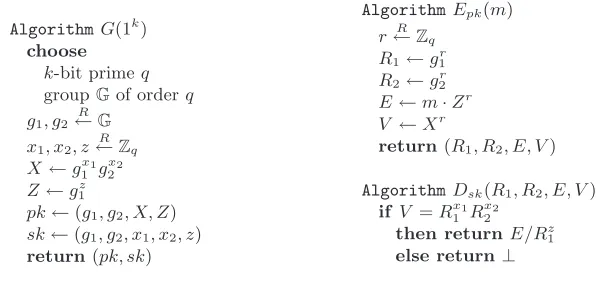
Let us now consider the CS-lite encryption scheme defined in [6]. This is a simplification of the original Cramer-Shoup scheme [5] designed to achieve non-adaptive chosen ciphertext security. The scheme is described in Fig. 2.
Theorem 13. The CS-lite encryption scheme is CUD-CPA secure under the DDH assumption.
Proof. We shall prove that the setC=G4 has the properties required by Defi-nition 1. It obviously satisfies properties 1 and 2, it remains to prove the third property. Let (g1, g2, x1, x2, z)∈Z5q be a random fixed private key. Let us parti-tion the setC into four subsets as follows:
K={(R1, R2, E, V)∈G4 | logg1R1= logg2R2∧V =Rx11 R x2 2 }
L={(R1, R2, E, V)∈G4 | logg1R16= logg2R2∧V =Rx11 Rx22 }
M ={(R1, R2, E, V)∈G4 | logg1R1= logg2R2∧V 6=Rx11 Rx22 }
N ={(R1, R2, E, V)∈G4 | logg1R16= logg2R2∧V 6=Rx11 Rx22 } To finish the proof, we need to show that K∪L≈cM ∪N, assuming DDH.
First, let us prove thatK≈cM under the DDH assumption. Suppose there exists a probabilistic polynomial algorithmAthat distinguishes the setsK and
M with a non-negligible advantage. We shall useAto construct a DDH distin-guisher A′
. Let (s1, s2, t1, t2) be the challenge for A′, i.e. its task is to decide
AlgorithmG(1k) choose
k-bit primeq
groupGof orderq g←R G
x1, x2
R
←Zq
X1←gx1
X2←gx2
pk←(g, X1, X2)
sk←(g, x1, x2)
return(pk, sk)
AlgorithmEpk(m)
y←R Zq
Y ←gy
W ←Xy
1
U ←m·X2y
return(Y, W, U)
AlgorithmDsk(Y, W, U) if W =Yx1
then returnU·Y−x2
else return⊥
AlgorithmG(1k) choose
k-bit primeq
groupGof orderq g1, g2
R
←G
x1, x2, z
R
←Zq
X←gx1
1 g
x2
2
Z←gz
1
pk←(g1, g2, X, Z)
sk←(g1, g2, x1, x2, z)
return(pk, sk)
AlgorithmEpk(m)
r←R Zq
R1←gr1
R2←gr2
E←m·Zr
V ←Xr
return(R1, R2, E, V)
AlgorithmDsk(R1, R2, E, V)
if V =Rx1
1 R
x2
2
then returnE/Rz
1
else return⊥
Fig. 2.The CS-lite encryption scheme.
whether logs1t1 = logs2t2. First,A
′
picks at random w ←R Zq andE, Z R ←G. Then it determines the following values:
g1:=s1 R1:=s2 X :=t1
g2:=sw1 R2:=sw2 V :=t2 Finally, A′
runs A as a subroutine with the public key (g1, g2, X, Z) and the challenge (R1, R2, E, V) and returns the same answerA does. Since logg1u1= logg2u2= logs1s2 (let us denote this valuer), the challenge ciphertext belongs to K∪M and for A, this is a perfect simulation of the computational distin-guishability game. To see that the advantages of A and A′
are the same, note that (R1, R2, E, V)∈K⇔V =Rx11 Rx22 . Since logg1u1= logg2u2, this is equiv-alent to V = g1r(x1+wx2. This equation holds if and only if (g1, R1, X, V) is a DDH tuple. But this is just a different notation for the tuple (s1, s2, t1, t2).
By a similar argument, it can be proved that K ≈c L and M ≈c N un-der the DDH assumption. In both cases, any successful distinguisher A can be transformed into a DDH distinguisher. To decide whether (s1, s2, t1, t2) is a DDH tuple, it suffices to queryAfor a ciphertext withR1:=t1andR2:=t2, provid-ing a public key whereg1:=s1andg2:=s2. The rest of the public key and the challenge ciphertext can be easily chosen to provide a perfect simulation forA. Since K ≈c L, K ≈c M and M ≈c N, the difference in behavior of any probabilistic polynomial algorithm on these sets must be negligible. Therefore, it also holdsK∪L≈cM∪N, which proves the CUD-CPA security of the CS-lite
encryption scheme under the DDH assumption. ⊓⊔
Similar to the DEG scheme, CS-lite was also proved to be PA1 under the DDH and DHK1 assumptions by Bellare and Palacio [4]. Hence we can again use Theorem 6 to obtain the following corollary.
AlgorithmG(1k) choose
k-bit primeq
groupGof orderq H:G3
→Zq
g1, g2
R
←G
x1, x2, y1, y2, z1, z2
R
←Zq
c←gx1
1 g
x2
2
d←gy1
1 g
y2
2
h←gz1
1 g
z2
2
pk←(g1, g2, c, d, h, H)
sk←(x1, x2, y1, y2, z1, z2)
return(pk, sk)
AlgorithmEpk(m)
r←R Zq
u1←g1r
u2←g2r
e←m·hr
α←H(u1, u2, e)
v←vr·drα return(u1, u2, e, v)
AlgorithmDsk(u1, u2, e, v)
α←H(u1, u2, e)
if v=ux1+y1α
1 u
x2+y2α
2
then returne/(uz1
1 u
z2
2 )
else return⊥
Fig. 3.The Cramer-Shoup encryption scheme.
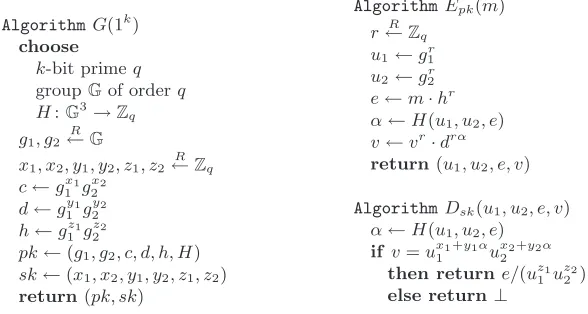
Finally, let us consider the ciphertext undetectability properties of the origi-nal Cramer-Shoup encryption scheme defined in [5]. Recall the definition of the original scheme, depicted in Fig. 3.
Theorem 14. The Cramer-Shoup encryption scheme is CUD-CPA secure un-der the DDH assumption.
Proof. The proof is analogous to the proof of Theorem 13. Again we choose the set C=G4, pick a random private key (x1, x2, y1, y2, z1, z2)∈Z6q and partition the setC into four subsets as follows:
K={(u1, u2, e, v)∈G4 | logg1u1= logg2u2∧v=ux11 +y1αu x2+y2α 2 }
L={(u1, u2, e, v)∈G4 | logg1u16= logg2u2∧v=ux11 +y1αux2 +y2α 2 }
M ={(u1, u2, e, v)∈G4 | logg1u1= logg2u2∧v6=ux11 +y1αu x2+y2α 2 }
N ={(u1, u2, e, v)∈G4 | logg1u16= logg2u2∧v6=ux11 +y1αu x2+y2α 2 }
Hereαdenotes the valueH(u1, u2, e). To finish the proof, we again need to show that K∪L≈cM ∪N, assuming DDH.
The only part that differs from the proof of Theorem 13 is to show that
K≈cM under the DDH assumption. Let us consider the same setting as in the previous proof and show how A′
can useA to help it solve the DDH problem. First,A′ picks at randomw, y
1, y2, z1, z2←R Zq ande←R G. Then it determines the following values:
g1:=s1 h:=gz11 gz22 v:=t2
g2:=sw1 u1:=s2 α:=H(u1, u2, e)
d:=g1y1g y2
Finally, A′ runs A as a subroutine with the public key (g
1, g2, c, d, h, H) and the challenge ciphertext (u1, u2, e, v) and returns the same answerAdoes. Since logg1u1= logg2u2=w, the challenge ciphertext belongs toK∪M and for A, this is again a perfect simulation of the computational distinguishability game. The advantages of A and A′ are the same, because (u
1, u2, e, v) ∈ K ⇔ v =
ux11 +y1αux22 +y2α. Since logg1u1= logg2u2, this is equivalent tov=crdrα, where
r denotes the value logg1u1. This equation holds if and only if (g1, g1r, cdα, v) is a DDH tuple, which corresponds to the tuple (s1, s2, t1, t2). The rest of the
argument is analogous to the proof of Theorem 13. ⊓⊔
6
Conclusion and Further Research
In this paper, we have explored the idea of ciphertext undetectability. We have compared this notion with the indistinguishability of ciphertexts and plaintext awareness. We have proved that, in general, these notions are unrelated. Since ciphertext undetectability does not provide secrecy for public-key schemes, it is important to find constructions that turn IND-atk or PA secure schemes into schemes having CUD property while preserving their IND-atk or PA se-curity. The constructions given in Section 5, namely the doubling technique and padding, can be applied only on schemes satisfying additional properties (e.g. cipher self-reducibility or easily recognizable set Cv). Definitely, more general constructions, without additional requirements, are needed.
Other approach to obtain schemes with the CUD property is to prove the CUD-atk security of some established schemes directly. Although we have proved the original Cramer-Shoup encryption scheme to be CUD-CPA secure, we con-jecture it to achieve the CUD-CCA2 degree of security. However, proving this would require a more sophisticated approach than the approach used in prov-ing the CUD-CCA1 security of CS-lite. This is mainly because the PA1 form of plaintext awareness achieved by CS-lite plays a useful role also for ciphertext undetectability (cf. Theorem 6, but this does not seem to be true for the stronger PA2 notion. In other words, the implication PA2 + CUD-CPA ⇒CUD-CCA2 does not seem to hold. This is because the PA2 notion was designed to model also the possibility of the adversary to get hold of one ciphertext (the challenge) for which it does not know the corresponding plaintext. However, in the CUD experiment, it can also receive an invalid “ciphertext”, so some modifications of the model would be needed.
References
1. Ahn, L., Hopper, N.: Public-Key Steganography, Advances in Cryptology – Euro-crypt 2004, LNCS vol. 3027, pp. 322–339, Springer, 2004.
4. Bellare, M. and Palacio, A.: Towards Plaintext-Aware Public-Key Encryption Without Random Oracles, ASIACRYPT 2004 Proc., LNCS vol. 3329, pp. 48–62, Springer-Verlag, 2004
5. Cramer, R. and Shoup, V.: A practical public key cryptosystem provably secure against adaptive chosen ciphertext attack, Advances in Cryptology – Crypto 98 Proc., LNCS vol. 1462, H. Krawzyk ed, Springer-Verlag, 1998
6. Cramer, R. and Shoup, V.: Design and Analysis of Practical Public-Key Encryption Schemes Secure against Adaptive Chosen Ciphertext Attack, SIAM Journal on Computing vol. 33, pp. 167–226, 2003
7. Damg˚ard, I: Towards practical public key systems secure against chosen ciphertext attacks, Advances in Cryptology – Crypto 91 Proc., LNCS vol. 576, J. Feigenbaum ed., Springer-Verlag, 1991
8. Dent, A. W.: The Cramer-Shoup Encryption Scheme is Plaintext Aware in the Standard Model, Advances in Cryptology – Eurocrypt 2006 Proc., LNCS vol. 4004, pp. 289–307, S. Vaudenay ed, Springer-Verlag, 2006
9. Hall, C., Goldberg, I., and Schneier, B.: Reaction Attacks against several Public-Key Cryptosystems, Information and Communication Security, Second Interna-tional Conference, ICICS’99, Springer-Verlag, LNCS vol. 1726, pp. 2–12, 1999. 10. M¨oller, B.: A Public-Key Encryption Scheme with Pseudo-Random Ciphertexts.
ESORICS 2004, LNCS vol. 3193, pp. 335-351, Springer-Verlag, 2004.