White Box Cryptography: Another Attempt
?JulienBringer1, Herv´eChabanne1, and Emmanuelle Dottax??
1
Sagem D´efense S´ecurit´e
Abstract. At CMS 2006 Bringer et al.show how to conceal the alge-braic structure of a “traceable block cipher” by adding perturbations to its description. We here exploit and strengthen their ideas by further perturbing the representation of a cipher towards a white box implemen-tation. Our technique is quite general, and we apply it – as a challenging example in the domain of white box cryptography – to a variant of the block cipher AES.
Key words:white box cryptography, obfuscation, perturbations, AES.
1 Introduction
In this work, we aim at protecting the design of a block cipher, as well as any secrets involved in the computations, while the whole implemen-tation is actually available to attackers, i.e. in a white box environment. White box cryptography is indeed intended to provide a practical level of protection of software implementations on an untrusted host. The main constraint is that the result must be directly executable.
Here, the attacker has in his possession the full implementation of a keyed block cipher and he looks for the key. The general idea to secure an implementation is to add one or more input and output encodings resulting in a obfuscated function that is harder to analyse or tamper with. Chow et al. introduce this idea and propose a white box imple-mentation of DES in [6] by interleaving affine transformations and using de-linearization techniques. An improvement is explained in [14]. An im-plementation of AES is also given in [7] by representing it with a set of key-dependent look-up tables. Some attacks that can exploit the non-linear properties of S-boxes have also been proposed regarding these at-tempts, such as the statistical bucketing attack and the injection of faults (e.g. see [13, 14]) for DES implementation or by the analysis of look-up
? Our previous attempt has been published on the eprint the 11th of December, 2006.
Jean-S´ebastien Coron pointed out an attack of this previous version to us in [8].
tables composition for AES [4]. Our approach here is different since, in addition to mixing transformations, we introduce some perturbations in the cipher.
In [3], Billet and Gilbert proposed a traceable block cipher. The idea was to represent and implement the same instance of a cipher in different ways. An authority, which knows secret components of the cipher, is able to distinguish the different instances, while attackers are unable to forge untraceable representations. The security of this scheme is based on the Isomorphism of Polynomials (IP) problem [16]. In [12], algorithms to solve this problem were proposed, and a challenging example of [3] has been broken.
In [11], the idea of introducing perturbations to reinforce an IP-based cryptosystem is introduced. In a similar approach, Bringer et al. show in [5] how to perturb the representation of the traceable block cipher by Billet and Gilbert to move it away from these attacks [12]. The principle of the protection is to addperturbationsto the original equations in order to dissimulate the algebraic structure, which is actually needed to mount the attack. Based on this work, we here propose new ideas which should help protecting better. Particularly, we add specific terms to the first round which are cancelled only in the last round such that every round is tightly linked to the others. As a challenging example, we give an application of our techniques to a variant of the AES block cipher where the S-boxes are part of the key and unknown to the adversary – called AEw/oS (Advanced Encryption without standard S-boxes) – and propose an implementation in a white box cryptography approach.
The paper is organized as follows. In Sect. 2, we give a brief recall of the principle of the protection and of the perturbations introduced by [5]. In Sect. 3, we present our modifications of these previous protections. In Sect. 4, we give practical implementations of our ideas to AEw/oS for a white box representation. In Sect. 5 we analyse the security of this new representation. Finally, we conclude in Sect. 6.
2 Bringer et al.’s perturbations [5]
The traceable block cipher introduced by Billet and Gilbert [3] consists of rounds, Gi,j denoting the system of equations of user j’s representation
which “often” vanishes – or, say, in a controlled way – and ˜P =P + ˜0, whereP is a polynomial. By the way, ˜Sstands for a systemSof equations where such substitutions are made, replacing some equations P by ˜P.
The idea of [5] is simply to replace the original systems of polynomials
Gi,j by Ggi,j and to insert random linear transformations between two
rounds to hide this modification. Then, the algebraic structure of each round is made less accessible to an attacker, and the attack [12] seems hard to apply anymore since the description of the original system is not available.
On the other hand, as the new system does not always give the right result anymore, the systemGi,j has to be replaced by distinct, concurrent
systems Ggi,j with correlated polynomials ˜0, such that a majority vote
allows to decide which result has to be kept.
The way polynomials ˜0 are constructed is recalled below as they are part of our new protection. They start with well-known linearized poly-nomials:
Definition 1. Let q0 a power of 2 andq =qm0 ,
– aPq0-polynomial over GF(q) is a polynomial of the form L(X) = e
i=0aiXq0
i
, with e∈Nand (a0, . . . , ae)∈GF(q)e+1,
– an affineq0-polynomialoverGF(q)is a polynomial of the formA(X) =
L(X)−α where α∈GF(q) and L is a q0-polynomial.
Proposition 1. Let L be a q0-polynomial, then the set of its roots is a
linear subspace of its splitting field, i.e. L(X) =Qα∈V (X −α)κ for V a linear subspace and some κ ≥1. In fact, for a q0-polynomial with simple
roots, κ= 1.
The construction of a polynomial ˜0 given in [5] is then the following:
1. letQbe an affineq0-polynomial over GF(q0m) which equals zero over
a subspaceU of dimensione,
2. a multivariate version ofQis made by choosing a random multivariate polynomial with a small number of termsf ∈GF(qm
0 )[X1, . . . , Xnf],
computing Qf =Q(f(X1, . . . , Xnf)) and checking if at least 1/2
m−e
points ofGF(qm
0 )nf have an image followingf in U,
3. then ˜0 = L(f(X1, . . . , Xnf))H(X1, . . . , Xn) where H is a random
polynomial in nvariables over GF(q) chosen s.t. ˜0 has at least some monomials of chosen shapes.
3 Perturbing a block cipher to hide its structure
3.1 Overview
We present a generalization of the ideas above by modifying rounds of a block cipher, when these rounds are expressed as a system of polynomial equations in a finite field. It leads to a polynomial white box implemen-tation.
For this, we introduce additional terms that are mixed to the ones of the original system by linear transformations:
– we introduce random variables in every round (but the last one), they are here to dissimulate the information;
– we also add specific terms to the first round, that will often take some predetermined value. These terms generalize the ˜0 described in the previous section. They are carried round after round, up to the last one;
– finally, corresponding polynomials – chosen for vanishing when the predetermined value is reached – are added to the last round.
Thus doing, intermediate results given by rounds are ‘false’ with a high probability as the specific terms added in the first round perturb all the intermediate values until they are cancelled in the last round.
3.2 Notations
Now, we work with a generic block cipher and in the remainder of the paper, we will adopt the following notations:
– X = (x1, . . . , xn) denotes the input variable of the cipher, – Yi1= (yi,11 , . . . , yi,n1 ) the output variable of thei-th round.
These variables lie in a finite field and each operation – including S-boxes – appearing in the round can be expressed as a polynomial, obtained by combination of its component functions. This way, we compute the system of equations representing the whole round and denote by Si the
system for thei-th round of the cipher.
We get Y11 = S1(X) and, for the other rounds, Yi1 = Si(Yi1−1). We
also introduce the following variables, associated to the i-th round:
Yi2= (yi,12 , . . . , y2i,s),
Yi3= (yi,13 , . . . , y3i,ti),
In the new representation, the i-th round outputs n+s+ti variables,
writtenZi. We now describe the operations implemented in the modified
rounds for a cipher consisting of R rounds. We distinguish the first and the last ones.
3.3 Modifying the representation of each round
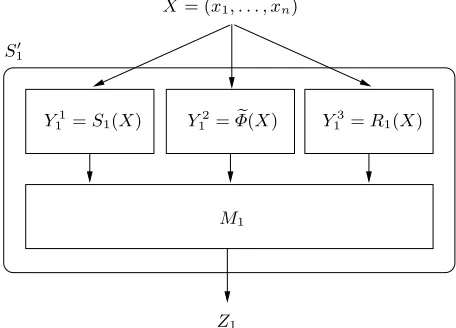
First round. The first round consists in the execution of the following operations (see. Fig. 1):
1. Y1
1 =S1(X), Y12 =Φe(X), Y13 =R1(X),
2. Z1=M1(Y11, Y12, Y13),
where:
– S1is the system corresponding to the first round of the original cipher; – Φe is a system of s polynomials taking “often” a value (ϕ1, . . . , ϕs)
and constructed as Φe(X) = (˜0(X) +ϕ1, . . . ,˜0(X) +ϕs) for a given
polynomial ˜0 (e.g. as in Sec. 2);
– R1 is a random system oft1 polynomial equations;
– M1 is a linear bijection, represented by an n+s+t1 square matrix.
The first round is implemented as the composition of these operations, i.e. by a system of n+s+t1 equations:Z1=S10(X).
PSfrag replacements
X = (x1, . . . , xn)
Y11=S1(X) Y 2
1 =Φe(X) Y 3
1 =R1(X)
M1
M2
S0
1
Z1
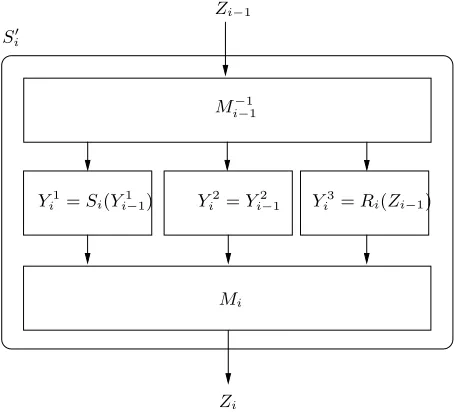
Following rounds. The following rounds, except the last one, consist in the following operations (see. Fig. 2). Fori∈ {2, . . . , R−1},
1. (Yi1−1, Yi2−1, Yi3−1) =Mi−−11(Zi−1),
2. Yi1=Si(Yi1−1), Yi2 =Yi2−1, Yi3=Ri(Zi−1),
3. Zi=Mi(Yi1, Yi2, Yi3),
where:
– Siis the system corresponding to thei-th round of the original cipher; – Ri is a new random system ofti polynomial equations;
– Mi is a linear bijection, represented by an n+s+ti square matrix.
The i-th round is then implemented as the composition of these opera-tions: Zi =Si0(Zi−1).
PSfrag replacements
M−1
i−1
Zi−1
Mi
Zi
Y1
i =Si(Yi1−1) Y 2
i =Y
2
i−1 Y 3
i =Ri(Zi−1)
S0
i
Fig. 2.Protected representation of inside rounds.
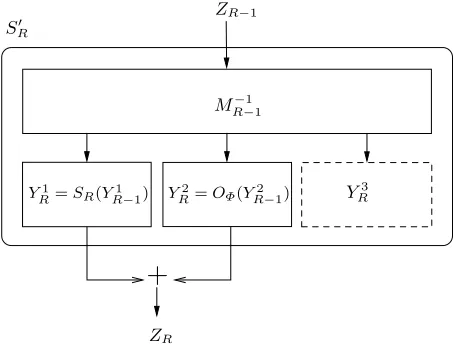
Last round. For the last round we execute (see Fig. 3): 1. (YR1−1, YR2−1, YR3−1) =MR−−11(ZR−1),
2. Y1
R=SR(YR1−1), YR2=OΦ(YR2−1),
3. ZR=YR1+YR2,
where:
– SRis the system corresponding to the last round of the original cipher; – OΦis a system ofnpolynomial equations that vanishes in (ϕ1, . . . , ϕs).
PSfrag replacements
M−1
R−1
ZR
ZR−1
Y1
R=SR(YR1−1) Y 2
R=OΦ(YR2−1) Y 3
R
+
S0
R
Fig. 3.Protected representation of last round.
3.4 Getting the right result
As we see, the resulting algorithm gives the right result (i.e. the result that would be given by the original algorithm) only when the system
e
Φ actually takes the value (ϕ1, . . . , ϕs). So several instances should be
implemented, with well chosenΦe’s, so that the right result can be deduced from a majority vote (cf. Sec. 4.4).
Remark 1. Note that, when the finite field is GF(2) (the cipher can al-ways be expressed by boolean equations), one instance of the protected cipher is enough. Indeed, the system Φe(X) = (˜0(X) +ϕ1, . . . ,˜0(X) +ϕs)
will take only two different values, (ϕ1, . . . , ϕs) and (ϕ1+ 1, . . . , ϕs+ 1).
By taking OΦ such that OΦ(ϕ1, . . . , ϕs) = OΦ((ϕ1+ 1, . . . , ϕs+ 1)) = 0,
we can get the right result with only one instance of the protected cipher. It is not always practical to represent a block cipher inGF(2), as for AES which representation would be too large, but some ciphers are nat-urally fitted to. For instance, we can compute a practical implementation of the block cipher 3-Way [10] inGF(2) following our ideas. We can also remark the simplicity of its polynomial representation and it seems well-suited for our work, but its white box implementation does not resist to interpolation (see Sec. 5.2).
4 An example: white box represention of AEw/oS
by considering that the S-boxes are part of the key and thus unknown to the adversary. The main advantage of AES or AEw/oS block ciphers, for this work, is that they can be efficiently written as a transformation on elements in GF(28) (cf. [17]). In fact, for pedagogical purposes, we give our white box represention of AEw/oS with the regular S-boxes of the AES. Note that due to an attack by Jean-S´ebastien Coron [8] which is described below 5.3, working with our white box representation of AES is no longer a viable option.
4.1 Brief description of AES
AES takes as input a 16-byte block and consists mainly in the iteration of a round. The 16-byte block is represented as a 4×4 square called a state and subject to the following operations:
– AddRoundKey: this operation adds a round key to the state by a bitwise XOR operation;
– SubBytes: the non-linear byte substitution operates independently on
each byte;
– ShiftRows: it is a permutation on the 16 bytes;
– MixColumns: this operation treats each column as a 4-byte vector and
multiplies it by a matrix.
The complete algorithm consists in the sequence of operations on the left part below but for our application, we will write the algorithm, as on the right part, i.e. in a slightly different, though equivalent, way.
1. AddRoundKey(K0)
2. for ifrom 1 to 9: (a) SubBytes; (b) ShiftRows;
(c) MixColumns; (d) AddRoundKey(Ki).
3. SubBytes;
4. ShiftRows;
5. AddRoundKey(K10).
1. for ifrom 1 to 9:
(a) AddRoundKey(Ki−1);
(b) SubBytes; (c) ShiftRows;
(d) MixColumns; 2. AddRoundKey(K9).
3. SubBytes;
4. ShiftRows;
5. AddRoundKey(K10).
4.2 Representation of the original rounds
If we compose the operations of one round we obtain the previously de-fined systems (Si)1≤i≤9; they are systems ofn= 16 equations inGF(28),
each one depending on 4 variables and having around 1020 monomials of maximal degree 254. The last round gives a system S10 of 16 equations,
each having around 255 monomials of maximal degree 254.
4.3 Choice of parameters
Firstly, we choose a polynomial ˜0 following Sec. 2, which equals zero at least half of the time, and we will construct Φeaccordingly.
Now, there are two important points to deal with: the efficiency of the representation, and the protection of the original rounds. Let i ∈ {2, . . . ,10} be a round index, let Ni−1 =n+s+ti−1 be the number of
inputs involved in this round and let (Li−1,1, . . . , Li−1,Ni−1) be the lines of M−1
i−1. Then, we obtain
Yi1 =Si(
Li−1,1
.. .
Li−1,n
Zi−1) and Yi2=
Li−1,n+1
.. .
Li−1,n+s
Zi−1.
The parameters should be chosen according to the following conditions:
Cond. 1 The size s of Φe is chosen in order to give a sufficient number of possible values for (ϕ1, . . . , ϕs), and such that it consists in enough
equations to ensure that the intermediate rounds are not valid, with a high probability when evaluated individually with random inputs (i.e. the systemY2
Rwill not be cancelled in the last round). We choose
here a system ofs= 4 equations.
Cond. 2 For the n first lines of Mi−−11, the number of non-zero coeffi-cients in a line should be small, otherwise the number of terms in the resulting imageY1
i of the blockSi would have an exponential number
of monomials in variableszi−1,1, . . . , zi−1,Ni−1. For instance with our example of AEw/oS white box representation, we set this number to exactly 2 variables by lines.
Cond. 3 As the value ofYi2 will be a constant with a probability greater than one half when the inputs come from the previous rounds, the number of non-zero inputs of lines Li−1,j (for j ∈ {n+ 1. . . n+s}),
Cond. 4 We should also control the number of non-zero coefficients in
Mi−1 to bound the number of monomials in each equations at the
output of the (i−1)-th round.
Cond. 5 At last, random systems Ri−1 should contain a sufficient
num-ber of equations (say at least as many as the total numnum-ber of equations of Y1
i−1 and Yi2−1) and should look like the other systems in order to
mask all the operations.
To manage all these points, we chose random systems Ri of ti = 23
equations for the i-th round (1 ≤i≤9) and matrix Mi are constructed
as block matrix having the following form:
Mi =πi◦
A(1)i
. ..
A(7)i Bi
◦σi,
where
– the A(j)i are random invertible blocks of size 5×5 such that their inverses have exactly 2 non-zero coefficients on each line;
– Biis a random invertible submatrix of size 8×8 with its inverse having
at least 7 non-zero coefficients by line;
– πi is a random permutation of{1, . . . , Ni};
– σi a random permutation of {1, . . . , Ni} such that
σi({1, . . . , n} ∪ {n+s+ 1, . . . , n+s+ 19}) ={1, . . . , n+ 19},
σi({n+ 1, . . . , n+s} ∪ {n+s+ 20, . . . , Ni}) ={n+ 20, . . . , Ni}
In other words, the A(j)i are used to mix the 16 original equations with 19 random equations (19 is in fact the first numberk greater thann= 16 such that 5|k+n) and Bi is used to mixed the second system Yi2 (of s
equations) with exactly s= 4 other random equations.
Thus, the choice of a diagonal block matrix helps for Cond. 4. The construction of A(j)i is implied by Cond. 2, the one of Bi comes from
Cond. 3. For Cond. 5, theRi will be taken with about the same number
of terms as Y1
i and Yi2 gathered with the aim to look like both these
systems. The parameter ti is chosen to have enough equations to mask
all other equations and with respect to the construction of Mi, i.e. to
concerns as it will be explained in Sec. 5. As this construction is regular and limits the transformations, the matrix are preceded and followed by the two permutations πi and σi in order to enlarge the space of possible
transformations.
4.4 Resulting cipher
We have actually computed one instance of the resulting cipher according to the previous parameters. Table 1 gives the results of our implementa-tion. Considering that each monomial can be coded on 17 bytes for the
Table 1.Size of the new representation of the cipher
round s ti # monomials
1 4 23 161.353
2 to 9 4 23 3.445.848
10 4 - 201.600
first round (one for the coefficient and the remainder for the exponents of the x1, . . . , xn), on 5 bytes (one for the coefficient, two for the variables
and two for the exponents, as there are in fact only binomials) in the rounds 2 to 9, and 44 bytes (one for the coefficient and the remainder for the exponents) for the last round, then 142MB are necessary to code one instance of the whole cipher.
To get the right result by a majority vote – as explained in Sect. 3.4 – four concurrent implementations are necessary. To this end, we choose four correlated polynomials ˜0 such that, for any input, two of them equal zero while the two others will give two different values (i.e. the good result will be distinguishable).
5 Security analysis
5.1 General observations
The random systemsRi are chosen such that they hide the equations
of original systemsSi and additional systems, namelyΦein the first round
and identity in the following ones.
In Mi, the block’s size are chosen such that each submatrix lie in
a subspace large enough to prevent an attacker to find them, one after the other by exhaustive search. Indeed, a block of size 5×5 was the minimum to have more than 280 invertible matrices in GF(28) with 2 non-zero coefficients on each line.
For the choice of the blocksBi (with regard to the fourth condition
page 9), it thwarts an attacker to recover (ϕ1, . . . , ϕs) and the
correspond-ing lines of M−1
i as there are too many guesses to make. To recover one
line for the i-th round, all the linear combination involving seven inputs of Zi have to be checked (by looking for the probability of constancy),
which means more than 437(28−1)7 >280 possibilities.
5.2 Resistance to a specific attack: interpolation
An attacker could try to recover the original system by using interpolation and solve the system to recover the value of the key. In this configura-tion, where the attacker is restricted to perform the interpolation in the base field, the best algorithm [18] has the following characteristics: for an equation of k terms and n variables in GF(q), the complexity is given by q4nlog(k)klog(q). Note also that this algorithm assumes the attacker can choose the points, which is not the case in our problem due to the perturbations.
If we consider our example with AEw/oS, the original systems lie in
GF(28) and have the following characteristics:
– for all rounds except the last one:k= 1020, n= 4;
– for the last round:k = 255, n= 4.
The complexity is thus around 232 ·4 · 10· 210·8 in the first case and
232·4·8·28·8 in the other, in each case it is more than 2100.
5.3 Coron’s attack of our white box representation of the AES [8, 9]
Suppose that an adversary considers, as a variable, one input byte of an intermediate roundS0
i of our white box representation of AES and settles
position – so he gets Yi1−1 = (x+u, a2, . . . , a16) whereu, a2, . . . , a16 stay
constant. HenceYi1is a vector made of 16 polynomials inxfor which it ex-ists a linear combination of these polynomials leading toSubBytes(x+v) where v is a constant. He thus obtains an overdefined system by look-ing at Zi = Mi(Yi1, Yi2, Yi3) and finally can solve it by trying all v in
SubBytes(x+v).
For the AEw/oS block cipher, this attack seems not to hold as instead ofSubBytes for the AES, the cipher uses now S-boxes which are unknown to the adversary. Note, however, that, as pointed out by [9], all the 160 S-boxes intervening in the AEw/oS block cipher must be different1. We
can for instance assume that the implementation of such a cipher is done with two keys: one follows the key schedule of AES and plays a classical role, another one follows a similar procedure as those described in [1] (see also [2]) and is employed to generate S-boxes in a pseudo-random manner but according to specific criteria regarding, for instance, resistance to differential and linear cryptanalysis.
6 Conclusion
We propose a new solution to the problem of white box representation of block ciphers. Following Bringer et al. [5], we improve their work on the perturbation of the algebraic structure of a cipher, implemented as systems of multivariate polynomials in a finite field. As a challenge, we describe how our techniques can be applied to a variant of the AES block cipher for which the S-boxes are all different and part of the key, and we give some elements to evaluate the security of our proposition against some specific attacks. Intended to run in software on a general purpose processor, our solution has still to be improved to achieve better perfor-mances. This problem – or designing a new cipher dedicated to our white box solution while staying efficient – and the scrutiny of the security are open avenues for future works.
Acknowledgments
The authors thank gratefully Jean-S´ebastien Coron for his contributions, in particular for having pointed out the attack of the previous version to us.
1
References
1. P. S. L. M. Barreto, V. Rijmen, The ANUBIS Block Cipher, First open NESSIE Workshop, Leuven, 13-14 November 2000
2. Joan Daemen, Vincent Rijmen, Paulo S. L. M. Barreto,Rijndael: Beyond the AES,
Mikul´aˇssk´a kryptobes´ıdka 2002 – 3rd Czech and Slovak cryptology workshop, Dec. 2–3, 2002, Prague, Czech Republic
3. Olivier Billet and Henri Gilbert,A Traceable Block Cipher, Advances in Cryptology – ASIACRYPT 2003 (C.S. Laih, Ed.), LNCS vol. 2894, Springer, 2003, pp. 331–346. 4. Olivier Billet, Henri Gilbert and Charaf Ech-Chatbi,Cryptanalysis of a White Box AES Implementation, Selected Areas in Cryptography (H. Handschuh and M. A. Hasan, Eds.), LNCS vol. 3357, Springer, 2004, pp. 227–240.
5. Julien Bringer, Herv´e Chabanne and Emmanuelle Dottax,Perturbing and Protecting a Traceable Block Cipher, CMS 2006, LNCS vol. 4237, Springer, 2006, pp. 109–119. 6. S. Chow, P. Eisen, H. Johnson and P.C. van Oorschot,A White-Box DES
Imple-mentation for DRM Applications, Proceedings of ACM CCS-9 Workshop DRM 2002 (J. Feigenbaum Ed.), LNCS vol. 2696, Springer, 2003, pp. 1–15.
7. S. Chow, P. Eisen, H. Johnson and P.C. van Oorschot,White-Box Cryptography and an AES Implementation, Proccedings of SAC’02 (K. Nyberg and H. M. Heys, Eds.), LNCS vol. 2595, Springer, 2003, pp 250–270.
8. J.S. Coron,private communication, 2006 December 13th 9. J.S. Coron,private communication, 2006 December 19th
10. Joan Daemen, Ren´e Govaerts, and Joos Vandewalle, A New Approach Towards Block Cipher Design, Proceedings of FSE’93 (R. Anderson Ed.), LNCS vol. 809, Springer, 1994, pp 18–32.
11. Jintai Ding,A New Variant of the Matsumoto-Imai Cryptosystem through Pertur-bation, Public Key Cryptography (F. Bao, R. H. Deng and J. Zhou, Eds.), LNCS vol. 2947, Springer, 2004, pp. 305–318.
12. Jean-Charles Faug`ere and Ludovic Perret,Polynomial Equivalence Problems: Al-gorithmic and Theoretical Aspects, Advances in Cryptology – EUROCRYPT 2006 (Serge Vaudenay, Ed.), LNCS vol. 4004, Springer, 2006, pp 30–47.
13. Matthias Jacob, Dan Boneh and Edward W. Felten,Attacking an Obfuscated Ci-pher by Injecting Faults, Proceedings of ACM CCS-9 Workshop DRM 2002 (J. Feigen-baum Ed.), LNCS vol. 2696, Springer, 2003, pp 16–31.
14. Hamilton E. Link and William D. Neumann, Clarifying Obfuscation: Improving the Security of White-Box Encoding, Cryptology ePrint Archive, Report 2004/025, http://eprint.iacr.org/2004/025, 2004.
15. National Institute of Standards and Technology,FIPS-197: Advanced Encryption Standard, 2001, available at http://csrc.nist.gov/publications/fips/.
16. Jacques Patarin,Hidden Fields Equations (HFE) and Isomorphisms of Polynomi-als (IP): two new Families of asymmetric Algorithms, EUROCRYPT’96, LNCS vol. 1070, Springer, 1996, pp. 33-48.
17. Joan Daemen and Vincent Rijmen,AES Proposal: Rijndael, Selected as the Ad-vanced Encryption Standard, available from http://csrc.nist.gov/encryption/aes/. 18. Kai Werther, The Complexity of Sparse Polynomial Interpolation over Finite