Key points
} In most preventive screening interventions, there is a trade-off between potential harms and benefits. Because individual
patients’ values and preferences can alter the balance for or against screening decisions, practice organizational approaches to enhancing prevention need to incorporate shared decision making as a core component.
} Core skills for physicians and multidisciplinary teams in this area include assessing the quality and appropriateness of
preventive screening guidelines, understanding appropriate outcome measures for preventive screening, using best approaches to risk communication, and knowing how to undertake shared decision making, including eliciting patient values and preferences.
} Practice information systems (ie, electronic medical records) should incorporate high-quality point-of-care knowledge
translation tools and patient decision aids to support shared decision making.
} Because many patients have multiple chronic diseases and multiple screening options, shared decision making practices
should be organized to allow physicians and multidisciplinary team members to provide complementary and supportive roles in shared decision making with patients.
} Outcome and quality assessment processes for preventive screening should focus on outcome measures that reflect the
importance of shared decision making and the potential for individual patients to make different, but appropriate, screening decisions on the same preventive strategy, based on their individual values and preferences.
Practice organization for preventive screening
Brenda J. Wilson MB ChB MSc MRCP(UK) FFPH Neil R. Bell MD SM CCFP FCFPRoland Grad MD CM MSc CCFP FCFP Guylène Thériault MD CCFP James A. Dickinson MB BS PhD CCFP FRACGP Harminder Singh MD MPH FRCPC Stéphane Groulx MD CCFP FCFP Olga Szafran MHSA
All screening programmes do harm; some do good as well. J.A. Muir Gray1
U
ntil fairly recently, guidance to primary carepractitioners on achieving high-quality preven-tive screening focused solely on the importance
of high test uptake in the eligible patient population.2
Messages would typically emphasize a few crucial orga-nizational requirements: accurate, up-to-date informa-tion on patients so that the target populainforma-tion for each test could be identified; a system to proactively invite and if necessary remind individual patients about spe-cific screening tests for which they were eligible; post-ers and leaflets displayed in the patient waiting area to raise general awareness of screening and its importance in promoting health; knowledgeable practitioners confi-dently communicating positive attitudes about screen-ing to their patients; and education materials, suitable for the patient population, available to reinforce the advice being offered by the professionals. A practice would know how well it was doing through regular audit of indicators such as patient satisfaction, false positive rates, and—very important—uptake rates for each of the screening tests offered. In many jurisdictions, financial reward in the form of performance-related payments would follow.3,4
How well does this paradigm serve today’s primary care practice? Let’s visit with Nadia.
Case
Nadia is a 60-year-old woman who smokes. She comes in to discuss her lipid profile, which was requested by one of your colleagues. You notice she has not had a Papanicolaou test for 4 years. You do not have a recent blood pressure measurement for
her, and her last hemoglobin A1c measurement was
done 5 years ago. (You make a mental note that you need to do a CANRISK [Canadian Diabetes Risk Assessment Questionnaire] assessment with her.) You need to discuss mammography screening with her— she has never heard about the pros and cons. She is also now in the age group for colon cancer screening and might meet the criteria for a careful discussion about lung cancer screening.
How would you measure “good performance” in pre-ventive screening in this situation? We see 7 guidelines published by the Canadian Task Force on Preventive
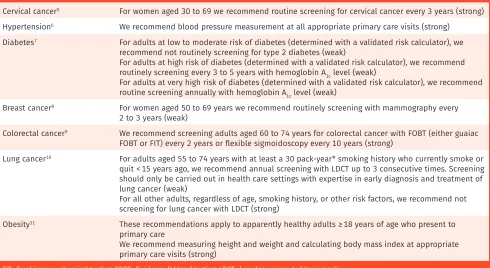
Health Care that are relevant to consider (Table 1).5-11
Readers who have followed this series by the Canadian Task Force on Preventive Health Care will anticipate our position, which is that a practice that judges its perfor-mance on positively ticking the “screened” box for each of Nadia’s issues is missing the most important point of preventive screening: “to improve health outcomes
that matter to the patient.”12 A high-quality preventive
Vol 64: NOVEMBER | NOVEMBRE 2018 |Canadian Family Physician | Le Médecin de famille canadien
817
making system, and we must adjust our view of what constitutes good performance and accept that achieving this is challenging.
Preventive screening practice
within a broader context
To understand the shifting paradigm underpinning
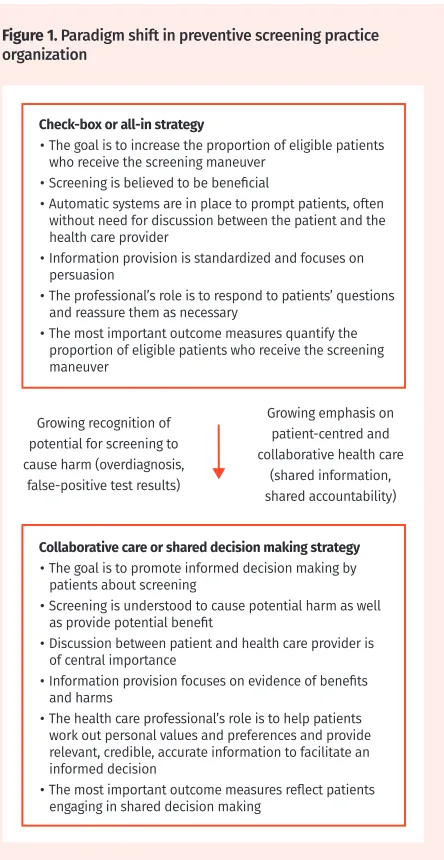
pre-ventive health care (Figure 1), we reflect on 2 important
converging trends.
First, irrespective of the culture of care, practitioners often have to make sense of “weak” or “conditional” guideline recommendations and help their patients make screening decisions based on their values and preferences. A conditional recommendation means that the guideline developers judge that most patients would follow it (whether for or against screening), but some would not. At least 3 issues can feed into a conditional recommendation: the overall balance of benefits and harms is close, there is considerable uncertainty in the research evidence underpinning the recommendation, and there is uncertainty about the outcomes that are
most important to patients.13 When patients are
pre-sented with such uncertainty in the form of conditional recommendations, we expect some variation in what they choose to do.
Second, it is argued that we are witnessing an
ongo-ing cultural shift in health care—once termed
patient-centred care, now sometimes called collaborative health.14
The defining attribute of collaborative health (care) is not
just a shift to shared decision making or greater patient engagement, it is the relocation of power from profes-sionals and the system to individual patients, citizens, and families. “Increasingly people can source informa-tion widely, integrate and manage their financial, social and domestic, and medical spheres, and decide who and
who not to share information with.”15 The health
profes-sional’s role as medical authority is evolving into one of trusted adviser. In the current discussion about preven-tive screening, this changed perspecpreven-tive places compe-tence in facilitating shared decision making as the very least that should be expected of a health professional.
What does this mean for organizing preventive
screening in a primary care context?
In simple terms, a primary care team aspiring to orga-nize itself to comprehensively implement evidence-based preventive screening in a collaborative care approach faces a number of important tasks:
• as a team, identifying the priorities for preventive screening;
• identifying and selecting relevant, credible guidelines16;
• developing systems within the practice to support
implementation, such as alerts and reminders,17 and
protocols shared with other team members to facili-tate efficient patient assessment (eg, for Nadia,
cal-culating her diabetes risk category,7 calculating her
pack-years of smoking for lung cancer screening
eli-gibility,10 taking her blood pressure adequately,6 and
Table 1. Canadian Task Force for Preventive Health Care recommendations relevant to Nadia
GUIDELINE RELEVANT POSITIVE RECOMMENDATION (STRENGTH OF RECOMMENDATION)
Cervical cancer5 For women aged 30 to 69 we recommend routine screening for cervical cancer every 3 years (strong)
Hypertension6 We recommend blood pressure measurement at all appropriate primary care visits (strong)
Diabetes7 For adults at low to moderate risk of diabetes (determined with a validated risk calculator), we
recommend not routinely screening for type 2 diabetes (weak)
For adults at high risk of diabetes (determined with a validated risk calculator), we recommend routinely screening every 3 to 5 years with hemoglobin A1c level (weak)
For adults at very high risk of diabetes (determined with a validated risk calculator), we recommend routine screening annually with hemoglobin A1c level (weak)
Breast cancer8 For women aged 50 to 69 years we recommend routinely screening with mammography every
2 to 3 years (weak)
Colorectal cancer9 We recommend screening adults aged 60 to 74 years for colorectal cancer with FOBT (either guaiac
FOBT or FIT) every 2 years or flexible sigmoidoscopy every 10 years (strong)
Lung cancer10 For adults aged 55 to 74 years with at least a 30 pack-year* smoking history who currently smoke or
quit < 15 years ago, we recommend annual screening with LDCT up to 3 consecutive times. Screening should only be carried out in health care settings with expertise in early diagnosis and treatment of lung cancer (weak)
For all other adults, regardless of age, smoking history, or other risk factors, we recommend not screening for lung cancer with LDCT (strong)
Obesity11 These recommendations apply to apparently healthy adults ≥ 18 years of age who present to
primary care
We recommend measuring height and weight and calculating body mass index at appropriate primary care visits (strong)
FIT—fecal immunochemical testing, FOBT—fecal occult blood testing, LDCT—low-dose computed tomography.
measuring her height and weight to calculate her
body mass index11);
• assembling a portfolio of tools to support shared deci-sion making, such as information sheets and patient decision aids18;
• attending to team members’ needs for education to support shared decision making—including their abil-ity to understand and communicate risk information
to patients accurately and understandably,19 and
elicit-ing patient values and preferences13; and
• developing an audit or evaluation system to check in on the effectiveness of their efforts, focusing on shared decision making outcomes rather than count-ing tests ordered.20
Importance of a team approach
Although it presents a substantial agenda, the list of tasks above is no more than a high-level road map for shifting a practice toward a successfully implemented
preventive approach. Developing systems to support implementation, in particular, suggests the need for involving many different team members. Many clini-cal activities in primary care are already carried out by nurses, nurse practitioners, or other colleagues, and working as a team to develop a practical system of pre-ventive care is a logical route to the most efficient use of time and human resources. There are also other com-pelling reasons for collaborating in a team approach: it makes good use of complementary professional skill sets, it helps ensure congruence in the messages com-municated by different professionals seeing the same patient, it increases opportunities for a team to build relationships and trust with patients, and it encourages team members to collaborate in developing a genuinely practice-led approach to preventive care.
Complexity of typical primary care practice
Every reader will appreciate that the blueprint provided above cannot be more than a starting point at best. Primary care teams exemplify the idea of a complex
adaptive system,21 and some argue that members’
“natu-ral tendency … to learn, form patterns of relationships,
organize and evolve”22 might be usefully harnessed to
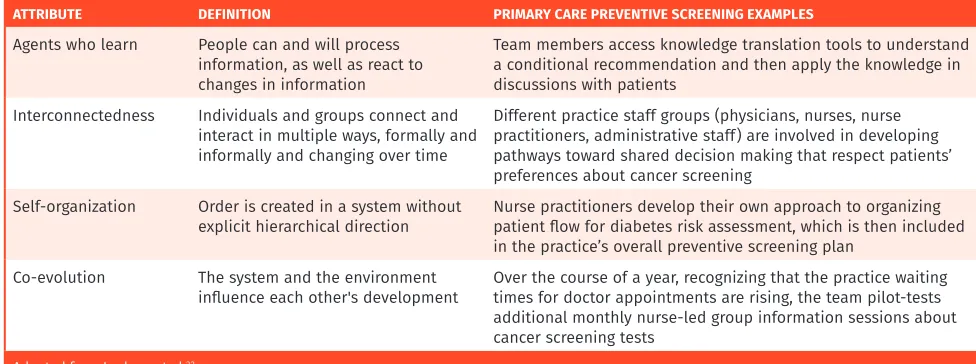
develop more change interventions that are more likely to be effective than simplistic, prescriptive approaches. Table 2 summarizes 4 of the key attributes of complex
adaptive systems.22 Drawing on this, we recognize that
setting up an electronic medical record–based alert sys-tem would not address complexity, but linking reminders to relevant background information and the rationale for
a recommendation would (agents who learn). Similarly,
other complexity attributes might be within the scope of a practice’s approach—for example, physicians and nurs-ing staff worknurs-ing together to develop practical shared
decision making processes (interconnectedness), different
professional groups agreeing to work out for themselves how to make different activities sustainable in practice (self-organization), and adapting processes as a team, as
members gain experience with the system over time (
co-evolution). Perhaps this seems like a formalization of
on-the-ground common sense? Leykum and colleagues22
provide evidence that implementation approaches embedding complexity thinking appear more likely to be effective than simple interventions. This evolving area of implementation science seems to support the argument that it is primary care practitioners themselves who are best placed to develop and adapt their practice to achieve, for their own patient populations, the preventive screen-ing goals that they themselves have prioritized.
Back to Nadia
Primary care is not a schedule of discrete encounters and services, but the orchestration of care delivered over time, across problems, and through conversations.
W.R. Phillips23
Figure 1. Paradigm shift in preventive screening practice organization
Check-box or all-in strategy
• The goal is to increase the proportion of eligible patients
who receive the screening maneuver
• Screening is believed to be beneficial
• Automatic systems are in place to prompt patients, often
without need for discussion between the patient and the health care provider
• Information provision is standardized and focuses on
persuasion
• The professional’s role is to respond to patients’ questions
and reassure them as necessary
• The most important outcome measures quantify the
proportion of eligible patients who receive the screening maneuver
Collaborative care or shared decision making strategy
• The goal is to promote informed decision making by
patients about screening
• Screening is understood to cause potential harm as well
as provide potential benefit
• Discussion between patient and health care provider is
of central importance
• Information provision focuses on evidence of benefits
and harms
• The health care professional’s role is to help patients
work out personal values and preferences and provide relevant, credible, accurate information to facilitate an informed decision
• The most important outcome measures reflect patients
engaging in shared decision making Growing recognition of
potential for screening to cause harm (overdiagnosis,
false-positive test results)
Growing emphasis on patient-centred and collaborative health care
Vol 64: NOVEMBER | NOVEMBRE 2018 |Canadian Family Physician | Le Médecin de famille canadien
819
In a genuinely collaborative care approach, what we do not yet know about Nadia is more important than
knowing which guidelines seem to apply to her. Table 1
embeds a disease-specific, vertical approach and, con-sidered in isolation, communicates an implicit pres-sure on the practitioner to find a way to work through
it in shopping-list style.5-11 Do we start by discussing
the results of the lipid profile ordered by a colleague, then turn to the strong recommendations? Is measuring blood pressure the easiest screening intervention (per-haps it was already done)? Maybe we can step back a little and try to elicit a bit of insight into her understand-ing and values as they apply to screenunderstand-ing in general— does she have a realistic sense of her disease risks? Is her faith in screening tests overly optimistic? These are all places to start the conversation that will hopefully morph into a shared decision making approach.
However, proponents of the collaborative care approach would probably start somewhere else alto-gether—who is Nadia in her own terms? What is her life like? What are her most important relationships and how are they going? What are her own perspectives on her health and health care decisions? And is she just hoping we will listen to her instead of talking at
her?24 At some point, we will get to exploring her
per-sonal thoughts about preventive screening interventions, working out whether she is OK with the disruption that
following preventive recommendations might cause,25
and following her lead on where to start, if anywhere. As Phillips suggests, the continuous relationship of a
patient with her personal physician is central to family medicine, “the specialty devoted to care of the whole
patient the whole time.”23
Conclusion
Any practice seeking to implement the kind of orga-nizational change discussed here will recognize it as an important activity that has to be approached as a
process. The shift from a data- and systems-centred approach to one that emphasizes collaborative care and
a team working together (Figure 1) means that effective
professional education is crucial but also requires criti-cal examination of attitudes, habits, and cultural norms within a practice organization.
The changing context for preventive health care takes place against more widespread changes in social cul-ture. We point to the combination of relatively poor
pop-ulation health literacy26,27 and the proliferation of social
media–facilitated dissemination of health
misinforma-tion.28,29 A side effect of democratizing access to health
information might be the “echo chamber” effect30: our
human tendency to close off competing perspectives and seek out views that reinforce what we already believe. If this is real, then the widely held belief that screening is overwhelmingly beneficial might prove resistant to challenges and does not take into account the potential
for real harms to people.31 This is all the more reason
for primary care professionals to pursue a day-to-day, patient-by-patient approach to evidence-based preven-tive screening within a collaborapreven-tive paradigm—to be part of a quiet revolution to promote well-informed
per-sonal health decision making.
Dr Wilson is Associate Dean and Professor in the Division of Community Health and Humanities at Memorial University of Newfoundland in St John’s. Dr Bell is Professor in the Department of Family Medicine at the University of Alberta in Edmonton. Dr Grad is Associate Professor in the Department of Family Medicine at McGill University and Senior Investigator at the Lady Davis Institute in Montreal, Que. Dr Thériault is Associate Vice Dean of Distributed Medical Education and Academic Lead for the Physicianship Component at Outaouais Medical Campus at McGill University. Dr Dickinson is Professor in the Department of Family Medicine and the Department of Community Health Sciences at the University of Calgary in Alberta. Dr Singh is Associate Professor in the Department of Internal Medicine and the Department of Community Health Sciences at the University of Manitoba in Winnipeg and in the Department of Hematology and Oncology for CancerCare Manitoba. Dr Groulx is Assistant Clinical Professor in the Department of Community Health Sciences at the University of Sherbrooke and Associate Researcher at the Charles-LeMoyne Hospital Research Centre in Sherbrooke, Que. Ms Szafran is Associate Director of Research in the Department of Family Medicine at the University of Alberta in Edmonton.
Competing interests
All authors have completed the International Committee of Medical Journal Editors’ Unified Competing Interest form (available on request from the corresponding author). Dr Singh reports grants from Merck Canada, personal fees from Pendopharm, personal
Table 2. Attributes of complex adaptive systems
ATTRIBUTE DEFINITION PRIMARY CARE PREVENTIVE SCREENING EXAMPLES
Agents who learn People can and will process information, as well as react to changes in information
Team members access knowledge translation tools to understand a conditional recommendation and then apply the knowledge in discussions with patients
Interconnectedness Individuals and groups connect and interact in multiple ways, formally and informally and changing over time
Different practice staff groups (physicians, nurses, nurse practitioners, administrative staff) are involved in developing pathways toward shared decision making that respect patients’ preferences about cancer screening
Self-organization Order is created in a system without
explicit hierarchical direction Nurse practitioners develop their own approach to organizing patient flow for diabetes risk assessment, which is then included in the practice’s overall preventive screening plan
Co-evolution The system and the environment
influence each other's development Over the course of a year, recognizing that the practice waiting times for doctor appointments are rising, the team pilot-tests additional monthly nurse-led group information sessions about cancer screening tests
820
Canadian Family Physician | Le Médecin de famille canadien}Vol 64: NOVEMBER | NOVEMBRE 2018fees and other from Ferring Canada, and personal fees from Takeda Canada, outside the submitted work. The other authors declare that they have no competing interests. Correspondence
Dr Brenda Wilson; e-mail [email protected] References
1. Gray JAM. New concepts in screening. Br J Gen Pract 2004;54(501):292-8.
2. Canadian Task Force on the Periodic Health Examination. The Canadian guide to clinical preventive health care. Ottawa, ON: Canada Communication Group—Publishing; 1994. Avail-able from: https://canadiantaskforce.ca/wp-content/uploads/2016/09/1994-red-brick-en. pdf. Accessed 2018 Aug 28.
3. Kaczorowski J, Goldberg O, Mai V. Pay-for-performance incentives for preventive care. Views of family physicians before and after participation in a reminder and recall project (P-PROMPT). Can Fam Physician 2011;57:690-6.
4. NHS Employers [website]. Quality and outcomes framework. London, Engl: NHS Employers; 2018. Available from: www.nhsemployers.org/PayAndContracts/GeneralMedicalServices Contract/QOF/Pages/QualityOutcomesFramework.aspx. Accessed 2018 Aug 29.
5. Canadian Task Force on Preventive Health Care. Recommendations on screening for cervical cancer. CMAJ 2013;185(1):35-45. Epub 2013 Jan 7.
6. Lindsay P, Connor Gorber S, Joffres M, Birtwhistle R, McKay D, Cloutier L. Recommendations on screening for high blood pressure in Canadian adults. Can Fam Physician 2013;59:927-33 (Eng), e393-400 (Fr).
7. Canadian Task Force on Preventive Health Care. Recommendations on screening for type 2 diabetes in adults. CMAJ 2012;184(15):1687-96. Erratum in: CMAJ 2012;184(16):1815. 8. Canadian Task Force on Preventive Health Care. Recommendations on screening for breast
cancer in average-risk women aged 40-74 years. CMAJ 2011;183(17):1991-2001. Erratum in:
CMAJ 2011;183(18):2147.
9. Canadian Task Force on Preventive Health Care. Recommendations on screening for colorectal cancer in primary care. CMAJ 2016;188(5):340-8. Epub 2016 Feb 22. 10. Canadian Task Force on Preventive Health Care. Recommendations on screening for lung
cancer. CMAJ 2016;188(6):425-32. Epub 2016 Mar 7.
11. Brauer P, Connor Gorber S, Shaw E, Singh H, Bell N, Shane ARE, et al. Recommendations for prevention of weight gain and use of behavioural and pharmacologic interventions to manage overweight and obesity in adults in primary care. CMAJ 2015;187(3):184-95. Epub 2015 Jan 26. 12. Bell NR, Grad R, Dickinson JA, Singh H, Moore AE, Kasperavicius D, et al. Better decision making in preventive health screening. Balancing benefits and harms. Can Fam Physician
2017;63:521-4 (Eng), 525-8 (Fr).
13. Lang E, Bell NR, Dickinson JA, Grad R, Kasperavicius D, Moore AE, et al. Eliciting patient values and preferences to inform shared decision making in preventive screening. Can Fam Physician 2018;64:28-31 (Eng), e13-6 (Fr).
14. Millenson ML. When “patient centred” is no longer enough: the challenge of collaborative health: an essay by Michael L Millenson. BMJ 2017;358:j3048.
15. Godlee F. Are you ready for “collaborative health”? BMJ 2017;358:j3257.
16. Dickinson JA, Bell NR, Grad R, Singh H, Groulx S, Szafran O. Choosing guidelines to use in your practice. Can Fam Physician 2018;64:357-62 (Eng), e225-31 (Fr).
17. Shojania KG, Jennings A, Mayhew A, Ramsay CR, Eccles MP, Grimshaw J. The effects of on-screen, point of care computer reminders on processes and outcomes of care. Cochrane Database Syst Rev 2009;(3):CD001096.
18. Moore AE, Straus SE, Kasperavicius D, Bell NR, Dickinson JA, Grad R, et al. Knowledge trans-lation tools in preventive health care. Can Fam Physician 2017;63:853-8 (Eng), e466-72 (Fr). 19. Bell NR, Dickinson JA, Grad R, Singh H, Kasperavicius D, Thombs BD. Understanding and
communicating risk. Measures of outcome and the magnitude of benefits and harms. Can Fam Physician 2018;64:181-5 (Eng), 186-91 (Fr).
20. McCormack J, Elwyn G. Shared decision is the only outcome that matters when it comes to evaluating evidence-based practice. BMJ Evid Based Med 2018;23(4):137-9. Epub 2018 Jul 12. 21. Braithwaite J, Churruca K, Ellis LA, Long J, Clay-Williams R, Damen N, et al. Complexity
science in healthcare. Aspirations, approaches, applications and accomplishments. A white paper. Sydney, Aust: Australian Institute of Health Innovation, Macquarie University; 2017. 22. Leykum LK, Pugh J, Lawrence V, Parchman M, Noël PH, Cornell J, et al. Organizational
inter-ventions employing principles of complexity science have improved outcomes for patients with type II diabetes. Implement Sci 2007;2:28.
23. Phillips WR. Checking in on the annual checkup [Letters]. Can Fam Physician 2018;64:410-1. 24. Singh Ospina N, Phillips KA, Rodriguez-Gutierrez R, Castaneda-Guarderas A,
Gionfriddo MR, Branda ME, et al. Eliciting the patient’s agenda - secondary analysis of recorded clinical encounters. J Gen Intern Med 2018 Jul 2. Epub ahead of print. 25. May C, Montori VM, Mair FS. We need minimally disruptive medicine. BMJ 2009;339:b2803. 26. Rootman I, Gordon-El-Bihbety D. A vision for a health literate Canada. Report of the Expert
Panel on Health Literacy. Ottawa, ON: Canadian Public Health Association; 2008. Available from: https://www.cpha.ca/sites/default/files/uploads/resources/healthlit/report_e.pdf.
Accessed 2018 Sep 4.
27. The Conference Board of Canada. How Canada performs. Provincial and territorial ranking. Adults with inadequate numeracy skills. Ottawa, ON: The Conference Board of Canada; 2014. Available from: www.conferenceboard.ca/hcp/provincial/education/adlt-lownum.aspx.
Accessed 2018 Sep 4.
28. Schwitzer G. Pollution of health news. Time to drain the swamp. BMJ 2017;356:j1262. 29. Waszak PM, Kasprzycka-Waszak W, Kubanek A. The spread of medical fake news in social
media – the pilot quantitative study. Health Policy Technol 2018;7(2):115-8.
30. Wikipedia [encyclopedia online]. Echo chamber (media). Los Angeles, CA: Wikipedia Foun-dation Ltd; 2018. Available from: https://en.wikipedia.org/wiki/Echo_chamber_(media). Accessed 2018 Aug 28.
31. Singh H, Dickinson JA, Thériault G, Grad R, Groulx S, Wilson BJ, et al. Overdiagnosis: causes and consequences in primary health care. Can Fam Physician 2018;64:654-9 (Eng), e373-9 (Fr).
This article is eligible for Mainpro+ certified Self-Learning credits. To earn credits, go to www.cfp.ca and click on the Mainpro+ link.
La traduction en français de cet article se trouve à www.cfp.ca dans la table des matières du numéro de novembre 2018 à la page e477.
LEO18FU007-JA-IP-1E_E3.indd
9-19-2018 10:31 AM
Project Name Docket # Client/Brand
Built At Final Output
Scale Live/Safety Trim
Launch Journal Ad JA-IP-IE LEO18FU007 LEO/Fucibet
100% 100%
1” = 1”
7” w x 4.5” h 7” w x 4.5” h 7.875” w x 5.375” h 7.875” w x 5.375” h Job info
None Notes
Creative Medical PS Production Proofreader
ME/EB VM/MD AI/DS BF SF
Approvals Fonts & Images
Saved at Laser Printed At None
LAST ROUND
_
None Publication Alex Vrzovski / Kevin Aiello
by
Fonts Academy Sans
Images
Fucibet_Pr_4C_EN.eps
Colour Black S:7”
S:4.5”
T:7.875”
T:5.375”
B:8.375”
B:5.6875”