ABSTRACT
SERENARI, CHRISTOPHER. Understanding Environmentally Significant Behavior among Guides in the Garhwal Himalaya. (Under the direction of Dr. Aram Attarian.) Gahrwal, Uttarakhand, India is attempting to manage environmental impacts related to tourism. Nature-based guides have been shown to play a role in recreation resource management. Much of the attention has been paid to eco guides. Commonly, guide training follows prescribed American outdoor ethics and assumptions about their recreation resource roles are made without taking into account guides’ unique cultural context. This has implications for transfer of environmental education, dissemination of related information to clients and team members, and manifestation of internal outdoor ethics. Guides working in Garhwal operate in a vastly different cultural context than guides studied elsewhere. To date, their beliefs and attitudes towards pro-environmental behavior have not been explored by social scientists.
A volunteer sample was obtained from a population of Garhwal-based whitewater and trekking guides in 2009. The Theory of Planned Behavior was applied to assess the modal salient beliefs, attitudes, and intention of Garhwal-based guides to pack out trash, bury human waste, and refrain from cutting/cut living trees for firewood. Results show that Garhwal-based guides find more advantages than disadvantages to performing these behaviors and are mainly self-influenced when choosing to perform these behaviors. However, a number of constraints and barriers were identified that may make
Understanding Environmentally Significant Behavior Among Guides in the Garhwal Himalaya, India
by
Christopher Serenari
A thesis submitted to the Graduate Faculty of North Carolina State University
in partial fulfillment of the requirements for the Degree of
Master of Science
Natural Resources
Raleigh, North Carolina 2010
APPROVED BY:
_________________________ _________________________
Dr. Yu-Fai Leung Dr. Gene Brothers
_________________________ _________________________
Dr. Aram Attarian Dr. Keith Bosak
ii
BIOGRAPHY
Crediting an article he read about the creation of a protected area in Africa as his inspiration, Christopher Serenari left his career as an industrial hygienist and decided to pursue graduate studies in human-environment interactions. During summer 2009 Chris completed a study abroad course and data collection for his Master’s research in the Himalayan Mountains of Garhwal, Uttarakhand, India. The research was funded by the American Alpine Club and the North Carolina State University College of Natural Resources.
Five weeks were spent traveling throughout the Himalayan Mountains: trekking, rafting, motorcycle riding, sweating profusely, battling a stubborn infection, eating the same foods over and over, and working with some amazing people. Chris states, “It is my hope that this study will highlight the need for research with a cultural and cognitive foundation that enhances our appreciation for environmental ethics in their rightful context.
iii
ACKNOWLEGEMENTS
I would like recognize the sacrifices and contributions of those who made this document possible:
My dear wife Susan Serenari Dr. Aram Attarian Dr. Yu-Fai Leung Dr. Keith Bosak Dr. Gene Brothers The American Alpine Club
North Carolina State University College of Natural Resources Chris Franck
Sunil Kainthola Raja Borai Vivek Badola
Denzel and the guides of Garhwal Pranav Verma
iv
TABLE OF CONTENTS
LIST OF TABLES ... vii
LIST OF FIGURES ... viii
CHAPTER 1. UNDERSTANDING ENVIRONMENTALLY SIGNIFICANT BEHAVIOR AMONG GUIDES IN THE GARHWAL HIMALAYA, INDIA ... 1
Introduction ... 1
Problem Statement ... 2
Approach and Purpose ... 3
Delimitations ... 4
Significance... 5
2. EVALUATING THE CROSS-CULTURAL UTILITY OF AMERICAN OUTDOOR ETHICS IN GARHWAL, HIMALAYA, INDIA ... 6
Abstract ... 6
Introduction ... 7
Purpose ... 9
Outdoor Ethic Among Guides ... 11
Theoretical Framework and Salient Beliefs ... 12
Methods ... 15
Sampling and Data Collection ... 15
Participants ... 15
Survey Instrument ... 16
Analysis ... 16
Limitations ... 17
Results ... 19
Behavioral Beliefs ... 20
v
Control Beliefs ... 23
Discussion ... 29
Future Research ... 34
Conclusions/Implications ... 36
3. UNDERSTANDING ENVIRONMENTALLY SIGNIFICANT BEHAVIOR IN THE GARHWAL HIMALAYA, INDIA: AN EXPLORATORY STUDY OF WHITEWATER AND TREKKING GUIDES ...40
Abstract ... 40
Introduction ... 41
The Significance of Guides ... 42
Theoretical Framework ... 45
Past Behavior ... 48
Methods ... 48
Study Area ... 48
Participants ... 50
Sampling and Data Collection ... 50
Survey Instruments ... 51
Past Behavior ... 53
Missing Values ... 53
Assumptions of Multiple Regression ... 55
Data Analysis ... 56
Sample Size ... 57
Results ... 57
Predicting Behavioral Intentions ... 57
Packing out Trash ... 58
Burying Human Waste ... 58
vi
Discussion ... 63
Limitations ... 68
Conclusions/Implications ... 69
Lessons Learned... 73
REFERENCES ...76
APPENDIX ...90
vii
LIST OF TABLES
Table 1 Elicitation Study Questions………18
Table 2 The number (N) and percent (%) of behavioral beliefs………..21
Table 3 The number (N) and percent (%) of normative beliefs……….. 24
Table 4 The number (N) and percent (%) of control beliefs………... 26
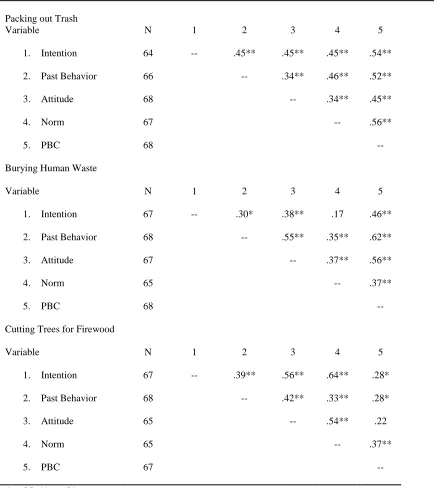
Table 5 Intercorrelations Between Variables of Interest………...61
viii
LIST OF FIGURES
Figure 1 The rise of outdoor ethics in the United States………...….9
Figure 2 Taking a cultural approach to outreach in Gangotri National Park…38 Figure 3 Human waste left unburied at a campground in Gangotri National Park ………...……...44
Figure 4 The Theory of Planned Behavior ……….. 47
Figure 5 Divisions of Garhwal ……….49
Figure 6 Map of Uttarakhand ………..………...49
Figure 7 The common result of burning trash, Gangotri National Park.……...67
Figure 8 Food scraps left for the animals, Gangotri National Park…………...68
1
Understanding Environmentally Significant Behaviors Among Guides in the Garhwal, Himalaya, India
Introduction
A stronghold of Hinduism and spanning 29.26 N-31.28 N latitude to 77.49 E – 80.6 E longitude, the Garhwal Himalaya covers an area approximately 30,090 square mountainous miles. Garhwal is located within the state of Uttarakhand, India, formerly Uttaranchal, with an approximate population of 4,919,000. This part of India is known for its cultural and historical depth along with magnificent rivers, mountains, and wildlife. Mountain tourism in India was firmly established in 1961 with the creation of the Indian Mountaineering Foundation, but has entertained explorers and climbers since the 19th century (Bisht, 1994). The Garhwal Division saw frequent expeditions as climbers frequented the Rishi Gorge on the way to the slopes of Nanda Devi (7816m), among other peaks. During the 1970’s, Garhwal saw a dramatic increase in expeditions after the Hill Area Development Board opened some restricted areas along the Indo-Tibetan boarder (Bisht, 1994).
2
nature-based tourism numbers have grown steadily for decades (Bisht, 1994; Indian Council, 2008).
Problem Statement
Most nature-based tourists are Indian and they take to the mountains of Garhwal in the millions pursuing sightseeing, religious endeavors, and recreation, among other activities (Indian Council, 2008). Poor infrastructure combined with millions of tourists in Garhwal has resulted in environmental impacts, many of them negative and significant. The most commonly cited issues in scholarly literature have been waste disposal (organic and inorganic) and vegetation loss (deforestation) (Bisht, 1994; Farooquee, Budal, & Maikhuri, 2008; Kuniyal, 2002; Nigam, 2002; Rai & Sundriyal, 1997; Singh, Mal & Kala, 2009; Silori, 2004). According to Singh (2002), mountain tourists, Indians in particular, have been apathetic to or uneducated of traditional conservation values. These impacts and issues are being tackled by land managers and scholars.
3
ways. For example, environmental education commonly draws on America’s Leave No Trace outdoor ethics program and research focused on nature-based guides tends to assume that guides should perform as recreation resource managers with an outdoor ethic to share. The weaknesses of these two approaches are the drivers of the following
research as understanding cultural and cognitive components of behavior have
implications for transfer of environmental education (Ziguras, 2001), dissemination of related information to clients and other team members, and manifestation of internal outdoor ethics.
Approach and Purpose
This study is divided into two manuscripts. The first examines the cross-cultural utility of American outdoor ethics (e.g., LNT). As indicated on their website
(www.lnt.org), LNT has been adopted in many parts of the world. Jones and Bruyere (2004) declared that LNT employs a belief changing strategy and seeks to get
4 environmental behavior.
The second manuscript addresses the need for research on the natural resource role of guides in a context outside of ecotourism in a “developing” country. Howard, Thwaites, and Smith (2001) found that thecultural context that directs a guide’s
conservation behavior is important to understanding their current and potential resource management role. This research argues that for recreation resource management efforts pertaining to environmental education to be efficient and effective, managers and similar interested parties must discover the cognitive context of the population of interest in which they seek to alter and influence recreation behavior. This study attempted to uncover this cognitive context among guides in Garhwal by examining intention to perform pro-environmental behavior.
The Theory of Planned Behavior was chosen to lay a foundation to understanding whitewater and trekking guides cultural and cognitive context for performing
pro-environmental behavior, for its ability to help understand and predict pro- environmentally-related behavior (Beedell & Rehman, 2000; Bissonnette & Contento, 2001; Fielding, McDonald, & Louis, 2008; Hinds & Sparks, 2008; Karppinen, 2005; Knussen, Yule, MacKenzie, & Wells, 2004; Teo & Loosemore, 2001; Tonglet, Phillips, & Bates, 2004) and increased effectiveness when culture was incorporated (Oreg & Katz-Gerro, 2006).
Delimitations
5
Subjects approached for the study were whitewater and trekking guides that live and work in Garhwal. Some guides may not have been born in Garhwal, or India, as the guiding profession attracts outsiders who come to live within Uttarakhand’s borders to live and work.
Significance
This research is intended for resource managers domestic and abroad, related educators and trainers in the field of recreation resource management who seek to advance their understanding of culture, context, and indigenous recreation populations. However, the research will also be of strong interest to a broader audience that includes policy-makers, project and program managers and staff, researchers, and others
6
Evaluating the Cross-Cultural Utility of American Outdoor Ethics in Garhwal Himalaya, India
Abstract
American beliefs, rationale, and experience have resulted in ethics (right and wrongs) that seek to reduce the impacts of recreationists on public lands. These ethics have been exported to the rest of the world. However, many non-American societies rely on religious beliefs, cultural perceptions, and traditions different from those used to create LNT to serve as the foundation for environmental concern. This notion also pertains to nature-based guides, who have been assumed to be steadfast influences in terms of recreation resource management and dissemination of environmental education. To date research has not addressed the cross-cultural utility of American outdoor ethics (Leave No Trace) and paid little attention to nature-based guides outside of ecotourism. An elicitation study was conducted in Garhwal, Uttarakhand, India in 2009 following the Theory of Planned Behavior. The modal salient beliefs that led to forty-four Garhwal-based whitewater and trekking guides intention to pack out trash, bury human waste, and refrain from cutting living trees for firewood were acquired. Results show that Garhwal-based guides find more advantages than disadvantages to performing these behaviors and are mainly self-influenced when choosing to perform these behaviors. However, a
7 Introduction
The Himalayas have been a playground for explorers since the 19th century. In particular, the Garhwal Division of India was passage to Nanda Devi (7816m), once the second most attempted Himalayan peak behind Everest. The arduous approach via the Rishi Gorge made it one of the most difficult approach/climbs in the world (now
8
The leading program in outdoor ethics in America, Leave No Trace (LNT), was developed as an education-based response to wild land management challenges,
expansion of wild land use, and degradation of recreational areas in the United States (Marion & Reid, 2007). Now firmly established in America, outdoor enthusiasts in six of seven continents are acquiring these skills and ethics from individuals who complete the LNT Master Educator course (Marion & Reid, 2001). There has been mention of
expeditions leaving no trace in the Arctic as well (Rolston III, 2000). In addition,
governments, schools, organizations, and businesses in Taiwan (Government of Taiwan, 2010), India (Nehru Institute of Mountaineering, personal communication, June 26, 2009), New Zealand (New Zealand schools, 2008), and South Africa (van den Berg & Swain, 2007) have adopted LNT principles. The intent of these principles (i.e. ethics) is to reduce negative outdoor recreation impacts and change or reinforce recommended behavior by targeting and changing the belief system of the recreationist (Adams & Hulme, 2001; Christensen & Cole, 2000; Jones & Bruyere, 2004).
It is interesting that it has been deemed necessary to export these ethics outside of the United States to countries with socially, culturally, and historically different
9
(2003) illustrated the relationship between belief and knowledge suggesting “what we believe” is not the same as “what we know” and that it is common for humans to hold knowledge in a higher regard than beliefs (Lassiter, 2003, p. 169).To many, the implied goal of these ethics “is to leave the landscape as charming and healthy” as it was found by European settlers (United States Forest Service, 2001, p.3), get recreationists to “do the right thing” (Jones & Bruyere, 2004, p.3), and prevent natural landscapes from looking like the “back alleys of third world villages” (McGivney, 2003, p. 19). American outdoor ethics, by definition, are not beliefs any longer but a body of knowledge based on a collective set of values and morals, and accordingly, perception of right and wrong. This is evidenced by the existence and enforcement of current federal land management policies.
+ + =
1Figure 1. The rise of outdoor ethics in the United States.
Purpose
This research does not seek to criticize the seven principles of LNT. This study questions whether American outdoor ethics are universally viable by examining the role of culture on beliefs to perform pro-environmental behavior. The overarching research question driving the scholarly idea is: what is the cross-cultural utility of American outdoor ethics when introduced to populations with different conceptions, if any
Outdoor Ethics Policy/
Enforcement Experience/
Research Conceptions
10
conceptions at all, about nature and conservation? An American brand of nature and conservation is not shared in all corners of the globe (Guha, 1989). Further, perhaps the exportation of these ethics can be seen as a semblance of cultural or educational
imperialism as local epistemologies are replaced by a more dominant way of knowing; a similar argument has been made pertaining to other educational programs distributed offshore (Ziguras, 2001). In addition, despite the global achievements of LNT, the reverence of nature and pro-environmental behavior has not always needed an American outdoor ethic or policy to occur. A number of societies have relied on religious beliefs, cultural perceptions, and traditions different from those used to create LNT to serve as the foundation for conservation, resource management, environmental protection, and to influence related behavior without the aid of policy (Byers, Cunliffe, & Hudak, 2001; Guha, 1989; Luo, Liu, & Zhang, 2009; Kuriyan, 2002; Sharma, Rikhari, & Palni, 1999; Sinha, 1995). For example, Sinha (1995) detailed biodiversity conservation as an outgrowth of religion in India and remarked that apolitical reverence of the natural landscape and animals has occurred since 5000 B.C.
11
variety of tourists that use the natural landscape, and rich and diverse cultural and
environmental history. These characteristics provided a contrast with American beliefs of the natural landscape. The data presented in this study address the following research question: what are those salient beliefs that prompt whitewater and trekking guides’ intention to perform pro-environmental behavior? The behaviors selected were based on recreation resource impacts of prominence in the Indian Himalaya and addressed by LNT (trash, human waste, and tree cutting for firewood). It was anticipated that by eliciting Garhwal-based guide beliefs a greater understanding of this unique population’s outdoor ethics would be achieved. This understanding can aid those that seek to implement outdoor ethics in non-American cultures to avoid assumptions of adequate transfer of environmentally-based information and neocolonialist predispositions (Ziguras, 2001). It can also help draw out internal outdoor ethics rooted in culture.
This paper does not seek to engage in a sophisticated dialogue of nature and conservation as social constructions, nor to debate epistemologies regarding these topics. It does argue that outdoor ethics are born from unique experiences and rationale and that extrapolation of American outdoor ethics should be predicated on a sound cultural and cognitive understanding of environmentally significant behavior of the population of interest.
Outdoor Ethic Development Among Guides
12
Nature based guides provided an appealing look at Garhwal citizens with a dualistic existence. According to researchers, whitewater and trekking guides would be expected disseminators of outdoor ethics (Muñoz, 1995; Black, Ham, & Weiler, 2001) and thus arguably most likely exposed to outdoor ethics as part of their jobs. On the other hand, Garhwal-based guides must still exist as citizens in a society with norms perceived as negative towards the environment (e.g. littering). In light of these observations, an
assessment of nature-based guide beliefs was found to be a practicable avenue to evaluate the utility of American outdoor ethics in Garhwal.
Theoretical Framework and Salient Beliefs
The Theory of Planned Behavior was chosen for its ability to help understand and predict environmentally-related behavior (Beedell & Rehman, 2000; Bissonnette & Contento, 2001; Fielding, McDonald, & Louis, 2008; Hinds & Sparks, 2008; Karppinen, 2005; Knussen, Yule, MacKenzie, & Wells, 2004; Teo & Loosemore, 2001; Tonglet, Phillips, & Bates, 2004). An understanding of environmentally-related behavior, as sought in this study, begins with the discovery of an “informational foundation” for explaining human behavior in specific contexts (Ajzen, 1991). The starting place for discovering this foundation is by eliciting salient beliefs within a representative sample of the population (Sutton, French, Henning, Mitchell, Wareham, Griffin, Hardeman, & Kinmoth, 2003).
13
(motivation) and actual performance of a behavior is based on three predictor variables: attitude toward the behavior, subjective norm, and perceived behavioral control (Ajzen, 1991). Attitude is used in the theory to assess one’s perception of the behavior in terms of positive or negative, favorable or unfavorable. Subjective norm is defined as a person’s external or social influence to perform the behavior. Perceived behavior control refers to the resources and opportunities one has at their disposal that enables them to carry out a behavior.
An extension of the Theory of Planned Behavior was used to establish a belief foundation for intention to perform three low impact behaviors. The antecedents of the abovementioned predictor variables are salient beliefs, which also play a role in determining intention and action. The TOPB assumes that behavioral beliefs influence
attitudes toward the behavior by producing a favorable or unfavorable attitude toward the behavior. These beliefs are based on consequences, or advantages and disadvantages, of performing the behavior. Thus, those with a favorable attitude towards low impact travel behaviors would be have greater intention to perform pro-environmental behaviors (Ajzen, 1991). Normative beliefs result in a subjective norm and are dictated by perceived social pressure. These beliefs stem from an individual’s perceptions that people important to them would approve or disapprove of the individual performing the behavior in
14
opportunities perceived necessary by an individual may not always be present in their view. Ajzen (1991) wrote that experience with the behavior and influence by second-hand information about the behavior, among other factors, can manipulate the perceived difficulty of performing the behavior in question. Ajzen (1991) explained, “The more resources and opportunities individuals believe they possess, and the fewer obstacles or impediments they anticipate, the greater should be their perceived control over the behavior” (p. 196).
The role of behavioral, normative, and controlbeliefs was illustrated by Ajzen (1991) writing that “when attitudes are estimated on the basis of salient beliefs,
correlations with a standard measure tend to be higher than when they are estimated on the basis of an intuitively selected set of beliefs” (p. 192). An elicitation study was used to extract these beliefs pertaining to intention to pack out trash, bury human waste, and refrain from cutting living trees for firewood. The resultant list of modal salient beliefs for each construct is fleshed out by content analysis that abides by certain parameters, such as accounting for a certain percentage of beliefs above 20%, 10%, etc. (Sutton et al., 2003).
15 Methods
Sampling and Data Collection
A volunteer sample was obtained from a population of Garhwal-based
whitewater and trekking guides during May-June 2009. Three local (indigenous) guides served as assistants and helped approach subjects, obtain verbal informed consent before collecting data, and administer questionnaires. Assistants were first briefed on the research objective and then on the appropriate manner in which to assist a subject to complete a questionnaire (e.g. refrain from coaching responses, obtaining verbal consent first, maintaining confidentially of responses). Questionnaires were administered on a volunteer basis by frequenting adventure tour companies and guide agencies in
Joshimath, Rishikesh, and Uttarkashi, India and asking guides present at these locations to participate in the study. The study was carried out during the peak of the adventure tourism season and very busy much of the week. Subjects were occasionally contacted by telephone and arrangements were made to meet them. Participants were given the option of completing the questionnaire on site or returning a completed questionnaire at a drop location, such as a guide company. Research assistants provided translation and
clarification services to the participants as needed.
Participants
16
experience, ranging from 1 to 20 years. The overwhelming majority of respondents were male (98%). Over one-third (36%) were employed as whitewater guides, 41% as trekking guides, and 23% as both a whitewater and trekking guide.
Survey Instrument
A questionnaire was comprised of 18 belief-based questions (Table 1) following Ajzen (2006). Based on the Theory of Planned Behavior’s belief constructs, the
questionnaire was translated from English to Hindi and then administered. There was a delay in the translation; a number of questionnaires were completed in English by guides who felt capable of answering in English.
Analysis
Open-ended questions were included at the end of the questionnaire. Twenty of the forty-four guides responded in Hindi requiring translation by a fluent speaker of Hindi and English. A code sheet was developed to direct the open coding process after evaluating all forty-four questionnaires and following suggestions by Riddick and Russell (2008) and faculty at North Carolina State University (K. Henderson, personal
17
Overlapping codes, such as those referring to a belief related to the preservation of the natural environment in a general sense (e.g. PUR = Keep the environment pure/protected; SAV = Save the environment) were reduced to account for the range of answers given by the respondents seemingly attempting to arrive at the same belief. Answers were then reduced into themes using a format adapted from Downs and Hausenblaus (2005) and falling within the three categories specified by the TOPB :
• behavioral beliefs
• normative beliefs
• control beliefs
Limitations
The location of the study resulted in various limitations that should be noted. The translation from English to Hindi took longer than expected and questionnaires had to be issued in both English and Hindi. Many guides were assisted by a Hindi speaking
research assistant/guide in order to complete the questionnaire. However, many guides refused assistance despite needing it. Foregoing support resulted in alternative or
18 Table 1
Elicitation Study Questions
Behavioral Beliefs
What are the advantages of packing out trash during the expeditions that you work? What are the disadvantages of packing out trash during the expeditions that you work? What are the advantages of burying your human waste during the expeditions that you work? What are the disadvantages of burying your human waste during the expeditions that you work?
What are the advantages of refraining from cutting living trees for firewood during the expeditions that you work? What are the disadvantages of refraining from cutting living trees for firewood during the expeditions that you work? Normative Beliefs
Who would approve of your packing out trash during the expeditions that you work? Who would disapprove of your packing out trash during the expeditions that you work? Who would approve of your burying your human waste during the expeditions that you work? Who would disapprove of your burying your human waste during the expeditions that you work?
Who would approve of your refraining from cutting living trees for firewood during the expeditions that you work? Who would disapprove of your refraining from cutting living trees for firewood the expeditions that you work? Control Beliefs
What are the factors or circumstances that enable you to pack out trash during the expeditions that you work?
What are the factors or circumstances that make it difficult for you to pack out trash during the expeditions that you work? What are the factors or circumstances that enable you to bury your human waste during the expeditions that you work? What are the factors or circumstances that make it difficult for you to bury your human waste during the expeditions that you work?
What are the factors or circumstances that enable you refrain from cutting living trees for firewood during the expeditions that you work?
19
and subjects. These types of samples have been known to result in a non-representative sample as people with strong opinions usually participate. The sample consisted of mainly males who appear to make up the majority of guides in Garhwal. The one female in all likelihood was a male who checked the wrong box due to an error in the number of boxes drawn in for “Sex”.
Results
Ajzen and Fishbein (1980) suggested using one of three rules when analyzing salient beliefs. These were summarized by Sutton et al. (2003):
1. Include the ten or twelve most frequently mentioned outcomes. According to Ajzen and Fishbein (1980), this procedure results in a set of beliefs that is likely to include at least some of the beliefs mentioned by each respondent in the sample.
2. Include those beliefs that exceed a particular frequency, for example all beliefs mentioned by at least 10 percent or 20 percent of the sample.
3. Choose as many beliefs as necessary to account for a certain percentage (e.g., 75 percent) of all beliefs elicited (pp. 237).
20
addition to the 10% cutoff, a minimum of the highest three modal beliefs were reported. Analysis of control beliefs followed rule number one; ten to twelve beliefs were reported.
Behavioral Beliefs (Table 2)
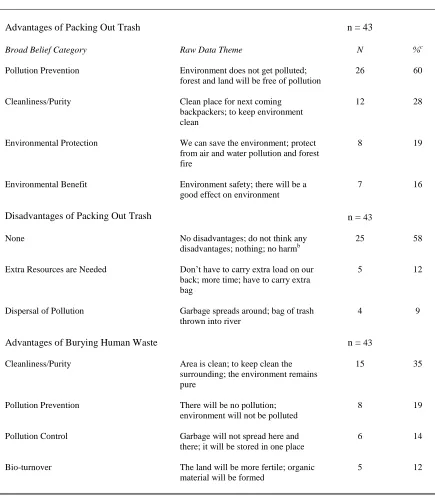
A majority of guides reported Pollution Prevention as the primary advantage for packing out trash (N = 26, 60%) followed by Cleanliness/Purityof Setting (N = 12, 28%). The non-specific response category Environmental Benefit (N = 7, 26%) was third followed by Environmental Protection (N = 8, 19%). The majority of guides reported
Dispersal of Pollution as the primary disadvantage for packing out trash (N = 25, 58%), followed by Extra Resources are Needed (N =5, 12%), and None (N = 4, 9%).
Cleanliness/Purity of Setting (N =15, 35%) was reported by guides to be the primary advantage to burying human waste. Other significant advantages were Pollution
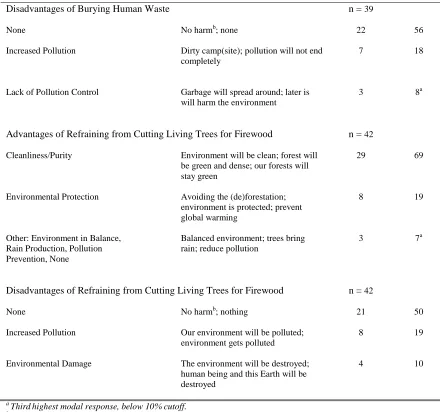
Prevention (N = 8, 19%), followed by Pollution Control (6, 14%) and Bio-Turnover (N = 5, 12%). A majority of guides reported no disadvantages/None (N = 22, 56%), Increased Pollution (N = 7, 18%), and Lack of Pollution Control (3, 8%) as the top three modal beliefs.
A large majority of guides declared Cleanliness/Purity of Setting (N =29, 69%) to be the primary advantage to refraining from cutting living trees. Other significant
21 Table 2
The number (N) and percent (%) of behavioral beliefs
(Adapted from Downs & Hausenblaus, 2005)
Advantages of Packing Out Trash n = 43
Broad Belief Category Raw Data Theme N %c
Pollution Prevention Environment does not get polluted;
forest and land will be free of pollution
26 60
Cleanliness/Purity Clean place for next coming
backpackers; to keep environment clean
12 28
Environmental Protection We can save the environment; protect
from air and water pollution and forest fire
8 19
Environmental Benefit Environment safety; there will be a
good effect on environment
7 16
Disadvantages of Packing Out Trash n = 43
None No disadvantages; do not think any
disadvantages; nothing; no harmb
25 58
Extra Resources are Needed Don’t have to carry extra load on our
back; more time; have to carry extra bag
5 12
Dispersal of Pollution Garbage spreads around; bag of trash
thrown into river
4 9
Advantages of Burying Human Waste n = 43
Cleanliness/Purity Area is clean; to keep clean the
surrounding; the environment remains pure
15 35
Pollution Prevention There will be no pollution;
environment will not be polluted
8 19
Pollution Control Garbage will not spread here and
there; it will be stored in one place
6 14
Bio-turnover The land will be more fertile; organic
material will be formed
22 Table 2 continued
Disadvantages of Burying Human Waste n = 39
None No harmb; none 22 56
Increased Pollution Dirty camp(site); pollution will not end
completely
7 18
Lack of Pollution Control Garbage will spread around; later is
will harm the environment
3 8a
Advantages of Refraining from Cutting Living Trees for Firewood n = 42
Cleanliness/Purity Environment will be clean; forest will
be green and dense; our forests will stay green
29 69
Environmental Protection Avoiding the (de)forestation;
environment is protected; prevent global warming
8 19
Other: Environment in Balance, Rain Production, Pollution Prevention, None
Balanced environment; trees bring rain; reduce pollution
3 7a
Disadvantages of Refraining from Cutting Living Trees for Firewood n = 42
None No harmb; nothing 21 50
Increased Pollution Our environment will be polluted;
environment gets polluted
8 19
Environmental Damage The environment will be destroyed;
human being and this Earth will be destroyed
4 10
a
Thirdhighest modal response, below 10% cutoff.
b
According to the translator, the Hindi toEnglish translation was “No harm”.
c
Percents may not add up to 100% because respondents were permitted to contribute multiple responses.
23 Normative Beliefs (Table 3)
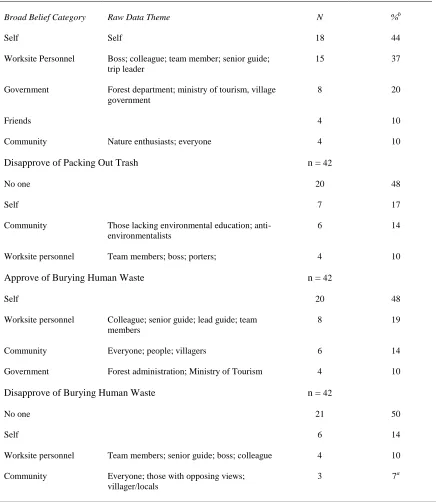
Guides reported that they/Self (N = 18, 44%) were the most influential on their intension to pack out trash. Worksite Personnel (N = 15, 37%) closely followed, with
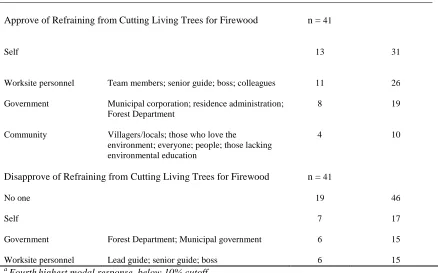
Government (8, 20%), Friends (N = 4, 10), and Community (N = 4, 10%) as the top modal beliefs. Most guides declaredthat No One (N =20, 48%) would disprove of their packing out trash. Other notable responses were Self (N = 7, 17%), Community (N = 6, 14%), Worksite Personnel (N = 4, 10%). Nearly half of guides reported they/Self (N = 20, 48%) would approve of their burying human waste. Worksite Personnel was a distant second (N = 8, 19%), with Community (6, 14%), and Government (N = 4, 10) rounding out the list. Half of guides reported that No One ((N = 21, 50%) would approve of their burying human waste. Other responses were Self (N = 6, 14%), Worksite Personnel (N = 4, 10%), and Community (N = 3, 7%). Self (N = 13, 31%) was found to be guides’ top modal belief followed by Worksite Personnel (N = 11, 26%). Government (N =8, 19%) and Community (N = 4, 10%) also contribute to top modal beliefs. Guides reported that No One ((N = 19, 46%) would disapprove of their refraining from cutting living trees for firewood. Following were Self (N = 7, 17%), Community (N = 6, 15%), and Worksite Personnel (N = 6, 15%).
Control Beliefs (Table 4)
24 Table 3
The number (N) and percent (%) of normative beliefs
(Adapted from Downs & Hausenblaus, 2005)
Broad Belief Category Raw Data Theme N %b
Self Self 18 44
Worksite Personnel Boss; colleague; team member; senior guide; trip leader
15 37
Government Forest department; ministry of tourism, village
government
8 20
Friends 4 10
Community Nature enthusiasts; everyone 4 10
Disapprove of Packing Out Trash n = 42
No one 20 48
Self 7 17
Community Those lacking environmental education;
anti-environmentalists
6 14
Worksite personnel Team members; boss; porters; 4 10
Approve of Burying Human Waste n = 42
Self 20 48
Worksite personnel Colleague; senior guide; lead guide; team members
8 19
Community Everyone; people; villagers 6 14
Government Forest administration; Ministry of Tourism 4 10
Disapprove of Burying Human Waste n = 42
No one 21 50
Self 6 14
Worksite personnel Team members; senior guide; boss; colleague 4 10
Community Everyone; those with opposing views;
villager/locals
25 Table 3Continued
Approve of Refraining from Cutting Living Trees for Firewood n = 41
Self 13 31
Worksite personnel Team members; senior guide; boss; colleagues 11 26
Government Municipal corporation; residence administration;
Forest Department
8 19
Community Villagers/locals; those who love the
environment; everyone; people; those lacking environmental education
4 10
Disapprove of Refraining from Cutting Living Trees for Firewood n = 41
No one 19 46
Self 7 17
Government Forest Department; Municipal government 6 15
Worksite personnel Lead guide; senior guide; boss 6 15
a
Fourthhighest modal response, below 10% cutoff.
b Percents may not add up to 100% because respondents were permitted to contribute multiple responses.
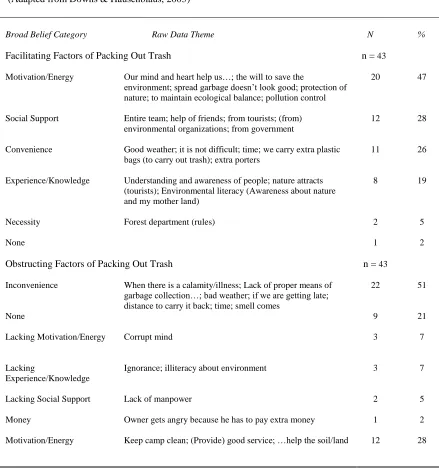
modal belief reported by guides. Social Support (N = 12, 28%), Convenience (N = 11, 26%), Experience/Knowledge (N = 8, 19%) Necessity (N =2, 5%), and None (N = 1, 2%) were also of significance. No obstructing factors/None (N = 9, 21%) was the top modal belief. Lacking Motivation/Energy (N = 3, 7%) and Lacking Experience/Knowledge (N = 3, 7%) tied for second. Lacking Social Support (N =2, 5%), and Money (N = 1, 2%) were also noteworthy. Guides expressed Motivation/Energy (N = 12, 28%) as the top
facilitating factor of burying human waste, closely followed by Convenience (N = 11, 26%) and Experience/Knowledge (N = 10, 23%). Social Support (N = 8, 19%), Necessity
26 Table 4
The number (N) and percent (%) of control beliefs
(Adapted from Downs & Hausenblaus, 2005)
Broad Belief Category Raw Data Theme N %
Facilitating Factors of Packing Out Trash n = 43
Motivation/Energy Our mind and heart help us…; the will to save the
environment; spread garbage doesn’t look good; protection of nature; to maintain ecological balance; pollution control
20 47
Social Support Entire team; help of friends; from tourists; (from) environmental organizations; from government
12 28
Convenience Good weather; it is not difficult; time; we carry extra plastic bags (to carry out trash); extra porters
11 26
Experience/Knowledge Understanding and awareness of people; nature attracts (tourists); Environmental literacy (Awareness about nature and my mother land)
8 19
Necessity Forest department (rules) 2 5
None 1 2
Obstructing Factors of Packing Out Trash n = 43
Inconvenience When there is a calamity/illness; Lack of proper means of
garbage collection…; bad weather; if we are getting late; distance to carry it back; time; smell comes
22 51
None 9 21
Lacking Motivation/Energy Corrupt mind 3 7
Lacking
Experience/Knowledge
Ignorance; illiteracy about environment 3 7
Lacking Social Support Lack of manpower 2 5
Money Owner gets angry because he has to pay extra money 1 2
27 Table 4 continued
Facilitating Factors of Burying Human Waste n = 43
Convenience Suitable weather; it is not difficult; human waste is easily degradable
11 26
Experience/Knowledge Enlightenment; awareness; very tough to teach clients; spreading no disease; organic soil/fertile land; pollution control
10 23
Social Support Combined efforts; support of staff (colleagues); (from) tourists; (from) government; villagers get angry when we dig in their area
8 19
Necessity (Forest) Administration orders; we have to do it to clean the
environment; we do not move away our camps until we clean it
4 9
None 1 2
Obstructing Factors Burying Human Waste n = 44
Inconvenience Weather; we do not have any means (to do so); nature does
not help us; if any calamities occur; laziness; lack of time
29 66
None 10 23
Lacking Social Support Clients like to go out and leave toilet tent; from tourists; from friends; from colleagues
5 11
Lacking Motivation/Energy Other people who don’t have knowledge of environment
people don’t know the bad (impacts); we get tired; not caring 4 9
Lacking
Experience/Knowledge
Awareness 2 4
Facilitating Factors of Refraining from Cutting Living Trees for Firewood n = 43
Necessity Ban on cutting trees; we do not require wood 14 33
Motivation/Energy Our own thoughts/understanding; avoiding deforestation; Green and healthy (environment); it is not difficult; bad for me; not spoiling nature; save the environment
13 30
Experience/Knowledge Sightseeing (requirements); green trees give me and my world oxygen; not good for nature, wildlife,…or the mountains; environmental literacy
11 26
Convenience Biotin gas, diesel help to stop (tree cutting); Alternative fuel 7 16
Social Support (Clients don’t require fire); (from) village administration); (influence from) environmental organizations/magazines/fliers
4 9
28 Table 4 continued
Obstructing Factors of Refraining from Cutting Living Trees for Firewood n = 44
None 12 27
Necessity Rules/laws of Forest Administration; cold night [read: to stay
warm]; Tourists need/pay for campfire
12 27
Experience/Knowledge Green wood will not burn; people don’t know the effects of
(deforestation); (forests provide) birds’ food; ignorance 12 27
Motivation/Energy I don’t want tree cutting and (do not) allow guests to cut (trees)
1 2
Lacking Social Support Lack of Forest Administration 1 2
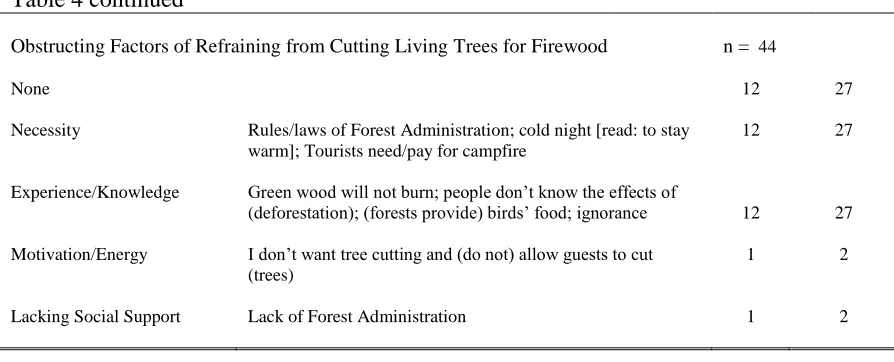
indicated that Inconvenience (N = 29, 66%) was the most obstructing factor to burying human waste. None (N = 10, 23%) made up almost one fourth of the responses. Lacking Experience/Knowledge (N = 5, 11%), Lacking Motivation/Energy (N = 4, 9%), and
Lacking Social Support (N = 2, 4%) were found to be worthy of reporting. Necessity (N =14, 33%) and Motivation/Energy (N = 13, 30%) were the top modal beliefs regarding Facilitating Factors of Refraining from Cutting Living Trees for Firewood.
Experience/Knowledge (N = 11, 26%), Convenience (N = 7, 16%), Social Support (N = 4, 9%), and None (N = 1, 2%) were also of note. Interestingly, guides indicated that beliefs falling into no obstructing factors/None (N = 12, 27%), Necessity (N = 12, 27%), and Lacking Experience/Knowledge (N = 12, 27%) classifications were of equal
29 Discussion
This study elicited guide beliefs to help determine the cross-cultural utility of American outdoor ethics. The results of this study are wide-ranging therefore following discussion focuses on major belief themes observed. The findings provide preliminary evidence that due to societal intricacies prescriptive training and certifications in LNT, as advocated regularly by researchers, may not be enough to establish consistent
pro-environmental behavior among guides in Garhwal.
30
Hindu lifestyle . Environmental education following LNT would have to ostensibly surmount the potential argument that these ethics perpetuate a disconnect with nature (Moskowitz & Ottey, 2006).
The overall positive view towards pro-environmental behavior may also be explained by the disposition of the guiding profession and suggests that guides have an influential emotional connectedness with the natural landscape achieved through environmental literacy (awareness). Like ecological literacy, the term refers to guides’ “lived experience of nature” and recognition of their long term impact on the non-human landscape (Martin & Ho, 2009, p. 87). Hinds and Sparks (2008) found “the more one has an affective connection with nature, the greater one’s intentions to engage with it” (p. 115) while Nord, Luloff, and Bridger (1998) found pro-environmental behavior and forest recreation to be linked. Traditional close ties to nature in conjunction with the out of doors character of guiding may reinforce awareness of as well as concern for the environment. Thus, it is suggested that Garhwal-based guides’ regular exposure to the natural environment may enhance their bond and influence their tendency to perform pro-environmental behavior in accord with American outdoor ethics, despite its perceptible Eurocentric origin.
The disadvantages specified by guides were few, but noteworthy, and are
31
around” or “thrown into (a) river” and that human waste would “not end completely”. Various beliefs responses, like the latter, show a need for education among guides. Other explanations for particular beliefs are undoubtedly more complex and likely attributed to embedded social norms discussed earlier as well as the outlawed caste system which has been in place for centuries and is alive and well in many rural parts of India. These social dynamics have arguably been ingrained into guide psyche long before they began their profession and may currently dictate how guides behave while moving through the landscape. Littering has a long history in India (Misra, 2007) and leaving food scraps to feed wild animals is acceptable to guides, possibly for religious reasons described above. Therefore, it may be that for programs such as LNT to be useful in a context like
Garhwal, environmental education would need to not merely address “ingrained and habitual behavior” (p. 9) as found by Borrie and Harding’s (2002) research on attitudes toward low-impact practices, but deal with the root origin of that behavior, such as religion and environmental histories. This appears to be currently out of the scope of LNT ethics and debatably a limitation of its utility in Garhwal.
32
reliant” (p. 163-164). By the same token, our findings suggest that Garhwal-based guides’ intention to perform pro-environmental behavior may be constructed from a similar sense of independence and self-reliance found among Beedie’s mountaineering guides. Though mainly independent in their performance over environmentally
significant behavior, results indicate a social component to performing these behaviors. External influences, such as worksite personnel, and to a lesser extent community and government, were found to be important as well. Garhwal-based guides may have an occupational culture that dictates their collective attitudes and actions and singularly a guide’s role, status, and expectations (Teo & Loosemore, 2001, p. 743) with respect to outdoor ethics. Social pressure and social identity among recreationists were discussed by Harding, Borrie, and Cole (2000). The authors note that motivations to perform pro-environmental behavior may not be rooted in any desire to protect the environment but to conforming to social demands. In Garhwal, it could be argued that environmental
identities vary depending on the behavior. Motivations for not packing out trash or burying human waste may not be rooted in a desire to harm the environment or
indifference but to social influence and related identity, whereas refraining from cutting trees for firewood may be due to heavy-handed forest management policy that has been integral in Garhwal society since the 19th century (Dangwal, 2009).
33
obstructing factors. A top facilitating factor was motivation and energy. Guides answered regularly that their hearts or minds would facilitate or obstruct their performance of the behaviors in question. Similar findings were noted by Parker and Avant (2000) who revealed that Sierra mountain guides internalized their outdoor ethics. In turn, their behavior was in accordance with what they thought was just. Guides did specify that for some behaviors social support was a facilitating factor, manly referring to immediate team members. In essence, guide will make the choice, but may be swayed if they knew they were not the only ones performing the behavior. Environmental education based on American outdoor ethics may have to settle for complementing those outdoor ethics that are already instilled within guides.
Convenience was a significant factor for packing out trash and burying human waste, while inconvenience was seen as the most salient obstructing factor. Convenience in this study meant a variety of conditions, but commonly referred to weather. Other barriers and constraints to behavior performance were calamities, having the means to carry out trash (e.g. bags), time, energy to carry extra weight, or motivation (e.g. laziness, overcoming smell of garbage). Findings suggest that there are prominent obstacles that stand in the way of altering and influencing environmentally significant behavior in Garhwal. Literature on outdoor ethics research has not adequately addressed such barriers and constraints to performance of pro-environmental behavior or how to deal with them.
34
forest department and were compelled to heed associated policies. Many also pointed to the benefits of leaving trees as they are for reasons varying from aesthetics and habitat protection to personal constraints. Where LNT may struggle in Garhwal regarding camp fires is by declaring that “potential damage to the backcountry” should be the most important factor in deciding to create a fire (Leave No Trace, n.d.). Some respondents
would likely disagree. Guides claimed that trees would be cut to stay warm or keep predators, such as the leopard, away while a team slept. These circumstances could be deemed “confounding variables” pertaining to limitations of LNT’s campfire ethics (Marion & Reid, 2005) in Gahrwal.
Future Research
Katz-35
Gerro (2006) described such a framework, the value-belief-norm (VBN) theory of environmentalism. This theory declares “pro-environmental behaviors stem from acceptance of particular personal values, from beliefs that things important to those values are under threat, and from beliefs that actions initiated by the individual can help alleviate the threat and restore the values” (Oreg and Katz-Gerro, 2006, p. 464). Personal norms (self-expectations based on internalized values) were also found to be important in determining intention to perform behavior (Harlan, Staats, & Wilke, 1999, p. 2057). Value-based frameworks, along with investigation into personal norms, might provide insight into Garhwal guide perceptions of self-influenced behavior that the TOPB cannot and resultant social and personal identities.
Secondly, further study should incorporate questions pertaining to complex social phenomena to determine their role in terms of influencing outdoor ethics among guides. Questions pertaining to religion, the caste system, environmental histories, perspectives on client-guide relationships, etc. can be difficult to ask and to answer. However, they appear to be crucial in putting outdoor ethics in their appropriate cultural and cognitive context.
36 environmental behavior in Garhwal.
Conclusions/Implications
Nature-based guides in Garhwal, by the very nature of their occupations, live a dualistic existence and straddle the divide of two worlds: the wild and the civilized. In America, these two worlds have been separated by historic (i.e. colonial) ideals of humans and nature and, as some have argued, encouraged (indirectly or directly) by LNT-style ethics (Simon & Alagona, 2009). In Garhwal, however, such a divide is not as clear as indicated by guide beliefs elicited in this study. This could pose challenges to implementing American outdoor ethics into a setting like Garhwal.
The LNT Center for Outdoor Ethics strives to do little more than aid recreationists in reducing their impacts by educational means. Still, the belief structure that LNT ethics were founded on is one that hopes “communication, reasoning and internalization will change people’s belief structure” and lead recreationists to “do the right thing”. (Jones & Bruyere, 2004, p.3). Though LNT has successfully helped land managers in America to uphold these beliefs, now these ethics, or rights and wrongs, have a bigger challenge. As they have been exported throughout the world they inadvertently try to change the underlying belief structures of not just individuals, but entire societies.
37
ecotourism framework and where the ethics have not already been laid out and whose clientele may not be seeking a guide whose behavior reflects that experience. As they were intended and currently exist, American outdoor ethics do not leave room for addressing or overcoming larger social constraints and barriers such as ingrained behavior and perspectives on nature and conservation to achieving pro-environmental behavior.
To expect Garhwal-based guides to take to LNT, be disseminators of
38
In summary, if LNT’s approach is indeed to appeal to personal responsibility this approach may not succeed in Garhwal in its entirety. Environmental education based on American outdoor ethics will have to engage their students beyond just feeding them information and may have to merely complement those outdoor ethics that are already instilled within guides and their clients (Figure 2). Environmental educational training may be more effective by following Oreg and Katz-Gerro who declared:
2Figure2. Taking a cultural approach to environmental education, Gangotri National Park.
39
40
Understanding Environmentally Significant Behavior in the Garhwal Himalaya, India: An Exploratory Study of Whitewater and Trekking Guides
Abstract
41 Introduction
The state of Uttarakhand, revered for its cultural affluence and scenic wonder, has been cited as having vast potential for tourism growth (Indian Council, 2008). Nature-based tourism, including eco, adventure, and religious tourism, has been cited as one type of tourism that could flourish within the state (Indian Council, 2008) and has been
growing steadily in the state for decades (Bisht, 2008; euttaranchal.com, 2009). The bulk of Uttarakhand’s 19.45 million tourists in 2006 were domestic tourists; the State seeks to
continue infrastructure development to attract more foreign tourists (Indian Council, 2008).
Garhwal, one of two administrative units in Uttarakhand, is one of the areas ripe for religious and adventure tourism (Rao & Nandy, 2001; Indian Council, 2008). In the past, however, increases in tourism, as well as pilgrimages, have resulted in
environmental impacts and subsequent scholarly research to address these impacts. Waste disposal and vegetation loss in the Garhwal Himalaya were common themes found
42
tourists, and trekkers in both Garhwal and Kumaon districts of Uttarakhand. Studies by Singh, Mal & Kala (2009) also looked at waste accumulation as part of their overall tourism impact study. More recent studies by Farooquee, Budal, & Maikhuri (2008) examined the more recently and widely popular whitewater rafting trips that have
exploded onto the scene in Garhwal. Little research has detailed the natural resource role of guides in Garhwal with respect to tourism impacts.
The Significance of Guides
Cohen (1985) analyzed the historic and modern role of the tour guide.The role proposed by Cohen’s “pathfinder” and “mentor” model has since been expanded upon. Weiler and Davis (1993) modified Cohen’s model by adding “motivator” and
43
identified as valuable components to minimizing environmentally destructive behavior displayed by their clients (Barker & Roberts, 2004; Littlefair & Buckley, 2008; Wagstaff & Wilson, 1988).
Aiding in this minimization of impacts is the natural resource role taken on by guides. According to Muñoz (1995) eco guides are expected to be role models of pro-environmental and culturally sensitive behavior and assist in natural resource
management (Black, Ham, & Weiler, 2001). Black et al. (2001) include all nature-based guides within the eco guide profession and stated that training is required to meet these expectations. Despite a number of ecotourism studies focusing on the natural resource management role of eco guides (Ormsby & Mannle, 2006; Black et al., 2001; Haig & McIntyre, 2002; Peake, Innes, & Dyer, 2009), there is limited research on the natural resource role of guides in a context outside of ecotourism and particularly in
“developing” countries where the majority of the clientele is indigenous, as in the case of Garhwal, India. The musings by Howard et al. (2001) on the style of education provided by eco and indigenous guides aided the construction of this research by suggesting that thecultural context that directs a guide’s conservation behavior is important to
understanding their current and potential resource management role.
44
2003, p. 626) where the activity, rather than the setting, is paramount (Weber, 2001). Ecotourists are known hold the destination and its scenic beauty, biodiversity, and culture in a higher regard (Donohoe & Needham, 2006). The definition of religious tourism has been debated by scholars (Shinde, 2007). In this study, religious tourists are those who visit religious sites for religious and cultural motives (Shinde, 2007). They are much like ecotourists, however set principles do not exist for their experience as there are for ecotourism (Subramaniam, 2008). This research was conducted with the hopes of clarifying a common recreation resource role than can be applied to all tourists using guides to move about the natural landscape in Garhwal.
3
Figure 3. Human waste left unburied at a campground, Gangotri National Park.
It was first believed necessary to understand why guides performed
45
foundation to address this possibility this study asked: What are the cognitive factors that lead whitewater and trekking guides to perform what Stern (2000) called environmentally significant individual behavior?
Theoretical Framework
46
takes into account the belief that the subject has the necessary “opportunities and resources” (level of knowledge, skill, or cooperation) to perform a behavior. In other words, taking non-volitional control into consideration greatly improves prediction capabilities (Ajzen and Driver, 1992). The second change includes the role of beliefs in determining human behavior. Ajzen (1991) stated that “behavior is a function of salient information” (p. 189). The TOPB model includes three kinds of salient beliefs
(behavioral, normative, and control) that influence their respective predictor variables. These beliefs are first elicited from a small sample of the population of interest via a pilot study and then measured intently via a larger study. Cheung et al. (1999) cite
considerable empirical support for the predictive capabilities of the theory. However, Lee, Ebesu-Hubbard, Kulp-O’Riordan, and Kim (2006) found few studies had been conducted to support the validity of the TOPB within “non-Western” cultures.
Additionally, this theory has not been applied in an adventure tourism context focusing on guide behavior. Thus, this research is an opportunity to extend the TOPB’s
capabilities.
The Theory of Planned Behavior is not without its criticisms. Arguments include that PBC may not always predict actual behavioral control and that only self-reported rational thoughts are addressed (Sharma & Kanekar, 2007). The shortcomings of the theory found in this study can be resolved through continued study of the topic.
47
2000; Bissonnette & Contento, 2001; Fielding, McDonald, & Louis, 2008; Hinds & Sparks, 2008; Karppinen, 2005; Knussen, Yule, MacKenzie, & Wells, 2004; Teo & Loosemore, 2001; Tonglet, Phillips, & Bates, 2004). Culture, a vital component of this study, was found to be a crucial part of TOPB. Oreg & Katz-Gerro (2006) stated that cultural conditions in conjunction with the TOPB were instrumental in shaping individual’s actions towards environmental issues. It was anticipated that by eliciting salient behavioral, normative, and control beliefs a greater understanding of this unique population’s outdoor ethics would be achieved. This understanding can aid those populations that seek to implement outdoor ethics in non-American, and particularly developing societies to consider the appropriate composition of such knowledge before implementation. One other variable, past behavior, was selected to be potentially useful in predicting intention to perform the behaviors in question.
48 Past Behavior
Past behavior has proven to be a strong test of the sufficiency of the TOPB model and has proven to be a productive predictor of intentions and behavior (Ajzen, 1991; Cheung et al., 1999; Knussen et al., 2004; Rossi & Armstrong, 1999). There have been some proponents of using past behavior in conjunction with the TOPB, however, there has been recent strong support for its inclusion due to the construct habit. Habit refers to “automatic responses to situations” (Verplanken, Aarts, van Knippenberg, & Moonen, 1998, p.112) and has been given special attention because environmental impacts are a result of repeated behavior (Knussen et al., 2004). Ajzen (1991) wrote that past behavior “is best treated not as a measure of habit but as a reflection of all factors that determine the behavior of interest” (p. 203). Due to the reputation that past behavior has for being a dependable test of stability and reliability, it was included in this study as an addition to the TOPB as suggested by Ajzen (1991). Examples of TOPB and past behavior question structure are described below.
Methods
Study Area
A stronghold of Hinduism the Garhwal Himalaya (Figure 5) covers an area
49
5
Figure 5. Divisions of Uttarakhand.
50
described the region in detail in their book Garhwal Himalaya. To the north, the Himalayan Mountains create a snow and ice clad border with Tibet. The River Tons separates with Himachal Pradesh to the northwest, and the Himalayan foothills give way to the plains of Uttar Pradesh to the southwest. This area is known as a series of hill ridges bisected by steep valleys. Forming the border with Tibet, the Greater Himalaya, also known as Himadari (abode of the snows), contains clusters of massive peaks (including Nanda Devi [7817m], Kamet [7756m], and Chaukhamba [7318m]), glaciers, lakes, cirques, and hanging valleys separated by the Yamuna, Bhagirathi, and
Alakananda drainage systems. The Bhagirathi and Alakananda rivers combine to form the river Ganga.
Participants
Garhwal-based whitewater and trekking guides based are a mixed network of independent contractors and those employed by adventure companies. Sixty-eight (68) questionnaires were obtained from the population of adult (India’s minimum legal working age is 16) whitewater and trekking guides employed in the Garhwal region.
Sampling and Data Collection
51
obtaining verbal consent first, maintaining confidentially of responses). Questionnaires were administered on a volunteer basis by frequenting an unknown number of adventure tour companies, guide agencies, and storefronts in Joshimath, Rishikesh, and Uttarkashi, India and asking guides present at these locations to participate in the study. The study was carried out during the peak of the adventure tourism season to maximize
participation. Subjects were occasionally contacted by telephone and arrangements were made to meet them. Participants were given the option of completing the questionnaire on site or returning a completed questionnaire at a drop location, such as a guide company. Research assistants provided translation and clarification services to the participants as needed.
Survey Instrument
A two-part questionnaire was constructed following Ajzen’s TOPB model (2006) containing forty-five questions. Due to a significant delay in obtaining translation from English to Hindi, thirty-nine (39) questionnaires were issued in English and twenty-nine (29) in Hindi. The first part of the questionnaire measured four predictor variables of behavioral intention (attitudes, subjective norms, and perceived behavioral control, and past behavior), including the dependent variable behavioral intention. It was also
52
second half of the questionnaire was comprised of an 18-question elicitation study was included in the questionnaire. Beliefs that influence littering, burying human waste, and deforestation would be relevant in a larger study using the TOPB.
To measure behavioral intentions, participants were asked to respond to the following: (a) I plan to pack out my trash/bury my human waste/ to cutliving trees for firewood during the expeditions that I work (b) I will try to bury my human waste/to cut living trees for firewood during the expeditions that I work. (Due to an error not
discovered until the survey was completed, intention to pack out trash was measured with one construct). The response format was a 5-point semantic differential scale ranging from strongly disagree (1) to strongly agree (5) and definitely no to definitely yes (5), respectively.
To measure attitudes, participants were asked to respond to the following: Packing out my trash/burying my human waste/ cutting living trees for firewood during the expeditions that I work. The response format was a 5-point semantic differential scale ranging from extremely bad to extremely good, extremely foolish to extremely wise, and
extremely unlikely to extremely likely.
Subjective norms were measured by asking participants to respond to the
53
response format was a 5-point semantic differential scale ranging from strongly disagree
(1) to strongly agree (5) and disapprove to approve (5), respectively.
Perceived behavioral control was measured by askingparticipants to respond to the following: (a) How much control do you have over packing out your trash/burying your human waste/refraining from cutting trees during the expeditions that you work? and (b) For me to pack out my trash/bury my human waste/cut trees during the
expeditions that I work is…The response format was a 5-point semantic differential scale ranging from very little control (1) to complete control (5) and difficult to easy (5), respectively.
Past Behavior
Respondents were asked: In the last month, how often have you (performed target behavior) during the expeditions that you have worked? Four answers were provided and ranged from Never to Always. This measure gauged the frequency of occurrence of the target behavior in the month prior to the study.
Missing Values
A considerable number of missing values were received for three attitude
54
(Scheffer, 2002), while multiple imputation (MI) performed well under both normal and non-normal conditions (Schafer & Olsen, 1998; Scheffer, 2002). Multiple imputation using the Markov Chain Monte Carlo (MCMC) method in SAS version 9.1.3 was chosen to replace missing values after giving the issue much thought. Like many MI methods, MCMC assumes a normal distribution. Thus it should be noted that including non-normally distributed variables into the MI procedure may introduce bias such as low or negative values (Sterne, White, Carlin, Spratt, Royston, Kenward, Wood, & Carpenter, 2009). The potential for bias introduced is a limitation of this study. However, inspection of the data post imputation revealed plausible results. Commonly, transformation of non-normal variables is conducted prior to imputation or not at all. Transformation prior to imputation posed an issue when collapsing constructs (e.g. three attitude measures were totaled to achieve one measure). If data were missing from one or more constructs, the zero value inserted would artificially lower overall scores. Further, transformation did not yield satisfactory results prior to MI.
MI using MCMC performs “very well” for values missing up to 25% (Scheffer, 2002). However, missing values for the behavior Cutting Living Trees for Firewood
exceeded the 25% mentioned by a small margin. The researchers considered deleting the worse offending of the three constructs for all behaviors and achieve the 25% benchmark. However, this method increased deviation from normality significantly, even after