Research
Building physician resilience
Phyllis Marie Jensen
RN PhDKaren Trollope-Kumar
MD PhDHeather Waters
MD CCFPJennifer Everson
MD CCFP FCFPABSTRACT
OBJECTIVE
To explore the dimensions of family physician resilience.DESIGN
Qualitative study using in-depth interviews with family physician peers.SETTING
Hamilton, Ont.PARTICIPANTS
Purposive sample of 17 family physicians.METHOD
An iterative process of face-to-face, in-depth interviews that were audiotaped and transcribed. The research team independently reviewed each interview for emergent themes with consensus reached through discussion and comparison. Themes were grouped into conceptual categories.MAIN FINDINGS
Four main aspects of physician resilience were identified: 1) attitudes and perspectives, which include valuing the physician role, maintaining interest, developing self-awareness, and accepting personal limitations; 2) balance and prioritization, which include setting limits, taking effective approaches to continuing professional development, and honouring the self; 3) practice management style, which includes sound business management, having good staff, and using effective practice arrangements; and 4) supportive relations, which include positive personal relationships, effective professional relationships, and good communication.CONCLUSION
Resilience is a dynamic, evolving process of positive attitudes and effective strategies.EDITOR’S KEY POINTS
•
Why do some physicians seem to handle the stress of
being a physician well and others become
dissatis-fied, physically drained, and emotionally exhausted?
•
This study interviewed 17 physicians with a
repu-tation for resilience in their practice communities.
Four key areas contributing to resilience were
iden-tified; each of these areas has support in the
litera-ture.
•
While some might argue that resilience is a result
of inherited personality traits, some of the factors
described in this study as contributing to resilience
can be learned behaviours.
Recherche
POINTS DE REPèRE DU RéDACTEUR
•
Pourquoi certains médecins semblent-ils supporter
aisément le stress de leur profession alors que
d’autres développent de l’insatisfaction et de
l’épui-sement physique et émotionnel?
•
Dans cette étude, on a interviewé 17 médecins
réputés pour leur résistance dans leurs milieux de
pratique. On a identifié 4 éléments-clés contribuant
à la résistance, chacun étant appuyé par des
publi-cations.
•
Bien qu’on pourrait prétendre que la résistance est
le résultat de traits de personnalité héréditaires,
cer-tains des éléments contribuant à la résistance qui
sont décrits dans cette étude peuvent être des
com-portements appris.
Cet article a fait l’objet d’une révision par des pairs.
Can Fam Physician 2008;54:722-9
Améliorer la résistance des médecins
Phyllis Marie Jensen
RN PhDKaren Trollope-Kumar
MD PhDHeather Waters
MD CCFPJennifer Everson
MD CCFP FCFPRéSUMé
OBJECTIF
Examiner les éléments contribuant à la résistance des médecins de famille.TYPE D’éTUDE
Étude qualitative à l’aide d’entrevues en profondeur avec des médecins de famille.CONTEXTE
Hamilton, Ontario.PARTICIPANTS
Échantillon raisonné de 17 médecins de famille.MéTHODE
Un processus itératif d’entrevues individuelles en profondeur enregistrées sur bande magnétique et transcrites. L’équipe de recherche a révisé indépendamment chaque entrevue pour identifier les thèmes émergents; un consensus était ensuite obtenu par comparaison et discussion. Les thèmes ont été regroupés par catégories conceptuelles.PRINCIPALES OBSERVATIONS
Quatre aspects principaux de la résistance du médecin ont été identifiés: 1) attitudes et perspectives, incluant valoriser le rôle du médecin, maintenir l’intérêt, développer la perception de soi et accepter ses propres limites; 2) équilibre et choix des priorités, incluant établir ses limites, adopter un plan de développement professionnel adéquat et reconnaître sa propre valeur; 3) style de pratique, incluant bien gérer sa pratique, s’entourer d’un personnel compétent et prendre des arrangements de pratique efficaces; et 4) support relationnel, incluant des relation interpersonnelles positives, des relations professionnelles efficaces et une bonne communication.Research
Building physician resilience
T
he concept of physician resilience is emerg-ing in response to increasemerg-ing evidence of physi-cian stress.1-4 The Canadian Medical Associationreported that 55% of its members claimed their family and personal lives had suffered because they chose med-icine as a profession.5 The journal Hippocrates reported
that, among their readers, fewer than half (44%) of male physicians and only a quarter (26%) of female physicians were very satisfied with their practices.6
Physician stress is attributed to changes in organiza-tional structures7 with loss of clinical autonomy and with
third-party control by managers, government, insur-ance companies, and medical corporations,8,9 as well
as demanding work,10 long hours, poor ergonomics,5,11
escape into work,12 personality,13 and interpersonal
problems.14 Although the data are not conclusive, work
stress is theorized as manifesting as a triad of doubt, guilt, and exaggerated sense of responsibility resulting in emotional exhaustion, depersonalization, a low sense of personal accomplishment,10 and psychiatric
disor-ders.15 While rates of depression16,17 are reported to be
higher among physicians than in the general population, physician alcoholism and drug dependency are not sub-stantially higher than in age-matched peers.18 Physician
suicide rates are substantially higher compared with the general population,19-21 yet physicians are slow to seek
help22,23 owing to fears of judgment, stigma,12 and
puni-tive actions.17 McCue and Sachs argue that the
“con-spiracy of silence” about the nature and level of stress inherent in the physician role has inhibited the sharing of problems and solutions.24
Our advisory team of 8 researchers with 5 family phy-sicians met on 5 occasions to explore research direction and design. After an extensive literature review on phy-sician stress and emergent research on resilience, we decided to take the more positive approach and focus on physician resilience. Four recent works guided us. The qualitative study of physician self-protective practices by Weiner et al25 identifies 5 strategies: relationships,
religion or spirituality, self-care, work attributes, and life philosophies. Huby et al26
define 3 predictors of phy-sician morale: workload, personal style, and practice arrangements. Polk27 identifies 4 factors of resilience:
dispositional, relational, situational, and philosophical. Barankin et al describe resilience as “a dynamic process of actively managing life events and rebalancing work and family life.”28
METHODS
Open inquiry29 permits subjects to define issues and
allows the wisdom of experience to emerge, while using physician peer interviewers ensures greater understanding of issues and meaningful conversa-tions.30 We began by posing nonpersonal questions
to establish the domain of inquiry and to build rap-port in the interview before moving to more personal inquiries. Ethics approval was granted by the McMaster University Research Ethics Board.
Interview questions
Physician participants were asked the following ques-tions:
1. Suppose a young person is considering medicine as a career and asks for your advice. What would you say? 2. If a resident asks you about physician resilience—
how to avoid stress and burnout—what kind of advice would you offer?
3. Making clinical errors is often a source of stress. How do you deal with this?
4. Keeping up in medicine can be a difficult task. How do you manage this?
Probes are follow-up questions, used when needed to deepen the level of response and to increase the richness of the data without directing the response.31
Probe ques-tion topics drawn from the literature on physician roles included competing time demands, clinical work issues, range of professional activities, and leadership roles.
Sample
Our 8-member advisory committee identified a purpo-sive sample of 20 senior practitioners with reputations for resilience in a community population of 350 fam-ily physicians in Hamilton, Ont. When half had been selected systematically and interviewed, saturation was reached on core elements. It became apparent the sample needed to be expanded to reflect the changing demographics of family medicine and to include physi-cians of all ages, stages, and practice types. Of a total of 20 potential subjects contacted, 2 did not respond to 3 phone messages, 1 interview was excluded owing to audiotape technical difficulties, and none declined. The resulting 17 interviews were found to be sufficient for saturation.
Data collection
The potential sample was divided between 2 peer interviewers (K.T.K., H.W.) who selected those they did not know or know well. Physician subjects were asked to participate in audiotaped interviews of 30 to 60 min-utes and to sign consent forms. Interviews were num-bered with only the interviewers knowing identities of subjects. (H.W.’s interview numbers are 200s; K.T.K.’s interview numbers are 300s.) Transcribed tapes have numbered lines and were kept in a locked file before being erased. Quotations are referred to by interview number and line of text (eg, 201:9).
Interview transcriptions were examined at 3 stages: early (after 5 done), halfway (10 completed), and late (after 17), when it was determined that saturation had been reached.
Data analysis
Each interview, when completed, was read indepen-dently at least twice by 3 researchers (P.M.J., K.T.K., H.W.) for themes identified in the literature, new findings, and possible saturation. Constant comparison of themes guided the search for meaning and relative importance of concepts. These were organized into an axial coding scheme for text processing in NVivo. Face validity was assured through an internal review by 2 members of the McMaster University Department of Family Medicine.
RESULTS
Response rate
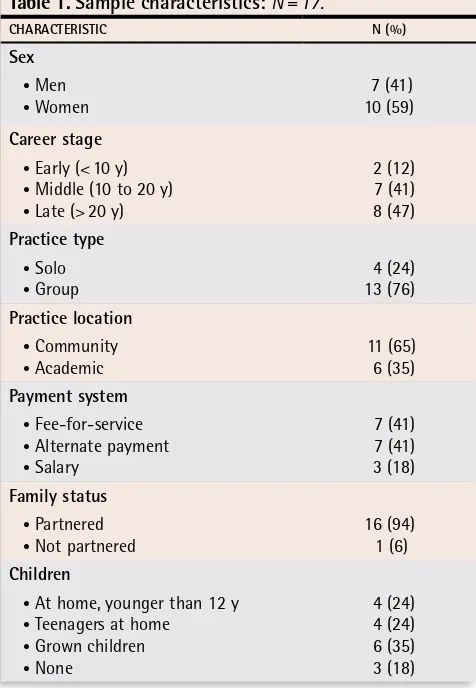
The inclusion of physicians in early stages of practice (start to 10 years) with heavy family responsibilities slightly skews the sample in favour of women (59%) and salaried academics (35%). Two-thirds of late-career physicians (>20 years’ experience) were men. A quarter (24%) of the sample were solo practitioners. Hamilton was one of the first cities in Ontario to embrace primary care reform and currently has a high proportion of fam-ily physicians working within some form of capitated payment system, so there was a lower number of fee-for-service physicians (41%) compared with the rest of Canada. Almost all subjects had partners (94%) and 82% were parents (Table 1).
Themes
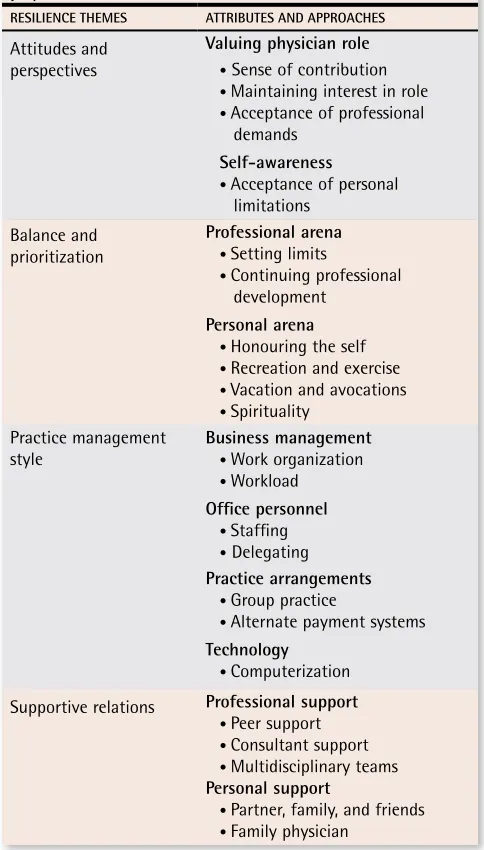
Four resilience themes were identified with attributes and related approaches: attitudes and perspectives; bal-ance and prioritization; practice management style; and supportive relations (Table 2).
Attitudes and perspectives
Valuing the physician role
Sense of contribution: Central to building resil-ience is valuing the physician role with its unique
contributions, privileges, and rewards. “I can’t think of anything else that I would rather be doing.” (204:9) “I’m really privileged to be able to do this.” (201:9) The physician-patient relationship provides opportunities to play a special and meaningful role in the lives of others and to learn from them. “I feel honoured to be part of those conversations because they change my life; they change how I live.” (201:9)
Maintaining interest in role: Physician ability to main-tain interest in work varies. For some, interest is inher-ent to the practice itself, while for others, interest is something that has to be cultivated. “I think like a mar-riage where the romance of the honeymoon goes after a little while, you have to use your imagination and you have to work at keeping your relationship with your spouse, and the same thing with your job.” (302:55)
Acceptance of professional demands: An ability to accept the demands of the physician role builds resil- ience. Lack of time is cited as a stressor and time man-agement the key to resilience. As physicians become experienced, they learn to creatively juggle unexpected demands and speak of setting aside administrative time to organize office hours and external commitments (hospital visits, housecalls, and long-term care). “[I]t’s usually just a matter of shutting the door … sitting down and looking big picture, what’s on the plate, what are
Table 1.
Sample characteristics:
N = 17.
CHARACTERISTIC N (%)
Sex • Men • Women
7 (41) 10 (59)
Career stage • Early (< 10 y) • Middle (10 to 20 y) • Late (> 20 y)
2 (12) 7 (41) 8 (47)
Practice type • Solo • Group
4 (24) 13 (76)
Practice location • Community
• Academic
11 (65) 6 (35)
Payment system • Fee-for-service • Alternate payment • Salary
7 (41) 7 (41) 3 (18)
Family status • Partnered • Not partnered
16 (94) 1 (6)
Children
• At home, younger than 12 y • Teenagers at home
• Grown children • None
Research
Building physician resilience
the priorities, what needs to be done …. I make incred-ibly good use of little bits of time.” (300:23)
Self awareness
Acceptance of personal limitations: Through self-awareness, a growing sense of expertise emerges along with realistic expectations, acceptance of per-sonal limitations, and self-forgiveness for medical errors. “[I]t takes a certain amount of humility to be able to say ‘you know what, I can’t figure this out by myself’ … and there’s nothing wrong with that.” (208:84) “I still reflect on errors that I made over the years and you feel bad about it but I can permit myself to be human.” (202:85)
Balance and prioritization
Professional arena. Balance in the professional arena is achieved through prioritization.
Setting limits: Balance requires knowing and setting limits, being able to say “no.” This comes with experi-ence. “I think it’s taken me a long time to realize that I’m allowed to set limits and to give myself permission to do that.” (202:25) Setting limits might require changing or restricting practice.
Continuing professional development (CPD): Respondents identified 4 strategies for CPD:
• Prioritizing educational needs. “[I]f I need to learn something to manage my patient then that’s what I read … you cannot learn it all.” (300:60)
• Scheduling CPD. “I spend a half an hour each day looking at the journals.” (301:41) “[Continuing pro-fessional development is] scheduled for a year in advance.” (208:71)
• Peer learning occurs through direct questioning and practice-based small groups (PBSGs). “[I]f I don’t know something … I’ll ask.” (201:29) Learning in PBSGs is more than CPD; it counters isolation, increases knowl-edge, and provides professional support. “[T]he small group thing is terrific for me …. It’s really the best way for me to be up to date.” (203:73)
• Teaching is a way to keep current and contributes to role stimulation. “Teaching in particular is just won-derful … the residents just constantly challenge you … they’ll catch you up in a heartbeat.” (300:7)
Personal arena
Honouring self: Balance requires honouring self to avoid exhaustion. “I have to look after myself and I can’t believe how much more productive and energetic I am if I pay attention to that piece.”(306:69) Time off must be protected. “The old advice, you need to set limits, you need to walk out the door; you need to make sure you’re looking after yourself. It’s the advice they give you on the airplane—if you’re traveling with a child, [in an emer-gency] put your own [oxygen] mask on first and then put the child’s on. Working in here, you have to look after yourself or you can’t look after your patients.” (203:52)
Recreation and exercise: Time out should include rec-reation and physical exercise.
Regular vacation: Regular vacations promote men-tal health and can be combined with distant educational events. “You don’t have to run yourself ragged before you can take time off. Take it off when you’re still feel-ing not too burnt out or too tired and you enjoy it bet-ter.” (208:47)
Spirituality: Reflection on deep philosophical ques-tions arising in medical practice is a spiritual task, putting work within a larger context. One physician rec-ommended prayer to gain perspective. “Prayer is very important …. I think it helps.” (305:70)
Practice management style
Business management. Physicians emphasized that medical practice is a business. “Obviously people have
Table 2.
Attributes and approaches in building
physician resilience
RESIlIENCE THEMES ATTRIBuTES AND APPRoACHES
Attitudes and perspectives
Valuing physician role • Sense of contribution • Maintaining interest in role
• Acceptance of professional
demands
Self-awareness
• Acceptance of personal
limitations Balance and
prioritization
Professional arena • Setting limits
• Continuing professional development
Personal arena • Honouring the self • Recreation and exercise • Vacation and avocations • Spirituality
Practice management style
Business management • Work organization
• Workload office personnel
• Staffing • Delegating Practice arrangements
• Group practice
• Alternate payment systems Technology
• Computerization Supportive relations Professional support
• Peer support
• Consultant support • Multidisciplinary teams Personal support
to have some sort of business sense, some ability to rec-ognize that medical practice is also a business.” (202:61)
Work organization: Work organization includes time planning and systematic patient scheduling. Time needs to be budgeted for paperwork. “[A]cknowledge the fact that you are going to need another chunk of time every single week for paperwork.” (306:49)
Workload: The level of workload must be a con-scious decision. “I’ve just had to deliberately just stop doing things …. I do restrict my practice and try to restrict my other professional responsibilities as much as I can.” (300:13-17)
Office personnel
Staffing: Hiring quality personnel is critical. “If you’ve got a good staff, your office runs well, if you’ve got a bad staff, your office is going to be just a disaster.” (203:113)
Delegating: Delegation and teamwork are impor-tant. “I give a lot of the tasks to others who enjoy doing them … we have multidisciplinary teams doing things for the patients.” (300:46)
Practice arrangements
Group practice: Benefits of group practice are described as collegiality, mentorship, and reliable on-call coverage. “I’m in a very supportive group. I think the other really important piece to sustainability is who you are working with day to day.” (306:41)
Alternate payment systems: The greater Hamilton area has a substantial proportion of physicians partici-pating in primary care reform, with rostered patients, alternate payment systems (capitation), and funding for allied professional staff. Cited advantages are flexibility, regular income, vacation, and improved on-call cover-age. “[G]oing into the primary care reform, financially, was the best thing I could have done … and now I think I am being paid appropriately … getting paid for doing forms and all the administrative part.” (304:10-12)
[I]t’s a really highly satisfied group of physicians … you cut the phone at 5 o’clock … there’s an after hours clinic … there’s someone carrying their pager through the night … the patients are happy and they are looked after … when I leave the office, I leave the office, which is probably for the first time in my life. (200:41)
Technology. Technology—pagers, faxes, cellular tele-phones, and computers—can make life easier. One has to feel confident in turning them off to protect personal time. E-mail is described as a mixed blessing—an after-hours challenge. “I went ahead and computerized the office …. I think that has added years to my career …. It’s not for everybody because some people feel over-whelmed when they look at a screen …. I would never, ever advise anybody to even think of setting up an office
with the chart system, it’s just too complex, too passé, too disorganized.” (200:25)
Supportive relations
Professional support
Peer support: Peer support is essential with open communication around difficult cases and stress-related issues. “We usually just sit down and talk … offer gen-eral support to whoever it is.” (201:23) For some, PBSGs provide peer support, and over the years special friend-ships often develop. Colleagues who can step in at a moment’s notice are invaluable.
Consultant support: Building relationships with con- sultants is important for family physicians who increas-ingly manage very ill patients in the community. “I refer. I don’t tend to tinker; I try to stay away from tinkering because then you end up in trouble.” (200:25)
Multidisciplinary teams: Multidisciplinary teams can provide vital support. “We have nurses in our office and certainly they play a very large role.” (202:25)
Personal support
Partner, family, and friends: A personal support sys-tem of partner, family, and friends builds resilience. “I just have the most supportive home environment imag-inable and it’s probably the major thing in my life that allows me to get through the weeks, so marry well.” (300:101) “Just having someone not related to medicine that I can talk to … can be a big help.” (206:17)
Physicians recommend allocating time for personal life, warning that it can easily be eroded. Obtaining help with household chores can be useful.
Family physician: Having a family physician is criti-cal. It eliminates treatment of self and family members; it provides the opportunity to discuss personal health or stress concerns.
DISCUSSION
One could argue attitudes contributing to building resil-ience are inherent personality traits13 rather than learned
behaviours.32 But our study physicians reported
learn-ing to set limits, resultlearn-ing in improvements in sense of well-being and productivity. Hamilton family physi-cians’ recommendations for building resilience shift the focus from pathological stress to successful adaptation emphasizing 4 dynamic elements, each of which has research support.
Attitudes and perspectives. Attitudes and perspec-tives reflect 2 factors identified by Polk in a system-atic review of the literature on resilience: dispositional (sense of self and personal competence) and philo-sophical aspects (personal beliefs).27 They also
Research
Building physician resilience
workshop by the Toronto Health Project: 1) being self-aware, reflective, and attuned, 2) having core values and an optimistic philosophy of life and being altruis-tic, 3) having a healthy temperament and a sense of humour, 4) acceptance of self and others and being able to forgive self and others, and 5) feeling that one is making a difference in one’s profession.28
Balance and prioritization. Balance and prioritization are supported by Polk’s situational factor of resilience and studies on workload26 that show sense of control
over the practice environment is a key contributor to physician morale.9 While early studies describe
“phy-sician work addiction” as a way of life,33 more recent
research in Australia,34 Canada,6,35 the United Kingdom,36
and the United States,2 identify heavy workload and time
pressures inherent to the role itself and not the person. Time pressures affect perceptions of having adequate time for patient care and do influence job satisfaction.9
Time for personal life includes family,37 leisure, fitness,
and health maintenance.38 Some studies show men and
women perceive work stress differently,39 with women
more likely to report having difficulties balancing profes-sional and personal commitments40,41; but the evidence
remains inconclusive.42,43 Options some women choose
when their children are young are salaried positions and part-time work.44
Practice management. Study physicians advised careful decision making about personal capacity for work,45,46 avoiding comparisons with others, and
del-egating to allied health professions. Studies of work organization and physician job satisfaction from the United Kingdom36,47 report 3 factors related to
phy-sician morale: partnership dynamics, personal styles, and workload.26 Hamilton family physicians stressed
the importance of well structured work routines and practice arrangements that foster supportive networks of colleagues, consultants, and allied staff. Good com-munications with colleagues and patients is key to dealing with medical errors, and an essential element of enjoying practice.14,48
Supportive relations. Regular and strong peer inter-action allows physicians to find practical answers to difficult clinical questions, and to address pervasive occupational stresses.47 Methods in Australia include
voluntary educational programs,49 health and
well-being programs for doctors with weekend retreats,50
stress management training,51 and Balint groups,
which are also popular in the United States52 and the
United Kingdom.3 Support services in Wales53
and one-to-one peer support in New Zealand54 permit
explo-ration of issues in confidential settings. The most popular option for the Hamilton physicians in this study was PBSGs, which provide CPD, mentoring, and
peer support. The Ontario Physician Health Program offers resources for those at risk and workshop train-ing to build resilience.28
Balance between personal and professional life is deemed essential.55 Hamilton physicians in this study
stressed the importance of personal relations, exercise, relaxation, spirituality,56 and cultivating outside
inter-ests.2 Personal support networks are necessary,44,57 but if
family life is dysfunctional, it can magnify work-related stress.12,58 Hamilton physicians strongly recommended
having a family doctor as an important part of self-care17
and avoiding the trap of self-treatment.12,44
limitations
Our study’s main limitation is its descriptive nature, which does not distinguish between innate and learned elements of resilience or the relative importance of the 4 resilience themes. While only family physicians were interviewed, we assume the challenges they face and the resilience strategies discussed are generalizable to other medical specialties.
Conclusion
Hamilton family physicians identified 4 dynamic ele-ments for building resilience: attitudes and perspec-tives; balance and prioritization; practice management; and supportive relations. Attitudes and perspectives include valuing the physician role, maintaining inter- est in one’s career, accepting career demands, develop-ing self-awareness, and accepting personal limitations. Balance and prioritization of work and personal life include setting limits to work, scheduling time off, and maintaining healthy relationships. Despite varied prac- tice management styles, common contributors to resil-ience are identifiable: efficient organization, trusted and experienced office staff, supportive group practices with good on-call systems, and effective communica-tion with colleagues and patients. Positive personal relationships protect against stresses of busy medical practices.
The next step is to pilot-test this theoretical model of physician resilience using a survey instrument based on the concepts with a random sample of all physician specialties.
acknowledgment
We thank Lori Edey, Cheryl Levitt, Denise Marshall, Cathy Risdon, and Chris Woodward for initial consulta-tion and Lori Edey and Cheryl Levitt for internal review of the manuscript. This research was supported by a grant from the Hamilton Health Sciences Research Development Fund.
Contributors
analysis and interpretation of data; and drafting, revising, and approving the manuscript.
Dr Trollope-Kumar participated in conception and design of the study; acquisition, analysis, and interpretation of data; and drafting sections of, revising, and approving the manuscript. Dr Waters participated in acquisition, analysis, and interpretation of data and drafting sections of, revising, and approving the manuscript. Dr Everson participated in conception and design of the study; sample selection; analysis and interpretation of data; and drafting sections of, revising, and approving the manuscript.
Competing interests
None declared
Correspondence to: Dr Karen Trollope-Kumar, West End Clinic, 690 Main St W, Hamilton, ON L8S 1A4; e-mail [email protected]
References
1. Goldberg R, Boss RW, Chan L, Goldberg J, Mallon WK, Moradzadeh D, et al. Burnout and its correlates in emergency physicians: four years’ experience with a wellness booth. Acad Emerg Med 1996;3(12):1156-64.
2. Shanafelt TD, Sloan JA, Habermann TM. The well-being of physicians. Am J Med 2003;114(6):513-9.
3. Benson J, Magraith K. Compassion fatigue and burnout: the role of Balint groups. Aust Fam Physician 2005;34(6):497-8.
4. Chopra SS, Sotile WM, Sotile MO. Physician burnout. JAMA 2004;291(5):633. 5. Sullivan P, Buske L. Results from CMA’s huge 1998 physician survey point to
a dispirited profession. CMAJ 1998;159(5):525-8.
6. Gunderson L. Physician burnout. Ann Intern Med 2001;135(2):145-8.
7. Light D, Levine S. The changing character of the medical profession: a theo-retical overview. Milbank Q 1988;66(Suppl 2):10-32.
8. Grant P. Physician job satisfaction in New Zealand versus the United Kingdom. N Z Med J 2004;117(1204):U1123.
9. Williams ES, Konrad TR, Linzer M, McMurray J, Pathman DE, Gerrity M, et al. Physician, practice, and patient characteristics related to primary care physi-cian physical and mental health: results from the Physician Worklife Study.
Health Serv Res 2002;37(1):121-43.
10. Arnetz BB. Psychosocial challenges facing physicians of today. Soc Sci Med 2001;52(2):203-13.
11. Firth-Cozens J, Moss F. Hours, sleep, teamwork and stress. Sleep and teamwork matter as much as hours in reducing doctors’ stress. BMJ 1998;317(7169):1335-6.
12. Myers MF. Medical marriages and other intimate relationships. Med J Aust 2004;181(7):392-4.
13. McManus IC, Keeling A, Paice E. Stress, burnout and doctors’ attitudes to work are determined by personality and learning style: a twelve year longitu-dinal study of UK medical graduates. BMC Med 2004;2:29.
14. Falkum E, Vaglum P. The relationship between interpersonal problems and occupational stress in physicians. Gen Hosp Psychiatry 2005;27(4):285-91. 15. Schernhammer ES, Colditz GA. Suicide rates among physicians: a
quantitative and gender assessment (meta-analysis). Am J Psychiatry 2004;161(12):2295-302.
16. Thommasen HV, Lavanchy M, Connelly I, Berkowitz J, Grzybowski S. Mental health, job satisfaction, and intention to relocate. Opinions of physicians in rural British Columbia. Can Fam Physician 2001;47:737-44.
17. Center C, Davis M, Detre T, Ford DE, Hansbrough W, Hendin H, et al. Confronting depression and suicide in physicians: a consensus statement.
JAMA 2003;289(23):3161-6.
18. Gastfriend DR. Physician substance abuse and recovery: what does it mean for physicians—and everyone else? JAMA 2005;293(12):1513-5.
19. Hawton K, Clements A, Sakarovitch C, Simkin S, Deeks JJ. Suicide in doc-tors: a study of risk according to gender, seniority and specialty in medical practitioners in England and Wales, 1979-1995. J Epidemiol Community Health 2001;55(5):296-300.
20. Hampton T. Experts address risk of physician suicide. JAMA 2005;294(10):1189-91.
21. Lindeman S, Laara E, Hakko H, Lonnqvist J. A systematic review on gender-specific suicide mortality in medical doctors. Brit J Psychiatry 1996;168(3):274-9.
22. Tyssen R, Vaglum P. Mental health problems among young doctors: an updated review of prospective studies. Harv Rev Psychiatry 2002;10(3):154-65. 23. Gross CP, Mead LA, Ford DE, Klag MJ. Physician, heal thyself? Regular
source of care and use of preventive health services among physicians. Arch Intern Med 2000;160(21):3209-14.
24. McCue JD, Sachs CL. A stress management workshop improves residents’ coping skills. Arch Intern Med 1991;151(11):2273-7.
25. Weiner EL, Swain GR, Wolf B, Gottlieb M. A qualitative study of physicians’ own wellness-promotion practices. West J Med 2001;174(1):19-23.
26. Huby G, Gerry M, McKinstry B, Porter M, Shaw J, Wrate R. Morale among general practitioners: qualitative study exploring relations between partner-ship arrangements, personal style, and workload. BMJ 2002;325(7356):140. 27. Polk LV. Toward a middle-range theory of resilience. ANS Adv Nurs Sci
1997;19(3):1-13.
28. Barankin T, Paré M, Bugeja K. Doctors for doctors—therapeutic and practi-cal challenges in treating physicians. Ont Med Rev 2004;71(7):46-9. 29. Stewart DW, Shamdasani PN. Focus groups: theory and practice. Newbury
Park, CA: Sage Publications; 1990.
30. Chew-Graham CA, May CR, Perry MS. Qualitative research and the prob-lem of judgement: lessons from interviewing fellow professionals. Fam Pract 2002;19(3):285-9.
31. Patton MQ. Qualitative evaluation and research methods. Newbury Park, CA: Sage Publications; 1990.
32. Addison RB, Riesenberg LA, Rosenbaum P. Psychosocial support services for family medicine resident physicians. Fam Med 2004;36(2):108-13. 33. Gerber LA. Married to their careers: career and family dilemmas in doctors’
lives. New York, NY: Tavistock Publications; 1983.
34. Gunzburg J. Stress management and the general practitioner. Aust Fam Physician 1988;17(1):18-9.
35. Klich B. Men and woman working as partners: a reality check of medical practice. Ont Med Rev 1999;66(7):35-8.
36. Sibbald B, Enzer I, Cooper C, Rout U, Sutherland V. GP job satisfaction in 1987, 1990 and 1998: lessons for the future? Fam Pract 2000;17(5):364-71. 37. Menninger R. Stress: defining the personal equation. BMJ
2003;326(7391):S107.
38. Murray A, Montgomery JE, Chang H, Rogers WH, Inui T, Safran DG. Doctor discontent. A comparison of physician satisfaction in different delivery sys-tem settings, 1986 and 1997. J Gen Intern Med 2001;16(7):452-9. 39. McMurray JE, Linzer M, Konrad TR, Douglas J, Shugerman R,
Nelson K. The work lives of women physicians results from the physician work life study. The SGIM Career Satisfaction Study Group. J Gen Intern Med 2000;15(6):372-80.
40. Bovier PA, Perneger TV. Predictors of work satisfaction among physicians.
Eur J Public Health 2003;13(4):299-305.
41. Bergman B, Ahmad F, Stewart DE. Physician health, stress and gender at a university hospital. J Psychosom Res 2003;54(2):171-8.
42. Swanson V, Power KG, Simpson RJ. Occupational stress and family life: a comparison of male and female doctors. J Occup Organ Psychol 1998;71:237-60.
43. Cohen JS, Patten S. Well-being in residency training: a survey examining resident physician satisfaction both within and outside of residency training and mental health in Alberta. BMC Med Educ 2005;5:21.
44. Blair JE, Files JA. In search of balance: medicine, motherhood, and madness.
J Am Med Womens Assoc 2003;58(4):212-6.
45. Sotile MO, Sotile WM. The resilient physician: effective emotional management for doctors and their medical organizations. Chicago, IL: American Medical Association; 2002.
46. Swenson RA. Overcoming overload. Fam Pract Manag 2003;10(3):76. 47. Calnan M, Wainwright D, Forsythe M, Wall B, Almond S. Mental health and
stress in the workplace: the case of general practice in the UK. Soc Sci Med 2001;52(4):499-507.
48. Firth-Cozens J. Interventions to improve physicians’ well-being and patient care. Soc Sci Med 2001;52(2):215-22.
49. Holt J, Del Mar C. Psychological distress among GPs—Who is at risk and how best to reach them? Aust Fam Physician 2005;34(7):599-602.
50. Sexton R. Maintaining the wellbeing of rural GPs. BMJ 2003;326(7391):S101.
51. Gardiner M, Lovell G, Williamson P. Physician you can heal your-self! Cognitive behavioural training reduces stress in GPs. Fam Pract 2004;21(5):545-51.
52. Cataldo KP, Peeden K, Geesey ME, Dickerson L. Association between Balint training and physician empathy and work satisfaction. Fam Med 2005;37(5):328-31.
53. Elliston S, Elliston P, Grout P, Vaughan A. The North Wales doctors’ support service for general practitioners. BMJ Career Focus 2002;324(7353):S205.
54. Bruce SM, Conaglen HM, Conagle JV. Burnout in physicians: a case for peer-support. Intern Med J 2005;35(5):272-8.
55. Spurgeon D. Medicine, the unhappy profession? CMAJ 2003;168(6):751-2.
56. Puchalski CM, Dorff RE, Hendi IY. Spirituality, religion, and healing in pallia-tive care. Clin Geriatr Med 2004;20(4):689-714,vi-vii.