The LHCb Upgrade
Donatella Lucchesi1,a
On behalf of the LHCb Collaboration
1University of Padova and INFN
Abstract. The LHCb experiment, designed to perform high-precision measurements in the heavy flavor sector, has achieved results that go well beyond the expectations during the LHC run 1. The 2010 - 2012 data taking demonstrated that the detector and the trigger system are robust and functioning very well. The physics potential of the experiment can be extended to study very rare phenomena and to search for new physics in the heavy flavor sector only if the collected data can be increased much beyond the 1 fb−1per year. In order to achieve this goal detector, data acquisition and trigger must be improved. The plans for the spectrometer upgrade, the new system read-out and the new trigger are presented here together with the major physics motivations.
1 Introduction
Physics beyond the standard model (SM) via new particles production has been searched at LHC directly with no success up to now. Physicists start questioning if new physics (NP) is at the expected TeV scale and whether it is described by the models currently considered. Indirect searches for new particles that appear as virtual contributions in loop processes studying heavy flavor properties can probe larger energy scales for new physics since it must manifest itself in heavy flavor interactions. The LHCb experiment at CERN has already demonstrated to be able to perform high precision mea-surements usingbandchadrons probing part of the new physics models parameter space. The most relevant processes useful to search for new physics at LHCb will be briefly described, showing the ex-perimental reaches with the upgraded detector. The expected increase in statistics will allow opening the door to new physics modes not only within the field of flavor physics but also in other physics top-ics for which the LHCb acceptance in the forward region is particularly interesting. These upgrades are mainly motivated by the need to increase the signal yields to reach the desired sensitivities. The major modification will involve the Data Acquisition (DAQ) that will go from 1 MHz to 40 MHz and the trigger system where an offline trigger logic is foreseen. This implies replacing all front-end electronics and those detector components with embedded electronics. In particular the tracking sub-detector that will be completely re-built. In the following these general aspects of the upgrade will be described.
a. e-mail: [email protected]
DOI: 10.1051/
C
Owned by the authors, published by EDP Sciences, 2014 ,
/2 01 0 007 (2014) epjconf
EPJ Web of Conferences
4 710007
71 6
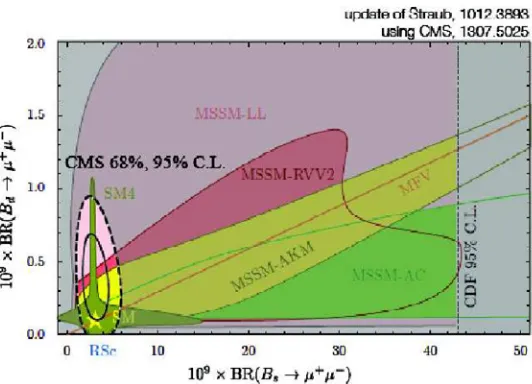
Figure 1.Branching ratio ofBd →μμversusBs→μμ. The contribution of new physics models could enhance the expected values. The current measurements already exclude several models.
2 The Physics Case
New physics beyond the SM at the TeV scale and naturalness are under discussion given the recent Higgs discovery and the lack of any other hint of new particle or new phenomena. The high-energy LHC run will probably return a verdict on the models we are using to describe physics beyond the standard model [1]. New physics is possible also in case of unnaturalness but in this case discoveries are not guaranteed at LHC. In this scenario LHCb can play a very important role because “New Physics, needed to stabilize the electroweak sector, must have a non generic flavor structure in order to be compatible with the tight constrains of flavor-changing process” [2]. The issue for LHCb is that new physics has to be searched via precise measurements that spot anomalies at the level of few percents in several processes. If these anomalies converge towards a new physics explanation we can infer the scale of the process opening the possibility to study it directly. In the following only a few modes are described to give an idea of the reach of the LHCb experiment in the near future.
2.1 Rare Decays:B→μμ
Rare decays include exotic decays with lepton flavor or number violating decays and flavor chang-ing neutral currents (FCNC) processes that are mediated by electroweak box and penguin diagrams in the standard model. Among the interesting decays theBs/d → μμis one of the most sensitive to NP
since its branching ratio can be enhanced or reduced by new particles entering in the decay diagrams that compete with the standard model ones. Figure 1 shows an updated version of the “Straub plot” [3] with theBd→μμversusBs→μμbranching ratio together with the expected value obtained in diff
er-ent new physics scenarios. With 2f b−1LHCb measuredBr(Bs→μμ)=2.9+−11..10(stat)+ 0.3
−0.1(syst)×10− 9
andBr(Bd→μμ)<7.4×10⁻¹⁰at 95% Confidence Level (CL).
With the upgraded detector the expected uncertainty on theBr(Bs → μμ) reaches 5% precision
but more importantly the error on the ratio of branching ratio,Br(Bd →μμ)/Br(Bs →μμ) will be of
γ γ α α d m Δ K ε K ε s m Δ & d m Δ ub V β sin 2
(excl. at CL > 0.95) < 0
β
sol. w/ cos 2 ex
cl uded at
C L > 0.
95
α
β γ
ρ
-1.0 -0.5 0.0 0.5 1.0 1.5 2.0
η -1.5 -1.0 -0.5 0.0 0.5 1.0 1.5
excluded area has CL > 0.95
FPCP 13
CKMf i t t e r
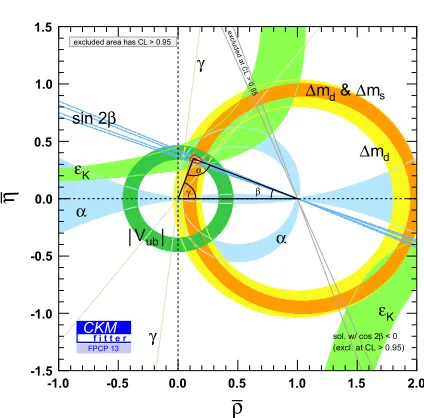
Figure 2.Result of the UT fit within the SM:{ρ¯−η¯}plane obtained by CKMfitter. The red hashed region of the global combination corresponds to 68% CL.
2.2 b→sTransitions
Another broad class of rare decays are theb→ stransitions. In theB0 → K∗(Kπ)μμmode new physics can manifest itself with angular distributions of the decay products which are different with respect to the standard model expectations due to contributions from new particles that can enter in competing amplitudes and modify the final decay amplitude. This decay mode has been studied ex-perimentally by LHCb [4, 5] by comparing several observables to the theoretical expectations. The forward-backward asymmetry as function ofq2, the dimuon invariant mass squared, has been deter-mined for the first time with a enough precision to measure the zero crossing point. The experimental value is in agreement with the expectations. ThePi=4,5,6,8 observables as function ofq2 have been measured for the first time and provide information on physics beyond SM. Agreement with SM has been observed in 23 out of 24 measurements, a local discrepancy of 3.7σis observed in the interval 4.30<q2 <8.68GeV2/c4 for the observableP
5. With the upgraded detector we expect to increase the precision on all these observables by at least one order of magnitude respect to the current one.
2.3 CP violation
Understanding the violation of Charge conjugation and Parity (CP) is one of the key question in physics.
In the SM CP violation enters via the CKM mechanism [6] which describes the current experi-mental data but it is known to generate insufficient CP violation to explain the baryon asymmetry in the Universe. The major part of models that extend the SM predict new sources of CP violation in particular in thebhadron system. The LHCb experiment has already studied several processes but in order to be sensitive to new physics effects a better precision is needed. One of the major goals of
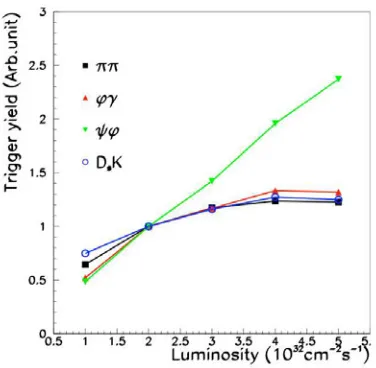
Figure 3.Trigger yield for different B decays as function of the instantaneous luminosity. Only muons based triggers do not saturate due to the Level 0 saturation.
the experiment is the determination ofγ = arg(−VudVub∗/VcbVcd∗), one of the angles of the unitarity
triangle (UT) [7] that is to date the least known. It is the only one that can be determined via decays that involve only tree diagrams and therefore with small theoretical uncertainties. New physics can manifest itself by comparing the experimental value ofγobtained by analyzing different decay modes like tree, loop or box processes. The current best determination ofγis obtained by LHCb [8] and with the upgraded detector the expected precision onγ,δγ <1o.
Another way to verify possible sources of NP is to over-constrain the SM. The CKM matrix pa-rameters can be determined by fitting the standard model allowing to predict the value of several physics observables that then can be compared to the experimental measurements. The analysis per-formed by the CKMfitter [9] group is shown in figure 2. There is a remarkable consistency at 95% CL between the value predicted by the global fit and the measured one for all the observables with some tensions in two of them, the branching ratio ofB→ τνand sin(2β). In order to explain them in term of new physics more precise input parameters are needed.
In the Bs system a potential anomalous CP violation was pointed out by the Tevatron
experi-ments [10], LHCb with 1 fb−1of data found values that are compatible with the SM [11] within the uncertainties. The LHCb upgrade will allow to determine theBs properties with a precision of the
order of 10−3in several decay modes returning the final verdict on possible sources of NP in these decay processes.
3 The Upgrade Strategy and the Consequences
The discussion presented above demonstrates that in order to be able to extract information on NP from the heavy flavor sector it is necessary to perform measurements at the level of a few percent. The LHCb experiment can reach the required precision only if it increases the signal yields significantly while keeping the excellent detector performances obtained during run 1.
photons, hadrons and muons to reduce the readout rate to 1 MHz. The trigger thresholds are about 1 GeV/c for muons and 3-4 GeV/c for electrons, photons and hadrons. The High Level Trigger (HLT) then accesses the full detector information at 1 MHz and performs mainly inclusive selections by trig-gering on partially reconstructed decays. Physics processes are finally selected by fully reconstructed decays together with mass requirements. The High Level Trigger tasks run almost 30.000 independent copies of the executable on about 1600 CPU nodes. With an output physics rate of 5kHz at√s=8TeV in run 1 this trigger configuration led to an efficiency of about 90% for selecting B decays to muons, about 30% for B decays to hadrons and about 10% for charm decays.
At a center of mass energy of 14 TeV and a luminosity up to 2×1033cm−2s−1 the fake rate will increase drastically and in order to stay within the reserved trigger bandwidth, the cuts on the transverse energy must be increased, with the inevitable consequence of reducing the signal yield. Figure 3 shows the trigger yields as function of the instantaneous luminosity for different decay chan-nels. While modes with muons are sufficiently clean to be handled efficiently even at high luminosity values, the hadronic modes reach already at low luminosity a saturation level due to the combinato-rial effects and the Level 0 trigger bandwidth limitation. Hence, an efficient trigger selection requires necessarily a reconstruction with information from the entire detector and removing the Level 0. The LHCb upgrade strategy therefore consists of reading out the entire detector at 40MHz, with a fully software trigger keeping the luminosity leveled atL = 1×1033cm−2s−1 but sustained up to L = 2×1033cm−2s−1 [12, 13]. The consequence of the 40 MHz readout is that all the sub-detector Front-End and Back-End electronics must be replaced and the detectors with embedded electronics have to be rebuilt. Furthermore the detector components have to be adapted to the increased occupan-cies.
4 Detector Upgrade
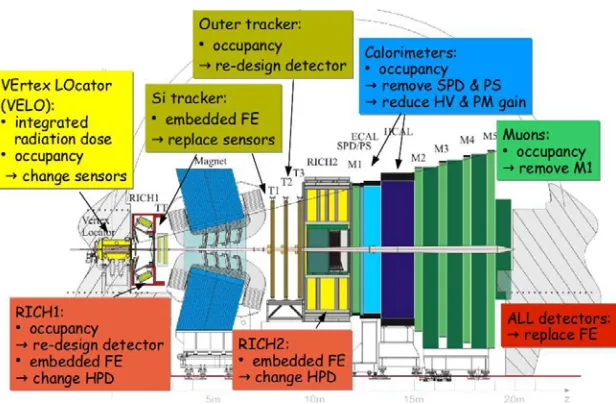
Figure 4 shows the LHCb detector as it is now. For each sub-detector a colored box briefly sum-marizes the planned upgrade with its motivations. The major changes will involve replacement of the tracking system and significant modifications of the particle identification detectors.
The VErtex Locator (VELO), the Trigger Tracker (TT) detector and the T-stations (T1/2/3) will be completely replaced with the goal of to keeping the current performances for track reconstruction and vertex finding, but in harsher conditions. The cartoon in figure 5 illustrates the three sub-detectors with the given tracks nomenclature given depending on which tracker information is used for recon-struction. Tracks, which have no connection to a particle in the detector, are classified asghost tracks. They may consist of measurements from several different particles, noise and spillover measurements which happen to look like a track to the pattern recognition. The tracking performance achieved during run 1 is summarized in table 1. The momentum resolutionδp/pgoes from 0.35% for low momentum tracks up to 0.55% at high momentum and the impact parameter resolution isσIP(μm)=14+35/pT
withpT in GeV/c.
The new VELO [14], as the previous one, is essential for offline track and vertices identification and it is very important to reconstruct efficiently and quickly tracks at the trigger level to reduce the large minimum bias rate. The new pixel detector will be readout at 40 MHz by a new radiation hard ASIC chip capable of coping with the expected data rates. It will reuse large parts of the current mechanical infrastructure, in particular the vacuum tank and part of the cooling system which will be an innovative evaporative microchannel CO2 cooling. Planar silicon pixel of 55x55μm2 will be used, increasing the granularity and consequently the spatial resolution. Since the impact parameter resolution is dominated by the radius of the first measured point and the material distribution, to determine the best configuration a simulation has been performed including all the passive and active
Figure 4.The LHCb detector as it is now. The colored boxes connected to each sub-detector flag the changes foreseen during the upgrade.
Figure 5.Cartoon of the tracking system with the definition of the track depending on which sub-detector is used for its identification.
detector elements. From these studies it has been determined that the sensor distance to the beam will be reduced by 2mmsuch that the inner radius will be about 3.5mm from the beam instead of 5.5mm. This will allow not only to improve the impact parameter resolution and but also to increase the track acceptance.
The Trigger Tracker will be replaced using silicon micro-strips with higher segmentation in order to reduce the occupancy and ghost tracks rate. The acceptance will be improved moving the sensors closer to the beam pipe and adapting their shape. The sensors thickness will go from 500μmto 300
Table 1.Summary of the tracking performances obtained during the first LHCb data taking.
Tracking efficiency
long tracks 94% (p>10 GeV/c) upstream tracks 75% (p>1 GeV/c) downstream tracks 80% (p>5 GeV/c)
Ghost fractions
long tracks 9%
upstream tracks 15%
The Main Tracker Stations upgrade aims mainly at reducing the occupancy in particular in the inner region in order to maintain the same offline tracking performances as of run 1, and to provide a fast tracking algorithm for the trigger. The current baseline solution assumes a scintillating fiber tracker with the possibility to keep straw tube modules on the sides of the outer tracker (OT). The detector area of 5m by 6m will be covered by layers of scintillating fibres with a diameter of 250μm and read out via Silicon Photo-Multipliers (SiPMs). The expected spatial resolution is about 60-100
μm. The backup solution consists of a new silicon micro-strips inner tracker and an outer tracker with with straw tubes.
The particle identification system is constituted by two RICH detectors, the muon chambers and the calorimeter detectors. In the case of the two RICH systems the hybrid photomultipliers (HPD) will be replaced by multi-anode photomultipliers since the FE electronics is integrated in the HPDs. Because of the too high occupancy in RICH1 with the upgraded conditions the optics will be re-designed and the aerogel will be replaced by a CF4 radiator. The first muon detector layer together with the scintillating pad and preshower detectors used to separate electrons from photons with the calorimeter, will be removed due to their very high occupancy. These detectors were essential for the Level 0 trigger that now is removed. In order to run at high luminosity, the calorimeters will only reduce the gain on the photomultipliers and compensate with an increased electronics gain. These facts together with the full electron and gamma reconstruction in the HLT are expected to improve the resolution of the electromagnetic calorimeter helping ine/γseparation. The muon detectors after the calorimeters will remain as they are.
5 Data Acquisition and Trigger
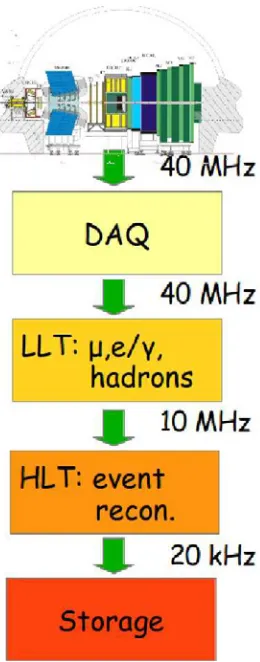
The architecture of the data acquisition system is designed to readout events trigger-less, syn-chronously with the LHC bunch crossing rate at 40 MHz. As shown in figure 6, data will go from readout board to the HLT computing farm with an intermediate step, the Low Level Trigger (LLT), which during the start-up phase is foreseen to reduce the rate at manageable levels to be handled by the computing farm. The final readout architecture is still under discussion and will depend on the tech-nological progress on computing and network. The baseline readout board, ATCA-based, is a custom board that requires the implementation of a local area network protocol directly in the readout board FPGAs. An alternative solution consists in building the readout boards as PCIe peripherals of the event-building servers. The advantage here is that it is a commercial solution and the final technology can be left open to the very last moment to profit from the most cost-effective market development.
The LLT is expected to work as the L0 in run 1 with different implementation. The LLT muon trig-ger will use the same detector information of the run 1 with the distinction that the first muon station will no longer be available. Because of the removal of the scintillating pad detector and preshowers,
Figure 6.Trigger flow assuming the baseline configuration.
the electromagnetic trigger will not distinguish between photons and electrons which will be resolved at the high level trigger.
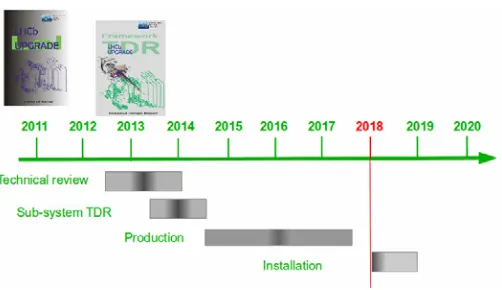
Figure 7.LHCb experiment upgrade road-map as approved by the CERN Research Board. Since then the starting of the data-taking after Long Shutdown 2 has been delayed to 2019.
6 Conclusions
The LHCb experiment has obtained impressive results and reached new important levels of pre-cision in heavy flavor physics which will be pursued further in run 2 in order to be able to observe small deviations from the SM. Nevertheless, the ultimate precision needed to access new physics be-yond the standard model may only be achieved with a 10-fold increase in statistics. For this reason, LHCb will undergo one major upgrade to allow operating the experiment at a luminosity of up to 2×1033cm−2s−1. The detector upgrade is scheduled for 2019 and consists of a complete re-design of the readout system and the trigger in order to read out the full detector at the bunch crossing rate and perform the triggering only by software, to allow selecting efficiently the interesting flavor decay chain. The flexibility in the upgraded trigger and detector re-optimization allows adapting the LHCb physics program and running conditions to any signature which may come out of a changing physics scene.
The road-map for the upgrade is approved by the CERN Research Board and shown in figure 7. The LHCb collaboration has recently released the VELO and PID TDR and it is currently involved in preparing the other sub-systems TDR which will be completed by the March 2014.
References
[1] G. Giudice, arXiv:1307.7879v2 [hep-ph] (2013). [2] A. Bharucha et al., Eur. Phys. J.C, 73:2373 (2013).
[3] D.M. Straub, arXiv:1012.3893 [hep-ph]; arXiv:1205.6094v1 [hep-ph]. [4] R. Aaij et al., J. High Energy Phys.08131 (2013).
[5] R. Aaij et al., Phys. Rev. Lett.111191801 (2013). [6] N. Cabibbo, Phys. Rev. Lett.10531 (1963)
M. Kobayashi, T. Maskawa, Prog. Theor. Phys.49652 (1973). [7] L. Wolfenstein, Physical Review Letters5121 (1945). [8] R. Aaij et al., Phys. Lett. B726151-163 (2013).
[9] J. Charles et al. (CKMfitter group), Eur. Phys. J. C411 (2005). Updated results and plots available at http://ckmfitter.in2p3.fr
[10] J. Beringer et al.Particle Data Group, Phys. Rev.D86, 010001 (2012) and 2013 partial update for the 2014 edition.
[11] R. Aaij et al., Phys. Rev.D87, 112010 (2013)