Article
NTRU-Like Random Congruential Public-Key
Cryptosystem for Wireless Sensor Networks
†
Anas Ibrahim1,2* , Alexander Chefranov2, Nagham Hamad1 , Yousef-Awwad Daraghmi1, Ahmad Al-Khasawneh3 , Joel J. P. C. Rodrigues4,5
1 Palestine Technical University–Kadoorie, Tulkarm, Palestine; [email protected] (A.I.); [email protected] (N.H); [email protected] (Y.D.)
2 Computer Engineering Department, Eastern Mediterranean University, North Cyprus; [email protected] (A.I.); [email protected] (A.C.)
3 Professor of Information Systems at Hashemite University, Jordan; [email protected]; (A.K.) 4 Federal University of Piauí, Teresina – PI, Brazil; [email protected] (J.R.)
5 Instituto de Telecomunicações, Portugal * Correspondence: [email protected];
† This paper is an extended version of our paper published in Ibrahim, A.; Chefranov, A.; Hamad, N. NTRU-Like Secure and Effective Congruential Public-Key 363 Cryptosystem Using Big Numbers. 2019 2nd International Conference on new Trends in Computing 364 Sciences (ICTCS) , Amman, Jordan, October 9-11, 2019, pp. 20–26..
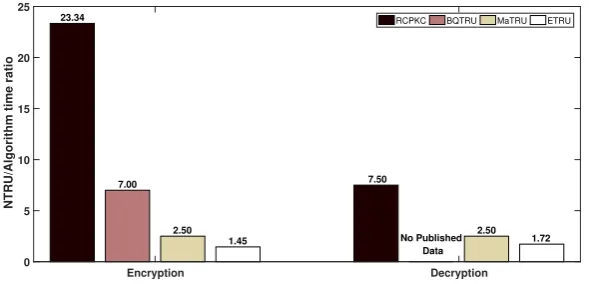
Abstract: Wireless Sensor Networks (WSN) are the core of Internet of Things and require cryptographic protection due to the increase number of attacks. Cryptographic methods for WSN should be fast and consume low power as these networks consist of battery-powered devices and constrained microcontrollers. NTRU, the fastest and secure public key cryptosystem, uses high degree polynomials, and is susceptible to the lattice basis reduction attack (LBRA). CPKC, proposed by NTRU authors, works on integers moduloqand is easily attackable by LBRA since it uses small numbers for the sake of the correct decryption. Herein, RCPKC, a random congruential public key cryptosystem working on integers moduloqis proposed, such that the norm of a two-dimensional vector formed by its private key is greater than√q. RCPKC works similar to NTRU, and it is a secure version of insecure CPKC. RCPKC specifies a range from which the random numbers shall be selected, and it provides correct decryption for valid users and incorrect decryption for an attacker using LBRA by Gaussian lattice reduction. RCPKC IND-CPA security is proved under the assumption of hardness of its one-way function. Due to the use of big numbers instead of high degree polynomials, RCPKC is about 24 (7) times faster in encryption (decryption) than NTRU. Also, RCPKC is more than three times faster than the most effective known NTRU variant, BQTRU. Compared to NTRU, RCPKC reduces energy consumption at least seven times that allows increasing life-time of unattended WSN more than seven times.
Keywords: Wireless sensor network; Internet of Things; random congruential public-key cryptosystem; lattice; NTRU; polynomial; lattice basis reduction attack; LLL algorithm; Gaussian lattice reduction; IND-CPA security
1. Introduction
Wireless Sensor Networks (WSN) play an important role in the development of Internet of Things (IoT). WSN consists of a large number of sensor nodes, battery-supplied devices with a limited memory and computational power microcontroller. WSNs are used widely, e.g., in environmental practices, health, industrial control, military [1], multimedia networks [2], smart grid networks [3]. WSNs need
security and confidentiality since sensitive information is stored, processed, or transferred by sensor nodes [4]. Therefore, cryptographic schemes efficiently working on limited WSN microcontrollers are demanded [5]. Also,energy saving is very important for WSN [6]. NTRU [7] is a Public Key Cryptosystem (PKC) standardized as IEEE P1363.1 and faster than RSA and ECC [8], and it is applicable cryptosystem for WSNs [9]. Contrary to RSA and ECC working with big numbers and homomorphic only in one operation, multiplication and addition, respectively, NTRU works with high degree,N, polynomial rings and is homomorphic with respect to both multiplication and addition [7]. These features of NTRU make it applicable to various applications, such as authentication for smart cards [10], encryption of user data in smart monitoring system [11], securing of SMS [12], mutual authentication and key agreement for wireless communications [13], embedded systems including microcontrollers and FPGAs [14], Internet of Things devices [15], and NTRU hardware implementation [16]. NTRU model expects that the public key is used for encryption only by a public user (sender), whereas the private key is used for decryption only by the keys owner (receiver).
NTRU and its known variants [17–38], shown in Section2, work with degreeNpolynomials. The main problem, NTRU faces, is that it is susceptible to the lattice basis reduction attack (LBRA) using Gaussian lattice reduction (GLR) algorithm for two-dimensional lattices and the LLL algorithm for higher dimensions [39]. The LBRA using LLL algorithm solves the shortest vector problem (SVP) with exponential running time in Nrevealing the secret key because the private keys are selected as polynomials with small coefficients for the decryption correctness [40]. To overcome the problem of susceptibility, the NTRU uses polynomials with high degree Nfor the encryption/decryption mechanism [7,41], and this increases its time complexity. In addition, NTRU originally proposed in [7] also is not an IND-CPA cryptosystem as shown in [42]. Therefore, NTRU variants, shown in Section2, try minimizing NTRU computational complexity by extending coefficients of the used polynomials, or using matrices of polynomials that allows preserving security level while decreasing the polynomial degree and to provide IND-CPA security. The extreme case is a polynomial of zero degree, that is a number, as used in CPKC, but CPKC as shown in [24] is insecure against LBRA by GLR. The authors of the NTRU applied its encryption/decryption mechanism in [24, p. 373-376] to integers modulo q >>1, considering congruential public key cryptosystem (CPKC), and they found that CPKC is insecure since GLR reveals its private keys in about ten iterations. So, the CPKC is considered as a toy model of NTRU because "it provides the lowest dimensional introduction to the NTRU public key cryptosystem" [24, p. 374]. Insecurity of CPKC stems from the choice of the private keys used as small numbers to provide decryption correctness. If CPKC could be made resistant to GLR attack, it would be the best possible choice for the NTRU modifications. Therefore, we previously proposed CPKC modification, RCPKC is originally proposed in [43] (we call it here RCPKC.1). However, our further studies of LBRA attack revealed some cases where the attack can succeed to compromise encrypted message in the originally proposed solution.
In this paper, an enhanced RCPKC is proposed by specifying a range from which the random numbers shall be selected based on short vectors returned by GLR attack on it. It provides correct decryption for valid users and incorrect decryption for an attacker using GLR. GLR cannot find its private key because it solves SVP returning the shortest in a lattice vector, whereas our private key is in the safe region (above the Minkowski’s boundary (29)-(32) for the shortest vector norm of a lattice). On the other hand, the short vectors returned by GLR cannot be used for correct decryption due to our choice of the random numbers. RCPKC is an IND-CPA secure cryptosystem more secure than NTRU because LBRA currently considered as one of the most effective attack against NTRU as well as a number of other attacks on NTRU are not applicable to RCPKC, whereas RCPKC resistance to other known attacks on NTRU is similar to that of NTRU. RCPKC is about 24 times faster in encryption and seven times faster in decryption than NTRU. Simplicity, speed, and security make RCPKC a good candidate cryptosystem for WSNs. The paper contribution can be summarized as follows:
• Hardness of RCPKC one-way (OW) function is proved.
• RCPKC semantic security, i.e. IND-CPA security, is proved under the assumption of the hardness of inverting an associated one-way function
• RCPKC performance is justified through implementation and comparison with the state-of-the-art ciphers.
• RCPKC better than NTRU applicability to WSNs is proved.
The rest of the paper is organized as follows. In Section2, known NTRU variants are presented. In Section3, overview of NTRU and CPKC is made, and formulas for CPU power consumption calculation are introduced. LBRA by GLR on CPKC is described, and Minkowski’s second theorem is presented in Section4used to define a region where GLR attack against CPKC private key/ message fails. In Section5, RCPKC is presented. In Section6, RCPKC security comparison versus NTRU is conducted. In Section7, RCPKC OW function and IND-CPA security are considered. In Section8, RCPKC performance comparison versus NTRU and its variants is presented, and RCPKC versus NTRU power consumption is studied. Section9concludes the paper.
2. Review of Known NTRU Variants
Many variants of NTRU have been proposed and studied recently targeting further decreasing its computational complexity. All these variants work with polynomials and mainly differ in the choice of their coefficients, ring defining polynomial, or the polynomials are used as entries of such structures as matrices. NTRU variants overview follows.
NTRU variants differing in the choice of their coefficients. In [25], an NTRU variant, ETRU, is proposed working with polynomials over Eisenstein integer coefficients and faster than NTRU in encryption/decryption by 1.45/1.72 times. Karbasi and Atani [26] modified ETRU, called ILTRU [26], so that it works with irreducible cyclotomic polynomial over Eisenstein integer coefficients. NTRU variant, BITRU, working with polynomials over so called binary numbers, usually known as complex numbers is proposed in [18]. NTRU variant, QTRU, working with polynomials over hyper-complex four-component numbers, quaternions, is proposed in [28]. Also Bagheri and colleagues proposed NTRU variant, BQTRU, working over quaternions but with bivariate polynomials seven times faster than NTRU in encryption [19]. A variant of NTRU working with polynomials over 8-component hyper-complex numbers, octonions, called OTRU, is proposed in [27]. In [32], NTRU variant, HXDTRU, is proposed working with polynomials over 16-component hyper-complex numbers, hexadecnions, also known as sedenions [17]. Also, a variant of NTRU working with polynomials over 16-component hyper-complex numbers, sedenions, is proposed in [29]. A variant of NTRU, called CTRU, working with polynomials coefficients of which are also polynomials in one variable over a binary field is proposed in [22]. Also, a variant of NTRU working with polynomials coefficients of which are polynomials in one variable over rational field called BTRU is proposed in [30].
NTRU variants working with different rings. NTRU variant that works with polynomials with prime cyclotomic rings is proposed in [33]. A variant of NTRU working with non-invertible polynomials is proposed in [20].
the keys owner only that uses for decryption the private key only, whereas the public key is used for encryption by the public user only.
NTRU variants provide IND-CPA security. NTRU [7] is not IND-CPA cryptosystem as shown in [42] and presented in Section7.3. Various NTRU variants have been proposed to resolve this issue, Stehlé and Steinfeld proposed IND-CPA NTRU variant by changing NTRU ring to(xN+1)withNa power of 2, and adding small error from LWE distribution [34]. Seck and Sow in [35] also provided two variants using the ring(xN+1)and the assumption of the hardness of Ring Learning With Error (Ring-LWE) problem. Howgrave-Graham et al. proposed IND-CPA secure variant called NAEP [36,37] using message padding and hashing. Wang et al. in [38] proposed IND-CPA variant, D-NTRU, using two-step encryption.
In conclusion, the NTRU variants try minimizing NTRU computational complexity by extending coefficients of the used polynomials, or using matrices of polynomials that allows preserving security level while decreasing the polynomial degree because operations with high-degree polynomials are time-consuming. However, these variants are still susceptible to LBRA using LLL but with less complexity than NTRU has. Also, the ITRU can be used by the keys owner only for encryption and decryption messages, but cannot be used by a public user knowing the public key only, and, hence, it is not compatible with NTRU model of use.
3. Preliminaries
3.1. Overview of NTRU
NTRU [24] uses the rings
Rq= Zq [x]
xN−1,Rp=
Zp[x]
xN−1,
elements of which are polynomials moduloxN−1 with coefficients inZ
q,Zprespectively, wherep<q,
p,Nare primes, gcd(p,q) =gcd(N,q) =1.
LetT(d1,d2)be a subset ofRqwith polynomials havingd1coefficients equal to 1,d2coefficients equal
to -1, and the rest coefficients equal to zero. The secret polynomials, f,g, are of the form
f ∈T(d+1,d), g∈T(d,d). (1)
The public polynomial,h, is computed as follows:
h=Fq·gmodq, (2)
whereFqis the inverse off moduloq. A random polynomial,r, and message,m, are of the form:
r∈T(d,d), m∈Rp. (3)
NTRU encryption is as follows:
e=p·r·h+mmodq. (4)
NTRU decryption consists of two steps:
Step 1: The private key,f, is applied to (4):
a = f·emodq
Step 2: The inverse off modulopis applied to (5) after the polynomialais center-lifted (making coefficients ofaby absolute value less thanq/2).
3.2. Overview of CPKC
Two secret integers, f,g, are defined as follows:
f <pq/2, pq/4<g<pq/2, (6)
gcd(f,qg) =1, (7)
whereqis a public integer.
The first secret value, f, has inverses modulogandq, that is,Fg,Fq, respectively, by virtue of (7):
1= f ·Fgmodg, 1= f ·Fqmodq. (8)
A public value,h, is computed using (6), (8) as follows
h=Fq·gmodq. (9)
Thus, CPKC has the private (secret) key,SK= (f,g,q,Fg,Fq), and the public key,PK= (h,q).
The plaintext message,m, meets the following condition:
0<m<pq/4. (10)
A random integer,r, is chosen as follows:
0<r<pq/2. (11)
3.2.1. CPKC Encryption
The ciphertext,e, is computed using (9)-(11) as follows:
e=r·h+mmodq. (12)
3.2.2. CPKC Decryption
Decryption is described by Steps 1, 2 below: Step 1:Multiply the ciphertext (12) by f getting
a= f·emodq
=r· f·Fq·g+ f·mmodq. (13)
Note thata=r·g+f ·mif (the remainder is allowed being negative):
|r·g+ f·m|<q, (14)
where (8), (9), and (12) are used. CPKC decryption correctness condition (14) holds under conditions (6), (10), (11):
|r·g+f ·m|<pq/2pq/2+pq/2pq/4<q.
Thus, the parameters, f,g,r, are selected small compared toq(see (6), (10), (11)) to meet the CPKC correctness decryption condition (14) used in Step 2 of the decryption.
Step 2:Multiply (13) byFg, getting
where (8) is used and the contributor with the factorgin (13) vanishes due to (14). 3.2.3. Example of CPKC Encryption/ Decryption
Example 1. CPKC Encryption/ Decryption.
The example is close to Example 7.1, from [24, p. 375]. Let according to (6), (7), (10), q =
122430513839, f = 231233,g=195696, andm=12345.
According to (8),Fg=127505, andFq=54368439252. Public key component,h, is calculated by (9):
h=Fq·gmodq=107143708775.
Let according to (11),r=10101. The ciphertext,e, is computed according to (12):
e=r·h+mmodq=95290525699. (16)
To decrypt the ciphertext (16), applyStep 1, equation (13):
a= f·emodq=r·g+f ·m=4831296681. (17) InStep 2, the messagemis retrieved using (15):
m=Fg·amodg=12345. (18)
Thus, in (18), the plaintext,mm is revealed. It can be seen that CPKC encryption/decryption procedure (12), (13), (15), works correctly due to (14) holding. Note that the norm of the vector, (f,g) = p
f2+g2=302928.4 is small compared to√q=759250123.0.
3.3. Formulas for CPU Power Consumption Calculation
Power,P, and energy,E, are measured in watts (W) and joules (J) [44], respectively, and calculated as follows :
P=V·I, (19)
E=P·T, (20)
whereV is the potential difference measured in volts (V), and I is the electric current measured in amperes(A),Tis the running time in seconds. There are three contributors to the CPU power consumption: dynamic, short-circuit, and power loss due to transistor leakage currents [45]:
Pcpu=Pdyn+Psc+Pleak. (21)
Power consumption is mainly defined by the dynamic and leakage components [46]. Leakage power, caused by leakage currents, is present in any active circuit independently of clock rates, and is calculated as follows [46]:
Pleak =V·Ileak, (22)
whereVis the supply voltage, andIleakis leakage current. Dynamic power consumption depends on
circuit activity (i.e. transistor switches, changes of values in registers, etc.), and is defined as follows [45]:
Pdyn =a·C·V2· f, (23)
from 1.8, .., 3.6V[48, p. 1], clock frequency from 1, .., 16 MHz [48, p. 18], is used for RCPKC power consumption evaluation in Section8.2.
4. Analysis of LBRA Attack Against CPKC
In this section, LBRA using GLR against CPKC private key/ message is described. Our implementation of GLR attack is shown (Maple 2016.2 is used throughout the paper). A demonstration by an example of how CPKC private key can be attacked using GLR is presented. Then, a region defined in terms of Minkowski’s second theorem where GLR attack fails is shown.
4.1. Lattice Basis Reduction Attack by GLR on CPKC Private Key/Message
In the following,||x||,(x·y),bae, andR, denote Euclidean norm [49] of the vectorx, dot product of the vectors,xandy, rounding of the real number,a, and the set of real numbers, respectively. LetE(V1,V2)⊂R2be a 2-dimensional lattice with basis vectors,V1andV2:
E(V1,V2) ={a1V1+a2V2:a1,a2∈Z}. (24)
GLR algorithm [24, p. 437], shown in Code1, on termination returns the shortest vectorv1inE(V1,V2).
Code 1. GLR algorithm pseudocode finding the shortest vector v1of the lattice E(V1,V2).
Input: basis vectors V1, V2;
Output: the shortest vector v1in E(V1,V2);
v1=V1; v2=V2;
Loop
If||v2||<||v1||
swap v1and v2.
Compute m=b(v1·v2)/||v1||2e.
If m = 0
return the shortest vector v1of the basis,{v1,v2}.
Replace v2with v2-mv1.
End Loop.
CPKC private key recovery problem can be formulated as the Shortest Vector Problem (SVP) in the two-dimensional lattice,E(V1,V2). From (9), it can be noticed that for any pair of integers,FandG,
satisfying:
G=Fhmodq, F=O(√q), G=O(√q), (25)
(F,G)is likely to serve as the first two components,f,g, of the private key,SK[24, p. 376]. Equation (25) can be written asF·h+q·n=G, wherenis an integer. So, our task is to find a pair of comparatively small by absolute value integers,(F,G), such that
F·V1+n·V2= (F,G), (26)
whereV1= (1,h)andV2= (0,q)are basis vectors, at least one of them having Euclidean norm of order
O(q). Similarly, CPKC message recovery problem can be formulated as SVP in the two-dimensional lattice, E(V1,V2), whereV1,V2are from (26). It can be also noticed from (12), that for any pair of
integers,(RR,EM), satisfying:
(RR,EM)is likely to serve as the vector(r,e−m)since the encryption equation (12) can be written asr·h+q·n=e−m, wherenis an integer. So, our task is to find a pair of comparatively small by absolute value integers,(RR,RM), such that
RR·V1+n·V2= (RR,EM). (28)
Our aim is to find the shortest vectorwfromE(V1,V2)using GLR that might disclose(r,e−m)if
e,rare of the order ofO(√q). Comparing (26) and (28), it is noticed that they are the same up to the unknowns’ names used, and hence, finding the shortest vector inE(V1,V2)may reveal either the
private key components(F,G)=(f,g), or the message related vector,(RR,EM) = (r,e−m). Code2is our implementation using Maple [50] of the LBRA by GLR based on Code1.
Code 2. Maple code of LBRA by GLR on CPKC private key/message returned as the shortest vector w=v1of the lattice E(V1,V2), where V1, V2are from (26).
LBRA by GLR using Code2on CPKC private key/message for the data from the Example1, finds in 9 iterations the shortest vector,v1 = (231233, 195696) as shown in Figure1. The shortest vector,v1, found by GLR corresponds to the private key components,(f,g), because they were selected small, having orderO(√q)values according to (6). The message related vector,(r,e−m), is not disclosed in the attack becausee=O(q)in the Example1.
Figure 1.Screenshot of LBRA by GLR using Maple Code 2 on CPKC for the data from the Example 1 finding the private key components,(f,g)=v1, in 9 iterations.
This section concludes that CPKC can be easily attacked using GLR. In order to modify CPKC to become resistant to GLR attack, first, in Section4.2a region where GLR attack fails is shown.
4.2. Region Resistant to GLR Attack on CPKC Private Key/ Message
LBRA by GLR succeeds in finding CPKC private key since it, by using settings (6), is likely the shortest vector in the lattice. Minkowski’s Second Theorem [51, p. 35] sets an upper bound for the norm of the shortest nonzero vector,λ, in a 2-dimensional lattice:
λ≤pλ2Vol(L)1/2, (29)
whereλ2=2/
√
3≈1.154 is the Hermite’s constant [51, p. 41], andVol(L)is the volume of the lattice which is equal toqfor the latticeL=E(V1,V2)whereV1,V2are defined in (26). Therefore, (29) can be
written as follows:
λ≤α√q, (30)
whereα=
√
λ2≈1.07. From (30), one gets for the relative norm,
λ0= √λ
the following inequality (32):
λ0≤α. (32)
GLR fails attacking CPKC private key/message when (32) is not satisfied for the secret vector relative norm(f,g), i.e. if
||(f,g)||/√q>α (33)
holds, GLR fails to find CPKC private key/message.
CPKC selects small values for private key(f,g)in (6) to satisfy decryption correctness condition (14). Hence, our goal is to propose in Section5a modification for CPKC, that is RCPKC, where(f,g)
satisfies (33) and provide correct decryption for valid users, and incorrect decryption for an attacker using GLR.
5. The proposed RCPKC
In this section, random CPKC (RCPKC), an adjustment of CPKC described in Section3.2, so that it becomes resistant to GLR attack, is proposed.
5.1. RCPKC Main Ideas
The main two ideas of RCPKC are:
• Contrary to the settings (6) of CPKC, which uses secret key(f,g)with small norm not exceeding √
qso that(f,g)may be found as a shortest vector (SV) in the latticeE(V1,V2)defined by (26),
RCPKC [43] (we call it in this section RCPKC.1) is originally proposed having private key(f,g)
with a large norm meeting (33) so that it cannot be returned by LBRA using GLR as the SV but
(f,g)also meets (14) due to the skew in its components.
• However, as mentioned in Section4.1that for any pair of integers,FandG, satisfying (25),(F,G)
is likely to serve as the first two components, f,g, of the private key. That means, in spite of the large norm of(f,g), theSV = (F,G), obtained in the result of LBRA using GLR may meet decryption correctness condition (14), and thus may be used for the correct plaintext message disclosure as shown in Example3. That is why, RCPKC.1, Section5.2, before encrypting by (12), (contrary to CPKC using a random number from the predefined range (11)), defines a range for the random number selection using the SV,(F,G)(returned by GLR attack on the latticeE(V1,V2)
defined by (26)), so that decryption correctness condition (14) holds for(f,g)but does not hold for(F,G)that leads to the failure of LBRA using GLR on RCPKC.1. Such interval defined in (42) -(44) for RCPKC.1 found to be vulnerable to GLR attack. Therefore, an enhanced RCPKC proposed herein (we call it in this section RCPKC.2) with more tight interval forris defined in (48), (52), and (53), so that such attack is inactive.
Thus, RCPKC.2 assumes that the private key owner selects a range for a random value,r(used in encryption (12)), based on the secret key,(f,g), and respective SV,(F,G), in the lattice,E(V1,V2),
defined by (26), guaranteeing correct decryption for a valid user and incorrect decryption for an attacker using GLR. Because of the special choice of the random value range, the proposed algorithm is called Random CPKC, RCPKC. The problem for RCPKC which might happen that the range for random numbers such kind defined may be rather narrow and, thus, security of RCPKC may suffer. But as it is going to be shown the range is rather large and may significantly exceed the range for a secret message.
5.2. RCPKC.1 [43] Description To meet (33), it is required that
f,r≥α·√q. (34)
The LBRA by GLR failure condition (33) holds if (34) is true since
||(f,g)|| √
q =
p
f2+g2
√
q =
p
α2·q+g2
√
q >α, ||(r,e−m)||
√
q =
p
r2+ (e−m)2
√
q =
p
α2·q+ (e−m)2
√
q >α,
forg,e−m6=0. Condition (34), in RCPKC.1, substitutes for the conditions (6), (11) onf,r, in CPKC. The message,m, and the private key,g, instead of (10), (6), used in CPKC, are redefined in RCPKC.1 as follows:
2mgLen >g≥2mgLen−1>m≥0, (35)
wheremgLenrepresents the length ofmandgin bits.
For RCPKC.1, correctness decryption condition (14) shall hold, that is true (see (41)) when f,r values in addition to (34) meet (36):
q
2·2mgLen > f,r. (36)
Since
q=2qLen. (37)
Then, (34) and (36) can be rewritten:
2qLen−mgLen−1> f,r≥α·2qLen/2. (38)
To have a non-empty range for f,r, of the width at leastα·2qLen/2, from (38), the following condition
is obtained:
2qLen/2 2·α >2
mgLen+1. (39)
By definingβ=log21/(2·α)≈ −1.103, (39) shows that
2β·2qLen/2>2mgLen+1,
qLen+2·β>2·(mgLen+1),
qLen>2·(mgLen+1−β). (40)
Let’s show that the decryption correctness condition (14) holds when (35), (38), and (40) hold:
r·g+f·m<2qLen−mgLen−1·2mgLen+2qLen−mgLen−1·2mgLen−1
<2qLen−1+2qLen−1=2qLen =q. (41) Thus, for RCPKC.1, norm of(f,g)meets (33), and decryption correctness condition (41) holds. We need additionally that decryption correctness condition (41) is violated for(F,G), that is the SV obtained in the result of GLR attack on the latticeE(V1,V2)defined by (26). Hence, it cannot be used
as a private key for the plaintext message correct decryption.
Inequality (38) defines a range forrso that f,g,r,mmeet (14). Now, we define constant onr,
such thatF,G,r,mviolate (14). Using (42) and (35):
|G·r+F·m| ≥ |G| · |r| − |F| ·m≥ |G|(q+g|F|)
|G| − |F| ·m ≥q+g|F| −m|F|>q.
(43)
Thus, inequality (38) is used forf, but forrfrom (42) and (38), we have
2qLen−mgLen−1>r≥max(α·2qLen/2,rmin). (44)
For RCPKC security, range defined by (44) shall be rather large, max(α·2qLen/2,rmin), hence:
2qLen−mgLen−1≥2·max(α·2qLen/2,rmin). (45)
Thus, RCPKC.1 is defined as follows. RCPKC.1 Definition:
The private key components,(f,g), meet (7), (8), (35), and (36), whereqLen,mgLenmeet (40) and (45), where(F,G)is an SV obtained in the result of GLR attack on the latticeE(V1,V2)defined by (26). The public key component,h, is defined by (9). Message,m, meets (35), and random integer,r, is selected from the range defined in (42), (44). Encryption and decryption follow (12), and (13), (15), respectively (see Sections3.2.1, and3.2.2). Decryption correctness condition (14) is proved for RCPKC.1 in (41).
5.3. Examples of RCPKC.1 Encryption/Decryption and LBRA Attack Against RCPKC.1
Let us consider now Example2showing RCPKC.1 encryption and decryption processes.
Example 2. RCPKC.1 Encryption/Decryption. For calculations, Maple is used.
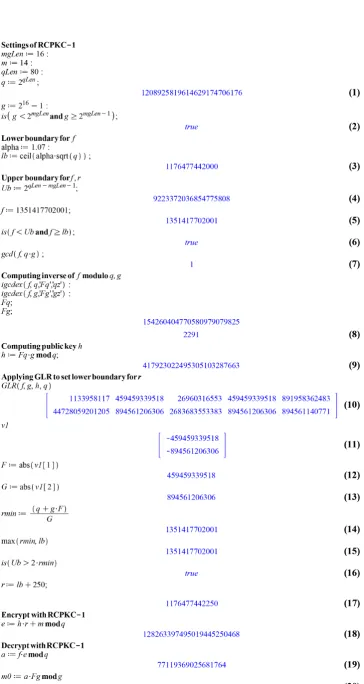
LetmgLen = 16, qLen = 80, meeting (40), q = 2qLen, private key components, private key component,g = 216−1, is selected to meet (35). On the other hand, private key component, f =
1, 351, 417, 702, 001, is selected to meet (38). See (1)-(6) in Figure2. According to (8),Fq, andFgare
calculated in (8) of Figure2. Then, public key component,h, is computed using (9) as shown in (9) of Figure2.
To compute the interval from whichris selected (44) and (45), lower boundary is found in (10)-(15) in Figure2.
To encrypt messagem=14, random numberr=1, 176, 477, 442, 250 is selected from the interval. Then, ciphertexte, is calculated using (12) in (18) of Figure2. For decryption, in the first step, according to (13), we findaby as the product of the ciphertext,e, and the private keyf moduloqas shown in (19) of Figure2. In the second decryption step, according to (15), we multiply,a, byFgto get the messagem
as we can see in (20) of Figure2. Hence, the message,m, is correctly retrieved. Example 3. LBRA attack using GLR against RCPKC.1 in settings of Example2.
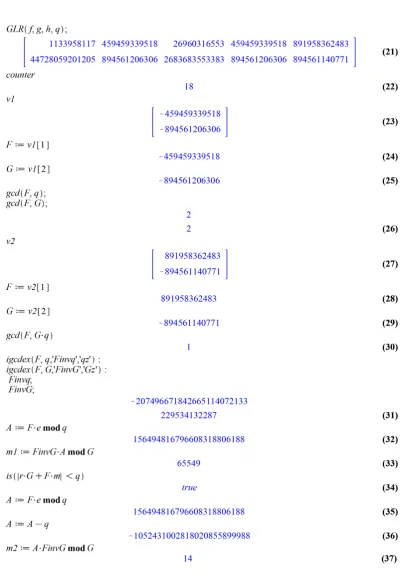
Now, we try attacking RCPKC.1 in Example2, using GLR Code2. GLR terminates in 18 iterations findingv1= (F,G) = (−459459339518,−894561206306)that is neither(f,g)nor(r,e−m)as shown in (21)-(25) Figure3. Since gcd(F,q) =gcd(F,G) =2,Fhas no inverses moduloqandG, andv1 cannot be used to decrypt the ciphertext.
Let’s try the second shortest vectorv2= (−207496671842665114072133, 229534132287)that is neither
It has been noticed by anonymous reviewer that the value ofF·e=r·G+F·mcould be negative, but still satisfy correctness decryption condition in the absolute value
|r·G+F·m|<q. Therefore, we can see that
F·e=r·G+F·m=156494785800294925503676=−1052431033814334249202500 modq, and| −1052431033814334249202500| < q = 1208925819614629174706176 as shown in (34) Figure
3. Thus, decryption correctness condition (41) holds. On the other hand,A = (F·emodq)−q =
−1052431033814334249202500. And the plaintext is restored as m3 = (F−1modG)·AmodG =
−509 = 14 mod 523, that is equal tom= 14 as shown in (35)-(37) Figure3. Thus, the GLR attack succeeds revealing the plaintext message in the conditions of Example2. Herein, it is necessary to be noticed that RCPKC.1 can be attacked by any of the short vectors returned by GLR.
In the following Section, RCPKC.1 is modified to RCPKC.2, so that it becomes immune against LBRA attack.
5.4. RCPKC.2 Proposal
In order to resist GLR attack shown in Example3, the definition of the region from whichris selected, should consider all SVs with norm less than a thresholdµ||(f,g)||as follows.
Random interval defined in (42), (44), and (45) using only the SV obtained by GLR attack on the latticeE(V1,V2)defined by (26), must be modified to include all the SVs with norm less than norm of
secret key, by thresholdµ||(f,g)|. Hence, all vectors(Fi,Gi)obtained in the course of GLR reduction
that have norms
||(Fi,Gi)||<µ||(f,g)||,i=1, ..,N, (46)
whereNis the number of(F,G)pairs satisfying (46),µis a threshold, e.g.,µ=10, and then it must be
checked that
(∀i=1, ..,N)((Fi,Gi)6= (f,g)). (47)
If (47) is violated, i.e. one of the vectors in the list is our vector(f,g), then another(f,g)is used. Inequality (38) defines a range forrso that f,g,r,mmeet (14). Now, constraint onris defined as follows:
q/g−f ≥rmax≥r≥rmin≥(q+g· max
i=1,..,N|Fi|)/ mini=1,..,N|Gi|, (48)
such thatFj,Gj,r,mviolate (14) for anyj=1, ..,N. We require also that
h·rmin>q. (49)
Using (48) and (35), it is noticed that actually decryption correctness condition (14) for anyj=1, ..,N, is violated:
|Gj·r+Fj·m| ≥ |Gj·r| − |Fj·m| ≥ |Gj| ·
q+g·maxi=1,..,N|Fi|
mini=1,..,N|Gi|
− |Fj·m|
≥ q+g· max
i=1,..,N|Fi| − |Fj·m|>q. (50)
From (35), (48), it is also perceived that the decryption correctness condition (14) holds for the original(f,g):
Thus, inequality (38) is used forf, but forrfrom (48) and (38):
rmax>r≥max(α·2qlen/2,rmin). (52)
For RCPKC.2 security, range defined by (52) shall be rather large, such as, e.g., max(α·2qlen/2,rmin),
hence, it is desirable having:
rmax≥2·max(α·2qlen/2,rmin). (53)
In order to provide IND-CPA security (see Section7.3), it is required to have
gcd(g,q)>1. (54)
Thus, RCPKC.2 proposal follows. RCPKC.2 Proposal:
The private key components,(f,g), meet (7), (8), (35), (36), and (54), whereqLen,mgLenmeet (40) and (45) The public key component,h, is defined by (9). Message,m, meets (35), and random integer,r, is selected from the range defined in (48), (49), and (52). Encryption and decryption follow (12), and (13), (15), respectively (see Sections3.2.1, and3.2.2). Decryption correctness condition (14) is proved for RCPKC in (51).
RCPKC.2 is more secure than RCPKC.1 because intermediate GLR outputs are also used for the random parameter range selection. However, their computational complexity is the same, since the both employ GLR and follow the same encryption/decryption procedures.
5.5. Example of RCPKC.2 Encryption/Decryption and LBRA by GLR Failure
This example aims to show the encryption/decryption process of RCPKC.2, and how LBRA using GLR fails to compromise RCPKC.2 private key/message.
Example 4. RCPKC.2 encryption and decryption, and GLR failure to find RCPKC.2 secret key/message. For calculations, Maple is used.
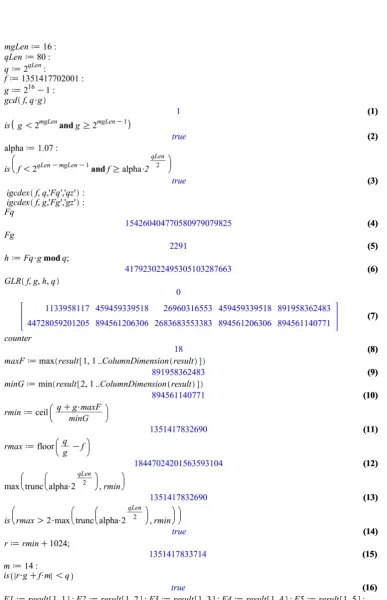
LetmgLen=16,qLen=80, meeting (40),q=2qLen, private key components,g =65, 535, and f =1, 351, 417, 702, 001, are selected to meet (35) and (38) respectively as shown in (2) and (3) of Figure
4.
ValuesFq andFg are found in (4) and (5) of Figure4. The public key component,h, is calculated
according to (9) as shown in (6) of Figure4. To select randomr, GLR algorithm shown in Code2is launched with inputsV1= (1,h)andV2= (0,q). GLR terminates in 18 iterations as shown in (8) of
Figure4, with 5 pairs(Fi,Gi)satisfying (46) shown in (7) of Figure4, it is noticed that none of these
vectors is equal to(f,g). Hence, (47) is satisfied. MaximumFiand minimumGiare found in (9), and
(10) of Figure4; valuerminis defined according to (48) as shown in (11),rminalso satisfies (49) as shown in (18) of Figure4.rmaxis calculated in (12) of Figure4. After calculatingmax(α·2qlen/2,rmin)
in (13) of Figure4, it is perceived that (53) is satisfied as shown in (14) of Figure4. Thus,ris selected from (52) as shown in (15) of Figure4. For the messagem=14, it is noticed that decryption correctness condition (51) is valid using private key (f,g) as shown in (16) of Figure4, and not valid for(Fi,Gi)
returned by GLR as shown in (17) of Figure4. Hence, GLR attack fails to return keys usable for ciphertext decryption.
6. RCPKC Security Analysis
In this section, attacks on NTRU are considered (Brute force (on the key and message), Meet-in-the-Middle (MITM) in Section6.1, Lattice basis reduction in Section6.3, Hybrid lattice basis reduction and MITM [52] in Section6.2, Multiple transmission (MTA) [7] in Section6.4, and also, the most recent, Chosen ciphertext [53–56], in Section6.5) and tried applying them to RCPKC. Herein, NTRU parameters used, EES401EP1 [41], of the security level,k=112 bits:
N=401,p=3,q=2048,d f1=d f2=8,
d f3=6,dg=133,dr1=dr2=8,dr3=6. (55)
In order to meet the same security level, the RCPKC settings satisfying (40) are:
qLen=473,mgLen=225. (56)
The key space cardinality (defined in Section6.1for parameters (55), (56)) is greater or equal to 22·kfor
k=112 to avoid MITM attack explained in Section6.1. 6.1. Brute Force and MITM Attacks
An attacker can recover NTRU private key by trying all possible values ofgand testing whether f·hmodqhas small coefficients (the product corresponds togaccording to (9)). On the other hand, an attacker can try all possible values ofgand test whetherh−1·gmodq(corresponding to f by virtue of (9)) has small coefficients. Equations (57) and (58) show search space cardinalities forgand f for security level,k=112 (taking into account MITM attack explained later in this section). Search space cardinality for f is computed as follows (see [53, Section 7]):
CNTRU(f,k) =
N d f1
N−d f1
d f1
N d f2
N−d f2
d f2
N d f3
N−d f3
d f3
= 401 8 393 8 401 8 393 8 401 6 395 6
=1.16×1090 ≥22·k=2224. (57)
Similarly, forg:
CNTRU(g,k) =
N dg
N−dg dg = 401 133 268 133
=4.34×10188 ≥22·k=2224. (58)
it is perceived the search space cardinality for f is less than that for g, so the best strategy for an attacker is to search for f values.
An attacker can reduce search space cardinality from 2kto 2k/2[57] using MITM by splitting the private key f (which is a polynomial of degreeN−1 ) into two polynomials,f = f1+f2, where f1is
a polynomial of degree at mostN/2−1, and polynomial f2contains terms of degree betweenN/2
andN−1, and then trying matches: f1·hmodq= (g−f2·h)modq. Hence, in order to meetk=112
security level, NTRU parameters must be chosen to meetk= 224 security level as it is already made in (55). For RCPKC, secret value,g, is selected from the interval[2mgLen−1, 2mgLen)(see (35)), hence, search space cardinality forgto meet 2·k-bit security level against brute force attack shall satisfy:
The secret value, f, is selected from the interval[α·2qLen/2, 2qLen−mgLen−1)(see (38)), hence, search
space cardinality for f to meet 2·k-bit security level against brute force attack shall satisfy:
CRCPKC(f,k) =2qLen−mgLen−1−α·2qLen/2≥22·k. (60)
For parameters (56),CRCPKC(g,k) =2224, whileCRCPKC(f,k) ≈ 2247. In order to provide security
level fork = 112, parameters (56) are chosen to meet twice greater security level of 2·k = 224 to counter MITM attack, considered below, which reduces the brute force attack effort by square root. SinceCRCPKC(g,k)<CRCPKC(f,k), the best strategy for an attacker is to search forgvalues. Similar to
NTRU, MITM attack can be applied to RCPKC private key component,g. SincemgLenis the bit length ofg, theng=g1+2(mgLen−1)/2g2, and theng1andg2, each of bit length equal to(mgLen−1)/2, can
be enumerated with the resulting search space cardinalityO(2(mgLen−1)/2)trying to find matching:
(f ·h−g1)modq=2(mgLen−1)/2g2modq.
Thus, RCPKC parameters (56) provide security levelk=112 against brute force attack with MITM. Now let us consider brute force attack on the message.
An attacker can compromise an NTRU message by trying all possible values ofrand testing whether e−r·hmodqhas small coefficients. Similarly, attacker can compromise RCPKC message by trying all possible values ofrand testing ife−r·hmodq∈[0, 2mgLen−1)by virtue of (35).
RCPKC message search space is defined by interval [0, 2mgLen−1) (see(35)), hence, search space cardinality formto meet 2·k-bit security level against brute force attack shall satisfy:
CRCPKC(m,k) =2mgLen−1≥22·k, (61)
while the search space ofris defined by (48), (52), (53). Hence, search space cardinality forrto meet 2·k-bit security level against brute force attack shall satisfy:
CRCPKC(r,k) =rmax−max(α·2qLen/2,rmin)≥22·k. (62)
Table1showsmgLenandqLenvalues to meet different 2·k-bit security levels condition (62) (see Row 1, 2) and the width of the range forr(Row 7) with f andgspecified in Rows 3, 4 respectively. It proves that the method can be practically used.
6.2. A Hybrid Lattice Basis Reduction and MITM Attack
The attack [52] on NTRU secret key combines LBRA and MITM strategies. The hybrid attack, first, splits the original lattice of order 2N,N> 1, into three subparts, only one of which is further reduced whereas vectors from the other parts are just enumerated, thus combining concepts of LBRA and MITM attacks. The hybrid attack is not applicable to RCPKC since
- RCPKC lattice is 2-dimensional and cannot be split into the three subparts;
Table 1. Width of the range forrvalue for different security levels (Row 7), Parameters of RCPKC affecting the width (mgLen,qLen,f,g,rmax,max(α·2qLen/2,rmin)) are specified in Rows 1-6.
2·k
224 336 448
1 mgLen 225 337 450
2 qLen 473 743 909
3 f=2qLen−mgLen−1−1 2.26·1074 8.26·10121 7.44·10137
4 g 2mgLen−1= 2mgLen−5= 2mgLen−11=
5.39·1067 2.79·10101 2.90·10135
5 rmax 2.26·1074 8.26·10121 7.44·10137
6 max(α·2qLen/2,rmin) 7.41·1072 1.62·10119 1.10·10137
7 CRCPKC(r,k) 2.1·1074 8.24·10121 6.34·10137
6.3. Lattice Basis Reduction Attacks
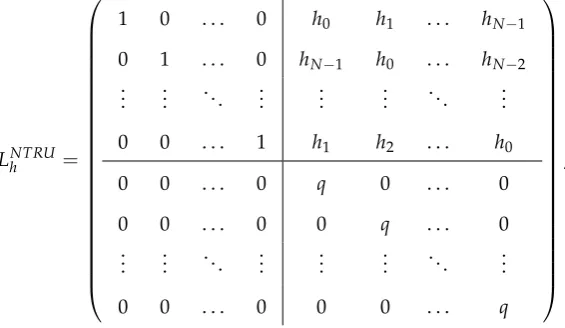
The NTRU lattice basis,LhNTRU, associated with public keyhdefined in (2) is
LNTRUh =
1 0 . . . 0 h0 h1 . . . hN−1
0 1 . . . 0 hN−1 h0 . . . hN−2
..
. ... . .. ... ... ... . .. ...
0 0 . . . 1 h1 h2 . . . h0
0 0 . . . 0 q 0 . . . 0
0 0 . . . 0 0 q . . . 0
..
. ... . .. ... ... ... . .. ...
0 0 . . . 0 0 0 . . . q
,
whereh0, ...,hN−1are coefficients of the polynomialh. For convenience, matrixLNTRUh is abbreviated
as
LNTRUh = I h
0 qI
!
.
NTRU private key recovery problem can be formulated as SVP in 2N-dimensional lattice,LhNTRU. Actually, if a polynomial,b, of degreeN−1 with integer coefficients satisfying
exists, then
(f,b)·LNTRUh = (f,g).
So, the vector(f,g)is in the latticeLhNTRU. Vector(f,g)or its rotation1can be found if it is the shortest vector in LNTRUh . Lattice reduction algorithm LLL [51] finds the shortest vector in LhNTRU in time exponential inN. According to [40], LLL takes 1.05×1031MIPS2-years to find the shortest vector or its rotation forN= 400 (as in (55)) that most likely is the NTRU private key part,(f,g).
Contrary to NTRU, RCPKC is resistant to LBRA since GLR attack fails for it (see Section 5). LBRA is one of the most used and effective techniques in attacking an NTRU private key (e.g., it is used in the Hybrid lattice attack, the most efficient on practical NTRU parameters [58], see Section6.2), but it is not applicable to RCPKC.
6.4. Multiple Transmission Attack (MTA)
MTA reveals large part of an NTRU message by sendingntimes one and the same message,m, using the same public key,h, but different random values,ri. For NTRU encryption (12) (see Section
3.1) is
ei=ri·h+mmodq fori=1, 2, ...,n. An adversary computes
(ei−e1)·h−1modq,
thereby recoveringri−r1modq,i =1, ...,n, and from these relations, many coefficients ofr1may be revealed. Knowledge ofr1allows disclosing the message,m. RCPKC is not susceptible to MTA
because no special structure is assumed forr1contrary to the case of NTRU (see (3)). 6.5. Chosen Ciphertext Attack
Three chosen ciphertext attacks (CCA) on NTRU are known. The first key recovering CCA described in [54] uses a ciphertext of a special shape which can be countered by message padding [53]. Standardized parameters [53] allow decryption failure, i.e., a ciphertext could fail to be decrypted correctly by NTRU. In [55], a CCA is presented where an attacker collects a large number of decryption failures. Another CCA is presented in [56] which is more efficient than [55] but still depends on decryption failures. RCPKC works on non-structured integers, and parameters, set in Section 5, guarantee correct decryption. Thus, neither of CCAs described above is applicable to RCPKC.
7. RCPKC One-Way Function and Semantic Security
7.1. RCPKC One-Way Function, Problem, and Assumption
Definition 1. Negligible function [59, p. 56]. A function v: N →Ris negligible if for every integer c≥0 there exists an integer kcsuch that for all k>kc,
|v(k)|< 1 kc.
Definition 2. Polynomial-time algorithm [60]. A polynomial-time algorithm, A, is one whose running time grows as a polynomial function of the input size.
1 Rotation of a polynomial,f, byisteps isxi·f∈R
Definition 3. Probabilistic algorithm [59, p. 54]. A probabilistic algorithm is algorithm having access to a source of random bits and, thus, it can make random choices.
Definition 4. Probabilistic polynomial-time [36, p. 3]. Probabilistic polynomial-time (PPT) adversary is an adversary that runs a PPT algorithm to attack a cipher.
In this section, we prove the security of RCPKC one-way function based on the discussions of security of NTRU one-way function in [36]. According to Section5.2and Section5.4, RCPKC defines the following four spaces:
• Df = [α·2qLen/2, 2qLen−mgLen−1): private key space, an interval from which a private key, f, is
selected;
• Dg= [2mgLen−1, 2mgLen): private key space, an interval from which a private key,g, is selected;
• Dm = [0, 2mgLen−1): RCPKC plaintext space, an interval from which a plaintext,m, is selected;
• Dr = [max(α·2qLen/2,rmin),rmax]: RCPKC random value space.
RCPKC encryption primitive is specified by the parameter set,P= (q,Df,Dg,Dm,Dr). The one-way
(OW) function underlying RCPKC is:
Fh:Dm× Dr →Zq,
Fh(m,r) =r·h+mmodq.
Definition 5. RCPKC-OW Problem. For a parameter set,P, we denote by SuccOWRCPKC(A,P), the success probability of a PPT adversary,A, for finding a pre-image of Fh,
SuccOWRCPKC(A,P) =Pr (m
0,r0)← A(e,h) s.t.Fh(m0,r0) =e
!
.
Assumption 1. RCPKC-OW Assumption. For every PPT adversary,A, solving the RCPKC-OW problem, there exists a negligible function, vA(k), such that for sufficiently large k, we have
SuccOWRCPKC(A,P)≤vA(k).
7.2. Security of the RCPKC-OW Function
An adversaryA1can compromise(m,r)by pickingr0 ∈ Dr, substituting it in(e−r0·h)modq,
and checking, if the result is inDm. Thus,SuccOWRCPKC(A1,P)is
SuccOWRCPKC(A1,P) = 2
mgLen
2qLen .
Since, qLen > mgLen by definition (40), SuccRCPKCOW (A1,P) decreases exponentially inqLen, and
Assumption 1 holds. Similarly, the attacker can try the following methods with exponentially decreasing success probability:
1. Adversary,A2, chooses randomly a pair(r0∈ Dr,m0∈ Dm), and checks ifr0·h+m0modq=e.
2. Adversary,A3picks f0 ∈ Df, substitutes it in f0·hmodq, and checks whether the result is in Dg.
3. Adversary,A4, chooses randomly a pair(f0 ∈ Df,g0∈ Dg), if possible, calculatesh0, decryptse
to(r0,m0), and checks, ifr0·h0+m0modq=e.
4. Also, adversary can apply GLR attack to get(f,g). However, by construction, RCPKC is immune to that attack, and, hence, the success probability is zero.
7.3. RCPKC Semantic Security
In this section, we prove the indistinguishability against chosen plaintext attack (IND-CPA), i.e. semantic security of the RCPKC. The semantic, IND-CPA, security for RCPKC is considered based on the discussions of semantic IND-CPA security for NTRU [7] and results of [38].
Definition 6. Public-Key CPA Indistinguishability Experiment [38, p. 24]. LetE be a public key encryption algorithm, A a PPT adversary. A public-key CPA indistinguishability experiment, EXPI NDA,E −CPA(k), is formalized as follows:
1. The user generates public and secret keys; public key is sent toA.
2. Aoutputs two distinct valid messages m0and m1, and sends the both to the user.
3. The user randomly chooses a bit, b∈ {0, 1}, and encrypts byEmessage mb, getting a cipher, c. Then, the
cipher, c, is sent toA. 4. Aoutputs b0as a guess on b.
The output of the experiment is 1 if b0 =b, and 0, otherwise.
Definition 7. IND-CPA security, Semantic security [38, p. 24]. A public-key encryption scheme, E, is IND-CPA secure if, for every PPT adversary,A, there exists a negligible function, vA(k), where k is a security
parameter, such that
Pr(EXPI NDA,E −CPA(k) =1)≤ 1
2+va(k).
It can be shown that breaking RCPKC IND-CPA security as it is done for NTRU [42, p. 3] is not possible becausehis noninvertible due to (37), (54). Hence, we introduce Assumption 2.
Assumption 2. RCPKC is IND-CPA secure.
Let us show that Assumptions1,2are equivalent. In the next discussions (definitions, theorems, proofs), we follow [38] with necessary changes.
Definition 8. RCPKC Ciphertext Distribution Problem. Given the RCPKC public key, h, the RCPKC ciphertext distribution problem is to distinguish the following distributions: PDUN I = {s←RZq}and PDRCPKC =
{s=h·rmodq|r←RDr}, where←Rdenotes random sampling from the respective domain.
Theorem 1. RCPKC ciphertext distribution problem is equivalent to RCPKC-OW problem. Proof. It consists of two parts considered below.
Part 1.If RCPKC ciphertext distribution problem can be solved, then adversary can solve RCPKC-OW problem.
Proof of Part 1.Let an adversary has a ciphertext,c=h·r+mmodq, of the plaintextm∈ Dm. It is
necessary disclosing(r,m). Seti=0,cl0=0,cu0=2mgLen.
Binary search step. Setδi = cli+2cui,c+ = c+δimodq, andc− =c−δimodq. Let the RCPKC
ciphertext distribution solver returns 1, if its input is fromPDRCPKC, and 0, if its input is fromPDUN I.
For(c+,c−)used as the input to the solver, it can returnOutput= (a,s)∈(0, 1)2, whereais the result
of classification ofc+, andsis the result of classification ofc−. Note that by the RCPKC definition,c+ is the ciphertext of the valid plaintext,m+δi, ifm+δi ∈ Dm, and not a valid ciphertext, otherwise.
Similarly,c−is the ciphertext of the valid plaintext,m−δi, ifm−δi∈ Dm, and not a valid ciphertext,
otherwise.
TheOutput= (0, 0)is not possible sincem∈ Dm, and, hence, either the sum, or the difference
shall be fromDm, and, hence, respective ciphertext shall be recognized as belonging toPDRCPKC. Thus,
IfOutput = (0, 1), then m ∈ [cli+1,cui+1), which is[2mgLen−1, 2mgLen) fori = 0. Actually, if
Output= (0, 1), subtraction ofδiresults in encryption of a number fromDm, and, hence, the second
ciphertext is considered as correct, but not the first one, for which the sum is out ofDm.
IfOutput= (1, 0), thenm∈[cli+1,cui+1) = [cli,cui−δi), which, in the casei=0, is[0, 2mgLen−1).
Actually, ifOutput= (1, 0), addition ofδiresults in encryption of a number fromDm, and, hence, the
first ciphertext is considered as correct, but not the second one, for which the difference is out ofDm.
TheOutput= (1, 1)is not possible sincem∈ Dm, and, hence, either the sum, or the difference
shall be not inDm, and, thus, respective ciphertext shall be recognized as not belonging toPDRCPKC.
Thus, we have a contradiction, meaning that classification fails, and it shall be repeated. Because the solver is assumed having sufficient advantage, this variant is not expected happening often.
In the result of the experiment described above, the uncertainty of the plaintext is twice decreased: we know, in which part ofDm, junior or senior,mresides. Continuing the process by settingi=i+1,
and repeating the Binary search step, we come to the exactmvalue in at mostmgLensteps.
Part 2.If RCPKC-OW problem can be solved, then the RCPKC ciphertext distribution problem can be solved.
Proof of Part 2.Letsis given, and it is necessary deciding, whether it is fromPDUN I, orPDRCPKC.
Considerc=s+mmodq, wherem∈ Dm, and ask the adversary to solve RCPKC-OW. Ifris fromDr,
thensis fromPDRCPKC, otherwise, fromPDUN I.
Theorem 2. An adversary A can break the semantic security of RCPKC if and only if he can solve RCPKC distribution problem.
Proof. It consists of two parts considered below.
Part 1.An adversaryAcan break the semantic security of RCPKC if he can solve RCPKC distribution problem.
Proof of Part 1.AdversaryA, generates two messagesm0andm1fromDmsuch thatm0−m1∈ D/ m,
and sends both of them to challenger, B. Challenger,B, randomly choosesb = 0 or 1, encrypts mb∈ Dm, by RCPKC to obtain ciphertextc=r·h+mbmodq, and sendscto adversary,A. Having
c = r·h+mbmodq,Afindst = c−m0modq, which isr·hmodq∈ PDRCPKC, ifb =0. On the
other hand,t =c−m0modq= r·h+m1−m0 ∈ PDUN I, ifb=1. sincem0−m1∈ D/ m. Hence, if
the result is fromPDRCPKC, thencis the cipher ofm0, otherwise, ofm1, and the semantic security is
broken.
Part 2. If an adversary, A, can break the semantic security of RCPKC, then he can solve RCPKC distribution problem.
Proof of Part 2. Assume that the adversary,A, can break the semantic security with an advantage greater thanewithin a polynomial time. It means that, given two distinctm0andm1fromDm, and a
challenge ciphertextc=r·h+mb modq, the adversary can succeed in guessing which message is
encrypted with a probability at least 12+e. Now, we use the adversaryAas an oracle to derive an
algorithmB, which solves the RCPKC distribution problem with an advantage greater thaneand
within a polynomial time. The input of the algorithmBiss∈Zq. The algorithmBoutputs 0 or 1. By 0
(1, respectively), we denote the fact that the algorithmBdecides thatscomes from the distribution PDUN I(PDRCPKC, respectively). We construct the algorithmBas follows. Firstly,Bruns the algorithm
Ato output two plaintextsm0andm1fromDm chosen by the adversaryA. Then the algorithmB
randomly choosesb = 0 or 1, and computesc = s+mbmodq. Then the algorithmB feeds the
challenge ciphertextcinto the adversary,A, andAoutputs a valuedas the guess of the algorithm Aon the algorithmB’s choice ofb. Ifd =b, the algorithmBoutputs 1; otherwise, the algorithmB outputs 0. Now we compute the probability for the algorithmBto succeed in distinguishing both distributionsPDUN IandPDRCPKC. Ifscomes from the random distributionPDUN I, we compute the
probability Pr(0)for the algorithmBto succeed in deciding thatscomes from the distributionPDUN I,
B, the probability is exactly the probability thatd 6=b. In other words, the probability Pr(0)should be the failure probability for the algorithmAto guessb. Noting thatsis uniformly distributed over PDUN I, we conclude thatc=s+mbmodqis also uniformly distributed overPDUN I, and hence is
independent of the choice ofb. Hence, the probability for the adversaryAto succeed in guessing the value ofbis exactly 12. So, the failure probability for the algorithmAin guessingbis also exactly 12. So, we conclude that Pr(0) =12.
Consider now the case thatscomes fromPDRCPKC. The probability, Pr(1), for the algorithmB
to succeed in deciding thatscomes fromPDRCPKC, is the probability for the algorithmBto output 1.
That is, Pr(1), should be the probability for the algorithmAto succeed in obtaining the right value ofb(the probability ford=b). Recalling thatscomes fromPDRCPKC, we conclude that there must
existr∈ Dr, such thats=r·hmodqis fromPDRCPKC. Soc=s+mbmodqis a valid ciphertext of
mb. So the adversaryAguesses the exact valuebwith a success probability greater than12+e, thus,
Pr(1)≥ 1
2+e. So the advantage of the algorithmBin successfully distinguishing the distributions
PDUN IandPDRCPKCis|Pr(1)−Pr(0)| ≥e. The algorithmBonly performs once the oracleAand
makes additions+mbmodq, taking polynomial time.
From Theorems 1, 2 immediately follows
Theorem 3. RCPKC is IND-CPA secure if and only if Assumption 2 holds. 8. RCPKC Performance and Power Consumption Evaluation
8.1. RCPKC Performance Evaluation
Experiments were conducted using NTRU code [61], and RCPKC implementation in C99 language similar to [61] with NTL library [62] on a PC equipped with 2 GHz Intel Pentium Dual CPU E2180, 3 GB RAM, and Windows 10. Both NTRU code [61] and the proposed RCPKC are implemented in Visual Studio 2017. NTRU parameters (55) and RCPKC parameters (56) are used. CPU encryption and decryption time of RCPKC and NTRU is measured for 103, 104, 105, and 106runs (see Figures
3 3.5 4 4.5 5 5.5 6 log
10 (Number of runs)
-5.5 -5 -4.5 -4 -3.5 -3 log 10 (Encryption time) (a)
3 3.5 4 4.5 5 5.5 6
log
10(Number of runs)
-5.5 -5 -4.5 -4 -3.5 -3 log 10 (Decryption time) (b)
Figure 5.CPU encryption (a) and decryption (b) time of RCPKC (blue) and NTRU (red) for 103, 104, 105, and 106runs with respective averages.
23.34 7.50 7.00 No Published Data 2.50 2.50 1.45 1.72 Encryption Decryption 0 5 10 15 20 25
NTRU/Algorithm time ratio
RCPKC BQTRU MaTRU ETRU
Figure 6.NTRU versus RCPKC, BQTRU, MaTRU, and ETRU encryption and decryption time ratio.
8.2. RCPKC Power Consumption Evaluation
In this section, RCPKC power consumption is compared to NTRU in two cases: applying both algorithms using same, or different frequencies.
Same frequencies. Let RCPKC and NTRU execution time beTRCPKC, andTNTRU, respectively.
Then, from (20), the consumed energy by NTRU and RCPKCENTRUandERCPKCis:
ENTRU =P·TNTRU,
ERCPKC=P·TRCPKC. (63)
And, sinceTNTRUis greater thanTRCPKCby more than 7 times, then, from (63):
ENTRU
ERCPKC
= TNTRU
TRCPKC
≥7. (64)
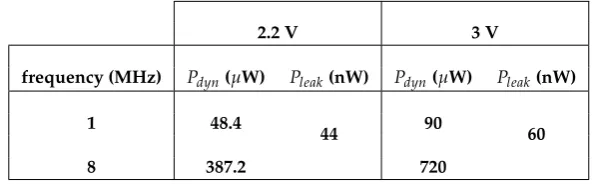
Table 2.MSP430FR5969 microcontroller dynamic and leakage power consumption,Pdyn, andPleakfor
frequencies from [48, p. 19] at active supply voltages 3 and 2.2 V.
2.2 V 3 V
frequency (MHz) Pdyn(µW) Pleak(nW) Pdyn(µW) Pleak(nW)
1 48.4
44 90 60
8 387.2 720
It follows from Table 2 thatPleak <<Pdyn, and can be neglected. From Table2, it follows that
reducing clock frequency from 8 to 1 MHz (81 = 8 times) leads to eight times power consumption reduction from 720 to 90µW. Note that MSP430FR5969, in lower frequency, operates at lower voltage:
operating on 1 MHz frequency at 2.2 V [48, p. 19] results in 48.4µW dynamic power consumption.
Hence, the total power reduction is48.4720 ≈15 times.
Therefore, RCPKC, compared to NTRU, is better applicable to WSN with power constrained devices.
9. Conclusion
In this paper, RCPKC is proposed, a secure and effective congruential, moduloq, public-key cryptosystem using big numbers. It uses the same encryption/decryption mechanism as NTRU does but works with numbers. Contrary to NTRU, RCPKC is resistant to the LBRA because its private key components,f,g, are chosen big with respect to√qto form a two-component vector with the norm exceeding the Minkowski’s boundary (29)-(32) for the shortest vector in a two-dimensional lattice and meeting (33). Hence, LBRA by GLR algorithm returning the shortest vector in a two-dimensional lattice fails finding the large-norm private key vector,(f,g).
In spite of the big numbers,f,r, meeting (38) used in RCPKC, it guarantees decryption correctness condition (14) holding (see (41)) due to the use of conditions (35), (38), (40), (48), (52) instead of the conditions (6), (10), (11), used in the original insecure CPKC (see Sections3.2-3.2.2) considered in [24]. It was found that insecurity of the original CPKC stems from the use of the conditions (6), (10), (11), defining smaller than√qnumbers f,g,m,rmeeting Minkowski’s boundary (29) and decryption correctness condition (14). RCPKC is resistant to LBRA by GLR attack due to the the special choice of the range for the random value,r, used in encryption (12) that guarantees correctness condition (14) violation for the short vectors returned by GLR but its holding for the original private key,(f,g). Section6shows also that security of RCPKC with respect to other known attacks on NTRU is not less than that of NTRU that allows us concluding that RCPKC is more secure than NTRU. Section7proves RCPKC IND-CPA security under the assumption of hardness of its OW function.
RCPKC uses numbers, i.e. minimal possible, degree zero, polynomials, that makes it about 24 (7) times more effective in encryption (decryption) than NTRU, and more than three times more effective in encryption with respect to the fastest most recent published NTRU variant, BQTRU [19], as experiments show (see Figures5,6). Compared to NTRU, RCPKC reduces energy consumption at least seven times that allows increasing life-time of unattended WSN more than seven times.
As a future work, the proposed RCPKC will be applied to telemedicine to secure the data collected by medical sensors and cameras.
Author Contributions:Conceptualization, A.I. and A.C.; Funding acquisition, J.R.; Investigation, A I. and A.C.; Methodology, A.I., A. C. and N.H.; Software, J.R.; Validation, A.K.; Visualization, Y.D.; Writing – review & editing, Y.D., A.K. and Joel J.R.
funds under the Project UIDB/EEA/50008/2020; and by Brazilian National Council for Research and Development (CNPq) via Grant No. 309335/2017-5. We thank anonymous reviewers for useful comments.
Conflicts of Interest:The authors declare no conflict of interest. The funders had no role in the design of the study; in the collection, analysis, or interpretation of data; in the writing of the manuscript, or in the decision to publish the results.
References
1. Yick, J.; Mukherjee, B.; Ghosal, D. Wireless Sensor Network Survey. Comput. Netw.2008,52, 2292–2330. doi:10.1016/j.comnet.2008.04.002.
2. Akyildiz, I.F.; Melodia, T.; Chowdhury, K.R. A survey on wireless multimedia sensor networks. Comput. Networks2007,51, 921–960. doi:10.1016/j.comnet.2006.10.002.
3. Gungor, V.C.; Lu, B.; Hancke, G.P. Opportunities and Challenges of Wireless Sensor Networks in Smart Grid. IEEE Trans. Industrial Electronics2010,57, 3557–3564. doi:10.1109/TIE.2009.2039455.
4. Li, M.; Lou, W.; Ren, K. Data security and privacy in wireless body area networks.IEEE Wirel. Commun.
2010,17, 51–58. doi:10.1109/MWC.2010.5416350.
5. He, D.; Kumar, N.; Chilamkurti, N.K. A secure temporal-credential-based mutual authentication and key agreement scheme with pseudo identity for wireless sensor networks. Inf. Sci. 2015,321, 263–277. doi:10.1016/j.ins.2015.02.010.
6. Feng, D.; Jiang, C.; Lim, G.; Jr., L.J.C.; Feng, G.; Li, G.Y. A Survey of Energy-Efficient Wireless Communications. IEEE Communications Surveys and Tutorials 2013, 15, 167–178. doi:10.1109/SURV.2012.020212.00049.
7. Hoffstein, J.; Pipher, J.; Silverman, J.H. NTRU: A Ring-Based Public Key Cryptosystem. Algorithmic Number Theory, Third International Symposium, ANTS-III, Portland, Oregon, USA, June 21-25, 1998, Proceedings; Buhler, J., Ed. Springer, 1998, Vol. 1423,Lecture Notes in Computer Science, pp. 267–288. doi:10.1007/BFb0054868.
8. Hermans, J.; Vercauteren, F.; Preneel, B. Speed Records for NTRU. Topics in Cryptology - CT-RSA 2010, The Cryptographers’ Track at the RSA Conference 2010, San Francisco, CA, USA, March 1-5, 2010. Proceedings; Pieprzyk, J., Ed. Springer, 2010, Vol. 5985,Lecture Notes in Computer Science, pp. 73–88. doi:10.1007/978-3-642-11925-5_6.
9. Kaur, I.; Kour, H.; Verma, A. Ticket based Secure Authentication Scheme using NTRU Cryptosystem in Wireless Sensor Network. International Journal of Computer Science and Information Security2017,15, 55. 10. Boorghany, A.; Sarmadi, S.B.; Jalili, R. On Constrained Implementation of Lattice-Based Cryptographic
Primitives and Schemes on Smart Cards. ACM Trans. Embed. Comput. Syst. 2015, 14, 42:1–42:25. doi:10.1145/2700078.
11. Behrens, G.; Weicht, J.; Schlender, K.; Fehring, F.; Dreimann, R.; Meese, M.; Hamelmann, F.; Thiel, C.; Försterling, T.; Wübbenhorst, M. Smart Monitoring System of Air Quality and Wall Humidity Accompanying an Energy Efficient Renovation Process of Apartment Buildings. From Science to Society; Otjacques, B.; Hitzelberger, P.; Naumann, S.; Wohlgemuth, V., Eds.; Springer: Cham, 2018; pp. 181–189. 12. Malla, A.; Sahu, P.; Mishra, M. A Novel Encryption Scheme for Secure SMS Communication. Advances in
Electronics, Communication and Computing; Kalam, A.; Das, S.; Sharma, K., Eds.; Springer: Singapore, 2018; pp. 467–478. doi:https://doi.org/10.1007/978-981-10-4765-7_50.
13. Jun, J.; Chen, H. A novel mutual authentication and key agreement protocol based on NTRU cryptography for wireless communications. Journal of Zhejiang University-SCIENCE A2005,6, 399–404. doi:10.1007/BF02839407.
14. Bailey, D.V.; Coffin, D.; Elbirt, A.J.; Silverman, J.H.; Woodbury, A.D. NTRU in Constrained Devices. Cryptographic Hardware and Embedded Systems - CHES 2001, Third International Workshop, Paris, France, May 14-16, 2001, Proceedings; Koç, Ç.K.; Naccache, D.; Paar, C., Eds. Springer, 2001, Vol. 2162,
Lecture Notes in Computer Science, pp. 262–272. doi:10.1007/3-540-44709-1_22.
16. Kamal, A.A.; Youssef, A.M. Strengthening hardware implementations of NTRUEncrypt against fault analysis attacks. Journal of Cryptographic Engineering2013,3, 227–240. doi:10.1007/s13389-013-0061-7. 17. Sedenion. https://en.wikipedia.org/wiki/Sedenion, Last Accessed 29/01/2020.
18. Alsaidi, N.M.; Yassein, H.R. BITRU: Binary Version of the NTRU Public Key Cryptosystem via Binary Algebra.International Journal of Advanced Computer Science and Applications2016,7, 1–6.
19. Bagheri, K.; Sadeghi, M.R.; Panario, D. A non-commutative cryptosystem based on quaternion algebras. Designs, Codes and Cryptography 2017. published online https://link.springer.com/journal/10623/onlineFirst/page/1, doi:10.1007/s10623-017-0451-4.
20. Banks, W.D.; Shparlinski, I.E. A Variant of NTRU with Non-invertible Polynomials. Progress in Cryptology - INDOCRYPT 2002, Third International Conference on Cryptology in India, Hyderabad, India, December 16-18, 2002; Menezes, A.; Sarkar, P., Eds. Springer, 2002, Vol. 2551,Lecture Notes in Computer Science, pp. 62–70. doi:10.1007/3-540-36231-2_6.
21. Coglianese, M.; Goi, B. MaTRU: A New NTRU-Based Cryptosystem. Progress in Cryptology - INDOCRYPT 2005, 6th International Conference on Cryptology in India, Bangalore, India, December 10-12, 2005, Proceedings; Maitra, S.; Madhavan, C.E.V.; Venkatesan, R., Eds. Springer, 2005, Vol. 3797,Lecture Notes in Computer Science, pp. 232–243. doi:10.1007/11596219_19.
22. Gaborit, P.; Ohler, J.; Solé, P. CTRU, a polynomial analogue of NTRU. PhD thesis, INRIA, 2002.
23. Gaithuru, J.N.; Salleh, M. ITRU: NTRU-Based Cryptosystem Using Ring of Integers. International Journal of Innovative Computing2017,7, 33–38.
24. Hoffstein, J.; Pipher, J.; Silverman, J.H.An Introduction to Mathematical Cryptography; Springer: New York, 2014; pp. 373–376. doi:10.1007/978-1-4939-1711-2\_7.
25. Jarvis, K.; Nevins, M. ETRU: NTRU over the Eisenstein integers. Designs, Codes and Cryptography2015,
74, 219–242. doi:10.1007/s10623-013-9850-3.
26. Karbasi, A.H.; Atani, R.E. ILTRU: An NTRU-Like Public Key Cryptosystem Over Ideal Lattices. IACR Cryptology ePrint Archive2015,2015, 549.
27. Malekian, E.; Zakerolhosseini, A. OTRU: A non-associative and high speed public key cryptosystem. Computer Architecture and Digital Systems (CADS), 2010 15th CSI International Symposium on. IEEE, 2010, pp. 83–90.
28. Malekian, E.; Zakerolhosseini, A.; Mashatan, A. QTRU: quaternionic version of the NTRU public-key cryptosystems. The ISC International Journal of Information Security2011,3, 29–42.
29. Thakur, K.; Tripathi, B. STRU: A Non Alternative and Multidimensional Public Key Cryptosystem. Global Journal of Pure and Applied Mathematics2017,13, 1447–1464.
30. Thakur, K.; Tripathi, B.P. BTRU, A Rational Polynomial Analogue of NTRU Cryptosystem. International Journal of Computer Applications2016,145, 22–24. doi:10.5120/ijca2016910769.
31. Vats, N. NNRU, a noncommutative analogue of NTRU.arXiv preprint arXiv:0902.18912009.
32. Yassein, H.R.; Al-Saidi, N.M. HXDTRU Cryptosystem Based On Hexadecnion Algebra. Proceeding of the 5th International Cryptology and Information Security Conference, Kota Kinabalu, Malaysia, May 31 - Jun 02, 2016, 2016.
33. Yu, Y.; Xu, G.; Wang, X. Provably Secure NTRU Instances over Prime Cyclotomic Rings. Public-Key Cryptography - PKC 2017 - 20th IACR International Conference on Practice and Theory in Public-Key Cryptography, Amsterdam, The Netherlands, March 28-31, 2017, Proceedings, Part I; Fehr, S., Ed. Springer, 2017, Vol. 10174,Lecture Notes in Computer Science, pp. 409–434. doi:10.1007/978-3-662-54365-8_17. 34. Stehlé, D.; Steinfeld, R. Making NTRUEncrypt and NTRUSign as Secure as Standard Worst-Case Problems
over Ideal Lattices. IACR Cryptol. ePrint Arch.2013,2013, 4.
35. Seck, M.; Sow, D. BI-NTRU Encryption Schemes: Two New Secure Variants of NTRU. Algebra, Codes and Cryptology; Gueye, C.T.; Persichetti, E.; Cayrel, P.L.; Buchmann, J., Eds.; Springer International Publishing: Cham, 2019; pp. 216–235.
36. Howgrave-Graham, N.; Silverman, J.H.; Whyte, W. Choosing Parameter Sets for NTRUEncrypt with NAEP and SVES-3. IACR Cryptol. ePrint Arch.2005,2005, 45.
37. Howgrave-Graham, N.; Silverman, J.H.; Singer, A.; Whyte, W. NAEP: Provable Security in the Presence of Decryption Failures. IACR Cryptol. ePrint Arch.2003,2003, 172.