Hadron physics at the COMPASS experiment
Fabian Krinner, on behalf of the COMPASS Collaboration1,a 1Technische Universität München, Physik-Department, E18
Abstract.Quantum Chromodynamics (QCD), the theory of strong interactions, in princi-ple describes the interaction of quark and gluon fields. However, due to the self-coupling of the gluons, quarks and gluons are confined into hadrons and cannot exist as free parti-cles. The quantitative understanding of this confinement phenomenon, which is responsi-ble for about 98% of the mass of the visiresponsi-ble universe, is one of the major open questions in particle physics. The measurement of the excitation spectrum of hadrons and of their properties gives valuable input to theory and phenomenology.
In the Constituent Quark Model (CQM) two types of hadrons exist: mesons, made out of a quark and an antiquark, and baryons, which consist of three quarks. But more advanced QCD-inspired models and Lattice QCD calculations predict the existence of hadrons with exotic properties interpreted as excited glue (hybrids) or even pure gluonic bound states (glueballs).
The Compassexperiment at the CERN Super Proton Synchrotron has acquired large data sets, which allow to study light-quark meson and baryon spectra in unprecedented detail. The presented overview of the first results from this data set focuses in particular on the light meson sector and presents a detailed analysis of three-pion final states. A new JPC = 1++ state, thea1(1420), is observed with a mass and width in the rangesm = 1412−1422 MeV/c2andΓ =130−150 MeV/c2.
1 The C
ompass
experiment
The Compassexperiment is a multi-purpose fixed-target spectrometer located at CERN’s Prevessin-area. It is supplied with secondary hadron and tertiary muon beams by the Super Proton Synchrotron. Compassis a two-stage spectrometer that covers a wide kinematic range and employs beam and final-state particle identification using Cherenkov-detectors (CEDARs and RICH, respectively). The wide physics program includes studies of the nucleon spin-structure, as well as hadron spectroscopy. The latter is presented here.
The presented analysis is performed on data taken in 2008, where a 190 GeV/cnegative secondary hadron beam, consisting mainly ofπ−(97%) with some admixture of negative kaons (2%) and an-tiprotons (1%), impinged on a 40 cm liquid-hydrogen target.
The analysis described here was performed on two different three pion final-states, namelyπ−p → π−π0π0pandπ−p→π−π+π−p. For these final states, 3.5 million events were recorded in the neutral channel,π−π0π0, and 50 million in the charged channel,π−π+π−. The latter constitutes at the moment the world’s largest 3πdata set.
ae-mail: [email protected]
DOI: 10.1051/
C
Owned by the authors, published by EDP Sciences, 2015
/201
) 2 c System (GeV/
−
π
+
π
−
π Mass of
0.6 0.8 1 1.2 1.4 1.6 1.8 2 2.2 2.4
)
2c
Number of Events / (5 MeV/
0 0.05 0.1 0.15 0.2 0.25 0.3 0.35
6 10
× π−p→π−π+π− p (COMPASS 2008)
y
Preliminary
P
y
y
relimin
relimin
P
P
P
P
P
P
P
P
5
5
.1
.1
Figure 1. Mass spectrum of theπ−π+π− fi-nal state.
) 2 (GeV/c
0
π
0
π
-π
m
0 0.5 1 1.5 2 2.5 3 3.5 4 4.5 5
)
2
events (per 10 MeV/c
0 10 20 30 40 50 60 70 80
3 10 ×
COMPASS 2008 p 0 π 0 π -π → p -π
2 /c 2 0.1 < t' < 1.0 GeV
Preliminary
(1260)
1
a
(1320)
2
a
(1670)
2
π
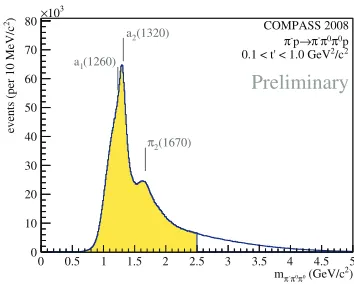
Figure 2.Mass spectrum of theπ−π0π0final state. The
main structures are labeled by the corresponding reso-nances described in sec. 3.1.
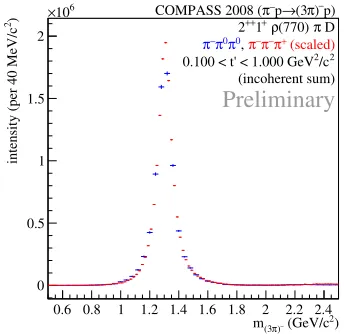
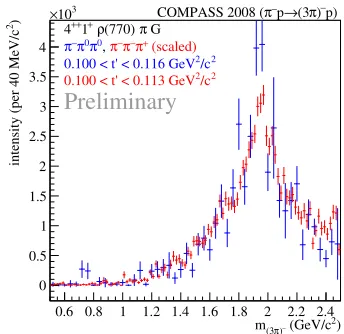
The anlyses of both channels were performed independently, using different software packages. Since the reconstruction of the two channels also relies on different parts of the spectrometer, the systematic uncertainties differ. Nevertheless, since both final states only vary in their decay modes, both data sets are expected to contain the same resonant structures.
2 Partial-wave analysis
For the following studies, a Partial-Wave Analysis (PWA) was performed on diffractively produced three-pion final states. In this process, the incoming beam pion gets excited via Pomeron exchange with the target proton into an intermediate stateX−, which then decays into the final state.
The intermediate stateX− is characterized by the quantum numbers JPCM of X−, where J is the
spin,PandCthe eigenvalues of parity and generalized charge conjugation,Mthe magnetic quantum number andthe reflectivity ofX−.
These quantum numbers are not known a priori and there are many different values they can take. Since inital and final state are always identical all these different possibilities may interfere with each other.
The main goal of the analysis is to disentangle the contributions of all these intermediate states, which is achieved via PWA.
2.1 The isobar-model