O R I G I N A L R E S E A R C H
Effects of multidisciplinary Internet-based
program on management of heart failure
Machiko R Tomita1
Bin-Min Tsai2
Nadine M Fisher1
Neeraj A Kumar1
Greg Wilding3
Kathy Stanton1
Bruce J Naughton4
1Department of Rehabilitation Science, University at Buffalo, Buffalo, New York, USA; 2Department of Occupational Therapy, I-Shou University, Taiwan; 3Department of Biostatistics, University at Buffalo, Buffalo, New York, USA; 4Department of Medicine, University at Buffalo, Buffalo, New York, USA
Correspondence: Machiko R Tomita 515 Kimball Tower, UB, 3435 Main Street, Buffalo, NY 14214, USA
Tel +1 716 829 6740 Fax +1 716 829 3217 Email [email protected]
Objectives: To develop and test the effectiveness of an Internet-based self management program by multidisciplinary health care professionals for patients with heart failure (HF).
Methods: The comprehensive educational material for HF was created and posted on a website. A computer with Internet connection and computer training were provided fi rst. A secure and simple web-based recording system of vital signs and health behaviors and a mechanism for feedback regarding each participant’s record were developed. A randomized controlled trial with a one-year intervention was conducted using a total of 40 patients who were assessed three times in their homes. An intention-to-treat analysis used multivariate statistics.
Results: The treatment group had a high (85%) adherence to the intervention. Only the
treatment group showed a signifi cant improvement in the knowledge level (p 0.001), amount
of exercise (p = 0.001), and quality of life (p = 0.001), and reduction in HF related symptoms
(dyspnea, p = 0.001; fatigue, p = 0.003; functional emotion, p 0.001), blood pressure
(systolic, p = 0.002; diastolic, p 0.001), frequency of emergency room visit, and length of
hospital stay (both p = 0.001).
Conclusions: An effective program to change one’s behaviors in managing HF takes a multidisciplinary approach to create and provide feedback regarding a patient’s daily record, which can be accomplished through Internet use.
Keywords: e-health, self-management, Internet, heart failure, older adults, exercise
Introduction
Heart failure (HF), or congestive heart failure, is a debilitating illness affecting about fi ve million Americans, with 550,000 new cases diagnosed each year.1 Approximately
79% of adults with HF are over 65 years of age, with a 30%–40% annual hospital-ization rate.2 This is the most expensive illness among the population 65 years and
over due to recurring emergency room visits and hospitalizations. In 2005, in the US alone, HF-related costs rose to $27.9 billion, a $4.7 billion increase in three years.3
This rise is likely to continue due to the rapid growth in the aging population along with a longer life expectancy. HF is a fi nal common pathway of various illnesses and conditions and is usually chronic without a cure. HF, therefore, is a condition that greatly impacts the individual and society as a whole.
One strategy for slowing decline with chronic HF is to improve daily healthy behaviors including reducing and monitoring salt and fat intake, smoking, and alcohol consumption, committing to regular exercise,1 medication adherence, and
maintaining a positive attitude. This strategy takes a multidisciplinary approach to develop and individualize. Although effective, the obstacles for this intervention have been identifi ed: the high cost and the large amount of effort4 for providers as
well as patients.
In order to overcome these limitations, Internet use has been suggested as a means to change daily health behavior4 by empowering a large number of patients to take
Journal of Multidisciplinary Healthcare downloaded from https://www.dovepress.com/ by 118.70.13.36 on 24-Aug-2020
Tomita et al
more control of their health.5 An early study with HF patients
compared the effi cacy of an interactive voice response system and interactive web-based technologies (e-health group) to change health behavior.6 After one year of intervention,
exercise and general activities were similar for both groups, but the e-health group had lower health care costs. A study using a meta-analysis concluded that Internet-based health interventions can improve behavioral outcomes such as increased exercise time, knowledge of nutritional status, knowledge of asthma treatment, body shape perception, and was also effective in weight loss maintenance.7
Although Internet access is less common among older adults than younger adults, once they use, their use pattern is similar to that of younger adults.8,9 As rapid growth of Internet
use among older adults advances, theoretically, so do both the opportunity and the tools to improve health practices and improve health outcomes while reducing health costs.
A conceptual framework, Model Toward Optimal I n d e p e n d e n c e t h r o u g h T e c h n o l o g i c a l A d o p t i o n (M-TOMITA) was formed for this study based on the Trans-theoretical Model (TTM),10 social support theory,11 and a
mass communication theory called Uses and Gratifi cations.12
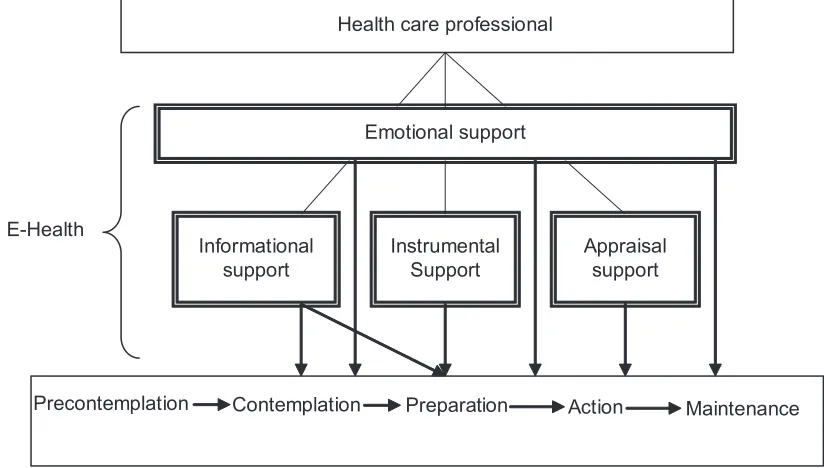
The M-TOMITA works best when individuals are already aware of their chronic conditions and are contemplating doing something to manage their illness but are not sure what to do (the contemplation stage). If someone has little knowledge of their illness and is not aware that changing health behavior may help them, this model may not be effec-tive. The model is an empowerment process that progresses through stages from contemplation, preparation, and action, to maintenance. Using the Internet method, four types of support by health care professionals can be provided. Informational support or education of chronic illness and suggested health behaviors is especially important in the initial stage but should continue all the stages. Among the recommended health behaviors, patients will choose an activity to focus on. Once the fi rst activity is successfully implemented, additional activities will be added, one by one. After the decision regarding a particular health behavior is made, Instrumental support should be provided via the Internet. Through the online record-keeping system the participant can track their own vital signs and health behav-iors so that they can become aware of a cause (life style) and effect (symptom and general health) relationship. The website also provides participants and nurse monitors the record with alerts for critical measures so that health care providers can be notifi ed. This record is shared with their health care providers at offi ce or home visits for the purpose
of monitoring as well as appraisal support to reinforce patient motivation. Internet use, especially in the initial stage, boosts older adults’ self-esteem. They realize their ability to learn something new and feel they are up to date with their children and their grandchildren. The Internet is so versatile; it provides not only opportunities for education, but also for frequent communication with families and friends, leisure through playing games to stimulate and challenge the mind, and can improve instrumental activity of daily living (IADL) by participating in online shopping on drugs, books, and even groceries. Mastering Internet technology, therefore, improves the quality of life of older adults. Throughout this process, emotional support from health care professionals is important to keep the participants motivated until the time that their illness prevents them from using the computer. Its application to Internet use is described in the intervention section of this study, and is illustrated in Figure 1.
The objectives of this study were to develop and test an e-health intervention using a multidisciplinary approach to improve health behavior and outcomes among older adults with HF. Hypotheses in this study are that the treatment group will: (1) adhere to the intervention program at a high rate (75%)13; (2) improve in knowledge of HF and related
healthy behaviors; (3) reduce specifi c HF symptoms and sick days, and improve blood pressure (BP), (4) improve in perceived quality of life; and (5) reduce frequency of emergency room visits and length of hospital stays. Participants’ subjective evaluation of the program was also sought. It included satisfaction/dissatisfaction, reasons for the rating, benefi t, improved or not improved HF, the most liked/disliked part of the method, and suggestions for the program.
Methods
Study design
The study employed a randomized controlled design with a one-year intervention. Three assessments (baseline, and fol-low-ups at six and 12 months) were conducted in participants’ homes. The control group received usual care. Usual care for home-based patients in the US is a three-month regular check up with their physicians. If they are hospitalized, they may have nurse visits, physical or occupational therapists’ home care, and phone calls from their insurance company to report their weight and blood pressure for three months. None of the partisans were receiving nurse visits due to hospitalization. The treatment group received the e-health intervention in addition to usual care, and process measures were collected daily.
Journal of Multidisciplinary Healthcare downloaded from https://www.dovepress.com/ by 118.70.13.36 on 24-Aug-2020
Effects of e-health in patients with heart failure
Subjects
Individuals with HF were recruited from three hospitals and two health insurance companies in Western New York using a convenience sampling method. Inclusion criteria were those who: (1) were living at home and 60 years of age or older; (2) had at least one emergency room visit or overnight hospital admission due to HF in the past year; and (3) met the New York Heart Association (NYHA) Classifi cation of Heart Failure for Class II (Slight limitation of activity or dyspnea and fatigue with moderate physical activity) or Class III (Marked limita-tions of activity or dyspnea with minimal activity).14 Exclusion
criteria were individuals who: (1) were scheduled for any kind of heart surgery and/or (2) had cognitive impairment (Mini Mental State Exam [MMSE] 24).15
The sample size, determined by a power analysis to achieve 80% of power at α1= 0.05 with a large effect size (d = 0.90)16 was 15 in each group. Considering a high attrition
rate anticipated for the control group, 24 in the control group and 16 in the treatment group were recruited. The sample size fl ow-chart is included in Figure 2.
Intervention
TechnologyParticipants in the treatment group were provided a standard PC with Internet access as well as basic computer training. Publicly accessible and secured websites were created by a multidisciplinary health care team of a health behaviorist,
a geriatric physician, a geriatric nurse, an occupational therapist, a physical therapist, and an exercise physiologist. We used the web creation guidelines published by the National Institute on Aging and the National Library of Medicine.17
Four types of support (informational, instrumental, appraisal, and emotional) at suitable stages of behavioral changes were provided in this e-health intervention.
Informational support included online information on: HF, drugs used to treat HF, effects of alcohol and smoking, depression, prescribed home exercise, nutrition, weight management, and exercise in general using the Flesch– Kincaid Reading Grade level of eight on average. An exercise instruction program (walking, breathing, stretching, range of motion, upper and lower extremity strength training, and stationary biking) was developed and delivered via streaming video. This support was provided in the beginning of the intervention period.
Instrumental support included availability of a secure, simple, and short online recording system using Lotus Notes Web Server 6.5. This support was provided after participants became comfortable with the use of a computer and Internet. Participants were asked to access the website daily to record their vital signs and health behaviors. The site asks questions about blood pressure, pulse, weight, medication use, type and amount of exercise, levels of fatigue, intake of salt, sugar, alcohol, and tobacco, health changes, and HF-specifi c questions regarding swelling, Health care professional
Emotional support
Informational support
Instrumental Support
Appraisal support
Precontemplation Preparation Action
E-Health
Contemplation Maintenance
Figure 1 Model toward optimal management of independence through technological adoption.
Journal of Multidisciplinary Healthcare downloaded from https://www.dovepress.com/ by 118.70.13.36 on 24-Aug-2020
Tomita et al
fatigue, and dyspnea. Additionally, a webpage containing their past records with an automatic alerting function for sudden weight gain was available. Any overnight gain of 3 lbs or more resulted in a red dot display in the record that signaled participants to contact their physician.
Appraisal support was provided via email every month from appropriate health care professionals in dealing with subjects for the purpose of feedback for patients’ records. This support was provided to encourage participant’s ongo-ing actions for changongo-ing their health behaviors toward a maintenance stage (beyond six months).
Emotional support was provided on an as needed basis via email. Since no participants were depressed (15 Center of Epidemiological Study- Disease18) at the time of initial
assessment, an online discussion group was not formed.
Dependent variables
A knowledge questionnaire was developed for this study consisting of 20 questions with a possible total score ranging from 0 to 60 (all correct responses). Frequency of exercise was captured on a nominal scale (every day, 2–3 times/week, less than once/week, rarely and none) for breathing exercise, Lost to follow-up (n = 3)
• Moved to assistive living (n = 1) Allocated to control (n = 24)
Lost to follow-up (n = 5)
• Died (n = 2)
• Nursing home placement (n =2)
Allocated to intervention (n = 16) Assessed for eligibility (N = 262)
Enrolled
Randomized (N = 40)
• Died (n = 1)
• Quit: too sick due to CHF (n = 1) • Noncompliant (n = 1)
Excluded (n = 220)
• Family’s refusal to participate
• Refused to participate (n = 20)
• No response (n = 129)
• Not meeting inclusion criteria (n = 69)
Figure 2 Flow chart of sample sizes.
Journal of Multidisciplinary Healthcare downloaded from https://www.dovepress.com/ by 118.70.13.36 on 24-Aug-2020
Effects of e-health in patients with heart failure
stretching, walking, and mild exercise including stationary biking, swimming, and golfi ng.
HF-specifi c symptoms (dyspnea during daily activities, fatigue, and emotional function) were measured using the Con-gestive Heart Failure Questionnaire (CHFQ).19 Higher scores
are indicators of better conditions. The psychometric of CHFQ has been tested. It has good reproducibility for the total score and the three subcategories and responsiveness for change.20
The responsiveness was found to be similar to the Minnesota Living with Heart Failure21 and better then SF 12.22,23
Perceived quality of life (QOL) was assessed using a 50-item age relevant questionnaire on diet, health care, safety, social, communication, psychological health, activities, and perceived aging, with a higher score indicating a higher level of wellness.
Statistical methods
An intention-to-treat analysis was conducted using mostly a multivariate linear model. To explain the observed variability in the data and test for differences within and between groups, the model was fi t to numeric endpoints via restricted maximum likelihood methods, adjusting to the difference for the severity of illness. To analyze health care use, actual data of those whose data were available at follow-up 2, due to nonnormal distributions, Friedman’s Tests for correlated samples were used. A signifi cance level of 0.05 was set for each hypothesis test. SAS version 9.1.3 statistics software (SAS Inc., Cary, NC) was used for all analyses.
Results
Demographic and health information at baseline for 40 participants is summarized in Table 1. The two groups were equivalent for all characteristics. An overall mean age was 76.2 years, 32.5% were males, 2.5% were Asian, 12.5% were African American/Black, and 85.0% were Caucasian. Fifty-eight percent had 12 years of education or less, 36.7% had between 13 and 16 years, and 5.4% had 17 years or more. Mean MMSE score was 29 of 30. The mean number of comorbidity was 10 and medication taken was 8. The control group was comprised of 79.2% of patients with NYNA Level II and 20.8% of Level III while the treatment group had 75% and 25%, respectively. Although statistically not signifi cant, this difference was adjusted in the multivariate linear approach. The control group had 5.1 years of HF while the treatment group, 3.6 years.
Adherence to the program (Hypothesis 1)
All participants in the treatment group visited the publicly available website with a mean frequency of 3.5
Table 1 Baseline demographic and health characteristics (N = 40)
Variable Control Treatment Difference
(n = 24) (n = 16) values Age (years) M = 77.5 M = 74.2 t= 1.240
SD = 7.4 SD = 9.7 p = 0.223 Gender
Male 9 (37.5%) 4 (25.0%) χ2= 0.624
Female 15 (62.5%) 12 (75.0%) p = 0.408 Race
Asian 0 1 (6.3%) χ2= 1.544
African American/Black 3 (12.5%) 2 (12.5%) p = 0.462 Caucasian 21 (87.5%) 13 (81.3%)
Education
12 years 13 (54.2%) 9 (56.3%) χ2= 0.430
13–16 years 8 (33.3%) 6 (37.5%) p = 0.806 17 yeas 3 (12.5%) 1 (6.3%)
Living status
Live alone 9 (37.5%) 8 (50.0%) χ2= 0.614
Live with someone 15 (62.5%) 8 (50.0%) p = 0.433 Income
$10,000 4 (16.7%) 4 (25.5%) χ2= 0.556
$10,000–$29,999 12 (50.0%) 8 (50.0%) P = 0.757 $30,000 8 (33.3%) 4 (25.0%)
Number of comorbidities M = 9.5 M = 8.7 t= 1.746 SD = 3.1 SD = 3.5 p = 0.099 Number of medications M = 8.4 M = 7.1 t = 1.358
SD = 2.5 SD = 2.9 p = 0.218 MMSE M = 28.9 M = 28.9 t = 0.228
SD = 1.5 SD = 1.3 p = 0.821 NYHA Class
II 19 (79.2%) 12 (75.0%) χ2 = 0.096
III 5 (20.8%) 4 (25.0%) p = 0.757 Years since diagnosed M = 5.1 M = 3.6 t = 1.273 SD = 4.3 SD = 3.0 p = 0.211
times a month and recorded daily vital signs and health activities a mean of 85% of the days in one year which is considered high.
The number of exercisers was analyzed using a nominal binary scale: exercisers (exercising 2–3 times/week or more) and nonexercisers (exercising 1 time/week or less). The change in percentage of exercisers for three time points for various exercises is summarized in Figure 3. For any exercises, there were no signifi cant changes for the control group during the study while the treatment group showed significant increases in all exercises
Journal of Multidisciplinary Healthcare downloaded from https://www.dovepress.com/ by 118.70.13.36 on 24-Aug-2020
Tomita et al
after one year. At 12 months the percentage of exercisers increased to 92% for both breathing and stretching, 54% for mild exercise, and 100% for walking. At 12 months, signifi cant differences were found between the two groups for all exercises.
Knowledge of HF and related health
behaviors (Hypothesis 2)
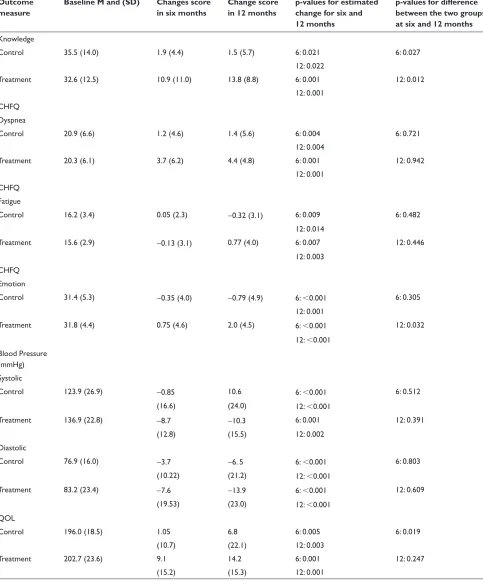
At baseline, the control group had higher knowledge scores than the treatment group, but at six months, the treatment group increased their knowledge level surpassing the control group, and maintained the trend at 12 months. At both six and 12 months, the treatment group was signifi cantly higher than the control group (both p 0.05). Descriptive statistics, change scores, and p-values for within-group change and between group differences for Hypotheses 2 through 5 are presented in Table 2.
HF-speci
fi
c symptoms and general health
indicators (Hypothesis 3)
For dyspnea, the control group, which initially scored better (23.5) than the treatment group (18.5) worsened gradually. The treatment group showed improvement with signifi cance at six and 12 months (both p = 0.001). For fatigue, the control group showed signifi cantly lower levels of fatigue at six months, then showed a signifi cant increase at 12 months (p = 0.011). The treatment group recorded greater fatigue at
six months but felt less tired at 12 months as compared to the baseline (p = 0.002). These changes were both signifi cant.
For emotional function, the control group showed signifi cant gradual decrease over one year (p = 0.001), while the treatment group exhibited signifi cant gradual improvement (p 0.001).
Elevated BP was observed in both groups during the year. The control group’s systolic BP decreased signifi cantly initially, but rebounded to signifi cantly higher levels at 12 months relative to baseline readings (p = 0.003). While initially much higher than the control group, the treatment group’s systolic BP signifi cantly decreased by six months and remained lower at 12 months (p = 0.010). Regarding diastolic BP, both groups decreased signifi cantly.
For the treatment group, the number of people who were sick less than one week in the past six months was signifi cantly increased at six months and 12 months.
QOL (Hypothesis 4)
Although both groups increased the QOL scores signifi cantly for the fi rst six months and maintained for another six months, the treatment group had greater gains at both follow-ups, resulting in signifi cant between groups differences (p 0.05).
Health care utilization (Hypothesis 5)
For the control group, health care use did not change. For the treatment group, the number of visits to an emergency
0 10 20 30 40 50 60 70 80 90 100
Initial 6 mon. 12 mon.
C-Breath
T-Breath
C-Stretch
T-Stretch
C-Walk
T-Walk
C-Mild
T-Mild
Figure 3 Percent changes in exercisers (2–3/week or more).
Abbreviations: C, the control group; T, the treatment group; Breath, breathing exercise; Walk, walking; Mild, mild exercise.
Journal of Multidisciplinary Healthcare downloaded from https://www.dovepress.com/ by 118.70.13.36 on 24-Aug-2020
Effects of e-health in patients with heart failure
Table 2 Change over one year in heart failure-related symptoms, blood pressure, and weight
Outcome measure
Baseline M and (SD) Changes score in six months
Change score in 12 months
p-values for estimated change for six and 12 months
p-values for difference between the two groups at six and 12 months Knowledge
Control 35.5 (14.0) 1.9 (4.4) 1.5 (5.7) 6: 0.021 6: 0.027
12: 0.022
Treatment 32.6 (12.5) 10.9 (11.0) 13.8 (8.8) 6: 0.001 12: 0.012
12: 0.001 CHFQ
Dyspnea
Control 20.9 (6.6) 1.2 (4.6) 1.4 (5.6) 6: 0.004 6: 0.721
12: 0.004
Treatment 20.3 (6.1) 3.7 (6.2) 4.4 (4.8) 6: 0.001 12: 0.942
12: 0.001 CHFQ
Fatigue
Control 16.2 (3.4) 0.05 (2.3) −0.32 (3.1) 6: 0.009 6: 0.482
12: 0.014
Treatment 15.6 (2.9) −0.13 (3.1) 0.77 (4.0) 6: 0.007 12: 0.446
12: 0.003 CHFQ
Emotion
Control 31.4 (5.3) −0.35 (4.0) −0.79 (4.9) 6: 0.001 6: 0.305
12: 0.001
Treatment 31.8 (4.4) 0.75 (4.6) 2.0 (4.5) 6: 0.001 12: 0.032
12: 0.001 Blood Pressure
(mmHg) Systolic
Control 123.9 (26.9) −0.85 10.6 6: 0.001 6: 0.512
(16.6) (24.0) 12: 0.001
Treatment 136.9 (22.8) −8.7 −10.3 6: 0.001 12: 0.391
(12.8) (15.5) 12: 0.002
Diastolic
Control 76.9 (16.0) −3.7 −6. 5 6: 0.001 6: 0.803
(10.22) (21.2) 12: 0.001
Treatment 83.2 (23.4) −7.6 −13.9 6: 0.001 12: 0.609
(19.53) (23.0) 12: 0.001
QOL
Control 196.0 (18.5) 1.05 6.8 6: 0.005 6: 0.019
(10.7) (22.1) 12: 0.003
Treatment 202.7 (23.6) 9.1 14.2 6: 0.001 12: 0.247
(15.2) (15.3) 12: 0.001
Notes: For weight, McNemar Test was used. The last column presents Z-score and p-value.
Journal of Multidisciplinary Healthcare downloaded from https://www.dovepress.com/ by 118.70.13.36 on 24-Aug-2020
Tomita et al
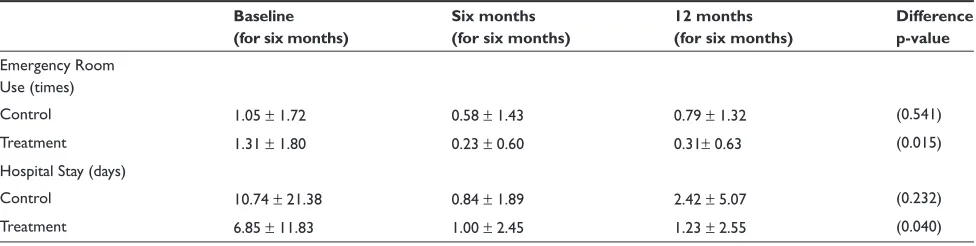
Table 3 Health care utilization
Baseline (for six months)
Six months (for six months)
12 months (for six months)
Difference p-value Emergency Room
Use (times)
Control 1.05 ± 1.72 0.58 ± 1.43 0.79 ± 1.32 (0.541)
Treatment 1.31 ± 1.80 0.23 ± 0.60 0.31± 0.63 (0.015)
Hospital Stay (days)
Control 10.74 ± 21.38 0.84 ± 1.89 2.42 ± 5.07 (0.232)
Treatment 6.85 ± 11.83 1.00 ± 2.45 1.23 ± 2.55 (0.040)
room and the length of hospital stay decreased signifi cantly at six months; this was maintained at 12 months.
Participants’ evaluation of the e-health
program
At the end of the study period, 100% of the treatment group reported that they were confi dent in dealing with HF due to the e-health program and said that they would recommend the program to other people who have similar conditions. Furthermore, 84.6% said that they were very satisfi ed with the system, 15.4% were satisfi ed, and 92.3% thought that their HF was better than one year before. The most often cited reason for satisfaction was “Monitoring myself for increased awareness.” The second and third reasons were “Better health” and “Support from health care providers.” Two participants reported that the most disliked part of the program was “Feel guilty when I have to record that I did not exercise, so I had to do exercise.” Two suggestions were “Expand the program to diabetes” and “Create a way to fi nd out how other study participants are doing, so that I know my relative status.”
Discussion
This randomized controlled study tested a e-health method of self-management of HF for one year in home-based older adults. Four types of support were delivered via Internet by a team of multidisciplinary health care professionals. Although this e-health method may not be effective for all HF patients, it was benefi cial for HF patients with NYHA Class II or III with respect to increasing knowledge of HF and related health behaviors, exercise time, emotional function, and quality of life, and reducing levels of dyspnea, fatigue, blood pressure, and sick days. The result of exercise was parallel to the fi nding of the meta analysis by Wantland and colleagues.7 It was also
effective in decreasing the number of emergency room visits and length of hospital stays. Limitation of the study was that it did not calculate cost effectiveness of the e-health method,
which is necessary for its practical application. Also many between-group comparisons were not statistically signifi cant mainly due to the small sample size. On the other hand, with this small sample size, most of within-group comparisons were signifi cant, which is a strong indicator that the interven-tion was effective. With a larger sample size, it is expected that many between-group comparisons would be statistically signifi cant. Vigorous studies with geographical and ethnical diversity are also needed in the future. Nevertheless, this study provided evidence that the effective e-health method in changing health behaviors and improving health outcomes takes an interdisciplinary approach since changing one’s health behaviors covers various health care disciplines.
Major e-health strategies that lead to successful health behavior change identifi ed in this study are that: (1) relevant information should be provided using easy-to-understand language in an easy-to-see format; (2) a simple recording system for vital signs and health behaviors should be available to allow patients to be aware of their behaviors; (3) patients should be aware that their health activities are monitored by a health professional; and (4) feedback should be provided for continued health behavior change. The strategy was supported by a conceptual framework, M-TOMITA, which applied a concept of human social support to the Internet use by strategically placing the types of support in the stages of health behavioral change. In this model, a multi disciplinary team is necessary at the initial stage but once the program is in place, a nurse may be able to run the program with input from the team for appraisal. In this study we convened a regular distance team meeting every month for appraisal support, but this frequency should be further investigated for its validity. For a comprehensive self-management program, it is strongly recommended to include a pharmacist to check interactions of multiple medication intake and a nutritionist for better diet.
In this study, emotional support was not independent of appraisal and instrumental support, but was not provided in
Journal of Multidisciplinary Healthcare downloaded from https://www.dovepress.com/ by 118.70.13.36 on 24-Aug-2020
Effects of e-health in patients with heart failure
a specifi c manner, such as forming a discussion/chat group. For patients who are not depressed or believe that they have control over their illness, the level of emotional support provided in this study may be suffi cient. However, especially for patients who are depressed, the Internet-based method has been utilized and its effectiveness has been reported.24,25
Subjective evaluation of this program found that some par-ticipants wished to know their health behaviors in relation to other participants’. Providing an average of aggregated data of all study participants can be easily done via the Internet. TTM describes a process of behavioral change called social liberalization as the person’s realization of changes of social norms. E-health may be able to create a social norm among study participants and allow them to see how it is changing.
Finally, evidenced by a very high adherence to the program, 85% of 355 days (Internet was not available for 10 days), an e-health approach utilizing a multidisciplinary health care team can be accepted as a tool for self-management of HF and other chronic diseases in the near future when technology is more advanced, computer costs are reduced, and older adults become more computer literate.
Disclosure
This study was funded by the National Institute on Aging, USA.
Reference
1. American Heart Association. Heart Failure. Heart and stroke Statistical Update [updated 2007]. Cited on Oct 31, 2008. Available from: http:// www.americanheart.org/presenter.jhtml?identifi er=1486.
2. Centers for Education and Research on Therapeutics. Better Treatment for Heart Failure [updated 2003]. Cited on Oct 31, 2008. Available from: http://www.certs.hhs.gov/about_certs/annual_reports/year2/centers/ duke.html.
3. The Joint Commission; The Joint Commission’s Annual Report on Quality. Heart Failure. Improving American’s Hospitals [updated 2007]. Cited on Oct 31, 2008. Available from: http//www.jointcommissionreport. org/conditions/heartfi lure.aspx.
4. Glasgow RE, Emmons KM. How can we increase translation of research to practice? Types of evidence needed. Annu Rev Public Health. 2007;28:413–433.
5. eHealth Institute; eHealth Institute Mission. [updated 2004]. Cited on Oct 31, 2008. Available from: http://www.ehealthinstitute.org?Index. aspx.
6. Ruggerio C, Minassian P, Barr E, et al. Disease management and e-health can be successfully merged. Proceedings of the 2000 Healthcare Information and Management System Society. 2000;2:1–9.
7. Wantland DJ, Portillo CJ, Holzemer WL, et al. The effectiveness of web-based vs non-web-based interventions: A meta-analysis of behav-ioral change outcomes. J Med Internet Res. 2004;6:e40.
8. Fox S. Older Americans and the Internet. 2004. Cited on Oct 31, 2008. Available from: http://www.pewinternet.org/PPF/r/117/report_display.asp. 9. Becker SA. Web accessibility for older adults. 2003. Cited on
Oct 31, 2008. Available from: http://cob.fi t.edu/facultysites/abecker/ Accessibility/OlderAdutlsStats/OlderAdultsSats.html.
10. Prochaska JO, Redding CA, Evers KE. The trenstehrotical model and stages of change. In: Glanz K, Rimer B, Lewis FM (editors). Health Behavior and Health Education. 3rd ed. San Francisco, CA: Jossey-Bass; 2002. 11. House JS, Kahn R. Measures and concepts of social support. In: Cohen
S, Syme S (editors). Social Support and Health. Orlando, FL: Academic Press, 1985;83–108.
12. Rossi E. Uses and gratifi cations/dependency theory. 2002. Cited on Oct 31, 2008. Available from: http://zimmer.csufresno.edu/∼johnca/ spch100/7–4-uses.htm.
13. Castro CM, King AC. Telephone-assisted counselling for physical activity. Exerc Sport Sci Rev. 2002;30:64–68.
14. Heart Failure Society of America. The strategy of heart failure. [updated 2006 Sept 26] Cited on Oct 31, 2008. Available from: http://www. abouthf.org/questions_stages.htm.
15. Folstein M, Folstein SE, McHugh PR. Mini-mental state: a practical method for grading the cognitive state of patients for the clinician.
J Psychiatr Res.1988;12:189–198.
16. Stewart S, Marley JE. Horowitz JD. Effects of a multidisciplinary, home-based intervention on unplanned readmissions and survival among patients with chronic congestive heart failure: a randomised controlled study. J Lancet. 1999;25;354:1077–1083.
17. The National Institute on Aging and the National Library of Medicine. Making your site senior-friendly. 2002. Cited on Oct 31, 2008. Available from: http://www.nlm.nih.gov/pubs/checklist.pdf.
18. Radloff LS. The CES-D scale: A self report depression scale for research in the general population. Appl Psycholl Measure. 1977;1:385–401. 19. Guyatt GH, Nogradi S, Halcrow S, et al. Development and testing of
a new measure of health status for clinical trials in heart failure. J Gen Intern Med. 1989;4:101–107.
20. O’Keeffe S, Lye M, Donnellan C, et al. Reproducibility and responsiveness of quality of life assessment and six minute walk test in elderly heart failure patients. Heart. 1998;80:377–382.
21. Rector TS, Cohn JN. Assessment of patient outcome with the Minnesota Living with Heart failure Questionnaire: Reliability and validity during a randomized, double-blind, placebo-controlled trial of pimobendan.
Am Heart J. 1992;124:1017–1025.
22. Ware JE Jr, Kosinski M, Keller SD. A 12-Item Short-Form Health Survey: Construction of scales and preliminary tests of reliability and validity. Med Care. 1996;34:220–233.
23. Bennett SJ, Oldridge NB, Eckert GJ, et al. Comparison of quality of life measures in heart failure. Nurs Res. 2003;52:207–216.
24. Gerhard A. Internet-based self-help for depression: randomised controlled trial. Br J Psychiatry. 2005;187:456–461.
25. Christensen H, Griffi ths KM, Jorm AF. Delivering interventions for depression by using the internet: randomised controlled trial. BMJ.
2004;328:265.
Journal of Multidisciplinary Healthcare downloaded from https://www.dovepress.com/ by 118.70.13.36 on 24-Aug-2020
Journal of Multidisciplinary Healthcare downloaded from https://www.dovepress.com/ by 118.70.13.36 on 24-Aug-2020