Future perspectives for jet substructure techniques in LHC Run2
Matthias Mozer1,a
1Institut für Experimentelle Kernphysik, KIT
Wolfgang-Gaede-Str. 1, 76131 Karlsruhe, Germany
Abstract.The increased pile-up expected in the LHC Run 2 and High Luminosity LHC creates a challenging
environment for utilizing the jet-substructure techniques which were successfully demonstrated in the LHC Run 1. The ATLAS and CMS experiments are studying a range of methods to improve jet reconstruction to increase the resilience against high pile-up. Promising results are obtained in simulation but await validation on the first Run 2 data.
1 Introduction
In the search for new physics at the LHC, jets play a dom-inant role. They are of particular importance in studies involving electroweak bosons, top-quarks and the Higgs boson, as these particles decay into hadron with large branching ratios. At the high energies probed at the LHC the decay hadrons will often form a single jet, so called boosted topologies. The distribution of particles within such jets differs substantially from jets originating from the hadronization of single quarks or gluons and tech-niques that exploit these differences have been used suc-cessfully to suppress QCD induced backgrounds. The jet characteristics used in the substructure methods originate from the initial parton composition of the jets and the QCD evolution of the parton shower. However, in the presence of many simultaneous interactions (“pile-up”), the signa-tures can be diluted by the presence of additional jet con-stituents (calorimeter clusters, tracks...) not originating from the primary interaction. In the upcoming LHC Run 2, the number of simultaneous interactions is expected to rise to∼40, compared to∼25 in Run 1, and even more for the future High Luminosity LHC (“HL-LHC”) upgrade. Under these harsh conditions, the performance of jet sub-structure techniques, but also basic reconstruction, such as the measurement of the jet transverse momentum (pT) are
negatively impacted. The LHC experiments have started to investigate various methods to reduce the effects of pile-up on jet measurements in order to retain or even improve the good performance observed in Run 1.
The LHC experiments are approaching this issue from three directions:
• improving the basic event reconstruction of the experi-ments.
• removing pile-up particles before the event is interpreted as a specific final state.
ae-mail: [email protected]
• refining physics interpretation tools such as b-tagging and jet-substructure techniques to be more resilient against pile-up.
2 Improved Reconstruction
Before data are reconstructed for analysis, events have to pass the trigger selection in order to be permanently stored. The ATLAS [1] and CMS [2] experiments both use a multi-stage trigger design, where the first step of the selection is performed by hardware designed for this pur-pose (referred to as L1 trigger) and the last step is imple-mented as a somewhat reduced version of the full recon-struction run on a dedicated but otherwise generic cluster of computers (called HLT). The ATLAS experiment im-plements an intermediate step, while the CMS experiment uses just the two steps discussed above. The whole range of jet-substructure techniques can be relatively easily im-plemented in the HLT at the only cost of some additional processing time. However, for triggers that solely rely on boosted jet identification, the L1 trigger can impose a se-rious bottle neck. To improve on this situation, the AT-LAS collaboration is currently implementing an upgrade to their L1 trigger system that allows for wider jets [3]. Figure 1 (left), shows how this upgraded trigger can in-crease the efficiency in identifying hadronic top quark de-cays.
The CMS collaboration has invested a significant effort into improving the existing Particle Flow (PF) [6, 7] recon-struction to more accurately measure the properties of very energetic jets. In previous versions of this reconstruction techniques, the large multiplicity of tracks in a very ener-getic jet could overwhelm the tracking algorithm, leading to a significant deficit in the fraction of charged particles within a very energetic jet. This issue has been cured by the addition of additional tracking steps, tuned specifically to recover tracks aligned with the jet axis. Additionally,
[GeV]
jet T
p
uncalibrated
100 200 300 400 500
per-Jet Ef
ficiency
0.0 0.2 0.4 0.6 0.8 1.0
=80
〉 μ 〈
=14 TeV s t t
R=1.0 (5% trimmed)
T k
anti->20 GeV
T p
D=0.3 subjet with
T k
1 ≥
R>2 Δ |<2.5; isolated by
jet η |
L1_J100 (Run 1 L1Calo sim.) 1 subjet 2 subjets
3 subjets ≥
L1_G140 1 subjet 2 subjets
3 subjets ≥
ATLASPreliminary
Simulation
pruned jet mass (GeV)
0 50 100 150
Normalized Distribution
0 0.1 0.2 0.3
merged PF neutrals split PF photons split PF photons+neutrals AK R=0.8
(W) < 2.4 TeV
T
1.6 < p |<2.4
η
|
13 TeV
CMS
Simulation PreliminaryFigure 1.Left: Simulated efficiency of new (L1_G140) and previous (L1_J100) L1 triggers of the ATLAS detector as function of jetpT
using boosted top quarks as case study. Large efficiency gains are observed in the case of boosted topologies with two or three subjets. Right: Reconstructed jet mass for a hypothetical resonance with an invariant mass of 4 TeV decaying to two W bosons. The dotted line shows the mass reconstructed with the pruning [4, 5] algorithm using the PF configuration as used in Run 1; the solid line adds higher granularity treatment of deposits in the electromagnetic calorimeters and the points show the results when the hadronic calorimeters are treated with finer granularity as well.
overlapping calorimeter deposits are treated with a finer granularity, greatly improving the reconstruction of the jet mass for very energetic jets. As an example, Figure 1 (right) from [8] shows the jet mass distribution for a hypo-thetical resonance with an invariant mass of 4 TeV decay-ing to two W bosons. Usdecay-ing the methods described above, the reconstruction of the W mass improved substantially.
Additionally, algorithms that identify the hadroniza-tion of b-quarks (“b-tagging”) are being transferred from their initial use in jets originating from a single b-quark to the case of boosted hadronic decays with at least on b-quark. Initial studies were driven by boosted top decays, but with the discovery of the Higgs boson and its high branching ratio to b-quark pairs, additional attention has be focused on boosted hadronic Higgs decays.
The CMS collaboration has largely relied on reusing the same algorithms tuned to the identification of jets originating from single b-quarks also to identify b-quarks within larger decay chains [9, 10]. While this approach foregoes the opportunity for further optimization, it allows for a very rapid use of b-tagging in boosted topologies and focuses limited manpower resources. Even without spe-cific optimizations, this approach leads to large gains in the identification of boosted top quark (see Figure 2, left) and Higgs boson decays. Conversely, the ATLAS col-laboration is optimizing additional b-tagging algorithms specifically for their performance within hadronic decays of boosted heavy particles [11, 12]. The results are very promising, as shown in Figure 2 (right), and excellent effi -ciencies and background rejection rates can be achieved.
3 Pile-Up Removal
Once reconstructed, particles from pile-up may be re-moved from further consideration by directly identify-ing them, or alternatively, by statistically subtractidentify-ing their contributions from other other variables, such as jet mo-menta or lepton isolation variables. Such corrections were already necessary in the LHC Run 1 in order to meet ex-pected resolutions and efficiencies. For Run 1, the pre-dominant corrections were applied based on the jet- or isolation-cone area and proportional to the pile-up activ-ity measured in a given event [13, 14].
In the CMS experiment, the PF reconstruction addi-tionally allowed individually reconstructed charged parti-cles to be classified as pile-up according to the association of their measured tracks to the vertices in the event. While this method (called charged hadron subtraction, CHS) has the advantage that the contributions from charged pile-up particles is subtracted exactly, neutral pile-pile-up contri-butions can only be subtracted statistically.
= 8 TeV s
CMS Simulation,
Top Tag Efficiency
0 0.1 0.2 0.3 0.4
Mistag Rate
-5
10
-4
10
-3
10
-2
10
Matched parton > 200 GeV/c
T
p
HEP Top Tagger
2 τ
/
3 τ
HEP +
HEP + sub. b-tag + sub. b-tag
2 τ
/
3 τ
HEP + HEP WP0 HEP Comb. WP1 HEP Comb. WP2 HEP Comb. WP3
Graviton Mass [GeV]
1000 1500 2000 2500
Ef
ficiency
0 0.05 0.1 0.15 0.2 0.25 0.3 0.35 0.4
Track jets (R=0.2) Track jets (R=0.3) Calo subjets (R=0.3) Track jets (R=0.4)
Simulation Preliminary ATLAS
= 1.0 plank M = 8 TeV, k/ s
track jets t anti-k
calo subjets t k
Figure 2.B-tagging performance in boosted objects.
Left: CMS top tagging performance with (brown lines) and without (purple lines) using subjet b-tags to select boosted top-quark decays.
Right: Efficiency to select a resonance decaying to two hadronically decaying Higgs bosons using several different working points for subjet b-tagging with the ATLAS detector.
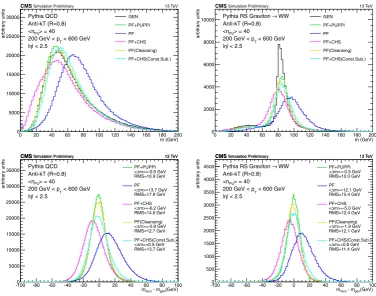
tors between zero and one. Figure 3 compares the jet mass spectra and resolutions for QCD jets and boosted hadronic W decays using the different algorithm. The best perfor-mance is achieved with the PUPPI algorithm, closely fol-lowed by the constituent subtraction. CHS and statistical corrections as used in Run 1 perform much worse.
In Run 1, the so called Jet Veto Fraction (JVF) was widely used in the ATLAS collaboration to suppress jets largely consisting of pile-up particles. The JVF is defined as the sum of thepTof the tracks within a jets area coming
from the primary vertex, divided by the sum of the pT of
all tracks within the jets area. A requirement for the JVF to exceed a given threshold was then employed to select jets originating from the primary vertex. However, the fixed cut requirement leads to a noticeable dependence of the selection efficiency on the number of simultaneous colli-sions in the event, as shown in Figure 4, left. This issue is solved by two improvements: For future use, the JVF computation is rescaled to explicitly take into account the dependence on the number of vertices in the event. Addi-tionally the JVF variable is combined with a variable re-lated to the fraction of charged particles within a jet to further reduce the pile-up dependence of the variable and increase overall tagging efficiency [18].
4 Jet-Substructure Techniques
In the LHC Run 1, a number of different jet-substructure techniques have been employed. In the CMS collab-oration, the so called pruning algorithm [19] has seen widespread use in order to reconstruct the invariant mass of hadronic W- and Z-boson. The algorithm is designed to clean the jet from soft and wide-angle particles. Jets are reclustered with a modified Cambrige-Aachen (CA) algo-rithm [20], where combinations only proceed if the to con-stituents pass criteria on their relative angle and transverse momentum.
In addition the jet pruning, results of the ATLAS col-laboration have been prepared with the trimming [21] and mass-drop [23] algorithms (see Ref. [24] for correspond-ing performance studies). In the trimmcorrespond-ing algorithm a jet with wide radius parameter is reclustered with a narrower radius parameter. Of the resulting subjets, only the ones carrying a certain fraction of the wide jets transverse mo-mentum are retained. The mass drop algorithm is applied to jets reconstructed with the CA algorithm. In each step, the most recent combination of the CA algorithm is un-done and it is checked whether the more massive of the two resulting subjets carries more than a certain fraction of the mass of the parent jet, in which case the lighter subjet is discarded and the procedure continues on the remaining subjet.
In preparation for the HL-LHC and the large amount of pile-up expected, the ATLAS collaboration has revisited the topic of jet substructure algorithms. The results show (see Figure 5, left) that even in the extreme case of 200 si-multaneous interactions, the mass of hadronically decay-ing top-quarks can be well reconstructed.
m (GeV) 0 20 40 60 80 100 120 140 160 180 200
arbitrary units 0 5000 10000 15000 20000 25000
30000 Pythia QCD
Anti-kT (R=0.8) > = 40
PU
<n
< 600 GeV
T
200 GeV < p | < 2.5
η | GEN PF+PUPPI PF PF+CHS PF(Cleansing) PF+CHS(Const.Sub.) 13 TeV
CMSSimulation Preliminary
m (GeV) 0 20 40 60 80 100 120 140 160 180 200
arbitrary units 0 2000 4000 6000 8000
10000 Pythia RS Graviton → WW
Anti-kT (R=0.8) > = 40
PU
<n
< 600 GeV
T
200 GeV < p | < 2.5
η | GEN PF+PUPPI PF PF+CHS PF(Cleansing) PF+CHS(Const.Sub.) 13 TeV
CMSSimulation Preliminary
(GeV) gen - m reco m
-100 -80 -60 -40 -20 0 20 40 60 80 100
arbitrary units 0 5000 10000 15000 20000 25000 30000
35000 Pythia QCD
Anti-kT (R=0.8) > = 40
PU
<n
< 600 GeV
T
200 GeV < p | < 2.5
η
|
13 TeV
CMSSimulation Preliminary
PF+PUPPI m>=-0.6 GeV Δ < RMS=10.9 GeV PF m>=13.7 GeV Δ < RMS=17.9 GeV PF+CHS m>=-6.2 GeV Δ < RMS=14.6 GeV PF(Cleansing) m>=-0.8 GeV Δ < RMS=12.7 GeV PF+CHS(Const.Sub.) m>=0.5 GeV Δ < RMS=13.7 GeV 13 TeV
CMSSimulation Preliminary
(GeV) gen - m reco m
-100 -80 -60 -40 -20 0 20 40 60 80 100
arbitrary units 0 500 1000 1500 2000 2500 3000 3500 4000
4500 Pythia RS Graviton → WW
Anti-kT (R=0.8) > = 40
PU
<n
< 600 GeV
T
200 GeV < p | < 2.5
η
|
13 TeV
CMSSimulation Preliminary
PF+PUPPI m>=-0.5 GeV Δ < RMS=10.0 GeV PF m>=12.1 GeV Δ < RMS=15.4 GeV PF+CHS m>=-5.0 GeV Δ < RMS=12.4 GeV PF(Cleansing) m>=-1.9 GeV Δ < RMS=12.1 GeV PF+CHS(Const.Sub.) m>=0.6 GeV Δ < RMS=11.4 GeV 13 TeV
CMSSimulation Preliminary
Figure 3. Mass distributions (top) and resolutions (bottom) for QCD jets (left) and boosted hadronic W decays (right) using several different pile-up mitigation techniques.
Vtx
N
5 10 15 20 25
Fake Rate 0 0.02 0.04 0.06 0.08 0.1 JVF>0.5 JVT>0.6
ATLASSimulation Preliminary
Pythia8 dijets LCW+JES R=0.4
t
Anti-k
| < 2.4 η < 30 GeV, |
T
20 < p
Target signal efficiency = 0.9
Efficiency
0.8 0.85 0.9 0.95
Fake Rate -2 10 -1 10 JVF corrJVF pT R JVT
ATLASSimulation Preliminary Pythia8 dijets
LCW+JES R=0.4 t
Anti-k | < 2.4
d
|
< 50 GeV T 20 < p
JVF = 0.5 JVF = 0.25
Figure 4.Left: Comparison of the pile-up-dependence of the JVF used in Run 1 to the improved combined variable (JVT).
Right: Fake rate as function of tagging efficiency for the JVF used in Run 1 compared to the scaled JVF (corrJVF), the additional charge-fraction variable (RpT) and the combination (JVT).
5 Summary and Outlook
The LHC experiments are demonstrating with simulation studies, that the previously used jet reconstruction and substructure techniques are affected by the increased pile-up expected in Run 2 and the HL-LHC. However, im-proved reconstruction and substructure methods have been devised to minimize the impact of the additional pile-up.
Nevertheless, these methods will have to be validated and possibly revised when high pile-up data-taking starts with the LHC Run 2 in 2015.
References
[GeV] jet m
-100 0 100 200 300 400 500
Normalized Entries 0 0.02 0.04 0.06 0.08 0.1 0.12 0.14 0.16 0.18 0.2 0.22 =30) μ ( noise pileup σ >=0, μ < =40) μ ( noise pileup σ >=40, μ < =80) μ ( noise pileup σ >=80, μ < =140) μ ( noise pileup σ >=140, μ < =200) μ ( noise pileup σ >=200, μ < = 14 TeV, 25 ns bunch spacing
s
ATLAS Simulation Preliminary
| < 1.2 η LCW jets with R=1.0, 0.0< | t
anti-k
< 750 GeV jet T 500 < p
=2 TeV) Z’ (m t t → Pythia8 Z’
No jet grooming, no jet pileup correction
[GeV] jet m
-100 0 100 200 300 400 500
Normalized Entries 0 0.02 0.04 0.06 0.08 0.1 0.12 0.14 0.16 0.18 0.2 0.22 =30) μ ( noise pileup σ >=0, μ < =40) μ ( noise pileup σ >=40, μ < =80) μ ( noise pileup σ >=80, μ < =140) μ ( noise pileup σ >=140, μ < =200) μ ( noise pileup σ >=200, μ < = 14 TeV, 25 ns bunch spacing
s
ATLAS Simulation Preliminary
| < 1.2 η LCW jets with R=1.0, 0.0< | t
anti-k
< 750 GeV jet T 500 < p
=2 TeV) Z’ (m t t → Pythia8 Z’
Trimmed, jet 4-vector pileup correction
Figure 5.Reconstructed mass for boosted top quarks in the ATLAS detector with different amounts of pile-up without (left) and with (right) jet-grooming techniques and pile-up corrections applied.
m mraw
=0.05 frac =0.2 pT sub r =0.03 frac =0.1 pT sub r =0.03 frac =0.2 pT sub r =0.03 frac =0.3 pT sub r =0.5 cut =0.1 R cut z =0.5 cut =0.05 R cut z =0.75 cut =0.05 R cut z =0.75 cut =0.1 R cut
z β=1 β=0 β=2
Resolution (GeV)
0 10 20 30 4050 RS Graviton → WW, Anti-kT (R=0.8) >=40
PU
<n
> 300 GeV
T
p
| < 2.5 η |
Pruning
Trimming Soft Drop
PF
PF + CHS
PF + PUPPI σ
fitted RMS
13 TeV
CMS Simulation Preliminary
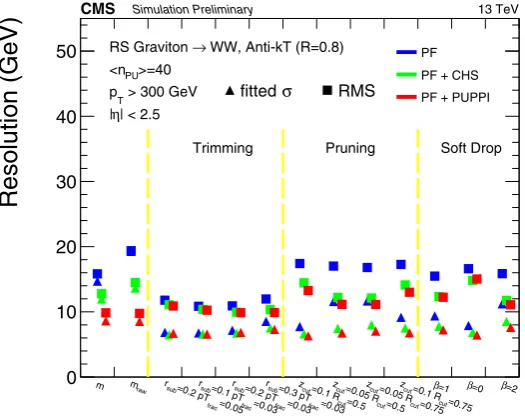
Figure 6. Comparison of the jet mass resolution of a variety of jet grooming algorithms in combination with pile-up reduction tech-niques. The trimming, pruning and soft drop algorithms are combined with CHS and PUPPI pile-up reduction techtech-niques. Shown are mass resolutions from a Gaussian fit as well as the RMS values of the distributions, indicating the size of non-Gaussian tails in the resolution.
[3] ATLAS Collaboration, Global Feature Extraction
(gFEX) Performance Plots,
ATLAS-COM-DAQ-2014-087 (2014), https://cds.cern.ch/record/1749167 [4] Ellis, S. D.et. al., Phys. Rev. D80, 094023 (2010), [5] Ellis, S. D.et. al., Phys. Rev. D81, 094023 (2010) [6] CMS Collaboration,Particle–Flow Event
Reconstruc-tion in CMS and Performance for Jets, Taus, and ETmiss, CMS-PAS-PFT-09-001 (2009), https://cds.cern. ch/record/1194487
[7] CMS Collaboration, Commissioning of the Particle-flow Event Reconstruction with the first LHC collisions recorded in the CMS detector, CMS-PAS-PFT-10-001 (2010), https://cds.cern.ch/record/1247373
[8] CMS Collaboration,V Tagging Observables and Cor-relations, CMS-PAS-JME-14-002 (2014), https://cds. cern.ch/record/1754913
[9] CMS Collaboration, Boosted Top Jet Tagging at CMS, CMS-PAS-JME-13-007 (2014), https://cds.cern. ch/record/1647419
[10] CMS Collaboration, Performance of b tagging
at √s=8 TeV in multijet, tt and boosted topology events, CMS-PAS-BTV-13-001 (2013), https://cds. cern.ch/record/1581306
[12] ATLAS Collaboration, b-tagging in dense environ-ments, ATL-PHYS-PUB-2014-014 (2014), https://cds. cern.ch/record/1750682
[13] M. Cacciari, G. P. Salam and G. Soyez, JHEP0804, 005 (2008)
[14] M. Cacciari and G. P. Salam, Phys. Lett. B659, 119 (2008)
[15] CMS Collaboration, Study of Pileup Removal
Al-gorithms for Jets, CMS-PAS-JME-2014-001 (2014),
https://cds.cern.ch/record/1751454
[16] P. Berta, M. Spousta, D. W. Miller and R. Leitner, JHEP1406092 (2014)
[17] D. Bertolini, P. Harris, M. Low and N. Tran, JHEP 141059 (2014)
[18] ATLAS Collaboration, Search for high-mass states with one lepton plus missing transverse momentum in
pp collisions at √s = 8 TeV with the ATLAS detec-tor, ATLAS-CONF-2014-018 (2014), https://cds.cern. ch/record/1700870
[19] CMS Collaboration, arXiv:1410.4227 [hep-ex].
[20] M. Wobisch and T. Wengler, In *Hamburg
1998/1999, Monte Carlo generators for HERA
physics* 270-279 [hep-ph/9907280].
[21] D. Krohn, J. Thaler and L. T. Wang, JHEP 1002 (2010) 084
[22] A. J. Larkoski, S. Marzani, G. Soyez and J. Thaler, JHEP1405(2014) 146