Gozo in the world
and
the world in Gozo
The cultural impact of migration
and return migration
on an island community
Raymond C. Xerri
Thesis submitted in fulfilment of the
requirements for Doctor of Philosophy
Europe-Ausfralia Institute
Victoria University of Technology
CONTENTS
Declaration iv Acknowledgements v
Abstract ix
INTRODUCTION 1
PARTI GOZO
1. Ferry Crossings 15 2. Gozitan Identity Under Construction 43
3. Double Crossings: Positioned Ethnography
and Writing Gozo 77
Pictorial Essay I Imag(in)ing Gozo 94
PARTII GOZO IN THE WORLD
4. The Land at the Edge of the World 99
5. Making Dreams Work 123
6. Faith and Festa 148 7. Linguistic Menus 181
PART III THE WORLD IN GOZO
8. Bingo, Races and Bars 9. Making Money
10. Flags and Firecrackers
202 221 247
Pictorial Essay III Melbourne-Gozo Crossings 271
CONCLUSION REFERENCES APPENDICES
276 280 289
TABLES AND FIGURES
Figure 1. Nassa tas-Sajd G^awdxija (Gozitan Fisherman's pot) Figure 2. Village of Qala coat-of-arms Figure 3. City of Rabat coat-of-arms Figure 4. The Flag of Gozo
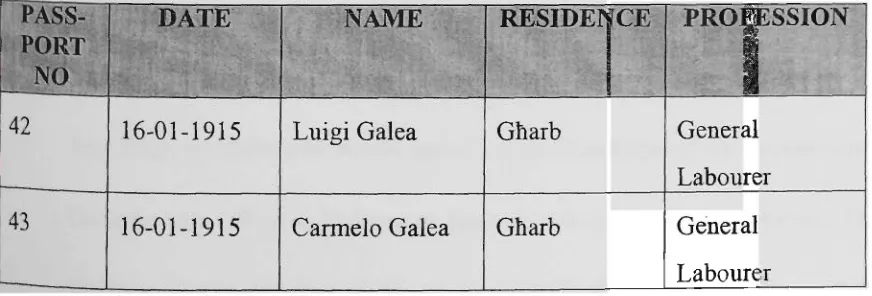
Table 1. 1915 Gozitan Passport Applications for Ausfraha Nos. 42-52
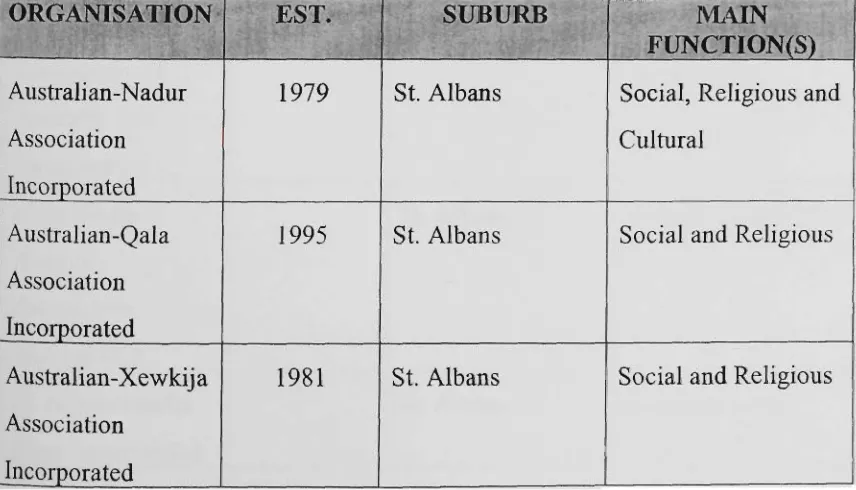
Table 2. City of Brimbank: Residents' Place of Birth Table 3. Gozitan Organisations in Melbourne
27 38 39 39
Table 4. Gozitan Festas Celebrated in Melboume 160
APPENDICES
Appendix 1. Basic Xerri-Buttigieg Family Tree Appendix 2. Xerri Buttigieg Marriages
Appendix 3. Questionnaire/Interview Questions Appendix 4. Responses to Question : Why did so
many Gozitans settle in Melboume?
Appendix 5. Responses to Question: When you migrated did you think that it was permanent or temporary? Appendix 6. Gozitan Applicants for Passports to Austtalia
1915-1928
Appendix 7. Gozitan Words/Phrases
Appendix 8. Words/Phrases with different meaning(s) or usage in
Gozo
DECLARATION
I declare that this thesis is my original work, except where otherwise cited, and has not been submitted, in whole or in part, for any other academic award.
ACKNOWLEDGEMENTS
This thesis owes much to the encouragement and guidance of others. Fust and foremost, I would acknowledge the role of my supervisors at Victoria University. For the first three years of my part-time candidature these included Dr Barry York, who shared with me his incomparable knowledge of and enthusiasm for the history of Maltese and Gozitan settlement in Austtalia. Erik Lloga, who patiently and generously shared with me his exttaordinary familiarity with the literature and the issues, showed me how to recognise and begin to articulate theoretical and conceptual dimensions of which I was only vaguely aware. In taking over from Erik as co-supervisor for the past year, Dr Greg Gow has helped me to tighten and further develop both my ideas and my capacity to communicate those ideas. Dr Les Terry also provided valuable advice for improving both my ideas and my writing. My Principal Supervisor, Professor Ron Adams, encouraged and guided me at every stage of the project and instilled in me sufficient self-confidence to fread paths of unknown destinations. Without him, I doubt that I would have made the crossing that this thesis represents.
field for the benefit' of the Maltese in Ausfralia. My own experience confirms this observation. Professor Jarlath Ronayne, Vice-Chancellor and President, Professor Rob Pascoe, Dean of the Faculty of Arts, and Professor Ron Adams, at the time Head of the Department of Social and Cultural Studies, arranged for me to receive a Victoria University Occasional Scholarship, which spared me financial difficulties. Jane Trewin in the Faculty of Arts and Niky Poposki in the Europe-Austtalia Institute ensiued that I was spared many administtative headaches. I owe Ms Poposki my particular thanks for the many hours she laboured typing and retyping text and tables, scanning images and locating and inserting Maltese font into the final draft. The continuing encouragement and goodwill of Professor and Mrs Ronayne helped maintain my own commitment to the project. To these and all the other Victoria University staff who have assisted me over the years, I say thank you.
I wish also to thank the many individuals who assisted with access to such records as the archives of the Malta High Commission in Canberra, the passport applications held at the Santo Spirito National Archives at Mdina, Malta, and the Qala Parish House Archives and Nadur Parish House Archives on Gozo—and the other precious repositories of information where
Haber, Euchar Mizzi, Fr Emanual Cutajar and Gaetan Naudi. To these people and all those I may have overlooked but who have contributed in this project I offer my heartfelt thanks.
I thank also those who have shared with me their insights into various aspects of this work: Jean Cassar and my dear cousin Linda Josephine Buttigieg, Rev. Dr Joseph Bezzina, Gozo's leading contemporary historian. Professor Maurice Cauchi and the other acknowledged experts from whom I have
leamt so much.
Finally, there are the unacknowledged experts— all the informants both in Australia and Gozo who answered my questions, who welcomed me into their midst, who shared with me then enthusiasm for this story to be told. In particular I would mention Noel Formosa, Mayor of the village of San Laurenz, and Michael Buttigieg, President of the Ausfralian-Qala Association in Melboume, the management of the St Paul's Bocci Club in Melboume and the Xerri Bocci Club in Gozo, and the members of my immediate family.
ABSTRACT
This thesis explores the meaning and significance of migration and return migration between the Maltese island of Gozo and the Austtalian city of Melboume. The exploration begins in the Inttoduction with 'Lina', a Gozitan retum migrant from Melboume whose situation captures the dilemma of cultural 'hybridity'. Through Lina, the reader is infroduced in turn to the concept of crossings into worlds beyond the familiar, a metaphor which is employed throughout the thesis. With her experience of crossings, Lina, it is suggested, is, like so many Gozitans, simultaneously 'home' and 'homeless'. As argued throughout the thesis, among Gozitan migrant and retum migrant communities, diversity and difference coexist alongside similarity and unity, and should not be thought of as mutually exclusive. Similarly, it is argued that local and global must be understood as intermeshed—^particularly in the processes of migration and retum migration—if we are to understand the evolving Gozitan identity.
their island and themselves in deliberate conttast to the neighbouring island of Malta and the Maltese.
Chapter 2, 'Gozitan Identity Under Construction', elaborates some of the theoretical difficulties and conttadictions of such idealised self-representations. It engages with debates surrounding questions of identity formation in relation to Gozitan migrants to the western suburbs of Melboume and retum migrants back to Gozo. Borrowing such concepts as 'positionality', 'habitus', 'hidden franscripts' and 'reflexivity', the chapter establishes a conceptual and theoretical framework for approaching the notion of 'Gozitan identity'.
Chapter 3, 'Double Crossings: Positioned Ethnography and Writing Gozo', outlines the ethnographic method employed to research these issues. As the chapter describes, the writer's engagement with the topic—as 'outside' researcher and 'inside' Gozitan—was at times a problematic process. As its title suggests, the chapter sets the stage for ethnographically mapping the contours of Gozitan identity as they are affected by the crossings and double (retum) crossings between Gozo and Melboume.
ways in which Gozitan migrants responded to them generated a set of socially-produced practices and perceptions—a 'habitus' in Bourdieu's terms—^which continues to inform and form thefr sense of who they are and their place in the world.
Specifically, Chapter 4, 'The Land at the Edge of the World', describes how Gozitans transformatively created 'Gozo' in Melboume as they settled in the municipality of Brimbank. As the chapter argues, perceived similarities between the westem suburbs of Melboume and the island of Gozo were refracted, in particular, through the prism of identification with the land.
Chapter 5 argues that just as land is cenfral to the habitus of Gozitan identity, so too is work. 'Making Dreams Work' explores the importance of work— including recreational activities—for Gozitans, and contends that in the process of negotiating what it means to be Gozitan in Melboume the work ethic is cenfral.
Pinu in Bacchus Marsh provide the performative spaces where Gozitan identity can be constituted as 'real'.
Chapter 7 shows how religion and the social life of Gozitans in Melboume reach into other areas of thefr lives, in this case language. 'Linguistic Menus' argues that as the Gozitan language is publicly spoken, written and sung, 'Gozitaness' is re-presented and re-created. In the process Maltese dominance is publicly contested, as Gozitans by their language choice refuse to place themselves (or allow themselves to be placed) in a subordinate position within a centtal Maltese narrative.
The following three chapters explore how these various fransformations wrought in Melboume affect life back on Gozo in the context of retum migration. Chapter 8, 'Bingo, Races and Bars', considers changes to recreational life in Gozo in the wake of retum migration, and argues that what is emerging is a fransnational Gozitan identity which implicitly contests cenfral Maltese narratives of identity.
occurred in Gozo returned migrants from places such as Melboume have featured prominently.
Finally, Chapter 10, 'Flags and Ffrecrackers', discusses the impact of retum migration on religion and religious life in Gozo. Specifically, it focuses on the re-definition of the role of the Church in the lives of Gozitans as retumees loosen their dependence on the clergy and Church stmctures, infroduce changes and additions to village festas, and bring new dimensions to the Ta' Pinu cult.
Interspersed in the text are three Pictorial Essays: three series of images which should be viewed as visual essays complementing the themes of the three sections of the thesis.
INTRODUCTION
Lina is a thirty year old Gozitan woman. She migrated to Australia with her family when she was eight years old. She was married to a Gozitan migrant in Melboume, where her two children, a daughter and a son, were bom. Five years later she and her husband, together with thefr young children, retumed to Gozo, to live permanently. Lma had dreamt all her life of the day she could retum to the island of her childhood and to a place that resonated with familiarity, warmth and a deep sense of belonging. Lina now works with her husband in the small family business that caters to tourists on the island during the tourist season. During the rest of the year she is a mother and a housewife taking care of her family and the family's home.
As life has settled into a predictable pattem, Lina misses her life in Melboume and the freedom and the exciting things that life there could offer her. She speaks longingly of the many school friends that she left behind, as she recalls her childhood and youth on the other side of the world. Lina would like to continue her studies and fraining in art and design, which she had started when her first child was bom, but there is little chance of that now. She says that she feels trapped between two vastly different and overlapping worlds. On the one hand, the world of Melboume where she
All names used throughout this thesis are fictional and have been adopted in order to protect the privacy of the people concerned. This case is a composite of several interviews with Lina over an extended period in 1998 and
grew up, worked, studied and enjoyed a level of freedom that she no longer feels she has. And, on the other, the world of Gozo, an island, steeped in ttadition and where life as a married woman is predictable and her place is cfrcumscribed by the demands of life to make ends meet and the communal expectations related to her position in her island world. She weeps quietly as she reflects on her predicament. She loves Gozo, she says, but she doesn't feel that she fiilly belongs here. And reflecting on her life as a migrant in Ausfralia, with all the stmggles, joys, uncertainties and longmgs to be 'home' that that experience entailed, she wonders if she now belongs anywhere. She describes herself as bemg what the local Gozitans refer to as 'an American' , a cultural 'hybrid', a person who is both at 'home' and homeless.
As Lma's case illusttates, the desfre to belong and to be 'anchored' in a place, a culture, a 'community', is centtal to a sense of identity. And yet, as her case also illusttates, for large numbers of the worid's people who have been displaced, either by choice or necessity, the theme of connection between place and identity is a much more complex and problematic issue (Castles and Miller 1993). Migration from as well as 'rettim migration' to places of provenance, or origin, is fraught with its own set of challenges and tensions that make a rettim 'home' an attractive but elusive goal. As this
thesis argues, a rettnn 'home', as much as migration, suffers from the limitations of the ways in which it is concepttialised. The compartmentalised view, which separates the worids of 'home' and places of (re)settlement, such as Ausfralia, tends to ignore the contmuing actions, journeys, culture contacts and the fluidity of relationships between people and communities. In a globahsmg world of fast fransport and real time elecfronic communication technologies, the time and space separations that once imposed a 'tyranny' of distance need to be rethought in light of these changes.
Migration and 'return migration', like all joumeyings, are what I call crossings into worlds beyond the familiar one(s) that one is bom in, or has
What Lina and many other similarly positioned people, to borrow Stuart Hall's term (1995), are discovering is that identity is mcreashigly 'anchored' in several, not easily reconcilable, places at once. That is, that no smgle social and cultural locale, or physical place, however rich and diverse it may be, can be the 'sufficient space' that can respond to the yearning for the wholeness of 'home'. As I argue in this thesis, in any given locale—social, cultural and economic—^there is an excess that is produced through the experience of migration and cultural crossings, that cannot be fully accommodated within any extant culture. Questions of identity need to be rethought, as Hall (1995), Bhabha (1994) and others suggest, in other terms, different from the 'fraditional' and fixed notions of socially and culturally self-contained places, geographically located or 'anchored', at different points on a given social, geographical or other conceptual map.
joumeys, for the individuals and communities concerned, will depend on their actions and placement within a given field of social forces, which constittite the specific social and cultural context, at particular pomts in time.
This study is an inquiry into the question of identity formation among Gozitans who have joumeyed to and settled in Austtalia, and some who, like Lina, have joumeyed back and are now busy rebuilding thefr lives in the island of Gozo. The study raises questions about the ways in migration has been conceptualised in the past, in terms of clear-cut categories, such as fixed points of 'departure' and 'arrival', which are reflected in a substantial part of the available literature. As the discussion in the chapters that follow suggests, binary categorisations, such as 'us' and 'them', migrants and non-migrants, are difficult to sustain in the context of movements of people. The Gozitan experience of migration and return migration suggests that such altogether commonplace binary categorisations need to be rethought, in the present conditions of fast fravel and communications in a rapidly globalising world.
illusttates, a single and essentialised Gozitan identity was and remams, from my vantage point, more complex, varied and problematic than is commonly appreciated or admitted to in Gozitan discourses on migration and the changes taking place.
As argued in this thesis, migration experiences represent sets of life's ttajectories, at given times and places, temporarily grounded and permanently open to the possibility of change. In this thesis, I have sought to provide a picture of the complex and dynamic set of ttajectories of engagements, experiences and stmggles, which collectively give form and substance to a diverse and evolving Gozitan identity. I have sought to reveal something of the dynamics of the interplay of a set of factors and practices that constitute what I call an evolving Gozitan identity. Conttary to outward appearances and assertions of a monolithic and fixed Gozitan identity, the view that emerges from the research presented in this thesis suggests that, behind the 'facade' of a monolithic identity, there are discourses that contest
the official ttanscript (Scott 1990) of the definers of Gozitan identity.
ethnicity are integral to the dynamic processes of an evolving Gozitan identity and the myriad of issues and processes that constitute it.
The Gozitans, the subjects of this study, are migrants who have joumeyed or migrated to Austtalia, to the westem suburbs of Melboume, as well as a large number of those have retumed 'home', to the island of Gozo, one of the three inhabited islands that constitute the nation-state of Malta. Travel, migration and crossings to worlds beyond the sea are neither new nor, in terms of magnitude, unusual. Gozitans, like thefr Maltese fellow citizens, have a long history of journeying and migrating to other worlds beyond thefr shores, which sfretches back to the earhest reaches of human history. Indeed, Gozitan history is replete with examples of experiences of migration, forced expulsion and invasions—a constant merging of the local and global—^which have had a profound impact on the formation of Gozitan culture and identity.
their rich cultural ttaditions and history in order to make sense of who they are, across cultures and changing cfrcumstances. In short, thefr identity and place in the modem context is informed and formed by these experiences and the meanings that are given to them.
As argued in this thesis, 'Gozitan identity' is variegated, deepened and enfolded by the diversity of experiences of the people that make up the 'community'. Indeed, Gozitan identity needs to be thought of not as one essentiahsed entity, which is 'fixed in the tablet of fradition' (Bhabha, 1994), but as a multiplicity of articulations of relationships and intensities, which are bound together by a common thread of over-riding unity across differences (Hall 1995). While a set of common historical, cultural and other experiences provides the broad framework that defines an over-arching Gozitan identity, vis-a-vis every other similarly consttiied identity, difference and diversity need to be thought of as integral and constitutive of these same processes. As argued in this study, diversity and difference coexist alongside similarity and unity and must be thought of together, as two sides of the same coin, or not at all.
adaptation and change, able to accommodate changmg circumstances, across time and space. Agreemg with Sttiart Hall (1995), Gozitan identity is always positioned m time and space, and is permanently m pursuit of completion m, and against, a changing set of cfrcumstances. At the same time, as bell hooks (1995) reminds us, we must not forget that pursuits of collective interests, captured within a shared identity, must not obscure or silence the individual aspirations for wholeness, belonging and emancipation, within the complex web of social relations which constitute society. For people such as Lina, the experience of migration to Austtaha and 'return migration' to Gozo serves to remind us of the continuing stmggles for emancipation by individuals and groups, such as women, in the 'interstitial spaces' (Bhabha 1994) of a deeply ttaditional society.
place for themselves m an island that has limited space, jobs and resources to support a large population, in conditions of change. Gozo, like the rest of Malta, is undergoing change, as part of the globalismg processes that have drawn it increasmgly closer into the complex intemational economic and cultural orbit—for example, as a popular tourist destination, on which much of its economy depends.
social spaces (Bhabha 1994) available to them, m which they have sought to create a space for themselves in Ausfralian society.
The 'retum migrants' to Gozo, and Malta m general, as Lever-Tracy (1988) has persuasively argued, represent the exercise of an option that is available to other Gozitans, such as the (re)mtegration into a society that they are familiar with and whose history, culture and fraditions, as well as kmship stmctures, they share. The skills and resources acquired in thefr joumeymgs, for example in Ausfralia, provide a reservoir of culture capital that can enhance thefr status and standing in thefr communities of origin, m what Bourdieu (1991) refers to as the permanent competition for cultural and material resources in any given social setting.
Cultural crossings, such as migration and 'return migration', which pervade modem Gozitan and Maltese history, represent specific measured sttategies and tactical responses to concrete life cfrcumstances, in pursuit of improved living conditions and securing needed and valued social and material resources. In this context, Gozitan migration to Austtalia and 'retum migration' to Gozo might be viewed as part of a larger set of global processes, which have been integral to the modem era (cf Castles 1988). The separation between the local and global, which might have existed at some pouit in the past, has now become blurred and deeply problematical. As Massey has rightly argued, it is exttemely difficuh to separate the 'local' from the 'global', because 'the global is everywhere and afready, m one way or another, implicated in the local'. (1994:120). ft is this increasmgly complex and fluid social, cultural and economic intermeshmg of the local and the global, which is exemplified m the processes of 'migration' and
'retum migration', that led me to explore the emergmg problematic of an evolving Gozitan identity. This also accounts for the somewhat ambiguous titie that I have chosen for my thesis: 'Gozo in the worid and the world in
Gozo'.
global processes, through migration to the mdusttial centtes of the worid (Casties 1988). As Calhoun (1994) and others have argued, questions over identity are quintessentially modem, because of the break up or irrelevance of most previously established all-encompasshig identity schemes, such as kinship, religious and village-based identities.
a singular, totalised and monolithic Gozitan identity inherently unstable and open to question.
Paradoxically, the instability is literally inscribed in stone on the Gozitan landscape in the form of the many emblems of the countries that the retum migrants had joumeyed to. These represent not only powerful statements about the Gozitans' pride in their achievements, but are also a testament to the ongoing affinities that they retain with Austtalia and many other countries. One of the most powerftil symbols of what I have called crossings that remains with me is a huge sandstone carving of the Ausfralian coat-of-arms, with the family's coat of arms inserted between the kangaroo and emu, placed on top of a large and ornate house.
PART I
CHAPTER ONE
FERRY CROSSINGS
'Nannu ,' I am not going to Malta, the sea is a bit rough', said Irene while
sittmg on the livingroom sofa to watch 'Neighbours" on NET Television. 'Rough sea!' said Guzepp Buttigieg, Irene's grandfather, 'You are scared of a thfrty minute ferry ride to Cfrkewwa Malta? ... Imagine spending a month and a half on the Oriana " to Ausfralia. Five days of continuous tteacherous seas, until the captain gamed conttol ... We prayed and prayed to the Immaculate Conception, il-Madonna Ta' Pinu, ' and Saint Joseph to get us to Kxtstxalia fbicca wahda *(safe and sound).'
'That is rough sea,' Guzepp yelled out, '... you young people have no guts.' 'I get dizzy and my stomach becomes upset', responded Irene, while switching off the television. She sat and asked Nannu to continue, 'Tell me more about your days'. Bedridden, sitting upright, he was ending his fust recital of the rosary for the day and he ordered Irene to check if her father.
Refers to the television soap series produced in Melboume.
"* One of the many ships operated by P&O Shipping Co. Ltd. which carried hundreds of Maltese and Gozitan migrants and retum migrants to and from Australian ports.
Joseph, had put up the flag and after a long cough uttered, 'ft is the feast of the Immaculate Conception and don't you forget'. Irene puzzled, 'Nannu, it does not make sense, puttmg up the Austtalian flag on the day of the feast of the Conception Tuta',' shouted Irene.
With a determined effort, he responded, 'Listen binti,^ I fed my family and built this house from working the sugarcane plantations of Queensland and later in Melboume. Your father worked in Footscray and Ausfralia is where you were bom. Don't you ever forget that ... even though you could have gone to Malta today to get your Maltese citizenship'. Guzepp continued, 'You do not know how lucky you are being able to hold both citizenships. If I knew I would get both in my days, even if I had to swim in these waters to Malta I would have made it there'. Sudden silence reigned until Irene replied forcefully, 'I cross over to work every day, Nannu. I will sort it out and please bugger o f f
The preceding exchange represents the cmx of what this thesis is about. Irene crosses daily to work in Malta and her grandfather crosses on the Oriana to Ausfralia. They are arguing about the same symbolic voyage away from
' Gozitan word used in a number of villages for grandfather.
Gozo yet they cannot seem to agree on any point. The metaphor of 'crossings' emerges. On one hand, there are the daily ferry crossmgs of thousands of Gozitan commuters to Malta, mainly for study, work and business purposes, and their retum to Gozo in the evening. On the other hand, the crossings by ship of thousands of Gozitan migrants to Melboume and their eventual retum to Gozo.
To 'cross' implies to move between two land points, with a space in the middle. This space is the sea with all its storms. The land and sea figure in the minds of Gozitans; in many respects they both serve as metaphors for how Gozitans see themselves, and thefr differences from the Maltese. The somewhat idealised (and manichean) representation of the land Gozo as beautiful and good vis-a-vis neighbouring Malta is the prism through which the Gozitans make sense of their experiences of Maltese donunation—^but, as demonsfrated throughout this thesis, it is also a prism which refracts that experience, leading to tension and confradiction when the idealised myth seems far removed from the more pragmatic demands of life.
begm. As will become clear, the popularised myth of the 'Gozitan fisherman's pot' acts as a reference point for the affirmation of an essential Gozitan identity that is perceived as biologically based and distinct from Malta. The nativist fisherman's pot illusfrates how Gozitans see themselves and their distinctive relationship with the land Gozo. The use of topographical nicknames which reinforce the sfrong connection with the land will also be sketched.
For members of the island community, the ferry crossing from Gozo to Malta starkly rehiforces the unity of Gozo and its apparent difference from Malta. Ferry crossmgs are one of the fundamental differences between the life-styles of the Gozitans and the Maltese, and uievitably influence how Gozitans see themselves and how the Maltese see the Gozitans. After all, the Maltese do not need to wake-up early, catch boats, worry about time, spend two hours on bus trips, face the danger of rough seas, verbal abuse, discrimination and a lack of understanding.
Malta has remained relatively constant, despite all the facilities promoted by the Cenfral Govemment and the Local Councils' in the last decade. Furthermore, the time of leaving Gozo and reaching the destmation m Malta by ferry has not changed much. It still takes at least two hours ttavelling from home in Gozo to the destination on Malta and another two hours back. The typical Gozitan schedule for a worker, student and busmessmen havmg to cross to Malta is an experience in itself
In the not-so-distant past, those who wanted to cross over to Malta took the first ferry, which left at about five m the morning. However, many preparations have to be made between the time a person awakens and the time he/she reaches the workplace, the lecture room, or the govemment office to obtain a service. Some wake-up and attend the 3.30 a.m. mass after which preparations start for the journey. Lunch is prepared and breakfast taken quickly. Most Gozitan commuters face constant worries about timing and whether enough time is left to either walk, catch the bus or drive to Mgarr Harbour to catch the ferry. Upon arriving in Mgarr, from where the ferry departs, one must quickly purchase a ticket and msh onto the boat to beat the crowds. The early morning ferries depart Gozo between five and six o'clock, a time when most Maltese remain fast asleep. Timing is not the only
concem; there are also the conditions at sea and the cold momings. On most stormy days, the ferry service does not operate and this causes great mconvenience: Gozitans are unable to cross over to work, attend lectures and so on.
The ferry to Malta resembles a floatmg village square where discussions continue as on Gozo, until the boat docks at Malta. Silence returns aboard the boat as Gozitans prepare themselves mentally to face the day in Malta. Getting a seat on the limited number of buses forces Gozitans to start their stmggle with a sprint to the bus. Whoever remains without a seat must wait about an hour for the next bus, or else remain standing in a bus for the whole joumey, crammed and uncomfortable. The hour-long journey from the port of Cfrkewwa Harbour to Valletta (where all buses leave and converge) is another experience. The compact 1930s steel bus with rough seats and no afr conditioning ensures the frip is an unforgettably novel experience for any foreigner. But for Gozitans it is a daily ordeal, compacted with the poor conditions of roads leading to Valletta ensuring that those still remaining half asleep become wide awake.
Maltese about particular aspects of the Gozitan character. One aspect most Maltese find difficult to understand in the Gozitan character is why Gozitans are always in a hurry, always alert, often very suspicious and tending to filter every word said in any conversation. In general, Gozitans, though kind-hearted and hospitable, are rather abmpt in thefr maimers (cf Aquilina
1987:986). Many Maltese expressions exist about this situation, the most popular being: Ha naghmel bhall-Ghawdxin, 'I'll drink this and then leave (as the Gozitans do)'. This is a current idiom in Maltese when someone wants to say that he/she has only time to take a drink and then leave.
Like other minority groups, Gozitans often reflect on their identity. Usually stmctured in conversations among themselves is their expression of concerns about the difficulties they face on Malta. Small island communities like Gozo can be found all over the Mediterranean Sea and throughout the world. As the population does not exceed 30,000, the island is small enough for the people inhabiting it to know of just about everyone else. In fact, most Gozitans are blood-related, often finding their origm m a handful of families. To this extent I speak of the Gozitans as a 'community of affmes'.
The land serves as a metaphor for how Gozitans see themselves: a small island community living in the shadow (or on the margins) of a larger dominant island. The collective Gozitan consciousness thhiks of the relationship between Gozo and Malta in manichean terms. The Gozitans define themselves against and opposite to the Maltese. For example, Malta is large, Gozo is small; Malta is impersonal and fragmented while Gozo is personal and communal. At its extteme, Gozo is good and Malta is bad. Like the identity politics of other minority groups, the Gozitans sttategically essentialise themselves and the Maltese who dominate them.
The gritty and resilient characteristics of the idealised Gozitan identity are captured by Joseph Bezzina:
Throughout the centuries, the Gozitan developed a strong and independent character, a conservative person with staunch, clear thoughts; a person who can think for himself, unaffected by what others think about him; a person who carefully deliberates every single action to determine its compatibility with one's interests and plans. With the passing of time the Gozitan became known as an able farmer, an honest and sought after emigrant, and a courageous, hard-working and diligent person.
(Bezzina 1988:6)
difference between the identity of Gozitans and Maltese. But often more subterranean nativist explanations are cited which root Gozitan identity m the landscape of Gozo. To this extent, it is the landscape which most vividly affirms the manichean distmctions that are so important to Gozitan self-representation, distinctions remforced by the daily ferry crossings which present the differing landscapes of Gozo and Malta.
The island inhabited by Gozitans is isolated and physically quite distinct from the rest of the Maltese archipelago. The very fact that Gozo is an island separated by 4.8 nautical miles of water from mainland Malta provides a certain degree of autonomy to both populations. This remains so, despite all the bridging work provided by the various modem means of communication. Over the centuries, being away from the centre of power meant that Gozitans had to create a functional and practical system to order their lives.
Gozo has an area of 67 square kilomefres and Malta occupies a land mass of 245.7 square kilomefres (Bezzina 1991:7). Gozo lies on a separate fault line from Malta, though still on the African plate. Although both islands share the same geology, a stark difference exists in the physical appearance. Malta has one major geological fault dividing the island;'" it lies on a high plateau on
the west side and slides gradually down on the east side into the sea, resembling a huge sinkmg afrcraft carrier. Gozo's physical appearance is different m that the entire island is fertilis ab undis caput effero—a fruitful land raismg its head from the sea, as the motto of Gozo's emblem proclaims (Bezzina 1988:9). With the exception of a number of bays with difficult access, particularly the mam port of Mgarr, all the island lies at least five to ten mettes above sea level—^unlike most of the eastern and southem areas of Malta. Gozo is a greener land mass in that it has a much higher clay content, is more fertile and has proportionally greater numbers of trees, vegetation and diverse species.
The state of Malta (which includes Gozo) with a total population of over 390,000 has the second highest population density in Europe, with 1,164.2 inhabitants per square kilomette (Eurostat 1999). Gozo, although a thfrd the size of Malta, has less than 30,000 inhabitants. This has allowed the island to maintain its rural character and, more importantly, its well-preserved villages, separated from each other by low hills with terraced fields on the slopes. The three villages of Nadur," Xaghra,'^ and Zebbug" are situated on
"Nadur occupies the top of a flat-topped hill in the east Gozo, and is the largest village of the island.
'^Xaghra, in the central north-east of the island, rises on a hill and was one of the earliest inhabited areas in prehistoric times.
three hill tops. The other villages, Qala,"* Ghajnsielem,'' Xewkija,'' Ta' Sannat,'' Munxar," Ta' Kercem," Fontana,'" Ghasri^' and Gharb'^ surround these hills, and at the centte lies the capital city of Gozo, Rabat, called Victoria'' smce 1887. This well-organised and neat settmg, where the capital lies m the centte with the villages surroundmg it, provides a sense of manageability and self-containment in the minds of the islanders. In Gozo, the villages consist of patches or clusters of dwellings surrounded by a larger natural environment.
Gozo's beautiful natural environment has been well captured by Malta's nature poet and second President of the Republic,'" Anton Buttigieg
(1912-1983). In his autobiographical book (1981) Mill-Album ta' Hajti (From the
'''Qala, the most eastern village of Gozo, has the largest number of bays.
'^Ghajnsielem, a valley village closest to the Port of Mgarr.
'^Xewkija, lies in the exact centre of the island and is the first contrada (district) and later became Gozo's first
rahal (village).
'^Ta' Sannat lies in the south of Rabat,
'*Munxar lies to the south of Gozo, neighbouring Ta' Sannat.
19.
Ta' Ker6em, lies to the south-west of Rabat overlooking the Lunzjata Valley.
'"Montana or It-Triq ta' l-Ghajn (the way of the spring) is the only village joined to Rabat by dwellings.
'Ghasri is the smallest village lying to the northwest of Gozo.
Gharb, the westernmost village of Gozo.
"So named on June 10, 1887, on the occasion of the golden jubilee of Queen Victoria, Rabat was officially declared a town and its name changed to Victoria.
Album of My Life), Buttigieg portrays the first years of his life experience m
Qala, a typical village of Gozo and one of the earliest settlements m the Maltese islands (Veen & van der Blom 1992:72). His collection of poems describes Gozitan places and scenes, and celebrates the personal intimacy with nature and simple lifestyle for which Gozitans are famous. He has captured the beauty of the Gozitan envfronment, especially m his poetry dedicated to the frees, valleys and plants which surrounded the village of Qala. In his later years, at the town of Hamrun in Malta and at the Presidential Palace, his youthful memories of Gozo and the life of Gozitans were identified by Buttigieg as the tteasured years and memories of his life.
Although Gozitans have very few resources, historically the distribution of their skills made the island self-sufficient. Agriculture, fisheries, quarrying, constmction and ttaditional crafts were the backbone industties for Gozo before the late 1960s when the ffrst manufacturing industries were established. Agriculture and fishing produced the food for Gozitans. Until a few decades ago, every village or group of villages was renowned for a particular sector or sectors of the economy, by specialising in the production of one or a number of products. The specialised crafts of the Xewkija people include the nassi tas-sajd (fisherman's pots) which remain an intticate work of art. Figure 1 indicates a completed Gozitan fisherman's pot.
jBttie
Ring A
The fisherman's pot is made up of dry remforced mdividual bamboo pieces knitted together in pafrs. Fishermen can still be seen at Xewkija and Mgarr Harbour constmcting such pots, on side streets and near the dghajjes tal-latini^^ (Gozitan boats) on the shores.
The nassi tas-sajd may be viewed as a symbol of Gozo's family stiiicture, reflecting Gozo's interwoven genealogical pattem after the 1551 Ottoman siege. As the followmg pages describe, the Gozitans have mtermarried many times over and this mterrelation resembles the making and stmcture of a typical nassa tas-sajd Ghawdija^^ (Gozitan fisherman's pot).
Prior to 1551, the population of Gozo numbered around 5000 people. Following the Ottoman siege, all except a few dozen old men were dragged into exile to Constantinople (Fiorini 1986:209). The Ottoman forces led by Sinan Pasha and Dragut Rais first attacked the largely defenceless Gozo in July 1551, then fourteen years later attacked Malta, and were finally defeated in the famous Great Siege of 1565. The few remaining men in Gozo along with the Gozitan survivors who had fled to Malta and Sicily, supplemented by the Maltese who settled in Gozo, formed the entire population of some 80
25
Id-Dghajsa tal-Latini, boat with lateen sails, formally the Gozo boat.
to 100 families. These families are represented in the constmction of the Gozitan fisherman's pot by the 80 to 100 ties forming ring A. As the pot is constmcted from ring A to rmg base B and finally completed at ring C, it resembles the fomung of the Gozitan family tree through time, where each knot represents a marriage in Gozo (starting at ring A in 1551 and ending in rmg C in recent times). Ring A represents the families formed after the 1551 attack.
The Gozitan fisherman's pot remains a typical part of the Gozitan landscape in that it confines to be used by fishermen. Here I use it symbolically, to highlight a fundamental difference between Gozitan self-representation and thefr confrasting representation of the Maltese.
Gozitans. This frend contmues to the present day with the overwhelming majority of Gozitans marrymg other Gozitans.
Gozitans like to highhght the dissimilarity of thefr genealogy to the case of Malta, where every colonial power mling the island left a remammg population which contiibuted to a hybrid Maltese gene-pool. The isolation of Gozitans and their ability to mamtain relative autonomy from the mlers in Malta led to over four centuries, or twenty-two generations, of intermarrymg." This resulted in a population of closely related people, represented by ring C of the fisherman's pot. Now nearly all persons on the island are consanguinely related. This genealogical history is franslated mto an essentiahst assumption which posits a particular characteristic to the Gozitan that is biologically based. This assumption is franslated to cultural politics whereby the identity of the Gozitan is clearly marked off from that of the Maltese on the basis of an essentialist/hybrid dichotomy. The fisherman's pot provides an important starting point from which Gozitans are able to define themselves as distinct from the Maltese and legitimate their nationalist political program to obtain a status of an island-region in the event of Malta becoming a member of the European Union.
The Xerri-Buttigieg genealogy'*—to which I belong—represents a model and pattem of development commonly found in the family ttees of Gozitan sumames. The Xerri-Buttigieg families in Malta are an example of the new addition to the Gozitan nation durmg the 1570s. Xerri and Buttigieg are two relatively common sumames in Malta and Gozo. My surname Xerri is inherited from my father and Buttigieg is my mother's maiden sumame. Genealogy and heraldry today atttibute the origms of both to Malta, although Xerri can also be fraced to the Catalan region of Spain and France. Buttigieg is originally a German sumame, prior to the fourteenth century. The current project, in spreading out to families who are relatives on both sides, encompasses over 800 Gozitan families over four centuries (cf R. Xerri 1995). The simple family ttee of both the Xerri and Buttigieg families can be found in Appendix 1. Appendix 2 provides the list of marriages in both family ttees (Xerri and Buttigieg) which are common to both ttees since 1618, indicating the interrelatedness of the Xerri and Buttigieg families—and
indeed most Gozitan families. This frequency of marriages in the family ttee tightens the circle of the Gozitan fisherman's net as it gradually forms an upside down funnel shape (ring C).
The Xerri-Buttigieg genealogy is typical of the Maltese families who moved from Malta to re-populate Gozo after 1551. The way these two family ttees
grew over the centuries in Gozo resembles the constmction of the Gozitan fisherman's pot. This is the case with all the families who moved from Malta to marry the surviving families in Gozo.'' Such families assimilated quickly in Gozo since the original Gozitans would have accepted them on thefr terms only. As Stanley Fiorini remarked, this "original Gozitan community emerges as a rather compact, closely-knit and closed group, very jealous of its possessions and averse to the mtmsion by Maltese outsiders into thefr affafrs ... Any penefration of Gozitan phalanx by Maltese was only achieved via marriages" (Fiorini 1986:235). Over the centuries their sumames became
the typical Gozitan sumames; very few of the original (i.e. pre-1552) Gozitan sumames still existed, and the 'new-comers' were given nicknames and their coats of arms were 'Gozitanised'.
Fiorini lists sumames of Gozitan survivors of this siege, Gozitans who sought refuge in Sicily, Tunis and Algiers, and Maltese who settled during the following decades. The comparison between both sets of sumames (before and after 1552) indicate that there was very little input of new sumames, though a number of sumames existing prior to 1552 are today extinct since no male was bom to carry on the sumame. The year 1552 proved to be a cornerstone in Gozitan history, which will be referred to
29.
throughout this study m examming what are the characteristics of a Gozitan
family and its particular identity in Gozo and, furthermore, how these
characteristics have been affected by migration and retum migration between
Gozo and the suburbs of Melboume in Austtalia.
A Gozitan searching for a marriage partner can be fafrly confident of reliably
knowing about their prospective spouse. This is because in Gozitan villages
everybody knows everyone else, and they also know the reputation of the
particular individual, family or razza (family free). In the past, persons
seeking a relationship in Gozo first made contact either at the annual village
festa^" or at Lejliet tal-Ghana—folklore music nights. The search for a
compatible partner was often made difficult by the desire on the part of one
to emigrate and start a new life or seek their fortune elsewhere while the
other wanted to remain in Gozo. In this way, the pool of prospective
marriage partners was limited.
Gozitans quite often opted to marry relatives: cousins, second and thfrd
cousins, even uncles and aunties (L. Xerri 1995). Until recentiy, this was the
practice of most families. Id-demm jigbed—'hlood relatives are atfracted to
each other'—^remams a common Gozitan expression referring to marriages
^°A festa is an annual festival in honour of the village or city patron saint. Some villages as well as Rabat have
between relatives and to when a child was bom with birth defects as a result
of close marriages. Some relatives married because they had known each
other for years. Others married relatives to contain wealth in the family, and
usually came from the same village or area. My grandparents on my father's
side were ffrst cousins, and both were second cousins with my grandmother
on my mother's side. The only different bloodline was my mother's father.
Yet others insisted on marrying a partner from the same locality because they
were, in effect, enslaved to a strong parochial mentality.
Naming is important to the Gozitans and the varying landscapes and villages on Gozo have been given unique topographical nicknames (toponyms). This is another dimension which distinguishes the Gozitans from the Maltese. There are five types of toponyms in Gozo: laqam tar-rahal village toponym; 2-ioni residenzjali, residential zone toponyms, inhawi, area toponyms; sinet
raba', a cluster of fields toponyms; and qasam raba', individual-field
toponyms used in Gozo. In most parts of Malta, stteet names and social establishments have replaced these forms of toponyms, though some villages still use them.
from the west to the east of the village). They are: Ta' Fuq is-Sur; Tal-Kaptan; Iz-Zewwieqa; Ta' Tonnm; Tal-Hbula; Tal-Klm; Ta' Wied Biljun; II-Qortin; Il-Wardija; Tat-Torri; Il-Hodba; Tal-Merhba; Ta' Kassja; Ta' Boffa; Id-Dar is-Safra; Ta' Gmnju; Tas-Salib; Herep; L-Andar il-Qadim; Tal-Gebla 1-Wieqfa; Ta' Sufa; Ta' Semper; Tal-Lukkiet; Il-Bajjad; Tal-Minmff; Halq; Ta' Ruba; Marga; Qassis; Ta' Hondoq fr-Rummien; Tal-Ghassa; Ta' Kordina; Tal-Blata; Tal-Maqjel; Il-Gebla tal-Halfa; Il-Qortin; Ta' Berqa; Il-Qawra ta' Cjotu; Ta' Nemes; Tal-Qasam; Ta' Dandalona; Tax-XuUiel; Ic-Cens; Ta' Gwidi; Il-Wileg; Ta' Cassar (also, known as) Ta' Qassar; Andar ix-Xaghri; Ta' Gafan; Ta' Cmi; Il-Hanaq; Tal-Malvi; It-Taksis; Ghajn Hagar; Ta' Dahlet Qorrot; Ta' Tocc; Ta' Tawm; Ta' Ras il-Qala; Tas-Simar; Ghajn id-Dar; Ta' Lambert; Il-Qortm Tal-Lacca; In-Nigret; Ta' Gerimija; Tal-Hanzfra; Il-Hawlija; Tal-Hbela; Tal-Blata; Il-Hejja and Tal-Ghassa.
Most field toponyms carry the family ttee nicknames or just family nicknames of the owners. Some still have nicknames given after the siege of
VILLAGE-RELATED TOPONYMS
Residential Zone
Toponyms
Area
Toponyms
Cluster-Fields
Toponyms
Individual Field
Toponyms
Each village in Gozo has the same complex naming system which enables
people, especially farmers, to identify and categorise any area of Gozo down
to a few square mefres. In Malta such categorisation has almost completely
lost its social significance and is now largely confmed to the maps of the
Planning Authority and the records held at the archives of Notaries Public.
certam autonomy and has always resisted such imposition from Malta's land tenure system which was based on titles of nobility or association. Land in Gozo was sold freely between farmers. However, the land still belonging to the Gozitan nobility prior to French mle or land that had a nickname associated with a noble title was generally sold to another noble family in Malta. Noble families that decided to relocate in Gozo after the 1551 siege lost their noble title since Gozitans did not recognise them as such. In Malta, noble titles were abolished in 1974.
Figure 3 - City of Rabat {Citta' Vittoria) coat-of-arms
Figure 4 - The Flag of Gozo
for nearly two decades. Gozo also has its own flag, which is identical to the coat-of-arms. The land features as the means by which Gozitans represent themselves. Although not officially recognised by the Centtal Govemment, the Gozo flag can be seen flying on many homes during the village festa. The three hills and star symbol is used on many publications such as il-Hajja fGhawdex (Gozo Diocese journal), Gozitan newspapers in the past, places
referring to Gozo and emblems sculptured on rooftops of homes, in churches and theatres.
These and other Gozitan 'national' symbols are integral to the self-representation of the Gozitans. In particular, they are held up to the Maltese and are often the subject of debate, especially when Gozitans and Mahese exchange comments on such symbols or other differences they may encounter. These exchanges degenerate from time to time to abusive verbal exchanges, even over relatively nunor incidents. Gozitans, perhaps more than Maltese, are acutely aware of their difference.
reserved ways—usually between Gozitans and with a certain language and cunningness, understood only by fellow Gozitans.
Gozitan pride often manifests itself during conversations between Gozitans about the Maltese. While there are many places and circumstances where such talk arises, it is the 30 minute ferry crossing from Gozo to Malta that consistently provides the site for renewing Gozitan pride and reinforcing their sense of difference from the Maltese identity. The hundreds of workers, students, businessmen and ordinary Gozitan men and women gather together on the boat space. They sit and converse about their work, studies, business and other matters. And the most common topic of discussion are the problems faced by Gozitans in dealing with the Maltese. Thefr conversations continually reinforce their sense that the Gozitan character is not understood by the Maltese, a sentiment captured in the popular Gozitan saying: 'Ma' jafux minn xiex nghaddu' 'Maltese do not know and do not understand what
Gozitans have to experience everyday'.
Gozitan has experienced years of thefr parents, particulariy the Gozitan mother, 'hammering into their brains' the value of Gozitan pride, discipline, hard work, cunning, the value of money and meeting Hl-maltempati tal-hajja', 'the challenges and storms of hfe'. For Gozitans the storms of life are
not only dealing with the Maltese; but are often literally facing the storms while crossing the channel in the autumn and winter seasons.
CHAPTER TWO
GOZITAN IDENTITY UNDER CONSTRUCTION
Theorising culture and identity, as well as migration, is fraught with difficulties. The available literature is full of examples that testify to the complexity as well as to the essentially problematic nature of this vast and, in many ways, contested terrain (cf Bottomley 1992; Castles 1988). This chapter explores the debates that surround questions of identity formation in relation to Gozitan migrants to Australia or, more specifically, the westem suburbs of Melboume, and those who have migrated back to Gozo. Though the Gozitans who have migrated back to Gozo and those who remain in Australia are in many ways different, they also share common ground, such as relations of kinship, a shared culture, language and history, including histories and experiences of journeying and displacement.
by the many writers on the subject. As used in this thesis, the term culture, which is borrowed from Raymond Williams' Keywords (1976) and Culture (1981), refers to 'a constitutive social process creating specific and different ways of hfe' (in Bottomley 1992:10-11). In agreement with Bottomley (1992), I would also add to that definition Stuart Hall's note that culture includes:
... both the meanings and values which arise among distinctive social groups and classes, on the basis of their given historical conditions and relationships, through which they handle and respond to the conditions of existence; and the lived traditions and practices through which those 'understandings' are expressed and in which they are embedded.
(Quoted in Bottomley 1992:11)
cultural processes and practices. Such a view of culture is explicitiy rejected in this study.
Bourdieu's useful notion of habitus, or 'history turned nature', derived from his studies into class-based universes, is a key concept that provides a rich mediating theoretical framework that helps account for the complex links between Gozitan migrants in Ausfralia and elsewhere, those who retum 'home', as well as those who never migrated from the island of Gozo. As Bourdieu (1986) has demonstrated, a 'sense of one's place' in the world is experienced as natural by those whose historical conditions have produced particular lifestyles and practices. Culturally based identities, in Stuart Hall's terms, are therefore always positioned, or placed, within social contexts, and in which 'the limits of necessity' help create another way of being, knowing and seeing. For a group of migrants, such as the Gozitans in Austtalia, the experiences of living and working in a modem society, largely in unskilled and semi-skilled occupations, thefr experiences of marginalisation and displacement, form an ongoing existential reality in which they continue to live and define themselves.
space, poverty, resistance and the daily stmggles for survival have formed a central and ongoing theme. The work of the foremost Gozitan historian, Joseph Bezzina—who, following in the footsteps of Giovanni Pietto Francesco Agius de Suldana,^' is compiling an encyclopaedia of Gozo, entitled Gaulitana—provides ample evidence of the existential realities and stmggles in Gozo over an extended period of its history. His detailed documentation and analysis illusttates the immensely complex, and largely hitherto ignored, stmggles of the Gozitans in their attempts to not only survive but to actively resist external domination and the inherent threats to their existence that they posed.
It is these existential conditions and the many ways in which Gozitans have responded to them that have generated a set of socially produced practices and perceptions, or a habitus, which continues to inform and form their sense of who they are and their sense of place in the world. Although Gozo shares much of the same history with its larger sister island, Malta, there are also significant differences that arise from Gozo's, at times, separate history as well as from the particular existential conditions that are specific to it. The claims of Gozitans for greater recognition of their identity and heritage and for greater attention to be paid to the specific issues they face, such as economic development and employment on the island of Gozo, by the
national govemment in Valletta, constitute historically generated differences, grounded in conditions of necessity.
Such differences, arising from, and reinforced by, the daily experiences and perceptions of being located within a specific social and economic sttiicture, can provide important bases from which Gozitans in Austtalia and those m Gozo, albeit differently in their respective contexts, can relativise thefr particular claims to legitimacy vis-a-vis the dominant cultures and
established social assumptions. These voices, or specific enunciations of difference, which Scott (1995) refers to as 'hidden ttanscripts', speak of cultural differences on top of assumed similarities and unities, and insist on attention (cf Hall 1995).
1989, 1990, 1991, 1992), who has recorded and extensively documented the oral narratives and stories of the migration experiences in Australia of both Maltese and Gozitan migrants. From the Maltese and Gozitan end, Lawrence Attard's (1983, 1989, 1997) important series of publications on Maltese and Gozitan migration, Man and Means, has performed a similar task by documenting the stories of those who joumeyed to Australia and elsewhere, as well as those who retumed, nearly all after many years of stmggle and toil in other countries.
In theorising Gozitan identity, I have drawn on the emerging literature from a number of disciplines, such as cultural studies, women's studies, migration and diaspora studies. Researching at a time such as this, when previously all-encompassing grand narratives, such as objectivist and 'north-west Eurocenttic'^' theories, have been rendered unstable by the critiques of the formerly excluded—^women, the formerly colonised and the displaced—is both daunting and exciting. It is daunting because there are no ready-made grand theories into which a study such as this would readily fit. Moreover, the expectation that research into the specific conditions of life confronting diverse groups of people needed to comply with institutionalised models of scholarship consistent with expectations of writing in the grand narrative 'ttaditions', has given way to experimentation and exploration. On the other hand, the theorising in the various disciplines, such as cultural studies and women's studies, have opened up new perspectives and ways of understanding and seeing, that make it possible to delve into a multitude of hitherto obscured areas of life.
As indicated above, Gozitan identity is an evolving entity whose 'existence' can only be understood as the product of their history within the contexts in
32
which it is produced. Such an identity represents transnational processes of negotiation and dialogue in which Gozitans everywhere, regardless of whether they reside in Australia or in Gozo or elsewhere, engage in a multitude of dialogues with people and institutions in the contexts ui which they are located, as well as across them. Drawing on the writings of Stuart Hall, Homi Bhabha and others, this study argues that Gozitan identity represents a multi-layered constmction, a 'work in progress', made up and intersected by a variety of cultural elements and processes. That is, Gozitan identity is an articulation of practices.
framework is particularly relevant to the study of Gozitans and the cultural changes that they are subject to, at this time in thefr history.
Hall's notion of positionality suggests a flexibility and openness to new and emergmg possibilities of being, respondfrig and engagmg with issues and challenges, in ever-changing social circumstances. His conception also has the advantage of placing people at centre stage—not as subjects but as active agents—in the processes of change. In this, he breaks with the monolithic conceptions of identity, as the term itself suggests, and proposes that multiple identities can simultaneously co-exist flexibly within a common and evolving umbrella. The notion of positionality also offers a way of linking positioned identities and identifications of Gozitans in Austtalia with those on Gozo. Such a conception is of particularly pressing relevance to an understanding of the experiences of retumed migrants and their attempts to renegotiate a place for themselves in Gozo.
Using the experiences of identity formation amongst Caribbeans as an example. Hall argues that black Caribbean identities are 'framed' by two axes that are simultaneously operative: the axis of similarity and continuity; and the axis of difference and mpture (1990:226). Caribbean identities have
always been thought of in terms of the dialogic relationship between these two axes; thus identity formation is characterised by a 'doubleness' between similarity and difference. Similarity exists within an 'imagined community' that provides a common 'African' identity and history (that of ttansportation, slavery and colonisation). Differences persist as Caribbeans position and reposition their cultural identities in relation to the various cultural
'presences' (European, African and American), which constitute the complexity of Caribbean identity (Hall 1990:230.) Rather than simply viewing Gozitans, with various life experiences, such as that of retum migrants in Gozo, as a homogeneous community with a fixed identity. Hall's notion of 'doubleness' is particularly useful in the case of a diverse community whose sense of who they are is characterised by both similarity and difference.
'worlds' and is based upon a recognition that every identity is 'placed, positioned, in a culture, a language, a history. Every statement comes from somewhere, from somebody in particular' (Hall 1986:46).
Hall calls this process of belonging to overlapping 'imagined communities' a 'politics of articulation', because the self is always a fiction formed at the points of intersection between stories of subjectivity and the narratives of history, as are the various categories of identification such as nation, gender and ethnic group. Thus multiple identifications are characteristic of modem life. Those thousands of Gozitans, 'who are now obliged to inhabit at least two identities, to speak at least two cultural languages, to negotiate and franslate between them' (Hall 1993:362), are at the leading edge of the 'late-modem' experience.
assigned to the 'margins of Europe', of a people expected to play not only the role of the 'living ancestor' of Europe but to also function as a palpable reminder of the consequences of 'orientahzation' (Herzfeld 1987). This insight is particularly relevant in the case of Gozo, a predominantly Maltese-speaking island with fourteen dialects, which has been marginalised in tangible and perhaps more fundamental ways. "^
The Gozitan marginalisation is compounded by its physical isolation from Malta and the surrounding countries, as well as by the fact that Gozo has missed out on the industrial age and the developments that followed in its wake, for example, on the island of Malta. In many respects, Gozo continued to function as a society characterised by close-knit village communities, retaining a continuity with its past as a predominantly agricultural society. In recent decades, Gozo has been characterised by the growth of service industries, such as tourism, which cater for the large number of people who use the island as a holiday destination—in part for the vicarious experience
of being on an island represented in the tourist literature as 'unchanging' and 'ageless' (cf Adams 1994).
This is not to suggest that Gozitans do not employ essentialist arguments as they seek to claim recognition of their identity and cultural heritage. Claims based on a long history of separate development of a unique historically produced cultural heritage, as the discussion in this thesis illusttates, attest to the use of essentialist constructions and arguments in support of their claims. In a world where the past is used universally, for example by nation-states in order to legitimise their power and dominance, uses of essentialist arguments and narratives by the less powerful, or subordinate groups, represent strategies that contest the legitimacy of hegemonic claims. Gozitans use essentialist arguments because they are simply essential for their survival. As postcolonial critic Spivak (1987) has argued in relation to the Asian Subaltern Studies Group, essentialist arguments are used in order to blunt the claims of the powerftil and to use the same sttategies that they employ in defence of one's own rights. Not to contest the 'essentialist' terrain that the more powerful use, would leave the field open to such arguments being (mis)taken as valid.
complex nature of the social processes of identity formation. The concept of doubleness and the apparent ability for people to flexibly 'suture' together a variety of cultural elements, including disparate, incongmous and contradictory practices, can appropriately be accounted for by this usefiil and generative concept.
migrants or by global television from the worlds beyond. These displays, which are intended to represent tangible examples of modernity, sophistication, wealth and achievement, stand in stark conttast, with, for example, local 'ttaditional' displays, such as the older and more modest styles of houses.
complex set of issues in my discussion and analysis of the forms of articulations of Gozitan identity in the chapters that follow.
Yet, cultural articulations, such as the material wealth of the Gozitans, alongside the similarities and continuities, also announce something of the differences and mptures that have marked and continue to mark the lives of a large proportion of the island's population. These public displays represent resources that affirm a pride in what the Gozitans have become, in spite of the forces arrayed against them by the constraints and hardships of life on the island and beyond it, in the lands they migrated to and in which they toiled, often for many years. In contrast with Herzfeld's study of Greeks acknowledging an Oriental identity, in subdued voices among themselves, Gozitans conspicuously display their acquired cultural and material resources. This represents not an act of agonistic reflexivity and soul-searching, but a sttategy of cultural appropriations, which are used to legitimise their claims for recognition of their identity.
of which are the constmction of modem and ostentatious styles of housing •and the very public events, such as the many village festas and the visits each Wednesday to the Ta' Pinu Sanctuary by thousands of Gozitans. These displays, though fraught with incongmities, ambiguities and departures from past 'ttaditions', denote a complex set of relational dynamics that at their most basic level signal an openness to change, communality and solidarity, confidence to meet emerging challenges and to affirm a distinct Gozitan identity.
The term 'tradition' is used throughout this thesis as a key marker in this discussion. Although most of what Gozitans do can be described, and is frequently explained and justified, in terms of ttaditional practices, which go back in time for generations, this does not mean that tradition—as it is frequently constmed—is fixed and unchangeable. As Berman (1982), among others, has rightly pointed out, traditions have always been far from static and fixed. In the critical debates about modemity and its preceding epoch, one of the key issues that has been the subject of more recent criticism has been the very notion of durable and unchanging ttaditions, against which modemity has defined itself (Le Goff 1998). Rather, as Hobsbawm and Ranger (1983) emphasise, traditions were always arenas of contestation in which innovation and change, as well as stmggles for power and battles for confrol over issues, forms of ritual, content and representations, were part of the tradition-making process.