A STUDY ON LEACH PROTOCOLS AND ITS
VARIANTS IN WIRELESS SENSOR NETWORKS
Reeta
1,
Mrs. Meenu
21,2
Department of Computer Science & Engineering,
M.M.M. University of Technology, Gorakhpur (Uttar Pradesh)
ABSTRACT
Wireless sensor network (WSN) is a wireless network consisting of spatially distributed autonomous devices
using sensors to monitor physical or environmental conditions. Energy effectiveness is the main issue in
wireless sensor networks. Therefore, to maximize network lifetime and achieve maximum reliability and
scalability, routing techniques have been developed. LEACH is the conventional hierarchical clustering
protocol widely used in WSNs. This paper studies the classification of WSN routing protocols and also
highlights issues in LEACH protocol along with disadvantages. The main aim of this paper is to provide brief
detail of some LEACH improved versions. Finally this paper compares some features of LEACH protocol
variants.
Keywords:
Wireless
Sensor Network (WSN), LEACH Protocols, Cluster Head, Classification,
Sensor Node.
I.
INTRODUCTION
Fig. 1: Wireless Sensor Network
Wireless Sensor Network is a special kind of non-infrastructure networks capable of wireless communication having large number of low-cost sensor nodes with limited power and multi-functional capability [2].
Wireless Sensor Networks are not centralized one as no static infrastructure exists. Peer-to-peer communication exists between nodes. Multi-hopping can cause a sensor node to communicate with a node that is not in radio range of each other via intermediate nodes. All the sensor nodes are grouped into clusters and the CH manage every other node in the cluster [3]. CH collects data from sensor nodes and delivers it to the sink. These CHs keep on rotating to maintain a stable network [4]. So WSN provides flexibility of adding or removing nodes in the network. The network can be divided into no. of clusters called clustering. In each cluster, one of the sensor nodes is elected as Cluster Head (CH) and the rest of the nodes act as Cluster Members (CM). All sensor nodes work in cooperation within each cluster to serve the request. Cluster head collects the data from its members and data aggregation is done by each cluster head to remove data redundancy and forwarded to the sink.
Several researchers have evaluated and presented comparative analysis of WSN Routing protocols. Several conclusions have been drawn by evaluating the performance of routing protocols [5]. Low Energy Adaptive Clustering Hierarchy (LEACH) protocol is the first hierarchical cluster based routing protocol successfully used in the Wireless Sensor Networks. This paper are also provided the comparative analysis of various routing protocols along with the most energy efficient protocol (LEACH) and some improve versions of it. We analysis the different hierarchical routing protocols derived from LEACH. This paper highlighted issues and drawbacks of LEACH and discussed a comparative study of features and performance issues of all hierarchical protocols. In this paper, various enhancements used in the original LEACH protocol are examined. The basic operations, advantages and limitations of the modified LEACH algorithms are compared to identify the research issues to be solved and to give the suggestions for the future proposed routing algorithms of wireless networks based on LEACH algorithm. Main aim of our analysis is how these extended routing protocols work in order to increase the life time and how quality routing protocol is improved for the wireless sensor network. This paper also highlights some of the issues faced by LEACH and also explains the some versions of LEACH. We comparisons the features and performance issues of each hierarchal routing protocol.
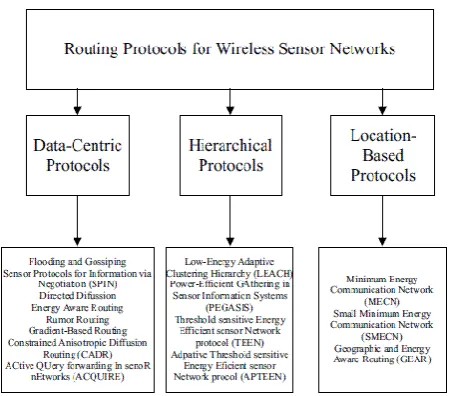
II. CLASSIFICATION OF WSN ROUTING PROTOCOLS
Data-Centric Protocols Hierarchical Protocols Location- Based Protocols
The following subsections are detailed description of this classification.
Fig 2: Classification of Routing Protocols in WSN
2.1 Data-Centric Protocol
In many application of sensor network it is not feasible to have unique global identifier due to numerous nodes deployment. Due to this problem it is hard to select a particular set of nodes to be queried. Therefore data is usually sent from each sensor node within the deployment region with lot of redundancy. This is very wasteful in terms energy consumption. Routing protocols that will be able to select a set sensor nodes and use data aggregation during the relaying of data have been considered. This consideration has led to data centric protocols. Based on the data centric algorithm SPIN is the first protocol.
SPIN (Sensor protocol for information Negotiation) Directed Diffusion
2.2 Hierachical Protocol
Scalability is the one of major design issue in the all network. A single-tier network can cause the gateway to overload with the increase in sensors density. Such overload might cause latency in communication and inadequate tracking of events. In addition, the single-gateway architecture is not scalable for a larger set of sensors covering a wider area of interest since the sensors are typically not capable of long-haul communication. The main aim of the hierarchical based routing is to efficiently maintain the energy consumption of the sensor nodes by involving them in multi hop communication within a particular cluster and performing the data aggregation and fusion in order to decrease the no of transmitted messages to the sink. LEACH is the first cluster based routing protocol for the sensor network.
APTEEN (Adaptive Threshold TEEN)
PEGASIS (Power efficient Gathering Sensor Information System)
2.3 Location-Based Protocol
Sensor nodes are addressed by mean of their locations. The distance between neighboring node can b estimated on the basic of incoming signal .Relative coordinates of neighboring can be obtained by exchanging such information between neighboring or by communication with the satellite using GPS. To save energy, some based schemes demand that nodes should go to sleep if there is no connectivity.
III. LEACH PROTOCOL
LEACH (Low-Energy Adaptive Clustering Hierarchy) is a routing protocol for wireless sensor networks. It is a hierarchical based protocol that is energy efficient as compared to traditional protocols. It’s the first network protocol which adopted hierarchical structure. LEACH algorithm [6] is one of the most popular clustering algorithms proposed for wireless sensor networks because of its simplicity and effectiveness. LEACH uses rotation of cluster heads to balance network energy consumption. The operation of the LEACH is divided into a number of rounds. Each round includes a set-up and a steady phase. Clusters are organized in set-up phase while sensed data are transferred from sensors to cluster heads in steady phase. In LEACH, cluster heads are elected in a distributed manner and independent from each other. The role of cluster heads is to collect data from cluster members and to aggregate and forward them to the base station. In each round, nodes make their decision to be cluster heads by choosing a random number x which is a number between 0 and 1. A sensor decides to be a cluster head in a round if its generated random number is less than the below threshold [6]:
.
(1)
Where,
P = Desired cluster head percentage r = Current Round
G = Set of nodes which have not been cluster heads in 1/P rounds
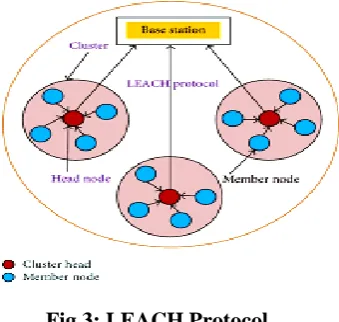
LEACH is a self-organizing, adaptive clustering protocol that uses randomization to distribute the energy load evenly among the sensors in the network. In LEACH, the nodes organize themselves into local clusters, with one node acting as the local base station or cluster-head. The cluster head nodes receive sensed data, aggregate the data to remove redundancy and fusion processes are carried out and data is send to the sink (or Base Station). So LEACH increases network lifetime by decreasing network energy consumption, and reducing number of communication messages by data aggregation and fusion. The process of formation of clusters in LEACH is shown in figure 3.
if n G 1
1 * ( mod )
( )
0 otherwise
P
P r
T n
P
Fig 3: LEACH Protocol
In order to achieve the design goal the key tasks performed by Leach are as follows [7]: 1. Randomized rotation of the cluster heads and the corresponding clusters.
2. Global communication reduction by the local compression. 3. Localized co-ordination and control for cluster setup and operation. 4. Low energy media access control.
5. Application specific data processing.
3.1 Disadvantages of LEACH Protocol
There are some disadvantages of clustering also which are as follows [8]:
The spending of energy on cluster-heads has not been tackled because nodes will absorb with more calculation and communiqué of data to superior level.
In this clustering there is no real life situation but only an idyllic network is assumed. Different clusters have load imbalance possibly.
The Overhead is not deemed which is related with the cluster-heads selection.
IV. VARIANTS OF LEACH PROTOCOL
There are some variants of LEACH Protocols in wireless sensor networks. a. LEACH-C (Centralized LEACH
):
b. LEACH-F (Fixed number of clusters):
It is the modified version of LEACH protocol with fixed clusters and rotating cluster heads. A stable clusters and rotating cluster head concept is used by Leach-F in which cluster once formed is maintained stable throughout the network lifetime in order to avoid re-clustering. In Leach-F does not allow new nodes to be added to the system and do not adjust their behaviour based on nodes dying. Only the cluster head position is rotated among the nodes within the cluster.
c. Enhanced-leach (E-LEACH):
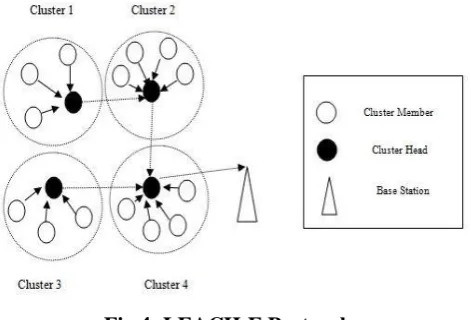
E-LEACH IS based on LEACH protocol to balance the energy consumption of sensor nodes in order to solve the overload energy consumption problem. The E-LEACH adopts the same round concept with the original LEACH. In hierarchical routing protocols, the number of cluster-heads is a key factor that affects the performance of routing protocols. If the number of cluster-heads is less, each cluster-head needs to cover larger region, this will lead the problem that some cluster-members get far from their cluster-heads and consume much more energy. As the communication between cluster heads and the base station needs much more energy than common nodes, the excessive number of cluster-heads will increase the energy consumption of the whole network and shorten the network lifetime. Therefore, it is necessary to select optimal cluster head number to make the energy consumption minimum. In the E-LEACH minimum spanning tree between cluster heads is used, choose the cluster head which has largest residual energy as the root node [11].
Fig 4: LEACH-E Protocol
d. LEACH-B (Balanced- LEACH):
LEACH-B uses decentralized approach of cluster formation in which each sensor node knows about its own position and position of final destination irrespective of position of rest of the nodes in the network. LEACH-B works in three stages: Cluster head selection, Cluster formation and data transmission with multiple accesses. According to energy dissipated in the path between a node and final receiver, each node chooses its cluster head. LEACH-B has better energy efficiency than basic LEACH protocol [12].
e. Multi-hop leach (M-LEACH):
communication between CHs or the sink is not possible due to the distance between them. Thus, the main innovation of the solution proposed here is that the multi-hop approach is followed inside the cluster and outside the cluster. CHs can also perform data fusion to the data receive, allowing a reduction in the total transmitted and forwarded data in the network [13].
f. I-LEACH (Improved Low Energy Adaptive Clustering Hierarchy):
Detection of Twin nodes and assignment of Sub-Cluster Head (SCH) nodes are the two functions served by Improved-LEACH protocol. Randomly deployment of nodes results in high probability of two nodes located very close to each other called Twin nodes. It is necessary to keep one node sleep until the energy of another node depletes. Therefore I-LEACH has uniform distribution of cluster head so that it doesn’t run out of energy when longer distance transmission takes place. This protocol uses threshold approach for managing number of cluster members for each cluster head in the network at a time [14].
g.LEACH-A(ADVANCEDLOWENERGYADAPTIVECLUSTERINGHIERARCHY):
LEACH protocol has a problem that the cluster head node consumes more energy than normal nodes. Advanced-LEACH protocol, a heterogeneous protocol used to decrease probability of failure nodes and for extending the time interval before the death of the first node (called stability period). Each sensor knows the starting of each round using synchronized clock. Let n be the total number of nodes and m be the fraction of n that have energy more than other nodes called CGA nodes (nodes selected as gateways or cluster heads) [15]. h. V-LEACH (Vice Cluster Head Low Energy Adaptive Clustering Hierarchy):
In classical LEACH protocol, the cluster head node consumed more energy as compared to normal nodes in sending aggregated data to the base station (located far away). Therefore the cluster head node dies early and the whole cluster will become useless, results data loss [13] [16]. V-LEACH improves this drawback having vice-cluster head in each vice-cluster that takes the role of vice-cluster head when vice-cluster head dies. In this way, this protocol reduces overhead of selecting new cluster head each time when a cluster head dies and the data will always reach to the base station. Hence network lifetime increases.
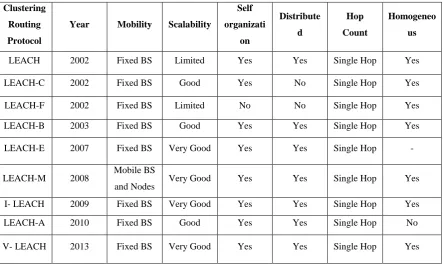
V. COMPARES THE FEATURES OF LEACH PROTOCOL AND ITS VARIANTS
TABLE 1: Performance Comparison Between LEACH Protocol Variants
Clustering
Routing
Protocol
Year Mobility Scalability
Self
organizati
on
Distribute
d
Hop
Count
Homogeneo
us
LEACH 2002 Fixed BS Limited Yes Yes Single Hop Yes
LEACH-C 2002 Fixed BS Good Yes No Single Hop Yes
LEACH-F 2002 Fixed BS Limited No No Single Hop Yes
LEACH-B 2003 Fixed BS Good Yes Yes Single Hop Yes
LEACH-E 2007 Fixed BS Very Good Yes Yes Single Hop -
LEACH-M 2008 Mobile BS
and Nodes Very Good Yes Yes Single Hop Yes
I- LEACH 2009 Fixed BS Very Good Yes Yes Single Hop Yes
LEACH-A 2010 Fixed BS Good Yes Yes Single Hop No
V- LEACH 2013 Fixed BS Very Good Yes Yes Single Hop Yes
VI. CONCLUSION
In this paper we considered a well known protocol for WSNs called LEACH protocol, which is the first and the most important protocol in WSN which uses energy efficiently in the network has been the main issue in WSNs for prolonging lifetime of the network. LEACH has found one of the most energy efficient protocols used in WSN. In this study, LEACH protocol has been discussed with its drawbacks and how these drawbacks are overcome by its descendants. A brief study of various improved versions of LEACH protocol has been done in order to compare performance of these descendants with the classical LEACH. It is concluded from given study that for prolonging network lifetime of WSN, there is need to explore more robust, reliable and efficient protocols in future.
REFERENCES
[1] Huang, Ru, Zhihua Chen, and Guanghui Xu. "Energy-aware Routing Algorithm in WSN using Predication-mode." In Communications, Circuits and Systems (ICCCAS), 2010 International Conference on, pp. 103-107. IEEE, 2010.
[2] J.Zheng and A.Jamalipour, Wireless Sensor Networks: A Networking Perspective, Institute of Electrical and Electronics Engineers, 2009.
[3] Ye, Zhengmao, and Habib Mohamadian. "Adaptive Clustering based Dynamic Routing of Wireless Sensor Networks via Generalized Ant Colony Optimization." IERI Procedia 10 (2014): 2-10.
Communication Systems and Network Technologies (CSNT), 2014 Fourth International Conference on, pp. 83-88. IEEE, 2014.
[5] A.Braman and Umapathi G.R, “A Comparative Study on Advances in LEACH Routing Protocol for Wireless Sensor Networks: A survey,” International Journal of Advanced Research in Computer and Communication Engineering (IJARCCE), vol. 3, issue 2, pp. 5683-5690, February 2014.
[6] W. Heinzelman, A. Chandrakasan, and H. Balakrishnan, “Energy-Efficient Communication Protocol for Wireless Micro sensor Networks” Proceed- ings of the 33rd Annual Hawaii International Conference on System Sciences, pp. 3005–3014, Jan. 2000.
[7] W.Heinzelman, A.Chandrakasan, and H.Balakrishnan, ”Energy-efficient Routing Protocols for Wireless Microsensor Networks,” in Proc. 33rd Hawaii Int. Conf. System Sciences (HICSS), Maui, HI, Jan.2000. [8] Alia Sabri and Khalil Al-Shqeerat, "Hierarchical Cluster-Based Routing Protocols for Wireless Sensor
Networks – A Survey," IJCSI International Journal of Computer Science Issues, Vol. 11, Issue 1, No 2, January 2014.
[9] PrakashgoudPatil, UmakantKulkarni and N. H. Ayachit, " Some Issues in Clustering Algorithms for Wireless Sensor Networks," IJCA Special Issue on “2nd National Conference- Computing, Communication and Sensor Network CCSN, 2011.
[10] T. Murata and H. Ishibuchi, “Performance evaluation of genetic algorithms for flowshop scheduling problems,”Proc. 1st IEEE Conf. Evolutionary Computation, vol. 2, pp. 812–817, June 1994.
[11] Jia Xu,Ning Jin, Xizhong Lou,Ting Peng,Qian Zhou,Yanmin Chen “Improvement of LEACH protocol for WSN” 2012 IEEE.
[12] M.Usha and Dr.N.Sankarram, “A Survey on Energy Efficient Hierarchical (Leach) Clustering Algorithms in Wireless Sensor Network,” International Journal of Innovative Research in Computer and Communication Engineering (IJIRCCE), Proceedings of International Conference On Global Innovations in Computing Technology (ICGICT’14), vol.2, special issue 1, pp. 601-609, March 2014.
[13] Hwa Young Lim, Sung Soo Kim, Hyun Jun Yeo, Seung Woon Kim, and Kwang Seon Ahn “ Maximum Energy Routing Protocol based on Strong Head in Wireless Sensor Networks ” 2007 IEEE.
[14] E.Abdellah, S. Benalla, A.B.Hsaane, and M. Lahcen, “Advanced Low Energy Adaptive Clustering Hierarchy,” (IJCSE) International Journal on Computer Science and Engineering, vol. 02, no. 07, pp. 2491-2497, 2010.
[15] V.Kumar, S.Jain, and S. Tiwari, “Energy Efficient Clustering Algorithms in Wireless Sensor Networks: A Survey,” International Journal of Computer Science Issues (IJCSI), vol. 8, issue 5, no. 2, pp. 259-268, September 2011.