c
Owned by the authors, published by EDP Sciences, 2016
A framework for unified Dirac gauginos
Karim Benakli1,a
1Sorbonne Universités, UPMC Univ Paris 06, UMR 7589, LPTHE, F-75005, Paris, France CNRS, UMR 7589, LPTHE, F-75005, Paris, France
Abstract. We identify the Minimal Dirac Gaugino Supersymmetric Standard Model (MDGSSM) as the minimal field content with Dirac gauginos allowing unification of gauge coupling. We stress that its parameter space describes also other most popular models as the MSSM, NMSSM and MRSSM. We discuss the generation of trilinear cou-plings in models of gauge mediation that has been overlooked in the past. We study the different source of Higgs mixings and constraints from theρparameter. Finally, we provide new experimental limits on the masses of the scalar octets.
1 Introduction
The possibility of extending the MSSM to allow Dirac gaugino masses has been subject to many studies (see for example [1–23]. Multiple realisations have been proposed that differ by the fate of
R-symmetry, the presence or absence of additional states and interactions (for a short introduction see for example [14]). Here we argue that the field content of the MDGSSM is the minimal content of extra states to describe al these models that automatically preserve unification of gauge couplings while allowing the new couplings to the Higgs to enhance naturalness and allow the boundary conditions to be unified at a high energy scale.
The additional states compare to the MSSM are:
• A singlet, a triplet and an octet supermultipletsS,TandO, respectively, introduced to give the gauginos Dirac masses.
• There are extra vector-like charged states, subsequently called “fake leptons” [16] as they carry the same quantum numbers as the Standard Model leptons. They were introduced in order to restore the automatic gauge coupling unification that was spoiled by the addition of the adjoint representations of the Standard Model gauge group.
One of the important novelty of the Dirac gaugino models with respect to the NMSSM is its mixing with the Standard Model Higgs. This mixing is present at tree level due to the supersymmetric operator describing the Dirac gaugino bino mass leads to a modification of theU(1)YD-term as
D1=D(0)Y →D1=−2m1DSR+D(0)Y with D(0)Y =−g
j
Yjϕ∗jϕj (1.1)
whereSRis the real part ofS andϕja scalar field with chargeYjunderU(1)Y. Upon elimination of the auxilliary fields, this implies an interaction of the form:
gm1DSR(|Hu0|2− |Hd0|2). (1.2)
thereof a tree-level induced mixing. However, as this can typically be compensated by the presence in the superpotential of a term of the form:
W ⊃λSS HuHd. (1.3)
A precise evaluation of this mixing at the tree and one-loop level needs to be carried out carefully. The parameter space is constrained by the requirements of stability of the vacuum avoiding ex-istence of directions in the phase space of the model taking the fields expectation values to charge-and colour- breaking vacua. This is important due to trilinear terms, some have not been explicitly discussed in the existing literature while they are expected to be generically present in the model. This is the case for example of soft terms mixing three adjoint scalars that we will show that they are generated in models of gauge mediation. It is also constrained if one needs to keep couplings small enough if we want to preserve perturbativity up to the GUT scale. This restriction can be of course relaxed if one allows for Landau poles below the GUT scale. However, as one of the virtues of the MSSM was to predict perturbative unification of gauge couplings, and was one of the motivations for introducing the MDGSSM, we shall place emphasis on regions of the parameter space which respect this condition.
2 The MDGSSM field content
The MDGSSM field content can be seen as the minimal set providing the MSSM gauginos a Dirac mass while preserving two-loop unification and perturbativity of gauge couplings. We summarised it in Table 1. In addition to the chiral multiplets transforming under the adjoint representations of the gauge groups, it includes new fields charged under the lepton number global symmetry. They consist of extra Higgs-like doublets1Ru,Rdas well as two pairs of vector-like right-handed electron superfieldsE1,2 in (1,1)1 and ˜E1,2 in (1,1)−1. Such states are compatible with an (S U(3))3 Grand Unification gauge group. This is the minimal set which enables a “natural” unification (unification without mass thresholds tuning) similar to the MSSM. The adjoint chiral multiplets contain new com-plex adjoint scalars,S,T andO:
S = SR√+iSI
2
T = 1
2√2
TR+iTI √2(T+R+iT+I)
√
2(T−R+iT−I) −(TR+iTI)
O(a)= O(Ra)+iO(Ia)
√
2 (2.1)
where theSR,O(Ra),TR,T−R,T+R and theSI,O(Ia),TI,T−I,T+I are real scalars and pseudo-scalars, re-spectively.
1The hypercharges are opposite with respect to the Higgs doublet in the MSSM to match the MRSSM notation for the same
whereSRis the real part ofS andϕja scalar field with chargeYjunderU(1)Y. Upon elimination of the auxilliary fields, this implies an interaction of the form:
gm1DSR(|Hu0|2− |H0d|2). (1.2)
thereof a tree-level induced mixing. However, as this can typically be compensated by the presence in the superpotential of a term of the form:
W ⊃λSS HuHd. (1.3)
A precise evaluation of this mixing at the tree and one-loop level needs to be carried out carefully. The parameter space is constrained by the requirements of stability of the vacuum avoiding ex-istence of directions in the phase space of the model taking the fields expectation values to charge-and colour- breaking vacua. This is important due to trilinear terms, some have not been explicitly discussed in the existing literature while they are expected to be generically present in the model. This is the case for example of soft terms mixing three adjoint scalars that we will show that they are generated in models of gauge mediation. It is also constrained if one needs to keep couplings small enough if we want to preserve perturbativity up to the GUT scale. This restriction can be of course relaxed if one allows for Landau poles below the GUT scale. However, as one of the virtues of the MSSM was to predict perturbative unification of gauge couplings, and was one of the motivations for introducing the MDGSSM, we shall place emphasis on regions of the parameter space which respect this condition.
2 The MDGSSM field content
The MDGSSM field content can be seen as the minimal set providing the MSSM gauginos a Dirac mass while preserving two-loop unification and perturbativity of gauge couplings. We summarised it in Table 1. In addition to the chiral multiplets transforming under the adjoint representations of the gauge groups, it includes new fields charged under the lepton number global symmetry. They consist of extra Higgs-like doublets1Ru,Rdas well as two pairs of vector-like right-handed electron superfieldsE1,2 in (1,1)1 and ˜E1,2 in (1,1)−1. Such states are compatible with an (S U(3))3 Grand Unification gauge group. This is the minimal set which enables a “natural” unification (unification without mass thresholds tuning) similar to the MSSM. The adjoint chiral multiplets contain new com-plex adjoint scalars,S,TandO:
S = SR√+iSI
2
T = 1
2√2
TR+iTI √2(T+R+iT+I)
√
2(T−R+iT−I) −(TR+iTI)
O(a)= O(Ra)+iO(Ia)
√
2 (2.1)
where theSR,O(Ra),TR,T−R,T+R and theSI,O(Ia),TI,T−I,T+I are real scalars and pseudo-scalars, re-spectively.
1The hypercharges are opposite with respect to the Higgs doublet in the MSSM to match the MRSSM notation for the same
fields.
Names Spin 0 Spin 1/2 Spin 1 (S U(3),S U(2),U(1)Y) R-charge Quarks Q Q˜ =(˜uL,d˜L) (uL,dL) (3,2, 1/6) 1
Uc U˜c
L ULc (3,1, -2/3) 0
(×3 families) Dc D˜c
L DcL (3,1, 1/3) 0
Leptons L (˜νeL,˜eL) (νeL,eL) (1,2, -1/2) 1
(×3 families) Ec E˜c Ec (1,1, 1) 0
Higgs Hu (Hu+,H0u) ( ˜Hu+,H˜u0) (1,2, 1/2) 1 Hd (Hd0,Hd−) ( ˜H0d,H˜−d) (1,2, -1/2) 1
Gluons W3α λ3α g (8,1, 0) 1
[≡gα]˜
W W2α λ2α W±,W0 (1,3, 0) 1
[≡W˜±,W˜0]
B W1α λ1α B (1,1, 0 ) 1
[≡B]˜
DG-octet O O χg (8,1, 0) 0
[≡g˜]
DG-triplet T {T0,T±} {χ0
T, χ±T} (1,3, 0 ) 0 [≡ {W˜±,W˜0}]
DG-singlet S S χS (1,1, 0 ) 0
[≡B˜]
Higgs-like Ru Ru R˜u (1,2, -1/2) 1
leptons Rd Rd R˜d (1,2, 1/2) 1
Fake ˆE(×2) Eˆ Eˆ˜ (1,1,1) 0
electrons ˆE(×2) Eˆ Eˆ˜ (1,1,-1) 2
Table 1:Chiral and gauge multiplet fields in the model.
The superpotential for these fields can be written as
W =WYukawa+WDG+WRV (2.2)
whereWYukawacontains the usual MSSM Yukawas part
WDGcontains theR-symmetric (according to the choice of R-charges in table 1) contributions of the non-MSSM fields
WDG=(µ+λSS)HdHu+√2λTHdTHu (µR+λS RS)RuRd+2λTRRuTRd
+(µE i jˆ +λSEˆci jS)ˆEiˆEj+λS Ei jSEciˆEj (2.4)
+λS LRiSLiRd+2λT LRiLiTRd−YEiˆRuHdˆEi
−YLFVi j Li·HdˆEj−YEFVj RuHdEcj, whileWRVgathers the R-symmetry violating terms
WRV=LS+ ˆ M1
2 S2+ κ
3S3+Mˆ2tr(TT)+Mˆ3tr(OO)
+λS TStr(TT)+λS OStr(OO)+κO
3 tr(OOO)−YEˆiRdHuˆEi
−→
R−symmetry0 (2.5)
For the soft SUSY-breaking terms, from the MSSM we retain only the bilinear terms – i.e. con-ventional mass-squared terms and theBµterm. All the scalar trilinear and Majorana gaugino mass terms violate R-symmetry; while forBµwe suppose that, since R-symmetry is a chiral symmetry, we are breaking R-symmetry in the Higgs sector – and in fact it is only in combination with the super-potential termsµ, λS, λT that the R-symmetry is violated. Hence in principle we can have an entirely R-preserving supersymmetry-breaking sector.
The soft SUSY breaking terms beyond those of the MSSM consist of2:
• Dirac gaugino masses:
Wsupersoft=
d2θ√2θαm
D1SWYα+2mD2tr(TW2α)+2mD3tr(OW3α)
. (2.6)
• soft terms associated with the adjoint scalars
−∆Lscalar softadjoints =m2S|S|2+1
2BS(S2+h.c.)+2m2Ttr(T†T)+(BTtr(TT)+h.c.) +2m2Otr(O†O)+(BOtr(OO)+h.c.)
+TSS Hu·Hd+2TTHd·T Hu+13κAκS3+tSS +h.c.
+TS OStr(O2)+TS TStr(T2)+1
3TOtr(O3)+h.c.
(2.7)
The terms on the last line have generally been neglected, but will play an important role in this work.
• soft terms involving the new vector-like leptons:
−∆Lscalar softvector−like=m2Ru|Ru|2+m2Rd|Rd|2+[BRRdRu+h.c.]
+Eˆi(m2Eˆ)ijEˆj+Eˆi(m2Eˆ) j
iEˆj+[BEi jˆEˆiEˆj+h.c.]
+[TS Ei j SEˆiEˆj+TS RS RdRu+h.c.]. (2.8) 2We suppress gauge indices while retaining generation indices and denote the complex conjugation of fields by upper versus
WDGcontains theR-symmetric (according to the choice of R-charges in table 1) contributions of the non-MSSM fields
WDG=(µ+λSS)HdHu+ √2λTHdTHu (µR+λS RS)RuRd+2λTRRuTRd
+(µE i jˆ +λSEˆci jS)ˆEiˆEj+λS Ei jSEciˆEj (2.4)
+λS LRiSLiRd+2λT LRiLiTRd−YEiˆRuHdˆEi
−YLFVi j Li·HdˆEj−YEFVj RuHdEcj, whileWRVgathers the R-symmetry violating terms
WRV=LS+ ˆ M1
2 S2+ κ
3S3+Mˆ2tr(TT)+Mˆ3tr(OO)
+λS TStr(TT)+λS OStr(OO)+κO
3 tr(OOO)−YEˆiRdHuˆEi
−→
R−symmetry0 (2.5)
For the soft SUSY-breaking terms, from the MSSM we retain only the bilinear terms – i.e. con-ventional mass-squared terms and theBµterm. All the scalar trilinear and Majorana gaugino mass terms violate R-symmetry; while forBµwe suppose that, since R-symmetry is a chiral symmetry, we are breaking R-symmetry in the Higgs sector – and in fact it is only in combination with the super-potential termsµ, λS, λT that the R-symmetry is violated. Hence in principle we can have an entirely R-preserving supersymmetry-breaking sector.
The soft SUSY breaking terms beyond those of the MSSM consist of2:
• Dirac gaugino masses:
Wsupersoft=
d2θ√2θαm
D1SWYα+2mD2tr(TW2α)+2mD3tr(OW3α)
. (2.6)
• soft terms associated with the adjoint scalars
−∆Lscalar softadjoints =m2S|S|2+1
2BS(S2+h.c.)+2m2Ttr(T†T)+(BTtr(TT)+h.c.) +2m2Otr(O†O)+(BOtr(OO)+h.c.)
+TSS Hu·Hd+2TTHd·T Hu+13κAκS3+tSS +h.c.
+TS OStr(O2)+TS TStr(T2)+1
3TOtr(O3)+h.c.
(2.7)
The terms on the last line have generally been neglected, but will play an important role in this work.
• soft terms involving the new vector-like leptons:
−∆Lscalar softvector−like=m2Ru|Ru|2+m2Rd|Rd|2+[BRRdRu+h.c.]
+Eˆi(m2Eˆ)ijEˆj+Eˆi(m2Eˆ) j
iEˆj+[BEi jˆEˆiEˆj+h.c.]
+[TS Ei j SEˆiEˆj+TS RS RdRu+h.c.]. (2.8) 2We suppress gauge indices while retaining generation indices and denote the complex conjugation of fields by upper versus
lower indices.
Let us highlight that in an R-symmetry conserving model, one cannot simultaneously have the trilinearsTS E (respectivelyTS R) from (2.8) and the superpotential couplingsλS E(respectivelyλS R) from (2.4) as each term requires a different R-charge for the fields ˆEand ˆE(respectivelyRuandRd) to be R-invariant.
We consider now the scalar mass matrix. We use the notation
˜ m2
S = m˜2S R+λ2S v 2 2 ˜
m2
T = m˜2TR+λ2T v2
2 , (2.9)
where the effective masses for the real parts ofS andT read:
˜ m2
S R = m2S +4m21D+BS, m˜2TR =m2T+4m22D+BT. (2.10) Then, at tree level the scalar mass matrix in the basis{h,H,SR,TR0}is [15]:
M2
Z+ ∆hs22β ∆hs2βc2β ∆hS ∆hT
∆hs2βc2β M2A−∆hs22β ∆HS ∆HT
∆hS ∆HS m˜2S λSλTv
2
2
∆hT ∆HT λSλTv22 m˜2T
(2.11)
where we have defined:
∆h = v 2
2(λ2S +λ2T)−MZ2 (2.12)
which vanishes whenλS andλT take theirN=2 values,
∆hS =−2vS vm˜
2
S R, ∆hT =−2vT v m˜
2
TR (2.13)
and
∆HS =gm1Dvs2β, ∆HT =−gm2Dvs2β.
(2.14) This matrix is diagonalised by the mixing matrixSi j. Of particular interest will beS11which measures if the lightest scalar eigenstate is Standard Model Higgs like, andS13which measures the proportion of the scalar singletSRin this lightest eigenstate.
3 Higgs mixing
The singletS is that it will in general mix with the Higgs eigenstates. This will lead to tree-level de-cays ofS into tops,W,Zor Higgs which are experimentally constrained. The minimisation condition ofvS on the off-diagonal element∆hS of the scalar mass matrix given in (2.13) leads to (see [13])
∆hS =v[vSλ2S −gm1Dc2β+√2λSµ+λSλTvT]
=v[√2λSµ˜−gm1Dc2β], (3.1)
where we used the effective mass parameter
˜
µ=µ+ √1
From this basic analytical calculation, we see that we can minimise the tree-level mixing by choosing:
λS ∼ gYm1√Dc2β
2˜µ . (3.3)
In general, this relation will be modified at one-loop, but the property that one value ofλS is favoured will remain.
Also, the v.e.v. ofT gives a contribution to theWboson mass and the electroweak precision data give bounds on it. The induced correction to theρ-parameter:
ρ≡ M 2 W c2
θWM 2 Z
=1+ ∆ρ , (3.4)
with∆ρis given analytically at tree-level by ([13])
∆ρ∼ 4v
2 T
v2 , (3.5)
wherevis the usual Standard Model Higgs v.e.v.. In order to be below the experimental constraints, we need∆ρ(4.2±2.7)×10−4, ( [13] – see also [24,25] –). At tree level, we have
vT v 2
2 ˜m2 TR
−gm2Dc2β−√2˜µλT , (3.6)
with ˜m2
TR=m2T+4m22D+BT, therefore, small∆ρrequire large triplet Dirac and soft masses. This re-quirement can often be at odd with naturalness which prefers smaller triplet masses. Indeed, radiative corrections induced by the adjoint triplet scalars tom2
Hu,dare [13]:
δm2 Hu,d⊃ −
1
16π2(2λ2Tm2T)log
Λ
TeV
, (3.7)
withΛthe UV cut-off, m2Hu
,d,m 2
T the squared masses for Higgses and scalar triplet T, and λT the coupling defined in (2.4). ForΛat the Planck scale, requiring a fine-tuning∆T =δm2H/m2Hbetter than 10% finally gives us
mT 1
λT450 GeV. (3.8)
4 Trilinear couplings
Previous studies of Dirac gaugino models have generally neglected the phenomenology of adjoint self-coupling terms, with an exception being a superpotential term κ
3S3used in [13] to generateµ/Bµ as in the NMSSM, and a recent brief discussion in [26]. In the case of superpotential terms such as λS O these can be neglected when considering an R-symmetric visible sector; however, trilinear soft couplings such asTS O,TO(see (2.7)) are always allowed. It is therefore interesting to consider what values we expect from models of supersymmetry-breaking mediation.
Starting with a spurion analysis where supersymmetry is broken by either a D-termDor F-termF, then if the mediating dynamics is at a scaleMthe terms in our effective Lagrangian should be given by
powers of D
M,FM,MD2,MF2 with appropriate factors of couplings andκl≡1/16π2. Furthermore, quartic
From this basic analytical calculation, we see that we can minimise the tree-level mixing by choosing:
λS ∼ gYm1√Dc2β
2˜µ . (3.3)
In general, this relation will be modified at one-loop, but the property that one value ofλS is favoured will remain.
Also, the v.e.v. ofT gives a contribution to theWboson mass and the electroweak precision data give bounds on it. The induced correction to theρ-parameter:
ρ≡ M 2 W c2
θWM 2 Z
=1+ ∆ρ , (3.4)
with∆ρis given analytically at tree-level by ([13])
∆ρ∼ 4v
2 T
v2 , (3.5)
wherevis the usual Standard Model Higgs v.e.v.. In order to be below the experimental constraints, we need∆ρ(4.2±2.7)×10−4, ( [13] – see also [24,25] –). At tree level, we have
vT v 2
2 ˜m2 TR
−gm2Dc2β−√2˜µλT , (3.6)
with ˜m2
TR=m2T+4m22D+BT, therefore, small∆ρrequire large triplet Dirac and soft masses. This re-quirement can often be at odd with naturalness which prefers smaller triplet masses. Indeed, radiative corrections induced by the adjoint triplet scalars tom2
Hu,dare [13]:
δm2 Hu,d ⊃ −
1
16π2(2λ2Tm2T)log
Λ
TeV
, (3.7)
withΛthe UV cut-off,m2Hu
,d,m 2
T the squared masses for Higgses and scalar triplet T, and λT the coupling defined in (2.4). ForΛat the Planck scale, requiring a fine-tuning∆T =δm2H/m2Hbetter than 10% finally gives us
mT 1
λT450 GeV. (3.8)
4 Trilinear couplings
Previous studies of Dirac gaugino models have generally neglected the phenomenology of adjoint self-coupling terms, with an exception being a superpotential term κ
3S3used in [13] to generateµ/Bµ as in the NMSSM, and a recent brief discussion in [26]. In the case of superpotential terms such as λS Othese can be neglected when considering an R-symmetric visible sector; however, trilinear soft couplings such asTS O,TO(see (2.7)) are always allowed. It is therefore interesting to consider what values we expect from models of supersymmetry-breaking mediation.
Starting with a spurion analysis where supersymmetry is broken by either a D-termDor F-termF, then if the mediating dynamics is at a scaleMthe terms in our effective Lagrangian should be given by
powers of D
M,MF,MD2,MF2 with appropriate factors of couplings andκl≡1/16π2. Furthermore, quartic
and higher-order couplings – which are “hard” SUSY-breaking parameters – are always generated, but
do not lead to quadratic divergences because they appear suppressed by powers of the scaleMwhich is the cutoffof our effective theory. Important in this work are the quartics such asL ⊃ λ4S
24S4which must have sizeλ4S ∼κpl
D M2
q
for some integer p,q (or similarly for F-terms witheven q)); taking p=1,q=1 for a D-term we naively have a quadratic divergence in the scalar mass proportional to
λ4S but this yields∆m2S ∼κlλ4SM2 ∼κ2lDM2, while forq=2 we haveκ2l D
2
M2. In fact, this tells us
that the caseq =1 is special because it implies a much larger correction at one loop than the direct
mass, and could therefore destabilise the calculation. We shall return to this below.
As a first observation, if the mediation is by gravity, thenMshould be identified with the Planck scale (unless there is significant sequestering) and we should only consider the leading order terms. We would therefore require the quantum gravity theory to give us the termsTS O,TOat leading order D/M,F/Mand the quartics must, by the above reasoning, be negligible.
On the other hand, in the case of low-scale supersymmetry breaking – where it was argued in [21] that this requires Dirac gauginos – √F ∼ √D ∼ M ∼TeV, and we generate all terms at a similar order, which would includeTS O,TO. However, the phenomenology is significantly changed by the presence of higher-dimensional operators and the goldstino couplings [27] and, since it is difficult to
reconcile with perturbative unification, we shall not discuss this further here.
Finally, for gauge mediationM could be as small as √F or √Dbut there is no a priori upper limit on M until we choose a particular quantum gravity embedding. The Dirac gaugino masses are expected to be generated at one loop and be of order κlMD or κlF
2
M3. For F-term breaking the
standard gauge-mediation soft mass-squareds for the squarks/sleptons are of orderκ2l FM22, while in
D-term breaking they may be suppressed. Therefore if we imagine thatκlMD ∼TeV, then for termsκlMD23
to be significant we would needD∼M2and furthermoreM ∼100 TeV.
4.1 Adjoint couplings in gauge mediation
One of the most interesting issues in the construction of gauge mediation models with Dirac gaugino masses has been that of the adjoint scalar masses: in the simplest realisation, only a B-type mass-squaredL ⊃ −1
2BΣΣ2 is generated at leading order in D/M2, and not a conventional mass-squared
L ⊃ −m2
Σ|Σ|2. This happens for one pair of vector-like messengersQ,Q˜having charges under a hidden U(1) of+1,−1, where theU(1) obtains a D-term. This was noticed from the earliest models [3,5]
with the original proposed solution being to add a supersymmetric mass for the adjoint – which would also violate the R-symmetry and generate Majorana masses for the gauginos, with a see-saw effect.
However, an alternative solution was found to be to introduce additional messenger states with non-diagonal couplings to either the adjoints (in the D-term case) [10,12] or an F-term spurion [8,10,12]; in the D-term case this requires the couplings to violate theU(1)-charges. In [12] examples were given where the ratio of B-type to conventional masses is arbitrary. The general ansatz was to couple the adjoint to messenger fieldsQi,Q˜jand to possible F-term spurionsXvia superpotential couplings
W ⊃MQiQ˜i+λi˜jQiΣQ˜j+µi˜jXQiQ˜j (4.1)
and D-terms via chargesei,e˜iwhich we can write as a matrixei j(QiQ∗j−Q˜iQ˜∗j).
More in the spirit of the earlier works, the issue was rephrased in the language of effective
op-erators in [26,28,29], where it was claimed that the explanation for the absence of conventional mass-squared terms for the adjoints at leading order is that the operator responsible for the generation of a leading-order mass-squared term should be
L ⊃
d4θ 1
M2[ψ†e
whereψ,ψ˜ are a pair of fields charged under the hiddenU(1) with charges±qwhich obtain v.e.v.s (and thus generate a contribution to the hidden D-term). The above operator is generated by including terms in the superpotential that mix the messengersQ,Q˜ with other pairs of fields N,N˜ which are neutral (or at least have different charges) under the hiddenU(1), so that the v.e.v.s ofψ,ψ˜ generate messenger mixing terms. This is clearly nearly equivalent to the above ansatz, and can be written in the form
W ⊃Mi jQiQ˜j+λiQiΣQ˜i (4.3)
where we now write the mass terms as violating theU(1) charges instead.
If we start with the case of no couplings/mass mixing terms that violate theU(1) D-term charges,
we shall first give a simple proof that the conventional mass term|Σ|2vanishes at leading order for any
number of messengers, and then look at higher-order terms. Considering first the visible gauge group to beU(1), we have the effective potential contribution from the messenger scalars (since the fermion
potential is independent ofD):
V =
ddq
(2π)dtr log(q2+M2Q+De)+tr log(q2+M2Q˜ −De)
≡V++V−. (4.4)
Here we haveM2Q=(M+λΣ)(M†+λ†Σ),MQ2˜ =(M†+λ†Σ)(M+λΣ)(M†+λ†Σ) are the supersymmetric mass-squared matrices. Now, if we take the couplings to preserve theU(1) charges then we can write the
V+=De
ddq (2π)dtr
q2+1M2 Q
−12D2e2 ddq
(2π)dtr
q2+1M2 Q
2
+O(D3)
→16π2V=D2e2trlogM2 Q/µ2
+O(D4) (4.5)
since the eigenvalues ofM2QandM2Q˜ are equal. Next, by taking the derivative with respect toΣwe find only a holomorphic function ofΣ:
16π2∂V ∂Σ =D
2e2tr[M+λΣ]−1λ+O(D4)
→V =D
2e2
16π2
trlogMM†/µ2+V(˜ Σ)+V(˜ Σ)+O(D4). (4.6)
As an example, consider the simple model of a single messenger where the matrices become numbers; then we have
˜ V(Σ)=−
∞
n=1 1 n
−λΣ
M n
. (4.7)
This potential manifestly has trilinear and quartic couplings, although at order D2
M3,D 2
M4 respectively.
Indeed, if we continue with the ansatz (4.1) then it is easy to see that there are no terms of linear order inD, becauseM2Q=(M+λΣ)(M+λ†Σ†)=M2Q˜ and
V=D
ddq (2π)dtr
[q2+M2
Q]−1−[q2+M2Q˜]−1
whereψ,ψ˜ are a pair of fields charged under the hiddenU(1) with charges±qwhich obtain v.e.v.s (and thus generate a contribution to the hidden D-term). The above operator is generated by including
terms in the superpotential that mix the messengersQ,Q˜ with other pairs of fields N,N˜ which are
neutral (or at least have different charges) under the hiddenU(1), so that the v.e.v.s ofψ,ψ˜ generate
messenger mixing terms. This is clearly nearly equivalent to the above ansatz, and can be written in the form
W⊃Mi jQiQ˜j+λiQiΣQ˜i (4.3)
where we now write the mass terms as violating theU(1) charges instead.
If we start with the case of no couplings/mass mixing terms that violate theU(1) D-term charges,
we shall first give a simple proof that the conventional mass term|Σ|2vanishes at leading order for any
number of messengers, and then look at higher-order terms. Considering first the visible gauge group
to beU(1), we have the effective potential contribution from the messenger scalars (since the fermion
potential is independent ofD):
V =
ddq
(2π)dtr log(q2+M2Q+De)+tr log(q2+M2Q˜−De)
≡V++V−. (4.4)
Here we haveM2Q=(M+λΣ)(M†+λ†Σ),MQ2˜ =(M†+λ†Σ)(M+λΣ)(M†+λ†Σ) are the supersymmetric
mass-squared matrices. Now, if we take the couplings to preserve theU(1) charges then we can write
the
V+=De
ddq
(2π)dtr
q2+1M2
Q
−12D2e2 ddq
(2π)dtr
q2+1M2
Q
2
+O(D3)
→16π2V =D2e2tr
logM2Q/µ2
+O(D4) (4.5)
since the eigenvalues ofM2QandM2Q˜ are equal. Next, by taking the derivative with respect toΣwe
find only a holomorphic function ofΣ:
16π2∂V
∂Σ =D
2e2tr[M+λΣ]−1λ+O(D4)
→V=D 2e2
16π2
trlogMM†/µ2+V˜(Σ)+V˜(Σ)+O(D4). (4.6)
As an example, consider the simple model of a single messenger where the matrices become numbers; then we have
˜ V(Σ)=−
∞
n=1 1 n −λΣ M n . (4.7)
This potential manifestly has trilinear and quartic couplings, although at order D2
M3,D 2
M4 respectively.
Indeed, if we continue with the ansatz (4.1) then it is easy to see that there are no terms of linear order
inD, becauseM2Q=(M+λΣ)(M+λ†Σ†)=M2Q˜ and
V =D
ddq
(2π)dtr
[q2+M2
Q]−1−[q2+M2Q˜]−1
e+O(D2). (4.8)
Hence to have large cubic interactions we should start from ansatz (4.3). In this way, in order to have
an interesting phenomenology we require eitherD∼ M2with both at a low scale, or we require (as
proposed in [28]) that
BΣ<m2Σ∼aD+b D2
M2 (4.9)
with some cancellation between the two terms so that we can havemΣ ∼ TS O. Note that once we
take this ansatz with non-zero mixing between the messengers and [M,e]0 we typically generate
trilinear terms in the potential – but also tadpoles. The issue of tadpoles is then easily circumvented
by embedding the coupling of the singlet adjointS to theS U(3) andS U(2) adjoints into the
gener-atorTY = √1
60diag(2,2,2,−3,−3). This then also means that the couplings of the singlet adjointS
are related to those ofT andO; for example, forTS O, if we have calculated the coupling forU(1)
messengers as beingL ⊃ 16TΣΣ3, then we have
TS Oδab =TΣtr(TYT3aT3b)
=√1
15TΣδ
ab (4.10)
whereTa
3,T3bareS U(3) generators. However, exploring sets of messengers which give these desired
properties with sufficiently large trilinear couplings and exploring the vacuum stability of the total system would be very interesting, but is beyond the scope of this work.
5 Octets production
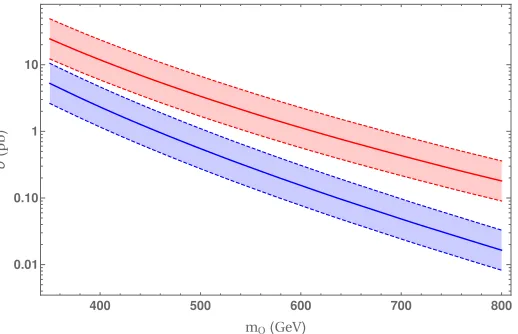
Consider the case when either the scalar or pseudoscalar colour octets are lighter than a TeV. Even though such light scalars should be copiously produced in pairs at both 8 and 13 TeV, as shown in figure 1, their decays are loop suppressed and this inhibits single production.
400 500 600 700 800
0.01 0.10 1 10
mO(GeV)
σ
(
pb
)
Figure 1:Pair production cross-section of octets at tree-level, at 8 TeV (blue, lower curves) and
Since current limits place all squarks above about 800 GeV, then, as discussed in [30], the octets decay only to gluons and quarks – in particular almost entirely top quarks. This means that the possible signatures are four jets, dijet/ditop searches, and four tops. Up until relatively recently the constraints
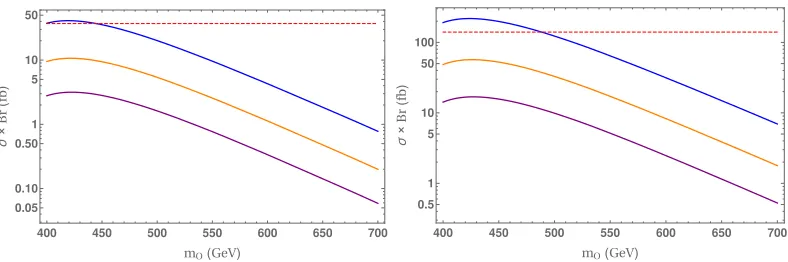
on them were rather weak, with dijets providing no constraint, and a mild constraint from ditops [31]. However, now the four top channel is particularly important: [32] placed a limit of 32 fb at 8 TeV, and [33] found 370 fb for Standard-Model-like kinematics, or 140 fb with and EFT pointlike interaction, at 13 TeV.
We consider the cross-section times branching ratio approach, taking the most conservative values of twice the tree-level cross-section (i.e. a K-factor of 2) and a limit at 13 TeV of 140 fb. To compute the branching ratio into four tops, we require the widths into gluons and tops. Expressions given in [30] usedcomplex octets, which is not appropriate for our case where the necessarily large gluino mass causes a large splitting. Instead we use the expressions presented in [27].
The first important observation is that the pseudoscalar octetdoes not coupleto gluons, and so pair production of pseudoscalar octets yields only four-top events, and by our above criteria excludes pseudoscalars below about 880 GeVby the13TeV data. These are therefore less interesting for our analysis.
On the other hand, the scalar octet couples to squarks via its D-term coupling, and so couples to gluons. Since it couples toallcoloured squarks, this can potentially be large. However, to be very conservative, we show production times branching ratio of four-tops via scalar octets in figure 2 at 8 and 13 TeV with the limits shown using a K-factor of 2, as we vary the octet mass and for three different values of the Dirac gluino mass, where the first two generations of squarks are decoupled (i.e.
heavy and degenerate). To produce these, we take left-handed stops and sbottoms of 1200 GeV, right-handed stops of 800 GeV, and decoupled right-right-handed sbottoms (at 4 TeV). We neglect all squark mixing (which is a good approximation in this model). Since the couplings involve a cancellation between left- and right-handed squarks, this is very conservative: if we took heavier left-handed squarks, we would enhance the gluon rate relative to the top rate (because it has a contribution from sbottoms as well as stops) weakening the bounds.
We conclude that for 2.5 GeV gluinos, the octet scalars must be heavier than 500 GeV; but for 3 TeV gluinos there is no constraint.
400 450 500 550 600 650 700
0.05 0.10 0.50 1 5 10 50
mO(GeV)
σ
×
Br
(
fb
)
400 450 500 550 600 650 700
0.5 1 5 10 50 100
mO(GeV)
σ
×
Br
(
fb
)
Since current limits place all squarks above about 800 GeV, then, as discussed in [30], the octets decay only to gluons and quarks – in particular almost entirely top quarks. This means that the possible signatures are four jets, dijet/ditop searches, and four tops. Up until relatively recently the constraints
on them were rather weak, with dijets providing no constraint, and a mild constraint from ditops [31]. However, now the four top channel is particularly important: [32] placed a limit of 32 fb at 8 TeV, and [33] found 370 fb for Standard-Model-like kinematics, or 140 fb with and EFT pointlike interaction, at 13 TeV.
We consider the cross-section times branching ratio approach, taking the most conservative values of twice the tree-level cross-section (i.e. a K-factor of 2) and a limit at 13 TeV of 140 fb. To compute the branching ratio into four tops, we require the widths into gluons and tops. Expressions given in [30] usedcomplex octets, which is not appropriate for our case where the necessarily large gluino mass causes a large splitting. Instead we use the expressions presented in [27].
The first important observation is that the pseudoscalar octetdoes not coupleto gluons, and so pair production of pseudoscalar octets yields only four-top events, and by our above criteria excludes pseudoscalars below about 880 GeVby the13TeV data. These are therefore less interesting for our analysis.
On the other hand, the scalar octet couples to squarks via its D-term coupling, and so couples to gluons. Since it couples toallcoloured squarks, this can potentially be large. However, to be very conservative, we show production times branching ratio of four-tops via scalar octets in figure 2 at 8 and 13 TeV with the limits shown using a K-factor of 2, as we vary the octet mass and for three different values of the Dirac gluino mass, where the first two generations of squarks are decoupled (i.e.
heavy and degenerate). To produce these, we take left-handed stops and sbottoms of 1200 GeV, right-handed stops of 800 GeV, and decoupled right-right-handed sbottoms (at 4 TeV). We neglect all squark mixing (which is a good approximation in this model). Since the couplings involve a cancellation between left- and right-handed squarks, this is very conservative: if we took heavier left-handed squarks, we would enhance the gluon rate relative to the top rate (because it has a contribution from sbottoms as well as stops) weakening the bounds.
We conclude that for 2.5 GeV gluinos, the octet scalars must be heavier than 500 GeV; but for 3 TeV gluinos there is no constraint.
400 450 500 550 600 650 700
0.05 0.10 0.50 1 5 10 50
mO(GeV)
σ
×
Br
(
fb
)
400 450 500 550 600 650 700
0.5 1 5 10 50 100
mO(GeV)
σ
×
Br
(
fb
)
Figure 2:Four-top production times branching ratio from scalar colour octets as a function of the octet mass, for gluino masses of 2.5 TeV (upper curve, blue), 3 TeV (middle curve, orange) and 3.5 TeV (lower curve, purple). The experimental limit is shown as the dashed red horizontal line. The left plot is computed for√s=8 TeV, and right is for√s=13 TeV.
Acknowledgments
This work is supported by the European Research Council (ERC) under the Advanced Grant Higgs@LHC (ERC-2012-ADG20120216-321133), the support of the Agence Nationale de Recherche under grant ANR-15-CE31-0002 “HiggsAutomator”, the Labex “Institut Lagrange de Paris” (ANR-11-IDEX-0004-02, ANR-10-LABX-63).
References
[1] P. Fayet,Phys.Lett.B78417 (1978)
[2] L. J. Hall and L. Randall, Nucl. Phys.B352289 (1991) [3] P. J. Fox, A. E. Nelson, and N. Weiner, JHEP0208035 (2002) [4] A. E. Nelson, N. Rius, V. Sanz, and M. Unsal, JHEP08039 (2002)
[5] I. Antoniadis, K. Benakli, A. Delgado, and M. Quiros, Adv. Stud. Theor. Phys.2645 (2008) [6] I. Antoniadis, K. Benakli, A. Delgado, M. Quiros and M. Tuckmantel, Nucl. Phys. B744 156
(2006)
[7] G. D. Kribs, E. Poppitz, and N. Weiner, Phys. Rev.D78055010 (2008)
[8] S. D. L. Amigo, A. E. Blechman, P. J. Fox, and E. Poppitz, JHEP01018 (2009)
[9] G. Belanger, K. Benakli, M. Goodsell, C. Moura, and A. Pukhov, JCAP0908027 (2009) [10] K. Benakli and M. D. Goodsell, Nucl. Phys.B816185 (2009)
[11] K. Benakli and M. D. Goodsell, Nucl. Phys.B830315 (2010) [12] K. Benakli and M. D. Goodsell, Nucl. Phys.B8401 (2010)
[13] K. Benakli, M. D. Goodsell, and A.-K. Maier, Nucl. Phys.B851445 (2011) [14] K. Benakli, Fortsch.Phys.591079 (2011)
[15] K. Benakli, M. D. Goodsell, and F. Staub, JHEP06073 (2013)
[16] K. Benakli, L. Darmé, M. D. Goodsell, and P. Slavich, JHEP05113 (2014)
[17] K. Benakli, M. Goodsell, F. Staub, and W. Porod, Phys. Rev.D90no. 4, 045017 (2014) [18] E. Dudas, M. Goodsell, L. Heurtier, and P. Tziveloglou, Nucl. Phys.B884632 (2014) [19] K. Benakli, L. Darmé and M. D. Goodsell, JHEP1511100 (2015)
[20] S. Abel and M. Goodsell, JHEP06064 (2011) [21] T. Gherghetta and A. Pomarol, JHEP12069 (2011) [22] S. P. Martin, Phys. Rev.D92no. 3, 035004 (2015)
[23] R. Davies, J. March-Russell, and M. McCullough, JHEP1104108 (2011) [24] E. Bertuzzo, C. Frugiuele, T. Gregoire, and E. Ponton, JHEP04089 (2015) [25] H. Beauchesne and T. Gregoire, JHEP05051 (2014)
[26] L. M. Carpenter and J. Goodman, JHEP07107 (2015)
[27] M. D. Goodsell and P. Tziveloglou, Nucl. Phys.B889650 (2014)
[28] C. Csaki, J. Goodman, R. Pavesi, and Y. Shirman, Phys. Rev.D89no. 5, 055005 (2014) [29] L. M. Carpenter, JHEP09102 (2012)
[30] S. Y. Choi, M. Drees, J. Kalinowski, J. M. Kim, E. Popenda, and P. M. Zerwas, Phys. Lett.B672 246 (2009)
[31] CMSCollaboration, S. Chatrchyanet al., Phys. Rev. Lett.111no. 21, 211804 (2013), [Erratum: Phys. Rev. Lett.112, no.11, 119903 (2014)].
[32] CMSCollaboration, V. Khachatryanet al., JHEP11154 (2014)