Effective Prevention against DOS Attack in
OLSR Protocol over MANET Environment
B.Anusha, A.Naveena
PG Scholar
(
MTech), Dept. of ETM, G.Narayanamma Institute of Technologies and Sciences, Shaikpet,
Hyderabad, India
Assistant Professor, Dept. of ETM, G.Narayanamma Institute of Technologies and Sciences, Shaikpet,
Hyderabad, India
ABSTRACT:
Mobile Ad-Hoc Networks (MANET) a fast growing network scheme and it provides lots of features to
communication strategies and routing protocols. These routing protocols are introduced to avoid the attacker nodes and
provides the efficient communication between source and destination. The attacks in the network scenarios are: DOS,
Wormhole attack and Blackhole attacks. In this system, a new routing protocol strategy is defined by means of Route
Request and Route Response Strategies with the help of Optimized Link State Routing protocol (OLSR). Source Node
sends Route Request to the nearby node. The nearby node checks the request and sends the Route Response to Source
Node back within a proper interval. The proper and relevant response from the neighbor node indicates it as a proper
node as well as the neighbor node sequence Number will get incremented by 1. The node is proper then only the count
will be incremented otherwise it consists attack content. This kind of nodes are properly blocked from the present
scenario and the source checks for the alternate or other neighbor nodes to proceed for further communications. As per
the regular network strategies the node selection or path selection process is purely based on Shortest Path Routing
methodology.
KEYWORDS:
MANET, OLSR, Blackhole attack, DoS attack.
I.
INTRODUCTION
Mobile Ad hoc network (MANET) is the most desired network that are under growing interest of research due to its
benefits and development of an Intelligent Communication System (ICS). Appling a better communication in MANET
is a question mark because of its high mobility and limited coverage. In this type pervasive networks high mobility
generate frequent topology changes and network decentralization. Mobile ad hoc networks (MANET) are
self-configuring network same as the Vehicle ad hoc network (VANET) where the devices are changed to mobile
nodes[1],[2],[3],[4]. These networks are with changing topology and high mobility. MANET can provide comfort to
routes, communication among mobile nodes and also route safety. A MANET network is interconnected with mobile
nodes that are able to communicate each other and transfer the important information. The main objective of these
networks is givento good and available services to nodes while on mobile environment. However mobile environment
safety and traveling comfort applications are seeking many benefits. this paper deals with the communication and
routing strategies in MANET.
Overhead, Packet Delivery Ratio, End-to- End Delay, Throughput are considered. By analyzing the performance and simulation results, it is identified that the method can improve the performance of routing in MANET by selecting the quality based route on QOS metrics.
The topology created by the vehicle is highly dynamic and is significantly non-uniformly distributed.To offer a real time application to mobile nodes, it is needed to give better routing not only that optimal path is also needed for a better communication. To obtain a quality assured path for communication the routing strategy needs to be excellent. The traditional algorithms that are used in MANET are not that possible in this network due to its high mobility.
The traditional routing protocols that are used for VANET shows its performance poor when it is used in MANET. The problems behind these protocols like ad hoc on demand distance vector (AODV) and dynamic source routing (DSR) when applied to MANET network the routes will be instable. An established route which is fixed to succession of nodes (traditional node-centric view of routes) between the source and destination will lead to the disconnection or breaking up of routes in the network. As MANET mobility is very higher so that it cannot maintain the routes also the packets are dropped. Due to the route failure which significantly happens increases the overhead and lead to low delivery ratio and high transmission delay.
The characteristics of MANET are more similar to the VANET some of the characteristics are high mobility, Rapidly Changing Network Topology, Unbounded Network Size, Frequent Exchange of Information, Wireless Communication, Time Critical, Sufficient Energy, Better Physical Protection[5].
The proactive routing protocol like OLSR which designed for VANET can be applied to MANET due to some of its features [7]. In this paper using the concept of OLSR and Optimized Routing Algorithm to create an optimal and quality based path for communication from node to node. The clustering technique is used in which there are cluster head election and selection of MPR that plays the role of communication gateways between the clusters. Optimized Routing algorithm is added because it presents the best route the source and the destination and comply the QOS metrics.
The paper is organized as follow in further section, briefly identified the related work. In section 3, a detailed description of the proposed system is added. In section 4, define the result and simulation work of the proposed system in detail with performance results and simulation experiments. In section 5, finally addthe conclusion with the advantage of the proposed system, its drawback and the future work for the future research.
II. LITERATURE SURVEY
The research studies over routing for MANET have been carried out in different field in general as well as cluster based technique in particular. The traditional algorithms are mostly not suitable in MANET due to its mobility need to satisfy the mobility of the network. In this section some existing studies that adopt the clustering technique reviewed.
Optimization is a techniquethat tends to improve maximum results[5]. In this paper they have consider MANET to play and vital role for mobile environment side safety and to solve the emergency situation. Communication between mobile nodes is done by using routing protocol in this paper they have introduce a cluster based routing protocol i.e. CBLR and HCR [5]. Also they apply Bee Colony Optimization techniques on this protocol to achieve maximum results.
A new intelligent algorithm to perform the vehicle to vehicle communication. Each vehicle can pass the information to other regarding the path, speed etc [6] and also includes the information of accidentstatus. In this proposed work, it is said that if a vehicle is met with a collision it will inform all other mobile nodes to take a better decision. In this proposed work [6], as a vehicle get some collisions or accident it will inform to othermobile nodes about its status so that they can perform the decision regarding the route change at earlier stage.
This scheme [7], they aim at defining and solving an offline optimization problem to efficiently and automatically tune OLSR, which used by many authors for MANET as it present many features for it.In [7] more details about the use of OLSR in MANETs are provided by defining an optimization problem to tune the OLSR protocol. This done by obtaining the best fits configuration automatically, optimization issues are defined by quality or fitness function.
In paper [9], they have addressed the problem of clustering in VANETs using Quality of Service Optimized Link State Routing (QoS-OLSR) protocol. There are several clustering algorithms wheremobility-based algorithms avoid the Quality of Service requirements that are important for MANET safety. In [9] paper the solution is a new QoS-based clustering algorithm that considers QoS requirements and high speed mobility constraints. The aim of this paper [9] is to form a stable cluster and maintain the stability during communications and link failures which are achieved by using Ant Colony Optimization for MPRs selection.The algorithm offers reduction of control overhead and also the stability of the network.
III. PROPOSEDSYSTEM
In our proposed work the Cluster based Routing mechanisms form the communications. With this cluster based routing mechanisms to elect a set of optimal cluster-heads with the help of Cluster Head Selection procedures and dividing the networks into clusters as well as form the nodes with the clusters and provide the vehicular specialization to all nodes to move around all locations around the regions. In this approach use the MPR Cluster Selection Process, in which MPR nodes play the role of communication gateways between different clusters. All communication between clusters must transit through corresponding MPRs. One cluster consists of one or many MPRs. When clusters are formed and cluster heads are selected for each one of them, the algorithm of determining MPRs kicks off. Apart from this add to the Routing Provision called Optimized RoutingAlgorithm, which is presented here to find the best route between given source and destination and which complies with given QoS metrics. Routing operation is inspired by the behavior of bees in their search for food and by their strategy for pinpointing various routes from their hive to various locations.
A. CLUSTER HEAD ELECTION
In this model used by nodes (mobile nodes) for electing the cluster head. To improve the quality of service of the clusters, CB-OLSR use several QoS metric. The cluster head knows the other nodes in the cluster with all its details obtained through the Hello message. Nodes give an attention to link expiration as it leads to the cluster stability.
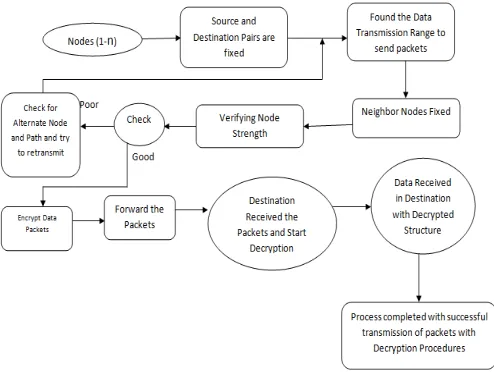
Fig 1: System Architecture
B. ROUTING TABLE
C.ROUTE DISCOVERY
When the node wants to send the data to other cluster then the source node send the request to the cluster head. If didn’t find any route in the table then the cluster head releases a scout to discover the route to destination.In this the scout moves from cluster head to MPRs and reaches the destination, and the routing table is updated.
IV. RESULTANDSIMULATIONWORK
The experiment is done using network simulator to show the efficiency of the proposed system. The performance of the protocol in MANET was simulated and succeeded to find the best route.
The proposed result shows that the protocol can increase the
Fig 2: Network Throughput
Throughput of the network. The figure 2 represent the Network Throughput analysis which shows some improvement.
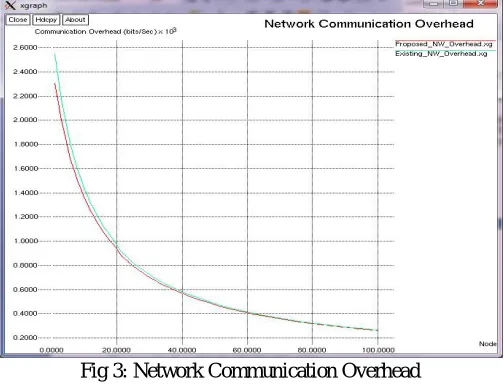
Fig 3: Network Communication Overhead
Fig 4: Analysis of Packet Delivery Ratio
This figure 4 shows the proposed result and Analysis of Packet Delivery Ratio analysis of the proposed architecture.
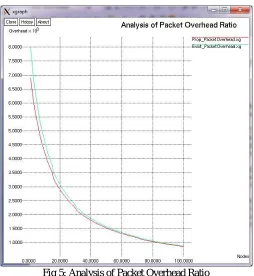
Fig 5: Analysis of Packet Overhead Ratio
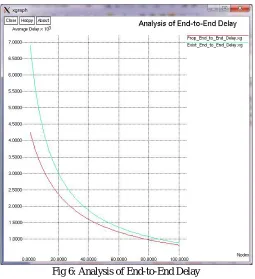
Fig 6: Analysis of End-to-End Delay
This figure 6 shows the Analysis of End-to-End Delay Ratio of the proposed architecture.
V.
CONCLUSION
The result shows the proposed system performs a better routing and communication system by delivering maximum
number of data packets. The proposed system has decreased the end-to-end delay increased the lifetime of the network.
In future, we can give some more security system to get far better network as MANET is also affected by attacks.
REFERENCES
[
1]S. Yousefi, E. Altman, R. El-Azouzi, M. Fathy, “Improving connectivity in vehicular ad hoc networks: an analytical study”, Computer Communications 31(9) (2008), pp. 1653–1659.[2] Y. Hongseok, K. Dongkyun Kim,”Repetition-based cooperative bmobile environmentcasting forvehicular ad-hoc networks”, Computer Communications 34 (15) (2011), pp. 1870–1882.
[3] J.-T.Isaac, J.-S. Camara, S. Z eadally, J.-T. Marquez,” A Secure vehicle-to-mobile environmentside communication payment protocol in vehicular ad hoc networks”, Computer Communications 31 (10) (2012), pp. 2478–2484.
[4] S.Lim, C.Yu,C.-R. Das, “Cache invalidation strategies for internet-based vehicular ad hoc networks”, Computer Communications 35 (3) (2012) , pp.380–391. [5] Bhushan T. Dhok ,Atul D. Deshmukh, Dr.S. S. Dorle, “Optimization of Cluster Based Routing Protocol Using Bee Colony Optimization for VANET”, International Journal of Advanced Research in Electronics and Communication Engineering (IJARECE) Volume 5, Issue 4, April 2016.
[6]Jaya Sehgal, PoonamArora, “Delay Optimization in VANET Using Ant Colony Optimization and WI-MAX”,International Journal of Advanced Research in Electrical, Electronics and Instrumentation Engineering Volume. 3, Issue 8, August 2014.
[7] Jamal Toutouh, José García-Nieto, And Enrique Alba, “Intelligent OLSR Routing Protocol Optimization For Vanets”, IEEE transactions on vehicular technology, Volume 61,Issue 4, may 2012.
[8] D. Karaboga , B. Basturk, “On the performance of artificial bee colony (ABC) algorithm”, Applied Soft Computing 8 (2008), pp. 687–697.
[9] Omar Abdel Wahaba, HadiOtrokb, AzzamMourada,“VANET QoS-OLSR: QoS-based clustering protocol for Vehicular Ad hoc Networks”, Computer Communications 36 (2013), pp. 1422–1435.