63 | P a g e
ADVANCED LIBRARY MANAGEMENT SYSTEM
USING SMART CARD
Kr. Manohar
1, M.Saritha
2, G. Ravindranath Kumar
31
Pursuing M. Tech (ES),
2Assistant Professor,
3Professor
1,2,3
Visvesvaraya College of Engineering and Technology
Patelguda, Ibrahimpatnam, Rangareddy Dist, Telangana, (India)
.
ABSTRACT
The Library management system is a very important issue in schools, colleges and public libraries in villages
and towns. Compared to the olden days, the utilization of libraries and books became less due to the
development in the field of electronics and computers. Libraries are still successful due to there is a special
significance to libraries from the book lovers and people who passionate about reading books. The main
consideration in libraries is the database maintenance about users and also books. So, the modern library
management systems involved with computer systems to maintain the database and various technologies for
extracting the information about users and books.
A Smart Card is a device integrated with an IC and also having memory capacity in it. A smart card reader is
needed to read the information from smart card with a physical contact with the Smart card. In our project, the
smart card is used as authentication for users and also books i.e. every user will be provided with a smart card
and every account is also contains a smart card tagged with it. When the user wants to borrow a book from the
library, she/he has to insert their smart card into the reader. Then the details of the user can be analyzed by the
microcontroller in our system and allows the user to borrow the book if they are authorized. The details of the
books also can be read by the smart card before giving to the user. The data about the borrowed books will be
stored in the smart card allotted to the user. If the limit exceeded to borrow the books, the system automatically
intimates the user when they tried to borrow a book. The database will be maintained in the individual smart
cards of users. Here no need to use any external memory for storing the data. The details of books will be
automatically updated in smart card every time when the user inserted the smart card.
Keywords: Arm7 Board, Smart Card Reader, Keypad, Gsm.
I. INRODUCTION
The Library management system is a very important issue in schools, colleges and public libraries in villages
and towns. A smart card is reader is needed to store the data. In our project the authorized person details and
will stored in the smart card. For every user we will provide a one smart card. Whenever we need a book from
the library we need to place the smart card on the reader. The book data we need to enter through keypad that
data will be stored in the smart card and system data base. While we are returning the book we need the place
64 | P a g e
II. LITERATUREREVIEW
2.1 Exiting System
The existing technologies for library management systems include Manual Registers, Bar code readers, etc. The
library management systems with bar code readers will be very expensive and having more disadvantages such
as it needs a human intervention to read the details from bar code and require reading the code in a line of sight
communication with a laser beam projection. So, by overcoming the drawbacks with the existing technologies,
we are introducing the Smart card technology for library management systems.
III. PROPOSED SYSTEM
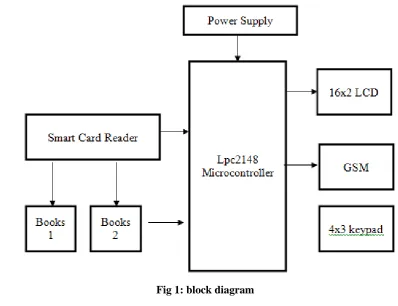
A Smart Card is a device integrated with an IC and also having memory capacity in it. A smart card reader is
needed to read the information from smart card with a physical contact with the Smart card. In our project, the
smart card is used as authentication for users and also books i.e. every user will be provided with a smart card
and every book is also contains a smart card tagged with it. When the user wants to borrow a book from the
library, she/he has to insert their smart card into the reader. Then the details of the user can be analyzed by the
microcontroller in our system and allows the user to borrow the book if they are authorized. The details of the
books also can be read by the smart card before giving to the user. The data about the borrowed books will be
stored in the smart card allotted to the user. If the limit exceeded to borrow the books, the system automatically
intimates the user when they tried to borrow a book. The database will be maintained in the individual smart
cards of users. Here no need to use any external memory for storing the data. The details of books will be
automatically updated in smart card every time when the user inserted the smart card.
Block Diagram
65 | P a g e
IV.
HARDWARE REQUPIREMENTS
4.1 LPC2148 microcontroller
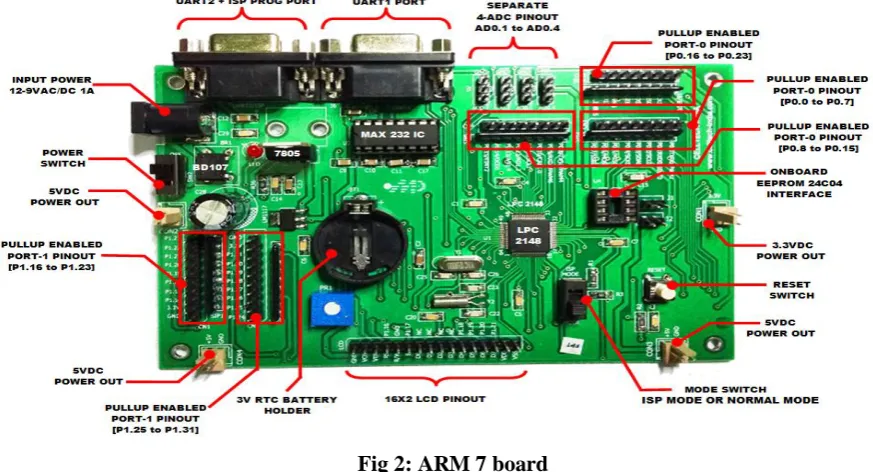
The Advanced RISC Machine7 (ARM 7) board is primarily based on a 16/32 bit, consists of 16/32 bit consist of
ARM7 TDMI-S micro controller. It consist of the on the on-chip static RAM memory and 512 bytes of flash
memory, 128 bit In-system programming (ISP). 32 timers/ counter used as generating the time delay and
counting the number of events are occurring outside the controller. PWM pulse width modulation unit with six
outputs and watch dog timer and low strength Real Time Clock (RTC). The most important feature is the ARM
7 controller contains the two UARTs (uart0 and uart1) and 32 interrupt lines with priority. It contains the totally
64 pins those are divided into the two ports (port 0 and port 1) with 48 GPIO pins.
Fig 2: ARM 7 board
4.2 LCD
LCD (liquid crystal display)is important component for the every project. It is in the form 16x2 matrix, that
means it contains two lines and every line we can use the 16 characters. In this LCD every character is displayed
by the 5x7 matrix form.in this we have the 8 data lines, two power supply pins ,one contrast pins, two back light
pins, and three control pins. The data will transmits or received through that 8 data lines only. The data is that
the ASCII worth of the character to be shown on the LCD. In this LCD we have some commands like clearing,
for next line and for shifting having some different commands for the LCD
66 | P a g e
V. GSM (GLOBAL SERVICE FOR MOBILE COMMUNICATION)
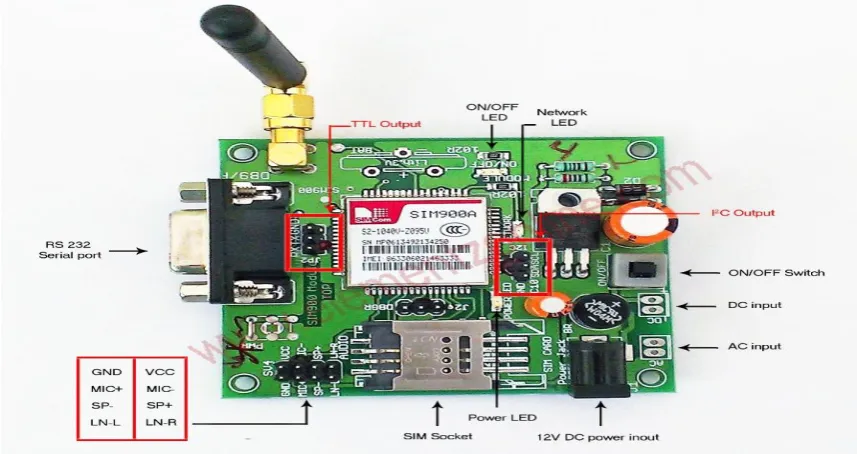
The GSM module is SIM 900D is a powerful GSM module for SMS and call control.GSM networks feature in
four specific frequency levels. Maximum GSM networks feature within the 900 MHz or 1800 MHz bands. A
few international locations in the Americas use the 850 MHz and 1900 MHz bands because the 900 and 1800
MHz frequency bands had been already allotted. The rarer 4 hundred and 450 MHz frequency bands are
assigned in a few worldwide places, wherein those frequencies were previously used for first-era structures. The
module consists of SIM 900 A for calling and messages.
Fig4: SIM 900D GSM MODULES
5.1 Smart Card
The smart card is memory device which can store the 256 kb data. The smart card has the 256 kb of the data. In
that 0-31 data was stored the company profile data from 32- 256 memory locations we can stored our required
data. In the smart card we can write and read the data. In this we give one smart for every account, whenever
the/she take the book from the library he need to place the card on the reader that data will be stored in the card
and system data base. While we are returning the book again need to insert the card so that will be deducted in
our account. By writing and reading the data we have a some specific format with that format only we can read
and write the data.
67 | P a g e
5.2 Key Pad
A keypad is a set of buttons organized in numbers and letters, digits and other symbols however not a complete
set of alphabetical letters. If it mostly contains numbers then it will conjointly be known as a numeric data input
device. Keypad area unit victimization typewriting of security purpose area unit found on several alphabetic
keyboards and on alternative devices such as calculators. It’s given that an data input device, sometimes half of
a typical keypad, consisting of a separate grid of numerical and function keys organized for economical
information entry.
Fig 6: 4X3 keypad
VI. SOFTWARE DESIGN
In this proposed gadget, as we used LPC2148 we want to use following software equipment to program for
it.
Keil4 Vision
Flash MagicTheKeil4 Vision is an IDE for Embedded c language .In this IDE,we want to import the utilities and libraries
according to the controller. This IDE is very easy and user friendly way to apply. It consists so fall the C/C++
compilers, assemblers, and debuggers in it.It simplifies the manner of embedded simulation and trying out in
conjunction with Hex file technology.
The flash magic is a programming utility. The C/C++ software written in IDE may be processed into Hex
document i.e. in hex layout. By using hex file we dump the code into microcontroller and perform the task
with respective application.
VII. WORKING PROCEDURE
The Library management system is a very important issue in schools, colleges and public libraries in villages
and towns. Compared to the olden days, the utilization of libraries and books became less due to the
development in the field of electronics and computers. Libraries are still successful due to there is a special
significance to libraries from the book lovers and people who passionate about reading books. The main
consideration in libraries is the database maintenance about users and also books. So, the modern library
management systems involved with computer systems to maintain the database and various technologies for
68 | P a g e
A Smart Card is a device integrated with an IC and also having memory capacity in it. A smart card reader isneeded to read the information from smart card with a physical contact with the Smart card. In our project, the
smart card is used as authentication for users and also books i.e. every user will be provided with a smart card
and every account is also contains a smart card tagged with it. When the user wants to borrow a book from the
library, she/he has to insert their smart card into the reader. Then the details of the user can be analyzed by the
microcontroller in our system and allows the user to borrow the book if they are authorized. The user needs to
enter the book details through the keypad. So the data will store into the smart card and system data base.
Whenever returning the book the again need to place the card again on the reader. We have some options on
card like adding the book and retuning book. While we are taking the book we need to click on the adding the
book same as returning the book choose the option retuning the book with that the book was deducted from our
account. After added and removed the book the message will sends to the account holder through GSM
technology. If we added one book it will sends a message as “one book was added in your account” same as
removed the book.
VIII. RESULT
Here we are shown the “Advanced Library Management System Using Smart Card”project was
successfully implemented.Whenever the person need to take book from the library need to place smart card on
the reader and need to enter the details of the book. So that book will added into our account and that data will
be stored into the smart card. While returning the smart card again need to place the card on the reader and need
69 | P a g e
IX. CONCLUSION
By using this project the capability of making our personal lives and our work lives in the library more
convenient. Libraries should not yet implement smart card systems. Libraries that choose to implement smart
card technologies in advance of policy safeguards being put in place should take extra precautions to follow
evolving best practices guidelines. Libraries should continue to protect privacy by ensuring that they are not
seen as proponents of smart card before it can be safely deployed.
REFERENCES
[1] www.capterra.com/library-automation-software
[2] www.oiirj.org/oiirj/july-aug2012/30.pdF
[3] https://www.ijert.org/download/8871/nfc-based-library-automation-using-smart-phone
[4] www.hades.in/BasePapers/Wireless/Journal/Nfc/HWL%20(56).pdF
[5] www.edutechpn.com/index.php/library-automation
[6] www.ijird.com/index.php/ijird/article/download/57732/45062
[7] multimedia.3m.com/mws/media/588509O/3m-library-systems-security-brochure.pdf
[8] www.white-clouds.com/iclc/cliej/cl32osayande.pdf
AUTHOR DETAILS
KR MANOHAR ,PursuingM.Tech (ES ) from Visvesvaraya College Of Engineering
And Technology, Patelguda, Ibrahimpatnam, RangaReddy dist. telangana, INDIA.
M.SARITHA2,working as Assistant Professor from Visvesvaraya College Of
Engineering And Technology, Patelguda, Ibrahimpatnam, RangaReddy dist.,
telangana, INDIA.
HOD(G. Ravindranathkumar),working as Assistant Professor from Visvesvaraya
College Of Engineering And Technology, Patelguda, Ibrahimpatnam, RangaReddy