949 | P a g e
EMBEDDED BASED DESIGN AND
IMPLEMENTATION OF HEALTHCARE SYSTEM
USING IOT
Parthiban.M
1, E.Kanniga
2, M.Sundararajan
31
PG-Scholar Technology of Digital Communication and Networking
2
Professor, Department of Electronics and Telecommunication Engineering
3
Professor,Deanof Electronics Sciences and Research
1,2,3
Bharath University, Chennai, Tamil Nadu (India)
ABSTRACT
Internet of Things (IoT) is the emerging paradigm, which contains huge amount of smart object and smart
devices connected to the internet for communicating with each other. IoT devices are used in many fields which make the users’ day to day life more comfortable. These smart devices are used to collect temperature, blood
pressure, sugar level etc., which are used to evaluate the health condition of the patient. Communicating the
collected information to the doctor, making accurate decision on the data collected and notifying the patient is
the challenging task in the IoT. In this paper, the architecture of the Patient Health Monitoring System (PHMS)
using IoT devices is proposed to collect the required parameters and evaluate the data obtained from the IoT
devices. PHMS also notifies the patient with possible precautionary measures to be practised by them. This
system suggests the patient with medical care and next step to be followed in case of critical situation. The
PHMS system is evaluated for certain parameters and the decisions made on the data obtained from the source
are assumed to evaluate the system. The simulated results experiments the correctness and effectiveness of the
proposed system. This system is efficient with low power consumption capability, easy setup, high performance
and time to time response.
Keywords: GPS, GSM, IOT, LCD, Microcontroller, Sensors
I. INTRODUCTION
Recent works in communication technologies have inspired the development of telemedicine to a large extent.
Telemedicine benefits not only the customers who are able to receive health care more efficiently; it also
benefits the doctors who can streamline their efforts to assist more patients.
The advances in information and communication technologies enable technically, the continuous monitoring of
health related parameters with wireless sensor, wherever the user happens to be. They provide valuable real time
information enabling the physicians to monitor and analyze a patient’s current and previous state of health. Now
950 | P a g e
Although many wireless standards can be used, there are important considerations such as range, throughput,
security, ease of implementation and cost. The patient monitoring involves handling of sensitive data. These
data should be transmitted securely without any intrusion.
The web-database is a system where the web server will store the data in table format where the digital data are
filled in column and then it is plotted against the time to get the parameters. For GUI, Android is used, since its
open source and very cheaply available in market which fulfils the criteria of low cost system. Also now days,
Android is available to each and every person, including Doctors, since they have started using the Smartphone.
In present paper, we report on development of patient monitoring system an android platform which is an open
source, to display three parameters such as Heart Beat, Temperature and humidity. With this module, the
doctors who are not present in hospital at time of emergency, they can also operate looking at the different
parameters on his or her smart phone or laptop.
1.1.
Internet of Things
Internet of things is defined as Things having identities and virtual personalities operating in smart spaces using
intelligent interfaces to connect and communicate within social, environmental, and user contexts. It can be
considered the Future of Internet, where every object is connected to other objects. Every object is given a
unique identity in the network. This allows remote access of devices through the network, anytime and at any
location.
IoT enabled objects communicate with each other, access information over the Internet, and interact with users
creating smart , pervasive and always connected environments. IoT also enables machine to machine (M2M)
communication which allows machines being controlled by the Internet and by other machines. This can
revolutionize the way technology is used, as machine takes control of machines overcoming the constraints that
people face while communicating with digital systems. Machines can monitor sensors all over the world to
generate vast quantity of valuable information that would take a human years to achieve.
IoT makes the concept of pervasive computing and ubiquitous computing a reality by allowing objects of our
everyday life like cars, roadways, pacemakers, pill shaped cameras in our digestive tracks, billboards that adjust
to passersby, refrigerators and even cattle’s equipped with sensors to communicate with humans and assisting
them in every step The application of IoT in health-care system is highlighted in the following section.
1.2.
IoT in Health-care
IoT enabled remote health monitoring system has huge advantages over traditional health monitoring system.
Health sensing components have become very compact and portable, allowing patients to wear them round the
clock for monitoring. If these monitoring devices are equipped with unique identifiers like RFID, then those
devices can be uniquely identified over the Internet. It acts as an information retriever, retrieving information
from the physical world to the digital world . An IoT enabled health monitoring device connected to a patient
can be considered as a virtual patient in the digital world. The virtual patient has the exact physiological
conditions as the real patient.
A doctor can monitor a patient only a few times a day but critical health issues can occur at any moment. So
24/7 monitoring of health data is necessary. As IoT enabled patients can be accessed over the Internet and by
951 | P a g e
detected at the right time so that proper actions can be taken. Also, IoT can help to collect health records.
Generating statistical information related to health condition, can be performed by machines. It is faster and
voluminous and error free collection of data that is possible manual methods could never achieve. Generating
statistics, surveillance, risk mapping of diseases can be done using remote health data.
II. LITERATURE SURVEY
Karandeep Malhi et al to develop Zigbee smart noninvasive wearable physiological parameters monitoring
device has been developed and reported in this paper. The system can be used to monitor physiological
parameters, such as temperature and heart rate, of a human subject. The system consists of an electronic device
which is worn on the wrist and finger, by an at risk person. Using several sensors to measure different vital
signs, the person is wirelessly monitored within his own home. An impact sensor has been used to detect falls.
The device detects if a person is medically distressed and sends an alarm to a receiver unit that is connected to a
computer. This sets off an alarm, allowing help to be provided to the user.
B. Sirisha et al describes a solution for enhancing the reliability, flexibility by improving the performance and
power management of the real-time multi-patient monitoring system (MPMS). In the current proposed system
the patient health is continuously monitored by the MPMS and the acquired data is transmitted to a centralized
ARM server using Wireless Sensor Networks. A Zigbee node is connected to every patient monitor system
which will send the patient's vital information .Upon system boot up, the mobile patient monitor system will
continuously monitor the patients vital parameters like Heart Beat, body temperature etc and will periodically
send those parameters to a centralized server using Zigbee node configured as co-coordinator. If a particular
patient’s health parameter falls below the threshold value, a buzzer alert is triggered by the ARM server. Along
with a buzzer an automated SMS is posted to the pre-configured Doctors mobile number using a standard GSM
module interfaced to the ARM server.
Gagana P et al was explains a novel idea when a person falls and is not able to get assistance within an hour,
casualties arising from the fall can result in fatalities as early as 6 months later. It would seem then that a choice
between safety and independence must be made. Fortunately, as health care technology advances, simple
devices can be made to detect or even predict falls in the elderly, which could easily save lives without too much
intrusion on their independence. Much research has been done on the topic of fall detection and fall prediction.
Some have attempted to detect falls using a variety of sensors such as cameras, accelerometers, microphones, or
a combination of the same. This paper is aimed at reporting which existing methods have been found effective
and the combination of which will assist in the progression towards a safe, unobtrusive monitoring system for
independent living.
Maradugu Anil Kumar et al was proposed a novel idea for continuous monitoring patient's health conditions.
The health care scheme is focus on the measurement and monitoring various biological parameters of patient's
body like heart rate, oxygen saturation level in blood and temperature using a web server and android
application, where doctor can continuously monitor the patient's condition on his smart phone using an Android
application. And also the patient history will be stored on the web server and doctor can access the information
952 | P a g e
P. Karthick et al portrays a prototype model for the real time patient monitoring system. The proposed is used to
measure the physical parameters like body temperature, heartbeat, ECG, blood sugar, and oxygen level
monitoring with the help of biosensors. Conventionally there are number of techniques available for the ICU
patient’s health monitoring system with wired communication technology. In the novel system the patient health
is continuously monitored and the acquired data is transmitted to an ARM server using zigbee wireless sensor
networks. Embedded processor supports for analyzing the input from the patient and the results of all the
parameters are stored in the database. If any abnormality felt by the patient automatic alarm sound will arrive
and the message will send to the doctor mobile automatically by using GSM module. The implementation of the
system is achieved by the advanced processor and simulation results are obtained by Keil c software
III. PROPOSED SYSTEM MODEL
3.1.
Problem Identification
The medical world today faces two basic problems when it comes to patient monitoring. Firstly, the needs of
health care’s provider’s presence near the bedside of the patient and secondly, the patient is restricted to bed and
wired to large machines.
3.2.
Existing System
There are some shortcomings present in existing system. The patient is monitored in ICU and the data
transferred to the PC is wired. Such systems become difficult where the distance between System and PC is
more. The available systems are huge in size. Regular monitoring of patient is not possible once he/she is
discharged from hospitals. These systems cannot be used at individual level. The other problem with these
systems is that it is not capable of transmitting data continuously also range limitations of different wireless
technologies used in the systems. So to overcome these limitations of systems we proposed a new system. Our
system is able to transmit the parameters of patient continuously and over long distance in wireless medium.
Due to which we would be able attend the patient immediately. Therefore by developing a system that can
constantly measure the important parameters of patient’s body and which can alert the closed ones and the doctor on any time when the patient’s condition gets bad, this can really provide quick service and be beneficial
in saving a lot of lives.
3.3.
Proposed System
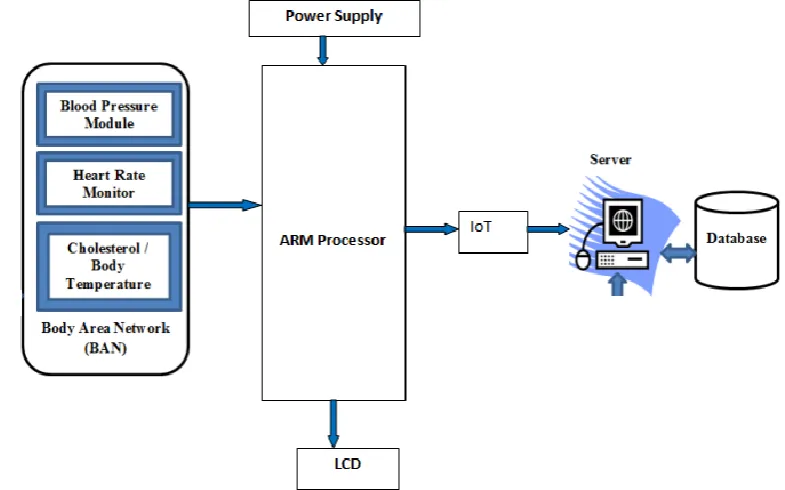
The architecture of PHMS contains three phases; they are collection phase, transmission phase, utilization
phase. Body Area Network (BAN) is constructed to collect the required data from the patient. The parameters
used to diagnose the disease may vary from one disease to another. Therefore each parameter is sensed by
separate IoT devices which are connected to the patient. All the devices connected in the body of the patient are
known as BAN in the data collection phase. Blood pressure module, heart rate monitor, temperature etc. are the
basic devices used to collect the blood pressure, heart rate and temperature of the patient. The data collected in
953 | P a g e
The proposed system is designed for monitor the patient is in any place. The system would constantly monitor
important physical parameters like temperature, heartbeat, pressure and would compare it against a
predetermined value set and if these values cross a particular limit it would automatically alert the alarm. This
system provides a continuous health monitoring service. Block diagram of the Proposed Systems the data
processed are transmitted by IoT. Finally the received data is sent to the PC. The graphical user interface
programs on the PC are coded using keil C software, Using IoT modem message is transmitted to the doctor
web server when the measured temperature exceeds the allowable value or if the heart beat measured is
abnormal.
Fig. 1: Proposed System Block Diagram
IV. Implementation Methodology
4.1.
Hardware Description
4.1.1. ARM Processor
ARM stands for Acorn RISC machine is a family of instruction set architectures for computer processors based
on a reduced instruction set computing (RISC) architecture. And in simple word ARM is "Processor
Architecture
"
. Many of newbie and students have misunderstanding that ARM is microcontroller or processor,but actually ARM is Architecture which is used in many processors and microcontrollers
4.1.2. 16X2 Liquid Crystal Display (LCD)
Liquid crystal display is very important device in embedded system. Now days it is very common for screen
954 | P a g e
4.1.3. IoT Modem
IoT has evolved from the convergence of wireless technologies, microelectromechanical systems (MEMS) and
the Internet. The concept may also be referred to as the Internet of Everything. The internet of things (IoT) is the
internetworking of physical devices, vehicles, buildings and other items— embedded with electronics, software,
sensors, actuators, and network connectivity that enable these objects to collect and exchange data. A thing, in
the Internet of Things, can be a person with a heart monitor implant, a farm animal with a biochip transponder,
an automobile that has built-in sensors to alert the driver when tire pressure is low -- or any other natural or
manmade object that can be assigned an IP address and provided with the ability to transfer data over a network.
4.1.4. Temperature Sensor (DS18S20)
DS18S20 is 1-wire digital thermometer which gives measurement of 9-bit Celsius temperature and incorporates
alert capacity with client programmable trigger focuses. It contains central processor with only one data line for
establishing communication. Operates at the temperature range of -100C to +850C.
4.1.5. Heart beat Sensor
The basic heartbeat sensor consists of a light emitting diode and a detector like a light detecting resistor or a
photodiode. The heart beat pulses causes a variation in the flow of blood to different regions of the body. When
a tissue is illuminated with the light source, i.e. light emitted by the led, it either reflects (a finger tissue) or
transmits the light (earlobe). Some of the light is absorbed by the blood and the transmitted or the reflected light
is received by the light detector. The amount of light absorbed depends on the blood volume in that tissue. The
detector output is in form of electrical signal and is proportional to the heart beat rate.
4.1.6. Pressure Sensor
In instruments like digital blood pressure monitors and ventilators, pressure sensors are needed to optimize them
according to patient’s health and his requirements.
4.1.7. MAX232
Max232 is a dual driver/receiver which converts TTL level to RS232 level. These receivers usually as the
threshold of 1.3v and can accept +/- 30v of supply. When Max-232 IC receives the TTL level it converts it in to
voltage levels i.e. logic0 changes to voltages between +3 and +15v and logic1 changes to voltages between -3
and - 15v.
4.1.8. Piezo Electric Buzzer
Buzzer is an electronic device used to produce sound. In the project the buzzer is used to alert the caretaker
955 | P a g e
V. SOFTWARE IMPLEMENTATION
5.1.
KEIL C
The µVision IDE from KEIL combines project management, make facilities source code editing, program
debugging, and complete simulation in powerful environment. The µVision development platform is easy to use
and helping you quickly creates embedded programs that work. The Keil C development tools for the ARM
processor family support every level of developer from the professional applications engineer to the student just
learning about embedded software development. The industry-standard Keil C Compilers, Macro Assemblers,
Debuggers, Real-time Kernels, and Single-board Computers support all ARM processor compatible derivatives
and help you get your projects completed on schedule. With the Keil tools, we can generate embedded
applications for virtually every ARM derivative. The Keil Software ARM development tools are designed for
the professional software developer; any level of programmer can use them to get the most output of the ARM
processor architecture. Keil C μ Vision 4 help provides the various simulation output.
Proteus (PROcessor for TExt Easy to Use) Proteus incorporates many functions derived from several other
languages: C, BASIC, Assembly, Clipper/dBase; it is especially versatile in dealing with strings, having
hundreds of dedicated functions; this makes it one of the richest languages for text manipulation. Proteus owes
its name to a Greek god of the sea (Proteus), who took care of Neptune's crowd and gave responses; he was
renowned for being able to transform himself, assuming different shapes. Transforming data from one form to
another is the main usage of this language.
5.2.
Algorithm
Step 1: Start the program
Step 2 : Enter the mode of operation.
Step 3 : Evaluate mode of operation with switch case
Step 4 : Heart Beat Measured
Step 5 : Temperature Measured
Step 6 : BP Monitored
Step 7 : Data base saved successfully
956 | P a g e
5.3.
Simulation Results
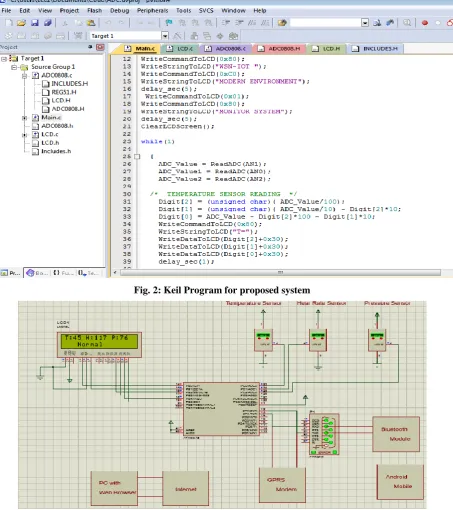
Fig. 2: Keil Program for proposed system
Fig. 3: Simulation results for proposed system
VI. Result Analysis
The devices sense the data from the patient’s body and send them to the local system through the wireless sensor
devices. Mobile application is designed for the benefit of doctors and patients. The health status of the patient is
updated in the application for every 60 seconds after the update in the server. The data collected from the IoT
957 | P a g e
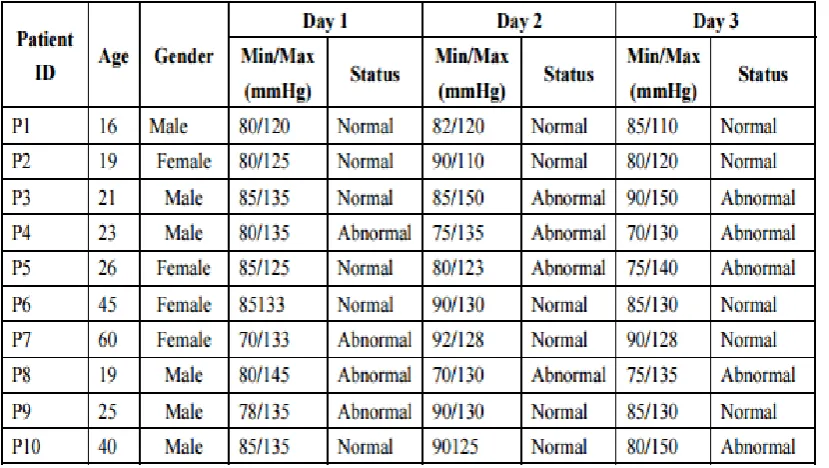
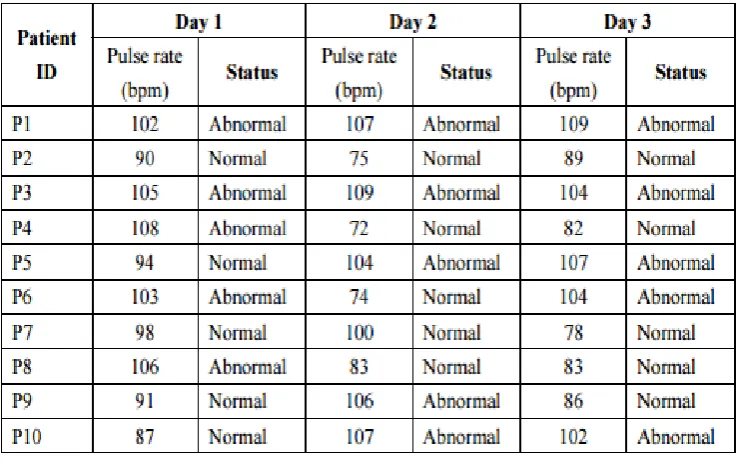
All parameters for the last three days can be viewed through the mobile application anywhere any time. To
evaluate the PHMS, sample data is collected to monitor the patient health. Sample data on blood pressure,
temperature and pulse rate are collected from ten patients are given in Table.1, Table.2 and Table.3.
Table 1: Blood Pressure Data for Ten Patients
958 | P a g e
Table 3: Heartbeat Rate Data for Ten PatientsVII.
CONCLUSION
This current designed system provides low complexity, low power consumptions and highly portable for health
care monitoring of patient’s and it can eliminates the need of utilization of expensive facilities. The doctor can easily access the patient’s information at anywhere with the help of android web server. In future, we can
develop a big data base of all the patients of any hospital and the these health parameters can be monitored
continuously, and also the information is uploaded to the hospital server. These servers keep the information of
the patients in the data base, and doctors can have the access of patient’s history, when any further consultancy
happens with the doctor.
REFERENCES
[1] Schnepper, Mathias Haefke, and Hartmut Ewald ―A Zigbee-Based Wearable Physiological Parameters
Monitoring System‖ IEEE sensors journal, vol. 12, no. 3, march 2012
[2] b. sirisha, t.sraddha, k. vijayanand ―Real-time multi-patient monitoring system using arm and wireless
sensor network‖ International Journal of Communication Network Security, ISSN: 2231 – 1882, Volume-2,
Issue-2, 2013
[3] Gagana P, Vani K, ―Fall Detection Methods for the Safe and independent living of Elderly People and
Patients ‖ International Journal of Advanced Research in Computer and Communication Engineering, Vol.
4, Issue 3, March 2015.
[4] Maradugu Anil Kumar, Y.Ravi Sekhar, ―Android Based Health Care Monitoring System‖, IEEE sponsored
2nd International Conference on Innovations in Information Embedded and Communication Systems
959 | P a g e
[5] P.Karthick, C.Suresh Kumar, P.Arun prasad, S.Pushparaj, M.Jagadeeshraja N.Suthanthira Vanitha
―Embedded Based Real-time Patient Monitoring System‖, International Journal of VLSI and Embedded
Systems-IJVES
[6] Purnima, Neetu Rout, Rahul Tiwary ,Renuka Bhandari ― Zigbee and GSM based Patient Health Monitoring
System ‖, International Journal of Advanced Research in Electrical, Electronics and Instrumentation
Engineering (An ISO 3297: 2007 Certified Organization) Vol. 3, Issue 1, January 2014.
[7] Manisha Shelar, Jaykaran Singh, Mukesh Tiwari ―Wireless Patient Health Monitoring System‖,
International Journal of Computer Applications (0975 – 8887) Volume 62– No.6, January 2013.
[8] Reza S. Dilmaghani, Hossein Bobarshad, M Ghavami, Sabrieh Choobkar, and Charles Wolfe ―Wireless
Sensor Networks for Monitoring Physiological Signals of Multiple Patients‖ IEEE transactions on
biomedical circuits and systems, vol. 5, no. 4, august 2011
[9] Yadav Satyendra Satyanarayan, Yadav Raghvendra Satyanarayan, Deep H. Desai ―Intelligent Wireless
Emergency Alert System for Patient Monitoring using AT89S52 Microcontroller‖ International Journal of
Advanced Research in Electrical, Electronics and Instrumentation Engineering Vol. 2, Issue 4, April 2013
[10]shyr-kuen chen, tsair kao, chia-tai chan, chih-ning huang, chih-yen chiang, chin-yu lai, tse-hua tung, and
pichung wang ―A reliable transmission protocol for zigbee-based wireless patient monitoring‖ IEEE