Journal of Nuclear Materials 69 & 70 (1978) 109-I 16 0 North-Holland Publishing Company
NON- CLASSICAL DIFFUSION PROCESSES A.M. STONEHAM
Theoretical Physics Division, AERE Harwell, Oxfordshire OX11 ORA, UK
This paper surveys quantum effects in diffusion,. with special emphasis on isotope effects for hydrogen isotopes In metals. The various possible contributions to the isotope effect are surveyed, and their importance assessed. The bee metals 0.7, Nb, Ta) and fee metals (Cu, Ni, Pd) involve different mechanisms, and these are still doubts in detail about some aspects. A full understanding requires knowledge of the hydrogen-metal interactions. Recent theoretical work supports some of the quali- tative ideas discussed, and offers promise for future analyses.
Ce papier passe en revue les effets quantiques en diffusion en mettant particulikrement l’accent sur les effets isotopiques pour les isotopes de l’hydrogene dam les metaux. Les differentes contributions possibles i l’effet isotopique sont pa&es en revue et leur importance est &al&e. Les metaux cubiques cent& (V, Nb, Ta) et les metaux cubiques i faces centrees (Cu, Ni, Pd) impliquent differents mecanismes. et il existe encore des doutes dans le detail sur quelques aspects. Une comprehen- sion complete requiert une connaissance des interactions metal-hydrogene. Un travail theorique recent supporte quelques- unes des idees quantitatives present&es et offre des promesses pour des analyses futures.
In dieser Arbeit werden Quanteneffekte bei der Diffusion mit besonderer’Betonung des Isotopieeffekts fib die Wasser- stoffisotope in Metallen betrachtet. Die verschiedenen moglichen Beitrage zum Isotopieeffekt werden abgeschatzt und ihre Bedeutung kritisch bewertet. Die krz. Metalle V, Nb und Ta und kfz. Metalle Cu, Ni und Pd betreffen unterschiedliche Me- chanismen, iiber einige Gesichtspunkte bestehen noch Zweifel. Ein volles Verstindnis erfordert die Kenntnis der Wasserstoff- Metall-Wechselwirkungen. Neuere theoretische Arbeiten sttitzen einige der diskutierten qualitativen Ideen und bieten gute Aussichten fur zukiinftige Analysen.
1. Introduction
Diffusion studies have a long and venerable history. During this time, ideas of behaviour on an atomic scale have changed enormously. Yet neither the discovery of the electron nor the belief that Schrodinger’s equation, not Newton’s law of motion, determines microscopic phenomena have had a major effect on diffusion. I think it worthwhile to analyse the reasons for the con- tinued dominance of classical descriptions, as well as indicating the areas where quantum theories have been successful and the phenomena which lack a simple classical interpretation.
One major reason for the limited role of quantum theories is that diffusion has been primarily a phenom- enological science, based on Fick’s laws and the Arrhe- nius equation rather than on an atomistic description. Since both quanta1 and classical theories agree that diffusion should be thermally activated at high temper- atures, there is little to encourage experimenters to venture into the treacherous areas of quantum physics.
But there have been developments in recent years which do encourage using the quantum approach more actively, going beyond the mere addition of quantum statistics to classical models.
This brief review will be concerned with two main areas: quantum effects in diffusion and related phenom- ena, and isotope effects. These two topics are not sim- ply related, although they have some common areas. In particular, isotope effects in diffusion constants, ac- tivation energies, heats of transport and effective charges can contain indications of quantum behaviour. Isotope effects in many other phenomena have been sur- veyed recently by Alefeld and Wipf [ 11, and range from thermal conductivities to effects on superconducting transition temperatures. Quantum effects have been re- viewed too both by myself [2,3] by Sussmann [4], and by Flynn [5]. No attempt will be made to duplicate their analysis. This is perhaps the time to stress that quantum effects are those which become insignificant when Planck’s constant becomes zero. The tempera- ture need not be low, contrary to popular mythology.
The
mythcomes from the observation that, in quantum
statistics, one finds ir, only in the combination
tiw/klYIf statistics alone are important, then high T and low A
are equivalent. But diffusion involves dynamics as well
as statistics, and indeed the mechanism of diffusion
may be altered when h is finite. ~antum effects can
occur atall temperatures.
2. General
mechanisms of diffusion
It is useful to classify diffusion mechanisms into
three broad groups [3]. These are not the conventional
divisions into vacancy and interstitialcy mechanisms,
for example, but a much more fundamental split de-
pending on broad features of how the jump occurs.
(1) Cases where jumps occur when some general-
ized atomic coordinate exceeds a critical value &
This includes classical diffusion, when Qe usually
refers to a saddle-point con~~uration. However, there
may be argument in detail about what reaction coordi-
nate Qo is appropriate, or indeed whether only one re-
action coordinate is needed. Flynn and Stoneham’s
model of H diffusion in fee metals [6] is also in this
class, since the transition matrix element is only large
when the atoms straddling the jump path have moved
sufficiently.
(2) Cases where jumps occur when some general-
ized coordinate lies in some small range SQ close to a
critical value Qe. This includes the Flynn-Stoneham
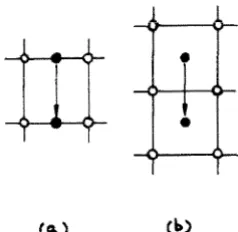
model for H diffusion in bee hosts illustrated in fig. I.
Here the hydrogen causes lattice distortion centred on
the (initial) interstice it occupies; Qe is the disortion
necessary for the hydrogen to have the same energy in
the initial and final neighbouring interstices.
(3) Cases where jumps proceed by excitation to
I F I F
la) (b)
Fig. 1. I~us~ation of diffusion limited only by the self-trap ping distortion. In (a) the interstitial has a lower energy in the central site than in the adjacent ones and cannot tunnel; in (b) a fluctuation makes two sites energetically equivalent. The ac- tivation energy is the energy needed to produce the fluctuation.
some well-defined excited state for which rapid motion
can occur.
All three groups give therma~y-activated behaviour
at high temperatures, although the origin of the activa-
tion energy E,
differs from case to case:
(1) (i) For classical diffusion
E8is a saddle-point
energy, possibly with minor corrections; (ii) for the
“lattice-activated” case of Flynn and Stoneham, & is
the energy needed to strain the host lattice so that the
transition matrix element is appreciable (fig. 2).
(2) & is a lattice energy, being the energy to distort
the lattice so that the diffusing particle would have the
same energy in the initial and final positions.
(3) Ea
is the excitation energy of the important ex-
cited state, again with possible minor corrections.
There may be a slight temperature dependence of
the pre-exponenti~ factor too, although this is rareiy
significant. For a single simple harmonic oscillator at
high temperatures, for example, the probability that
the displacement lies within SQ of Qe is proportional
to
TV”’ exp(-&/kT) SQ, and the probability thatQ exceeds Qe varies as T’12 exp(-&/kT);
in both cases
Eois $Mti2Q$
Clearly the pre-exponential factor is not enough to
be sure of the type of mechanism. The isotope effect
gives a number of clues, and certain measurements
(notably of heats of transport) are particularly impor-
tant guides [I 21. In particular, for some mechanisms
[e.g. (2)] there is a contribution proportional to the
activation energy in the reduced heat of transport
(‘* = OtE, t /I), whereas in others [e.g. (2) or (Ii)
above] there is no such term.
A A
(a)
6)
A.M. Stoneham /Non-classical diffusion processes 111
Examples of the various mechanisms have been discussed by Flynn [5] and Stoneham f7]. Simple vacancy motion and most impurity diffusion falls into category (1). Category (2) appears to cover H in bee metals, and the reorientation of H trapped by 0 or N in Nb [7] is a particularly good example. Other in- stances include a number of systems which are not discussed in conventional diffusion work. Examples are p” diffusion [9] and the small polaron systems such as the V, centre in alkali halides [5,7] and the electronic hole in MnO [lo]. It is worth stressing that many systems show behaviour closely analogous to diffusion but without involving matter transport over large distances. Perhaps the best example of case (3) is in this group, namely the orientation of 0; ions substituting for anions in alkali halides.
3. Sources of isotope effects
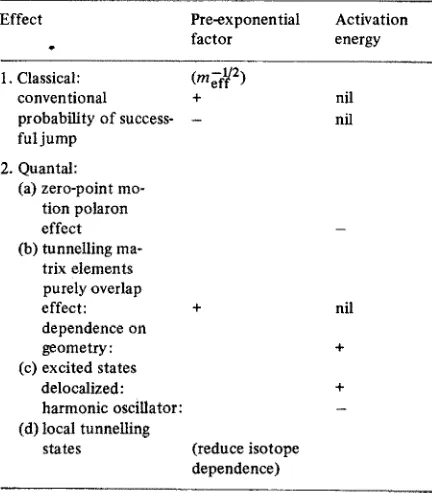
This section summarizes the ways in which isotope mass can affect diffusion rates. Since it is usual to de- scribe diffusion data by fits to Arrhenius expressions (even if valid over restricted temperature ranges only), the effects on the activation energy and pre-exponent- ial factor are given separately in table 1. The main point of this section is to indicate just how complicated and varied isotope effects can be, in contrast to naive views often expressed. The question of which mecha- nisms actually operate in particular systems, notably H in metals, is taken up later. For both future use and simplicity of exposition it is useful to think mainly of the interstitial diffusion of an impurity atom.
3. I. Classical effects
In the classical treatments, the activation energy de- pends on the potential energy of some saddle-point configuration, and is independent of isotopic mass. The pre-exponential factor does depend on mass, basic- ally through the mean square amplitude of thermal vi- bration in the reaction coordinate [S]. The simplest theories give a rate proportional to M-‘j2. However, the isotope effect is reduced because of the participa- tion of atoms other than the diffusing particle in the motion leading to the jump.
Classical theory is usually developed for harmonic systems, and assumes a jump will occur whenever a
Table I
contributions to the isotope effect.
Here a positive effect is one which increases the rate for lighter masses, i.e. the lighter the mass, the smaller the activation ener- gy or the larger the pre-exponential factor
-_-
Effect Pre-exponential Activation
factor
c energy
1. Classical: (W$y*)
conventional + nil
probability of success- - nil ful jump
2. Quantal:
(a) zero-point mo- tion poiaron
effect _
(b) tunnelling ma- trix elements purely overlap
effect: + nil
dependence on
geometry: +
(c) excited states
delocalized: +
harmonic oscillator: (d) local tunnelling
states (reduce isotope dependence)
saddle point is crossed in the right direction. Molecular dynamics calculations (which usually include anharmo- nicity) stress how hard it is to justify this view, for there are often “jumps” in which the diffusing particle moves straight back to the site it has vacated. Bennett [ 131 has suggested another criterion, as follows. Sup pose one considers the motion from A to B via a saddle- point S shown in fig. 3. Then a successful jump is one
SADDLE -POINT IPLANE
I Y 1
I I I I
I I
INITIAL I I I FINAL
SITE I
k DTEF;;3 4
SITE
X Y
A and S) and then through Y (between S and B) with- out making any subsequent intermediate crossings of X.
The classical definition is achieved if X and Y coin- cide with S. The importance of the molecular dynamics work is that the probability that a jump will be success- ful after X is reached is isotope dependent. Bennett has given promising results which may remove some of the anomalies in the literature. In particular, he suggests heavy isotopes have a larger chance pf a “successful” transit from X to Y. Obviously this depends on the precise choices of X and Y. Bennett’s choice is a sen- sible one, albeit isotope-independent; since X and Y presumably correspond roughly to the limits of vibra- tional (rather than diffusive) excursions from the ini- tial and final sites one could argue for an isotope- dependent choice, which would reduce the effect.
3.2. Quantum effects
The qualitative differences between classical and quanta1 approaches have been reviewed recently [2-4] and will not be repeated here. But there are three main ways in which isotope effects arise.
(a) There is zero-point motion which causes a distor- tion of the surrounding lattice. This “polaron” effect alters the activation energy, increasing it for lighter isotopes. Other effects of zero-point motion will be mentioned later.
(b) The jump frequency is proportional to the square modulus of a matrix element. Normally this element, J, will be bigger for lighter masses. Thus J may depend on the overlap of initial and final state ~vefunctions, and this is usually bigger for the larger zero-point mo- tions of lighter atoms. However, in some cases the ma- trix element is very small unless atoms straddling the jump path move by more than some critical amount. The critical movement leads to a term in the activation energy corresponding to the strain energy needed to make the movement. Since the critical amount is iso- tope-dependent, the activation energy will change with isotope. Probably the contribution to E, will be less for lighter isotopes, simply because the larger zero-point motion makes smaller critical displacements possible.
(c) The vibrational levels of the diffusing particle may be discrete, rather than a continuum. In certain cases diffusion may occur by excitation to a well-de- fined excited state. Two obvious effects on the activa-
calized, so that its energy depends little on the isotope mass, then the activation energy (the difference be- tween ground and excited state energies here) will be less for lighter masses because the zero-point energy ;Rw raises the ground state energy of the light mass relative to the heavy mass. (ii) If the levels are like those of a harmonic oscillator, the larger frequency w for the light mass raises the excited state energies and increases the activation energy.
(d) Local tunnelling states. One effect which proves especially important for H in bee metals like V, Nb and Ta comes from the possibility that light atoms can tun- nel between interstitial sites within one interstice, as well as jumping between interstices [ 141. This phenom- enon has as its main effect the increase of the transition matrix element and a diminution of the isotope effects in (b). However, the situation is complicated because the precise form of the potential energy surface is af- fected by the local lattice distortions mentioned in (a).
Another case, which is quanta1 with a vengeance, concerns the reo~entation of 0, in alkali halides. Here a pair of like isotopes [e.g. (O”)?] and a pair of unlike isotopes [e.g. (016-0’8)-] behave differently just be- cause of the exclusion principle and its effect on al- lowed rotational states. However, this is not a case which need cause concern in diffusion. Still further examples of isotope effects should exist, for example in self-interstitial motion in metals. I shall not discuss these, despite their interest, because no measurements exist or seem likely in the near future.
4. Models for quantum ~haviour
A.M. Stoneham /Non-classical diffusion processes 113
application to diffusion by Flynn and Stoneham [6]. Recent papers often reproduce the same results by dif- ferent means; in the present outline rather little will be mentioned of these aspects, despite their value.
In the “small” polaron description of light intersti- tial diffusion, there are three regimes of behaviour. In order of increasing temperature these are as follows.
(1) A propagating regime, where the interstitial propagates through the lattice rather like an electron. Flynn and Stoneham argued that this regime occurs only at temperatures below those of practical’impor- tance, although this has been disputed [ 181.
(2) A hopping regime, where the activation energy is related to the energy associated with lattice distor- tion (the “self-trapping distortion”) and is not a po- tential energy barrier. This regime appears dominant for hydrogen in metals.
(3) A “classical” regime in which diffusion is domi- neted by either excitation to states above the energy barriers (i.e. as in the classical description) or to states below the barrier for which tunnelling is sufficiently rapid.
Most real systems will show one, or at most two, of these regimes. Propagation is seen only in the reorien- tation of anisotropic defects, and need not concern us here. The relative roles of regimes (2) and (3) is much harder to decide. However, one sensitive check of a transition between regimes is the heat of transport [12] and it should be stressed that experiment gives no in- dication of a transition in hydrogen-metal systems. It should also be stressed that regime (3) may only be rel- evant at temperatures so large as to be irrelevant, for example above a melting temperature.
Of the papers discussing regimes (2) and (3) (refs.
[ 18-23]), several also concern the question of self- trapping, i.e. whether regime (2) can exist at all [18-231. There seems general agreement that, if a system moves from regime (2) to (3) with increasing temperature, then the activation energy changes from the polaron value to the classical barrier height. However, there is no agree- ment about the smaller corrections, and some features are ignored (notably the configuration-dependence of the transition matrix element which is important for H in fee metals [6,2]). Furthermore, at high temperatures, any transition to a classical regime could be hidden by the effects of correlations between successive jumps. In this effect, discussed for polarons by Emin [22], the host lattice distortion recovers only in a time compa-
rable with the rapid jump frequency, and the probabil- ity of subsequent jumps is affected.
The role of the excited states of an interstitial in an interstice has been discussed several times. Formulae were given by Flynn and Stoneham, but were not ap plied because they involved unknown parameters and because they seemed unnecessary. Explicit calculations can be made (e.g. [20]) but these make assumptions about the excited states which are chosen to be alge- braically simple, rather than realistic physically. Another aspect which needs detailed discussion is the adiabatic or non-adiabatic nature of the transition. The non-adia- batic case is usually assumed (here the transition matrix element is sufficiently small to be taken to lowest-order perturbation only) although there may be cases where this is inadequate and where estimates of the limits of the regimes may need revision [ 18,191.
5. Experiment and the isotope effect
Isotope effects have been discerned in a wide range of phenomena, recently reviewed in [ 11. This section concentrates on a few examples to illustrate the argu- ments of the last section.
5.1. Hydrogen in bee metals
Experiment shows three main features for diffusion in V, Nb and Ta. First, hydrogen always diffuses faster (DH > 0~) than deuterium. Secondly, the pre-exponent- ial factors are insensitive to the isotope. Thirdly, the activation energy for hydrogen is less than that for deu- terium (QH < Qn). Fig. 4 shows schematically the tem- perature dependence of DH/DD and of the diffusion rates.
It would be unrealistic to discuss these data without mentioning that hydrogen in V, Nb and Ta shows anom- alies of several sorts, notably in:
(i) the magnitude, temperature dependence and scat- tering-vector dependence of the Debye-Waller factor [24];
(ii) the widths of quasi-elastic neutron spectra [25]; (iii) the lack of anisotropy in the elastic dipole tensors
1151;
(iv) specific heat data [ 161; and
J-2 ---_---em-_--_-
~‘H~DD BCC
-11 /TEMPERATURE) LOG ml
4 H
0
Fig. 4. Schematic illustration of isotope effects in bee metals like V, Nb and Ta.
The most probable interpretation of the mechanism
of H diffusion in bee hosts is that of Flynn and Stone-
ham [6], who argued that the diffusion rate is deter-
mined by the inertia associated with lattice distortion
by the interstitial hydrogen. This mechanism is illus-
trated in fig. 1. The evidence is summarized by Stone-
ham [23; further support comes from the detailed stud-
ies of hydrogen trapped by 0 or N in Nb [8]. However,
in its simplest form, the theory predicts two results at
variance with experiment: it suggests a larger activa-
tion energy for hydrogen than deuterium, and it sug-
gests a strong mass dependence for the pre-exponent-
ial factor.
One way out of the anomalies is to assume [ 141 that
the interstitial is not located at a single interstitial site
but, because of its zero-point motion, tunnels rapidly
between a group of (possibly inequivalent) sites, mak-
ing diffusive jumps between groups. An example for a
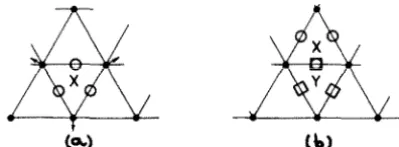
two-dimensional lattice is shown in fig. 5; note that
certain sites may be shared between groups. This model
solves most of the problems, at least qualitatively. It
has some direct backing for Nb from specific heat data
[
161 and also from neutron data [26],-in that the hy-
drogen seems to be confined mainly but not solely to
the tetrahedral sites. Recent c~culations for V
: H[27]
also suggest a multiwell structure of much the sort re-
quired.
Since many details remain to be sorted out, it is
probably most useful to show how the right qualitative
isotope effect could arise without disturbing the agree-
ment already achieved. First, consider the pre-exponent-
(a)
W
Fig. 5. (a) Example of an interstitial centred at X but spending most of its time at the inequivalent sites 0. The local lattice distortion is indicated roughly. (b) Example of a diffusive jump between two adjacent sites X and Y for a system like that in (a). Lattice distortions are not shown. Note that one subsidiary minimum is common to both sites X (involving o) and Y (involving 0).
A.M. Stoneham / Non-classical diffusion processes 115
tally correct, there are simplifications in detail which
are important in a feature as complex as the isotope
dependence. In particular, the assumption that the
transition matrix element does not depend on the lat-
tice geometry (Condon approximation) may break
down, or the excited states may be involved in a variety
of subtle ways.
5.2. Hydrogen in fee metals
The diffusion behaviour in fee metals is quite differ-
ent from the bee case. This (e.g. refs. [2,4,6]) is mainly
a fairly natural consequence of the lattice structures.
The isotope effect differs in having these three charac-
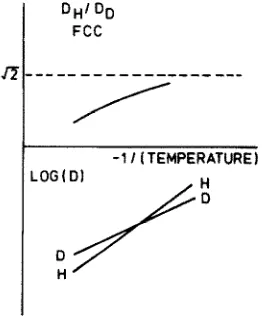
teristics (fig. 6). First, deuterium diffuses faster than
hydrogen below a certain temperature. Secondly, the
pre-exponential factors show roughly the classical
M-1’2dependence, notably for Ni and Cu; Pd may be
anomalous, in that tritium does not seem to follow
the trends for H or D. Thirdly, the activation energy
for hydrogen is larger than that for deuterium; again,
tritium in Pd may be anomalous.
As usual, a unique explanation is lacking. Simple
classical descriptions with quantum statistics only are
adequate for solubi~ity and diffusion data for hydrogen
in Cu, but less so for Ni and still less for Pd. Such semi-
classical descriptions seem inadequate for the isotope
dependence of effective charges and heats of transport
[
12,3 11. In the alternative Flynn-Stoneham theory,
the transition probability depends on certain transition
DH’ DD FCC
“___---/_______
-1 I i TEMPERATURE J
LOG(D) H
0
Fig. 6. Schematic illustration of isotope effects is fee metals like Cu, Ni and Pd.
matrix elements. These matrix elements are of the order
of a vibrations energy (which depends on the isotope
and is larger for lighter isotopes) and a factor which re-
presents the influence of the atoms straddling the jump
path. The activation energy is dominated by the lattice
energy required to move these atoms apart by a critical
distance for the matrix element to become large. With-
out detailed interatomic potentials, it is hard to say
what isotope effect to expect, although one might ex-
pect it to give a lower activation energy for the lighter
isotope, contrary to observation. To explain the ob-
served effect one is forced to assume either (i) that it
is the stronger isotope effect of the modest polaron
contribu~on [section 3.2(a)] to the activation energy
which dominates, or (ii) that the self-trapping lattice
distortion caused by the zero-point motion (which is
more for lighter isotopes) affects the critical distances
by which the atoms straddling the jump path must move
so as to give the effect observed.
6. Final comments
The explanation of isotope effects in hydrogen dif-
fusion has certainly not been settled in the last few
years. Indeed, there are now even more results needing
explanation, ranging over phenomena from effective
charges and heats of transport to phase diagrams. As
observed in [2], the root of the difficulty in finding an
explanation lies partly in the complex mixture’of pos-
sible effects and partly in our lack of detailed knowl-
edge of the hydrogen- metal interactions. Recent the-
ory ([27] and [32]) shows promise for this second as-
pect, and one can be a little more optimistic that theo-
ry with continued experiment will clarify the basic me-
chanisms.
References
[ 11 (a) G. Alefeld and H. Wipf, Fiz. Nizk. Temp.
(1975) in press; (b) H.K. Birnbaum and C.A. Wert, Ber. Bunsenges 76 (1972) 806.
[2] A.M. Stoneham, Ber. Bunsenges. 76 (1972) 817. [3] A.M. Stoneham, Collective Phenomena 2 (1975) 9. [4] J.A. Sussmann, Ann. Phys. 6 (1971) 135.
[ 51 C.P. Flynn, Point Defects and Diffusion (Oxford, 1972). [6] C.P. Flynn and A.M. Stoneham, Phys. Rev. Bl (1970)
[ ? j A.M. Stoneham, Theory of Defects in Solids (Oxford, 1975).
1261 B. Fender, 1976 Birmingham Conference Hydrogen in Metals.
[8] C.G. Chen and H.K. Birnbaum, (1976), to be published. [27] A. Mainwood, AERE Report TP. 684 (1976). [9] E.g. A. Seeger, Phys. Le- 58A (1976) 137 for Fe and [28] H. Peisl, private communication.
preprints (1976) by Kossler, Fiory and co-workers on [29] J.A.D. Matthew, Phys. Status Solidi 42 (1970) 841. CF and p-Pd H. [ 301 R.D. Kirby, A.E. Hughes and A.J. Sievers, Phys. Rev. [lo] E.g. C.R.A. Catlow, WC. Mackrodt, M.J. Norgett and
A.M. Stoneham, Phil. Mag. (1976) and references therein. [ 1 l] E.g. ref. [7], section 21.3 and references therein. [ 121 A.M. Stoneham and C.P. Flynn, J. Phys. F3 (1973) 505. [ 131 C.H. Bennett, Thin Solid Films 2.5 (1975) 65.
[ 141 The idea that H might occupy one interstitial site at low tem~ratures and another at high temperatures is very old. The idea that, even at absolute zero, hydrogen could tunnel significantly between several (possibly inequivalent) sites associated with an interstice came later. Despite much earlier work on other systems - the NH3 molecule first of all, the systems like KC1 : Li - the earliest specific reference appears to be [ 21, with important later discus- sions in [ 15,161.
B2 (1970) 481.
[31] For experimental data see, e.g., H. Wipf, J. LessCom- mon Metals 49 (1976) 291.
[ 321 See also the papers at this meeting by M.J. Stott; MS. Shaw and N.F. Lane; C.F. Melius, CL. Bisson and W.D. Wilson; R.W. Simpson, N.F. Lane and R.C. Chaney; and by J.P. Van Dyke; see further A. Mainwood and A.M. Stoneham, J. Less-Common Metals 49 (1976) 271.
Discussion
[ 151 J. Bucholz, J. VSlkl and G. Alefeld, Phys. Rev. Lett. 30 (1973) 318.
[ 161 H.K. Birnbaum and C.P. Flynn, Phys. Rev. Lett. 37 (1976) [ 17J ?Holstein, Ann. Phys. 8 (1959) 325, 343.
[ 181 M.I. Klinger, J. Phys. C8 (1975) 2343;
Y. Kagan and M.I. Klinger, J. Phys. C7 (1974) 2791. Note that H in metals constitutes a strongly-coupled system, and references to weak-coupling cases are irrelevant.
R.A. Johnson: T’he classical picture of a migration jump IS that of a local vibrational mode by which the saddle-point configuration is attained. The transition probability is related to a barrier height by being proportional to a Boltzmann factor e -E/k? (1) Can we somewhat similarly think of the quan- tum picture for both the direct and the lattice activated me- chanisms as a local vibrational mode by which the appropriate conditions for a tunneling transition are attained? (2) Is the quantum transition probability proportional to the integrated proPability of a Boltzmann factor edErlkT times the probability ity of tunneling at energy Er?
[ 191 G.B. Arnold and T. Holstein, Bull. Amer. Phys. Sot. 21 (1976) 355.
[ZO] E. Gorham-Bergeron, Phys. Rev. Lett. 37 (1976) 146. (211 S. Fujii and Y. Uemura, J. Phys. Sot. Jap. 40 (1976) 1095. [22] D. Emin, Phys. Rev. B3 (1971) 1321; B4 (1971) 3639. [ 231 P. Prelovsek, J. Phys. C8 (1975) 2436;
D. Emin, Phys. Rev. Lett. 28 (1972) 604; Advan Phys. 22 (1973) 57;
H. Sumi, J. Phys. Sot. Jap. 33 (1972) 327;
A, Sumi and Y. Toyozawa, J. Phys. Sot. Jap. 35 (1973) 137;
D. Emin and T. Holstein, Phys. Rev. Lett. 36 (1976) 323. [ 241 Debye-Waller factor results are given by Rowe et al., J.
Phys. Chem. Solids 32 (1972) 41;
Birchall and Ross, Jill. Conf. 6 (1972) p. 333; Gissler et al., Phys. Lett. 43A (1973) 279;
Wakabayashi et al., Solid State Commun. IS (1974) 503. [ 2.51 Quasi-elastic neutron data are given by Rowe et al., Phys.
Rev. B9 (1974) 5039;
Stump et al., Phys. Status Solidi 54 (1972) 295; de Graaf et al., J. Chem. Phys. 56 (1972) 4574.
A.M. Sronehnm: (1) There is an analogy of the sort you men- tion. One can think of a mode of distortion of the host lattice atoms (and not of the local mode of vibration of the tight in- terstitial) by which appropriate conditions for tunneling are ob- tained. (2) The quantum transition probability is indeed pro- portional to an appropriately weighted product of a Boltzmann factor and a tunneling probability for the corresponding energy El. Here, the energy is the host Iattice strain energy required to produce appropriate conditions for tunneling.
The main difference between the coordinates in the present quanta1 case and the usual classical case is this: in the classical case the local coordinate is roughly the coordinate of the dif- fusing particle; in the quanta1 case the only positions of the host atoms are involved in the local coordinate.
M. Doyama: I just want to point out the similarity between a hydrogen atom and a positron or a positive muon. Your calcu- lation is probably quite applicable to those particles.