Experimental Study on Effect of Water
Ingestion into Inlet Manifold on Performance
and Emissions in Compression Ignition Engine
Rajmohan.N
1, Dr. Swaminathan M. R
2Department of Mechanical Engineering, College of Engineering, Guindy, Chennai, India1,2
ABSTRACT: The performance of a diesel engine depends mainly on mixing of the fuel and air in the combustion chamber. The diesel engine suffer from significant generation of nitric oxide and particulate matter emission due incomplete combustion. As the fuel is injected directly into the combustion chamber in conventional diesel engines, spatial distributions of air-fuel ratio vary widely from rich to lean in combustion chamber. The NOx is formed in stoichiometric zone and smoke is generated during diffusion combustion period where the combustion rate becomes slower. One of the effective method to reduce oxides of nitrogen and particulate matter emissions simultaneously is to reduce the intake charge temperature in diesel engine. Therefore in the present study, the effect of water injection into intake air on performance and emission characteristic of single cylinder CI engine are carried out at different load and constant speed, with variable water to diesel ratio by mass. The water is injected into intake air by an elementary carburettor.
KEYWORDS: xides of nitrogen, CI, Particulate Matter, Mixing controlled combustion
I. INTRODUCTION
Diesel engines play a major role in power generation, agriculture, mass transportation etc. India, one of the fast developing countries, is known as diesel driven economy as the consumption of diesel to gasoline is about 5:1. This is mainly due to diesel engine operation at higher compression ratio and leaner air fuel ratio than SI engine resulting in higher thermal efficiency. Even though the levels of HC and CO are very lower in the diesel engines than gasoline engine, however, it emits high levels of NOx and smoke emission. The stringent emission norms pose to a big challenge to the researchers for controlling these emissions.
The main causes of formation of particulate emission from diesel engines are heterogeneous air-fuel mixture, poor mixing of fuel with air, high diffusion combustion phase, fuel containing sulphur content, high fuel density, etc. Particulate emission could be reduced by improving mixing rate of fuel with air, enhancing premixed combustion phase by increasing ignition delay, etc. However, it would lead to high in-cylinder temperature resulting in high NOx formation as it is mainly a function of temperature. This conflict nature leads to difficulty in simultaneous control of NOx and particulate emissions from diesel engines.
faster evaporation of diesel and better mixing of diesel and air. This enhances more combustible mixture during ignition delay period. Such that more combustible mixture participates in uncontrolled (premixed) combustion phase and heat release rate is high. In cylinder temperature rise suppressed by water vapour. So that oxides of nitrogen reduced. The particulate emissions reduces due to shorter controlled combustion phase.
II. EXPERIMENTALSETUP
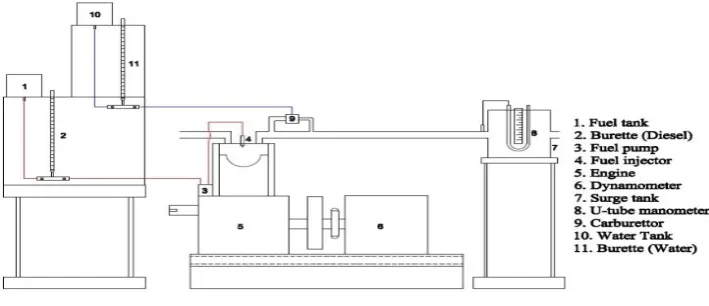
Experimental were contacted on single cylinder, Air-cooled engine. The engine specifications are shown in Table 1. The schematic of experimental set-up is shown in Fig. 1. Time taken for fuel consumption was measured with the help of a digital stopwatch.
S.NO PARAMETERS SPECIFICATION
1 Make Kirloskar TAF 1
2 Bore, mm 87.5
3 Stroke, mm 110
4 Number of cylinder 1-vertical
5 Type NA
6 Cubic capacity, cc 662
7 Compression ratio 17.5: 1
8 Brake power, kW 4.4
9 Rated speed, rpm 1500
10 Fuel injection pressure, bar 200 11 Type of cooling Air cooled
Chromel alumel thermocouple in conjunction with a digital temperature indicator was used for measuring the exhaust gas temperature. An orifice meter was used to measure air consumption of the engine with the help of a U tube manometer. The surge tank fixed on the inlet side of an engine maintains a constant airflow through the orifice meter. A simple carburettor were used for ingestion water into intake tract.
The AVL exhaust gas analyser used for measuring the engine tail pipe emissions. The smoke opacity measured by AVL opacity device.
Fig. 1. Schematic diagram of experimental setup
III. ERRORANALYSIS
All measurements of physical quantities are subject to uncertainties. Uncertainty analysis is needed to prove the accuracy of the experiments. To get the realistic error limits for the computed result, the principle of root-mean square method was used to get the magnitude of error
∆R = [(∂R/∂X1*∆X1)2 + (∂R/∂X2*∆X2)2 + ….. + (∂R/∂Xn*∆Xn) 2]1/2
Using this equation the uncertainty in the computed values such as brake power, brake thermal efficiency and fuel flow measurements were estimated. The uncertainties in the measured parameters, voltage (∆V) and current (∆I), estimated by the Gaussian method, are ±3 V and ±0.14 A respectively. For fuel time (∆tr) and fuel volume (∆t), the uncertainties are taken as ±0.2 s and ±0.1 cc/s respectively. Percentage of uncertainty for the measurement of speed, mass flow rate, NOx, hydrocarbon, smoke and pressure are given below:
i) Speed: 1.1
ii) Mass flow rate of air: 1.3 iii) Mass flow rate of diesel: 1.0 iv) NOx: 1.1
v) Hydrocarbon: 0.01 vi) CO: 0.8
vii) CO2: 1.2 vi) Smoke: 2.0 vii) Pressure: 1.1
IV. RESULTSANDDISCUSSION
The effects of water ingestion into intake manifold with varies water–diesel ratio on the performance, combustion and emission characteristics of the diesel engine.
Performance characteristics of engine
It is seen from Fig. 2 that the brake thermal efficiency reduces at all outputs below diesel values with ingestion due to poor combustion as a result of reduction in the charge temperature.
Fig. 2. Variation of brake thermal efficiency with load.
This reduction in power output, need to feed more fuel than neat diesel for compensating power loss. The feeding of more fuel which reduce brake thermal efficiency than base diesel for all water-diesel ratio.
Emission characteristics of engine
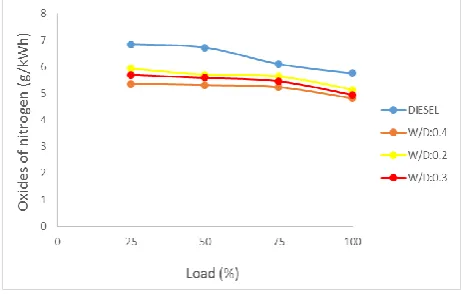
The oxides of nitrogen levels are lower than diesel fuel for all water-diesel ratio shown in Fig.3. Because of presents water vapour in combustion chamber reduce the in-cylinder temperature. The formation of NO mainly due to combustion temperature and availability of oxygen. The W/D: 0.4 ratio were reduce the oxides of nitrogen than other water-diesel ratio.
Fig. 3. Variation of brake specific oxides of nitrogen with load
The water have high specific heat and laterned heat of vaporization, phase change during constant pressure in absorbed the heat energy from the combustion. Thereby reduction in temperature. The formation of NO directly proportional to cylinder temperature. The catering of water increase it reduce the oxides of nitrogen. So that W/D: 0.4 ratio supreme over than other water to diesel ratio.
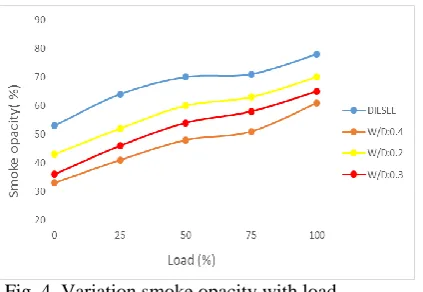
The smoke opacity of water ingestion below the diesel for all
Fig. 4. Variation smoke opacity with load
output. Its seam in Fig.4. The micro-explosive phenomenon of water which mixed the fuel vapor and air perfectly and homogeneously thereby reduction in smoke emission because of closer to complete combustion. And other reason reduction of smoke by shorter duration of diffusion combustion. It accomplished due to increase ignition delay period.
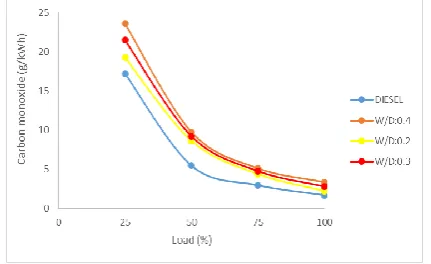
CO and HC lever are higher than diesel fuel over all engine output. It is seam in Fig. 5. and Fig.6.
Fig. 5. Variation of brake specific hydrocarbons with load.
Fig. 6. Variation of brake specific carbon monoxide with load.
The present of water vapour increase ignition delay as aforementioned. Increase of ignition delay period which tend increase the lean flame out region (LFOR). In this region of mixture does not participate the combustion or partially burned these are reason for hydro carbon emission and reduction of cylinder temperature were increase carbon monoxide emission. Aforementioned both emission were increased proportional to water to diesel ratio increased as shown profile.
V. CONCLUSION
From this study, ingestion of water by carburettor reduce engine tail pipe emissions significantly and brake thermal efficiency were slightly reduced. In this conclusion W/D: 0.4 were supremely reduce NOx and smoke exhaust emission than other water to diesel ratio. HC and CO emission were higher than all other W/D ratio but diesel engine these emission are not significant. The brake thermal efficiency slightly lower than base diesel fuel.
REFERENCES
1. Abu Zaid M. Performance of single cylinder direct injection diesel engine using water fuel emulsion. Energy convers manage 2004; 45: 697-705.
2. Alain Maiboom, Xavier Tauzia. NOx and PM emissions reduction on an automotive HSDI diesel engine with watet-in-diesel emulsion and
3. M. Ebna Alam Fahd, Yang Wenming, P.S Lee, S.K. Chou, Christopher R. Yap. Experimental investigation of the performance and emission characteristics of direct injection diesel engine by water emulsion under varying engine load condition. Applied energy 102 (2013) 1042-1049. 4. Miyauchi T, Mori Y, Yamaguchi T. Effect of steam addition on NO formation. In: 18th symposium (international) on combustion. The
Combustion Institute, USA; 1981.
5. Subramanian KA. A comparison of water-diesel emulsion and timed injection of water into the intake manifold of a diesel engine for simultaneous control of NO and smoke emissions. Energy Conversion Manage 2011:52:849e57.
6. B. Tesfa, R. Mishra, F. Gu, A.D. Ball. Water injection effects on the performance and emission characteristics of a CI engine operating with biodiesel
7. Udayakumar R. Reduction of NOx emissions by water injection in to the inlet manifold of a Diesel engine. Society of automotive engineers. SAE paper no. 2003-01-0264.
8. Xavier tauzia. Experimental study of manifold water injection on combustion and emissions of an automotive direct injection diesel engine. Energy 35 (2010) 3628-3639.
9. Zehra sahin. Experimental investigation of the effect of water adding to the intake air on the engine performance and emissions in a DI automotive diesel. Fuel xxx (2013) xxx-xxx.