ISSN (Print) : 2347 - 6710
I
nternationalJ
ournal ofI
nnovativeR
esearch inS
cience,E
ngineering andT
echnology Volume 3, Special Issue 3, March 20142014 International Conference on Innovations in Engineering and Technology (ICIET’14) On 21st&22ndMarch Organized by
K.L.N. College of Engineering, Madurai, Tamil Nadu, India
P N H Phanindra kumar
1, D M Deshpande
2, Manisha Dubey
31M.Tech Scholar in Electrical Department, MANIT, Bhopal, India
2 Professor in Electrical Department, MANIT, Bhopal, India
3 Professor in Electrical Department, MANIT, Bhopal, India
ABSTRACT— This paper describes the various
mathematical models of both squirrel cage and wound rotor induction motors in different reference frames with different state-space variables. The work suggests the d-q axis unified approach for both types of induction motors by using the state-space analysis and it is a strong tool in the modeling of the symmetrical induction motors. When an electrical motor is represented as a mathematical model with inputs and outputs, it can be analyzed and described in many ways, considering different reference frames and state-space variables. The applications of each model are
also discussed. Models are simulated with
MATLAB/SIMULINK software for transient response of the squirrel cage induction motor in terms of electromagnetic torque and rotor angular velocity and results are discussed.
KEYWORDS— modeling of induction motor, sensor
less control, d-q axes model, and different reference frames.
I. INTRODUCTION
Due to advances in control system, induction motor is used as variable speed drive. When an electrical motor is represented as a mathematical model with inputs and outputs, it can be analyzed and described in many ways, considering different reference frames and state-space variables. In three-phase symmetrical or two-phase unsymmetrical version, the induction motor is employed with vector control strategy. Thus, induction motor can be analyzed as DC motor [1].
The dynamic operation of the induction motor drive system has an important role in the overall performance of the system and there are two fundamental methods for the induction motor control: one is the Direct measurement of the machine parameters, which are compared to the reference signals through closed control loops and other is
the estimation of the machine parameters in the sensor less control schemes, with the following implementation methodologies: slip frequency calculation method, speed estimation using state equation, estimation based on slot space harmonic voltages, flux estimation and flux vector control, direct control of torque and flux, observer-based speed sensor less control with parameter adaptation, neural network based sensor less control, fuzzy-logic based sensor less control.[2]
The development of the precise system model is fundamental to each stage in the design, analysis and control of all electrical machines. The level of accuracy required for these models entirelydepends on the design stage under consideration. In some cases, the mathematical description used in machine design requires very fine tolerance levels as stated by Nabae and Murata [3], [4]. However, in the development of suitable models for control purposes, considercertain assumptions that simplify the resulting machine model. Additionally, since modern electric machines are continuously fed from switching power conversion stages, the developed motor models should be valid for arbitrary applied voltage and current waveforms [5]. Generally, the following assumptions are made while implementing the induction motor models
No magnetic saturation.
No saliency effects.
Negligible spatial MMF harmonics.
The effects of the stator slots may be neglected.
There is no fringing of the magnetic circuit.
The magnetic field intensity is constant quantity and
directed radiallyacross the air-gap.
Hysteresis and eddy current effects are negligible.
The goal of this paper is to establish the commonly used
d-q models in different reference frames.
Matlab/Simulink software is used to simulate the
dynamic models of squirrel cage induction motor. The paper has been organized as follows: section II briefly explains the measurement of motor parameters, section III demonstrate the mathematical model of the induction motor, section IV describes the d-q axis models, and the results of implemented Matlab models are shown in section V.
II.MEASUREMENTOFROTORPARAMETERS
A. Stator Resistance
The stator phase resistance is measured by applying a DC voltage and the resulting current with the rotor at standstill. This procedure gives only the DC resistance at a certain temperature, the AC resistance is calculated by considering the wire size, the stator frequency and the operating temperature.
B. No-Load Test
This test is performed by applying a balanced rated voltage on the stator windings at the rated frequency and driven at synchronous speed by DC motor or synchronous motor, preferably a DC motor. The no-load test provides information about exciting current and rotationallosses.
C. Locked-Rotor Test
The rotor of the induction motor is locked and a set of low three phase voltages is applied to calculate rated stator currents. The input power per phase is measured along with the input voltage and stator current. The locked rotor test provides the information about leakage impedances and rotor resistance. [7]
III. MODELING OF INDUCTION MOTOR
A. Space vector equations for three-phase induction motor
For the modeling of three-phase induction motor generally two theories are used. First one is the two real axis reference frame theory initially developed by Park for the synchronous machine [8]. Second one is the space complex vector theory elaborated by Kovacs and Racz [9]. Both theories are used to describe the complete equations system of continuous-time linear model of the induction motor with certain assumptions. Usually, the following assumptions are made [10]:
Geometrical and electrical machine configuration is
symmetrical.
Space harmonics of the stator and rotor magnetic flux
are negligible.
Infinitely permeable iron.
Stator and rotor windings are sinusoidally distributed
in space and replaced by an equivalent concentrated winding.
Magnetic saturation, anisotropy effect, core loss and
skin effect are negligible.
Windings resistance and reactance do not vary with
the temperature.
Currents and voltages are sinusoidal terms.
End and fringing effects are neglected
In this approach, all variables are represented by polar vectors indicating the magnetic and angular
position for the rotating sinusoidal distribution. Let 𝑉𝑝=
Phase Voltage, 𝑉𝑠= Space Vector Stator Voltage, 𝑉𝑟=
Space Vector Rotor Voltage, 𝐼𝑠= Space Vector Stator
Current, 𝐼𝑟= Space Vector Rotor Voltage, 𝐼𝑚= Space
Vector Magnetisation Current, 𝜆𝑠= Space Vector Stator
Flux, 𝜆𝑟 = Space Vector Rotor Flux, f = Supply
Frequency, 𝜔𝑒= Synchronous Speed, 𝜔𝑟= Electrical
Rotor Angular Velocity, 𝜔𝑚= Mechanical Rotor Angular
Velocity, 𝑅𝑠= Stator Resistance, 𝑅𝑟= Rotor Resistance,
𝐿𝑠= Stator Self-Inductance, 𝐿𝑟= Rotor Self-Inductance,
𝐿𝑚= Mutual Inductance, J = Moment of Inertia, 𝐿1𝑠=
Stator Leakage Inductance, 𝐿1𝑟 = Rotor Leakage
Inductance, 𝐾𝑠= Stator Coupling Factor, 𝐾𝑟 = Rotor
Coupling Factor, σ = Leakage co-efficient, 𝜏 𝑠= Stator
Time Constant, 𝜏 𝑟= Rotor Time Constant, 𝜏 𝑠′= Transient
Stator Time Constant, 𝜏 𝑟′ = Transient Rotor Time
Constant, þ = Derivative Operator.
From the Fig (1), the stator voltage equation is
𝑉𝑠 =
2
3 1. 𝑉𝑎𝑠+ 𝛼 𝑉𝑏𝑠+ 𝛼
2𝑉 𝑐𝑠
𝑉𝑠 = 2
3 1. 𝐼𝑎𝑠+ 𝛼 𝐼𝑏𝑠 + 𝛼 2𝐼
𝑐𝑠 .𝑅𝑠+ þ 2
3 1. 𝜆𝑎𝑠+
𝛼𝜆𝑏𝑠+𝛼2𝜆𝑐𝑠 Or in a condensed form
𝑉𝑠 = 𝑅𝑠𝐼𝑠+ þ𝜆𝑠 (1)
Similarly, the rotor equation is
𝑉𝑟 = 𝑅𝑟𝐼𝑟+ þ𝜆𝑟 (2)
And stator and rotor flux linkage-current equations are
𝜆𝑠= 𝐿𝑠𝐼𝑠+ 𝐿𝑚𝑒𝑗𝜃I𝑟 (3)
𝜆𝑟 = 𝐿𝑟𝐼𝑟+ 𝐿𝑚𝑒−𝑗𝜃𝐼𝑠 (4)
Where θ is relative rotor position angle
Vs, Is
Vr, Ir
Vas
Var
Vbs
Vbr
Vcs
Vcr
θ
Fig (1) Model of the 3-ϕ induction motor in Space Vector Notation
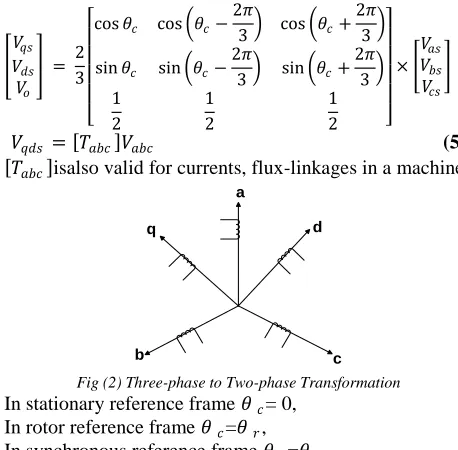
B. Three-Phase to Two-Phase Transformation
To develop models of the induction motor, three-phase (a, b, c) to two-three-phase (d, q) transformation is needed. Fig (2) shows the three-phase to two phase transformation windings. Assuming that each of the
three-phase windings has T1 turns per phase and equal
current magnitudes, the two-phase windings will have
3T1/2 turns per phase for MMF equality. Let the q-axis is
assumed to be lagging the a-axis by 𝜃𝑐. The relationship
𝑉𝑞𝑠
𝑉𝑑𝑠
𝑉𝑜
= 2 3
cos 𝜃𝑐 cos 𝜃𝑐−
2𝜋
3 cos 𝜃𝑐+
2𝜋 3
sin 𝜃𝑐 sin 𝜃𝑐−
2𝜋
3 sin 𝜃𝑐+
2𝜋 3 1
2
1 2
1 2
× 𝑉𝑎𝑠
𝑉𝑏𝑠
𝑉𝑐𝑠
𝑉𝑞𝑑𝑠 = 𝑇𝑎𝑏𝑐 𝑉𝑎𝑏𝑐 (5)
𝑇𝑎𝑏𝑐 isalso valid for currents, flux-linkages in a machine
a
q
b c
d
Fig (2) Three-phase to Two-phase Transformation
In stationary reference frame 𝜃 𝑐= 0,
In rotor reference frame 𝜃 𝑐=𝜃 𝑟,
In synchronous reference frame 𝜃 𝑐=𝜃 𝑒.
C. Generalized Model in Arbitrary Reference Frame The analysis of induction motor drive system is carried out by representing the stator and rotor variables are in a common reference frame. By using the same space vector notations, we can define an arbitrary reference frame, which rotates with the angular velocity
𝜔𝑐, and according to Fig (3), the following relation is
valid
𝑥𝑞𝑑𝑐 = 𝑥𝑞𝑑. 𝑒−𝑗 𝜃𝑐
Where 𝜃 𝑐 is the time variable relative angle between
the arbitrary reference frame and the stationary reference frame. The reverse transformation relation is
𝑥𝑞𝑑 = 𝑥𝑞𝑑𝑐 . 𝑒𝑗 𝜃𝑐
In an arbitrary common reference frame, the voltage and flux linkage equations (1)–(4) becomes
𝑉𝑠𝑐= 𝑅𝑠. 𝐼𝑠𝑐+ 𝑗. 𝜔𝑐. 𝜆𝑐𝑠+ þ𝜆𝑐𝑠 (6)
𝑉𝑟𝑐= 𝑅𝑟. 𝐼𝑟𝑐− 𝑗. 𝜔𝑐− 𝜔𝑟 𝜆𝑐𝑟+ þ𝜆𝑟𝑐 (7)
𝜆𝑠𝑐= 𝐿𝑠. 𝐼𝑠𝑐+ 𝐿𝑚. 𝐼𝑟𝑐 (8)
𝜆𝑟𝑐 = 𝐿𝑟. 𝐼𝑟𝑐+ 𝐿𝑚. 𝐼𝑠𝑐 (9)
Equations (6) to (9) represent the mathematical model of the induction motor in a common arbitrary reference frame. The main advantage of the arbitrary reference frame is mutual inductance doesn’t depend on the relative rotor position. The magnetisation flux and current in an arbitrary reference frame becomes
𝜆𝑚𝑐 = 𝐿𝑚 𝐼𝑠𝑐+ 𝐼𝑟𝑐 (10)
𝐼𝑚𝑐 = 𝐼𝑠𝑐+ 𝐼𝑟𝑐 (11)
q
d
cd
θc
q
cFig (3) Transformation into an arbitrary reference Frame
D. Instantaneous Electromagnetic Torque
The electromagnetic torque of the induction motor is the ratio of the air-gap power by mechanical rotor speed
(𝜔𝑚) in rad/sec. The induction motor electromagnetic
torque can be written as
𝑇𝑒 = 3 2 𝑃 2𝐿𝑚 𝐼𝑞𝑠
𝑐 . 𝐼
𝑑𝑟𝑐 − 𝐼𝑑𝑠𝑐 . 𝐼𝑞𝑟𝑐
(12)
Where P is the number of poles and Te is the
instantaneous electromagnetic torque. The
electromagnetic torque can be expressed in many other forms by substituting the equations (8), (9), (10) & (11). Neglecting mechanical damping, the torque and rotor speed are related as
𝑑𝜔𝑟 𝑑𝑡 =
𝑃
2𝐽 𝑇𝑒− 𝑇𝐿
(13)
where𝑇𝐿 is the load torque.
E. Modeling of induction motor in Different Reference Frames
When the mathematical model of the induction motor is established, several reference frames can be employed depending on the application and the chosen strategy control. There are several main reference frames: stationary reference frame fixed to the stator, rotor reference frame fixed to the rotor shaft, synchronous rotating reference frame revolving with an angular velocity equal to: the air-gap flux, the rotor flux, the stator voltage, the rotor current space vectors. The significance of the index is as follows:
s –stationary reference frame r –rotor reference frame
e –synchronous rotating reference frame a. Stationary Reference Frame Model Equations The choice of the reference frame for the dynamic analysis of the induction motor, especially when the stator circuits are unbalanced or discontinuous and the rotor-applied voltages are balanced or zero, is more convenient to be fixed to the stator frame. This stationary reference frame was first employed by Stanley [11]. Transformation from the arbitrary reference frame to the stationary reference frame fixed to the stator is made by
substituting 𝜔𝑐=0 and the induction motor equations
system can be written as
𝑉𝑞𝑠𝑠 = 𝑅𝑠. 𝐼𝑞𝑠𝑠 +þ𝜆𝑞𝑠𝑠
(14) 𝑉𝑑𝑠𝑠 = 𝑅𝑠. 𝐼𝑑𝑠𝑠 +þ𝜆𝑑𝑠𝑠
(15)
𝑉𝑞𝑟𝑠 = 𝑅𝑟. 𝐼𝑞𝑟𝑠 − 𝜔𝑟. 𝜆𝑑𝑟𝑠 +þ𝜆𝑞𝑟𝑠
(16)
𝑉𝑑𝑟𝑠 = 𝑅𝑟. 𝐼𝑑𝑟𝑠 + 𝜔𝑟. 𝜆𝑞𝑟𝑠 +þ𝜆𝑑𝑟𝑠
(17) 𝜆𝑠𝑐 = 𝐿𝑠. 𝐼𝑠𝑐+ 𝐿𝑚. 𝐼𝑟𝑐
𝜆𝑟𝑐 = 𝐿𝑟. 𝐼𝑟𝑐+ 𝐿𝑚. 𝐼𝑠𝑐
b. Rotor Reference Frame Model Equations
the induction motor by Brereton [12]. The method of referring the machine variables to a rotor reference frame is most useful for field oriented control systems. Transformation from the arbitrary reference frame to the
rotor reference frame is made by substituting 𝜔𝑐=𝜔𝑟 and
the induction motor equations system becomes
𝑉𝑞𝑠𝑟 = 𝑅𝑠. 𝐼𝑞𝑠𝑟 + 𝜔𝑟. 𝜆𝑑𝑠𝑟 + þ𝜆𝑟𝑞𝑠 (18)
𝑉𝑑𝑠𝑟 = 𝑅𝑠. 𝐼𝑑𝑠𝑟 − 𝜔𝑟. 𝜆𝑟𝑞𝑠+ þ𝜆𝑟𝑑𝑠 (19)
𝑉𝑞𝑟𝑟 = 𝑅𝑟. 𝐼𝑞𝑟𝑟 + þ𝜆𝑟𝑞𝑟 (20)
𝑉𝑑𝑟𝑟 = 𝑅𝑟. 𝐼𝑑𝑟𝑟 + þ𝜆𝑑𝑟𝑟 (21)
𝜆𝑠𝑐= 𝐿𝑠. 𝐼𝑠𝑐+ 𝐿𝑚. 𝐼𝑟𝑐
𝜆𝑟𝑐 = 𝐿𝑟. 𝐼𝑟𝑐+ 𝐿𝑚. 𝐼𝑠𝑐
c. Synchronous Reference Frame Model Equations The synchronously rotating reference frame is suitable when incorporating the dynamic characteristics of an induction motor into a digital computer program used to study the dynamicandtransient stability of the system. The synchronous reference frame may also be useful in variable frequency applications if we may assume that the stator voltages are a sinusoidal balanced set. It was systematically developed by Kovas [9], Krause [10] and Lorenz [6]. Transformation from the arbitrary reference frame to the synchronous reference frame is made by
substituting𝜔𝑐=𝜔𝑒 and the induction motor equations
system becomes
𝑉𝑞𝑠𝑒 = 𝑅𝑠. 𝐼𝑞𝑠𝑒 + 𝜔𝑒. 𝜆𝑑𝑠𝑒 +þ𝜆𝑒𝑞𝑠 (22)
𝑉𝑑𝑠𝑒 = 𝑅𝑠. 𝐼𝑑𝑠𝑒 − 𝜔𝑒. 𝜆𝑞𝑠𝑒 +þ𝜆𝑒𝑑𝑠 (23)
𝑉𝑞𝑟𝑒 = 𝑅𝑟. 𝐼𝑞𝑟𝑒 + 𝜔𝑒− 𝜔𝑟 . 𝜆𝑑𝑟𝑒 +þ𝜆𝑞𝑟𝑒 (24)
𝑉𝑑𝑟𝑟 = 𝑅𝑟. 𝐼𝑑𝑟𝑟 − 𝜔𝑒− 𝜔𝑟 . 𝜆𝑞𝑟𝑒 +þ𝜆𝑑𝑟𝑟 (25)
𝜆𝑠𝑐= 𝐿𝑠. 𝐼𝑠𝑐+ 𝐿𝑚. 𝐼𝑟𝑐
𝜆𝑟𝑐 = 𝐿𝑟. 𝐼𝑟𝑐+ 𝐿𝑚. 𝐼𝑠𝑐
IV. D-Q AXES MODELS
The three-phase induction motor can be modeled by using different state-space variables and keeping as inputs the stator voltages and the load torque, and as outputs the electromagnetic torque and the rotor angular velocity. The possible set of currents and flux linkages per second space vectors are defined as
𝑥 = 𝐼𝑠 𝐼𝑟 𝐼𝑚 𝜆𝑠 𝜆𝑟 𝜆𝑚 𝑇(26)
The d-q axes are orthogonal and fixed to the stator, q axis coincide with the magnetic axis of the as winding. As there are four voltage equations, it is necessary to consider two of the space vectors as state-variables in order to obtain a solution for the equations system. Let the selected
pair of state-space variables are denoted as𝑥1, 𝑥2. The set
of six state-space variables will be expressed in terms of the two selected state-space variables:
𝑥 = 𝐼𝑠 𝐼𝑟 𝐼𝑚 𝜆𝑠 𝜆𝑟 𝜆𝑚 𝑇
=
𝑎11 𝑎12
𝑎21 𝑎22
𝑎31 𝑎32
𝑎41 𝑎42
𝑎51 𝑎52
𝑎61 𝑎62
. 𝑥1 𝑥2 𝑇
There are mainly three types of d-q models: current state-space variables models, flux linkage state-space variables models, mixed currents-flux linkage state-space variables models. By using d-q model to obtain a
complete version of the three-phase IM model, viewed as the key for a motion control system. The general form of d-q model equations written in state variables system is given by:
þ𝑥 = 𝐴. 𝑥 + 𝐵. 𝑢(27)
Where x is the selected set of state-variables and represent also the output of the model, u is the input vector (stator voltage), A is the coefficient matrix of x, B is the coefficient matrix of u, and þ is the differential
operator (𝑑
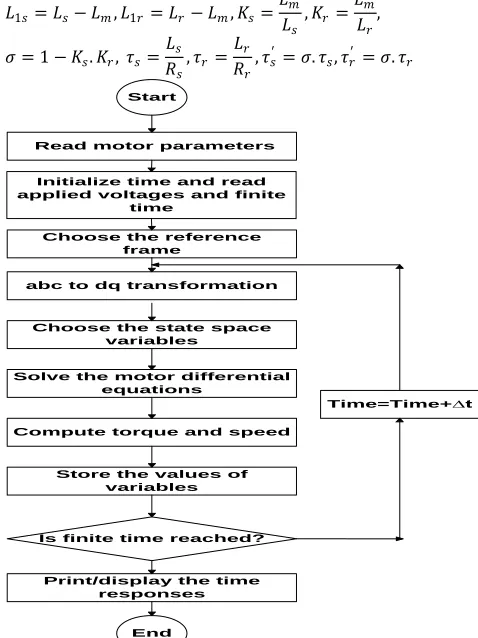
𝑑𝑡). Flowchart for the dynamic simulation of the
induction motor in d-q model is shown in Fig (4) and in this paper commonly used state space-variables models are presented below:
𝐿1𝑠= 𝐿𝑠− 𝐿𝑚, 𝐿1𝑟= 𝐿𝑟− 𝐿𝑚, 𝐾𝑠=
𝐿𝑚
𝐿𝑠 , 𝐾𝑟=
𝐿𝑚
𝐿𝑟,
𝜎 = 1 − 𝐾𝑠. 𝐾𝑟, 𝜏𝑠 =
𝐿𝑠
𝑅𝑠, 𝜏𝑟=
𝐿𝑟
𝑅𝑟, 𝜏𝑠
′ = 𝜎. 𝜏
𝑠, 𝜏𝑟′ = 𝜎. 𝜏𝑟
Start
Read motor parameters
Initialize time and read applied voltages and finite
time
Choose the reference frame
abc to dq transformation
Choose the state space variables
Solve the motor differential equations
Compute torque and speed
Store the values of variables
Is finite time reached?
Print/display the time responses
End
Time=Time+∆t
Fig (4) Flowchart for dynamic simulation of the IM
A. 𝑰𝒒𝒔 𝑰𝒅𝒔 𝑰𝒒𝒓 𝑰𝒅𝒓 :
In this mathematical d-q model, stator and rotor space
vector currents are selected as state-space variables𝑥 =
𝐼𝑞𝑠 𝐼𝑑𝑠 𝐼𝑞𝑟 𝐼𝑑𝑟 . The stator current space vector is
𝐈𝐪𝐬𝐜 𝐈𝐝𝐬𝐜 𝐈𝐪𝐫𝐜 𝐈𝐝𝐫𝐜 = −𝟏 𝛕𝐬 −𝛚𝐜 −𝐊𝐬.þ −𝛚𝐜. 𝐊𝐬 𝛚𝐜 −𝟏 𝛕𝐬 𝛚𝐜. 𝐊𝐬 −𝐊𝐬.þ −𝐊𝐫.þ − 𝛚𝐜− 𝛚𝐫 . 𝐊𝐫 −𝟏 𝛕𝐫 𝛚𝐜− 𝛚𝐫 𝛚𝐜− 𝛚𝐫 . 𝐊𝐫 −𝐊𝐫.þ − 𝛚𝐜− 𝛚𝐫 −𝟏 𝛕𝐫 . 𝐈𝐪𝐬𝐜 𝐈𝐝𝐬𝐜 𝐈𝐪𝐫𝐜 𝐈𝐝𝐫𝐜 + 𝟏 𝐋𝐬 𝟎 𝟎 𝟎 𝟎 𝟏 𝐋𝐬 𝟎 𝟎 𝟎 𝟎 𝟏 𝐋𝐫 𝟎 𝟎 𝟎 𝟎 𝟏 𝐋𝐫 . 𝐕𝐪𝐬𝐜 𝐕𝐝𝐬𝐜 𝐕𝐪𝐫𝐜 𝐕𝐝𝐫𝐜
B. 𝐼𝑞𝑠 𝐼𝑑𝑠 𝐼𝑞𝑚 𝐼𝑑𝑚 :
In this mathematical d-q model, stator and magnetisation currents space vectors are selected as
state-space variables 𝑥 = 𝑰𝒒𝒔 𝑰𝒅𝒔 𝑰𝒒𝒎 𝑰𝒅𝒎 . By selecting
the magnetisation current space vector among the state-space variables, it is possible to include the saturation effect in modeling the IM. Also, the stator current space vector is a measurable quantity, and determines a precise and accurate option for implementing controllers [13]. This model is derived by substituting equations (8), (9) & (11) in the equations (6) & (7) and expressed in a matrix form as follows:
𝐈𝐪𝐬𝐜 𝐈𝐝𝐬𝐜 𝐈𝐪𝐦𝐜 𝐈𝐝𝐦𝐜 = −𝐑𝐬 𝐋𝟏𝐬 −𝛚𝐜 −𝐋𝐦 𝐋𝟏𝐬 .þ −𝛚𝐜. 𝐋𝐦 𝐋𝟏𝐬 𝛚𝐜 −𝐑𝐬 𝐋𝟏𝐬 𝛚𝐜. 𝐋𝐦 𝐋𝟏𝐬 −𝐋𝐦 𝐋𝟏𝐬 .þ 𝟏 𝛕𝐫+ 𝟏−𝐊𝐫 .þ 𝛚𝐜− 𝛚𝐫 . 𝟏 − 𝐊𝐫 −𝟏 𝛕𝐫 − 𝛚𝐜− 𝛚𝐫 − 𝛚𝐜− 𝛚𝐫 . 𝟏 − 𝐊𝐫 𝟏 𝛕𝐫 + 𝟏−𝐊𝐫 .þ 𝛚𝐜− 𝛚𝐫 −𝟏 𝛕𝐫 . 𝐈𝐪𝐬𝐜 𝐈𝐝𝐬𝐜 𝐈𝐪𝐦𝐜 𝐈𝐝𝐦𝐜 + 𝟏 𝐋𝟏𝐬 𝟎 𝟎 𝟎 𝟎 𝟏 𝐋𝟏𝐬 𝟎 𝟎 𝟎 𝟎 𝟏 𝐋𝐫 𝟎 𝟎 𝟎 𝟎 𝟏 𝐋𝐫 . 𝐕𝐪𝐬𝐜 𝐕𝐝𝐬𝐜 𝐕𝐪𝐫𝐜 𝐕𝐝𝐫𝐜
C. 𝜆𝑞𝑠 𝜆𝑑𝑠 𝜆𝑞𝑟 𝜆𝑑𝑟 :
In this mathematical d-q model, stator and rotor flux linkages space vectors are selected as state-space
variables 𝑥 = 𝝀𝒒𝒔 𝝀𝒅𝒔 𝝀𝒒𝒓 𝝀𝒅𝒓 . When flux linkages
space vectors are selected as state-space variables, the models are less complex than the current state-space variables models because of it contains information about two current space vectors components. From the equations (8) & (9)
𝐼𝑠𝑐=
𝐿𝑟.𝜆𝑠𝑐−𝐿𝑚.𝜆𝑟𝑐
𝐿𝑠.𝐿𝑟−𝐿𝑚2 (30)
𝐼𝑟𝑐=
𝐿𝑠.𝜆𝑟𝑐−𝐿𝑚.𝜆𝑠𝑐
𝐿𝑠.𝐿𝑟−𝐿2𝑚 (31)
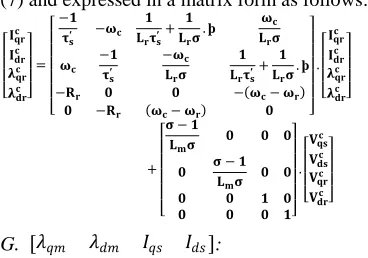
This model is derived by substituting equations (30) & (31) in the equations (6) & (7) and expressed in a matrix form as follows:
𝛌𝐪𝐬𝐜 𝛌𝐝𝐬𝐜 𝛌𝐪𝐫𝐜 𝛌𝐝𝐫𝐜 = −𝟏 𝛕𝐬′ −𝛚𝐜 𝐊𝐫 𝛕𝐬′ 𝟎 𝛚𝐜 −𝟏 𝛕𝐬′ 𝟎 𝐊𝐫 𝛕𝐬′ 𝐊𝐬 𝛕𝐫′ 𝟎 −𝟏 𝛕𝐫′ − 𝛚𝐜− 𝛚𝐫 𝟎 𝐊𝐬 𝛕𝐫′ 𝛚𝐜− 𝛚𝐫 −𝟏 𝛕𝐫′ . 𝛌𝐪𝐬𝐜 𝛌𝐝𝐬𝐜 𝛌𝐪𝐫𝐜 𝛌𝐝𝐫𝐜 + 𝟏 𝟎 𝟎 𝟎 𝟎 𝟏 𝟎 𝟎 𝟎 𝟎 𝟏 𝟎 𝟎 𝟎 𝟎 𝟏 . 𝐕𝐪𝐬𝐜 𝐕𝐝𝐬𝐜 𝐕𝐪𝐫𝐜 𝐕𝐝𝐫𝐜
D. 𝜆𝑞𝑠 𝜆𝑑𝑠 𝜆𝑞𝑚 𝜆𝑑𝑚 :
In this mathematical d-q model, stator and air-gap flux linkages space vectors are selected as state-space
variables 𝑥 = 𝝀𝒒𝒔 𝝀𝒅𝒔 𝝀𝒒𝒎 𝝀𝒅𝒎 . This choice
presents the advantage of an easier saturation effect modeling, but the disadvantage of an increased computational burden. This easier saturation effect modeling imposes many practical solutions for vector-control schemes. This model is derived by substituting equations (30), (31) & (10) in the equations (6) & (7) and expressed in a matrix form as follows:
𝛌𝐪𝐬𝐜 𝛌𝐝𝐬𝐜 𝛌𝐪𝐦𝐜 𝛌𝐝𝐦𝐜 = −𝟏 𝛕𝐬. 𝟏 − 𝐊𝐬 −𝛚𝐜 𝟏 𝛕𝐬. 𝟏 − 𝐊𝐬 𝟎 𝛚𝐜 −𝟏 𝛕𝐬. 𝟏 − 𝐊𝐬 𝟎 𝟏 𝛕𝐬. 𝟏 − 𝐊𝐬 𝐊𝐬 𝛕𝐫′+ 𝐊𝐬. 𝟏 − 𝐊𝐫 𝛔 .þ 𝛚𝐜− 𝛚𝐫 𝐊𝐬. 𝟏 − 𝐊𝐫 𝛔 −𝟏 𝛕𝐫′ − 𝛚𝐜− 𝛚𝐫 − 𝛚𝐜− 𝛚𝐫 𝐊𝐬. 𝟏 − 𝐊𝐫 𝛔 𝐊𝐬 𝛕𝐫′ +𝐊𝐬. 𝟏 − 𝐊𝐫 𝛔 .þ 𝛚𝐜− 𝛚𝐫 −𝟏 𝛕𝐫′ . 𝛌𝐪𝐬𝐜 𝛌𝐝𝐬𝐜 𝛌𝐪𝐦𝐜 𝛌𝐝𝐦𝐜 + 𝟏 𝟎 𝟎 𝟎 𝟎 𝟏 𝟎 𝟎 𝟎 𝟎 𝐊𝐫. 𝟏 − 𝐊𝐬 𝛔 𝟎 𝟎 𝟎 𝟎 𝐊𝐫. 𝟏 − 𝐊𝐬 𝛔 . 𝐕𝐪𝐬𝐜 𝐕𝐝𝐬𝐜 𝐕𝐪𝐫𝐜 𝐕𝐝𝐫𝐜
E. 𝜆𝑞𝑠 𝜆𝑑𝑠 𝐼𝑞𝑠 𝐼𝑑𝑠 :
In this mathematical d-q model, stator flux linkage and stator current space vectors are selected as
state-space variables 𝑥 = 𝝀𝒒𝒔 𝝀𝒅𝒔 𝑰𝒒𝒔 𝑰𝒅𝒔 . This
mathematical model is selected when stator flux oriented strategy is implemented and derived by substituting equations (9) & (31) in the equations (6) & (7) and expressed in a matrix form as follows:
𝛌𝐪𝐬𝐜 𝛌𝐝𝐬𝐜 𝐈𝐪𝐬𝐜 𝐈𝐝𝐬𝐜 = 𝟎 −𝛚𝐜 −𝐑𝐬 𝟎 𝛚𝐜 𝟎 𝟎 −𝐑𝐬 𝟏 𝐋𝐬𝛕𝐫′ + 𝟏 𝐋𝐬𝛔 .þ 𝛚𝐜− 𝛚𝐫 𝐋𝐬𝛔 −𝟏 𝛕𝐫′ − 𝛚𝐜− 𝛚𝐫 − 𝛚𝐜− 𝛚𝐫 𝐋𝐬𝛔 𝟏 𝐋𝐬𝛕𝐫′ + 𝟏 𝐋𝐬𝛔 .þ 𝛚𝐜− 𝛚𝐫 −𝟏 𝛕𝐫′ . 𝛌𝐪𝐬𝐜 𝛌𝐝𝐬𝐜 𝐈𝐪𝐬𝐜 𝐈𝐝𝐬𝐜 + 𝟏 𝟎 𝟎 𝟎 𝟎 𝟏 𝟎 𝟎 𝟎 𝟎 𝛔 − 𝟏 𝐋𝐦𝛔 𝟎 𝟎 𝟎 𝟎 𝛔 − 𝟏 𝐋𝐦𝛔 . 𝐕𝐪𝐬𝐜 𝐕𝐝𝐬𝐜 𝐕𝐪𝐫𝐜 𝐕𝐝𝐫𝐜
F. 𝜆𝑞𝑟 𝜆𝑑𝑟 𝐼𝑞𝑟 𝐼𝑑𝑟 :
In this mathematical d-q model, rotor flux linkage and rotor current space vectors are selected as state-space
variables 𝑥 = 𝝀𝒒𝒓 𝝀𝒅𝒓 𝑰𝒒𝒓 𝑰𝒅𝒓 . This model is
substituting equations (8) & (30) in the equations (6) & (7) and expressed in a matrix form as follows:
𝐈𝐪𝐫𝐜
𝐈𝐝𝐫𝐜
𝛌𝐪𝐫𝐜
𝛌𝐝𝐫𝐜
= −𝟏
𝛕𝐬′ −𝛚𝐜
𝟏 𝐋𝐫𝛕𝐬′+
𝟏 𝐋𝐫𝛔.þ
𝛚𝐜
𝐋𝐫𝛔 𝛚𝐜
−𝟏 𝛕𝐬′
−𝛚𝐜
𝐋𝐫𝛔
𝟏 𝐋𝐫𝛕𝐬′
+ 𝟏 𝐋𝐫𝛔
.þ
−𝐑𝐫 𝟎 𝟎 − 𝛚𝐜− 𝛚𝐫 𝟎 −𝐑𝐫 𝛚𝐜− 𝛚𝐫 𝟎
. 𝐈𝐪𝐫𝐜
𝐈𝐝𝐫𝐜
𝛌𝐪𝐫𝐜
𝛌𝐝𝐫𝐜
+ 𝛔 − 𝟏
𝐋𝐦𝛔
𝟎 𝟎 𝟎
𝟎 𝛔 − 𝟏 𝐋𝐦𝛔
𝟎 𝟎 𝟎 𝟎 𝟏 𝟎 𝟎 𝟎 𝟎 𝟏
. 𝐕𝐪𝐬𝐜
𝐕𝐝𝐬𝐜
𝐕𝐪𝐫𝐜
𝐕𝐝𝐫𝐜
G. 𝜆𝑞𝑚 𝜆𝑑𝑚 𝐼𝑞𝑠 𝐼𝑑𝑠 :
In this mathematical d-q model, air-gap flux linkage and stator current space vectors are selected as state-space
variables 𝑥 = 𝝀𝒒𝒎 𝝀𝒅𝒎 𝑰𝒒𝒔 𝑰𝒅𝒔 . It preserves
information regarding both stator and rotor parameters. This choice also presents the advantage of an easier saturation effect modeling. This model is suitable choice for the air-gap flux orientation control strategy and derived by substituting equations (8), (9), (10) & (31) in the equations (6) & (7) and expressed in a matrix form as follows:
𝐈𝐪𝐬𝐜
𝐈𝐝𝐬𝐜
𝛌𝐪𝐦𝐜
𝛌𝐝𝐦𝐜
=
−𝐑𝐬
𝐋𝟏𝐬 −𝛚𝐜
−𝟏 𝐋𝟏𝐬.þ
−𝛚𝐜 𝐋𝟏𝐬 𝛚𝐜
−𝐑𝐬
𝐋𝟏𝐬
𝛚𝐜
𝐋𝟏𝐬
−𝟏 𝐋𝟏𝐬
.þ
𝐋𝐦 𝛕𝐫
+ 𝐋𝐦. 𝟏−𝐊𝐫 .þ 𝛚𝐜− 𝛚𝐫 . 𝐋𝐦. 𝟏 − 𝐊𝐫
−𝟏 𝛕𝐫
− 𝛚𝐜− 𝛚𝐫
− 𝛚𝐜− 𝛚𝐫 . 𝐋𝐦. 𝟏 − 𝐊𝐫
𝐋𝐦
𝛕𝐫
+ 𝐋𝐦. 𝟏−𝐊𝐫 .þ 𝛚𝐜− 𝛚𝐫
−𝟏 𝛕𝐫
. 𝐈𝐪𝐬𝐜
𝐈𝐝𝐬𝐜
𝛌𝐪𝐦𝐜
𝛌𝐝𝐦𝐜
+ 𝟏 𝐋𝟏𝐬
𝟎 𝟎 𝟎
𝟎 𝟏 𝐋𝟏𝐬 𝟎 𝟎 𝟎 𝟎 𝐊𝐫 𝟎
𝟎 𝟎 𝟎 𝐊𝐫
. 𝐕𝐪𝐬𝐜
𝐕𝐝𝐬𝐜
𝐕𝐪𝐫𝐜
𝐕𝐝𝐫𝐜
IV. SIMULATION RESULTS
The simulation scheme for the modeling of squirrel cage induction motor in different frames is shown in Fig (5) and flowchart for the dynamic simulation of the squirrel cage induction motor in d-q model is shown in Fig (4). For squirrel cage induction motor, rotor voltage is
equal to zero i.e. 𝑉𝑞𝑟 = 𝑉𝑑𝑟 = 0 and the following
induction motor parameters are chosen for the simulation studies:
𝑅𝑠= 0.78Ω, 𝑅𝑟 = 0.15Ω, 𝐿𝑠= 0.0434𝐻, 𝐿𝑟 = 0.0407𝐻
𝐿𝑚 = 0.041 𝐻, 𝑓 = 50 𝐻𝑧, 𝐽 = 0.095 𝑘𝑔 − 𝑚2, 𝑃 = 4.
At t=0, the motor is connected to a 400 V, 50 Hz
three-phase supply. The load torque TL is applied at t=1 sec.
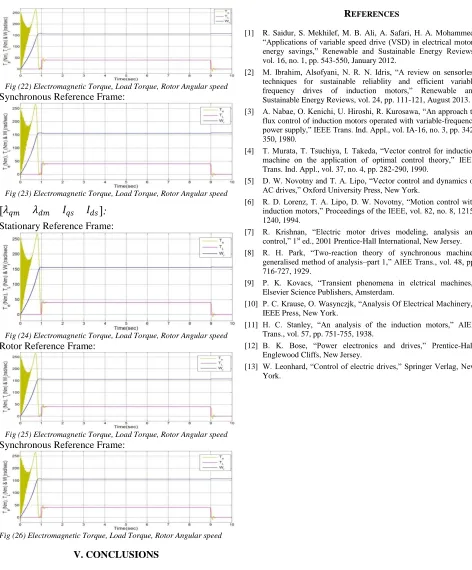
Figures (6) to (26) shows the results of computer simulation using the MATLAB/SIMULINK models with
TL= 40 N-m.
Fig (5) Simulation scheme of squirrel cage induction motor model
𝐼
𝑞𝑠𝐼
𝑑𝑠𝐼
𝑞𝑟𝐼
𝑑𝑟:
Stationary Reference Frame:
Fig (6) Electromagnetic Torque, Load Torque, Rotor Angular speed
Rotor Reference Frame:
Fig (7) Electromagnetic Torque, Load Torque, Rotor Angular speed
Synchronous Reference Frame:
Fig (8) Electromagnetic Torque, Load Torque, Rotor Angular speed
𝐼
𝑞𝑠𝐼
𝑑𝑠𝐼
𝑞𝑚𝐼
𝑑𝑚:
Stationary Reference Frame:
Fig (9) Electromagnetic Torque, Load Torque, Rotor Angular speed
Fig (10) Electromagnetic Torque, Load Torque, Rotor Angular speed
Synchronous Reference Frame:
Fig (11) Electromagnetic Torque, Load Torque, Rotor Angular speed
𝜆
𝑞𝑠𝜆
𝑑𝑠𝜆
𝑞𝑟𝜆
𝑑𝑟:
Stationary Reference Frame:
Fig (12) Electromagnetic Torque, Load Torque, Rotor Angular speed
Rotor Reference Frame:
Fig (13) Electromagnetic Torque, Load Torque, Rotor Angular speed
Synchronous Reference Frame:
Fig (14) Electromagnetic Torque, Load Torque, Rotor Angular speed
𝜆
𝑞𝑠𝜆
𝑑𝑠𝜆
𝑞𝑚𝜆
𝑑𝑚:
Stationary Reference Frame:
Fig (15) Electromagnetic Torque, Load Torque, Rotor Angular speed
Rotor Reference Frame:
Fig (16) Electromagnetic Torque, Load Torque, Rotor Angular speed
Synchronous Reference Frame:
Fig (17) Electromagnetic Torque, Load Torque, Rotor Angular speed
𝜆
𝑞𝑠𝜆
𝑑𝑠𝐼
𝑞𝑠𝐼
𝑑𝑠:
Stationary Reference Frame:
Fig (18) Electromagnetic Torque, Load Torque, Rotor Angular speed
Rotor Reference Frame:
Fig (19) Electromagnetic Torque, Load Torque, Rotor Angular speed
Synchronous Reference Frame:
Fig (20) Electromagnetic Torque, Load Torque, Rotor Angular speed
𝜆
𝑞𝑟𝜆
𝑑𝑟𝐼
𝑞𝑟𝐼
𝑑𝑟:
Stationary Reference Frame:
Fig (21) Electromagnetic Torque, Load Torque, Rotor Angular speed
Fig (22) Electromagnetic Torque, Load Torque, Rotor Angular speed
Synchronous Reference Frame:
Fig (23) Electromagnetic Torque, Load Torque, Rotor Angular speed
𝜆
𝑞𝑚𝜆
𝑑𝑚𝐼
𝑞𝑠𝐼
𝑑𝑠:
Stationary Reference Frame:
Fig (24) Electromagnetic Torque, Load Torque, Rotor Angular speed
Rotor Reference Frame:
Fig (25) Electromagnetic Torque, Load Torque, Rotor Angular speed
Synchronous Reference Frame:
Fig (26) Electromagnetic Torque, Load Torque, Rotor Angular speed
V. CONCLUSIONS
In this paper, various mathematical d-q models of both squirrel cage and wound rotor induction motors in different reference frames are presented. This paper presents the d-q axes unified approach for both types of induction motors. The applications of each model are also discussed. Models either only with magnetisation current space vector or air-gap flux space vector, or both includes saturation effect in modeling of induction motor. MATLAB/SIMULINK software was used to implement the dynamic response of squirrel cage induction motor d-q models in different reference frames and these models are analyzed in terms of torque and rotor angular velocity.
REFERENCES
[1] R. Saidur, S. Mekhilef, M. B. Ali, A. Safari, H. A. Mohammed, ―Applications of variable speed drive (VSD) in electrical motors energy savings,‖ Renewable and Sustainable Energy Reviews, vol. 16, no. 1, pp. 543-550, January 2012.
[2] M. Ibrahim, Alsofyani, N. R. N. Idris, ―A review on sensorless techniques for sustainable reliablity and efficient variable frequency drives of induction motors,‖ Renewable and Sustainable Energy Reviews, vol. 24, pp. 111-121, August 2013. [3] A. Nabae, O. Kenichi, U. Hiroshi, R. Kurosawa, ―An approach to
flux control of induction motors operated with variable-frequency power supply,‖ IEEE Trans. Ind. Appl., vol. IA-16, no. 3, pp. 342-350, 1980.
[4] T. Murata, T. Tsuchiya, I. Takeda, ―Vector control for induction machine on the application of optimal control theory,‖ IEEE Trans. Ind. Appl., vol. 37, no. 4, pp. 282-290, 1990.
[5] D. W. Novotny and T. A. Lipo, ―Vector control and dynamics of AC drives,‖ Oxford University Press, New York.
[6] R. D. Lorenz, T. A. Lipo, D. W. Novotny, ―Motion control with induction motors,‖ Proceedings of the IEEE, vol. 82, no. 8, 1215-1240, 1994.
[7] R. Krishnan, ―Electric motor drives modeling, analysis and control,‖ 1st ed., 2001 Prentice-Hall International, New Jersey.
[8] R. H. Park, ―Two-reaction theory of synchronous machines generalised method of analysis–part 1,‖ AIEE Trans., vol. 48, pp. 716-727, 1929.
[9] P. K. Kovacs, ―Transient phenomena in elctrical machines,‖ Elsevier Science Publishers, Amsterdam.
[10] P. C. Krause, O. Wasynczjk, ―Analysis Of Electrical Machinery,‖ IEEE Press, New York.
[11] H. C. Stanley, ―An analysis of the induction motors,‖ AIEE Trans., vol. 57, pp. 751-755, 1938.
[12] B. K. Bose, ―Power electronics and drives,‖ Prentice-Hall, Englewood Cliffs, New Jersey.