Utilization of Waste Foundry Sand and Waste
Ceramic Tiles as Partial Replacement for Fine
and Coarse Aggregates in Concrete
Shruthi H.G1, Pujitha Ganapathi C², Chaithra R³, Sachin Gowda M4, Nagesh B.S5
Assistant Professor, Department of Civil Engineering, ATME College of Engineering, Mysuru, Karnataka, India1
U.G. Students, Department of Civil Engineering, ATME College of Engineering, Mysuru, Karnataka, India2,3,4,5
ABSTRACT:Concrete is considered to be the most widely used and versatile material of construction all over the world. In recent years, concrete technology has made significant advances which have resulted in economical improvements in strength of concretes. This economical development depends upon the intelligent use of locally available materials. To overcome the use of natural resources and by attempting to use waste materials like foundry sand and ceramic tiles in concrete could result in low cost construction. Also the use of waste foundry sand and waste ceramic tiles in construction could help to avoid the problems related to environment pollution. An attempt has been made in this study to determine the compressive strength of M20 grade concrete using waste foundry sand and waste ceramic tiles as partial replacement for fine and coarse aggregates.
KEYWORDS:waste foundry sand, waste ceramic tiles, compressive strength, split tensile strength.
I. INTRODUCTION
Concrete is a versatile engineering composite material made with cement, aggregates and admixtures in some cases. Due to development in construction field, the consumption of natural aggregate is very high and at the same time the production of solid wastes from the demolitions and manufacturing units is also very high. Therefore extreme use of concrete leads to scarcity of natural aggregates. Because of this reason the reuse of waste foundry sand and waste ceramic tiles came into picture.
Foundry sand is high quality silica sand with uniform physical characteristics. Foundries attempt to reuse as much of sand as possible within the foundry process itself, but eventually a fraction becomes spent and unsuitable for further foundry processes. At the moment, 90% of this waste is disposed of to landfill as non-hazardous waste while only 10% is beneficially reused. The disposing of waste foundry sand (WFS) to landfill is becoming increasingly cost prohibitive and is likely to become more difficult as legislation governing waste disposal becomes more stringent. Currently about 500,000 to 700,000 tons of foundry sand is used annually in engineering applications. In the present study, steps have been taken to partially replace the fine aggregate with WFS.
Ceramic waste can be separated in two categories in compliance with the origin of raw materials. The first one are all fired waste generated by the ceramic factories that use only red paste to manufacture their products, such as brick, blocks and roof tiles. The second one is all ignited waste manufactured in stoneware ceramic such as wall, floor tiles and sanitary ware.
II. RELATEDWORK
Waste Foundry Sand has been tried as fine aggregate in place of sand and ceramic waste has been used as partial substitute to conventional coarse aggregate by 15%, 20%, and 30% in concrete by Saravanan [1]. The results indicated effectiveness of Waste Foundry Sand as fine aggregate and partial replacement of conventional coarse aggregate by ceramic waste up to 15%, 20% without affecting the design strength.
Er. Rahul[2],carried out an experimental study on concrete containing waste foundry sand in the range of 0%, 10%, 20%, 30% and waste ceramic tiles in the range of 0%, 10%, 20% and 30% by weight for M-25 grade concrete. The experimental results showed that there is some increase in compressive strength, split tensile strength and modulus of elasticity after replacing the fine aggregates with some percentage of foundry sand so that foundry sand can be safely used in concrete for durability and strength purposes.
Rama Rao [3],tested the concrete replaced partially with waste foundry sand and ceramic tiles and compared with conventional concrete in plastic state as well as in harden state for workability, compressive strength & split tensile strength. These tests were carried out on standard cube, cylinder for 7 and 28 days to determine the properties of concrete.
Md. Daniyal [4],used crushed waste ceramic tiles in concrete as a replacement for natural coarse aggregates with 10%, 20%, 30%, 40% and 50% of substitution. After analyzing results, the optimum value of waste ceramic tile to be used within the concrete mix with a water/cement ratio of 0.5was determined as about 30%. The findings revealed that using waste ceramic tile leads to enhancing the properties of concrete.
III.METHODOLOGY
In this experimental study M20 grade concrete is designed as per the code IS10262:2009. The materials used are fine aggregates, coarse aggregates, cement, waste foundry sand and waste ceramic tiles with control concrete i.e, 5%, 10%, 15%,20%,25%,30% of concrete is partially replaced with the waste foundry sand and waste ceramic tiles in fine and coarse aggregates. The moulds are casted for both conventional concrete and replaced concrete with foundry and ceramic waste, casted specimens are cured in water for 7, 14, 28days respectively. After curing, compressive strength test and split tensile strength test is conducted at 7, 14, 28 days. Two specimens are tested for each designation and average of two results will be taken.
MATERIALS
A. Cement
Portland cement is the most common type of cement in general usage. It is a basic ingredient of concrete, mortar and plaster. Of the various ingredients used in concrete, cement is the most energetical and expensive. In the present investigation OPC 53 grade cement is used.
Table 3.1: Physical properties of Cement
Elements Content
Specific Gravity 3.29
Fineness Modulus 7.9%
Standard Consistency 34%
Initial Setting time 45min
Final Setting time 300min
Table 3.2: Chemical properties of Cement
Oxides Percentages
Cao 62.85
SiO2 20.98
Al2O3 5.42
Fe2O3 3.92
MgO 1.76
SO3 2.36
Na2O 0.28
K2O 0.53
Loss of Ignition 1.90
Table 3.2 shows the chemical composition of Ordinary Portland Cement (OPC 53 grade) that has been used for this experimental study.
B. Water
Combining water with a cementitious material forms a cement paste by the process of hydration. The cement paste glues the aggregate together, fills voids within it, and makes it flow more freely. Lower water to concrete ratio yields a stronger, more durable concrete, while more water gives a free-flowing concrete with a higher slump. Impure water used to make concrete can cause problems when setting or in causing premature failure of the structure.
C. Fine aggregate
It is the aggregate most of which passes 4.75 mm IS sieve and contains only so much coarser as is permitted by specificationAccording to size the fine aggregate may be described as coarse sand, medium sand and fine sand. IS specifications classify the fine aggregate into four types according to its grading as fine aggregate of grading Zone-1 to grading Zone-4. The four grading zones become progressively finer from grading Zone-1 to grading Zone-4. 90% to 100% of the fine aggregate passes 4.75 mm IS sieve and 0 to 15% passes 150 micron IS sieve depending upon its grading zone.
Table 3.3: Physical properties of fine aggregates
Sl no. Particulars Obtained values
1 Specific Gravity 2.66
2 Fineness Modulus 4.96
3 Bulk density 1750 kg/m³
4 Water absorption 2.0%
Table 3.3 shows the physical properties such as specific gravity, fineness modulus,bulk density, water absorption of fine aggregates (sand).
D. Waste foundry sand
Table 3.4: Physical properties of waste foundry sand
Sl no. Particulars Obtained values
1 Specific Gravity 2.07
2 Fineness Modulus 4.49
The basic tests such as specific gravity and fineness modulus test were conducted for waste foundry sand and the results are as shown in table 3.4.
Table 3.5: Chemical properties of waste foundry sand
Constituent Value (%)
SiO2 87.91
Al2O3 4.70
Fe2O3 0.94
CaO 0.14
MgO 0.30
SO3 0.09
Na2O 0.19
K2O 0.25
TiO2 0.15
P2O5 0.00
Table 3.5 shows the chemical composition of waste foundry sand. Waste foundry sand has low absorption and is nonplastic. Reported values of absorption were found to vary widely, which can also be attributed to the presence of binders and additives. The content of organic impurities can vary widely and can be quite high. This may preclude its use in applications where organic impurities could be important (e.g., Portland cement concrete aggregate). This variability has been attributed to the variability in fines and additive contents in different samples. In general, foundry sands are dry, with moisture contents less than 2 percent.
Fig1. Waste foundry sand
E. Coarse Aggregates
Crushed stone aggregates of 20mm size obtained from local quarry site were used for the experiment. The physical properties of coarse aggregates are shown in table below.
Table 3.6: Physical properties of coarse aggregates
Sl no. Particulars Obtained values
1 Specific Gravity 2.7
2 Fineness Modulus 4.406
3 Water absorption 0.25%
Table 3.6 shows the results for various tests such as specific gravity, fineness modulus and water absorption for coarse aggregates.
F. Waste ceramic tiles
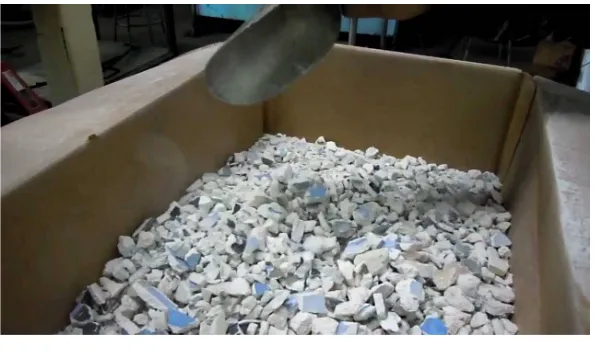
The amount of ceramic tile waste on earth is enough for use as a coarse and fine aggregate in concrete. Ceramic tile is produced from natural materials sintered at high temperatures. There are no harmful chemicals in tile. Waste tiles cause only the hazard of pollution. So due to such reasons waste tiles are stored in factory fields because of their economic value. Ceramic waste can be transformed into useful fine and coarse aggregates. It has been calculated that about 30% of the daily production in the ceramic industry is left as a waste. This waste is not recycled in any form at present.
Table 3.7: Physical properties of waste ceramic tiles
Sl no. Particulars Obtained values
1 Specific Gravity 2.3
2 Fineness Modulus 14.4%
3 Impact value 24%
Table 3.7 shows the various physical properties such as specific gravity, fineness modulus and impact value of waste ceramic tiles.
Fig2. Waste ceramic tiles
IV.EXPERIMENTALRESULTS
Mix Proportion by volume = 1: 1.8: 3.02
1= cement 1.8= fine aggregate 3.02= coarse aggregate 0.5= Water-cement ratio
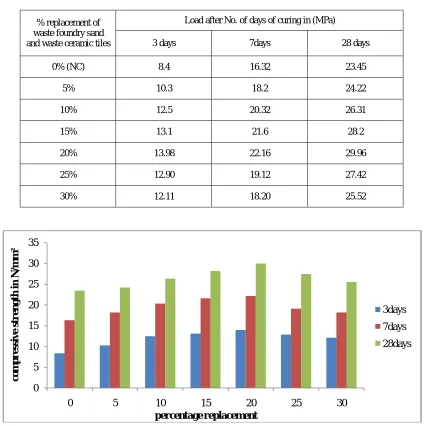
Table 4.1: Compressive Strength in N/mm2with different percentage of waste foundry sand replacing fine aggregate and waste ceramic tiles replacing coarse aggregate for M20 grade concrete
% replacement of waste foundry sand and waste ceramic tiles
Load after No. of days of curing in (MPa)
3 days 7days 28 days
0% (NC) 8.4 16.32 23.45
5% 10.3 18.2 24.22
10% 12.5 20.32 26.31
15% 13.1 21.6 28.2
20% 13.98 22.16 29.96
25% 12.90 19.12 27.42
30% 12.11 18.20 25.52
Fig 4.1: Shows the variation of Compressive Strength at 3, 7 and 28 days for M20 grade concrete with different percentages of waste foundry sand replacing fine aggregate and waste ceramic tiles replacing coarse aggregates
0 5 10 15 20 25 30 35
0 5 10 15 20 25 30
c
o
m
p
r
e
ss
iv
e
s
tr
e
n
gth
i
n
N
/m
m
²
percentage replacement
3days
7days
The above graph indicates the variation of Compressive Strength of concrete at 3, 7 and 28days of curing for M20 grade concrete with different percentages of waste foundry sand replacing fine aggregate and waste ceramic tiles replacing coarse aggregates. It was observed that, strength of concrete increases gradually with increases in percentage of replacement upto 20% after which it decreases.
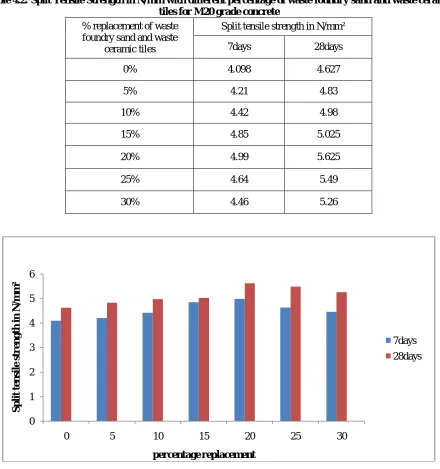
Table 4.2: Split Tensile Strength in N/mm2with different percentage of waste foundry sand and waste ceramic tiles for M20 grade concrete
% replacement of waste foundry sand and waste
ceramic tiles
Split tensile strength in N/mm²
7days 28days
0% 4.098 4.627
5% 4.21 4.83
10% 4.42 4.98
15% 4.85 5.025
20% 4.99 5.625
25% 4.64 5.49
30% 4.46 5.26
Fig 4.2: Shows the variation of Split Tensile Strength at 7 and 28 days for M20 grade concrete with different percentages waste foundry sand replacing fine aggregate and waste ceramic tiles replacing coarse aggregates.
0 1 2 3 4 5 6
0 5 10 15 20 25 30
S
p
li
t
te
n
si
le
s
tr
e
n
gth
i
n
N
/m
m
²
percentage replacement
The above graph indicates the variation of Split Tensile Strength of concrete at 7 and 28days of curing for M20 grade concrete with different percentages waste foundry sand replacing fine aggregate and waste ceramic tiles replacing coarse aggregates. It was observed that, strength of concrete increases gradually with increase in percentage of replacement upto 20% after which it decreases.
V. CONCLUSION
The maximum compressive strength and split tensile strength of the concrete are obtained when 20% of fine and coarse aggregates were replaced with waste foundry sand and waste ceramic tiles respectively. The compressive strength and split tensile strength has decreased for 25% and 30% replacement with waste foundry sand and ceramic tiles, however there is little variation in strength compared to conventional concrete. Utilization of waste foundry sand and waste ceramic tiles in concrete mix have the advantage of reduction in cost of construction materials. By using waste foundry sand and ceramic wastes in concrete, problems regarding safe disposal is reduced.
REFERENCES
[1] Jagannathan Saravanan, G. Srinivasan, B. Palani, “Strength properties of concrete incorporating foundry sand and ceramic aggregates”,
International Journal of Engineering Inventions, Vol. 4, Issue 7, pp.37-44, 2014.
[2] Er. Rahul, Mechanical properties of concrete incorporating used foundry sand and waste ceramic tiles, International Research Journal of Engineering and Technology, Vol. 3, Issue 12 ,pp.758-762, 2016.
[3] B. Rama Rao, Anuradha, “Partial replacement of waste foundry sand by fine aggregate and waste ceramic tiles by coarse aggregate in
concrete”, International Journal for Scientific Research & Development, Vol. 4, Issue 9, pp.271-273, 2016.
[4] Md. Daniyal, Shakeel Ahmad, “Application of waste ceramic tile aggregates in concrete”, International Journal of Innovative Research in Science, Engineering and Technology, Vol. 4, Issue 12, pp.12808-12815, 2015.
[5] Mohamed Anjum, Dr. Mohamed Ilyas Anjum, “Partial Replacement of Fine Aggregates with Foundry Sand in Concrete”, International
Journal for Scientific Research& Development, Vol. 5, Issue 06, pp.2072-2074, 2017.
[6] Vikas Rajora, Gurtej Singh Sidhu, “Effect of Partial Replacement of Fine and Coarse Aggregate (10mm) with Ceramic Waste on the
Properties of Concrete”, International Journal of Science and Research , Vol. 5, Issue 8, pp.75-77, 2016.
[7] Pendhari Ankush R, et.al,“Partial replacement of sand by waste foundry sand”, International Research Journal of Engineering and Technology,
Vol.4, Issue05, pp.2771-2776, 2017.
[8] Parminder Singh, Dr. Rakesh Kumar Singla, “Utilization of Waste Ceramic Tiles as Coarse Aggregate in Concrete”, Journal of
Multidisciplinary Engineering Science and Technology, Vol. 2, Issue 11, pp.3294-3300, 2015.
[9] M. Sekar, “Partial Replacement of Coarse Aggregate by Waste Ceramic Tile in Concrete”, International Journal for Research in Applied
Science & Engineering Technology, Vol. 5, Issue III, pp.472-479,2017.
[10] V. Giridhar, H. Sudarsana Rao, P. Suresh Praveen Kumar,“Influence of Ceramic Waste Aggregate Properties on Strength of Ceramic Waste
Aggregate Concrete”, International Journal of Research in Engineering and Technology, Vol. 04, Special Issue 13, pp.15-24,2015.
[11] T. C. Nwofor, C. Ukpaka, “Assessment of Concrete Produced with Foundry Waste as Partial Replacement for River Sand”, Journal of Civil
Engineering Research, Vol. 6, Issue 1, pp. 1-6, 2016.
[12] Vema Reddy Chevuri, S.Sridhar, “Usage of Waste Foundry Sand in Concrete”, SSRG International Journal of Civil Engineering, vol. 2, Issue
12, pp.5-12, 2015.
[13] Yogesh Aggarwal, Rafat Siddique, “Microstructure and properties of concrete using bottom ash and waste foundry sand as partial replacement