ABSTRACT
PAUL, SUJATA. First Principles Investigation of Technologically and Environmentally Important Nano-structured Materials and Devices. (Under the direction of Marco Buongiorno Nardelli).
In the course of my PhD I have worked on a broad range of problems using simulations from first principles: from catalysis and chemical reactions at surfaces and on nanostructures, characterization of carbon-based systems and devices, and surface and interface physics. My research activities focused on the application of ab-initio electronic structure techniques to the theoretical study of important aspects of the physics and chemistry of materials for energy and environmental applications and nano-electronic devices. A common theme of my research is the computational study of chemical reactions of environmentally important molecules (CO, CO2) using high performance simulations. In particular, my principal aim was to design novel nano-structured functional catalytic surfaces and interfaces for environmentally relevant remediation and recycling reactions, with particular attention to the management of carbon dioxide.
the carbon-mediated partial sequestration and selective oxidation of CO in a hydrogen atmosphere.
We have elucidated the atomic scale mechanisms of activation and reduction of carbon dioxide on specifically designed catalytic surfaces via the rational manipulation of the surface properties that can be achieved by combining transition metal thin films on oxide substrates. We have analyzed the mechanisms of the molecular reactions on the class of catalytic surfaces so designed in an effort to optimize materials parameters in the search of optimal catalytic materials. All these studies are likely to bring new perspectives and substantial advancement in the field of high-performance simulations in catalysis and the characterization of nanostructures for energy and environmental applications.
Moving to novel materials for electronics applications, I have studied the structural and vibrational properties of mono and bi-layer graphene. I have characterized the lattice thermal conductivity of ideal monolayer and bi-layer graphene, demonstrating that their behavior is similar to that observed in graphite and indicating that the intra-layer coupling does not affect significantly the thermal conductance. I have also calculated the electron-phonon interaction in monolayer graphene and obtained electron scattering rates associated with all phonon modes and the intrinsic resistivity/mobility of monolayer graphene is estimated as a function of temperature.
On another project, I have worked on ab initio molecular dynamic studies of novel Phase Change Materials (PCM) for memory and 3D-integration.
an engineering transport model of the component electrochemical cell. To support that model, we have proposed a reaction kinetics expression for the REDOX (reduction-oxidation) reaction at the porous positive electrode. We validate the kinetics expression with electrochemical measurements.
First Principles Investigations of Technologically and Environmentally Important Nano-structured Materials and Devices
by Sujata Paul
A dissertation submitted to the Graduate Faculty of North Carolina State University
in partial fulfillment of the requirements for the degree of
Doctor of Philosophy
Physics
Raleigh, North Carolina 2010
APPROVED BY:
_______________________________ _____________________________
Jerry Bernholc Lubos Mitas
________________________________ ______________________________
Thomas P. Pearl Gregory Parsons
DEDICATION
BIOGRAPHY
Education
2005 - 2010: PhD in Physics, Department of Physics, North Carolina State University, Raleigh, NC 27695, USA
2000 – 2003: Senior Research Fellow (SRF) at S. N. Bose National Center for Basic Sciences, Kolkata, India
1998 – 2000: MSc in Physics (Specialization: Electronics) at Kalyani University, West Bengal, India
1995 – 1998: BSc in Physics at Kalyani University, West Bengal, India
Professional Experience
May - August 2009: Summer Intern @ IBM SRDC, Albany Nanotech, Albany, NY May - August 2008: Summer Intern @ Polymer and Chemical Technologies Division, General Electric Global Research Center, GE, Niskayuna, NY
ACKNOWLEDGMENTS
I would like to acknowledge my advisor Prof. Marco Boungiorno Nardelli for his constant support and encouragement throughout the course of my stay in North Carolina State University. I would also like to thank my committee members for taking time out of their busy schedules to critique this work.
I had an opportunity to do three industrial internships at IBM and General Electric during my tenure as a PhD student. I had the good fortune of participating in vibrant research projects at these corporate research labs in areas as diverse as Phase Change memories, electrochemistry and advanced device design for 15 nm technology nodes. For this, I’d like to acknowledge Dr. Glen J Martyna (IBM), Dr. Michael Vallance (GE), Dr. Glen Merfeld (GE) and Dr. Huiming Bu (IBM) for mentoring my progress during the summers of 2007, 2008 and 2009.
I would like to thank my parents and my husband, Kingsuk Maitra for helping me reaching my goal; friends and near ones like Nancy, Frisco, Jeff, and Cecillia made my stay at North Carolina a very memorable one. Nancy and Cecillia were always there when I needed them most.
My adopted family members at North Carolina Jill and Alan (and their siblings) offered me a home far away from home. Thank you Jill.
TABLE OF CONTENTS
List of Tables...x
List of Figures ...xi
Chapter 1 ...1
1.1 Introduction...1
1.2 Density Functional Theory (DFT)...3
1.2.1 Exchange and correlation functional for DFT... 8
1.2.2 Plane wave basis set ...10
1.2.3 Pseudopotential ...11
1.2.4 Computation with DFT ...13
1.3 Post-Processing: Tools and Capabilities...16
1.4 Nudged Elastic Band Method (NEB)... 20
1.5 Density Functional Perturbation Theory (DFPT)...22
1.6 Ab Initio Molecular Dynamics (AIMD)...25
1.7 Partition Functions of Molecules and Solids (ParFuMS)...28
1.8 Organization of The Thesis...29
Figures...32
References...37
Chapter 2: Sequestration and selective oxidation of carbon monoxide on graphene edges...40
2.1 Introduction...40
2.2 Methods...42
2.3 Results and Discussion...44
2.3.2 Interaction of CO with armchair graphene edge ...48
2.3.3 Interaction of CO+H2 with armchair graphene edge ...52
2.4 Concluding Remarks...55
Figures...57
References...68
Chapter 3: Activation of CO2 on transition metal surfaces and oxide supported metal thin films... ...70
3.1 Introduction...70
3.2 Computational details...75
3.3 Theoretical results...78
3.3.1 Activation of CO2 on Pd (001)...78
3.3.2 Activation of CO2 on Pt (001)...81
3.3.3 Oxide Supported metal thin film...83
3.3.4 Activation of CO2 on 1LPd/BaO (001)...84
3.3.5 Activation of CO2 on 1LPt/BaO (001)...89
3.3.6 Activation of CO2 on 2LPd/BaO (001) and 2L Pt/BaO(001)...92
3.3.7 Activation of CO2 on 3LPd/BaO (001) and 3L Pt/BaO (001)...94
3.4 Conclusion...96
Tables...96
Figures...102
References...134
Chapter 4: First principles calculations of structural, vibrational properties of mono and bi-layer graphene...135
4.2 Computational Details...136
4.3 Band structure...137
4.4 Phonon dispersions...139
4.5 Electron phonon interaction...141
4.5 Conclusion...142
Figures...143
References...151
Chapter 5: Ab initio molecular dynamic studies of Novel Phase Change Materials for memory and 3D-integration ...153
5.1 Introduction...153
5.2 Methods...158
5.3 Liquid GST systems...160
5.3.1 Liquid Ge0.15Te0.85: The Eutectic Alloy ...160
5.3.2 Liquid GeTe ...161
5.3.3 Liquid Ge1Sb2Te4...161
5.4 Pressure induced transformation of Ge2Sb2Te5...162
5.5 Pressure induced transformation of GeSb...163
5.6 Conclusion...165
Figures...166
References...181
Chapter 6: Na / NiCl2 Cell Positive Electrode REDOX Kinetics: Model development and verification ...183
6.1 Introduction...183
6.2 Previous models of Sodium/metal chloride cells...185
6.3.1 Oxidation...187
6.3.2 Reduction... 191
6.3.3 Relationship between NiCl2 volume fraction and passivation area density during oxidation... ...193
6.3.3.1 Homogeneous, invariant oxidation...194
6.3.4 Relationship between NiCl2 volume fraction and passivation area density during reduction... ...195
6.3.4.1 Homogeneous, Invariant Reduction...196
6.3.5 Verification of Kinetics Model with Smooth Electrode REDOX ...197
6.3.5.1 Oxidation... ...197
6.3.5.2 Reduction... ...199
6.4 Materials and Electrochemical Methods...201
6.4.1 Working Electrode... ...201
6.4.2 Reference Electrode... ...202
6.4.3 Auxiliary Electrode... ...202
6.4.4 Electrolyte... ...202
6.4.5 Electrochemical characterization...202
6.5 Results and Analysis...205
6.5.1 Electrochemical Data... ...205
6.5.2 Finite Element Analysis (FEM).... ... 206
6.5.3 Oxidative Charge Capacity... ...210
6.5.4 Verification of Kinetic Model... ...212
6.6 Conclusion...214
List of symbols...215
References...219
Chapter 7: Extraction of effective oxide thickness for SOI FINFETs with
high-κ/metal gates using the body effect ...234
7.1 Introduction ...234
7.2 Theory and experiment...238
7.3 Discussion ...242
Figures...244
References...252
Chapter 8: Summary... ...254
Summary...254
LIST OF TABLES
Chapter 3: Activation of CO2 on transition metal surfaces and oxide
supported metal thin films......70
LIST OF FIGURES
Chapter 1: Introduction
Figure 1.1 Modeling a physical phenomenon from a broad range of
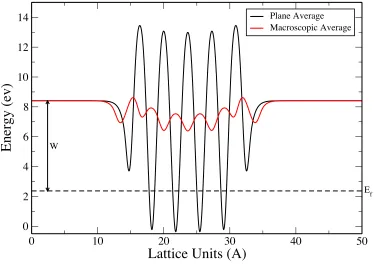
perspectives, from the atomistic to the macroscopic end ...32 Figure 1.2 Plane average and macroscopic average of 5 layer Pt (001) Surface ...33
Figure 1.3 Activation energy barrier (EA), saddle point in a chemical reaction. ...34 Figure 1.4 Potential energy surface, minimum energy path is depicted along
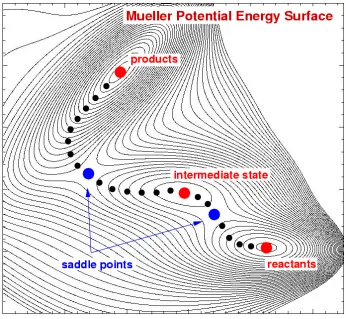
with the saddle point (transition state) between reactants and products of a chemical reaction ...35 Figure 1.5 Car-Parrinello Molecular Dynamics algorithm ...36
Chapter 2: Sequestration and selective oxidation of carbon monoxide on graphene edges
Figure 2.1 Equilibrium energetics for a zigzag graphene edge interacting with CO molecules at high CO concentration ...57
Figure 2.2 Activation energy barrier for the reaction of an oxygen atom with CO to yield CO2 at the zigzag graphene edge...58
Figure 2.3 Activation energy barrier for the reaction of an oxygen atom with CO to yield CO2 when the oxygen atoms are bonded to 7-5-7 carbon rings at the zigzag graphene edge ...59
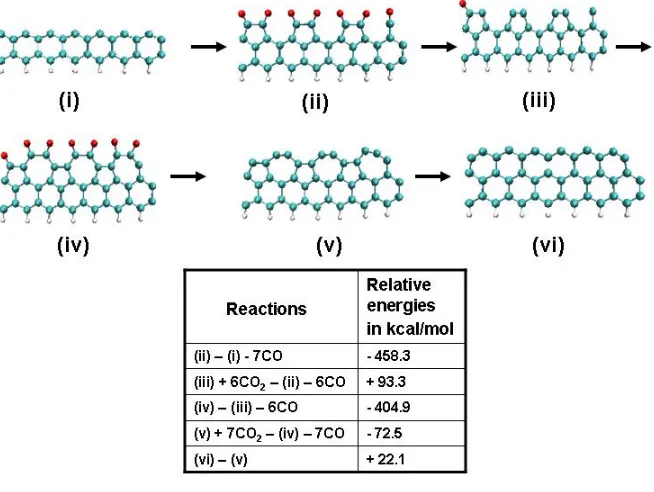
Figure 2.5 Energetics for the interaction of an armchair graphene edge with gas phase CO molecules. Table II (inset): the reactions at different steps and the corresponding reaction energies in kcal/mol...61
Figure 2.6 Activation energy barrier for the reaction of an oxygen atom with CO to yield CO2 at the armchair graphene edge ...62
Figure 2.7 Van’t Hoff plot for the two main steps in the deposition of carbon on an armchair graphene edge in a CO atmosphere ...63
Figure 2.8 Energetics for the competition between CO and hydrogen for the active sites on the advancing graphene edge ...64
Figure 2.9 Plots of equilibrium constants vs temperature for the main reactions In Figure 2.8...65
Figure 2.10 Representative chemical reactions of CO and H2 at the armchair graphene edge involving hydroxyl and carboxyl groups...66
Figure 2.11 Van’t Hoff plot for the reactions involving hydroxyl and carboxyl groups at the armchair graphene edge...67
Chapter 3: Activation of CO2 on transition metal surfaces and oxide supported
metal thin films
Figure 3.1 Adsorption geometries of CO2 on different sites of Pd (001) Surface ...102
Figure 3.2 Relative energy diagram of “CO2 dissociation” of Pd (001) Surface ...103
Figure 3.3 Surface LDOS of Pd (001) with adsorbed CO2 at different sites ...104
Figure 3.6 Adsorption geometries of CO2 on different sites of Pt (001) surface... ...107 Figure 3.7 Relative energy diagram of “CO2 dissociation” of Pt (001)
surface... ...108 Figure 3.8 Surface LDOS of Pt (001) with adsorbed CO2 at different sites ... ...109
Figure 3.9 LDOS of CO2 on Pt (001) surfaces...110 Figure 3.10 The charge density difference plot of “adsorptions of CO2 on Pt (001) surface... ...111 Figure 3.11 Barium oxide supported metal thin films: site A is supported over O atom and Site B is supported over Ba ...112
Figure 3.12 Activation of CO2 on 1LPd/BaO (001) surface...113 Figure 3.13 (a) Relative energy diagram of “CO2 dissociation” on 1LPd/BaO (001) surface... ...114 (b) Optimized structures of dissociation: the energetics are given in Figure 3.13(a)... ...115 Figure 3.14 Surface LDOS of 1LPd/BaO (001) with adsorbed CO2 at different sites... ...116
Figure 3.15 LDOS of CO2 on 1LPd/BaO (001) ...117 Figure 3.16 Adsorption geometries of CO2 on different sites of Pt (001) surface... ...118
Figure 3.19 Surface LDOS of 1LPt/BaO (001) with adsorbed CO2 at different
sites... ...122
Figure 3.20 LDOS of CO2 on 1LPt/BaO (001) ...123
Figure 3.21 The charge density difference plot of “adsorptions of CO2 on 1LPt/BaO (001) surface “...124
Figure 3.22 Barium oxide supported metal thin films...125
Figure 3.23 Activation of CO2 on 2LPd/BaO (001) surface...126
Figure 3.24 Activation of CO2 on 2LPt/BaO (001) surface...127
Figure 3.25 Activation of CO2 on 3LPd/BaO (001) surface...128
Figure 3.26 Activation of CO2 on 3LPt/BaO (001) surface...129
Figure 3.27 Binding energies of CO2 on different surfaces of Pd and Pd/BaO. ...130
Figure 3.28 Binding energies of CO2 on different surfaces of Pt and Pt/BaO ...131
Figure 3.29 Dissociation energy of CO2 [CO2 ⇔ CO + O] on different surfaces. Chemisorption energy at top site is considered as reference to calculate to dissociation energy...132
Figure 3.30 Dissociation of CO2 to CO and O atom over 2LMetal/BaO and 3LMetal/BaO. The dissociation energies are plotted in Figure 3.29...133
Figure 4.2 Left panel: electronic band structure of bi-layer graphene in the Along ΓKMΓ direction of Brillouin zone. Right panel: (a) band structure at zero gate field (b) band gap energy for the same system for an electric field with a potential energy U=0.5 V and (c) with potential energy U=1.0 V ...144
Figure 4.3 Phonon dispersion of monolayer graphene along the high Symmetry direction. Following the convention, the symbol Z denotes the out of plane vibration...145
Figure 4.4 Left panel: phonon dispersion of bilayer graphene with A-B stacking along the high-symmetry directions. Following the convention, the symbol Z denotes the out of plane vibration; Right Panel: optical phonon dispersion near Γ and near Κ
...146 Figure 4.5 Effect of bias on the phonon modes (at K points) of monolayer graphene...147
Figure 4.6 Phonon density of states for monolayer graphene ...148 Figure 4.7 Electron phonon spectral (Eliashberg Function) function for monolayer graphene...149
Figure 4.8 Phonon linewidth for monolayer graphene ...150
Chapter 5: Ab initio molecular dynamic studies of Novel Phase Change Materials for memory and 3D-integration
Figure 5.1 The operation principle of a memory device based on phase changes ...166
Figure 5.3 Fragments of the local structure of GST around Ge atoms in the crystalline (left) and amorphous (right) state ...168
Figure 5.4 Total g(r) of Ge0.15Te0.85 calculated at T=943 K with 20ps
production run (left panel) is compared with the total g(r) calculated by Bichara et.al. [14] is given in the (right panel)...169
Figure 5.5 Experimental (right ) and calculated (left) total Structure factor at T=943K of Ge0.15Te0.85...170
Figure 5.6 Calculated pair correlation function g(r) at T=1000 K (left) and experimental g(r) of GeTe...171
Figure 5.7 Calculated structure factor S(q) at T=1000 K (left) and experimental S(q) (right) of GeTe liquid ...172 Figure 5.8 Calculated total pair correlation function at T= 973 K (left) for Ge1Sb2Te4 in comparison to experimental g(r) (right: blue curve) ...173
Figure 5.9 Calculated partial pair correlation function (left) for Ge1Sb2Te4. Partial pair correlation function calculated at ρ = 0.0297 Å3
(black curve) in reference [19] ...174 Figure 5.10 Calculated (left) and Experimental (right: blue curve) total Structure factor S(q) at T=973 K for Ge1Sb2Te4...175 Figure 5.11 Pressure induced transformation of Ge2Sb2Te5 : crystal to
Amorphous ...176 Figure 5.12 Total energy of 225 GST system with total run time of MD
Figure 5.15 A comparison of experimental and simulation structure factors for
amorphous phase ...180
Chapter 6: Na / NiCl2 Cell Positive Electrode REDOX Kinetics: Model development and verification Figure 6.1 Idealized geometry of the electrode...221
Figure 6.2 Cell Schematic...221
Figure 6.3 Chronopotentiographs for oxidation at T=300°C ...222
Figure 6.4 Chronopotentiographs for oxidation at T=325°C ...222
Figure 6.5 Chronopotentiographs for oxidation at T=350°C ...223
Figure 6.6 Chronopotentiographs for reduction at T=300°C...223
Figure 6.7 Chronopotentiographs for reduction at T=325°C...224
Figure 6.8 Chronopotentiographs for reduction at T=350°C...224
Figure 6.9 FEM Model of Cell...225
Figure 6.10 FEM Analysis for I = -0.009 A and tcf = 3.82 s. Left panel is electrolyte potential. Right panel is chloride ion concentration normalized by equilibrium concentration. ...225
Figure 6.11 Chloride ion concentration predictions at T=300°C versus reduced time at current densities 3.35 (oxidation) and –3.35 (reduction) A/m2. Terminal oxidation and reduction times were 1708.3s And 163.6 s, respectively...226
Figure 6.12 Effective resistance in equation 5.8. ...226
Figure 6.13 ΔU corresponding to a typical discharge chronopotentiograph (300°C, -0.0005 A) ...227
Figure 6.15 Parameters for equation 5.10 ...229
Figure 6.16 Linear relationship between ia (|ic|) and η ...229
Figure 6.17 Comparison of predicted η to measurement at T=300°C...230
Figure 6.18 Comparison of predicted η to measurement at T=325°C... 231
Figure 6.19 Comparison of predicted η to measurement at T=350°C...232
Figure 6.20 Model parameters as functions of temperature ...233
Chapter 7: Extraction of effective oxide thickness for SOI FINFETs with high κ/metal gates using the body effect Figure 7.1 (a) A bulk planar MOSFET (b) Double gate SOI (silicon on insulator) MOSFET ...244
Figure 7.2 Cross section of FINFET. The fin is connected to source and drain. ...244
Figure 7.3 Equivalent circuit model and TEM cross-section of fin...246
Figure 7.4 Upper panel: Is-Vg sweeps for different back biases both for n and pFET, Lower panel: The close look of Is-Vg to show the effect of VBB. Also, the IV’s have been color coded to emphasize the “forward bias” regime...247
Figure 7.5 Evolution of threshold voltages as a function of back gate voltage. The closed symbol (square: pFET, circle: nFET) represents |VT| vs back bias voltage calculated from Figure 4. Both pFET and nFET “forward bias” curves, with the different straight line fits used to extract the slopes for estimating Tinv’s...248
Figure 7.6 Representative CV sweeps for nFET and pFET...249
Figure 7.8 Simulation study illustrating the evolution of the location of the charge centroid relative to the gate oxide/Si interface as a function of gate voltage for DC- and AC-type measurements (representative cuts are taken @ Vg = 0.5 & 0.9 V to illustrate the difference
between the value of charge centroid for low and high gate voltages respectively under DC and AC measurement condition)...251
Chapter 8: Summary
Chapter 1
1.1 Introduction
In this dissertation we have addressed the modeling of material properties such as
structure, electronic behavior, dynamics, etc. using Density Functional Theory (DFT)
as our basis. We also studied the integration with other atomistic simulation
techniques, such as Molecular Dynamics (MD) and advanced applications of DFT to
modern outstanding problems such as chemical reactions on catalytic surfaces.
In Figure 1.1, we have shown the multi-scale modeling a physical phenomenon from
a broad range of perspectives, from the atomistic to the macroscopic end. The
ab-initio methods calculate material properties from first principles, solving the
quantum-mechanical Schrödinger (or Dirac) equation numerically. These methods give
information on both the electronic and structural/mechanical behavior; can handle
processes that involve bond breaking/formation, or electronic rearrangement (e.g.
chemical reactions); can (in principle) obtain essentially exact properties without any
input but the atoms conforming the system. There are some disadvantages; ab-initio
can only study fast processes, usually O(10) ps. There are some substantial gaps
exist between the dimensions of the largest systems accessible to ab-initio DFT
simulations and between the maximum time span of MD simulations and the time
and length scales of laboratory experiments. To bridges the gaps, strategies for
multi-scale simulations are being developed over the years.
We actively worked on a broad range of problems in first principles simulations of
catalysis and chemical reactions, characterization of carbon nanostructures, and
surface and interface physics. The research activities were aligned on the
application of ab-initio electronic structure techniques to the theoretical study of
important aspects of the physics and chemistry of catalytic reactions in
nano-structured media. The focus of our work is the computational study of chemical
reactions of environmentally important molecules (CO, CO2) using high performance
simulations. In particular, our aim is to design novel nano-structured functional
catalytic surfaces and interfaces for environmentally relevant remediation and
recycling reactions, with particular attention to the management of carbon dioxide.
We have also studied the electronic structure, vibrational and dynamical properties
of graphene.
Moreover we have also studied the electronic structure of phase change materials
The dissertation also contains experimental studies on two real-life systems: 1.
Ni/NiCl2 electrochemical cell; 2. ultra scaled FINFETS.
1.2 Density Functional Theory (DFT)
Density functional theory is one of the most popular and successful quantum
mechanical approaches to matter. DFT has proved to be highly successful in
describing structural and electronic properties in a vast class of materials, ranging
from simple crystalline solids to more complex solids (including glasses and liquids)
and molecules. This is a remarkable theory that allows one to replace the
complicated N electron wave function
€
Ψ
(
r1,r2,...,rN)
and associated Shrödinger equation by much simpler electron density. The History begins with the works ofThomas and Fermi in the 1920’s. Countless modifications and improvements of the
Thomas-Fermi theory have been made over the years1. However it starts with
approximations that are too crude, missing essential physics and chemistry. The
situation changed in 1964 with the publication of the landmark paper by Hohenberg
and Kohn2. The modern formulation of DFT originated from the classic work of Kohn
and Sham3. The collection of nuclei and electrons in a piece of a material is a
formidable many-body problem, because of the intricate motion of the particles in the
The Hamiltonian for a system of electrons (
€
ri j
{ }
) and nuclei (€
Rij
{ }
) is,
€
H =− 2
2me ∇i 2
i
∑
+ ZIe2
ri −RI
i,I
∑
+ 12
e2
ri−rj
i≠j
∑
− 2
2MI ∇I 2
I
∑
+ 12
ZIZJe2
RI −RJ
I≠J
∑
(1)According to Born-Oppenheimer approximation4, we can drop the kinetic energy of
the nuclei (4th term in eqn.(1)) due to the large difference between electron and
nuclear masses. The fundamental Hamiltonian for the theory of electronic structure
is,
€
H=T+Vext+Vint+EII (2)
Where,
€
T=
2
2me ∇i 2
i
∑
is the kinetic energy of the electrons,€
Vext = 1
2
∑
i,I VI(
ri −RI)
is the potential acting on the electrons due to the nuclei and,€
Vint = 1
2
e2
ri−rj i≠j
∑
is the electron-electron interaction. The last term,€
EII, is the
classical interaction of nuclei with one another, plus any other terms that contribute
to the total energy of the system but are not germane to the problem of describing
electrons. The systems of electrons in the external potential of atoms are described
by the many body wave function,
€
Ψ(r). This wave function is a solution of
Schrödinger equation,
€
HΨ=EΨ. Knowing
€
Ψ allow us to evaluate all the
fundamental properties of the system. For example, a quantity of great relevance is
€
n
( )
r = N d3 r1∫
...d3 rNψ∗
r1,r2....,rN
(
)
ψ(
r1,r2....,rN)
(3)The main quantity is the ground state density, which is the expectation value of
€
H,
€
E = H = T + Vint +
∫
drVext(r)n(r)+ EII (4)The ground state wave function
€
Ψ0 is the state with lowest energy. This can be
determined by minimizing the total energy with respect to all the parameters in
€
Ψ
( )
r ,with the constraints that
€
Ψ must obey the particle symmetry and any conservation.
This is the variational principle. Solving for
€
Ψ is a formidable problem because
electron-electron interactions (long range Coulomb force) induce correlations that
are impossible to treat.
The approach of Hohenberg and Kohn2 is to formulate DFT as an exact theory of
many-body system. This is based upon two theorem: there is only one external
potential
€
Vext
( )
r which yield a given ground state density€
n
( )
r . The demonstration isvery simple and uses a “proof by contradiction” argument2. A straightforward
consequences of the first HK theorem is that the ground state energy,
€
E is also
uniquely determined by the ground state density
€
n
( )
r . We can write,€
E(HK)
[
n( )
r]
= Ψ[ ]
n T+Vint +VextΨ[ ]
n =T n[
( )
r]
+Vint[
n( )
r]
+∫
Vext( )
r n( )
r dr= FHK
[ ]
n +∫
Vext( )
r n( )
r dr (5)The functional
€
functional is not known explicitly. So it would be rather useless if not for the clever
ansatz by Kohn and Sham, which provides a way to define useful approximate
functional for real systems of many electrons.
The Kohn-Sham3 approach is to replace the difficult many-body system obeying the
Hamiltonian in eqn.(1) with a different auxiliary system that can be solved more
easily. Kohn-Sham ansatz1 rests upon two assumptions: 1.the exact ground state
density can be represented by the ground state density of an auxiliary system of
non-interacting particles, i.e. the non-interacting electrons assumed to have the
same density as the true interacting system. 2.The Kohn-Sham Hamiltonian is
chosen to have the usual kinetic operator and an effective potential
€
Heffσ =−
2
2me∇
2
+Vσ(r) acting on an electron of spin
σ and point r. The ground state
density
€
n r
( )
of the auxiliary system is,€
n
( )
r = n(
r,σ)
σ∑
= Ψiσ
N
∑
σ
∑
2 (6)The Kohn-Sham approach to the full interacting many body problem is to write the
Hohenberg-Kohn expression for the ground state energy functional (5) in the for
€
EKS =TS
[
n( )
r]
+ EHartree[
n( )
r]
+∫
Vext( )
r n( )
r dr+ Exc[
n( )
r]
(7)
€
TS
[ ]
n = Ψiσ −
2
2me ∇2Ψiσ σ
∑
,N=− 2
2me
∇Ψi σ
σ
∑
,N 2(8)
The second term (called the Hartree energy1) contains the electrostatic interactions
between clouds of charge,
€
EHartree = 1
2 dr
3dr'3
∫
n( )
rr−nr( )
r'' (9)The third term, called the exchange-correlation energy. All the many body effects of
exchange and correlation are grouped into this term. So far the theory is still exact,
provided we can find an “exact” expression for exchange and correlation term.
Solution of the Kohn-Sham auxiliary system for the ground state1 can be found by
minimizing with respect to the independent electron wave function
€
Ψi
( )
r ,€
δEKS δΨi
σ*
r
( )
= δTS δΨiσ*
r
( )
+δ
[
Eext +EHartree +Exc]
δn(
r,σ)
δn
(
r,σ)
δΨiσ*
r
( )
=0 (10)€
with, Ψi
σ Ψi
σ
=δi,jδσ,σ'
The Lagrange multiplier method leads to the Kohn-Sham Schrödinger-like equation
€
HKSσ −εiσ
(
)
Ψiσ( )
r =0(11)
where εi are the eigenvalues and HKS is the effective Hamiltonian
HKS
σ r
( )
=− 2
2me∇
2
+VKSσ r
( )
We notice that the KS equations are standard differential equations with effective
potential ; any difficulty in the procedure has been confined to a reasonable guess of
the exchange correlation function.
1.2.1 Exchange and correlation functional for DFT
The exact form of the exchange and correlation energy
€
Exc
[
n( )
r]
for which Kohn andSham equations would give exactly the same ground state answer, as the many
body Schrödinger equation is not known and approximations must be used.
In the local density approximation (LDA), the local exchange-correlation energy
density is taken to be the same as in a uniform electron gas of the same density5,6.
LDA has turned out to be much more successful than expected. It yields results in
atoms, molecules and even highly inhomogeneous systems for which an
approximations based on the homogeneous electron gas would hardly look
appropriate. Structural and vibrational properties of solids are in general accurately
describe: the correct crystal structure is usually found to have the lowest energy,
bond length, bulk moduli and phonon frequencies are accurate within few percent.
gaps in insulators. LDA tends to badly overestimates (~20% and more) cohesive
energies in molecules and solids. As a general rule, LDA tends to over-bind. This
has some interesting consequences in systems bound by van der Waals (dispersive)
forces. The van der Waals interaction is absent from LDA by construction: it is due to
charge fluctuations, not to charge overlap.
LDA however overestimates the attractive potential coming from the overlap of the
tails of the charge density, thus yielding apparently good results for the binding
energy ( but wrong dependence on the separation distance, of course), for the
wrong reason. In finite systems the presence of self interaction ( the interaction of an
electron with the field it generates) is reflected in an incorrect long range behavior of
the potential felt by an electron. For an atom, we should have Vxc(r) -1/r for r∞,
but LDA yields instead a potential that decays exponentially.
The generalized gradient approximation (GGA) introduces a dependence of Exc on
the local gradient of the electron density
€
∇n r
( )
. Many different forms of GGA
functionals are available in literature1, but for material simulations, it is good practice
to use parameter-free functional derived from known expansion coefficients and sum
molecular quantum chemistry9. LDA and GGA are by far the most commonly used
functionals today. Quite generally, GGA calculations represent a systematic
improvements, compared with the LDA. The study of reasons for the good
performance and failures of LDA and GGA, as well as search for better functionals,
is still a very active field.
1.2.2 Plane wave basis set
The effective one-electron Kohn-Sham equations are practically nonlinear partial
differential equations that are iteratively solved by representing the electronic wave
functions by a linear combination of a set of basis functions. Basis sets falls into two
classes: plane-wave (PW) basis sets and local basis sets. Basis set convergence is
crucial for the accuracy of the calculations, in particular for the prediction of
pressure, stresses and forces.
In the following we will assume that our system is a crystal with lattice vectors R and
reciprocal lattice vectors G. It is not relevant whether the cell is a real unit cell or real
periodic crystal or it is a supercell describing an aperiodic system. The Kohn-Sham
wave functions are classified by a band index and a Bloch vector k in the Brillouin
Zone (BZ). A PW basis set is defined as
€
r k+G = 1
V e
i(k+G).r, 2
2m k+G 2
where V is the crystal volume, Ecut is a cutoff on the kinetic energy of PW’s. PW’s
have many attractive features: they are simple to use (matrix elements of the
Hamiltonian have very simple form), orthonormal by construction, unbiased (there is
no freedom in choosing PW’s, the basis is fixed by the crystal structure and by the
energy cutoff) and it is very simple to check for convergence (by increasing the
cutoff). Unfortunately the extended character of PW’s makes it very difficult to
accurately reproduce localized functionals such as the charge density around a
nucleus or even worse, the orthogonalization wiggles of inner (core) states.
1.2.3 Pseudopotential
Core states prevent the use of the PW’s. However they don’t contribute in a
significant manner to chemical bonding and to solid-state properties. Only outer
electrons (valence) do, while core electrons are “frozen” in their atomic states. This
suggests that one can safely ignore changes in core states (frozen core
approximations)10. The idea of replacing the full atom with a much simpler
pseudoatom with valence electrons only arises naturally. In plane-wave calculations,
the electron-ion interactions must be described by pseudopotential11, eliminating the
need of an explicit treatment of the strongly bound and chemically inert electrons.
The theory of pseudopotential is mature, but the practice of constructing transferable
pseudopotentials by Troullier and Martins12 (conserving the norm of the wave
function) and the ultrasoft pseudopotentials introduced by Vanderbilt13 (which have
the merit of making calculations for d and f electron metals feasible at an acceptable
computational core). The Norm-conserving pseudopotentials are atomic potentials
which are devised so as to mimic the scattering properties of the true atom. For a
given reference atomic configurations, a norm-conserving pseudopotetials must fulfill
the following condition: (1) all-electron and pseudo-wavefunctions must have the
same energy and (2) they must be the same beyond and a given “core-radius” rc,
which is usually located around the outermost maximum of the atomic wave
function; (3) the pseudo charge and the true charge contained in the region r<rc,
must be the same11. More complex Ultrasoft pseudopotentials have been devised
are much softer than ordinary norm-conserving pseudopotentials, at the price of a
considerable additional complexity.
The criterion for the quality of a pseudopotential is not how well the calculation
matches experiments, but how well it reproduces the result of accurate all-electron
calculations. A certain drawback of pseudopotential calculations is that because of
the nonlinearity of the exchange interaction between valence and core electrons,
elaborate nonlinear core corrections are required in all systems where the overlap
between the valence and core electrons densities is not completely negligible. All
1.2.4 Computation with DFT
A variety of mature DFT codes are available nowadays to the community15. Some of
them are accessible through general public licenses, whereas others are proprietary.
The codes are based on different choices of basis sets, potentials,
exchange-correlation functionals and algorithm for solving the Schrödinger equation. We
primarily used QUANTUM ESPRESSO19 for the understanding of the
nano-structured materials in this thesis. Quantum Espresso/PWSCF, is an integrated
consortium of computer codes for electronic-structure calculations and materials
modeling based on density-functional theory, plane waves basis sets and
pseudopotentials to represent electron–ion interactions. This is free, open-source
software distributed under the terms of the GNU General Public License (GPL)
[http://www.gnu.org/licenses/]. The basic computations/simulations that can be
performed using PWSCF include14:
• calculation of the Kohn–Sham (KS) orbitals and energies for isolated or
extended/periodic systems, and of their ground-state energies;
• complete structural optimizations of the microscopic (atomic coordinates) and
macroscopic (unit cell) degrees of freedom, using Hellmann–Feynman forces and
stresses;
and noncollinear magnetism;
• ab initio molecular dynamics (MD), using either the Car–Parrinello Lagrangian or
the Hellmann–Feynman forces calculated on the Born–Oppenheimer (BO) surface,
in a variety of thermodynamical ensembles, including NPT variable-cell MD;
• density-functional perturbation theory (DFPT), to calculate second and third
derivatives of the total energy at any arbitrary wavelength, providing phonon
dispersions, electron–phonon and phonon–phonon interactions, and static response
functions (dielectric tensors, Born effective charges, infrared spectra, Raman
tensors). We will discuss this in details in section 1.5;
• location of saddle points and transition states via transition-path optimization using
the nudged elastic band (NEB) method. We will come back to this part of the
discussion in section 1.4;
• ballistic conductance within the Landauer–Büttiker theory using the scattering
approach;
• generation of maximally localized Wannier functions and related quantities;
• calculation of nuclear magnetic resonance (NMR) and electronic paramagnetic
resonance (EPR) parameters;
• calculation of K-edge x-ray absorption spectra.
There are more advanced and specialized tools and capabilities are implemented in
the PWSCF software package, which are described in section 1.3.
unit cell. For many interesting physical systems, however, perfect periodicity is
absent, but the system is either approximately periodic or periodic in one or two
directions or periodic except for a small part. Examples of such systems include
surfaces, point defects in crystals, substitutional alloys, heterostructures
(superlattices and quantum well). In all such cases it is convenient to simulate the
system with a periodically repeated fictitious supercell. The form and the size of the
supercell depend on the physical system being studied. The study of point defects
requires that a defect does not interact with its periodic replica in order to accurately
simulate a truly isolated defect. For disordered solids, the supercell must be large
enough to guarantee a significant sampling of the configuration space. For surfaces,
one uses a crystal slab alternated with a slab of empty space, both large enough to
ensure that the bulk behavior is recovered inside the crystal slab and that the
surface behavior is unaffected by the presence of the periodic replica of the crystal
slab. Even finite syatems (molecules, clusters) can be studied using supercells.
Enough empty space between the periodic replicas of the finite system must be left
so that the interactions between them are weak. The molecule has to be put in a big
unit cell, making sure the separation is big enough to avoid the artificial interactions .
The use of supercells for the simulation of molecular or completely aperiodic
systems ( liquids, amorphous systems ) has become quite common in recent years,
in connection with first principles simulations ( especially molecular dynamics
1.3 Post-Processing: Tools and Capabilities
For many applications in condensed matter science, the availability of a basic code
for solving Schrödinger equation is not sufficient; the resulting energies, wave
functions and electron (spin) densities are merely the starting point for the
calculations of many different materials properties. Much current code
development14 is focused on the routines for the post-processing of DFT results to
yield a comprehensive description of materials. There are a number of auxiliary
codes performing post-processing tasks such as plotting, averaging, and so on, on
the various quantities are implemented in Quantum Espresso as well as in other
advanced ab-initio electronic structure calculation codes15.
The main post-processing code (pp.x) in Quantum Espresso reads data file(s),
extracts or calculates the selected quantity, writes it into a format that is suitable for
plotting. Quantities that can be read or calculated are: charge density, spin
polarization, various potentials, local density of states at Fermi level (EF), local
density of electronic entropy, STM (Scanning Tunneling Microscope) images16,
selected squared wave function, ELF (electron localization function)17, planar
averages an integrated local density of states etc. Various types of plotting (along a
cube format) can be specified. The output files can be directly read by the free
plotting system Gnuplot18 (1D or 2D plots), or by code (plotrho.x) that comes with
PWscf19 (2D plots), or by advanced plotting software XCrySDen20, VMD21 and
gOpenMol22 (3D plots).
The code (bands.x) reads data file(s), extracts eigenvalues, regroups them into
bands (the algorithm used to order bands and to resolve crossings may not work in
all circumstances, though). The output is written to a file in a simple format that can
be directly read by plotting program (plotband.x). Unpredictable plots may results if
k-points are not in sequence along lines.
The calculation of Fermi surface can be performed using the codes (kvecs_FS.x)
and (bands_FS.x). The resulting file is in “xsf” format which can be read and plotted
using Xcrysden20. There are examples available for these calculations in PWSCF
software package.
The code (projwfc.x) calculates projections of wave functions over atomic orbitals.
The atomic wavefunctions are those contained in the pseudopotential file(s). The
Löwdin population analysis23 (similar to Mulliken analysis) is presently implemented.
The projected DOS (or PDOS: the DOS projected onto atomic orbitals) can also be
calculated and written to file(s). The auxiliary code (sumpdos.x) can be used to sum
selected PDOS, by specifiying the names of files containing the desired PDOS.
can be used to explain charge transfer and bonding characteristic at the atomistic
level (i.e. a molecule on a surface). A difference plot can be obtained by subtracting
from a total system (e.g. an adsorbate on surface) the densities of each isolated
system (e.g., the adsorbate, clean surface), keeping the atomic position same.
The work function W is defined as the minimum energy necessary to extract an
electron from the metal surface. This definition calls for zero temperature and a
perfect vacuum, since it is assumed that the metal is in its ground state, both before
and after the electron removal24. For a crystal with N electrons, if EN is the initial
energy of the metal and EN-1that of the metal with one electron removed to a region
of electrostatic potential Ve, we define
€
W =
(
EN−1−Ve)
−EN (14)The removed electron is assumed to be at rest, and therefore possesses only
potential energy. At zero temperature, the chemical potential µ by definition,
µ=EN-EN-1. In the limit of large systems, the chemical potential is shown to coincide
with the Fermi energy EF25. The work function, finally, is the difference between the
Fermi level and the vacuum level.
€
W =Ve−EF (15)
The vacuum level is defined as the electrostatic potential outside the metal surface.
Therefore, the calculation of work function is separated into two parts. One is to
calculation. The other part is the potential energy at the vacuum level. It is found by
the macroscopic technique26.
The electronic density n(r) is the basic variable calculated by the PWScf code19
based on the DFT. We first introduce the plane-averaged electronic density,
€
n (z)= 1
s
∫
s n( )
r dxdy (16)where z axis is chosen perpendicular to the slab surface S. The
macroscopic-average electronic density
€
n (z) is then defined from the plane-averaged density by
integration over the inter-planar distance d of the slab26:
€
n (z)= 1
d n (z+z ′)dz ′ −d
2 +d 2
∫
(17)The electrostatic potential Ve(r) is related to the total charge density, including the
ionic charge contribution, via the Poisson equation. Since these operations are
linear, the plane-averaged potential
€
V e(z) is related to its macroscopic average
€
V e(z)
by a relation similar to above equation (17):
€
V e(z)= 1
d V e(z+z ′)dz ′
−d 2 +d 2
∫
(18)By plotting the macroscopic average over the z-axis, the vacuum level is found. This
the vacuum is large enough. Subtracting this vacuum level from the Fermi level, we
can find the value of work function for the metal surface.
The code (average.x) calculates planar and macroscopic averages of a quantity
defined on a 3D-FFT mesh. The planar average is done on FFT mesh planes. It
reads the quantity to average, or several quantities, from one or several files and
adds them with the given weights. It computes the planar average of the resulting
quantity averaging on planes defined by the FFT mesh points and by one direction
perpendicular to the planes. The planar average can be interpolated on a 1D-mesh
with an arbitrary number of points. Finally, it computes the macroscopic average.
The size of the averaging window is given as input. In Figure 1.2, we have shown
the plane average and macroscopic average of the electrostatic potential in the unit
cell, as a function of the z-axis of the unit cell of five layer Pt (001) surface. The
vacuum level was taken as the potential at the cell boundary. The work function of Pt
(001) is 6.04 ev.
1.4 Nudged Elastic Band Method (NEB)
Calculation of transition states is an important problem in theoretical chemistry and
condensed matter physics. The transition state of a chemical reaction is a particular
configuration along the reaction coordinate. It is defined as the state corresponding
irreversible reaction, colliding reactant molecules will always go on to form products.
The Potential Energy Surface (PES) in a chemical reaction comes from the fact that
the total energy of an atom arrangement can be represented as a curve or
(multidimensional) surface, with atomic positions as variables. The identification of a
lowest energy path on the PES for a rearrangement of a group of atoms from one
stable configuration to another is important in chemical reactions. Such a path is
often referred to as the Minimum Energy Path (MEP). The goal is locating all the
relevant saddle points (Transition state) on the MEP, but saddle points are unstable
and their direct location is rather a difficult task. The potential energy maximum
along the MEP is the saddle point energy, which gives the activation energy barrier
(as it is depicted in Figure 1.3), a quantity of central importance for estimating the
transition rate within harmonic transition state theory27. In Figure 1.4 we have shown
the Mueller potential energy surfaces and the saddle point on the MEP between
reactants and products in a chemical reaction.
Many different methods have been presented for finding reaction paths and saddle
points28. The Nudged Elastic Band (NEB) method29 is used to find reaction pathways
when both the initial and final states are known. Using this method MEP for any
given chemical process may be calculated, however both the initial and final states
must be known. The NEB is implemented in the Quantum Espresso package19. The
code works by linearly interpolating a set of images between the known initial and
images. Each "image" corresponds to a specific geometry of the atoms on their way
from the initial to the final state, a snapshot along the reaction path. Thus, once the
energy of this string of images has been minimized, the true MEP is revealed. The
subsequent images of the chain are connected by springs and each image feels the
forces due to external potential and the springs. The elastic forces are projected
along the path and external forces are projected orthogonally to the path. With this
code, it is possible to calculate not only the MEP for the reaction but also the
transition state (TS) configuration at the saddle point. The climbing image (CI) NEB
method30 has one modification, which drives the image with the highest energy up to
the saddle point. This CI gives better resolution around the saddle point.
1.5 Density Functional Perturbation Theory (DFPT)
The calculation of vibrational properties of materials from their electronic structure is
an important goal for materials modeling. A wide variety of physical properties of
materials depend on their lattice dynamical behavior: specific heats, thermal
expansion, heat conduction, phenomena related to the electron-phonon interaction
such as resistivity of metals, superconductivity and temperature dependence of
optical spectra are just a few of them. Vibrational frequencies can be measured
Accurate calculations of frequencies and displacement patterns yield a lot of
information on atomic and electronic structure of materials.
Density functional perturbation theory (DFPT) is a particularly powerful and flexible
theoretical technique that allows calculation of such properties within the density
functional framework31,32. System responses to external perturbations can be
calculated using DFT with the addition of some perturbing potential.
In this thesis we concentrated the calculations of phonon frequencies and
electron-phonon interactions and related physical properties of different systems. We now
consider the application of perturbation theory to DFT, and use this formalism to
derive equations of phonons in crystalline materials. Using DFPT we can calculate
phonon dispersions and Inter-atomic Force Constants (IFC) in a crystalline solid.
Once the unperturbed ground state is determined (using equation 11), the phonon
frequencies can be determined from the IFC i.e. the second derivative of the total
crystal energy at equilibrium w.r.t. the displacements of the ions31,33.
€
Cαi,βj
(
R− ′R)
= ∂ 2E
∂uαi
( )
R∂uβi( )
R ′Equil
(19)
Here R(R’) is a Bravais Lattice vector, i(j) indicates the i th (j th) atom of the unit cell
and α(β) represents the Cartesian components.
perturbation; i.e., it allows direct access to the dynamical matrix related to the IFC
via a Fourier transform,
€
˜
D αi,βj = 1
MiMj
∑
R Cαi,βj( )
Re−iq.R (20)
where, Mi is the mass of the ith atom. Phonon frequesncies at any q are the
solutions of the eigenvalue problem
€
ω2
( )
q uαi( )
q = uβj( )
q βj∑
D ˜αi,βj
( )
q (21)Finally, the dynamical matrix and the phonon frequencies at any q point can be
obtained by Fourier interpolation of the real-space IFC. The IFC is related to the
forces. The forces FI can be calculated by Hellmann-Feynmann theorem36,
€
FI =−∂E
(
{ }
R)
∂RI =− Ψ{ }R
∂H{ }R
∂R Ψ{ }R =− n(r)
∂VI
(
r−RI)
∂RI
∫
−∂EN(
{ }
RI)
∂RI (22)
So,
€
CαI,βJ
(
R− ′R)
= ∂2
E
∂RIα∂RJβ =−
∂FαI
∂Rβ
J
(23)
The calculation of the IFC thus requires the knowledge of the ground state charge
density, n(r) as well as linear response to a distortion of the nuclear geometry. For a
detailed and complete description of DFPT please see the reference [31].
The Electron-phonon interaction (EPI) is a subject of intensive theoretical and
experimental investigations. For a quantitative understanding of physical
etc., a proper description of EPI is required. There are lots of developed scheme to
compute EPI for a large number of systems specially metals. In the framework of the
density-functional linear-response method, the electron-phonon matrix element is
defined as34
€
gkqν+qj ,′kj
= k+qj ′ δqνVeff kj (24)
The electron-phonon spectral distribution functions
€
α2F
( )
ω , in terms of linewidth€
γqν,
€
α2F
( )
ω = 12πN
( )
εFγqν ωqν
qν
∑
δ ω − ω(
qν)
(25)where N(εF) is the electronic density of state per atom per spin at the Fermi level.
The linewidth is given by the Fermi “golden rule” and this is related to
electron-phonon matrix element
€
γqν =2πωqν gk+qj ,′kj
qν
kjj ′
∑
2δ ε(
kj −εF)
δ ε(
k+qj ′−εF)
(26)We would like to discuss the importance of these equations in Chapter 4 in detail.
1.6 Ab Initio Molecular Dynamics (AIMD)
In classical molecular dynamics, a single potential energy surface (usually the
ground state) is represented in the force field. This is a consequence of the
ions can be described by a classical Lagrangian
€
L = 1
2 MiR ˙ i
2
i
∑
−Etot({R}) (27)where, Mi is the mass of the ions. The corresponding equations of motion are
Newton’s equations:
€
d dt
∂L
∂R ˙ i
− ∂L
∂Ri
=0,Pi =
∂L
∂R ˙ i
(28)
If excited states, chemical reactions or a more accurate representation is needed,
electronic behavior can be obtained from first principles by using a quantum
mechanical method, such as DFT. This is known as ab Initio Molecular Dynamics
(AIMD). Due to the cost of treating the electronic degrees of freedom, the
computational cost of these simulations is much higher than classical molecular
dynamics. This implies that AIMD is limited to smaller systems and shorter period of
time. Ab-initio quantum-mechanical methods may be used to calculate the potential
energy of a system on the fly, as needed for conformations in a trajectory. This
calculation is usually made in the close neighborhood of the reaction coordinate.
Although various approximations may be used, these are based on theoretical
considerations, not on empirical fitting. Ab-Initio calculations produce a vast amount
of information that is not available from empirical methods, such as density of
electronic states or other electronic properties. A significant advantage of using
ab-initio methods is the ability to study reactions that involve breaking or formation of
The AIMD simulation studies presented in this thesis were performed using the
Car-Parrinello method35. A finite basis set of plane-waves is employed to expand the
Kohn-Sham orbitals of Kohn-Sham Density Functional Theory (KS-DFT)3. Car and
Parrinello introduced a Lagrangian for both electronic and ionic degrees of freedom,
€
L = µ
2
∑
k drψ ˙ k(r)2
+ 1
2
∑
i Mi ˙R i2 −Etot({R},{ψ})+ Λkl
k,l
∑
ψk∗ (r)ψl
∫
(r)−δkl(
)
(29)which generates the following set of equations of motion,
€
µψ˙ ˙ k = Hψk − Λkl l
∑
ψl,MiR ˙ ˙ i = −∂Etot
∂Ri
(30)
where µ is a fictitious mass and the Lagrangian multipliers Λkl enforce orthonormality
constraints. The forces acting on ions have the Hellmann-Feynmann36 form:
€
Fi =−
∂Etot
∂Ri
=− ψk k
∑
∂∂RV iψk (31)
where V is the electron-ion interaction (pseudo-)potential. Highly simplified
description of the molecular dynamics simulation algorithm is depicted in Figure 1.5.
The Car-Parrinello dynamics has turned out to be very successful especially in the
study of low symmetry situations: surfaces, clusters, liquids, disordered materials
and for the study of chemical reactions.