T H E SIDE-CHAIN THEORY OF T H E STRUCTURE O F T H E GENE'
DAVID H
.
THOMPSONIllinois Natural History Survey. Urbana. Illinois
Received May 14. 1930 TABLE OF CONTENTS
INTRODUCTION . . .
Direction and frequency of mutations . . .
Origins and mutations of the genes of the bar series . . .
Origins and mutations of the genes of the infrabar series . . .
Somatic manifestations of mutations . . .
The so-called position effect . . .
Sexual dimorphism . . .
The facet numbers determined by genes a t the bar locus . . .
The genes of the infrabar series and facet number . . .
Other quantitative series with a completely dominant allelomorph . . .
The dominance of bar over infrabar . . .
Other manifestations of mutation a t the bar IOCLIS . . .
Dominance . . .
Two different bar deficiencies . . .
The mutable genes of Droso#hila wirilis . . .
The migration of the episome on the chromosome . . .
The greater mutability of newly formed genes . . .
The migration of the episome on the protosome . . .
Discussion . . . . . .
Attraction and repulsion phenomena . . .
The symmetry of genes ... . . . WILLSTATTER'S structure of enzymes . . .
Other structural explanations of gene mutation. . . ACKNOWLEDGMENTS . . . LITERATURE CITED . . .
Composite genes of bar and infrabar . . .
. .
PAGE
. . . 267
. . . 268
. . . 268
. . . . 273
. . . 274
. . . 275
. . . 275
. . . 276
. . . 277
. . . . 279
. . . 279
. . . 280
. . . 281
. . . 283
. . . 283
. . . 284
. . . . 284
. . . 285
. . . 285
. . . 286
. . . 286
. . . 286
. . . 287
. . . 287
. . . 288
. . . 289 INTRODUCTION
I n 1923. after three years as research assistant to Professor CHARLES
ZELENY during the time that the rates of mutation of the bar and ultrabar
genes were being determined. it occurred to the writer that mutation of these genes may be explained as the gain or loss of certain discrete particles
or units within the gene
.
This idea was developed and presented as a thesisin 1924 and a brief abstract published (THOMPSON 1925)
.
During the pastsix years it has been possible to extend the theory by using data published by numerous geneticists
.
the ILLINOIS STATE NATURAL HISTORY SURVEY
.
GENETICS 16: 267 M y 1931
268 DAVID H. THOMPSON
This conception pictures the gene as consisting of a main particle firmly anchored in the chromosome with varying numbers of one or more kinds of other particles attached. The main particle is called the protosome and the attached particles the episomes. (In the article just referred to, these particles were called the “base” and the “modifier,” terms which unfortu- nately are confusing since “modifier” is already used in genetics to mean accessory factor and “base” has also a wide range of technical meanings in the different branches of science.) Gene mutation is due most frequently to the loss of one or more episomes from the protosome and less frequently to the addition of episomes. When two or more episomes of the same kind are present in a gene, they are attached one to the other so as to form a side- chain. Different kinds of episomes do not enter into the same side-chain, but each kind has its own attachment with the protosome. Varying num- bers of the same kind of episome produce “quantitative” series of multiple allelomorphs. Epistatic series and allelomorphs which are “qualitatively” different involve variations in the numbers of two or more kinds of epi- somes. Shifting of the position of an episome or chain of episomes on the protosome may account for changes in the rate of mutation or for different linkage relations. Episomes may be transferred occasionally, not only from one protosome to its homologue in the other chromosome, but also from one locus to another. The writer visualizes the genetic chromosome as the conventional string of beads used to demonstrate crossing over, except that almost every bead bristles with side-chains of episomes.
DIRECTION AND FREQUENCY O F MUTATIONS
There is a wide variety of types of eye in Drosophila melanogaster de- pending on genetic conditions a t the bar locus in the X-chromosome. The eyes differ primarily in the number of facets, or ommatidia, which may be counted and accurate quantitative comparisons made. The individual om- matidium remains almost constant in size in the different types of eye under ordinarily good culture conditions, so that facet counts give an ex- pression of area.
Origins and mutations of the genes of the bar series
All bar-eyed flies and all of the bar allelomorphs are directly descended from a single bar male found by TICE in 1913 in an experiment involving only normal wild-type eyes. Among the millions of Drosophila with wild- type eyes that have been examined since 1913, no recurrence of the bar mutation has been reported.
STRUCTURE OF THE GENE 269
is, from bar to full, or round eye. His tests as well as those of a number of subsequent workers have failed to show that the full eye derived from bar by reverse mutation is in any way different from the wild-type eye.
In 1920, ZELENY described a new allelomorph, called ultrabar (double- bar of STURTEVANT), which was found in a homozygous bar stock. Whereas homozygous bar eyes ordinarily have about nine percent as many omma- tidia as the wild-type eye, this new allelomorph has only about three per- cent as many facets. Females heterozygous for bar and full have an inter- mediate eye with about half as many facets as are found in the wild-type eye. On the other hand, heterozygotes of ultrabar and full, while still inter-
moo
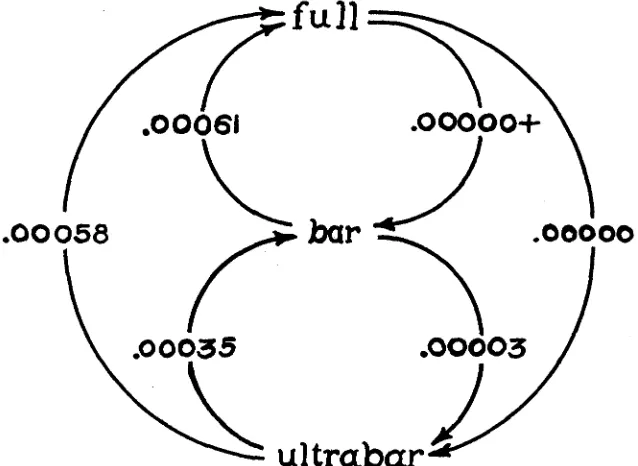
FIGURE 1.-Rates of mutation in the bar series of multiple allelomorphs. (After ZELENY 1921).
270 DAVID Er. THOMPSON
STURTEVANT (1925, 1928) explains the origin of ultrabar as due to un- equal crossing over a t the bar locus resulting in two bar genes lying next each other in the linear series of the genes. According to his explanation, reverted bar and presumably wild-type full, also, are not represented by an allelomorph a t the bar locus; furthermore, homozygous bar should produce full and ultrabar mutants in approximately equal numbers. This has not been realized. ZELENY’S (1921) data show that among 85,008 bars ex- amined the fulls outnumber the ultrabars 17: 1. (During the course of this experiment, numbers of flies with law facet counts were tested and found not to be ultrabar.) As STURTEVANT has pointed out, by the inclusion of certain untested flies with unusually low facet numbers this ratio is lowered to 6 . 5 : l . More recently (1928) he reports 8 full mutants and 2 ultra- bar mutants from homozygous bar; a ratio of 4: 1. While the true rate of
mutation from bar to ultrabar may be considerably in excess of the 0.00003 given by ZELENY, it is difficult for me to believe that I overlooked numbers of ultrabars approximating the fifty or so full mutants which were found. The difficulties of recognition of bar-ultrabar and full-ultrabar heterozy- gotes among an ultrabar population, as well as the preponderance of male mutants, make it seem likely that female mutants from ultrabar to bar were all overlooked and that part of those from ultrabar to full went un- recognized, so that the rates given in figure 1 (0.00035 and 0.00058) are probably too low.
STURTEVANT and MORGAN (1923) and STURTEVANT (1925, 1928), by a most ingenious and critical series of experiments, have shown that muta- tion a t the bar locus is associated with crossing over in that region. A most important result of these experiments is that STURTEVANT by genetic manipulation apparently has conclusively demonstrated that the germinal difference a t the bar locus resulting in a full eye on the one hand and a bar eye on the other is exactly equal to the germinal difference between a bar eye and an ultrabar (double-bar) eye.
Evidence from other sources shows that mutations a t the bar locus may occur in the female a t other stages in the life history than a t the matura- tion divisions, and in the male as well as in the female. HANSON (1928a, 192813) reported 9 reversions of bar to full among the off spring of irradiated bar males. It seems improbable that these mutations were associated with crossing over, since crossing over does not occur in the male in Drosophila. Other evidence of HANSON’S (1929) shows that irradiation has its effect on mature spermatozoa, which are haploid, thus making any possible associa- tion with crossing over quite out of the question.
STRUCTURE OF THE GENE 271
lished data of his concerning an instance of coincidence of mutation from bar to full and from bar to ultrabar which occurred in 1922. A virgin fe- male of an inbred white bar stock was mated to a brother and gave 105 off- spring in 4 bottles. I n bottle 3 of this mating there were 8 females and 12 males. Of these 8 females one appeared to be a heterozygote between bar and full, and another was as low in appearance as ultrabar, while the rest were typical bars. This full-bar heterozygote was not tested, but numerous others have always proved to be what they seemed, that is, heterozygotes for bar and full. The low female, when mated to a bar brother, gave only two offspring and a third pupa which did not hatch. One of the two off- spring was a bar male with 83 facets and the other a male with 30 and 32 facets in the two eyes, respectively, a t room temperature.
A similar coincidence of mutation happened in the spring of 1920 in the course of work with the character erect wing. A white bar erect female, which was homozygous for the white and bar factors and heterozygous for the sex-linked erect factor and for an autosomal factor which makes erect dominant (THOMPSON 1921), was mated to a wild-type male. Neglecting erect and its accessory factor, the expected classes were full-bar heterozy- gotes with red eyes and white bar males. The offspring consisted of 49 fe- males and 47 males, respectively, for the expected classes and one red fuU- eyed female and one red-eyed female classified as low bar. Up to the time of the above-mentioned coincidence of mutation, this case could not be ex- plained, but i t now seems explicable in similar terms; that is, a bar female producedtwo mutant eggs, one of which bore a full and the other an ultra- bar gene.
That the process which causes bar to mutate to full is associated with the process that produces ultrabar seems certain; for if they occurred inde- pendently, the probability of obtaining the two in a bottle of twenty flies would be one in several millions. While i t has been shown by
STURTEVANT
(1925, 1928) that these two processes ordinarily are accompanied by forked-fused crossing over, these cases of coincidental mutation could not have involved crossing over; for in order to result in two mutants, the change in each case must have taken place one or more cell generations be- fore the maturation divisions.
Another interesting case of coincidence of mutation came to light in No- vember, 1923. An ultrabar forked female of a pure stock was mated to an ultrabar forked brother. The offspring consisted of 9 ultrabar forked fe- males, 19 ultrabar forked males, and one f u l l forked female. This full female could not have been the result of contamination because no forked full stock had been in the building for months, and no strays of this kind were in the
272 DAVID H. THOMPSON
fly traps. Neither could she have resulted from the highly improbable fer- tilization of a mutant egg by a mutant sperm, since mutation in the male is not known to take place except by irradiation. It therefore seems prob- able that she had received both of her full genes from her mother. This egg, then, must have contained two X-chromosomes and was fertilized by a Y -
sperm. I n this case the full female should give exceptional offspring due to secondary non-disjunction. She was mated to an ultrabar forked brother and gave 47 forked daughters heterozygous for ultrabar and full, 37 full forked sons, and one full forked daughter. She was then mated to afull forked son and, after a few offspring by the previous male, gave all full forked off spring. This correlation of mutation with non-disjunction is all the more significant since non-disjunction is extremely rare in the stocks used. Recent experiments involving over 500 matings did not show a single exceptional off spring that could be due to non-disjunction.
0 0 6 0 6
full bar ultrabar infrabar double-infrabar
fused forked
bar-infrabar infrabar-bar
FIGURE 2.-Diagrams of the different genes known to occur at the bar locus.
* The mutation phenomena of full, bar, and ultrabar thus far described
STRUCTmE OF THE GENE 273
that the second episome is attached to the first in a side-chain arrangement because the ultrabar gene loses both its episomes to produce a full mutant as readily as it loses one to produce bar.
STURTEVANT and MORGAN’S demonstration that mutation at the bar locus is associated with forked-fused crossing over is interpreted to mean that crossing over, with its implied intimate contact a t the point of break- ing, is an effective agency for dislodging episomes or for transferring them
to the homologous gene. That crossing over is not the only agency which can dislodge the bar episome is shown by HANSON’S production of muta- tions from bar to full by irradiating the spermatozoa of bar males. The two instances of coincidence of mutation a t the bar locus occurred in the fe- male during the oogonial divisions. Changes in cellular mechanics accom- panying non-disjunction seem to have been responsible for the loss of the episomes from the two ultrabar genes of an XX egg.
The genes of the bar series of allelomorphs may be diagrammed as in fig- ure 2.
Origins and mutations of the genes of the infrabar series
STURTEVANT in 1925 reported a new allelomorph of bar which he called infrabar. This mutation appeared as a single male in an experiment where all the fathers were bar and all the mothers had the two X-chromosomes attached, giving 100 percent non-disjunction. This mutation falls in a dif- ferent category from those being considered in this paper, as i t represents a change in the nature of the bar episome, that is, it involves episome mu- tation and not gene mutation. With this new kind of an episome STURTE- VANT has duplicated most of the phenomena described earlier in this paper for the bar series of “quantitative” allelomorphs. Infrabar behaves like bar in that it reverts to full, but a t a rate three to four times as ,great (STURTEVANT 1928). It also produces a new and more extreme allelomorph called double-infrabar, analogous to ultrabar. Just as homozygous bar produces ultrabar less frequently than i t reverts to full, homozygous infra- bar produces double-infrabar less frequently than i t reverts to full. Dou- ble-infrabar likewise breaks down to give infrabar or reverts to full di- rectly. Double-infrabar, infrabar, and full constitute a “quantitative” series of allelomorphs paralleling the ultrabar, bar, and full series.
This infrabar series differs qualitatively from the bar series. STURTE-
VANT (1925) says, “.
.
.
homozygous infrabar is about like bar over roundin facet number, but the two types can be separated by a peculiarity com- mon to all the larger infrabar and double-infrabar types, namely, a rough- ened appearance of the eye, due to irregularities in the rows of facets. This
2 74 DAVID H. THOMPSON
peculiarity is not present in bar eyes, and is almost completely recessive in bar over infrabar. In infrabar over round (which is not far from round in facet number) the roughness is variable in extent, and may be not a t all evident, in which case the type can not be distinguished with certainty from homozygous round. I n other stocks, where the modifiers are different, it often happens that infrabar over round is regularly conspicuously rough- ened and is easily distinguishable from round. This roughness of the eyes may be taken as evidence that the infrabar gene is qualitatively different from bar, rather than being merely a fraction of bar.”
KRAFKA (1920) showed that wide differences in facet number result from differences in temperature a t which bar or ultrabar larvae develop, ap- proximating 10 percent decrease in facet number for each degree C in- crease in temperature. ROSELLE KARRER HERSH (1924) showed that full eye is affected in the same direction but to a less extent, being 2% percent per degree. DRIVER (1926), in a very painstaking analysis of the tempera- ture effect on bar and ultrabar, has shown that with increasing tempera- tures the rate of facet formation per unit of time during the facet-forming period is not much altered, but that the lower facet numbers result prima- rily from a shortening of the temperature-eff ective period.
Further evidence of the qualitative difference between infrabar and bar is found in LUCE’S (1926) discovery of the surprising fact that temperature has the opposite effect on infrabar and double-infrabar; that is, increasing temperatures give increasing facet numbers. His analysis shows that with increase in temperature the rate of facet formation during the temperature- effective period, instead of being almost constant as in bar and ultrabar, is increased enormously-so much so that it far more than counterbalances the opposite effect due to a shortening of the temperature-effective period. The qualitative difference between the bar series and the infrabar series is represented in figure 2 by means of two different kinds of episomes, which, however, have the same structural relations to the protosome.
Composite genes of bar and infrabar
Evidence indicating some details in the relation of episomes and proto- somes is found in the manner of origin of certain mutants. STURTEVANT
STRUCTURE OF T H E GENE 275
crossing over. All the bar mutants were associated with crossing over be- tween the forked locus and the bar locus, while all the infrabars were cross- overs between the bar locus and fused. In another independently produced composite gene of bar and infrabar the relations were reversed, so that in- frabar resulted from crossing over in the first region and bar from the sec- ond. He reports thirteen mutants consistent in this relation to crossing over, with no exceptions.
The facts just mentioned are interpreted to mean that the bar and infra- bar episomes of these composite genes are not attached in side-chain ar- rangement but lie near the left and right poles of the gene, so that crossing over on the left side breaks off the one (or transfers it to the homologous bar allelomorph), while crossing over on the right side breaks off the other. The difference between bar-infrabar and infrabar-bar genes can be seen in figure 2. While, up to date, STURTEVANT has reported no direct mutations to full from these composite genes, an experiment showing whether or not they produce fulls at a rate approaching their rate of mutation to bar or in- frabar would be a test for this postulated structure.
SOMATIC MANIFESTATIONS OF MUTATIONS
In the preceding discussion of the structure of the genes a t the bar locus, only the most direct evidence available has been used, that is, evidence showing the origins of the different allelomorphs and the direction and fre- quency of mutation. Detailed discussion of facet number has been pur- posely avoided except as it was necessary to recognize the different muta- tions. All available data, however, do indicate that the gain or loss of one of these germinal units, or episomes, is accompanied by a definite jump in the facet number, and that these different units maintain their identity no matter what combinations they have entered into or what manipulations they have undergone in their past history. It is now proposed to discuss the somatic manifestation of these genes and to point out, in particular, how facet number is determined by the ratio of the number of episomes to the number of protosomes. Before undertaking the exact application of such a formula, however, i t is necessary to consider two apparent excep- tions, namely, the so-called position effect and sexual dimorphism.
T h e so-called position eject
STURTEVANT (1925, 1928) has pointed out what he calls the position ef- fect of genes on facet number. According to his unequal crossing over ex- planation of mutation a t the bar locus, it is $0 be expected that homozy-
gous bar females, with a bar gene in each X-chromosome, would have the
276 DAVID H. THOMPSON
same facet count as full-by-ultrabar heterozygotes, with two bar genes in one X-chromosome and none in the other. When these two are compared he finds that the heterozygote always has fewer facets than the homozy- gote, the number varying in different stocks from
N
to as many. The same relation holds when infrabar homozygotes are compared with hetero- zygotes of full and double-infrabar and when bar-by-infrabar heterozygotes are compared with heterozygotes between full and the composite bar- infrabar allelomorph. Such comparisons, a t first, appear to present the same difficulty of explanation on the basis of side-chain structure of the gene as on the basis of unequal crossing over, since the same structural ele- ments are present in both; but there is an essential difference. I am in- debted to Professor ZELENY for the suggestion that the difference in facet number shows that the two bar factors (episomes) in an ultrabar gene do not exist as separate entities but are bound up with a third and different member (the protosome) to form a single gene which, with a normal allelo- morph (protosome alone) in the homologous chromosome, may be expected to give a different result from that produced by a bar episome on each of two protosomes. If two episomes always gave the same result no matter how they were distributed, there would be no obvious need of postulating the existence of the protosome. Furthermore, if the same facet number al- ways resulted, it would indicate that two allelomorphic genes, although lo- cated in two separate chromosomes, could together constitute a genetic unit of a more fundamental nature than a single gene-a situation without parallel among the units of the physico-chemical world. Finally, the ab- sence of “position effect” on bristle number has been shown by STURTE-VANT (1928) in a case in which the genes unquestionably exist as separate
entities.
Sexual dimorphism
Males of the different allelomorphs a t the bar locus have consistenfly higher facet numbers than the corresponding homozygous females. The sex coefficients in the order of decreasing facet number, and the authority quoted for each, are as follows: full 0.984 (ROSELLE KARRER HERSH
1924); infrabar 0.729 (STURTEVANT 1925); bar 0.791 (KRAFKA 1920); dou-
ble-infrabar 0.831 (STURTEVANT 1925) ; bar-infrabar 0.899 (STURTEVANT
1925); ultrabar 0.953 (ZELENY 1920). Since the stocks on which these di-
STRUCTURE OF THE GENE 277
not necessarily due to single and double doses a t the bar locus alone; for
A. H. HERSH (1929) has demonstrated the existence of plus and minus
modifiers of facet number in other parts of the X-chromosome. His find- ings bear out ZELENY'S (1921) explanation that the marked decrease in sexual dimorphism following inbreeding results from the elimination of differences due to X-chromosome factors affecting facet number.
Sexual dimorphism is greatest in the middle range of facet number, where a more labile condition is also indicated by temperature coefficients and by coefficients of variability. The so-called position effect also falls in this labile range.
T h e facet numbers determined by genes at the bar locus
Facet number is more closely correlated with the ratio of the number of episomes to the number of protosomes than with the total number of each or with other mathematical relations of these structural elements. If the different facet numbers are determined by quantitative changes in the gene, there should be some mathematical relation between the number of bar episomes and facet number when the number of protosomes is held con- stant. The males of the bar series, having only three members, cannot be expected to show the relationship as readily as the female series with its six
members. The facet counts a t 25OC for full eye by ROSELLE RARRER HERSH
(1924) and for the other members of the series by A. H. HERSR (1922) have
been used because all of them were derived by recent mutation from one stock and should have about the same combination of accessory factors. Since homozygous bar females and full-ultrabar heterozygotes both have two bar episomes, their facet numbers will be averaged, leaving five facet numbers in the female series as follows:
Kindoffem& Number of epiaomca Foed number
Ultrabar homozygotes 4 24.5
Bar-by-ultrabar heterozygotes 3 28.1
average 2 49.0
1 325.0
0 740.0
Bar hdmozygotes
Full-by-ultrabar heterozygotes Full-by-bar heterozygotes Full homozygotes
1
278 DAVID H. THOMPSON
the last interval in the above tabulation represents a qualitative differ- ence in the composition of the gene, the full facet count should be excluded from the quantitative series. Analogous results are to be found in a con- sideration of the physical properties of series of organic chain-compounds, in which the zero, or end-member, of the series does not lie on the curve de- termined by the other members.
ZELENY (1920b) found an exponential relation to exist in the variations of the facet numbers of the different members of the bar series. KRAFKA, the HERSHES, and DRIVER found the same kind of relation in the facet counts of flies reared a t successive intervals of temperature. It is then desirable to express the facet number in this female series in terms of the number of epi- somes, preferably by a generalized exponential equation, as follows:
loglo f(n) = a
+
bc”Here the number of episomes is represented by n, and the facet number by the right-hand member of the equation, in which the constants a, b, and c were determined by the different combinations of the four remaining facet numbers taken three a t a time. The average values thus obtained were:
a = 1.363 b = 4.209 C = 0.276
By substituting these constants and the number of episomes, we may cal- culate the different facet numbers and extrapolate the facet numbers of hy- pothetical allelomorphs and their heterozygotes which have more than four episomes on the two protosomes of the female. The observed facet numbers and the calculated results are as follows:
Number a/ episomes in females
0 1 2 3 4 5 6 7 8
00
C&uloted/acet number Obaeroed facet n u d e r
373,250 740
335 325
48.2 49.0
28.3 28.1
24.4 24.5
23.4 23.2 23.1 23.1 23.1
__ __
- - -
STRUCTURE OF THE GENE 279
reached earlier by the rates of mutation, namely, that the full gene con- sists of a protosome with no episomes.
The main point of this discussion of facet number is to bring out math- ematically what seems evident from an inspection of the facet numbers, that is, that facet number in the bar series approaches a limit. This calcu- lated limit is 23.1 facets. This formula has been applied to thecorresponding facet numbers given by STURTEVANT (1925), also a t 25°C. While his facet numbers run somewhat higher than those used here, the limit approached is almost identical, being 23.05 facets. Females homozygous for these hy- pothetical allelomorphs with three or more episomes on each protosome would not have a facet number appreciably different from homozygous ul- trabar.
The genes of the infrabar series and facet number
The facet numbers given by STURTEVANT (1925) for the homozygotes and heterozygotes of the full, infrabar, and double-infrabar genes have been substituted in the same formula, and the constants calculated, as was done for the bar series. By using the four facet numbers determined by 1, 2, 3, and 4 infrabar episomes on the two protosomes of the female, and by extra- polating, i t is evident that facet number in this series does not approach any positive number. The trend of the curve indicates that a female homo- zygous for an allelomorph with three infrabar episomes on each protosome would be almost, if not quite, without facets. If this were true, the thresh- old ratio of episomes to protosomes in this infrabar series would be 3 : l . Assuming, as before, that flies with the same episome:protosome ratio have similar facet numbers, an allelomorph with six or more infrabar episomes would be completely dominant over full, and the flies would be without facets.
With all this discussion of hypothetical allelomorphs with more than two episomes, the reader may well wonder why they have not been found. STURTEVANT (1925), and the writer as well, have tried to find such allelo- morphs without success. One may surmise either that the decrease in vi- ability which accompanies decrease in facet number in these series may prevent the appearance of these more extreme forms, or else that the pro- tosome a t the bar locus is “saturated” by two episomes.
Other quantitative series with a completely dominant allelomorph
280 DAVID H. THOMPSON
completely dominant allelomorph. It is to be expected that in the bar se- ries all allelomorphs with four or more episomes on each protosome would be completely dominant over the three known allelomorphs. The facet for- mula given above shows that there is a threshold ratio of episomes to pro- tosomes, which is 2:l. Accordingly, there can be no change in facet number until this ratio goes below the threshold value. For example, mutation from a gene with four episomes to five episomes would go undetected either by a count of the facets of the homozygotes or of their heterozygotes with the known allelomorphs. On the other hand, two allelomorphs, one with three episomes, and another with four episomes, while indistinguishable in the homozygous condition, should be capable of separation by their heter- ozygotes with full because the episome:protosome ratio of the first is below the threshold of manifestation and the other is not.
The postulation of apparently identical end-members of a series, which differ only by their complete or incomplete dominance over the allelomorph at the other extreme of the series, has been realized in the vestigial series in Drosophila melanogaster reported by BRIDGES and MORGAN (1919). Here the four members allelomorphic to wild-type, named in the order of increasing wing reduction, are nick, antlered, strap, and vestigial. The nick homozygotes are indistinguishable from the wild-type homozygotes on the basis of somatic appearance; however, they can be separated by their dom- inance over vestigial, since the normal allelomorph is completely dominant while nick gives an intermediate compound with vestigial very much like the sex-linked character “notch.”
T h e dominance of bar over infrabar
STRUCTURE OF THE GENE 281
in any quantitative series but show further heterogeneity in that each is completely dominant over the ones following in the order named. This epistatic behavior is similar to that of bar and infrabar and makes it likely that these three mutations represent the loss (or, less probably, the gain) of three different kinds of episomes. .
Other manifestations of mutation at the bur locus
As a test of the structure of the gene pictured in this paper, a study was made of other quantitative character changes accompanying mutation a t the bar locus. On the basis of facet number, we arrange full, bar, and ultra- bar eyes in a quantitative series in the order named. If other quantitative character changes caused by the same mutations gave reason for arrang- ing these three in a different order, it would, obviously, be a serious criticism of the theory since it would indicate different structures for ident- ical genes. An example of such other manifestations of these mutations is the increase in vigor accompanying a full mutation in a bar stock, where the full-eyed flies tend to crowd out the bar flies in a few generations. Like- wise, bar mutants appearing in ultrabar stock crowd out the latter, which in turn are also crowded out if a full mutation occurs. Conversely, ultrabar flies never crowd out bar flies. This crowding out effect is obviously due to a variety of physiological differences affecting such things as number of eggs, length of immature period, and vigor. I n a series of experiments designed to determine the quantitative relations of these other manifestations, flies of all possible combinations of the bar series were produced under uniform conditions a t 25°C. The stocks used were forked ultrabar, forked bar, and forked full derived from the forked ultrabar by reverse mutation. The re- sults are summarized in the following paragraphs.
While facet number may be regarded as a combined expression of the length and breadth of the eye, the width of the head gives an expression of the depth of the eye. The average widths of the heads of one hundred each of the six kinds of females and the three kinds of males are : Females-full homozygotes, 873 microns; full-bar heterozygotes, 760 microns; bar homo- zygotes, 681 microns; full-ultrabar heterozygotes, 658 microns; bar-ultra- bar heterozygotes, 640 microns; ultrabar homozygotes, 637 microns. Males -full, 814 microns; bar, 636 microns; ultrabar, 601 microns.
282 DAVID H. THOMPSON
of the intermediate types occasionally had a double-appearing median oc- ellus, which recalls the double origin of this ocellus in development. The average of the two diameters of such ocelli were used. The average ratio of one hundred each of the six kinds of females and the three kinds of males are: Females-full homozygotes, 0.985 ; full-bar heterozygotes, 0.920; bar homozygotes, 0.623; full-ultrabar heterozygotes, 0.522; bar-ultrabar heter- ozygotes, 0.360; ultrabar homozygotes, 0.048. Males-full, 0.960; bar, 0.598; ultrabar, 0.042.
I n connection with this work on the median ocellus it was noticed that the ultrabars often had 10 or more ocellar bristles while the fulls usually had 7 or 8. The average ocellar bristle numbers of one hundred each of the above-mentioned material are: Females-full homozygotes, 7.50; full-bar heterozygotes, 7.56; bar homozygotes, 8.13; full-ultrabar heterozygotes, 7.92; bar-ultrabar heterozygotes, 8.53; ultrabar homozygotes, 8.74. Males -full, 7.17; bar, 7.41; ultrabar, 9.11.
The percentage of sterile females also varies in the allelomorphs of the bar locus. Data on hand from large numbers of single pair matings anduni- form culture methods indicate that about 10 percent of the full females, 30 percent of the bar females, and 90 percent of the ultrabar females are com- pletely sterile.
It appeared in a number of experiments that the ultrabars were hatch- ing somewhat later than other kinds. An experiment was carried out to find the differences in the time of emergence of the different combinations of full, bar, and ultrabar in females. An excellent control of this determina- tion was obtained by mating each of the three kinds of heterozygotes to the three kinds of males. Each of these nine different matings gave two kinds of females and two kinds of males which developed in the same bottle from the same parents. The flies were cultured in 8-dram vials containing 9 cc of banana agar food a t 25°C. Eight pairs of parents were used in each mating and transferred a t three-hour intervals until they had laid eggs in a series of thirty bottles. The time of emergence was recorded a t three-hour inter- vals throughout the hatching period. The average time of emergence of
STRUCTURE OF T H E GENE 283
$4.08 k 1.04
+2.02+ 1.39 full
+1.81& 1.21
-
______
+2.64+ 1.37
+4.54+1.01 +10,10+2.57 full
full bar
bar bar
full
-
-
ultrabar
bar full
bar -
-
bar+0.30f1.50
-0.34+ 1.43
These other somatic manifestations of mutation a t the bar locus agree with facet number in that the values for bar are intermediate between those for full and ultrabar. The similarity of the full-ultrabar heterozygote to homozygous bar is consistent, and unless other experiments prove it un- trustworthy, it provides a useful tool in working out the structure of the gene in other quantitative series of multiple allelomorphs. A comparison of the effects of these genes on these somatic characteristics shows nothing inconsistent with the view that they may accomplish their effects through a single intermediate agent, perhaps an enzyme. More critical evidence on this point should be furnished by a comparison of the effects of tempera- ture on these different manifestations.
Dominance
At this point in the discussion it seems obvious that dominance, per se, is a property of the somatic effects of genes but not of their structure, since it not only varies from one manifestation to another but also depends upon the point of view with which we approach a single manifestation. Not only are the threshold ratios of episome number to protosome number differ- ent for these different manifestations, but some manifestations occur above
certain episome:protosome ratios while others occur below certain other ratios. For example, variations in the median ocellus, which are parallel to variations in facet number, occur where the threshold of manifestation is below a 2 : l ratio; while variations in the number of ocellar bristles, which have an inverse relation to facet number, occur above a 0:l ratio.
TWO DIFFERENT BAR DEFICIENCIES
A comparison of two cases of mutational phenomena involving a change a t the bar locus substantiates the conclusion reached earlier in this paper
284 DAVID H. THOMPSON
that the wild-type eye, as well as reverted bar, is represented by a gene a t the bar locus. I n the first of these cases (BRIDGES 1917) the bar locus of the deficient X-chromosome behaves like a full gene, indicating the pres- ence of a protosome. I n the other case (MORGAN 1927) the bar locus of the deficient X-chromosome does not behave like an allelomorph; that is, no protosome is present, and females are haploid for the bar locus. Tests showed that the latter case did not involve adjoining loci in the X-chro- mosome. From the evidence presented, no other interpretation of this case seems possible but that it was a “real” deficiency and that both the protosome and the bar episome were lost. I n this case, the deficiency and a
bar gene gave females with bar eyes; in BRIDGES’ case, the deficiency and a
bar gene gave females with eyes typical of full-by-bar heterozygotes. The deficiency reported by BRSDGES (1917) occurred in a germ cell of a white bar male. It also produced changes a t the forked and bar loci. I n effect, it changed a bar gene to a full gene, and the normal gene for the forked locus to a forked gene. Forked mutations and similar allelomorphs
of forked (MOHR 1922) have repeatedly arisen from the wild-type gene, with no reverse mutations reported. Differential rates of mutation in the two directions are interpreted, by methods discussed in connection with the bar series, to mean that the wild-type gene a t the forked locus consists of a protosome with episomes attached in side-chain arrangement. Forked mutations and forked allelomorphs arise by the loss of all, or a part, of these side-chains. Applying this same interpretation to BRIDGES’ forked-bar deficiency, we find that both the forked and bar loci lost episomes very much as if the genetic chromosome had been shaved of its side-chains for a short distance.
The same explanation may be used for other regional mutations such as the notch-8 deficiency described by MOHR (1923) which involved the loci for white, notch, and abnormal abdomen.
THE MUTABLE GENES OF DROSOPHILA V I R I L I S
The migration of the episome on the chromosome
STRUCTURE OF THE GENE 285
realized. Each of these mutable genes has produced non-mutating genes which are indistinguishable in other respects from the parent genes. I n all these mutable genes, there are differential rates of mutation in the two di- rections, with the high rate toward the wild-type indicating that the few original mutants resulted from additions of an episome and that their re- version represents its loss. Mutable reddish (body color) was the first to be found (DEMEREC 1928). In an experiment involving reddish, mutable miniature (wing character) was found (DEMEREC 1926a). The origin of mutable magenta (eye color) is not certain, as i t may have gone unnoticed for several generations (DEMEREC 1927). These three mutable genes have so much in common in their mutational behavior that they may be re- garded as resulting from the same episome acting a t three loci on the X- chromosome.
T h e greater mutability of newly formed genes
From the evidence of chromosome maps, as well as the rates of mutation of genes under so-called natural conditions, i t is evident that most genes are stable. Furthermore, the very numerous lethal mutations and the sev- eral cases of multiple allelomorphs wherein the greater rate of mutation is away from the wild-type indicate that most genes have side-chains of epi- somes. These old established genes seem to have achieved a degree of stability and a nicety of balance not found in genes formed by the recent additions of episomes. This is well borne out by the mutable genes of Dro- sophila virilis and by those a t the bar locus in
D.
melanogaster, all of which represent additions to the germ-plasm.T h e migration of the episome on the protosome
DEMEREC (1928) has supplied pertinent evidence on the process by which a rapidly mutating gene becomes stabilized. Reddish-alpha, im- mediately after its origin, was crossed repeatedly to yellow (a stable allelo- morph) and gave a decreasing yield of reversions to wild-type. The rever- sion in the second generation was 12.4 percent; in the third generation, 1.6 percent; fourth, 0.6 percent; fifth, 0.32 percent; sixth, 0.043 percent; and in the seventh generation there were no reversions. On the basis of our side-chain explanation of gene mutation, such evidence is interpreted to mean that there are certain positions on a protosome where an episome will give a more stable gene than other positions. If i t be supposed that the equatorial” position is most unstable and that an episome varies some- what in its position from one cell generation to another, then episomes a t the “equator” would be eliminated most rapidly and those nearer the
( (
286 DAVID H. THOMPSON
“poles” of the protosome would be in a more “protected” position. When DEMEREC saw that the mutation rate was dropping rapidly, he attempted to bring back the original high rate by selecting for mutability. I n this he was partly successful, being able to maintain an average level of reversion amounting to 2.9 percent. It is understandable that he should not attain the original rate of reversion (12.4 percent), if we suppose that the “pres- sure” of mutability soon reaches an equilibrium with the “pressure” of selection when such high actual rates of mutation are involved.
The explanation of decreasing mutation rate by migration of the epi- some toward one, or both, of the poles of the protosome is further clarified by DEMEREC’S (1928) data. He found that almost half of the reddish-alpha reversions are crossovers between yellow (stable allelomorph of reddish- alpha) and scute, a gene 0.6 unit away from the reddish locus. No rever- sions were crossovers between yellow and sepia, which is 2.2 units on the other side of reddish. The remainder of the reversions were about equally distributed between non-crossovers and crossovers in other parts of the X-chromosome. It seems clear that the episome migrated toward the scute pole of the protosome but not toward the sepia pole.
DISCUSSION
Attraction and repulsiort phenomena
Since homologous chromosomes lie side by side during synapsis, each gene attracting its homologue in the other chromosome, and since most genes are identical with their homologues in paired chromosomes, we may conclude that like genes attract each other. I n “quantitative” series of multiple allelomorphs which are interpreted to be due to varying numbers of one kind of episome, the mutation rates indicate that like episomes unite to form side-chains. I n the composite bar-infrabar and infarbar-bar genes, the two different kinds of episomes seem to repel each other and they take up positions near the opposite poles of the protosome as shown in figure 2. The unusually high mutability of the reddish-alpha gene in heterozygotes and not in homozygotes also indicates attraction and repulsion.
The symmetry of genes
STRUCTURE OF THE GENE 287
homologue by its side. In the same way this“regenerated” gene may also be expected to be a mirror image of its progenitor. A number of interesting analogies may be drawn between such “dextro” and “laevo” genes and optically active organic substances, but their genetic applications seem too problematical to discuss further.
W I L L S T A T T E R I S structure of enzymes
I am indebted to Doctor A. H. HERSH for pointing out that the structure of the gene developed in this paper resembles in several points the structure of enzymes as given by WILLSTATTER (1926), who says : “ The
‘
molecule’ ofan enzyme appears to consist of a colloidal carrier and a purely chemically active group. The specificity of the enzyme is vested wholly in this active group, which can apparently be transferred from one colloidal carrier to another. It h i s not yet been possible to separate the enzyme molecule proper from the colloidal carrier without loss of activity.” Genes probably produce their effects through, and are the parent substances of, enzymes, so that it is fitting that they should be similar in structure.
Other structural explanatiolzs of gene mutation
When MAY (1917) reported the occurrence of reverse mutations of bar to full, he postulated the following explanation:
“If the normal wild fly carries a limiting factor with respect to the facet number then it is possible by partial non-disjunction for the factor to pass from one chromosome of a pair to the other, giving one chromosome with- out a limiting factor and the other with a double limiting factor. The bar- eyed race of Drosophila may be derived from such a chromosome with two limiting factors or factor groups, the mate of the chromosome having been lost in the maturation of the egg. If then in the bar-eyed race a second non-disjunction again separates the two factors the result should be one chromosome with triple factors and one heterozygous female. If the former passes into the egg it should give rise to a further reduction in the facet number, but it is possible that a fly with such a chromosome does not live. It is possible also that the male with 34 facets contained a chromosome with a triple reducing factor.”
According to the mathematical relations among the members of the bar series developed in the present paper, ultrabar fulfills the above predic- tion, but the evidence from mutation rates and other data indicates that bar does not represent the doubling of an inhibiting factor already present in the full gene but rather the addition of a new factor (episome).
CORRENS (1919), in explaining variegation in certain plants, postulated
288 DAVID H. THOMPSON
a structure in which he conceived of the gene as a large molecule with varying numbers of the same chemical radical attached, thus producing varying amounts of green and white in variegated foliage. The gene for intermediate variegation was held to have an intermediate number of radi- cals, to which new ones might be added or old ones sloughed off to produce plants with larger or smaller green or white areas. The addition of the greatest possible number of these chemical radicals or the loss of all of
them, he inferred, would give a self-green plant or a self-white plant, one or both of which should be constant. As long as the number of radicals was intermediate, selection would be effective in either direction until one or the other extreme was reached.
The large and complicated series of multiple allelomorphs in the cob and pericarp colors of maize has been investigated by many workers. I n a study of the mutational phenomena accompanying variegation, EYSTER (1924, 1925) has concluded that these genes consist of varying numbers of pig- ment-producing and non-pigment-producing gene elements. I n an inter- mediate color, such as orange pericarp, he conceives that mitosis may di- vide the two elements of the gene unequally between the two daughter genes, so as to produce adjacent areas of lighter and darker color. The side-chain explanation can equally well account for the same facts by the gain or loss of episomes between the two daughter genes.
A rather superficial examination of the data and material suggests an explanation that is alternative to both CORRENS’ and EYSTER’S, namely, that there are varying numbers of one kind of episome determining the total amount of pigment present, and that another kind of episome causes the pigment present to be evenly distributed or, if it be lost, to be concen- trated in certain areas. This latter phenomenon would not involve the unequal assortment of gene elements, but rather the critical concentrations of chromogenic substances unequally distributed during the ontogeny, very much as CONKLIN found among the organ-forming stuffs of Crepi- dula.
ACKNOWLEDGMENTS
This explanation of gene mutation was developed during 1923 and 1924 in the Zoological Laboratories of the UNIVERSITY OF ILLINOIS under the
STRUCTURE OF THE GENE 289
Whatever clarity may attend the presentation of this paper is largely a result of the untiring efforts of my friend, Mr. H. CARL OESTERLING, edi- tor for the ILLINOIS NATURAL HISTORY SURVEY.
I wish to thank Doctor C. N. WALL, of NORTH CENTRAL COLLEGE, and Doctor H. W. BAILEY, of the Department of Mathematics, UNIVERSITY OF ILLINOIS, for the calculation of the constants and aid in the application of the facet formula.
LITERATURE CITED
BRIDGES, CALVIN B., 1917 Deficiency. Genetics 2: 445465.
BRIDGES, C. B., and MORGAN, T. H., 1919 11. The second-chromosome group of mutant charac- ters. Pub. Carnegie Instn. 278.
CORRENS, C., 1919 Vererbungsversuche mit buntblattrigen Sippen. I. Capsella Bursa pastoris al- bovariabilis und chlorina. Sitzungsberichte der Akademie der Wissenschaften zu Berlin.
DEMEREC, M., 1926a Reddish-A frequently “mutating” character in Drosophila virilis. Proc.
1926b Minature-A second frequently mutating character in Drosophila virilis. Proc. Nat.
1927 Magenta-alpha-A third frequently mutating character in Drosophila virilis. Proc.
1928 Mutable characters of Drosophila virilis. I. Reddish-alpha body character. Genetics
1929a Genetic factors stimulating mutability of the miniature-gamma wing character of
1929b Changes in the rate of mutability of the mutable miniature gene of Drosophila virilis.
DRIVER, ERNEST C., 1926 The temperature-effective period-the key to facet number in Droso-
EYSTER, WILLIAM H., 1924 A genetic analysis of variegation. Genetics 9: 372-404.
HANSON, FRANK BLAIR, 1928a The effect of X-rays in producing return gene mutations. Science
1928b The effects of X-rays on productivity and the sex ratio in Drosopila melanogaster.
1929 Duration of effects of X-rays on male germ cells in Drosophila melanogaster. Amer.
HERSH, A. H., 1922 The effect of temperature upon the heterozygotes in the bar series of Droso-
1924 The effect of temperature upon the heterozygotes in the bar series of Drosophila. J. Exp.
1929 The effect of different sections of the X-chromosome upon bar eye in Drosophila melano-
HERSH, ROSELLE KARRER, 1924, The effect of temperature upon the full-eyed race of Drosophila.
KRAFKA, JOSEPH, JR., 1920 The effect of temperature upon facet number in the bar-eyed mutant
LUCE, WILBUR M., 1926 The effect of temperature upon infrabar, an allelomorph of bar eye in
33: 585-610.
Nat. Acad. Sci. Wash. 12: 11-16. Acad. Sci. Wash. 12: 687-690. Nat. Acad. Sci. Wash. 13: 249-253
13: 359-388.
Drosophila airilk. Proc. Nat. Acad. Sci. Wash. 15: 834439. Proc. Nat. Acad. Sci. Wash. 15: 870-876.
phila. J. Exp. Zool. 46: 317-332.
1925 Mosaic pericarp in maize. Genetics 10: 179-196.
67: 562-563.
Amer. Nat. 62: 352-361. Nat. 63: 511-516.
phila. Thesis, Univ. Illinois Grad. School (not published).
ZOO^. 39: 55-71.
gaster. Amer. Nat. 63: 378-382.
J. E K ~ . ZOO^. 39: 43-53.
of Drosophila. J. Gen. Physiol. 2: 445464. Drosophila. J. Exp. Zool. 46: 301-316.
290 DAVID H. THOMPSON
MAY, H. G., 1917 Selection for higher and lower facet numbers in the bar-eyed race of Drosophila and the appearance of reverse mutations. Biol. Bull. 33: 361-395.
MOHR, 0. L., 1922 Cases of mimic mutations and secondary mutations in the X-chromosome of Drosophila melanogaster. Z. indukt. Abstamm.- U. VererbLehre., 28: 1-22.
1923 A genetic and cytological analysis of a section deficiency involving four units of the
X-chromosome in Drosophiia melanogaster. Z. indukt. Abstamm.- U. VererbLehre. 32:
MORGAN, T. H., 1927 Exceptional classes of individuals in an experiment involving the bar locus
MULLER, H. J., 1920 Further changes in the white-eye series of Drosophila and their bearing on
STURTEVANT, A. H., 1925 The effects of unequal crossing over a t the bar locus in Drosophila.
1928 A further study of the so-called mutation a t the bar locus of Drosophila. Genetics 13:
STURTEVANT, A. H., and MORGAN, T. H., 1923 Reverse mutation of the bar gene correlated with THOIUSON, DAVID H., 1921 A new type of sex-linked lethal in Drosophila. Anat. Rec. 20: 215.
TICE, SABRA COLBY, 1914 A new sex-linked character in Drosophila. Biol. Bull. 26: 221-230.
WHITING, ANNA R., and BURTON, RAYMOND H., 1926 Quadruple allelomorphs affecting eye-color
WILLSTATTER, R., 1926. Chemical progress. Chem. Soc. of London, Rep. Prog. Chem. 232-234. WRIGHT, SEWALL, 1925 The factors of the albino series of guinea pigs and their effects on black
108-233.
of Drosophila. Hereditas 9: (Festskrift for W. Johannsen) 1-9. the manner of occurrenceof mutation. J. Exp. Zool. 31: 443-473. Genetics 10: 118-147.
401-409,
crossing over. Science 57: 746-747.
1925 Evidence of structure in the gene. Amer. Nat. 59: 91-94.
in Habrohracon. Amer. Nat. 60: 285-290
and yellow pigmentation. Genetics 10: 223-260.
1929 The dominance of bar over infra-bar in Drosophila. Amer. Nat. 63: 479-480.
ZELENY, CHARLES, 1920a A change in the bar gene of Drosophila melanogaster involving further decrease in facet number and increase in dominance. J. Exp. Zool. 30: 293-324. 1920b The tabulation of factorial values. Amer. Nat. 54: 358-362.
1921 The direction and frequency of mutation in the bar-eye series of multiple allelomorphs of
1922 The effect of selection for eye facet number in the white bar-eye race of Drosophila Drosophila. J. Exp. Zool. 34: 203-233.