Optimal Control of Output Signal of a Chaotic
Oscillator Using Genetic Algorithm Based
Discrete Time PI Controller
Aydın
Mühürcü
1, Ercan Köse 2
Assistant Professor, Department of Electrical and Electronic Engineering, Sakarya University, Turkey1
Assistant Professor, Department of Mechatronic Engineering, Mersin University, Tarsus, Mersin, Turkey2
ABSTRACT: In this study, state output variable of Lorenz chaotic oscillator which has nonlinear equations was controlled using reference based negative feedback discrete time PI controller. The coefficients belonging to controller parameters were chosen in the most suitable way by using Genetic optimization algorithm. So, input reference value change was provided independently without regarding linearization point in the control process. The study was implemented in a co-simulation environment in Matlab-Simulink. PI controller parameters optimization was implemented by converting discrete time negative feedback closed loop control system to hardware codes with PI parameters, utilizing genetic algorithms taking place in the Matlab-Optimtool GUI. The simulation results obtained by using controller showed that the suggested method is favorable for variable reference input control of nonlinear chaotic systems.
KEYWORDS:Lorenz chaotic oscillator, Discrete time, Dynamic behavior, Genetics, Optimization, PID control.
I. INTRODUCTION
Chaotic systems are deterministic signals which indicates non-linear behaviors. It is quite difficult to follow the behaviors. Initial conditions could significantly affect dynamic behaviors [1]. Dynamic structures of chaos systems are shown with mathematical equations related to situational variables. Chaotic systems with non-linear equations, controlling output of situational variables provides significant adventages to analyze these variables. In addition, it will improve areas of usage of chaotic systems.
controller [12]. Köse et al. in order to control the voltage of the Western System Coordinating Council (WSCC) system, the sliding mode parameters have been obtained by using algorithm (GA) optimization technique [13].
In this study, for optimization genetic algorithm have been chosen and then used. Genetic algorithm, for the first time has been invented by John Holland at Michigan University. Holland has used theory of evolution for optimization in genetic algorithms. Genetic algorithms create a solution set consisted of different solution instead of creating one solution for the problems. Thus, a lot of points can be regarded at the same time at search space and as a result, possibility of reaching holistic solutions have been raised [14].
Genetic algorithms provide successful solutions for parameter and system identification, control systems, applications of robot, image and sound recognition, engineering designs, planning, application of artificial intelligence, specialized systems, function and combinational optimization problems, web design problems, road finding problems, social and economic planning problems [14].
In this study, the coefficients belonging to controller parameters were chosen in the most suitable way by using genetic optimization algorithm. The simulation results have confirmed this state.
II. DESCRIPTIONS OF THE LORENZ CHAOTIC SYSTEMS
In this study, continuous time Lorenz chaotic oscillator [1] has been chosen to be controlled by a controller structured as PI. Here, the chaotic oscillator of Lorenz has non-linear equations where x, y and z are state variables and a, b, c are positive constant parameters, Equ 1.
b c ) ( a z xy z y xz x y x y x (1)
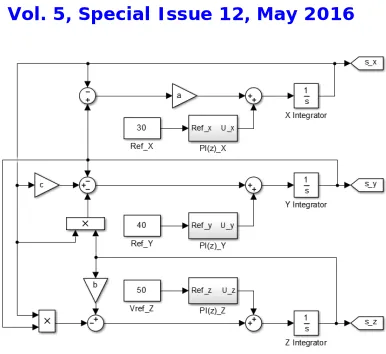
Using the Laplace transformation method [15], t-domain Lorenz equations are transformed to S-domain Lorenz equations as seen in Equ-2. For controlling state variables of the chaotic oscillator the outputs (Uxyz) of the controllers have been put into the equations. The reason of the discrete time PI controller usage, controllers’ outputs have been given on z-domain form.
) ( ) ( ) ( ) ( 1 ) ( ) ( ) ( ) ( ) ( ) ( 1 ) ( ) ( ) ( ) ( 1 ) ( s U s bZ s Y s X s s Z s U s Y s Z s X s cX s s Y s U s aX s aY s s X z y x (2)Fig.1. Lorenz MATLAB/SIMULINK chaos control model
s-domain equivalent of PI(t) control algorithms has been given the Equation 3.
s
K
K
s
e
s
U
x(
)
x(
)
p i1
(3)e(s) function used in Equation 4 is the difference between the input reference value and the output value.
)
(
)
(
)
(
s
R
s
X
s
e
x
(4)
Using forward difference method [13], Equation 5, PI(s) has been converted to PI(z) block diagram. 1
1
1 1
(
)
s
z
s
T
z
(5)Where,
T
s(named with t sample on Simulink), is the sample period [16]. After discrete t operation the PI algorithm states as,
1 1
1
s
x z p i
T z
U z e z K K
z
(6)
)
(
)
(
)
(
z
R
z
X
*s
e
x
(7)Using the direct programming method [17] for Equation 6, the Z-domain PI controller transfer functions have been converted to Z-domain PI block diagram based on 1 sample delay, as 1/z, Fig. 2. The task of the key that was used in Fig. 2 is arranged the starting time of the error signal for controller.
III.GENETIC ALGORITHM
The basic principles of GA were first proposed by Holland. The technique was inspired by the mechanism of natural selection, a biological process in which stronger indivisual is likely to be the winners in a competing environment. GA uses a direct analogy of such natural evolution to do global optimization in order to solve highly complex problems. It presumes that the potential solution of a problem is an indivisual and can be represented by a set of parameters. These parameters are regarded as genes of a chromosome and can be structured by a string of concatenated values. The form of variables representation is defined by the encoding scheme. The variables can be represented by binary, real numbers or other forms, depending on the application data. Its range, the search space, is usually defined by the problem. An illustrative flowchart of the GA algorithm implementation is shown in the Fig. 3. In the beginning an initial chromosome is randomly generated. The chromosomes are candidate solutions to the problem. Then, the fitness values of all chromosomes are evaluated by calculating the objective function in decoded form. So, based on the fitness of each indivisual, a group of the best chromosomes is selected through the selection process. The Genetic operators, crossover and mutation, are applied to this surviving population in order to improve the next generation solution. The process continues until the population converges to the global maximum or another stopping criterion is reached.
create feedback system’s (fsys)
difference equations
Ref==1 start
creat initial population (creat randomly)
dRef=1/value1 Ref=0
e2=0 Ts=value2
k=0
out=fsys(kTs;population)
e2=e2+(Ref-out)^2
k=k+1 Ref=Ref+dRef
No
Yes cross over
reproduce(e2) mutation
new population
No e2
satisfied
The most crucial step in applying GA is to choose the objective functions that are used to evaluate the fitness of each chromosome. In this study, the integral squared error in the shown Eq. (8) is chosen as the objective function.
2
0 n
ise k
I k e k
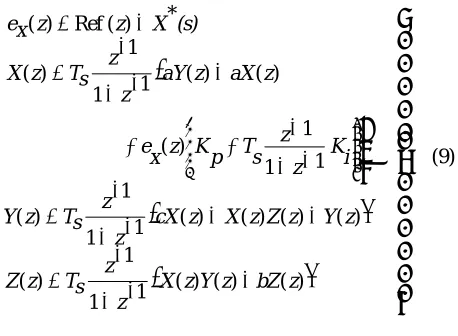
(8)In shown Fig. 3, the algorithms of the flow-chart has been runned in the Matlab-Optimtool GUI. In this method, in order to optimize parameters of the system, the system is transformed to the discrete time program code and then the transformed system is integrated in the GUI. Firstly, the hybrid time oscillator and controller equations are transformed to discrete time equations to perform this transformation process and then, the expressions given in the Equation 9 are converted to the software codes by using the direct programming technique.
) ( ) ( ) ( 1 1 1 ) ( ) ( ) ( ) ( ) ( 1 1 1 ) ( 1 1 1 ) ( ) ( ) ( 1 1 1 ) ( * ) ( Ref ) ( z bZ z Y z X z z s T z Z z Y z Z z X z cX z z s T z Y i K z z s T p K z x e z aX z aY z z s T z X (s) X z z x e (9)IV.OPTIMIZATION RESULTS
The important genetic algorithm parameters are given in Table 1.
Table 1. Genetic algorithm parameters
Population Size 500 Fitness Scaling Rank Bounds [0.3;300] Initial range [0.3;300] Selection function Rulette
Mutation function Gaussian Shrink:0.01 Crossover Constraint dependent
Generation max 1000 Fitness limit 1e-5 Function tolerans 1e-5
Fig.4.The fitness change in the optimization process of PI_x(z)
Fig.5.The Kp change in the optimization process of PI_x(z)
Table 2. Kp, Ki and fitness values
Kp Ki Fitness
PI_x(z) 211.2 17623.9 6.9e-05 PI_y(z) 183.1 10840.3 3.2e-05 PI_z(z) 249.4 22184.7 0.033e0
V. SIMULATION RESULTS
The simulation results are shown in Fig. 7, 8 and Fig. 9. The obtained results using the Ux(z) controller variable for only the
x
variable is shown in Figure 7. In addition, the change results of the y and z variables is presented in the same graph. 30 value for the x variable has been selected as the reference value. In the 25 seconds, the controller is to be active. With the introduction of the controller, the x variable is seen that immediately reaches the selected reference value.Fig.7.The time series of the Lorenz chaotic system for x, y and z state variables (a) x variable (b) y variable
Fig.8.The
xy
phase portrait of the Lorenz chaotic systemIn another case study, Ux(z), Uy(z) and Uz(z) as three different controller is used to the control of state variables
x
,y
andz
. The system variables of these three controllers variables have been want to move to 3 different reference point. This reference values is x=30, y=40 and z=50. When controllers are activated in 25 seconds, moved to the desired point of the system variables are shown in Figure 9.(a) x variable (b) y variable
VI. CONCLUSION
In this work, the output variables of the Lorenz chaotic system having non-linear equations are controlled by means of the optimization of the PI controller known as classical algorithms. The implemented parameter optimization process for the controller is performed by using genetic algorithm (GA). The obtained results showed that the performance of the GA is good for this optimization process that calculated the parameters of the controller in the defined interval. Thus, the non-linear output of the system for the variation input reference tracks the value of reference with minimum calculation time and minimum integrated squared error. Also, x, y, z 1-D, 2-D graphics change have been confirmed each other.
REFERENCES
[1] Edward N., Lorenz, “Deterministic non periodic flow”, J. Atmos. Sci., vol. 20, No.2, pp. 130–141, 1963.
[2] L. Pin-Lin, “Delay-dependent global exponential robust stability for delayed cellular neural networks with time-varying delay”, ISA Transactions, vol. 52, pp. 711–716, 2013.
[3] Kaveh Merat, Jafar Abbaszadeh Chekan, Hassan Salarieh, Aria Alasty, “Linear optimal control of continuous time chaotic systems”, ISA Transactions, vol. 53, pp. 1209-1215, 2014.
[4] Jianxiong Zhang, Wansheng Tang, “Optimal control for a class of chaotic systems” J.Appl Math. vol. 2012, Article ID 859542, 2012. [5] Ju H. Park, D.H. Ji,, S.C. Won, S.M. Lee, “H∞ synchronization of time-delayed chaotic systems”, Applied Mathematics and Computation, vol.
204, No.1, pp. 170-177, 2008.
[6] Hassan Salarieh, Mohammad Shahrokhi, “Indirect adaptive control of discrete chaotic systems”, Chaos Solitons Fractals, vol. 34, No.4, pp. 1188–1201, 2007.
[7] Ming-Chang Pai, “Chaotic sliding mode controllers for uncertain time-delay chaotic systems with input nonlinearity”, Applied Mathematics and Computation, vol. 271, pp. 757-767, 2015.
[8] Ercan Köse, “Controller Design by using Sliding Mode and Passive Control Methods for Continuous Time Non-Linear Shimizu-Morioka Chaotic System”, International Journal of Engineering Innovation & Research, vol. 4, No.6, pp. 895-902, 2015.
[9] Atta Ovesi, Mohammad Gudarzi, “Application of auto-tuning Ziegler-Nichols PID controller in chaotic vibration supression of a beam with nonlinear boundary conditions”, Latin American Applied Research, vol. 45, No.3, pp. 179-184, 2015.
[10] Rabindra Kumar Sahu, Sidhartha Panda, Umesh Kumar Rout, Dillip Kumar Sahoo, “Teaching learning based optimization algorithm for automatic generation control of power system using 2-DOF”, International Journal of Electrical Power& Energy Systems, vol. 77, pp. 287-301, 2016.
[11] Chiao-Ting Li, Huei Peng, Jing Sun, “Predictive control and sizing of energy storage to mitigate wind power intermittency”, Wind Energy, vol. 19, No.3, pp. 437-451, 2016.
[12] Gorazd Karer, Igor Skrjanc, “Interval-model-based global optimization framework for robust stability and performance of PID controllers”, Applied Soft Computing, vol. 40, pp. 526-543, 2016.
[13] Ercan Köse, Kadir Abacı, Hakan Kızmaz, Saddettin Aksoy, Mehmet Ali Yalçın, “Sliding Mode Control Based on Genetic Algorithm for WSCC Systems Include of SVC”, Elektronika Ir Elektrotechnika, vol. 19 No.4, pp. 19-24, 2013.
[14] https://tr.wikipedia.org/wiki/Genetik_algoritma
[15] Tomas B. Co, “Methods of applied mathematics for engineers and scientists”, 12.4 Cambridge University Press, 2013. [16] M.S. Fadali, A. Visioli, “Digital control engineering”, pp. 9-50, Academic Press, 2009.