Utilization of Recycled Concrete as Aggregate
for Structural Concrete
Dr. S. Suresh 1, J.Revathi 2
Professor, Sona College of Technology, Salem, India1
Asst. Professor, Ganesh College of Engineering, Salem, India2
ABSTRACT: Concrete is the premier construction material across the world and the most widely used in all types of civil engineering works, including infrastructure, low and high-rise buildings, environment protection and local/domestic developments. The use of recycled aggregate in concrete is gaining momentum these days. In the years to come the recycled aggregate concrete may become the need of the day. The most common are demolition projects. Many concrete structures like building, bridges, side walls and roads are razed after a period of time into their service life for purpose of replacement or landscape changes. In this study variation in strength between ordinary concrete and 30% replaced aggregate concrete. Replacement of natural aggregates by recycled concrete aggregate shows gradual increase in results with respect to compressive strength, split tensile strength and flexure strength. The natural coarse aggregate was replaced by recycled coarse aggregates with the following percentages 30%, 60% & 90%
KEYWORDS: Compressive Strength, Tensile Strength, Recycled Concrete, Recycled aggregate
I. INTRODUCTION
The applications of recycled aggregate in the construction area are very wide. There are many testing based on the recycled aggregate have been carried out all around the world. Recycled aggregate concrete utilizes demolition material from concrete and burnt clay brick masonry construction as aggregate. Reuse of demolition waste disposal and is also helpful in reducing the gap between the demand and supply of crushed granite fresh aggregate. The fragment of the crushed concrete which is less than 5 mm is separately collected from the crusher and sieved by using I.S. sieves. The fragment passing through 4.75 mm. I.S. sieves is taken as recycled concrete aggregate, which is used for partial replacement of natural sand.
Mentioned that the fineness modulus and percentage of water absorption used instead with the recycled aggregate is higher than natural aggregate. The results of compressive strength of added reduce water admixture concrete is higher than the one that not added reduce water admixture concrete, and the compressive strength of concrete produced that using recycled aggregate is higher than concrete using natural coarse aggregate.
II. EXPERIMENTAL PROGRAMME
A. Materials Used
a.
CementCement is a powdered material that serves as a binder in mortar or concrete after reactions of lime or lime compounds have taken place with appropriate medium-usually water. Portland cement is one of such materials, composed largely of calcium and aluminium silicates, in which the former upon reaction with water produces the new compound capable of imparting stone like quality to the mixture. While the specific gravity of Portland cement ranges from 3.12 to 3.16, its unit weight varies with the degree of compaction
b. Fine aggregate
Sand is naturally occurring granular material composed of finely divided rock and mineral particles. The most common of sand is Silicon di- Oxide, usually in the form of Quartz. Normally river sand is used as fine aggregate for preparing concrete. An Individual particle in this range is termed as sand grain. These sand Grains are between Gravel (2 mm – 64mm) and silt (0.004mm – 0.0625mm). Aggregate most of which passes 4.75mm IS sieve is used. Locally available river sand Zone III having a specific gravity of 2.62, fineness modulus of 2.75 is used.
c. Coarse aggregate
Aggregates are the most mined material in the world. Aggregates are a component of composite materials such as concrete and asphalt concrete the aggregate serves as reinforcement to add strength to the overall composite material. Gravel of Size 20mm is sieved and used. Crushed granite coarse aggregate of maximum size 20 mm and having a specific gravity of 2.387, fineness modulus of is used.
Recycled coarse Aggregate:
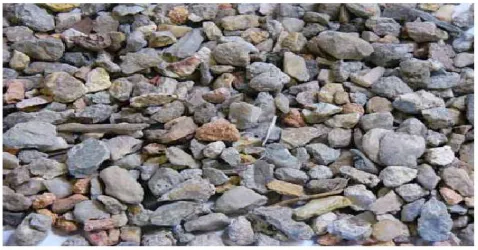
Crushed concrete waste passing through 20mm and retained on 4.75mm I.S sieve were used as recycled coarse aggregate and they met the grading requirements of IS: 2386 - 1983
D Water
Mixing water should contain no substances that can have an appreciably harmful effect on the process of hydration or upon the durability of concrete during its service period. Water having appreciable amounts of impurities-silt, oil, acids, alkalies, salts of alkalies, organic matter and sewage may have an injurious effect upon concrete. The reduction in strength of concrete through the use of water suspected of undesirable substances could be as high as 10%.
B. Experimental Procedure
Slump test
Compressive strength
Compressive strength is defined as the maximum resistance of a concrete cube to axial loading. Testing of specimens was carried out after curing. Specimen dimensions were measured before testing. Clean and surface dried specimens were placed in the testing machine.
Experimental Setup
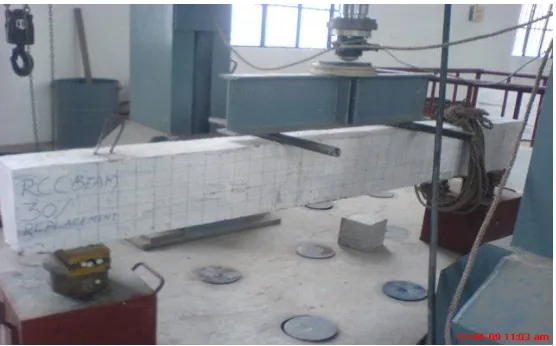
All the four beams were tested at the age of 28 days in a two point loading conditions, with load applied to the test beam as the two equal concentrated loads by means of a steel beam with shear-span to effective depth ratio of 2.67 as shown .Two point loads were applied to the beams by hydraulic testing machine up to the failure. The deflection was measured at the three points using dial gauge, one at the mid span and the other under the loading points. The loads were applied in small increments and at every increment of loading, the deflection was recorded.
Fig .2 Experimental Set-up of Beam with Loading Frame
III. RESULTS AND DISCUSSION
Split Tensile Strength
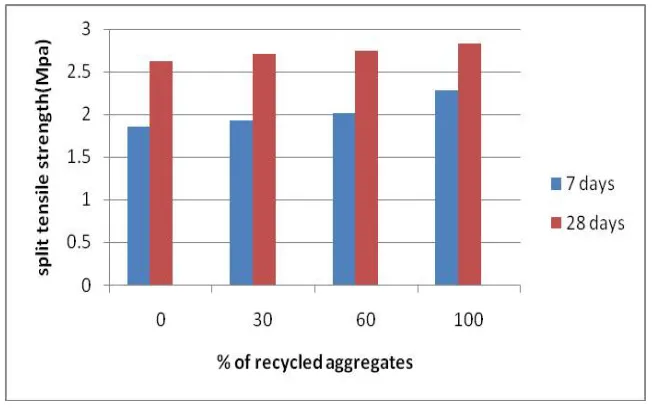
Fig .4 Comparison of 7th & 28th day Split Tensile Strength
Flexural strength
0 1 2 3 4 5
0 30 60 100
Fl
e
xu
ra
l S
tr
e
n
gt
h
N
/m
m
2
% of Recycled Aggregates
7 days
28 days
Fig. 5 Comparison of 7th & 28th day Flexure Strength
EXPERIMENTAL RESULTS FOR RCC BEAMS:
Load and Deflection for Ordinary RCC Beam:
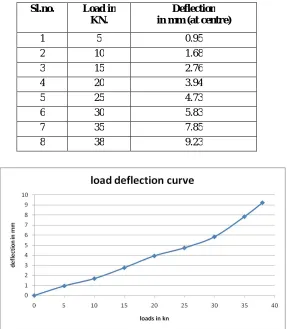
The deflection was measured at three points using the dial gauge, one at the mid span and other two at one-third point from the support. The deflection increased according to load increases. Load and Displacement values for ordinary Reinforced Concrete Beam are shown below in table 1
TABLE .1 LOAD VS DEFLECTION FOR ORDINARY RCC BEAM
Sl.no. Load in
KN.
Deflection in mm (at centre)
1 5 0.95
2 10 1.68 3 15 2.76 4 20 3.94 5 25 4.73 6 30 5.83 7 35 7.85 8 38 9.23
Fig 7 Testing of Ordinary RCC Beam
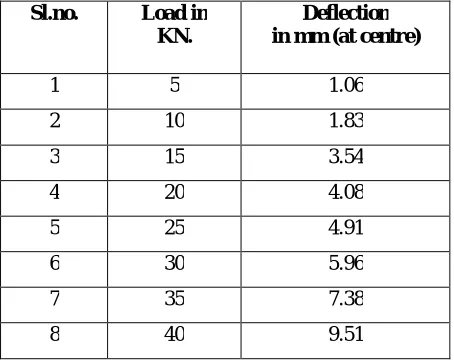
Load and Deflection for 30% Replaced RCC Beam:
TABLE 2 LOAD VS DEFLECTION FOR 30% REPLACED RCC BEAM
Sl.no. Load in
KN.
Deflection in mm (at centre)
1 5 1.06
2 10 1.83
3 15 3.54
4 20 4.08
5 25 4.91
6 30 5.96
7 35 7.38
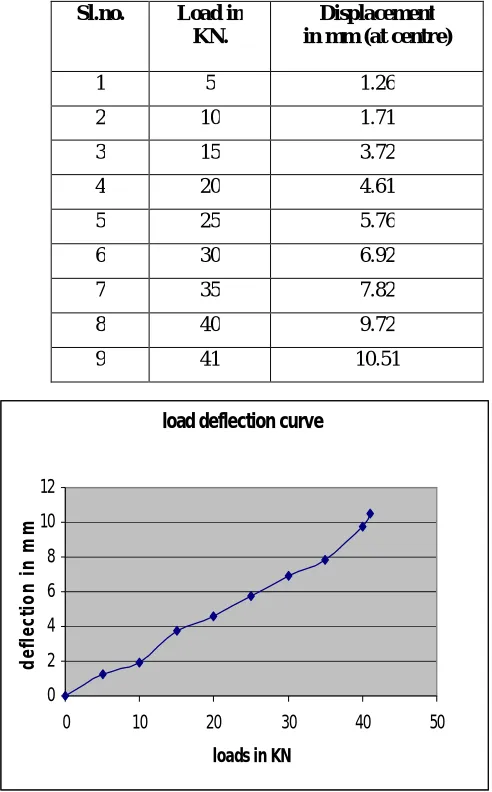
Load and Deflection for 60% Replaced RA RCC Beam
TABLE 3 LOAD Vs DEFLECTION FOR 60% REPLACED RCC BEAM
Sl.no. Load in KN.
Displacement in mm (at centre)
1 5 1.26
2 10 1.71
3 15 3.72
4 20 4.61
5 25 5.76
6 30 6.92
7 35 7.82
8 40 9.72
9 41 10.51
Fig 8 Load Vs Deflection Curve For 60%Replaced RCC Beam load deflection curve
0 2 4 6 8 10 12
0 10 20 30 40 50
loads in KN
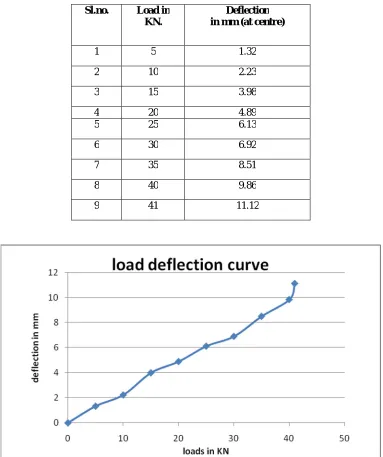
Load and Deflection for 100% Recycled Aggregate Concrete RCC Beam
TABLE 4. LOAD AND DEFLECTION FOR 100% RECYCLED AGGREGATE RCC BEAM
Fig 9 Load Deflection Curve For 100%Replaced RCC Beam Sl.no. Load in
KN.
Deflection in mm (at centre)
1 5 1.32
2 10 2.23
3 15 3.98
4 20 4.89 5 25 6.13
6 30 6.92
7 35 8.51
8 40 9.86
IV.CONCLUSION
In general, replacement of natural aggregates by recycled concrete aggregate shows gradual increase in results with respect to compressive strength, split tensile strength and flexure strength
However, further studies to determine the effect on durability and improvement on workability are necessary
Aggregate replaced increases there is a constant increase in strengths, In this study it is found that there is not much variation in strength between ordinary concrete and 30% replaced aggregate concrete, which proves the previous works.
Because it has been found that recycled aggregates obtained from recycling concrete are more angular and have higher absorption and specific gravity than natural coarse aggregates it may result on increase of strength and improved load carrying capacity.
The value of Recycled Aggregate with 0% that is normal concrete was the highest score for compressive strength,. Then, when Recycled Aggregate was added to the mixture, the value of compressive strength, were decrease. It can be concluded that the value of compressive strength will be decreased when more Recycled Aggregate was used.
REFERENCES
1. Anonymous. 2008. Use of Recycled Aggregate in Construction. Cement Concrete and Aggregate Australia.
2. Akbari, Y.V., Arora, N.K., Vakil, M.D. 2011. Effect on Recycled Aggregate on Concrete Properties. International Journal of Earth Sciences and Engineering ISSN 0974-5904, Volume 04, No 06 SPL, October 2011, pp. 924-928
3. Fraaij, A.L., Pieterson, H.S., Vries, J. 2002. Performance of Concrete With Recycled Aggregate Proceeding With International Conference: Sustainable Concrete Construction. Dundee, Scotland, September 2002.
4. Fumoto, T. and Yamada, M., 2006.Durability of Concrete with Recycled Fine Aggregate., American Concrete Institute, SP234, Durability ofconcrete, Seventh IntConf, Montreal, Canada, 2006,457–472.
5. Gomez, Shoberon, J.M.V. 2003. Relationship Between Gas Absorption and Shrinkage and Creep of Recycled Aggregate Concrete. Cement,Concrete and Aggregate. 25(2), 42-48
6. Hansen, TC. 2003. Recycling of Demolished Concrete and Masonry, RIELM Report No. 6, E&FN Spon, UK, pp. 81.
7. M C Limbachiya, A Koulouris, J.J. Roberts and A N Fried. 1998. Performance Of Recycled Aggregate Concrete. RILEM Internationalsymposium on Environment conscious-materials and system for sustainable development, Pages: 127-136.
8. Limbachiya M.C.,Leelawat T. And Dhir R.K. 2000. Use of recycled concrete aggregates in high strength concreteMaterials and structures,Vol-33,November-2000, pp.574-580
9. Montgomery, D.G. and Sturgiss, D. 1996. Properties of Concrete Incorporating Recycled Concrete Aggregates. Proceedings of the NationalSymposium on the Use of Recycled Materials in Engineering Construction. Sydney.