ISSN(Online): 2319-8753 ISSN (Print) : 2347-6710
I
nternational
J
ournal of
I
nnovative
R
esearch in
S
cience,
E
ngineering and
T
echnology
(A High Impact Factor, Monthly, Peer Reviewed Journal) Visit: www.ijirset.com
Vol. 7, Issue 12, December 2018
Portable Camera Based Assistive Text Reading
from Hand Held Objects for Blind Person
Priyanka Karande1, Prof. Jogdand S. V.2
PG. Students, Department of Electronics and Telecommunication, Shri Shivaji Institute of Engineering & Management
Studies, Parbhani, India1
Assistant Professor, Shri Shivaji Institute of Engineering & Management Studies, Parbhani, India2
ABSTRACT: We propose a camera-based assistive text reading framework to help blind persons to read text labels from hand-held objects in their day to day lives Self-Dependency of blind people is very important in their day-to-day lives. This paper presents a cost effective prototype system to help blind persons to shop independently. As we know printed text is everywhere like product names, instructions on medicine bottles, restaurant menus, signed boards etc. To read these text blind and visually impaired people need some help? This paper presents a camera-based assistive product label reader for blind persons to read information of the products. It is hard to detect text due to the variations of text font, sizes, color text, clutter background and different orientation. In this paper Camera is used to captured the image of the product .Then captured image is processed internally using different algorithms such as text localization and text recognition algorithm to extract text the label from image by using MATLAB .The extracted text label is converted to audio output using text to speech converter and it is pronounced as audio to the blind person.
KEYWORDS: camera-based label reader,text localization and text recognition algorithm, MATLAB, text to speech converter.
I. INTRODUCTION
ISSN(Online): 2319-8753 ISSN (Print) : 2347-6710
I
nternational
J
ournal of
I
nnovative
R
esearch in
S
cience,
E
ngineering and
T
echnology
(A High Impact Factor, Monthly, Peer Reviewed Journal) Visit: www.ijirset.com
Vol. 7, Issue 12, December 2018
people who are blind or those who have significant visualimpairments to read printed labels and product packages willenhance their independent living so here we are going to propose a system which is useful to blind people.
II. EXSISTING SYSTEM
Today, there are some systems that have some portable use, but they cannot handle product labeling. For example, portable bar code readers are designed that helps blind people to identify different products in an extensive product database can enable users who are blind to access information about these products. But a big limitation of this system is that it is very hard to find the position of the bar code and to correctly point the bar code reader at the bar code. Some reading systems such as pen scanners, mobile readers might are other examples of system which provide portable solution. OCR software is integrated to offer scanning and recognition function of text to these systems, also integrated voice output is integrated in some systems.
But, these systems perform better with document images with simple backgrounds, a small range of font sizes, standard fonts, and well-organized characters rather than hand held product packages with multiple decorative patterns. Most of the OCR software cannot directly handle scene images with complex backgrounds. A number of portable reading systems have been designed specifically for the visually impaired “K-Reader Mobile” runs on a cell phone which allows the visually impaired person to read mail, receipts, and many other documents [2]. However, this document must be flat, placed on a clear and dark surface. In addition, “K-Reader Mobile” accurately reads black print on a white background. But it has problems in recognizing colored text or text with colored background. Although a number of reading assistants systems have been designed specifically for the blind person, but still no existing reading assistant can read text from the complex backgrounds found on many everyday commercial products.
Fig.1. shows different examples of printed text from hand-held objects with multiple colors, complex backgrounds, or non-flatsurfaces [4].
Fig.1. Examples of printed text from hand-held objects
III. PROPOSED METHOD AND ALGORITHM OVERVIEW A. overview
ISSN(Online): 2319-8753 ISSN (Print) : 2347-6710
I
nternational
J
ournal of
I
nnovative
R
esearch in
S
cience,
E
ngineering and
T
echnology
(A High Impact Factor, Monthly, Peer Reviewed Journal) Visit: www.ijirset.com
Vol. 7, Issue 12, December 2018
ISSN(Online): 2319-8753 ISSN (Print) : 2347-6710
I
nternational
J
ournal of
I
nnovative
R
esearch in
S
cience,
E
ngineering and
T
echnology
(A High Impact Factor, Monthly, Peer Reviewed Journal) Visit: www.ijirset.com
Vol. 7, Issue 12, December 2018
B. Adaptive Thresholding:
After the color input image is converted to gray scale, an Adaptive Thresholding (AT) process is applied to constitute the binaries image. The idea used in algorithm is that the Pixel is compared with an average of neighboring pixels.Specifically, an approximate moving average of the last pixels seen is calculated while traversing the image. The value of current pixel is set to black if the value of current pixel is T percent lower than the average value, else it is set to white. This is very useful technique because comparing a pixel to the average of neighboring pixels will keep hard contrast lines and ignore soft gradient changes. The big advantage of this technique is that it needs only a single pass through the image. One eighth of the image width is used for the value of S and 0.15 for the value of T to yield the better results of variety of images. The value of T might be modified from the proposed value by Weller depending on the used images; whereas it should be in the range 0.1 < T <0.2 in our method. Weller’salgorithm depends on the scanning order of pixels. Since the neighborhood samples are not evenly distributed in all Directions, the moving average process is not suitable to give a good representation for the neighboring pixels.
C. Unwanted Line Elimination Algorithm:
Thresholding process in general produces many thin lines that do not belong to the text region. These noise and background edges are unwanted lines. These lines may interfere in the region of interest. Therefore, ULEA algorithm is proposed to eliminate unwanted lines from the image. This step can be considered as a morphological operation and enhancement process. The output after the ULEA is performed; many unwanted lines are removed from the image. This kind of image is nearly ready for a better segmentation process.
D. Vertical Edge Detection Algorithm:
The advantage of the Vertical Edge Detection Algorithm is to distinguish the region of interest, particularly the starting and the end of each character. Therefore, the text details will be easily detected, and the character recognition process will be faster. After thresholding and Unwanted Line Elimination Algorithm processes, the image will only have black and white regions, and the Vertical Edge Detection Algorithm is applied to these regions.
E. Region of Interest:
After applying the Vertical Edge Detection Algorithm, the next step is to highlight the desired details such as text and vertical edges in the image. Using text localization algorithm the region of interest is selected.
F. Text Recognition
The task of text recognition is performed by off-the-shelf OCR prior to output of informative words from the localized text region. A text region labels the minimum rectangular area for the accommodation of characters inside it, and border of the text region contacts the edge boundary of the text character. However, OCR generates better performance if text regions are first assigned proper margin areas and binaries to segment text characters from background. We propose to use Template matching algorithm for OCR. The output of the OCR is nothing but a text file containing the product label (its name) in textual form. Audio output component is to inform the blind user of recognize text code in the form of speech or Audio.
G. Product Name Identification
The text in output text file from OCR is matched with the saved product names in the Database the matched product is identified.
H. Audio output
ISSN(Online): 2319-8753 ISSN (Print) : 2347-6710
I
nternational
J
ournal of
I
nnovative
R
esearch in
S
cience,
E
ngineering and
T
echnology
(A High Impact Factor, Monthly, Peer Reviewed Journal) Visit: www.ijirset.com
Vol. 7, Issue 12, December 2018
IV. EXPERIMENTAL RESULTS
In this section the Adaptive Thresholding process is evaluated first. Then, the accuracy and the computation time of the VEDA are compared with that of the Sobel operator. Finally, the performance of the proposed Text detection method is evaluated. Firstly, Using Web camera the image of the product is captured. Fig 3(a) shows the original image. This image is then processed internally using Matlab. In fig 3(b) original color image is transformed into grey scale image for further processing of image. Grey image is calculated by taking average of each component in the color image.
Fig 3(a) original image fig 3(b) gray scale image
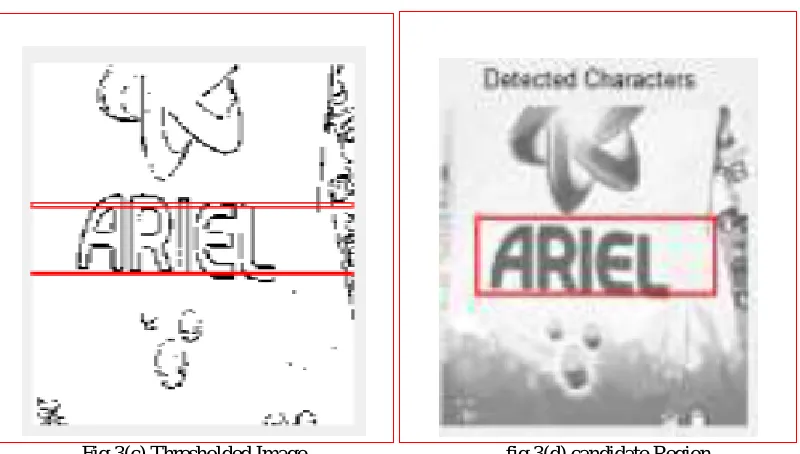
Binarized image is obtained by applying adaptive thresholding algorithm. The AT has been applied on the image shown in Fig 3(c).Then fig 3(d) shows the candidate region.
ISSN(Online): 2319-8753 ISSN (Print) : 2347-6710
I
nternational
J
ournal of
I
nnovative
R
esearch in
S
cience,
E
ngineering and
T
echnology
(A High Impact Factor, Monthly, Peer Reviewed Journal) Visit: www.ijirset.com
Vol. 7, Issue 12, December 2018
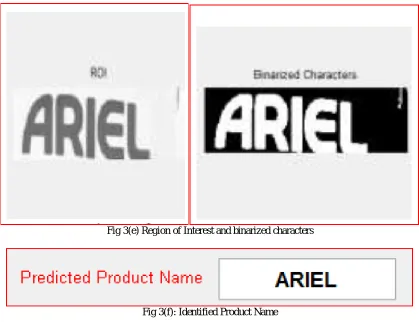
The text localization algorithm is applied on binarized image is shown in fig 3(e) .Using VEDA and HDD Algorithm the region of interest is detected. The identified product name is shown in fig 3(f).Using text to speech converter the identified product name is pronounced as audio
output.
Fig 3(e) Region of Interest and binarized characters
Fig 3(f): Identified Product Name
V. TEXT RECOGNITION AND AUDIO OUTPUT
ISSN(Online): 2319-8753 ISSN (Print) : 2347-6710
I
nternational
J
ournal of
I
nnovative
R
esearch in
S
cience,
E
ngineering and
T
echnology
(A High Impact Factor, Monthly, Peer Reviewed Journal) Visit: www.ijirset.com
Vol. 7, Issue 12, December 2018
VI. CONCLUSION
In this paper, a prototype system framework to read printed text on hand held object for assisting blind person is described. This paper proposed a method for detecting texts in product images. First input image is captured by camera and it is converted to grey scale image. Then image enhancement technique is used to improve quality of an image. Using adaptive thresholding method the Binarized image is obtained. Then text region are detected by VEDA. After finding the Edges the feature of each text is calculated to recognize the textin the image. Then each character in the image was classified and correct product name is identified. Finally detected product name is pronounced the speech by using text to speech converter in the matlab.Our future scope is to enhance these techniques for detecting text in different structures, fonts styles etc.
REFERENCES
[1] National Census of Indiahttp:// censusindia.gov.in/Census_And_You/disabled_population.aspx.
[2] KReader Mobile User Guide, knfb Reading Technology Inc. (2008). [Online]. Available: http://www.knfbReading.com.
[3] K. Jung, K.I. Kim, A.K. Jain, “Text information extraction in images and video: a survey”, Pattern Recognition, 37 977-997S, 2004.
[4] Rajkumar N, Anand M.G, Barathiraja N, “Portable Camera- Based Product Label Reading For Blind People”, International Journal of Engineering Trends and Technology (IJETT) – Volume 10, IssueNo : 1 - Apr 2014.
[5] Chucai Yi, Student Member, IEEE, YingLiTian, Senior Member,IEEE, Aries Arditi,” Portable Camera-based Assistive Text and ProductLabel Reading from Hand-held Objects for Blind Persons” IEEE/ASMETransactions on Mechatronics.
[6] ScanTalker, Bar code scanning application to help Blind Identify over one million products. (2006). [Online] Available:http://www.freedomscientific.com/fs_news/PressRoom/en/2006/ScanTalker2-Announcement_3–30–2006.asp
[7] PriyankaPatil,SonaliSolat,Shital Hake, “Camera Based Product Information Reading For Blind People” , International Journal Of Engineering And Computer Science ISSN:2319- 7242,Volume 4 Issue 3 March 2015, Page No. 11072-11075.
[8] Nanayakkara, S., Shilkrot, R., Yeo, K. P., and Maes, P.”EyeRing: a finger-worn input device for seamless interactions with our surroundings”. In Augmented Human ,2013.
[9] Carlos Merino-Gracia,, KarelLenc,MajidMirmehdi, " A Head- Mounted Device for Recognizing Text in Natural Scenes “Lecture Notes in Computer Science Volume 7139, pp 29-41,2012.
[10] Chengjun Zhu, yuanxinQuyang, Lei Gao, Zhenyong Chen, Zhang Xiong.”An Automatic Video Text Detection, Localization and Extraction Approach”. School of computer Science and Technology, Beihang University, SITIS - Pages 166-175-2006.
[11] Christin Wolf, Jean-Michel Jolion, and Francoise Chassaing.“Text localization, enhancement and binarization in multimedia documents”. In Int. Conf. on Pattern recognition, pages 1037–1040, Quebec City, Canada., August 2002.
[12] Rajkumar N, Anand M.G, Barathiraja N, “Portable Camera-Based Product Label Reading For Blind People”, International Journal of Engineering Trends and Technology (IJETT) – Volume 10 ,Issue No : 1 - Apr 2014.
[13] Chucai Yi, Student Member, IEEE, YingLiTian, Senior Member,IEEE, Aries Arditi,” Portable Camera-based Assistive Text and ProductLabel Reading from Hand-held Objects for Blind Persons” IEEE/ASMETransactions on Mechatronics.