Experimental Investigation and Optimisation
to Enhance The Performance of Hybrid Solar
Desalination System
S.Joe Patrick Gnanaraj1, Nadar Samuel James Paul2, Pratheesh K2, Nelson Emanuel S 2, Naresh Kannan P 2
Associate Professor, Department of Mechanical Engineering, Francis Xavier Engineering College, Vanarpettai,
Tirunelveli, Tamil Nadu, India 2
U.G. Student, Department of Mechanical Engineering, Francis Xavier Engineering College, Vanarpettai, Tirunelveli,
Tamil Nadu, India 1
ABSTRACT: One of the most important needs for a living thing on earth is the pure water and now a days this valuable natural source is facing severe scarcity problems. Solar refining is a better choice to minimize this problem by harvesting solar radiation in solar still and thereby producing pure water from hard water or brine. In this work, an attempt was made to improve the efficiency of still by external reflectors, glass wool insulation the combination. Finally the efficiency of the simple still was compared with that of external reflectors, glass wool the mixture. Use of external reflectors and glass wool increases the overall temperature of the still water and improve the evaporation respectively thereby this will improve the condensate making of the solar still. It was observed that productivity increased by 14% for still with collector, 10% for still with glass wool and 17% for still with collector glass wool combination when compared with simple still.
KEYWORDS:Solar Energy, Wick material, Solar incidence angle variation, Transmittance variation, Still modelling.
I. INTRODUCTION
Water is one of the most essential element for life on earth, Today each basic elements viz. air, water, soil etc., are impure which causes an unbalance in the survival of the living things on the earth. In case of water effluents from industrial, agricultural sectors are dumping into the water bodies thus make it unusable. Also the annul rainfalls are getting low so that our underground water levels are lowering at an alarming rate [1]. This also makes water too hard which cannot be used for domestic purposes. In short, both water quantity and qualities are becoming poor. Thus, efficient water treatment is necessary for this century to relief the thirst of our globe [2].
solar still. Experiment was done with water level of 1cm depth, still with collector, still with sponge and then the combination. Different arrangement can cause changes in the productivity in the still. Temperature variation for still water, glass, absorber, vapour and are noted and studied. Hourly and cumulative condensate production is measured and compared with that of productivity of simple still with water depth of 1 cm.
II. EXPERIMENTAL SETUP AND PROCEDURE
Four Slope Solar Still. Solar still consists of insulator and transparent glass for trapping thermal energy from the solar radiation. It is coated with black paint. Coating with black paint can increase the heat absorbing capacity of a material. Still is insulated with thermo col of thickness 1.5 cm. Still is covered with transparent glass in top which has a thickness of 4mm. Glass is maintained at a slope of 14o (in four side).This slope is sufficient for the smooth flow of condensate towards the collecting pipe. A steel plate with an suitable slope is made at both end of still in order to collect the condensate. The temperature of the absorber and water changes with time according to water depth and solar strength. Water has higher specific heat capacity and it needs higher heat energy to raise its temperature to one unit whereas, absorber has lower specific heat than water can attain higher temperatures for a given quantity of heat. Evaporation becomes higher as the water temperature increases. The top glass is four sloped transparent through which the sunlight can go through and maintains heat energy like greenhouse. This results in the rise of water temperature as the day progress. Bottom sides of glass (inside the still) have higher temperature and outer surface of the glass has lower temperature and condensation occurs due to this temperature difference.
External modification. The use of modification in the still increases the productivity of the still with reflectors has higher productivity compared to solar without reflectors
Fig.1 2D view ofSolarstill
III.EXPERIMENTALPROCEDURE
1. Experiment on four slope solar still with various modes such as Simple Still (SS) of water depth 1 cm (on 10/03/2019),
4. Combination of still black stone and granite (on13/03/2016). It is done for 8 hour in a fair sunny day from 10:00 am to 05:00 pm. Solar still was placed in glass facing four direction.
The various measured parameters such as solar intensity, 1. Glass temperature,
2. Water temperature, 3. Absorber temperature,
4. Digital thermometer (Measuring range: 500C to +2000C, Accuracy: +10C, Resolution: 0.1, Probe size: 3.5mm(ϕ) x 120mm(L). All the parameters and amount of condensate production was noted for every one hour.
IV.EXPERIMENTALRESULTS
Solar intensity.
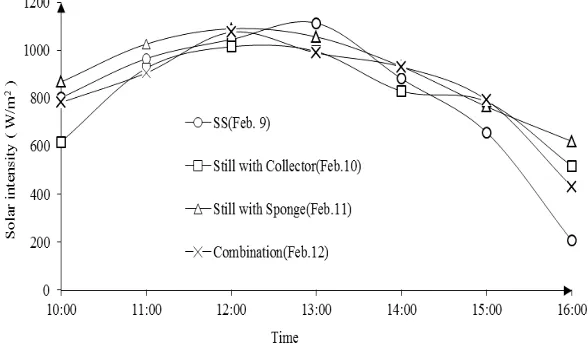
The variation of solar intensity with time for the period from 10th February 2019 to13th march 2019 is shown in the
Fig 2.
Fig.2 Solar Intensity with Time
Productivity of the solar still directly depends on the amount of solar radiation available and thus the still productivity should be compared with the solar intensity of experimented days which is random. Due to this, experiment was done on four successive fair sunny days which made result comparable.
Temperature variation.
The changes of measured temperature of glass, vapour, still water and absorber mirror with local time on the four consecutive days are plotted. Vapour temperature is always higher than the other temperature as seen from the graph. Also, glass temperature is always smaller than the other measured values.
Hourly productivity.
Fig .3 Hourly Condensate Productions
Yield from the still measured for every one hour. The production of condensate with time is shown in Fig.3. It is clear from the graph that hourly production was higher for almost all the time. Hourly production should be compared with the hourly solar intensity and it can be deduced that the condensate production is proportional to the solar intensity available. Also, the hourly production was higher for the reflector and glass wool combination in most cases except in the evening hours.
Comparison of Cumulative yield for various depths.
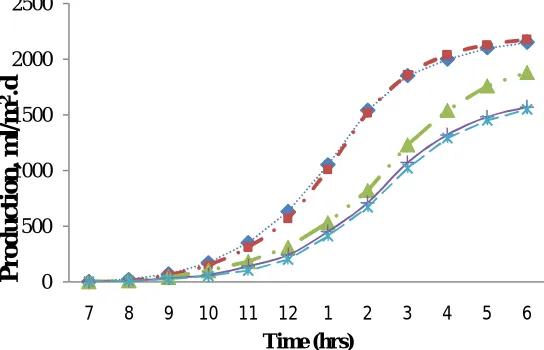
Cumulative production is the total amount of added hourly production for a period of 6 hours (calculated from the figure 4) as shown in figure 5. It is clear from the graph that total productivity is higher for still with reflector and glass wool combination and lesser for simple still of the same water depth (from 10:00 am to 4:00 pm).
Fig .4 Cumulative Condensate Productions 0 100 200 300 400 500 600 700
7 8 9 10 11 12 1 2 3 4 5 6
P
rod
u
ct
ion
,
m
l/
h
Time (hrs)Conventional solar still
Still with heat storage materials 0 500 1000 1500 2000 2500
7 8 9 10 11 12 1 2 3 4 5 6
Variations in the cumulative production are due to usage of collector and sponge that can be seen from the plot. Rate of evaporation varies due to various modes of still and due to this, cumulative production becomes different in each case
V.CONCLUSION
1. Based on the experimentation, increasing productivity per m2 for a period of 8 hours for simple still, still with black stone, still with granite and still with the black stone & granite combination are 4000 ml, 5200 ml, 5000 ml and 6750 ml respectively,
2. It was increased by 14 % for black stone, 10 % for granite and 17 % for the black stone and granite combination, when compared to that of still with 1 cm water depth. It is obvious that the productivity of still with reflector got increased due to the mixing of higher temperature water in the still.
REFERENCES
[1]V. Velmurugana, K. Srithar, Performance Analysis of Solar Stills Based on Various Factors Affecting the Productivity-A Review, Renewable and Sustainable Energy Reviews 15, pp.1294–1304, 2011.
[2]T. Rajaseenivasan, K.Kalidasa Murugavel,T.Elango, R.Samuel Hansen, A Review of Different Methods to Enhance the Productivity of the Multi-Effect Solar Still, Renewable and Sustainable Energy Reviews 17, pp. 248–259,2013.
[3]Hitesh N. Panchal, Mitesh I. Patel, Bakul Patel , Ranvirgiri Goswami and Manish Doshi, A Comparative Analysis of Single Slope Solar Still Coupled with Flat Plate Collector and Passive Solar Still, International Journal for Scientific Research & Development, Vol. 2,pp. 111-116,2011. [4]Raj Thundil Karuppa R, Pavan P and Reddy Rajeev D, Experimental Investigation of a New Solar Flat Plate Collector, Research Journal of Engineering Sciences, Vol. 1, pp.1-8, 2012.
[5]Shanmugan Sengottain, Janarathanan Balasundaram and Chandrasekaran Joseph, Thermal Asymmetry Model of Single Slope Single Basin Solar Still with Sponge Liner, Thermal Science, Vol. 18, pp. S439-S450,2014.
[6]Ekramian, S.Gh. Etemad and M. Haghshenasfard, Numerical Analysis of Heat Transfer Performance of Flat Plate Solar Collectors, Journal of Fluid flow, Heat and Mass Transfer, Vol. 1, pp. 38-42, 2014.
[7]M.K. Gaur and G.N. Tiwari, Optimization of Number of Collectors for Integrated Pv/T Hybrid Active Solar Still, Applied Energy 87, pp. 1763– 1772, 2010.
[8]Sunil.K.Amrutkar, Satyshree Ghodke and Dr. K. N. Patil, Solar Flat Plate Collector Analysis, IOSR Journal of Engineering (IOSRJEN), Vol. 2, pp.207-213,2012.
[9]Mouna Hamed, Ali Fellah and Ammar Ben Brahim, Parametric Sensitivity Studies on the Performance of a Flat Plate Solar Collector in Transient Behavior, Energy Conversion and Management, Vol. 78, pp. 938–947, 2014.
[10]M. Koussa , A. Cheknane, S. Hadji, M. Haddadi and S. Noureddine, Measured and Modelled Improvement in Solar Energy Yield from Flat Plate Photovoltaic Systems Utilizing Different Tracking Systems and Under a Range of Environmental Conditions, Applied Energy 88, pp.1756–1771, 2011.
[11]Behrooz M. Ziapour , Vahid Palideh and Ali Mohammadnia, Study of an Improved Integrated Collector-Storage Solar Water Heater Combined with the Photovoltaic Cells, Energy Conversion and Management 86, pp. 587–594, 2014.