Examining Forecasting Decision Making
Models under Prolonged Uncertainty
Hitender Thakur1, Prabhdeep Singh Bajwa2
P.G. Student, Department of Mechanical Engineering, L.R.I.E.T, Solan, Himachal Pradesh, India1
Assistant Professor, Department of Mechanical Engineering, L.R.I.E.T, Solan, Himachal Pradesh, India2
ABSTRACT: Making good risk-based decisions is especially hard for situations with deep uncertainty that extend over
time. Production planning problems may be especially prone to difficult uncertainties (such as demand, operations, and supply chain) and yet firms need to plan for several years or decades into the future. Traditional decision-making theories such as subjective expected utility may be challenging to implement if probability distributions are difficult to ascertain. This paper compares different decision-making methods for a complex problem under the presence of long-term uncertainty. The decision-making methods are expected efficacy, strong decision making, and information gap. The purpose of this comparison is to explore under what circumstances and assumptions each method results in different recommended alternatives and what these results mean making good decisions with significant uncertainty in the long-term future.
KEYWORDS: Forecasting, decision making, uncertainty, information gap, aviation.
I. INTRODUCTION
In general, uncertainty can be defined as a situation which involves imperfect and/or unknown information. Probability is the best communal way to handle uncertainty. Deep uncertainty is a condition, as stated by Walker “Uncertainties that cannot be preserved probabilistically consist of model structure uncertainty and situations in which experts cannot settle upon the probabilities.”[27] Risks with significant, severe, or deep uncertainty that extend over time can be especially difficult to manage. Assessments in the manufacturing industry are especially liable to this type of uncertainty [1] [5]. A typical approach to these problems is to develop a mathematical model that captures the essentials of the problem. Random variables overseen by probability distributions can represent that uncertainty, and the model can generally be solved in order to determine the optimal alternative. If the model involves optimizing an objective function with uncertainty, stochastic programming has become a rich field to find the optimal alternative. [14] [23]
Conferring to Courtney, uncertainty can be divided into 5 transitional levels between complete certainty and total ignorance. For level 4 (multiplicity of futures) and level 5 (unknown future) uncertainty, it is not an easy task to assign probability distribution for problems with uncertainty far into the future. So, these types of un- certainty, they are usually referred as deep uncertainty [27]. Based on certain assumptions and trend-based scenarios, some practical problem such as demand forecasting and GDP growth could be classified as situation with level 3 uncertainty (alternative futures with ranking). The development of demand forecasting model helps to reduce uncertainty for long-term capacity planning problem, so that it can be treated as situation with level 3 uncertainty. However, what if the conventions we made in previous chapter are not true? In this chapter, we use different decision methods to address the capacity planning problem and test the sensitivity of underlying assumptions.
decision-making method. Lempert compared strong decision making, expected utility and cautionary methods under a hypothetical environment problem [16]. As the Info-gap method being suggested, made a comparison between strong decision making and Info-gap for climate strategies problem[11]. One year late, similar assessment was done with the application in water resource system planning [19]. However, all assessments are in the area of environment and government policy. To the best knowledge of authors, no such assessment has been prepared for manufacturing capacity planning problem. This paper seeks to fill that gap by focusing on three popular decision- making methods: expected utility (EU), robust decision making (RDM), and information gap (Info-gap)
With its origins dating back to Daniel Bernoulli (Bernoulli, 1954) in 1738, EU is perhaps the most established and still one of the most popular methods for making decisions under uncertainty. EU selects the alternative that maximizes the decision makers estimated utility, and the decision makers’ utility includes his or her risk attitude. EU obliges a probability for each potential outcome, and the probabilities characterize the decision maker’s subjective beliefs about the future.
The idea of robust decision framework is first proposed by Jonathan Rosenhead. Then research in robust decision has emerged in areas such as politics, finance and operations research [10] [17] [7]. In 2003, RDM framework was developed [15]. RDM is a regular method to apply when there is multifaceted uncertainty that is not easily modelled with probability distributions. RDM is planned for circumstances under deep uncertainty, so it does not depend on prior probability which is a key input parameter in most decision-making models [16]. Even if the decision maker believes the uncertainty can be defined by a probability distribution, there may be uncertainty nearby the parameters informing the probability distribution. RDM offers a solution to include uncertainty in the parameter estimation. Generating all plausible scenarios remains a challenge in applying RDM. RDM look like regret-based decision making in which a decision maker seeks to minimalize the regret from a bad conclusion. It tends to overweight on the worst scenarios and the best alternative may be very conservative or risk averse.
Info-gap is another method used to deal with severe uncertainty in decision making, especially when probabilities are difficult to assess [3]. Similar to RDM, Info-gap uses sets of representors rather than a single probability distribution; considers the outcomes over a wide range of conditions; and provides a trade-off curve to decision maker. RDM needs to define scenarios (i.e., distributions), but Info-gap constructs the uncertainty model first and then uses it to identify candidate strategies. The criteria for selecting an alternative are robustness and opportuneness which is the minimum and maximum reward. Info-gap has been disparaged for not applicable under circumstances of “severe uncertainty”. We have an exchange of ideas about it in this chapter.
This research compares these different decision-making methods by establishing a stochastic process over time and comparing the results obtained from EU, RDM, and Info-gap. Simulation is used to produce the results and relate among the methods. Sensitivity analysis is also conducted for these methods. We find that EU is still the best decision-making method when there is little uncertainty. Info-gap is applicable for level 2 or 3 uncertainty and it delivers critical reward information which is especially convenient in commercial industry. RDM is the best decision-making framework under deep uncertainty but it requires more effort on scenarios exploration and computational optimization.
II. RELATEDWORK
1. Decision making in aviation Industry With Deep Uncertainty
1.1 Capacity Planning Model with Uncertain Demand
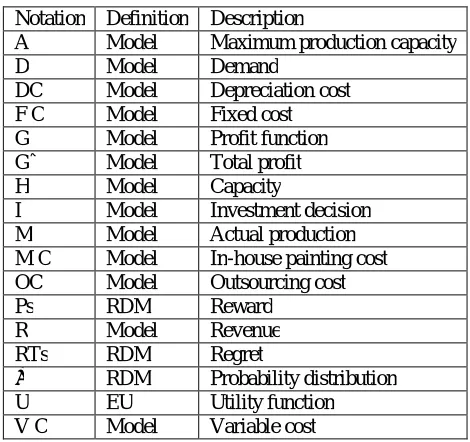
Table 1 and 2lists all notations used in this chapter. An airplane manufacturer wants to plan when and if it should construct new hangars to paint airplanes. It can plan to construct hangars on an annual basis, and I (t) is defined as the number of new hangars at time t, where t is an integer representing years. In this model, we only ponder building new hangars and not eradicating hangars, so I (t) ≥ 0, ∀t.
Table (1)Notation of functions:
Notation Definition Description
A Model Maximum production capacity D Model Demand
DC Model Depreciation cost F C Model Fixed cost G Model Profit function G˜ Model Total profit H Model Capacity
I Model Investment decision M Model Actual production M C Model In-house painting cost OC Model Outsourcing cost Ps RDM Reward
R Model Revenue RTs RDM Regret
θ RDM Probability distribution U EU Utility function V C Model Variable cost
The demand of airplanes for the manufacturer in year t can be written D (t), and we assume the manufacturer cannot influence demand. Based on prior analysis of aviation industry in, we undertake that demand follows Brownian motion with trend. Mathematically, demand is D (t) ∼Nor (µD, σ2 t), where µD = µD0 + µD1t, µD0 is the mean of demand at t = 0, µD1 is the annual trend coefficient, and σ2is the variancein demand at t = 1. We undertake the manufacturer’s production of airplanes in time tequals the demand at time t.
Table (2) Notation of variables and set:
Notation Type Definition Description
α Variable Info-gap Horizon of uncertainty CE Variable EU Certainty equivalent
g Variable EU Additional profit beyond baseline n Variable Model Number of decision options N Variable Model Number of strategies
t Set Model Time set
Θ˜ Set RDM Probability distribution set µA Variable Model Expected annual production µD Variable Model Expected annual demand x Variable Model State
X Set Model State set
z Variable Model Confidence level of best distribution
1.2 Decision Space
If a decision maker can choose n different alternatives in each year for T years, the number of strategies in the decision space is nT. As the number alternatives or years surge, the number of presented strategies surges dramatically. We assume that the maximum number of new hangars can be built over T years is hmax and the hangars are not distinguishable. These assumptions reduce the number of strategies.
III. DISCUSSION
Comparison of Methods under Deep Uncertainty
If σD = 10, but uncertainty exists around the estimation of µD1, which ranges between 0 and 38. Figure 1depict the optimal strategies for each of the three decision-making methods. The optimal strategy in EU is very sensitive to the input parameter µD1. The optimal strategies vary from building 2 hangars beginning in year 3 to building 1 hangar at year 15. If the decision maker really has no knowledge about µD1 except that it is between 0 and 38, EU provides little guidance unless the decision maker wishes to assume a uniform distribution over µD1 or choose µD1 = 18.6 as the expected average demand.
Figure (1) Optimal strategies for different required profit in Info-gap
more conservative. As discussed in the previous section, the variability and magnitude of the regret generates this conservative approach within RDM. Since RDM is pursuing to minimize regret, RDM puts extra weight on bad outcomes and is more sensitive to really bad outcomes. EU attempts to find the optimal alternative, but RDM is suitable when optimality is less important and possible bad outcomes have severe consequences.
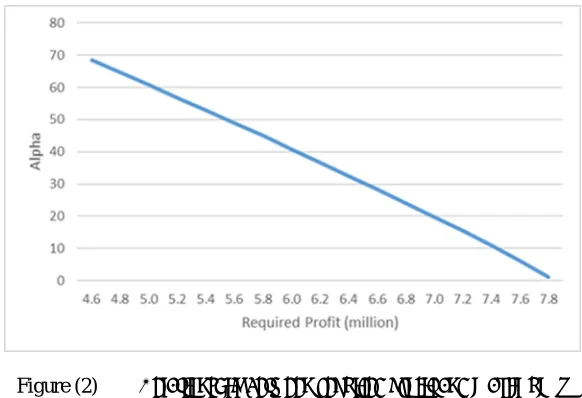
Figure (2) Relationship between required profit and maximum α
The Info-gap model structures the problem differently than RDM and EU. The uncertainty space (the state space in
this problem) is no longer a fixed set. The size of set is determined by the uncertainty parameter αˆ. Instead of directly defining that µD1 is in the range [0-38], the range of µD1 dynamically changes in the Info-gap given different reward requirements. Due to the dynamic state set, outcomes from Info-gap are not directly analogous to RDM and EU. However, given the initial state µˆD1 = 18.6 and that 2 units of rise in αˆ leads to 2 units of rise in the state set around the initial state, the strategy with $6 million required profit covers approximately the same state space as RDM and EU. With this required profit, Info-gap recommends that the decision maker should only build one hangar in year 18 (Figure 1). Before compared to other decision-making methods, the effect of risk tolerance in utility theory needs to be considered. It seems that the result of Info-gap is more conservative than RDM when decision maker with slightly risk aversion (Figure 1). However, RDM for which the decision maker with extreme risk aversion (p=0.99) suggests to build first hangar from year 17 to 20 . It yields very similar result as Info-gap. Although RDM and Info-gap have different model structures, the experiment from this problem suggests that both methods encourage less aggressive, or more risk-averse, decisions. The advantage of Info-gap method is the additional information regarding to the reward which has real- world applicability for a decision maker. However, because of the previously mentioned flaw, Info-gap may rely too much on the initial state. Comparing the result from Info-gap with that of RDM could be a good way to check the robustness of decision.
IV. CONCLUSION
in the demand distribution will lead the decision maker to build hangars too early which will not be fully utilized. If the demand is underestimated, the painting cost may increase significantly due to the high cost of outsourcing. Compared to RDM and Info-gap, EU does not provide any parameters to allow the decision maker to trade-off between optimality and uncertainty. A trade-off curve can help a decision maker because the trade-off curve shows a picture of the problem rather than a single “optimal” point.
Figure (3) Proposed strategies in RDM with extreme risk aversion (p=0.99)
RDM can seem to be a pretty multifaceted decision-making method. In one sense, RDM generalizes utility theory as it expands a single probability distribution in EU to a set of probability distributions. Uncertainty is incorporated in the state set. RDM searches the space to find the optimal strategy given the parameter z. Theoretically, all possible conclusions could be covered by founding a large set. However, more computational power and advanced optimization algorithms may be required to search a large state set. One of the important advantages of RDM is the trade-off curve based on the level of confidence to the best-case versus worst-case distribution. In our experiment, however, the interpretation of z could be misleading if the variability of worst case regret is larger than the magnitude of best-case regret. Unfortunately, the distribution of regret over strategies is based on individual problem and is likely to be unknowable before calculation. The actual interpretation of z may thus vary from case to case, and greater exploration of the interpretation of z may be a potential direction for improvement in RDM. In the painting example, RDM recommends more conservative decisions (build few hangars and later) than EU and the Info-gap model when decision maker is extreme risk averse. In the situation when decision maker is slightly risk averse, Info-gap gives the most conservative decisions.
Based on previous discussion, we conclude the situations to apply different decision-making methods. When a probability distribution can be assigned to represent uncertainty with very high confidence level, EU is the best decision-making method. Info-gap is applicable when uncertain future could be represented as several probability distribution with rank and we have relative high confidence on our initial state estimation. Moreover, by choosing Info-gap, the underlying assumption is that the decision maker cares robustness more than optimality. In the situation of deep uncertainty, we have little information about the future, RDM is the only decision-making method applicable among the three.
In general, before choosing particular decision-making method, one important question to ask ahead is whether we want an optimal solution or a good enough feasible solution. As the famous statement wrote by Box 1987,”All models are wrong, but some are useful.” In the end, all of these decision-methods should be evaluated by their use- fullness in making practical decisions.
REFERENCES
[1]. Applequist, G. E., Pekny, J. F., & Reklaitis, G. V. (2000). Risk and uncertainty in managing chemical manufacturing supply chains. Computers & Chemical Engineering, 24(9), 2211-2222.
[2]. Ben-Haim, Y. (2004). Uncertainty, probability and information-gaps. Reliability Engi- neering & System Safety, 85(13), 249-266.
[3]. Ben-Haim, Y. (2006). Info-gap decision theory : decisions under severe uncertainty / Yakov Ben-Haim (2nd ed.. ed.). Oxford: Oxford : Elsevier/Academic.
[4]. Ben-Haim, Y., Demertzis, Maria. (2015). Decision Making in Times of Knightian Un- certainty: An Info-Gap Perspective. Economics: The Open-Access, Open Assessment E-Journal, 9(2015-42).
[5]. Brouthers, K. D., & Brouthers, L. E. (2003). Why service and manufacturing entry mode choices differ: The influence of transaction cost factors, risk and trust. Journal of management studies, 40(5), 1179-1204.
[6]. Charnes, A., & Cooper, W. W. (1983). Response to ”Decision Problems under Risk and Chance Constrained Programming: Dilemmas in the Transition”. Management Science, 29(6), 750-753.
[7]. Dimitris, B., & Aurlie, T. (2006). Robust and Data-Driven Optimization: Modern De- cision Making Under Uncertainty Models, Methods, and Applications for Innovative Decision Making (pp. 95-122): INFORMS.
[8]. Epstein, L. G. (1985). Decreasing Risk Aversion and Mean-Variance Analysis. Econo- metrica, 53(4), 945-961. [9]. Fishburn, P. C. (1970). Utility theory for decision making (No. RAC-R-105). Research Analysis Corp Mclean va.
[10]. Groves, D. G., & Lempert, R. J. (2007). A new analytic method for finding policy-relevant scenarios. Global Environmental Change, 17(1), 73-85. [11]. Hall, J. W., Lempert, R. J., Keller, K., Hackbarth, A., Mijere, C., & McInerney, D. J. (2012). Robust Climate Policies Under Uncertainty: A
Comparison of Robust Decision Making and Info-Gap Methods. Risk analysis, 32(10), 1657-1672.
[12]. Hogan, A. J., Morris, J. G., & Thompson, H. E. (1981). Decision Problems under Risk and Chance Constrained Programming: Dilemmas in the Transition. Management Science, 27(6), 698-716.
[13]. Hogan, A. J., Morris, J. G., & Thompson, H. E. (1984). Reply to Professors Charnes and Cooper Concerning Their Response to ”Decision Problems under Risk and Chance Constrained Programming”. Management Science, 30(2), 258-259.
[14]. Infanger, G. (1992). Planning under uncertainty solving large-scale stochastic linear pro- grams (No. SOL-92-8). Stanford Univ., CA (United States). Systems Optimization Lab..
[15]. Lempert, R. J. (2003). Shaping the next one hundred years : new methods for quanti- tative, long-term policy analysis / Robert J. Lempert, Steven W. Popper, Steven C. Bankes. Santa Monica, CA: Santa Monica, CA : RAND.
[16]. Lempert, R. J., & Collins, M. T. (2007). Managing the risk of uncertain threshold re- sponses: comparison of robust, optimum, and precautionary approaches. Risk analysis, 27(4), 1009-1026.
[17]. Mahnovski, S. (2006). Robust decisions and deep uncertainty: An application of real op- tions to public and private investment in hydrogen and fuel cell technologies. (3233779 Ph.D.), The Pardee RAND Graduate School, Ann Arbor.
[18]. Mandelbaum, M., & Buzacott, J. (1990). Flexibility and decision making. European Journal of Operational Research, 44(1), 17-27.
[19]. Matrosov, E. S., Woods, A. M., & Harou, J. J. (2013). Robust Decision Making and Info-Gap Decision Theory for water resource system planning. Journal of Hydrology, 494, 43-58.
[20]. Moore, R. E. (1979). Methods and applications of interval analysis. Society for Industrial and Applied Mathematics. [21]. Moore, R., & Lodwick, W. (2003). Interval analysis and fuzzy set theory. Fuzzy sets and systems, 135(1), 5-9. [22]. Rabin, M. (2000). Risk aversion and expectedutility theory: A calibration theorem. Econometrica, 68(5), 1281-1292.
[23]. Santoso, T., Ahmed, S., Goetschalckx, M., & Shapiro, A. (2005). A stochastic program- ming approach for supply chain network design under uncertainty. European Journal of Operational Research, 167(1), 96-115.
[24]. Soroudi, A., Rabiee, A., & Keane, A. (2017). Information gap decision theory approach to deal with wind power uncertainty in unit commitment. Electric Power Systems Research, 145, 137-148.
[25]. Takewaki, I., & Ben-Haim, Y. (2005). Info-gap robust design with load and model un- certainties. Journal of Sound and Vibration, 288(3), 551-570. [26]. Tversky, A., & Kahneman, D. (1992). Advances in prospect theory: Cumulative repre- sentation of uncertainty. Journal of Risk and uncertainty, 5(4),
297-323.