ABSTRACT
PONCHERI, REANNA MAUREEN. The Impact of Work Context on the Prediction of Job Performance. (Under the direction of Mark A. Wilson.)
Although it is widely accepted that individual behavior is determined by person and situation characteristics, much research in the domain of job performance focuses more on person variables, while focusing less on the role of the work context. This study shows that elements of the work context (i.e., job/task characteristics, resources, and social
The Impact of Work Context on the Prediction of Job Performance by
Reanna M. Poncheri
A thesis submitted to the Graduate Faculty of North Carolina State University
In partial fulfillment of the Requirements for the Degree of
Master of Science PSYCHOLOGY
Raleigh March, 2006 APPROVED BY
_______________________ _______________________
BIOGRAPHY
Reanna Maureen Poncheri was born November 28, 1981 in Washington, DC. She graduated from Saint Mary's Ryken High School in Leonardtown, MD in 1999 and began her undergraduate studies at Mount Saint Mary's University in the fall of that year. She graduated summa cum laude with a Bachelor of Science degree in Business and a minor in Psychology in 2003. During the summer in both high school and college, Reanna worked at Continental Pools, Inc., a company specializing in swimming pool management.
ACKNOWLEDGEMENTS
I would like to thank my committee chair, Dr. Mark Wilson and my committee members, Dr. Bart Craig and Dr. Bob Pond for their valuable feedback and guidance during the course of this project.
I would like to thank Michael Kinloch, Nicholas Lally, and the staff at Continental Pools, Inc. Thank you, Mike and Nick, for your support and encouragement during this project and always. I would also like to thank Kelly Merchant and Amy Bowers for answering millions of administrative questions and helping to ensure successful data collection. I am very grateful for my experiences at Continental Pools, Inc. and know that I will always be a "pool girl" at heart.
Finally, I would like to thank my family and friends for all of their love,
encouragement, and support. I would like to thank my Mom and Dad, Debbie and Rick Poncheri, for always encouraging me to do my best and for supporting me in all that I do. I want to thank my brother, Jason, for being an example as one of the hardest workers I know and for helping me to have fun, at least every now and then. I would also like to thank my grandparents for their love and support.
TABLE OF CONTENTS
LIST OF TABLES... v
Section I: Literature Review ... 6
The Domain of Job Performance... 7
The Role of Work Context... 8
Defining Work Context... 11
Contextual Taxonomies... 12
Use of Situational Taxonomies in the Current Study... 17
Individual Differences and Job Performance... 18
Section II: Method ... 22
Participants... 22
Measures... 24
Procedures... 28
Section III: Results... 31
Section IV: Discussion... 35
Limitations... 37
Future Research... 38
Section V: References... 41
Section VI: Appendices ... 47
Appendix A: Workload Items... 48
Appendix B: Resources Items... 49
Appendix C: Social Relationships Items ... 50
Appendix D: Task Performance Items... 51
Appendix E: Organizational Citizenship Behavior Items... 53
LIST OF TABLES
Page
Table 1. Work Context Categories ………57
Table 2. Descriptive Statistics………....58
Table 3. Comparison of Model Fit Statistics for the CFA……….59 Table 4. Summary of Regression Analysis for GCA and Conscientiousness
Predicting Ratings of Task Performance, OCB, and CWB……….60 Table 5. Summary of Hierarchical Regression Analysis for Variables Predicting
Lifeguard Ratings of Task Performance……….…….61 Table 6. Summary of Hierarchical Regression Analysis for Variables Predicting
Supervisor Ratings of Task Performance………62 Table 7. Summary of Hierarchical Regression Analysis for Variables Predicting
Lifeguard Ratings of OCB………...63 Table 8. Summary of Hierarchical Regression Analysis for Variables Predicting
Supervisor Ratings of OCB………64 Table 9. Summary of Hierarchical Regression Analysis for Variables Predicting
Lifeguard Ratings of CWB……….65 Table 10. Summary of Hierarchical Regression Analysis for Variables Predicting
Section I: Literature Review
Work context has long been considered important to understanding work behavior (e.g., Frederiksen, 1972). Deming (1986) went so far as to state "I should estimate that in my experience most troubles and most possibilities for improvement add up to proportions something like this: 94% belong to the system (responsibility of management), 6% special (belong to the individual)" (p. 315). Although Deming was not the first or the only person to recognize the potential importance of these factors, he is arguably the boldest by suggesting that individuals are only accountable for 6% of their work-related outcomes. Much of the current research in industrial/organizational (I/O) psychology related to exploring
antecedents of job performance has failed to place such a high level of importance on factors external to individuals.
In order to carry out the objectives of this study, I will first define job performance and discuss the conceptualization of job performance that will be used in this study. Then, I will discuss the role of work context in research related to job performance and explain why the context has often been overlooked in the field of I/O psychology. After reviewing this literature I will offer a definition of work context. Then, I will review contextual or situational taxonomies that have been formulated in previous research and use these taxonomies as a basis for identifying important categories of variables related to the work context that will be explored in this study. I will then examine research that explores the relationship between individual differences and job performance to highlight the state of current knowledge in this area and present hypotheses and research questions that explore the impact of work context on the prediction of job performance. Finally, I will present the results from this study and discuss the main findings, study limitations, and areas where future research is needed.
The Domain of Job Performance
Borman and Motowidlo (1993) divided the performance domain into task and contextual performance, which distinguishes between behaviors that are directly related to the job and behaviors that contribute to organizational outcomes in ways that are not related to core job functions. Meyer, Becker, and Vandenberghe (2004) have indicated a similar division of the performance domain, by distinguishing between nondiscretionary and
discretionary behavior, which parallels task and contextual performance, respectively. Other researchers have further divided the domain of contextual performance into organizational citizenship behavior (OCB; e.g., Organ, 1988) and counterproductive work behavior (CWB; e.g., Sackett & DeVore, 2002). OCB typically refers to behaviors that positively impact the organization or its members while CWB typically refers to behaviors that negatively impact the organization or its members. In this paper, the domain of job performance will include task performance, OCB, and CWB. While there is some disagreement related to terminology in this domain of research, there is considerable agreement concerning the dimensions of job performance that are considered to be important.
The Role of Work Context
Cappelli and Sherer (1991) argue that psychologists have failed to incorporate elements of the external environment as predictors of individual-level behavior for three main reasons: resistance to paradigmatic change, the consistency condition (i.e., the belief that all new theories should maintain consistency with what is known according to previous theories), and the emphasis on the individual as a result of the cognitive revolution. Cappelli and Sherer argue that one reason why the context has received less attention is that the current paradigm in OB and I/O psychology favoring individual differences has limited the scope of research in a way that excludes an examination of context. They further argue that the dominant paradigm has not changed, despite evidence that factors beyond the individual are important predictors of behavior, because of resistance to paradigm shifts. In a related argument, Cappelli and Sherer cite the consistency condition as another reason why the context has a limited role in research in OB. This argument rests on the idea that new theories should maintain consistency with what is already known – an indication of further resistance to paradigmatic change. Finally, the researchers argue that the lack of research related to the external environment is due to the cognitive revolution in psychology. According to Cappelli and Sherer, "the rise of a cognitive paradigm in psychology and the efforts of OB researchers to be consistent with that paradigm represent the most important reason why OB has found it increasingly difficult to address the external environment" (p. 81-82).
variance in job performance, in more recent years, researchers have begun to explore the influence of contextual variables. This trend is most evident in studies that have explored antecedents of extra-role behavior, which includes both OCB and CWB (Miles et al., 2002; Spector & Fox, 2002). For example, Witt, Kacmar, Carlson, and Zivnuska (2002) explored the interaction between three personality variables (i.e., conscientiousness, extraversion, and agreeableness) and organizational politics on contextual performance. The researchers found evidence of a negative main effect of organizational politics on contextual performance in addition to an interaction between organizational politics and agreeableness, such that organizational politics had a greater impact on contextual performance for those lower in agreeableness.
studies previously mentioned indicate the importance of exploring the impact of context on various work outcomes.
Even though there have been some studies that have explored the impact of various contextual variables on extra-role behavior, there are far fewer if any studies that explore the impact of these variables on in-role or task performance. Furthermore, even the studies that do explore the impact of contextual variables on extra-role performance typically focus on only one or a few elements of the situation, rather than studying the situation in a more comprehensive manner. For example, several studies in the CWB literature that claim to explore the impact of the situation on CWB often explore only one or two contextual
variables (e.g., Greenberg, 2002). Some of the most commonly explored variables are related to organizational support, organizational policy (e.g., Hollinger & Clark, 1983),
organizational climate (e.g., Harris & Ogbonna, 2002), and work group norms (e.g., Lau, Au, & Ho, 2003). There are several possible explanations for why the context has not been explored comprehensively. One explanation is that there is no need to understand all of the elements of the work context to answer certain research questions. For example, Greenberg (2002) was primarily interested in exploring the impact of an ethics program on employee theft, not in understanding the entire domain of work context. Another reason that the context has been explored in this way is that there is no well-established taxonomy or a measure of work context. Without such an organizing framework, it is difficult for researchers to adequately evaluate the work context.
Defining Work Context
have been differentially labeled. Some researchers refer to these factors as situations or situational factors (e.g., Frederiksen, 1972), others refer to them as environmental
conditions/context (e.g., Miles, Borman, Spector, & Fox, 2002), and still others refer to the work context (e.g., Nord & Fox, 1999). Nord and Fox (1999) offer a definition of context as "attributes of the physical and social systems in which individuals exist" (p. 143). In this study, the term work context will be defined as characteristics of the immediate physical and social environment which are not primarily controlled by individuals who perform the job, and which can affect individual and organizational outcomes.
Contextual Taxonomies
As previously mentioned, one of the major difficulties associated with exploring the impact of contextual factors on job performance is the absence of an adequate classification system for these variables. Since the late 1970s, many researchers have asserted that the lack of an organizing framework limits our ability to fully understand the impact of the situation on behavior and have indicated a need for a taxonomy of situations (e.g., Frederiksen, 1972; Hattrup & Jackson, 1996; Page, Wilson, Meyer, & Inkson, 2003; Schneider, 1978).
Psychologists became very interested in exploring the role of the situation in predicting behavior during the 1970s. The interactionist perspective of behavior, which emphasizes the interaction between person factors and situation factors in contributing to behavior, received a great deal of attention during this time period (Magnusson, 1981; Terborg, 1981). As part of exploring behavior from this perspective, some researches devoted attention to developing a system for categorizing elements of the environment or situation. Edwards (1984) reviewed several classification systems for situations that were developed between the late 1950s and the early 1980s, with the intention of examining stressful life situations. Edwards made two important recommendations related to developing a taxonomy of situations. The first recommendation was to discuss and establish a standard definition of the "situation." The second recommendation was to determine the appropriate unit of analysis, which would involve determining the appropriate way to conceptualize and study the situation. For example, Edwards (1984) discusses the possibility of conceptualizing situations based on similarity of elements of the situation (i.e., situations that lead to similar behaviors), based on the formal structure of the situation (i.e., rules that govern situations), or based on categories or types of situations that are developed.
In his review, Edwards (1984) described taxonomies from a variety of different perspectives, including methods for categorizing social and physical environments. For example, Moos (1973) presented methods for classifying human environments which consisted of six categories: 1) ecological dimensions, which include both geographical and architectural design variables; 2) behavior settings, which include both ecological and
dimensions related to psychosocial characteristics and organizational climates; and 6) variables relevant to the functional or reinforcement analyses of environments.
The first category, ecological dimensions, is related to categorizing situations based on elements of the physical environment, such as geography, climate, temperature, and architectural design. The second category, behavior settings refers to classifying situations according to behaviors evoked by each situation (i.e., drug-store, basketball game). The third category, dimensions of organizational structure, includes considerations such as size of an organization and the level of centralization/decentralization. The fourth category refers to the notion that the environment is influenced by the characteristics of individuals within the environment, such as their age, socioeconomic status, and educational attainment. The fifth category refers to elements that are related to the organizational culture or climate (i.e., organizational support and involvement). Finally, the sixth category refers to analyzing and understanding environments based on the elements of the situation which may reinforce certain behaviors. Although Moos (1973) suggests several different approaches for assessing and studying situations, one theme that is emphasized in the conceptualization of these categories is the importance of both the physical and social environment.
One of the earliest attempts to classify situations in a work environment was presented in 1979 at an Interactional Psychology conference entitled, "The Situation in Psychological Theory and Research." At this conference, James and Sells (1981) presented a paper related to psychological climate. They identified five categories specific to the work environment in their efforts to explore perceptions of psychological climate. The five domains included role characteristics (role ambiguity and role conflict), job characteristics, leader behaviors, work-group and social environment characteristics, and organizational characteristics. This taxonomy emphasizes not only social characteristics of the work
environment, but also includes elements of the work environment that are both proximal and distal. For example, this taxonomy includes both job characteristics (proximal to the job) and organizational characteristics (distal to the job).
(8) work environment (i.e., physical work environment). This taxonomy of situational constraints emphasizes resources in the immediate work environment that may interfere with an employee's ability to successfully perform work-related functions.
More recently, Hattrup and Jackson (1996) presented a taxonomy encompassing person differences, situation differences, and criterion response differences. In the part of their taxonomy that focused on situation differences, the researchers proposed a taxonomy of situations that included four domains: information attributes, task attributes, physical
attributes, and social attributes. Hattrup and Jackson presented their taxonomy as a guideline and encouraged future theoretical development in this area. Due to the fact that they present their taxonomy as a guideline, they indicate that each of their categories may include certain characteristics which they identify.
In describing their taxonomy, Hattrup and Jackson (1996) describe information attributes as encompassing the ambiguity, availability, and degree of consensus from informational sources. They indicate that task attributes includes the amount of autonomy and the structure associated with the task. They indicate that physical attributes may include the level of privacy and danger associated with certain situations. Finally, they indicate that social attributes includes expectations of others. In their model, Hattrup and Jackson
emphasize that the strength of situational cues (i.e., strong or weak) is an important
distinction that applies to all four domains. In other words, Hattrup and Jackson indicate that within each of the domains they identify, the cues may be either strong or weak. They further indicate that the situation will largely determine behavior in strong situations, while
It is clear from the previous discussion that work context is an important determinant of behavior. Research in the domain of CWB lends support to the proposition that work context does have an impact on job performance. What remains unknown is whether
elements of the work context can explain a significant amount of variance in job performance over and above what we are already able to explain based on individual differences in strong or weak situations. The lack of a well-established taxonomy also makes it difficult to
determine what aspects of the context are most important in the prediction of different aspects of job performance (i.e., task performance, OCB, and CWB).
Use of Situational Taxonomies in the Current Study
In order to explore the impact of contextual variables, three important categories related to the work context were identified based on existing taxonomies and other research that has explored the impact of contextual variables on job performance. Based on the taxonomies previously reviewed and other research related to the impact of situational predictors on job performance, I identified three important categories of contextual variables: job/task characteristics, resources, and social relationships. It is important to emphasize that while these categories of work context are relevant for the particular job being studied, these categories are not meant to capture the entire domain of the work context or to be applicable in all job situations.
several taxonomies emphasized the availability of resources, which includes tools and materials, as well as information (e.g., Hattrup & Jackson, 1996; Peters & O'Connor, 1980). Job/task characteristics were also identified in several of the taxonomies (e.g., James & Sells, 1981; Peters & O'Connor, 1980).
These three categories were chosen to explore the work context in this study for several reasons. The first reason relates to the setting of this particular study. This study is being conducted with an organization that specializes in swimming pool management and operates in the field service industry. In this type of industry front-line workers (i.e., lifeguards) deliver the company's services (i.e., pool management services) to customers. Due to the fact that the service is provided at the customer's location and not at a centralized location certain factors, such as the provision of resources to front-line workers, are a crucial element of the work context. In addition, since the organization is a member of the service industry, the social environment is a highly important aspect of the work environment. These three categories were also chosen because they are considered more proximal to the job than some of the other characteristics that have been explored in previously developed
taxonomies. For example, perceptions of the organizational environment and organizational support would be considered more distal predictors of performance, although still an
important element of the work context. For the purposes of this study, only the most proximal elements of the work context will be explored.
Individual Differences and Job Performance
Mount, 1991; Schmidt & Hunter, 1998). The evidence supporting a link between GCA and job performance has been so consistent and convincing that Schmidt (2002) has argued that there can be no real debate regarding the importance of GCA for predicting job performance.
Typically GCA is measured using IQ tests, such as the Wechsler Adult Intelligence Scale or the Wonderlic IQ test. However, there are several important limitations to traditional standardized tests that are used to assess GCA. Paulhus and Bruce (1990) argue that although historically GCA has been measured with IQ tests, that several researchers have criticized the overreliance on such measures since they may not capture the entire domain of GCA. In addition, traditional IQ tests suffer from several administrative disadvantages, which may cause inaccurate measures of the construct. For example, most of these tests are timed and require the presence of an administrator, which could lead some individuals to experience high anxiety and perhaps perform more poorly than they otherwise would have.
Paulhus and Bruce (1990) argue that alternative methods for measuring GCA may be more appropriate in certain situations to address the shortcomings of more traditional
measures. In an effort to address some of the shortcomings associated with more traditional measures, Paulhus and Bruce developed a self-report measure of GCA called the
The validity of personality characteristics as predictors of job performance is not as well supported or accepted as the findings related to GCA. In fact, Guion and Gottier (1965) at one point asserted that personality was not a valid predictor of job performance and should not be used when making selection decisions. Although research regarding personality and job performance has advanced quite a bit since this assertion was made, the link between personality and job performance is not nearly as accepted across all occupations and organizational contexts as is the link between GCA and job performance.
In their well-known meta-analysis, Barrick and Mount (1991) explored the relationship between the Big Five personality dimensions and job performance. These dimensions are extraversion (e.g., being sociable, talkative, and active) emotional stability (e.g., being anxious, depressed, and insecure), agreeableness (e.g., being courteous, flexible, and tolerant) conscientiousness (e.g., being careful, thorough, and planful) and openness to experience (e.g., being imaginative, cultured, and artistically sensitive). Barrick and Mount found that conscientiousness was a valid predictor of job performance across all occupations, while extraversion was a valid predictor of job performance for jobs that required social interaction such as management and sales.
and CWB (e.g., Sackett & DeVore, 2002). Specifically, one of the strongest findings in the CWB literature is that conscientiousness is negatively related to CWB (Sackett & DeVore, 2002).
The findings previously reviewed support the importance of both cognitive ability and conscientiousness in the prediction of job performance. However, these categories of individual differences are not perfect predictors of job performance. There is still a substantial amount of variance in job performance that is unexplained. The average
correlation between GCA and overall job performance is .51, while the average correlation between conscientiousness and overall job performance is approximately .31 (Schmidt & Hunter, 1998). This means that GCA explains approximately 26% of the variance in overall job performance, while conscientiousness explains 9.6% of the variance in job overall job performance, when considered independently. In addition, these predictors have been shown to be independent in the literature. Schmidt and Hunter (1998) report that conscientiousness does account for incremental validity in job performance above and beyond GCA. While it is fruitful to continue exploring the relationship between various individual difference
predictors and job performance, another area of exploration that has been often overlooked is the impact of work context on job performance.
The main goal of the current study is to explore the amount of variance that work context predictors explain in job performance over and above what can be explained by individual difference predictors (i.e., GCA and conscientiousness). Two hypotheses will first be explored to confirm and expand upon previous findings discussed previously by Hattrup et al. (1998). The first hypothesis that will be explored is that GCA will account for
hypothesis is that conscientiousness will account for significantly more variance in OCB and CWB than in task performance.
Three research questions will explore the incremental validity of factors related to the work context. The first research question is: Will elements of the work context (i.e., job/task characteristics, resources, and social relationships) explain variance over and above that accounted for by individual difference predictors (i.e., GCA and conscientiousness) in task performance and will this relationship depend upon the source of task performance ratings? The second research question will explore if elements of the work context (i.e., job/task characteristics, resources, and social relationships) explain variance over and above that accounted for by individual difference predictors (i.e., GCA and conscientiousness) in OCB and if this relationship will depend upon the source of OCB ratings. The third research question will explore if explore if elements of the work context (i.e., job/task characteristics, resources, and social relationships) explain variance over and above that accounted for by individual difference predictors (i.e., GCA and conscientiousness) in CWB and if this relationship will depend upon the source of CWB ratings.
Section II: Method
Participants
Massachusetts, Northern Virginia, and Southern Virginia). Although the participants worked for the same organization, their individual work environments were distinct in terms of the immediate physical and social environment. For example, the size of the swimming pool, location of the pool, and the number of patrons who visit each pool varied from facility to facility.
The participants in this study were hired as seasonal employees and were employed between Memorial Day and Labor Day of 2005. Some employees worked full-time during the employment period, while others worked part-time during the employment period. Of the employees who participated in the study, 23% (N = 29) were citizens of the United States, while the remaining employees (75%; N = 93) were international workers. The majority of participants worked in Maryland (48%; N = 59) and Northern Virginia (38%; N = 47), which is reflective of the larger percentage of the workforce located in these regions. Overall, the international workers had attained higher levels of education than the US workers.
Approximately 62% of the US workers were high school students or had completed high school. Twenty four percent of US workers had completed some college, while the remaining US workers had completed college or had a master's degree. Approximately 30% of
international workers had completed high school, 46% had completed some college, 18% had a bachelor's degree, and 5% had a master's degree or doctoral degree.
job performance to determine if the relationships being explored depend upon the source of job performance ratings.
Measures
Two questionnaires were developed for use in this study, the Lifeguard Questionnaire and the Supervisor Questionnaire. The Lifeguard Questionnaire contained measures of conscientiousness, general cognitive ability, work context, task performance, OCB, and CWB. The Supervisor Questionnaire contained measures of lifeguard task performance, OCB, and CWB.
Conscientiousness. Conscientiousness was measured with 20 items from the International Personality Item Pool developed by Goldberg (1999). Lifeguard participants were instructed to rate how accurately each statement describes them. Items were scored based on a five-point Likert-type scale (1= very inaccurate to 5 = very accurate). Example items from the conscientiousness scale include: "Am always prepared" and "Pay attention to details." The coefficient alpha reliability for the conscientiousness scale reported in previous research is 0.88 (Goldberg, 1999). This scale has been shown to correlate with other
measures of conscientiousness, including the conscientiousness dimension of the NEO Personality Inventory (NEO-PI-R; r = 0.88, corrected).
events, fine arts, language, books and poems, authors and characters, social science and law, physical sciences, life sciences, century culture names, and consumer products.
Due to the fact that the OCQ-150 is not as strong of an indicator of GCA as some of the more traditional tests, a matching technique was planned using SAT scores. The US workers were asked to provide their highest combined SAT score which was going to be compared with responses on the OCQ-150 to determine if the OCQ-150 was an appropriate measure of GCA for the entire group of participants. Unfortunately, too few participants (N = 18) reported SAT scores to conduct this analysis.
Lifeguard participants were instructed to rate their familiarity with the items on the OCQ-150 on a scale ranging from 0 to 6 (0 = never heard of it to 6 = know it well). While 80% of the items on the OCQ-150 are real, the other 20% are foils. The OCQ-150 is scored by computing an accuracy index, which using a common-sense scoring procedure, is equal to the proportion of hits (number of real items given a rating greater than '0') minus the
proportion of false alarms (number of false items given a rating greater than '0'). The coefficient alpha reliability reported for the accuracy index using common-sense scoring is 0.90 (Paulhus & Harms, 2004).
Work context. Work context was assessed primarily using items developed by the researcher to reflect categories of work context previously outlined (See Table 1 for a summary of the three work context categories). For the purposes of this study, the category of job/task characteristics includes workload in addition to elements of Hackman and
strongly agree). Participants were also asked to indicate how many swimmers visited their pools at once during their shift and how many hours per week they worked (See Appendix A for items).
Hackman and Oldham's (1975) model contains five core job dimensions that have been shown to be relevant for several important work outcomes. These dimensions are skill variety, task identity, task significance, autonomy, and feedback (Hackman & Oldham, 1975). This study focused on three of the dimensions on the JDS: task significance,
autonomy, and feedback. Task significance is defined as the extent to which the job has an impact on the lives of other persons within or outside of the organization. Autonomy is the extent of one's freedom, discretion, and independence in scheduling and in the way in which one performs the job. Job feedback is the degree of reported or measured performance outcomes (Hackman & Oldham, 1975). These three dimensions were chosen because it was expected that there would be more variability in response to these dimensions than in response to the other two dimensions. These dimensions were measured using the Job Diagnostic Survey (JDS; Hackman & Oldham, 1980). The JDS includes three items for each dimension, so a total of nine items were included on the Lifeguard Questionnaire to assess task significance, autonomy, and feedback.
a 7-point Likert-type scale (1 = strongly disagree to 7 = strongly agree; See Appendix B for items).
Finally, the third category of work context, social relationships, includes the
employee's relevant work relationships with customers (i.e., resident or property managers), patrons (i.e., pool visitors), co-workers, direct supervisors, lifeguard trainers, and other upper management. Lifeguard participants were asked to indicate on a 7-point Likert-type scale (1 = strongly disagree to 7 = strongly agree) their level of agreement with statements related to the quality of their relationships with relevant individuals (See Appendix C for items).
Task performance. Task performance was measured using ten items. The items were developed based on a job analysis conducted by the researcher with the organization in 2002. Both lifeguards and supervisors were asked to complete this measure of lifeguard task
performance. Lifeguards were asked to rate how effectively they perform each task described using a 7-point Likert-type scale (1 = very ineffectively to 7 = very effectively). Supervisors were asked to use the same scale to rate how effectively lifeguards who participated in the study completed each task described (See Appendix D for items).
indicate how often they engaged in certain behaviors using a 7-point Likert-type scale (1 =
never to 7 = always). Supervisors were instructed to rate how often each lifeguard who participated in the study engaged in indicated behaviors using the same scale (See Appendix E for items).
Counterproductive work behavior. CWB was measured using items selected from a measure of workplace deviance developed by Bennett and Robinson (2000). Eleven items were selected from this scale based on their appropriateness for the job being studied. Lee and Allen (2002) used 27 items from the measure developed by Robinson and Bennett (2000) and reported a coefficient alpha reliability of 0.82. Both lifeguards and supervisors
completed this measure. Lifeguards were instructed to indicate on a 7-point Likert-type scale (1 = never to 5 = always) how often they engaged in indicated work behaviors. Supervisors were instructed to indicate on the same scale how often each lifeguard under their
supervision who participated in the study engaged in the indicated behaviors (See Appendix F for items).
Procedures
Data collection began in June, 2005 and lasted until September, 2005. Due to the seasonal nature of employment, the majority of supervisors and lifeguards began working for this organization in May, 2005 and finished working for the organization in September, 2005. Lifeguard data collection preceded supervisor data collection since supervisors were only asked to rate the performance of those employees who provided consent and participated in the study.
employment situation and for their jobs to become stabilized. In addition, having lifeguards assess the work context at approximately same time that supervisors assess job performance is based on a recommendation from Kane (1997) related to assessing situational constraints. One of Kane's (1997) recommendations is that to fully understand the relationship between work context and job performance, they should be assessed at the same time.
Lifeguards were contacted multiple times during data collection in an effort to maximize response rate (Dillman, 2000). Lifeguards were sent an initial contact letter and three reminder letters. The initial contact letter was sent one week prior to the beginning of data collection (on June 24, 2005) in the lifeguard's paycheck. This letter informed the lifeguards that they would be asked to participate in a study and that they would be mailed a packed of information regarding the study within the next week. This letter also described a random drawing that the participant would be entered in if they completed and returned the questionnaire to the researcher by July 15, 2005. During the last week of June 2005,
questionnaire packets, which included an informed consent form, the Lifeguard
Questionnaire, and a pre-addressed, stamped envelope, were sent to all lifeguard participants. The questionnaires were mailed to US workers and hand-delivered to international workers. This process was consistent with how these employees typically received mail
communication from the organization during their employment. Lifeguard participants were asked to complete the questionnaire and then mail it directly to the researcher using the pre-addressed, stamped envelope that was provided.
for their participation. If lifeguard participants returned their completed questionnaire to the researcher by July 15, 2005 (i.e., it was post-marked by that date), they were entered in random drawing in which one participant was selected to receive a $50 check from the researcher.
Due to a relatively low response rate, lifeguard data collection was extended beyond the originally planned time period. A second reminder letter was sent two weeks after the first reminder letter. This letter announced the winner of the first random drawing and the extension of data collection. A second $50 incentive was offered for participants who completed and returned their questionnaire. A final letter was mailed on September 2, 2005 at the end of the season to announce the winner of the second random drawing and to remind lifeguards who had not returned their questionnaires to do so.
returned, the post-it notes were removed and the researcher marked each questionnaire with a unique identifier assigned to the lifeguard who was being rated.
The Lifeguard Questionnaire and Supervisor Questionnaire were linked together for data collection using the lifeguard's pin number. The pin number is a company-issued number used by the employee to clock-in and clock-out. This number was requested from lifeguard participants on the Lifeguard Questionnaire so that their responses could be linked with ratings provided by supervisors.
Section III: Results
The descriptive statistics (i.e., means and standard deviations), coefficient alpha reliability statistics, and the correlation matrix for the relevant variables in this study are presented in Table 2. All of the coefficient alpha reliability values for the scales used in this study are above the acceptable level of 0.70 recommended by Nunnally (1978) with the exception of the three JDS scales: task significance, autonomy, and feedback. The low reliability of the JDS scales has been documented in previous research (Taber & Taylor, 1990). Taber and Taylor (1990) indicate that the low reliability of the scales is due to the fact that the each of the scales contains only three items and that one of the items on each scale uses as different response format than the other two items.
workload are not expected to load on one factor and are used in subsequent analyses as three separate indicators of workload.
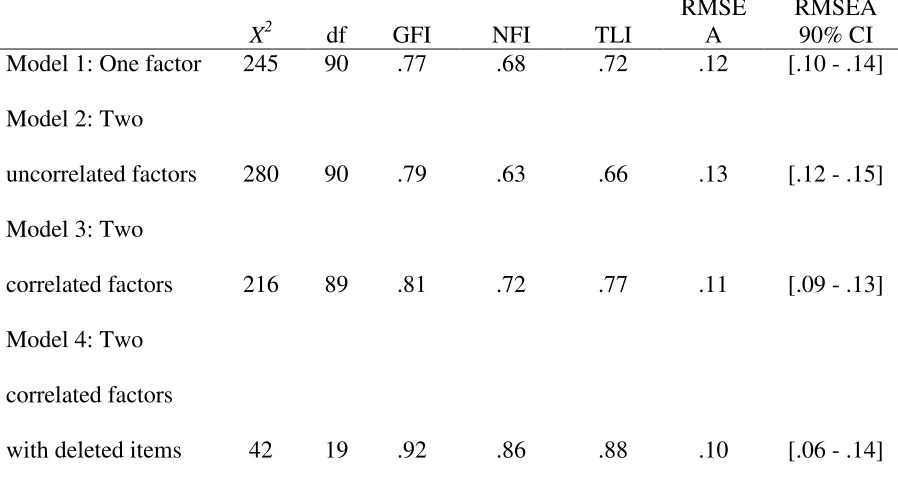
A CFA was conducted to determine if the two categories of work context are best represented as two factors that are allowed to correlate. The first step in this process is to test a one-factor model in which all of the items in these two categories will be permitted to load on one factor. The chi-square statistic for this model was significant and therefore, indicated poor fit X2(90, N = 119) = 245, p < .001. However, in addition to the chi-square statistic several fit indices were examined [i.e., the goodness of fit index (CFI), the normative fit index (NFI), the Tucker Lewis Index (TLI) and the and the root mean square error of
approximation (RMSEA)] to determine if the model is an adequate fit. According to Hu and Bentler (1999), the GFI, NFI, and TLI should be above 0.90, but values closer to 1.00 are better. Vandenberg & Lance (2000) and Millsap (2002) indicate that the RMSEA should be below .08 for the model to be considered a good fit. For the one factor model, the GFI, NFI, and TLI were less than 0.90 and the RMSEA was above 1.00 (see Table 3). The one factor model is therefore considered to have poor fit.
N = 119) = 42, p < .001, GFI = .92, RMSEA = .10 [.06 - .14]. The eight items used to test this model (four items to measure social relationships and four items to measure resources) are used in all subsequent analyses (See Appendices B and C for these items).
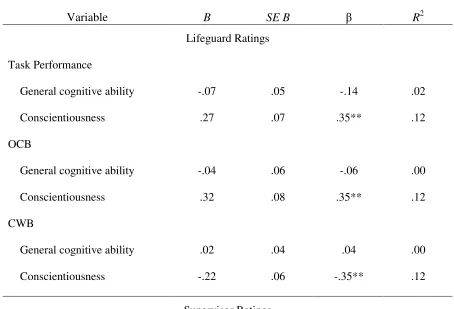
Regression analyses were used to address the hypotheses and research questions of interest in this study. The first hypothesis, which states that GCA will explain significantly more variance in task performance than in OCB and CWB, was assessed using multiple regression. GCA was entered as a single predictor with each of the criteria of interest (i.e., lifeguard and supervisor ratings of task performance, OCB, and CWB). GCA was not a significant predictor of any of the criteria of interest in this study (see Table 4). Therefore, Hypothesis 1 was not supported.
The second hypothesis, which states that conscientiousness will explain more variance in OCB and CWB than in task performance was also investigated using multiple regression. Conscientiousness was entered as a single predictor in the regression analysis with the criteria of interest. The findings show that conscientiousness explains the same amount of variance in lifeguard ratings of task performance [R2 = .12, F(1,117) = 16.48, p = .00], lifeguard ratings of OCB [R2 = .12, F(1,115) = 15.55, p = .00], and lifeguard ratings of CWB [R2 = .12, F(1,113) = 15.72, p = .00]. Furthermore, conscientiousness explained 5% of the variance in supervisor ratings of task performance [F(1,95) = 4.81, p = .03], but did not explain any variance in supervisor ratings of OCB or CWB (see Table 4). Therefore, Hypothesis 2 was not supported.
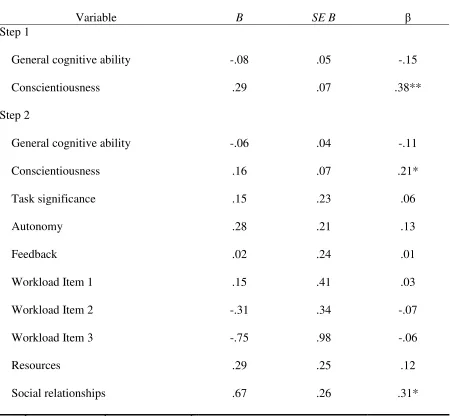
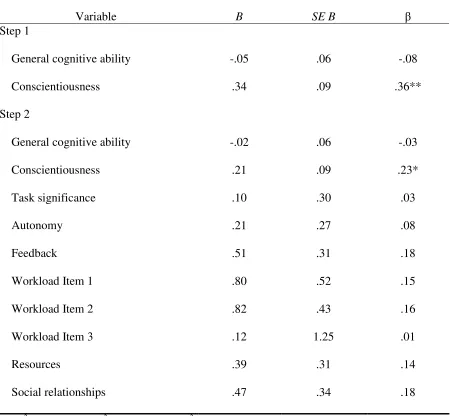
that accounted for by individual difference predictors (i.e., GCA and conscientiousness) in task performance and if this relationships depends on the source of performance ratings, three hierarchical regression analyses were used. In the first analysis, GCA and conscientiousness were entered into the regression equation in Step 1. In Step 2 of the analysis, the factors related to work context (i.e., job/task characteristics, resources, and social relationships) as rated by the lifeguards were entered into the regression equation. The criterion for this analysis was task performance as rated by the lifeguards. The findings show that elements of the work context do explain variance over and above that accounted for by the individual difference predictors, ∆R2 = .20 (p < .001; see Table 5). More specifically, the category of work context labeled social relationships was a significant predictor of task performance in Step 2 of the regression analysis.
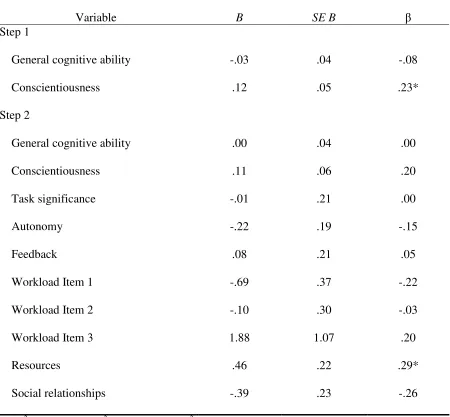
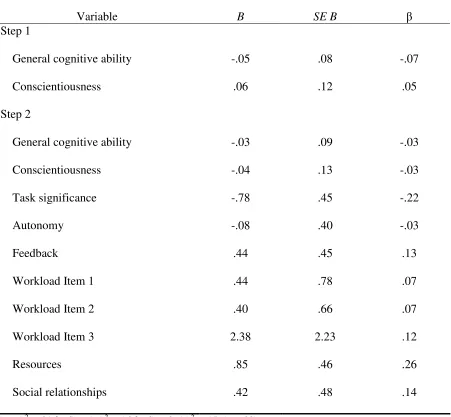
This analysis was also conducted by reversing the steps in the hierarchical regression (i.e., the factors related to work context were entered in Step 1 and the individual difference variables were entered in Step 2) to see if the work context factors explain a significant amount of variance in task performance prior to accounting for individual difference predictors. These findings indicate that the individual difference predictors explain a significant amount of variance in lifeguard ratings of task performance over and above elements of the work context, ∆R2 = .04 (p = .04). When supervisor ratings of lifeguard task performance was used as the dependent variable, elements of the work context did not explain variance above and beyond that accounted for by the individual difference predictors (∆R2 = .11, p = .22; see Table 6).
variable, the findings indicated that elements of the work context explain variance over and above that accounted for by the individual difference predictors, ∆R2 = .19 (p < .001; see Table 7). However, when Step 1 and Step 2 of the hierarchical regression analysis were reversed, the individual difference predictors did not explain variance in OCB above and beyond that accounted for by the work context predictors, ∆R2 = .04 (p = .06). When
supervisor ratings of OCB was used as the dependent variable, elements of the work context did not explain variance above and beyond that accounted for by the individual difference predictors (∆R2 = .15, p = .08; see Table 8).
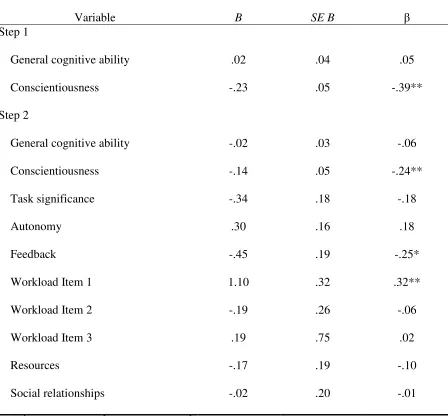
Finally, when lifeguard ratings of CWB was entered as the dependent variable, elements of the work context explained variance above and beyond that accounted for by individual differences, ∆R2 = .24 (p < .001; see Table 9). More specifically, feedback was negatively related to CWB and the perception of work overload was positively related to CWB in Step 2 of the regression analysis. When Step 1 and Step 2 of the hierarchical regression analysis were reversed, the individual difference predictors accounted for a
significant amount of variance above that accounted for by elements of the work context, ∆R2
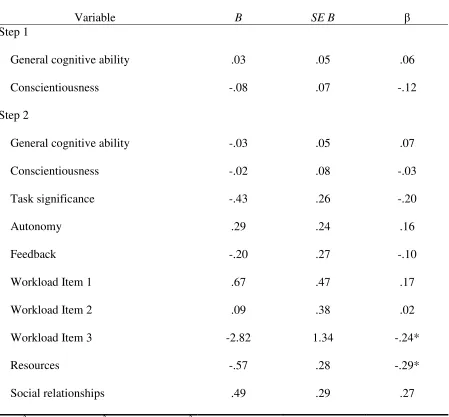
= .05 (p = .02). When supervisor ratings of CWB were used as the dependent variable, elements of the work context did not explain variance above and beyond that accounted for by the individual difference predictors (∆R2 = .13, p = .14; see Table 10).
Section IV: Discussion
study shows that there is a need for a more thorough understanding of the work context and its influence on individual job performance.
The results show that elements of the work context explain a significant amount of variance in lifeguard ratings of task performance, OCB, and CWB above and beyond that explained by GCA and conscientiousness. Examining the findings more closely shows that the lifeguards' evaluation of social relationships in the workplace was a significant predictor of lifeguard task performance after the individual differences were entered into the regression equation. The positive relationship between social relationships and task performance may be due to the fact that this lifeguarding is a service-oriented job and that the ability to perform job-related tasks is highly dependent upon the quality of these relationships. For example, if a lifeguard has a bad relationship with his or her supervisor, the supervisor may withhold important job-related resources from the employee. Furthermore, feedback was negatively related to CWB and the perception of work overload was positively related to CWB after the individual differences were entered into the regression equation. The finding related to feedback makes intuitive sense considering that individuals who do not have much
information about how they are performing may become frustrated and engage in CWBs or may seek information about their performance by "testing the waters" and engaging in deviant workplace behavior. The finding related to perception of work overload is also logical considering that individuals who are constantly busy and overloaded may engage in CWB as a way to release stress or to express frustration with work overload. These findings not only suggest that the work context is important in determining individual job
Limitations
While the findings from this study are promising, there are several limitations that should be noted. The first limitation is related to the measurement of GCA. The OCQ-150 developed by Paulhus and Bruce (1990) was chosen to measure GCA in this study in order to avoid previously documented shortcomings with other measures and because of operational constraints associated with data collection (i.e., the instrument needed to be self-administered and untimed). However, GCA was not a significant predictor of lifeguard or supervisor ratings of task performance, OCB, and CWB in this study (Hypothesis 1). Since previous research and theory support the relationship between GCA and job performance (e.g., Schmidt, 2002), it is possible that this measure did not assess GCA appropriately in this setting. Paulhus and Bruce (1990) note that the OCQ-150 is most appropriately used with college students and may not be appropriate for less educated groups. Although the sample in this study consisted primarily of college students, the international workers may have had difficulty with items on the instrument that were more appropriate for North Americans. This explanation is somewhat supported by the finding that there was a significant difference in GCA sores for US workers (mean = 71.52) and international workers (mean = 62.97), t(120) = 2.577, p = 0.011. Future research should explore the hypotheses and research questions in this study using an alternative measure of GCA or the OCQ-150 should be used to explore these hypotheses and research questions with a different sample of respondents.
A second limitation is related to the study sample and response rate. The response rate for this study was approximately 30%. While this response rate is typical when
(37%) and US workers (19%). It would have been preferable to have a more equal representation from these two groups.
A final limitation of this study is related to common method/common source
variance. The only relationships that were found to be significant in this study occurred when lifeguard (self) ratings of performance were used as dependent variables. Since lifeguards provided information about both the predictors and the criterion in the study, common source variance is a potential problem. However, it is important to note that lifeguards were
considered to a better source of both performance and context ratings because of the nature of the relationship between supervisors and employees in this setting. Since supervisors are not consistently present in the employees' work environment, the employee is a better source of ratings in this setting.
Future Research
While this study makes an important contribution to our understanding of how the work environment can affect job performance, much more research is needed in this area. First, it is important for researchers to define the work context domain more clearly.
Although many situational taxonomies were developed during the 1970s (e.g., Moos, 1973), this line of research has received far less attention in the past two and a half decades. It is essential that researchers not only develop a taxonomy of the work context, but also develop instruments that can be used by both practitioners and researchers to define and assess work environments across a variety of occupations.
An important goal for researchers interested in developing measures of the work context will be to develop ways to measure the work context both subjectively and
rate certain elements of their work environment. Although supervisors could have been asked to provide ratings of the work context, the lifeguards were considered to be more of an expert source of this information because they work at the same swimming facility all day, while supervisors travel to many different work environments during the course of the day. In some situations, it may be appropriate to have supervisors or peers evaluate the work context as opposed to relying exclusively on ratings from job incumbents. Furthermore, it may be appropriate to develop methods of measuring the work context more objectively than the approach used in this study. Future research needs to explore the different ways that the work context can be measured and determine when it is appropriate to measure the situation
objectively or subjectively.
One potential avenue for future research would be to use cluster analysis to group different work contexts based on similar features. In this context, it would be possible to group swimming pools together that shared common features (e.g.., size of swimming facility, depth of pool) and examine the impact on job performance.
As the pendulum between the individual differences camp and the situation camp continues to swing, it is important to remember the truth in Lewin's (1936) observation that behavior is a function of the person and the environment. While it may be tempting to become absorbed in the dominant paradigm during a particular time period, it is also
Section V: References
Bacharach, S. B., & Bamberger, B. (1995). Beyond situational constraints: Job resources inadequacy and individual performance at work. Human Resources Management Review, 5(2), 79-102.
Barrick, M. R., & Mount, M. K. (1991). The big five personality dimensions and job performance: A meta-analysis. Personnel Psychology, 44, 1-26.
Bennett, R. J., & Robinson S. L. (2000). Development of a measure of workplace deviance.
Journal of Applied Psychology, 85(3), 349-360.
Borman, W. C., & Motowidlo, S. J. (1993). Expanding the criterion domain to include elements of contextual performance. In N. Schmitt & W. C. Borman (Eds.), Personnel selection in organizations (pp. 71-98). San Francisco: Jossey-Bass.
Cappelli, P., & Sherer, P. (1991). The missing role of context in OB: The need for a meso-level approach. In L. L. Cummings & B. M. Staw (Eds.), Research in organizational behavior: Vol. 13. An annual series of analytical essays and critical reviews (pp. 55-110). Greenwich, CT: JAI Press, Inc.
Chen, P. Y., & Spector, P. E. (1992). Relationships of work stressors with aggression, withdrawal, theft and substance use: An exploratory study. Journal of Occupational and Organizational Psychology, 65, 177-184.
Deming, W. E. (1986). Out of the crisis. Cambridge, MA: Massachusetts Institute of Technology.
Edwards, J. M. (1984). Situational determinants of behavior. In N. S. Endler & J. M. Hunt (Eds.), Personality and the behavioral disorders, Vol. 1 (2nd ed., pp. 147-182). New York: John Wiley & Sons.
Frederiksen, N. (1972). Toward a taxonomy of situations. American Psychologist, 27, 114-123.
Goldberg, L. R. (1999). A broad-bandwidth, public domain, personality inventory measuring the lower-level facets of several five-factor models. In I. Mervielde, I. Deary, F. De Fruyt, & Ostendorf (Eds.), Personality Psychology in Europe, Vol. 7 (pp. 7-28). Tilburg, The Netherlands: Tillburg University Press.
Greenberg, J. (2002). Who stole the money, and when? Individual and situational determinants of employee theft. Organizational Behavior and Human Decision Processes, 89, 985-2003.
Guion, R. M., & Gottier, R. F. (1965). Validity of personality measures in personnel selection. Personnel Psychology, 18, 135-164.
Hackman, J. R., & Oldham, G. R. (1975). Development of the Job Diagnostic Survey.
Journal of Applied Psychology, 60, 159-170.
Hackman, J. R., Oldham, G. R. (1980). Work Redesign. Reading, MA: Addison-Wesley. Harris, L. C., & Ogbonna, E. (2002). Exploring service sabotage. Journal of Service
Research, 4, 163-183.
Hattrup, K., O'Connell, M. S., & Wingate, P. H. (1998). Prediction of multidimensional criteria: Distinguishing task and contextual performance. Human Performance, 11(4), 305-319.
Hollinger, R. C., & Clark, J. P. (1983). Deterrence in the workplace: Perceived certainty, perceived severity, and employee theft. Social Forces, 62, 398-418.
Hu, L., & Bentler, P. M. (1999). Cutoff criteria for fit indexes in covariance structure analysis: Conventional criteria versus new alternatives. Structural Equations Modeling, 6, 1-55.
James, L. R., & Sells, S. B. (1981). Psychological climate: Theoretical perspectives and empirical research. In D. Magnusson (Ed.), Toward a psychology of situations: An interactional perspective (pp. 275-295). Hillsdale, NJ: Lawrence Erlbaum Associates, Inc.
Kane, J. S. (1997). Assessment of the situational and individual components of job performance. Human Performance, 10(3), 193-226.
Lau, V. S., Au, W. T., & Ho, J. C. (2003). A qualitative and quantitative review of antecedents of counterproductive behavior in organizations. Journal of Business and Psychology, 18, 73-99.
Lee, K. & Allen, N. J. (2002). Organizational citizenship behavior and workplace deviance: The role of affect and cognitions. Journal of Applied Psychology, 87(1), 131-142. Lewin, K. (1936). Principles of topological psychology. New York: McGraw-Hill. Magnusson, D. (Ed.). (1981). Toward a psychology of situations: An interactional
Meyer, J. P., Becker, T. E., & Vandenberghe, C. (2004). Employee commitment and
motivation: A conceptual analysis and integrative model. Journal of Applied Psychology, 89(6), 991-1007.
Millsap, R.E. (2002). Structural equation modeling: A user’s guide. In F. Drasgow & N. Schmitt (Eds.), Measuring and analyzing behavior in organizations: Advances in measurement and data analysis (pp. 257-301). San Francisco: Jossey-Bass.
Miles, D. E., Borman, W. E., Spector, P. E., & Fox, S. (2002). Building an integrative model of extra role work behaviors: A comparison of counterproductive work behavior with organizational citizenship behavior. International Journal of Selection and Assessment, 10(1/2), 51-57.
Moos, R. H. (1973). Conceptualizations of human environments. American Psychologist, 1973, 28, 652-665.
Motowidlo, S. J. (2003). Job performance. In W. C. Borman, D. R. Ilgen, & R. J. Klimoski (Eds.), Handbook of psychology: Vol. 12: Industrial and organizational psychology (pp. 39-53). NY: John Wiley.
Motowidlo, S. J. & Van Scotter, J. R. (1994). Evidence that task performance should be distinguished from contextual performance. Journal of Applied Psychology, 79(4), 475-480.
Nord, W. R, & Fox, S. (1999). The individual in organizational studies: The great disappearing act? In S. R. Clegg & Hardy (Eds.), Studying organization: Theory and method (pp. 142-168). Thousand Oaks, CA: Sage.
Organ, D. W. (1988). Organizational citizenship behavior: The good soldier syndrome. Lexington, MA: Lexington Books.
Page, C., Wilson, M., Meyer, D., & Inkson, K. (2003). "It's the situation I'm in": The importance of managerial context to effectiveness. Journal of Management and Development, 22(10), 841-862.
Paulhus, D. L, & Bruce, M. N. (1990, June). Validation of the Over-Claiming Questionnaire: A preliminary study. Presented at the meeting of Canadian Psychological Association, Ottawa.
Paulhus, D. L., & Harms, P. D. (2004). Measuring cognitive ability with the overclaiming technique. Intelligence, 32, 297-314.
Peters, L. H., & O'Connor, E. J. (1980). Situational constraints and work outcomes: The influences of a frequently overlooked construct. The Academy of Management Review, 5, 391-397.
Rentsch, J. R., & Steel, R. P. (1998). Testing the durability of job characteristics as predictors of absenteeism over a six-year period. Personnel Psychology, 51(1), 165-190.
Sackett, P. R. & DeVore, C. J. (2002). Counterproductive behaviors at work. In N. Anderson et al. (Eds.) Handbook of Industrial, Work, & Organizational Psychology, Volume 1: Personnel Psychology. Thousand Oaks, CA: Sage.
Schmidt, F. (2002). The role of general cognitive ability and job performance: Why there cannot be a debate. Human Performance, 15(1/2), 187-210.
Schmidt, F., & Hunter, J. E. (1998). The validity and utility of selection methods in personnel psychology: Practical and theoretical implications of 85 years of research findings.
Schneider, B. (1978). Person-situation selection: A review of some ability-situation interaction research. Personnel Psychology, 31, 281-297.
Spector, P. E., & Fox, S. (2002). An emotion-centered model of voluntary work behavior: Some parallels between counterproductive work behavior and organizational citizenship behavior. Human Resource Management Review, 12, 269-292.
Taber, T. D., & Taylor, E. (1990). A review and evaluation of the psychometric properties of the Job Diagnostic Survey. Personnel Psychology, 43(3), 467-500.
Terborg, J. R. (1981). Interactional psychology and research on human behavior in organizations. Academy of Management Review, 6, 569-576.
Vandenberg, R. J., & Lance, C. E. (2000). A review and synthesis of the measurement invariance literature: Suggestions, practices, and recommendations for organizational research. Organizational Research Methods, 3, 4-69.
Witt, L. A., Kacmar, K. M., Carlson, D. S., & Zivnuska, S. (2002). Interactive effects of personality and organizational politics on contextual performance. Journal of
Appendix A: Workload Items
[Scale: 1 = Strongly Disagree, 2 = Disagree, 3 = Somewhat Disagree, 4 = Neutral, 5 = Somewhat Agree, 6 = Agree, 7 = Strongly Agree.]
Directions: Please use the 7-point scale to indicate your level of agreement/disagreement with the following statement.
1. There are more swimmers that visit my pool than I am able to handle. [Note: Workload Item 1].
Directions: Please circle your answer choice to the questions below.
2. How many swimmers are typically in the pool at once during your shifts? [Note: Workload Item 2]
[Scale: 1 = Less than 5, 2 = 5-10, 3 = 10-15, 4 = 15-20, 5 = 20-25, 6 = 25-30, 7 = More than 30]
3. How many hours per week do you work? [Note: Workload Item 3]
Appendix B: Resources Items
[Scale: 1 = Strongly Disagree, 2 = Disagree, 3 = Somewhat Disagree, 4 = Neutral, 5 = Somewhat Agree, 6 = Agree, 7 = Strongly Agree.]
Directions: Please use the 7-point scale to indicate your level of agreement/disagreement with the following statements.
1. There are enough lifeguards who work at this facility to handle the number of patrons that visit the facility.
2. My supervisor is available when I need him/her.*
3. My lifeguard training prepared me to perform my job successfully.* 4. I am able to get the information I need to perform my job successfully. 5. I have the safety materials I need to perform my job successfully.
6. I have the necessary chemicals and testing equipment that I need to perform my job successfully.*
7. I have the necessary paperwork that I need to perform my job duties. 8. All equipment at my pool is functioning properly.
9. I have the cleaning supplies that I need to perform my job duties.*
Appendix C: Social Relationships Items
[Scale: 1 = Strongly Disagree, 2 = Disagree, 3 = Somewhat Disagree, 4 = Neutral, 5 = Somewhat Agree, 6 = Agree, 7 = Strongly Agree.]
Directions: Please use the 7-point scale to indicate your level of agreement/disagreement with the following statements.
1. I have a good relationship with the patrons (residents) who visit my facility.*
2. I have a good relationship with the customer (Resident Manager or Property Manager) at my facility.*
3. I have a good relationship with my direct supervisor.*
4. I have a good relationship with my lifeguard training instructor. 5. I have a good relationship with my staffer.
6. I have a good relationship with my co-workers.*
Appendix D: Task Performance Items Task Performance (Lifeguard Questionnaire)
[Scale: 1 = Very Ineffectively, 2 = Ineffectively, 3 = Somewhat Ineffectively, 4 = Neutral, 5 = Somewhat Effectively, 6 = Effectively, 7 = Very Effectively]
Directions: Please use the 7-point scale to rate how effectively you perform the following tasks. Please read each statement carefully, and then circle the response that corresponds to the number on the scale.
1. Sit in the lifeguard chair when swimmers are in the pool.
2. Have appropriate safety materials when in the lifeguard chair (i.e., rescue tube, whistle, and sunglasses).
3. Check pool chemicals. 4. Enforce pool rules.
5. Check pool passes and have guests sign in (if required). 6. Practice the 10/20 Rule of Protection.
7. Wear lifeguard uniform. 8. Clean skimmers.
9. Vacuum the pool.
10.Maintain appropriate attendance records (i.e., clock in and clock out every day).
Task Performance (Supervisor Questionnaire)
Directions: Please use the 7-point scale shown below to rate how effectively this lifeguard performs the following tasks. Please read each statement carefully, and then circle the response that corresponds to the number on the scale.
1. Sits in the lifeguard chair when swimmers are in the pool.
2. Has appropriate safety materials when in the lifeguard chair (i.e., rescue tube, whistle, and sunglasses).
3. Checks pool chemicals. 4. Enforces pool rules.
5. Checks pool passes and have guests sign in (if required). 6. Practices the 10/20 Rule of Protection.
7. Wears lifeguard uniform. 8. Cleans skimmers.
9. Vacuums the pool.
Appendix E: Organizational Citizenship Behavior Items Organizational Citizenship Behavior (Lifeguard Questionnaire)
[Scale: 1 = Never, 4 = Sometimes, 7 = Always.]
Directions: Please use the 7-point scale to indicate how often you have engaged in the following behaviors. Please read each statement carefully, and then circle the response that corresponds to the number on the scale.
1. Adjusted your work schedule to accommodate other employees' requests for time off. 2. Helped others who have been absent.
3. Showed genuine concern and courtesy toward coworkers, even under the most trying business or personal situations.
4. Offered ideas to improve the functioning of the organization. 5. Expressed loyalty toward the organization.
6. Taken action to protect the organization from potential problems. 7. Demonstrated concern about the image of the organization.
8. Took the initiative to troubleshoot and solve technical problems before requesting help from a supervisor. (Adapted from Motowidlo & Van Scotter, 1994: "Take the initiative to solve a work problem.")
9. Voluntarily did more than the job requires so that I can help others or contribute to the overall functioning of the facility. (Adapted from Motowidlo & Van Scotter, 1994: "Voluntarily do more than the job requires to help others or contribute to unit effectiveness.")
Note. These items were adapted from an OCB measure developed by Lee and Allen (2002) and a measure of
Organizational Citizenship Behavior (Supervisor Questionnaire) [Scale: 1 = Never, 4 = Sometimes, 7 = Always.]
Directions: Please use the 7-point scale to indicate how often this lifeguard has engaged in the following behaviors. Please read each statement carefully, and then circle the response that corresponds to the number on the scale.
1. Adjusted his/her work schedule to accommodate other employees' requests for time off. 2. Helped others who have been absent.
3. Showed genuine concern and courtesy toward coworkers, even under the most trying business or personal situations.
4. Offered ideas to improve the functioning of the organization. 5. Expressed loyalty toward the organization.
6. Took action to protect the organization from potential problems. 7. Demonstrated concern about the image of the organization.
8. Took the initiative to troubleshoot and solve technical problems before requesting help from a supervisor. (Adapted from Motowidlo & Van Scotter, 1994: "Take the initiative to solve a work problem.")
9. Voluntarily did more than the job requires to help others or contribute to the overall functioning of the facility. (Adapted from Motowidlo & Van Scotter, 1994: "Voluntarily do more than the job requires to help others or contribute to unit effectiveness.")
Note. These items were adapted from an OCB measure developed by Lee and Allen (2002) and a measure of
Appendix F: Counterproductive Work Behavior Items Counterproductive Work Behavior (Lifeguard Questionnaire)
[Scale: 1 = Never, 4 = Sometimes, 7 = Always.]
Directions: Please use the 7-point scale to indicate how often you have engaged in the following behaviors. Please read each statement carefully, and then circle the response that corresponds to the number on the scale.
1. Taken an additional or a longer break than is acceptable at your workplace. 2. Come in late to work without permission.
3. Littered your work environment. 4. Cursed at someone at work. 5. Called in sick when you were not. 6. Lost your temper while at work.
7. Neglected to follow your boss's instructions. 8. Left work early without permission.
9. Left your work for someone else to finish. 10.Acted rudely toward someone at work. 11.Put little effort into your work.
Note. These items were selected from a workplace deviance scale developed by Bennett and Robinson (2002).
Counterproductive Work Behavior (Supervisor Questionnaire) [Scale: 1 = Never, 4 = Sometimes, 7 = Always.]