Diagonalizable Algorithm for Cell Scheduling
in Fixed Virtual Output Queued (VOQ)
Packets Switches
Sunil N Kore; Dr.P.J.Kulkarni, Sayali Kore
Associate Professor, Walchand College of Engineering, Sangli, Maharashtra, India Professor, Walchand College of Engineering, Sangli, Maharashtra, India B.Tech. Student, Walchand College of Engineering, Sangli, Maharashtra, India
ABSTRACT: Explosive growth in internet is demanding very fast switching fabric in internet routers and switches. Packets need to be buffered at input or output or on both sides of crossbar switching fabric. Crossbar switches are used for switching because of no bandwidth limitation & high scalability. It’s well known fact that buffering of packets on outside of switch demands switching fabric to be `N' time faster whereas buffering packets on input side limits throughput to 58%. Combined input output queued (CIOQ) switch demands that switch fabric to run at speed up of 2. VOQ (Virtual output Queue) i.e. `N' queues per input port i.e. total N2 queues on input side are suggested to resolve problem of throughput limitation of 58%. In VOQ throughput achieved is 100%. Selection of packets is the key issue in VOQ, Various schemes like,Maximum Weight matching (MWM), Maximum Size Matching MSM and maximal matching, are suggested by researchers in last two decades to improve the performance in terms of throughput and delay. Because of constraint of selecting one cell from an input port and sending one cell to an output port in a time slot puts limitation that selected elements are only diagonal elements. Such permutation of diagonal are N!Choosing appropriate diagonal is key issue in cell scheduling. We are addressing Diagonalizable Maximum Weight Matching (DMWM) Scheme which provides 100% instantaneous throughput in each slot under heavy traffic conditions & improves delay performance. Our scheme DMWM is computationally complex for large size switches but it outperforms at lower size switches and provides optimal performance nearer to output queued switch.We have also modified our DMWM to Modified DMWM (MDMWM)to reduce the computational complexity.
KEYWORDS: Fixed length packet switches, Maximum weight matching algorithms, Packet Scheduling, VOQ
I. INTRODUCTION
Internet services are growing faster and faster and it's becoming part of everybody'slife. Demand for fast internet service is increasing pressure on router design engineersto provide faster switching architectures. Basically cross bar switches are used in internet router/switches because of scalabilityand no bandwidth limitation exist with it.Present switches use crossbar switches along with buffering of packets either on input- output or on combined input output. Output queued switches provides 100% throughput but requires N times faster switch fabric. Input queued switch does not required N times faster switch fabrics but suffered from throughput limitation to 58%.Virtual Output queued (VOQ) switch provides 100 % throughput without N time faster switch fabric but scheduling or selection of cell from N2queues is the key issue.
II. RELATED WORK
Packet scheduling schemes are suggested and they are generally classified as MaximumSize Matching, Maximum Weight Matching,Maximal Matching and Maximal Matchingwith iteration and Maximal Weight matchingwith and without iteration [1], [5].
Maximum size matching guarantees for instantaneous throughput to be 100% but donot guarantee for good delay performance.Maximum weight matching scheme gives thebest performance equivalent to output queuedswitch but they are very complex in implementation [1], [8], [9].
A maximum matching is largest size matching that can be made on graph whereasmaximal matching is matching to which no further edges can be added without first removing an already matched edge. Hence maximummatch can be maximal but vice versa is not true.
Maximal matching provides good through-put performance and poor delay performance.Iterative maximal matching and its variantsuch as i-slip; DRR, FIRM, SRA, etc. provide good throughput and delay performancein multiple iteration. Expected number of iterations are Olog(N). There are some variantssuch as weighted i-slip, i-LQF, i-OCF, etc. [1],[6], [7],[10]which gives good delay performancebetter than simple i-slip but these are complexto implement in hardware.
Recent researchers worked on to reduce communication overheads reduction in complexity of hardware, stability, scalability, fairness, etc. Still efforts are made by researchersto provide best optimal solution for scheduling policy in selection of packets in VOQ [1], [7], [8]. Our efforts are also to provide scheduling scheme named as Permuted Diagonal Maximum Weight Matching scheme to provide gooddelay and throughput.
III.VOQSWITCH
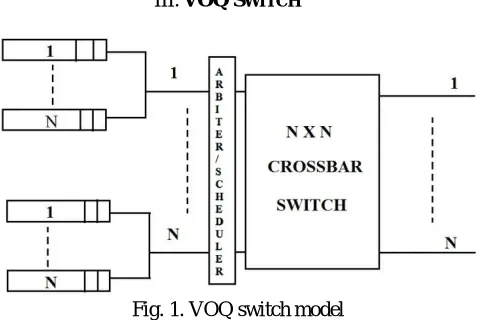
Fig. 1. VOQ switch model
Switch model is as shown in Fig. 1 is NxN switch with multiple input queues used to storethe arriving packets to input port `i' and destined to output port `j' in jth queue at inputport i. Hence there are `N' queues per inputport. There are total N2 queues at input sideof switch. Time assumed to be slotted witheach slot equal to transmission time of a cell orpacket. In each cell slot we select at most `N'packets from N2 HOL packets. We have putconstraint that at most one HOL packet willbe chosen from each input port and at mostone packet will be delivered to an output port.Hence we constrain pattern I of NxN matrixsuch that Where, Iij is permutation of indicator matrix. Indicator queue-length matrix K isformed such that Kij=1 if Queue-length matrixLij >0 else Kij=0.
IV.PROBLEM DEFINITION
A scheduling problem in crossbar based VOQ switches can be resolved by finding optimal weight matrix using VOQ occupancies reported in Queue-length matrix L.
Lij(t) = Number of packets backlogged at time(t-1) + arrival if any, at time (t-1 to t) -departure if any of HOL packet
It is basically constructing bipartite graph G = (V,E) that consist of set V of 2N vertices partitioned into two sets namely 'N' inputs and 'N' outputs. The set of edges E hasone edge connecting vertex i of input to vertexj of output for each Lij(t) > 0. A matchingM on G is any subset of E such that no twoedges in M have common vertex. Matchingguarantees that only one packet per input andoutput needs to be transferred [1], [6], [7]. Ascheduling policy should work under constrainmentioned above with aiming of instantaneous throughput of 100% and set
M
E
has maximum weight. Hence M must satisfy:1. Number of edges matched should be`N'. If no such set exist then select `M' such that it has maximal matched edges. This condition pulls throughput towards maximum.
2. A match `M' obtained should haveinstantaneous average Queue-length > overall average Queue-length an must have varianceminimum which is calculated w.r.t. overall average Queue-length(L).These conditions needto select appropriate permuted diagonals wherequeues are blowing with higher rate and shouldbe brought under control.
V. CELL SELECTION POLICIES
Random selection: In this policy of selection no weights are assigned to queues. Select randomly any input and switch the cellfrom it. Do not allow this input port and destined port for which cell is switched in currentor previous round. It may happen that selectedinput port has no HOL cell or is having queue occupancy very low. In such cases instantaneous throughput will be reduced and backlogswill increase yield in poor delay performance.Generally it may or may not be optimal solution[1], [9].
Maximum Queue Length (MAXQ): It is a greedy policy where highest backlog input is identified and selected first.Here weight Wij = Lij1 ≤ i, j ≤ NAgain restriction of not selecting the same input & output in remaining round
remains thesame [1], [9].
R C Sum minimum:In this policy of selection queue length Indicator matrix is considered. Queue length indicator matrix is formedas
Kij = 1 if Lij > 0
= 0 if Lij = 0 where 0 ≤ i; j ≤ N
This will reduce the number of bits required to handle in hardware implementation.Now weight Wij is evaluated
W = , + ,
ℎ 0≤ , ≤ ; 1≤ , ≤
Here queue whose weight is higher being selected first for switching. The queue elements from corresponding row and column of selected element willnot participate in further round. Such ‘N’ round will take place for selecting ‘N’ elements
VI.DIAGONALIZABLE MAXIMUM WEIGHTMATCHING ALGORITHM(DMWMA)
The aim of Diagonalizable Maximum Weight Matching Algorithm (DMWMA) is tomaximize the instantaneous throughput subject to stabilize the switch. Since the stabilityof switch is critical for bounding packet delays and buffer over flow. Maximizing the through-put is not equivalent to maximizing the stability region. Therefore, the focus of this policy isto maximize one subject to certain constraintson the other. However, DMWMA is computationally very complex algorithm. Presently it isnot possible to evaluate determinant value fora matrix of greater than 16*16. Later modifiedMDMWMA is proposed which is computationally less complex.
=
W
2,3
LetWbe the weight matrix for N2queues. Let W2,3 is weight for cells at input port 2 and destined for output port 3.
Evaluating weight at HoL position of (i,j) in W matrix using queue length matrix ‘L’, needsto consider queue lengths of HoL which are notin ith row and jth column. This is due to our constraint of only one cell must beswitched from ith row and jth column. If HoLcell (i,j) exists then positional weight of certainHoL should not depend only on queue occupancy of packets destined for particular output port or number of packets from that input portdestined for various output ports but also depend on occupancies of queues in other inputports.
L is a matrix of size N * N with each element lij indicating queue length of packet tobe switched from input port i to output port j.The weight matrix W is calculated in order totake decision about which cells to be switchedin one time slot . wijindicates element of matrix W i.e the weightage of HOL packet of theinput port i and going to output port j .
Wij = Lij:f (Lij), where f(Lij) is some weighted function of all lmn elements exceptm≠ i and n≠ j for all 1 ≤ m, n, I, j
≤N.It is observed that if lij = 0 then Wij = 0i.e. weight assigned to queue of ith input port buffering cells destined for jth
output port.
Let Mij denotes minor of matrix L and mij1cindicates first row and cth column elementof matrix Mij.The equation to
find the weightmatrix is given in (1).
, = , ∗( ( ))( ) Equ(3)
In eq(1),F(r)(Mij) is a recursive function.Where, r indicates level of recursion andvaries from 1 to (N - 1). Let Qr represents thenumber of columns in Mij matrix at rth levelof recursion.The minor of Mij is indicated byM1c. Then the recursive function F(r)(Mij) isevaluated as shown in eq (2).
( ) ( )=
, ( 1) 1 1
1
1
*
(
)
ij
r Qr
i j r c
c c
M
ifQ
m
F
M
otherwise
Equ(4)
In order to illustrate this method consider the example given below: Here L is of sizeN*N (i.e 4*4). Therefore r runs from 1 to 3.
=
11 12 13 14
21 22 23 24
31 32 33 34
41 42 43 44
l
l
l
l
l
l
l
l
l
l
l
l
l
l
l
l
= ∗ ( )
22 23 24
32 33 34
42 43 44
l
l
l
l
l
l
l
l
l
Step 2: with (r=2)
( )
22 23 24
32 33 34
42 43 44
l
l
l
l
l
l
l
l
l
= ∗ ( ) 33 34
43 44
l
l
l
l
+ ∗ ( ) 32 34
42 44
l
l
l
l
+ ∗ ( ) 32 33
42 43
l
l
l
l
Step 2: with (r=3)
( ) 33 34
43 44
l
l
l
l
= ∗ ( ){| |} + ∗ ( ){| |} = ∗ + ∗( ) 32 34
42 44
l
l
l
l
= ∗ ( ){| |} + ∗ ( ){| |} = ∗ + ∗( ) 32 33
42 43
l
l
l
l
= ∗ ( ){| |} + ∗ ( ){| |} = ∗ + ∗ Step 4:= ∗( ∗( ∗ + ∗ ) + ∗( ∗ + ∗ ) + ∗( ∗ + ∗ )) Equ(5)
Similarly, calculate all the other elementsof weight matrix W.
The calculation of weight matrix W fails when one or more rows/columns in the queuelength matrix L are zero. i.e. if any input portis out of service or there is no packet going tocertain output port. In order to solve this problem a matrix L' is formed given by
= +
.
Where,Uis a square matrix of size N*N with all ones.TheL' matrix is used instead of L matrix to calculate weight matrix W. Since, the L' matrix doesnot contain any zero element it gives correctweight matrix in any case.This is illustrated byan example EX-2.
After the weight matrix is calculated, the next step is to select the optimal diagonal forswitching. This is done by first selecting themaximum weighted queue say Wij. All the entries in weight matrix corresponding to the in-put port i
and output port j are made invalidfor selecting next element. Again an elementhaving maximum weight among the remainingvalid entries in the weight matrix is selected.This process continues until N input queues areselected for switching. Finally the DMWMA issummarized by following algorithm:
1. Get queue length matrix L .
2. Calculate L' matrix from L matrix by using L’=L+U. 3. Evaluate Weight Matrix W from L' matrix by using eq(3).
5. Switch packets corresponding to selected N diagonal elements, if and only if apacket is present in the correspondingqueue.
6. Go to step 1 and Repeat till there are no elements left for selection.
Complexity in DMWMA:In this algorithm number of multiplication required are 1).1)! and additions (N-1)! - 1, which is very high. It's difficult to implement with present parallel hardware infrastructure available. But DMWMA truly finds the weight of queue. In this algorithm queue length of each queue contribute to weight of other queue approximately.
VII. MODIFIED DIAGONALIZABLE MAXIMUM WEIGHT MATCHING ALGORITHM(MODIFIED DMWMA)
The Modified Diagonalizable Maximum Weight Matching Algorithm (Modified DMWMA) is computationally less complex as compared to DMWMA. In order to maximize the throughput subject to minimize the delay, the selection of queue for switching the packet from it depends on:
The queue length of that queue.
The average queue length of the queues from which the packets can be switched along with packet from that queue (supportive queues).
The average queue length of the queues from which the packets cannot be switched along with the packet from that queue (competitive queues).
Consider a 4*4 queue matrix.
=
11 12 13 14
21 22 23 24
31 32 33 34
41 42 43 44
l
l
l
l
l
l
l
l
l
l
l
l
l
l
l
l
Suppose, l22is selected queue. Then the supportive queue elements are shown by underline in below matrix.
=
11 12 13 14
21 22 23 24
31 32 33 34
41 42 43 44
l
l
l
l
l
l
l
l
l
l
l
l
l
l
l
l
The competitive queues of the queue l22are underlined in the matrix shown below:
=
11 12 13 14
21 22 23 24
31 32 33 34
41 42 43 44
l
l
l
l
l
l
l
l
l
l
l
l
l
l
l
l
L is a matrix of size N * N with each element lij indicating queue length of packetswitching from input port i to
Consider,Savg as average value of queuelength of supportive queues at position ij.It isevaluated using eq (6). Let Cavg
be averagevalue of queue length of competitive queues atposition ij. It is evaluated using eq (7). Thenthe weight matrix is evaluated using eq(6),eq(7),eq(8)
= ( −1) Equ(6)
≠ ≠
= (2∗( −1))
Equ(7)
= =
*
ij/
ijij ij avg avg
W
l
s
c
Equ(8)The modified DMWMA is an approximation of DMWMA. So it gives sub- optimal solution in some extreme cases as considered inEX-1.
VIII. EXAMPLES
EX-1
Consider a queue length matrix as shown below:
=
0
1
2
3
4
5
6
7
8
9
10 11
12 13 14 15
Average queue-length of entire queue occupancy = (0 + 1 + 2 +. . . + 16)/16 =7.5 The weights of selected diagonal are underlined.
Random Selection:Applying Random selection will select the elements randomly asdiscussed earlier. The resultant matrix afterapplying Random selection policy:
=
0
1
2
3
4
5
6
7
8
9
10 11
12 13 14 15
=
0
1
2
3
4
5
6
7
8
9
10 11
12 13 14 15
Here the summary of result and calculation will be :
Number of cells switched = 3,average queue-length of diagonal selected forswitching = (15 + 10 + 5 + 0)/4 = 7.5 Variance = {(15- 7.5)2 + (10 -7.5)2 + (5 -7.5)2 + (0 – 7.5)2}/4 = 31.25
RC Sum policy: Weight matrix by using RC sum policy:
=
6
7
7
7
7
8
8
8
7
8
8
8
7
8
8
8
Here the summary of result and calculation will be :
Number of cells switched = 3, average queue-length of diagonal selected forswitching = (0 + 6 + 9 + 15)/4 = 7.5 Variance = {(0-7.5)2+(6-7.5)2+(9-7.5)2+(15- 7.5)2}/4 = 29.25
Since some of the queue-length elements in weight matrix are having the same weightwe can say that there can be many versions ofweight matrix, after application of final step ofRC Sum, i.e maximum weight selection, andone of which is going to get selected. But thisis not feasible so we have to apply some logicat this point to select one of those possibilities.We have to go with random selection. It isobserved that because of random selection nooptimal solution can be obtained.
DMWMA:Weight matrix by using DMWMA
:
=
0
4352
7712 10368
6512
6000
5328
4592
7712
6048
4800
3872
8208
6032
4592
3600
Here the summary of result and calculation will be :
Number of cells switched = 4, average queue-length of diagonal selected for switching = (3 + 6 + 9 + 12)/4 = 7.5 Variance = {(3-7.5)2+(6-7.5)2+(9-7.5)2+(12 – 7.5)2}/4 = 11.25
Modified DMWMA:Weight Matrix by using Modified DMWMA:
=
0
1.52
2.8
3.85
4.72
5.43
6
6.44
6.77
7
7.14
7.2
7.2
7.12
7
6.81
Here the summary of result and calculation will be :
Number of cells switched = 4,average queue-length of diagonal selected forswitching = (1 + 6 + 11 + 12)/4 = 7.5 Variance = {(1-7.5)2+(6-7.5)2+(11-7.5)2+(12 – 7.5)2} /4 = 19.25
It is observed that though the solution isnon-optimal, it is unique and near to optimal.
EX-2
Consider a queue length matrix L as shownbelow
Average queue-length of entire queue occupancy = (5 + 6 + 12 + 7 + 20 + 8 + 0 +10 +0)/9 = 7.56
Random Selection: Applying Randomselection will select the elements randomly asdiscussed earlier. The resultant matrix afterapplying Random selection policy:
Maximum Queue length (MAXQ):
Applying Maximum Queue length will selectthe longest queue-length element first and willrepeat N times. N being 3 here. The resultantmatrix after applying Maximum queue lengthpolicy:
RC Sum policy:In RC Sum policy, first the indicator matrix is formed. Weight is calculated by taking sum of row and column elements of indicator matrix. No unique solution is possible as many places same weight is observed.
= =
5
6
12
7
20
8
0
10
0
W=5
6
12
7
20
8
0
10
0
W=5
6
5
5
6
5
3
4
3
Number of cells switched = Random Number of cells switched = 2 Number of cells switched = 2 average queue-length of diagonal
selected forswitching=Random
average queue-length of diagonal selected forswitching=10.67
average queue-length of diagonal selected forswitching=4.67
Variance= Random Variance=77.21 Variance=19.93
DMWMA: Weight matrix by usingDMWMA: MDMWMA: Weight matrix by using ModifiedDMWMA:
=
400
0
840
840
0
400
0
1240
0
=6.55
1.76
19.3
5.29
9.7
3.9
0
10.66
0
Number of cells switched = 3 Number of cells switched = 3
average queue-length of diagonal selected forswitching=9.67
average queue-length of diagonal selected forswitching=9.67
Variance=8.66 Variance=8.66
It is observed that though the solution isnon-optimal, it is unique and near to optimal.
Also this modified DMWMA has less computational complexity which is a plus point forthis kind of near optimal solution. Arrange queue length of selected packet is lower but it variance is smaller than other packet switching policies.
Special case: But,now here if consider amatrix having entire row or column zero i.e ifno cells are arrived to input port or no cells aredestined to output port from any input port.
=
5
6
12
7
20
8
0
0
0
=0
0
0
0
0
0
0
0
0
Here, weight matrix is a Null matrix,so nodecision can be taken for switching cells fromqueue. This problem can be solved by modifying the queue length matrix L to L' matrix asper L’=L+U.
=
6
7
13
8
21
9
1
1
1
=
180
119
377
160
399 117
336 158
182
Modified Queue Length matrix Special Case Weight Matrix by using DMWMA on L'
The actual switching is done by using LQueue length matrix .Hence if a queue containing zero packets is selected then no switchingof packets is done from that queue.
The L' matrix of the matrix in EX-2i.e. (10) is given as
=
6
7
13
8
21
9
1
1
1
=
720
119
1417
1200
399
657
336
1738
182
Modified Queue Length matrix Special Case Weight matrix by using MDMWMA on L'
Here it is observed that the switching diagonal found by L and L' matrix is same. In general L' matrix can be used to calculate weightmatrix in modified DMWMA instead of L.
IX.STATISTICAL ANALYSIS
= overall average queue-length of L
=
,
= average queue length of selected permuted diagonal
= ( ),( )
Where: c= column of selected diagonalelements in 1st row Var(D) = variance of diagonal element wrt.
= ( ),( ) −
Table 1. Result analysis of EX-1 Table 2. Result analysis of EX-2
Policy Var (D) Tn
RANDOM 75%
MAX QLength 7.5 7.5 31.25 75%
RCSUM MAX 7.5 7.5 29.25 75%
DMWMA 7.5 7.5 11.25 100%
MDMWMA 7.5 7.5 19.25 100%
Policy Var (D) Tn
RANDOM 100%
MAX QLength 7.56 7.5 31.25 66.67%
RCSUM MAX 7.56 4.67 19.93 66.67%
DMWMA 7.56 9.67 8.33 100%
MDMWMA 7.56 9.67 8.33 100%
Remark:DMWMA is best suitable algorithm because cell selected from diagonal elements has minimum variance and gives 100% instantaneous throughput.But computational complexity is very high. MDMWMA is near optimal solution. MDMWMA algorithm also gives 100% with instantaneous throughput but variance is higher than DMWMA.MDMWMA algorithm has computational complexity very less. It is observed in both example mentioned above. Following section represents the results obtained through simulation.
X. SIMULATION RESULT
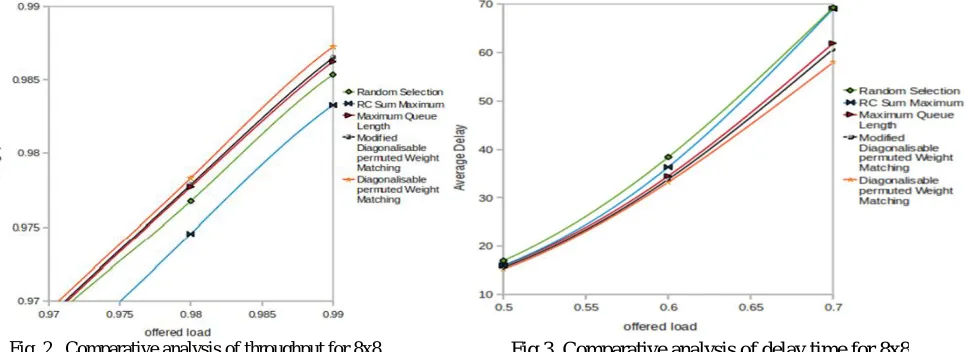
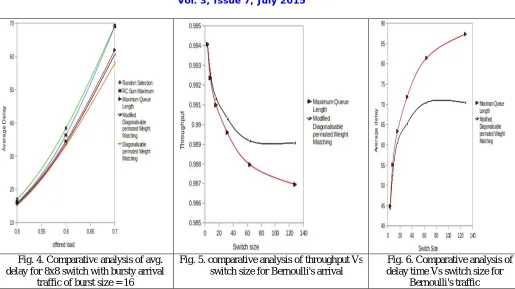
A simulation is carried out with switch size of 8x8 with VOQ. Simulation is run for10,000 slot time. Policies applied are random selection (RANDOM); Maximum queue length(MAXQ);RCSUM-MAX; DMWMA; and Modified DMWMA.While drawing the graphs of delay performance and throughput, all policies are takeninto account and mentioned in Fig.2,3, 4 Fig.5& 6 compares performance of MAXqlength andMDMWMA.
Fig. 2. Comparative analysis of throughput for 8x8 switch size with Bernoulli's traffic
Fig. 4. Comparative analysis of avg. delay for 8x8 switch with bursty arrival
traffic of burst size = 16
Fig. 5. comparative analysis of throughput Vs switch size for Bernoulli's arrival
Fig. 6. Comparative analysis of delay time Vs switch size for
Bernoulli's traffic
XI.CONCLUSION
DMWMA is providing unique and optimal solution for packet selection in VOQ switches.It's computationally complex but gives optimal solution. This is tested for various randomqueue occupancy matrix and observed that itimproves the throughput delay performance.This is theoretical attempt to show and suggest one method ofMWM algorithm. We have modified DMWMA so that it can be implementedusing parallel hardware architecture and givesnear suboptimal solution. Above policies arestable policies.
REFERENCES
1. Nick McKeown Venkat Anantharam JeanWalrand "Achieving 100Throughput inan Input-Queued Switch", IEEE Trans.On Communication Vol.47. No2.pp.188-201,April 1999.
2. Karol M., Hluchyj M., Morgan S., "Inputversus Output Queuing on a Space Division Switch", IEEE Transaction on Communications. Vol.35, n.12, p.1347-1356,Dec. 1987.
3. Awdeh, R.Y. and H.T. Mouftah, "Survey of ATM Switch Architectures", Computer Networks and ISDN Systems, vol. 27(1995), pp. 1567-1613.
4. Hui, J.Y. and E. Arthurs, "A BroadbandPacket Switch for Integrated Trans- port",IEEE J. Sel. Areas Commun., vol. 5, no.8, Oct. 1987, pp. 1264-1273.
5. Pankaj Gupta, "Scheduling in inputqueued switches: A survey", 1998
6. M.Ajmone Marsan, A.Bianco, E.Filippi,"A Comparison of Input Queuing CellSwitch Architectures", EEE BSS'99, 3rdInternational
Workshop on BroadbandSwitching Systems 1999.
7. Yanping Gao, Christoforos Kachris,Manolis Katevenis "An Ecient Sequential Iterative Matching Algorithm forCIOQ Switches" Computers and Communications (ISCC), 2011 IEEE Symposium,2011, pp. 558-563
8. Bing Hu, Kwan L. Yeung, and ZhaoyangZhang, "Minimizing the Communication Overhead of Iterative SchedulingAlgorithms for Input-queued Switches",Global Telecommunications Conference(GLOBECOM 2011), 2011 IEEE, 2011,pp. 1-5.
9. S. N. Kore, V.B. Dharmadhikari, H.S. Jamadagni, "cell Selection Policies inMultiple Input Queued ATM Switch",CCBR'99.
BIOGRAPHY
Sunil N Koreis anAssociate Professor in the Electronics Engineering Department,Walchand College of EngineeringSangli, Maharashtra ,India.He received Master of Electronics Engineering (M.E. - ELN) degree in a year 1992 from Shivaji University, Kolhapur, MS, India. His research interests are Computer Networks; Signal Processing and Algorithms, etc.
Dr.P.J.Kulkarniis a Professor in the Computer Science and Engineering Department, Walchand College of Engineering, Sangli, Maharashtra, India. He received Doctorate from Shivaji University, Kolhapur, MS, India. His research interests are Computer Networks, Image Processing and Algorithms, etc.