Smart Home Control Systems Based on
Wireless Sensor Networks Using ZIGBEE and
Power Line Communications
S.Malar, S.Nageswari
Department of ECE, Rajas Engineering College, Raja Nagar, Vadakkangulam, Tamil Nadu, India
Assistant Professor, Department of ECE, Rajas Engineering College, Raja Nagar, Vadakkangulam, Tamil Nadu, India
ABSTRACT: Wireless sensor networks (WSNs) and power line communications (PLCs) are used in this work to implement a smart home control network. The goals are to reduce the impact of wireless interference on a smart home control network and unnecessary energy consumption of a smart home. An isolated WSN with one coordinator, which is integrated into the PLC transceiver, is established in each room. The coordinator is responsible for transferring environmental parameters obtained by WSNs to the management station via PLCs. The control messages for home appliances are directly transferred using PLCs rather than WSNs. According to experimental results, the impact of wireless interference on the proposed smart home control network is substantially mitigated. The energy saving of lighting systems relative to those without smart control was evaluated. Numerical results indicate that the electricity consumption on a sunny or cloudy day can be reduced by at least 40% under the smart control. Experimental tests demonstrate that the proposed system for smart home control networks is practically feasible and performs well.
I. INTRODUCTION
Numerous studies have shown that smart homesor intelligent buildings can use energy more efficiently than traditional buildings. Thus, several researchers have advocated building smart homes for reducing energy consumption. Almost proposed smart home architectures in the literature adopt the WSN (Wireless Sensor Network) as the dominant technology. The WSN, rather than Wi-Fi, has been popularly employed for remote control and monitoring applications because it has a low cost and consumes little power. However, several problems in the construction of smart homes with WSNs are yet to be solved. The studies presented a comprehensive review of problems related to the development of smart homes.
II. LITERATURE REVIEW
2.1 Multiphysics Test Bed for Renewable Energy Systems in Smart Homes :Kan Chen, Davide Calì, Pooyan Jahangiri, Dirk Müller, and Antonello Monti.
This work introduces a multiphysics test bed which supports the testing of renewable energy systems in the context of home energy systems. The test bed, based on powerhardware- in-the-loop technology, allows for testing renewable energy systems and HESs in a holistic way. Homes, as the melting pot of different forms of energy, are one of the key enablers for the smart grid technology. The interface of different energy domains is the main propeller for innovation and development of new technologies. The test bed presented in this work comprises thermal, hydraulic, and electrical interfaces, enabling a variety of testing scenarios. The modular structure of the test bed allows for a very flexible setup for analyzing different kinds of HESs.
The sum of power consumption and generation within the home results in the power flow from the grid or into the grid. The power output of the PV system is not enough to cover the global power demand. Thus, there is no feed in of energy into the distribution grid. In a scenario with surplus power during the day, the power values would be negative and power would be fed into the grid. The power consumption of electrical appliances in the household in addition to the heat pump are represented by a standard load profits input data for the constant power load in the simulation. Wireless sensor networks (WSNs) have been becoming increasingly essential in recent years because of their ability to manage real-time situational information for various novel services. The sum of power consumption and generation within the home results in the power flow from the grid or into the grid.
2.2 Smart Home Energy Management System using IEEE 802.15.4 and ZigBee : Dae-Man Han and Jae-Hyun Lim. Wireless personal area network and wirelesssensor networks are rapidly gaining popularity, and the IEEE802.15 Wireless Personal Area Working Group has definedno less than different standards so as to cater to therequirements of different applications. The ubiquitous homenetwork has gained widespread attentions due to its seamlessintegration into everyday life. This innovative systemtransparently unifies various home appliances, smart sensorsand energy technologies. The smart energy market requirestwo types of ZigBee networks for device control and energymanagement. Today, organizations use IEEE 802.15.4 andZigBee to effectively deliver solutions for a variety of areasincluding consumer electronic device control, energymanagement and efficiency, home and commercial buildingautomation as well as industrial plant management. Wepresent the design of a multi-sensing, heating and airconditioningsystem and actuation application – the homeusers: a sensor network-based smart light control system forsmart home and energy control production.This paper designs smart home device descriptions andstandard practices for demand response and loadmanagement “Smart Energy” applications needed in a smart energy based residential or light commercial environment. The control application domains included in this initialversion are sensing device control, pricing and demandresponse and load control applications. This paper introducessmart home interfaces and device definitions to allowinteroperability among ZigBee devices produced by variousmanufacturers of electrical equipment, meters, and smartenergy enabling products. We introduced the proposed homeenergy control systems design that provides intelligentservices for users and we demonstrate its implementationusing a real testbad. The results show that compared to periodic sensing and transmission, situation based control without the situation based control with approximately 3- 12% and 8-34% reduction of energy consumption respectively.
2.3 Design and Implementation of Intelligent Home Control Systemsbased on Active Sensor Networks : Changsu Suh and Young-Bae Ko.
its implementation using a realtested.The home control system proximate atmospheric conditions in the house using temperature, humidity and pressure information from sensor nodes. The home control server can adaptively control the air conditioner and air cleaner using the Infra-Red node.Ubiquitous home networks excite new possibilities. We address a new intelligent home control system based on active sensor networks to make home networks more intelligent and automatic. We implement the proposed system and develop related hardware and software. We suggest new ubiquitous home scenarios based on the proposed system. We expect that our work contributes towards the development of ubiquitous home networks. This paper designs smart home device descriptions andstandard practices for demand response and loadmanagement “Smart Energy” applications needed in a smart energy based residential or light commercial environment.
2.4 An Intelligent Self-Adjusting Sensor for Smart Home Services based on ZigBee Communications : Jinsung Byun, Boungju Jeon, Junyoung Noh, Youngil Kim, and Sehyun Park.
Wireless sensor networks (WSNs) have been becoming increasingly essential in recent years because of their ability to manage real-time situational information for various novel services. Recently, the scope of WSN technologies has been expanded to places such as the home, in order to provide the residents with various intelligent services, such as home automation services or home energy management services. However, due to their architectural constraints, such as the trade-off between the performance and cost, WSNs are not effectively implemented in home environments. Therefore, this paper proposes a ZigBee-based intelligent self-adjusting sensor in order to address these concerns. This paper presents a situation-based self adjusting scheme, an event-based self-adjusting sensor network, and hardware and middleware implementation. We also introduce some smart home services using the proposed system. We implemented our system in real test bed and conducted an experiment. Our experiment shows that we reduce the system’s energy consumption.The results show that compared to periodic sensing and transmission, situation based control without the situation based control with approximately 3- 12% and 8-34% reduction of energy consumption respectively, depending on the number of the Zisas. The Zisas also gradually decreases the slope of the total energy consumption according to a new routing protocol based on cooperation between the SAS and the SMA, whereas no cooperating with the SMA when routing rapidly increases the total energy consumption due to the frequent packet collision and packet loss. The control application domains included in this initialversion are sensing device control, pricing and demandresponse and load control applications. This paper introducessmart home interfaces and device definitions to allowinteroperability among ZigBee devices produced by variousmanufacturers of electrical equipment, meters, and smartenergy enabling products.
2.5 Opportunities and Challenges of Wireless Sensor Networks in Smart Grid : Vehbi C. Gungor, Member, IEEE, Bin Lu, Senior Member, IEEE, and Gerhard P. Hancke.
network architecture is 97%. The prototype was tested to generate real-time graphical information rather than a test bed scenario.
2.6 Extended Wireless Monitoring Through Intelligent Hybrid Energy Supply : Michele Magno, Member, IEEE, David Boyle, Member, IEEE, Davide Brunelli, Member, IEEE, Brendan O’Flynn, Member, IEEE, Emanuel Popovici. This paper presents the design, implementation, and characterization of a hardware platform applicable to wireless structural health monitoring (WSHM). The primary design goal is to devise a system capable of persistent operation for the duration of the life cycle of a target structure. It should be deployable during the construction phase and reconfigurable thereafter, suitable for continuous long-term monitoring. In addition to selecting the most energy efficient useful components to ensure the lowest possible power consumption, it is necessary to consider sources of energy other than, or complementary to, batteries. Thus, the platform incorporates multisource energy harvesting, electrochemical fuel cell, energy storage, recharging capability, and intelligent operation through real-time energy information exchange with the primary controller. It is shown that, with appropriate integration, the device will have sufficient energy to operate perpetually in a distributed application. This conclusion is demonstrated through experimental results, simulations, and empirical measurements that demonstrate the high-efficiency energy conversion of the harvesters (up to 86%) and low-power characteristics of the platform (less than 1 mW in sleep mode). It is shown that energy autonomy is comfortably achievable for duty cycles up to 0.75%, meeting the demands of the application, and up to 1.5%, invoking the FC. Results are encouraging as the reliability of sensing information transmission through the proposed integrated network architecture is 97%. The prototype was tested to generate real-time graphical information rather than a test bed scenario.With the advancements in technology, it is expected that the availability of internet is everywhere and online at all time. Low-cost smart sensor node development enabled devices to be connected easily and corresponding information can be accessible globally. With the features of scalability, fault tolerance and effective power consumption of nodes and transceiver.
2.7 Towards the Implementation of IoT for Environmental Condition Monitoring in Homes: Sean Dieter Tebje Kelly, Nagender Kumar Suryadevara, and Subhas Chandra Mukhopadhyay.
In this paper, we have reported an effective implementation for Internet of Things used for monitoring regular domestic conditions by means of low cost ubiquitous sensing system. The description about the integrated network architecture and the interconnecting mechanisms for the reliable measurement of parameters by smart sensors and transmission of data via internet is being presented. The longitudinal learning system was able to provide a self-control mechanism for better operation of the devices in monitoring stage. The framework of the monitoring system is based on a combination of pervasive distributed sensing units, information system for data aggregation, and reasoning and context awareness. Results are encouraging as the reliability of sensing information transmission through the proposed integrated network architecture is 97%. The prototype was tested to generate real-time graphical information rather than a test bed scenario.With the advancements in technology, it is expected that the availability of internet is everywhere and online at all time. Low-cost smart sensor node development enabled devices to be connected easily and corresponding information can be accessible globally. With the features of scalability, fault tolerance and effective power consumption of nodes and transceiverIoT have facilitated ubiquity computational ability to internetwork heterogeneous smart devices easily and facilitate availability of data anywhere. In this paper, we proposed an efficient method for internetworking of 802.15.4 with IP network. The key idea of the proposed method is to provide a low-cost solution and flexible connection mechanisms for integrating Internet of things with home monitoring systems. Results are encouraging as the reliability of sensing information transmission 97%. The prototype was tested to generate real-time graphical information rather than a test bed scenario.
2.8 Communication and Computation in Buildings: A Short Introduction and Overview : Dietmar Dietrich, Dietmar Bruckner, Gerhard Zucker, and Peter Palensky.
Homes are referred to when the differences to Building Automation have to be explicitly stressed. This paper is an introduction for the special IEEE transactions on industrial electronics section on Building Automation and shall introduce the reader to this new topic. Building Automation not only has a huge economic potential but also is of significant academic interest today.Sensors need to become smaller and cheaper, on the one hand, and they need to perceive more aspects of the environment and preprocess the data, on the other hand. Nanotechnology already provides us with new powerful devices like laboratory-on-chip devices or detectors of all kinds of molecules in the air. It can be anticipated that sensor technology in the future is able to more and more deliver all kinds of required information for monitoring all kinds of processes within a building (speaking of building-relevant or user-relevant processes, not, e.g., manufacturing processes in industrial buildings). This paper starts with an overview of the application of WSNs for electric power systems along with their opportunities and challenges and opens up future work in many unexploited research areas indiverse smart-grid applications. Then, it presents a comprehensive experimental study on the statistical characterization of the wireless channel in different electric-power-system environments, including a 500-kV substation, an industrial power control room, and an underground network transformer vault. Field tests have been performed on IEEE 802.15.4-compliant wireless sensor node channel characteristics, and attenuation in the 2.4-GHz frequency band.
III. PROPOSED SYSTEM
This investigation aims to chart the challenges to take advantage of the dynamic varying context information, and provide solutions to customize the computing service to the contextual situations. The input given is different sensors and Radio Frequency Identity card. In our system,we propose a new technique where we could have the entire control of all the appliances using WiFi technology and sensor nodes.Different sensors such as temperature,gas,lights,PIR are placed in different spots.
Fig1. Proposed Block Diagram
Wireless sensor networks (WSNs) and power line communications (PLCs) are used in this work to implement a smart home control network. The goals are to reduce the impact of wireless interference on a smart home control network and unnecessary energy consumption of a smart home. An isolated WSN with one coordinator, which is integrated into the PLC transceiver, is established in each room. The coordinator is responsible for transferring environmental parameters obtained by WSNs to the management station via PLCs. The control messages for home appliances are directly transferred using PLCs rather than WSNs.
According to the experimental results, the impact of wireless interference on the proposed smart home control network is substantially mitigated. Additionally, a smart control algorithm for lighting systems and an analysis of the illumination of a fluorescent lamp were presented.
The energy saving of lighting systems relative to those without smart control was evaluated. Numerical results indicate that the electricity consumption on a sunny or cloudy day can be reduced by at least 40% under the smart control. Moreover, a prototype for the proposed smart home control network with the smart control algorithm was implemented. Experimental tests demonstrate that the proposed system for smart home control networks is practically feasible and performs well.
3.1 ZIGBEE
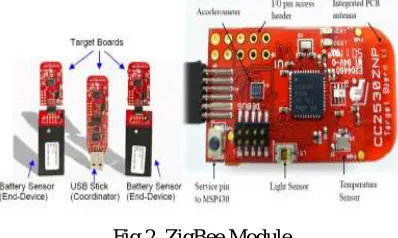
ZigBee is a specification for a suite of high-level communication protocols used to create personal area networks.ZigBee is a IEEE 802.15.4-based specification for a suite of high-level communication protocols used to create personal area networks with small, low-power digital radios.
in-home-displays, traffic management systems, and other consumer and industrial equipment that requires short-range low-rate wireless data transfer.
Its low power consumption limits transmission distances to 10–100 meters line-of-sight, depending on power output and environmental characteristics. ZigBee devices can transmit data over long distances by passing data through a mesh network of intermediate devices to reach more distant ones.
Fig 2. ZigBee Module
ZigBee is typically used in low data rate applications that require long battery life and secure networking (ZigBee networks are secured by 128 bit symmetric encryption keys.) ZigBee has a defined rate of 250 kbit/s, best suited for intermittent data transmissions from a sensor or input device.
ZigBee was conceived in 1998, standardized in 2003, and revised in 2006. The name refers to the waggle dance of honey bees after their return to the beehive.
3.2 WORKING PRINCIPLE
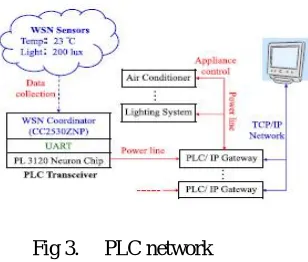
Figure displays the proposed architecture of the smart home control network. Two rooms in a smart home are considered as an example. Each home appliance is equipped with a PLC transceiver, which can directly receive commands to control the home appliance and send replies about the state of the home appliance to the management station. An isolated WSN, which includes various sensor nodes and one coordinator that is integrated into the PLC transceiver, is deployed in each room to collect environmental information, such as temperature, illumination, humidity, and other information. In the proposed architecture, WSNs are responsible for collecting environmental parameters and transmitting them to WSN coordinators. While PLCs are used as a network backbone to connect all WSN coordinators and transfer the collected environmental data to the management station and the control messages to home appliances. The proposed design in this work is quite different from that of conventional WSN-based smart homes in which the control commands for home appliances are transferred using WSNs. The main purposes of the proposed design are to extend the coverage of a smart home control network and mitigate the impact of wireless interference on the WSN data gathering subsystem.
3.3 POWER LINE COMMUNICATION
Power-line communication (PLC) carries data on a conductor that is also used simultaneously for AC electric power transmission or electric power distribution to consumers. It is also known as power-line carrier, power-line digital subscriber line (PDSL), A programmable logic controller, PLC, or programmable controller is adigital computer used for automation of typically industrial electromechanicalprocesses, such as control of machinery on factory assembly lines,amusement rides, or light fixtures. PLCs are used in many machines, in many industries. PLCs are designed for multiple arrangements of digital and analog inputs and outputs, extended temperature ranges, immunity to electrical noise, and resistance to vibration and impact. Programs to control machine operation are typically stored in battery-backed-up or non-volatile memory. A PLC is an example of a "hard" real-time system since output results must be produced in response to input conditions within a limited time, otherwise unintended operation will result.
consuming and expensive, aselectricians needed to individually rewire the relays to change their operational characteristics.
Fig 3. PLC network
Power-line communication (PLC) carries data on a conductor that is also used simultaneously for AC electric power transmission or electric power distribution to consumers. It is also known as power-line carrier, power-line digital subscriber line (PDSL), mains communication, power-line telecommunications, or power-line networking (PLN).A wide range of power-line communication technologies are needed for different applications, ranging from home automation to Internet access which is often called broadband over power lines (BPL). Most PLC technologies limit themselves to one type of wires (such as premises wiring within a single building), but some can cross between two levels (for example, both the distribution network and premises wiring). Typically transformers prevent propagating the signal, which requires multiple technologies to form very large networks. Various data rates and frequencies are used in different situations.A number of difficult technical problems are common between wireless and power-line communication, notably those of spread spectrum radio signals operating in a crowded environment. Radio interference, for example, has long been a concern of amateur radio groups.
IV. RESULT AND DISCUSSION
An isolated WSN with one coordinator, which is integrated into the PLC transceiver, is established in each room. There are 3 units which can control appliances by the one co – ordinator (ie . WSN) through the PLC transceiver. A prototype for the proposed smart home control network with the smart control algorithm was implemented.
Smart homes or control networks have adopted PLC technologies to build the communication systems. One of the most important benefits to use PLCs in this work is a less relevant packet failure rate for WSNs.
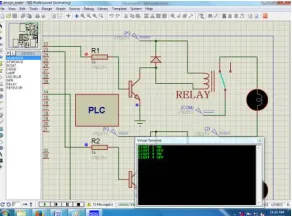
To control an appliances
1) Light is control through the data sender from the WSN through the PLC transceiver.
2) Virtual terminal is considered as an WSN and the PLC is connected in all microcontroller units
3) The data is transmitted from the Virtual terminal as ‘A’ it reaches the destination and the appliances controlled.
Fig 6.Control of various light.
To control an appliances
1) Number of appliances (ex. Light, Fan etc) is control through the data sender from the WSN through the PLC transceiver.
2) Virtual terminal is considered as an WSN the PLC is connected in all microcontroller units.
3) At the same time once the applicances gets activated it acknowledges the message to the Co-ordinater through PLC.
4) The high voltage appliances can be switch ON and OFF by Relay Circuit.
Fig 7. Representation of various appliances using PLC
To achieve this goal, smart controls must be implemented in a smart home.
1,According to the simulation results in packet failure not only deteriorates the final control achievement but also slows down the speed of approaching the control goal.
2.Accordingly, constructing the communication network with a low packet failure rate to support smart control systems is extremely required.
V. CONCLUSION
to intelligent buildings. A prototype of the proposed smart home control network with the smart lighting control was implemented.Simulations and practical experiments were conducted to demonstrate that the implemented prototype system works well and that the proposed smart home control network provides an reduced packet failure rate and considerable energy saving. Although numerical results have shown that the energy saving ratio in lighting is good, control of other home appliances, such as HVAC&R, must also be considered in future work to save more electrical energy.
REFERENCES
1. (2008,Dec.1).[Online].Available: http://www.un.org/News/ Press docs//2007/pop952.doc.htm 2012. 2. (2009, Jun. 23).[Online]. Available: http://www.who.int/ disabilities/en/
3. M. Chan, D. Est`eve, C. Escriba, and E. Campo, “A review of smartHomes-Present state and future challenges,” Comput. Methods Programs Biomed. vol. 91, pp. 55–81, Jul. 2008.
4. J. Hightower and G. Borriello, “Location systems for ubiquitous computing,”Computer, vol. 34, pp. 57–66, Aug. 2001.
5. E. D. Manley, H. A. Nahas, and J. S. Deogun, “Localization and tracking in sensor systems,” in Proc. IEEE Int. Conf. Sensor Netw., Ubiquitous, Trustworthy Comput., 2006, pp. 237–242.
6. R. J. Robles and T.-H. Kim, “Review: Context aware tools for smart home development,” Int. J. Smart Home, vol. 4, pp. 1–12, Jan. 2010. 7. D. Pishva and K. Takeda, “A product based security model for smart home appliances,” in Proc. 40th Annu. IEEE Int. Carnahan Conf. Security
Technol., 2006, pp. 234–242.
8. D. Pishva and K. Takeda, “Product based security model for smart home appliances,” IEEE Aerosp. Electron. Syst.Mag., vol. 23, no. 10, pp. 32–41, Oct. 2008.
9. R. Lutolf, “Smart Home concept and the integration of energy meters into a home based system,” in Proc. 7th Int. Conf. Metering Apparatus Tariffs Electr. Supply, 1992, pp. 277–278.
10. A. V. Berlo, A. Bob, E. Jan, F. Klaus, H. Maik, and W. Charles, Design Guidelines on Smart Homes: A COST 219bis Guidebook. Brussels, Belgium: Eur. Commission, 1999.