Department of ECE, Adhiyamaan College of Engineering, Hosur, Tamilnadu, India.
VLSI Implementation of a Parallel
Turbo-Decoder for Wireless Communication
Anitha.V
1, Menakadevi.T
2PG Scholar, Department of ECE, Adhiyamaan College of Engineering, Hosur, Tamil Nadu, India 1
Professor, Department of ECE, Adhiyamaan College of Engineering, Hosur, Tamil Nadu, India 2
ABSTRACT: Wireless sensor network can be considered to be energy constrained wireless scenarios, since the
sensors are operated for extended periods of time, while relying on batteries that are small, lightweight and sine expensive. Energy constrained wireless communication application is done with the help of lookup table-log-BCJR (LUT-Log-table-log-BCJR) architecture.. In our existing system the conventional LUT-Log-table-log-BCJR architecture have wasteful designs requiring high chip areas and hence high energy consumptions Energy constrained applications. This motivated our proposed System the LUT log BCJR is designed with Clock gating technique achieves low-complexity energy-efficient architecture, which achieves a low area and hence a low energy consumption, and also achieving a low energy consumption has a higher priority than having a high throughput. we use most fundamental add compare select (ACS) operations and It having low processing steps, so that low transmission energy consumption is required and also reduces the overallenergy consumption. Our demonstrated implementation has a throughput of 1.03 Mb/s.
KEYWORDS: Lookup table architectures, Clock gating technique, Throughput, ACS block, Transmission
energy.
I. INTRODUCTION
Turbo codes received a lot of interest from the research community, as they offer a performance unmatched by any other code so far. Turbo codes are also on the verge of finding their way in numerous cutting edge applications like cellular and satellite communications. A turbo decoder is composed of modules that work in an iterative scheme. Different alternatives exist for the algorithm incorporatedin these decoder modules.
Recent Application-Specific Integrated Circuit (ASIC)[1]based turbo decoder architectures have been designedfor achieving a high transmission throughput, rather than for low transmission energy. For example, turbo codes have facilitated transmission throughputs in excess of 50 Mbit=sin cellular standards, such as the 3rd Generation PartnershipProject 3GPP [2] Long Term Evolution (LTE) and recent ASICturbo decoder architectures have been designed for throughputsthat are in excess of 100 Mbit=s]. This has beenachieved by employing the Max-Log-BCJR [3] turbo decoding algorithm, which is a low-complexity approximation of theoptimal Logarithmic Bahl-Cocke-Jelinek-Raviv (Log-BCJR)algorithm.
Department of ECE, Adhiyamaan College of Engineering, Hosur, Tamilnadu, India.
II.PROPOSED ALGORITHM
LOG-BCJR algorithm with clock gating technique
There are two main advantages of inducing Log-BCJR algorithm. Firstly, the originalBCJR algorithm is consist of many multiplication operations which lead to very complexcircuits while implementing in hardware. Log-BCJR algorithm avoids the multiplicationsby transforming the algorithm into the logarithmic domain, where multiplicationsbecome additions. Secondly, the values of soft decisions in the normal domain couldhave a very large dynamic range and theoretically unlimited, which leads to a largeamount of memory space in practice. To transfer them to logarithmic domain reducesthe dynamic range of the soft decisions and consequently all the internal variables inthe algorithm. Hence significantly this approachreduces the memory requirement toimplement the algorithm. We use notation y to represent the systematic bits in theencoder including the termination bits, which means y = [a, e], and use fya to represent
The received uncoded sequence LLRs in our BCJR decoder {yn}^Ny n=1.
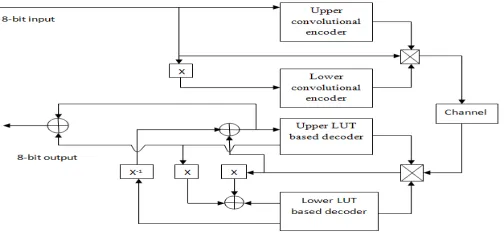
The conventional LUT-Log-BCJR architecture, which employs the sliding-window technique to generate the LLR sequence b1^e as the concatenation of wEqual-length sub-sequences. Each of these windows is generatedseparately, using a forward, a pre-backward and a backwardrecursion. These three different recursionsare performed concurrently for three different windows.For w=5. This schedule results in thecompletion of the windows in their natural order, starting withthat containing the first LLR b^e 1,1and ending with the one containingthe last LLR b^e 1,N
Fig. 1 Conventional lookup table architecture
When the forward recursion is performed for a particularwindow, one pair of its corresponding a priori LLRs
b^a 1,J and b^a 2,J is read from Mem 1 and processed per clockcycle, in the ascending order of the bit index . The forward recursionof the LUT-Log-BCJR algorithm can be performed in two pipelined steps using the corresponding dedicated hardwarecomponents.
Clock gating is a technique which is used to control power dissipated by clock input.The disadvantage of the clock gating is that the enable signal is generated by user software. If the protocol can generate the enable signal automatically by itself, the user software will be no need. Any application core can be modeled as a Finite State Machine (FSM) which includes several states like Idle, Ready, Run and so on. The state and the transition of the design will be mapped to the sequential circuit and the combinational circuit respectively.
Department of ECE, Adhiyamaan College of Engineering, Hosur, Tamilnadu, India.
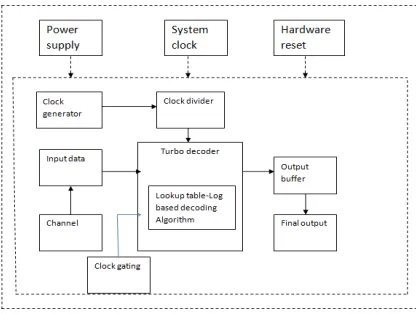
hardware.The proposed system consists of a novel architecture suits for the energy-constrained scenarios, which avoids the wastage of energy in the conventional architecture. The min work is to redesign the timing of the conventional architecture in a manner that allows the components to be efficiently merged. This produces an architecture comprising only a low number of low-complexity functional units, which are collectively capable of performing the entire algorithm. More wastage is avoided, since the critical paths of the functional units are naturally short and equally lengthened. This eliminates the requirement for additional hardware used for the purpose of managing.
Fig. 2 Proposed system architecture.
IV.RESULTS AND DISCUSSION
At the encoder side the 8-bit data is been generated with the help of Linear Feedback Shift Register, the obtained output is encrypted and finally sent through the communication channel. For the purpose of encryption we use a constant 8-bit code to do the process of “AND”ing with the original bit.
Fig. 3 Waveform of generating random input
Department of ECE, Adhiyamaan College of Engineering, Hosur, Tamilnadu, India.
Fig.4 Waveform of clock divider.
The proposed architecture is implemented at the decoder side and carries out the further decoding operation.
Fig 5 Waveform of counter.
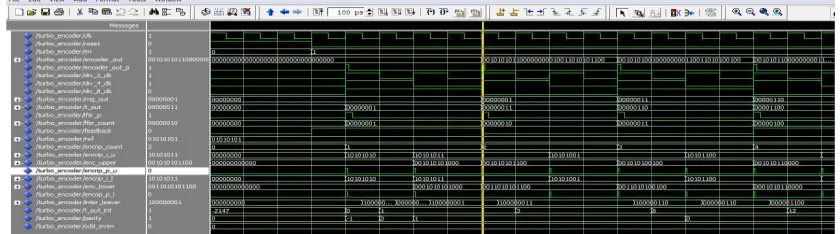
The turbo-encoder that includes the above designed block such as 8-bit input data generation, clock divider and counter for the process of encoding. In this design the input bits are encrypted using XOR operation. Further the code is sent through the channel for the turbo decoder. This turbo encoder uses aninterleaver for error detection and correction purpose. The final output waveform
Fig. 6 Output waveform of turbo encoder
V.CONCLUSION
Department of ECE, Adhiyamaan College of Engineering, Hosur, Tamilnadu, India.
hence a low energy consumption by decomposing the LUT-Log-BCJR algorithm into its most fundamental ACS operations. In addition, the proposed architecture may be readily reconfigured for different turbo codes or decoding algorithms. We validated the architecture by implementing an LTE turbo decoder, which was found, in Table III, to have an order-of-magnitude lower area than conventional LUT-Log-BCJR decoder implementations and an approximately 71% lower energy consumption of 0.4 nJ/bit/iteration. Compared to state of the art Max-Log-BCJR implementations, our approach facilitates a 10% reduction in the overall energy consumption at transmission ranges above 58 m. Furthermore, we demonstrated that our implementation has a throughput of 1.03 Mb/s, which is appropriate for energy-constrained applications, such as in environmental monitoring WSNs.
REFERENCES
[1] ChristophStuder, Christian Benkeser ,SandroBelfanti, and Qiuting (2011) ‘Design and Implementation of a Parallel Turbo-Decoder ASIC for 3GPP-LTE’, IEEE journal of solid-state circuits.
[2] T.Wark, R.jurdak (Nov 2010) “Error Control Coding in Low-Power Wireless Sensor Networks: When is ECC Energy-Efficient”Proc. IEEE, vol98, pp. 1903-1917.
[3] C.Schlegel, and K.Iniewski (2011), “Energy Efficiency of the IEEE 802.15.4 Standard in Wireless Sensor Networks: Modeling and Improvement Perspectives”IEEE 802.15.4 standard.
[4] E. Boutillon, C. Douillard, and G. Montorsi (Jun 2007) ‘Iterative decoding of concatenated convolutional codes: Implementation issues’, Proc. IEEE, vol. 95, no. 6, pp. 1201–1227.
[5]S.Badrinarayanan, J.M.Mathana and R.RaniHemamaliniKarthik (Feb 2014) ‘Efficient VLSI architecture of SISO based Turbo decoder for wireless applications’, International Journal of Advanced Research in Electrical, Electronics and Instrumentation Engineering. Vol. 3, Issue 2.