HIGHLIGHTED ARTICLE
GENETICS | INVESTIGATION
Genotype-Frequency Estimation from
High-Throughput Sequencing Data
Takahiro Maruki1and Michael Lynch Department of Biology, Indiana University, Bloomington, Indiana 47405
ABSTRACT Rapidly improving high-throughput sequencing technologies provide unprecedented opportunities for carrying out population-genomic studies with various organisms. To take full advantage of these methods, it is essential to correctly estimate allele and genotype frequencies, and here we present a maximum-likelihood method that accomplishes these tasks. The proposed method fully accounts for uncertainties resulting from sequencing errors and biparental chromosome sampling and yields essentially unbiased estimates with minimal sampling variances with moderately high depths of coverage regardless of a mating system and structure of the population. Moreover, we have developed statistical tests for examining the significance of polymorphisms and their genotypic
deviations from Hardy–Weinberg equilibrium. We examine the performance of the proposed method by computer simulations and
apply it to low-coverage human data generated by high-throughput sequencing. The results show that the proposed method improves our ability to carry out population-genomic analyses in important ways. The software package of the proposed method is freely
available fromhttps://github.com/Takahiro-Maruki/Package-GFE.
KEYWORDSgenotype frequency; Hardy–Weinberg test; inbreeding coefficient; polymorphism detection; population genomics
T
HE estimation of allele and genotype frequencies is fun-damental in population-genetic studies. Most evolution-ary inferences in population genetics, including those concerned with population demography and natural selection, start with this sort of information. When we study the relationship between genotypes and phenotypes in a population, proper inferences on genotype frequencies are also essential. There-fore, it is crucial to correctly estimate allele and genotype fre-quencies in population-genetic studies.High-throughput sequencing technologies enable the ex-tension of population-genomic analyses to a wide variety of organisms, which will improve our ability to draw evolution-ary inference in several ways. First, rapidly declining sequenc-ing costs enable researchers to sequence many individuals in a population. One of the majorfindings of recent population-genomic studies is the discovery of polymorphic sites harbor-ing rare alleles and their importance in genotype–phenotype relationships. For example, Nelsonet al.(2012) sequenced
202 drug-target genes in a sample of 14,002 human individ-uals and found that rare alleles likely associated with disease are abundant. Second, genome-wide analyses of polymor-phisms provide a basis for much more accurate inferences of natural selection and population demography than can be obtained with more limited data (Luikart et al. 2003). Finally, because most models for inferring population demog-raphy assume neutral evolution, exclusion of sites that are targets of natural selection is desirable, and this is substan-tially easier to accomplish with whole-genome sequence data.
Despite the promise, high-throughput sequencing technol-ogies have two disadvantages: high sequence error rates, which typically range from 0.001 to 0.01 with commonly used sequencing platforms (Glenn 2011; Quailet al.2012); and genotypic uncertainties resulting from random chromo-some sequencing. Because sequencing occurs randomly among sites, individuals, and chromosomes within diploid individuals, depths of coverage vary among them, and this can introduce biases in subsequent population-genetic anal-yses unless accounted for in a proper statistical framework (Poolet al.2010).
To overcome the above difficulties in estimating allele and genotype frequencies from high-throughput sequencing data, several statistical methods have been recently developed Copyright © 2015 by the Genetics Society of America
doi: 10.1534/genetics.115.179077
Manuscript received June 5, 2015; accepted for publication July 26, 2015; published Early Online July 29, 2015.
Supporting information is available online at www.genetics.org/lookup/suppl/ doi:10.1534/genetics.115.179077/-/DC1.
(Hellmannet al.2008; Johnson and Slatkin 2008; Jianget al.
2009; Li et al.2009b; Lynch 2009; Hohenlohe et al. 2010; McKenna et al.2010; DePristoet al.2011; Kim et al.2011; Keightley and Halligan 2011; Li 2011; Le and Durbin 2011; Nielsen et al. 2012; Vieira et al. 2013; Lynchet al. 2014). Among these, Lynch (2009) developed a maximum-likelihood (ML) method for estimating site-specific allele frequencies and error rates from high-throughput sequencing data, assuming Hardy–Weinberg equilibrium (HWE).
In this study, we generalize the ML allele-frequency estimator to allow application to diploid organisms with an arbitrary mating system and population structure. Spe-cifically, we relax the assumption of HWE by adding to the model parameters the site-specific disequilibrium co-efficient (Weir 1996), which measures the deviation of genotype frequencies from their HWE expectations. Fur-thermore, we develop statistical tests for the significance of polymorphisms and deviations from HWE. Examination of the performance of the proposed method with computer simulations reveals the generation of essentially unbiased estimates of allele and genotype frequencies with moder-ately high depths of coverage under general genetic conditions. As an example application to empirical data, we apply the proposed method to low-coverage, high-throughput sequencing data of 81 individuals from the CEU (Utah residents with ancestry from Northern and Western Europe) population generated in the human 1000 Genomes Project (1000 Genomes Project Consortium
et al.2012).
Methods
In the following, a maximum-likelihood (ML) method is de-veloped for estimating the genotype frequencies at a site, using high-throughput sequencing data from a diploid pop-ulation, which need not be in Hardy–Weinberg equilibrium. This is achieved by estimating three parameters from a pop-ulation sample of observed site-specific sequence read data: the major-allele frequency p, disequilibrium coefficientDA;
and the error rate per read per sitee. The proposed method assumes that the attribution of sequence reads to specific individuals is known,e.g., by uniquely tagging the DNA from each individual prior to sequencing. The two most abundant nucleotides in the population sample are considered to be candidates for alleles at the site.
For each individuali, the log-likelihood of the observed set of site-specific sequence reads is
lnLi¼ln
X3
g¼1
ggPg
niM;nim;nie1;nie2 2
4
3
5; (1)
whereggdenotes genotype frequencies, withg1¼p2þDA; g2¼2fpð12pÞ2DAg;andg3¼ ð12pÞ
2þ
DA;andniM;nim; nie1;nie2 are the observed number of reads of the most abun-dant nucleotide (major allele)M(e.g., C), the second-most
abundant nucleotide (minor allele)m(e.g., T), and other nucleotides e1 and e2 (e.g., in this case A and G), respec-tively. PgðniM;nim;nie1;nie3Þis the probability of the specific observed set of nucleotide reads given genotype g. Given a total depth of sequence coverage at the site in individual
i,niT¼niMþnimþnie1þnie2;PgðniM;nim;nie1;nie2Þis calcu-lated using the following formula for the multinomial distribution,
Pg
niM;nim;nie1;nie2
¼ niT!
niM!nim!nie1!nie2!
PgðMÞniM PgðmÞnimPgðe
1Þnie1 Pgðe2Þnie2; (2) wherePgðMÞis the probability of observed nucleotide readM
with genotypeg.PgðMÞis a function ofeand is obtained by
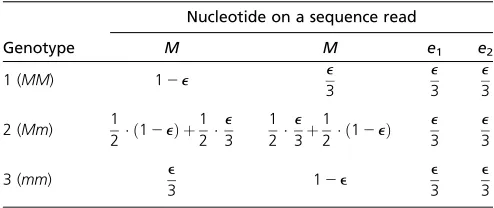
summing conditional probabilities of observed nucleotide readM, given the true nucleotide on the sequenced chromo-some chosen from the pair (Table 1). For example, when
g = 2 (Mm), the probability of nucleotide read M is
P2ðMÞ ¼ ð1=2Þð12eÞ þ ð1=2Þðe=3Þ; the second term aris-ing because we assume a random distribution of sequenc-ing error types. In practice, because the multinomial coefficient in Equation 2 is constant regardless of the values of the parameters to be estimated, for computa-tional efficiency, we reduce the preceding expression to
Pg
niM;nim;nie1;nie2
¼PgðMÞniMPgðmÞnimPgðe
1Þnie1Pgðe2Þnie2: (3) The ML estimates of the major-allele frequency, disequilib-rium coefficient, and error rate are found by maximizing the log-likelihood of the observed site-specific reads in the entire population sample, which is calculated by summing the log-likelihood (Equation 1) overNindividuals:
lnL¼X
N i¼1
lnLi: (4)
To accurately and rapidly estimate the parameters, we take two steps. Wefirst analytically estimate the allele frequencies and error rate and then conditioned on these approximations estimate the disequilibrium coefficient by a grid search. In the second step, we refine the preliminary ML estimates, using Equation 4. The preliminary estimates of the major-allele frequency and error rate are
^
p¼ 2nM2ne
2ðnMþnm2neÞ;
(5)
^e¼3
2
ne
nT; (6)
(Appendix), wherenM;nm;ne;andnTare the read counts of
A preliminary estimate of the disequilibrium coefficient
^
DAis obtained by substituting^pand^einto Equation 4 and finding the value ofDAthat maximizes the likelihood of the
observed data. The minimum and maximum possible val-ues of DA; DAmin and DAmax; are functions of the allele-frequency estimates and can be derived by noting that all of the three genotype frequencies need to be between zero and one,
DAmin¼max h
2^p2;2ð12^pÞ2i (7)
DAmax¼^pð12^pÞ (8)
(Weir 1996). Because the maximization is now reduced to a one-dimensional problem,D^Ais rapidly found by a search
over the span of possibleDAwith interval size 1=N:
Although the preliminary genotype-frequency esti-mates are reasonable for many cases, in situations involv-ing small numbers of individuals and/or high variance in coverage among individuals, unnecessarily high estima-tion variance can arise. To overcome this limitaestima-tion, we iteratively adjust the parameter estimates by examining whether the set of parameter estimates yields a local maximum in the likelihood surface, iterating by a localized grid search. Specifically, for each current estimate of major- and minor-homozygote frequency estimates ^g1 and g^3;we evaluate the likelihood of all adjacent pairs of estimates deviating by 1=N;whereNis the sample size. This procedure is repeated until no deviations from the current ML estimate yield further increases in the likelihood.
If thefinal ML estimate of the major-allele frequency^pis less than one, the ML disequilibrium coefficient estimateD^A
and inbreeding coefficient estimate^f are calculated as
^
DA¼g^12^p2 (9)
^
f ¼2^pð12^pÞ2g^2
2^pð12^pÞ ; (10)
where^g2is the ML estimate of the heterozygote frequency.
Statistical test of candidate polymorphisms
To avoid false-positive polymorphisms, we statistically test the significance of candidate polymorphisms by a likelihood-ratio test (Kendall and Stuart 1979). Letting LLp and LLm denote the maximum log-likelihood of the observed site-specific data under the assumptions of polymorphism and monomorphism, respectively, the likelihood-ratio test statis-tic LRTpis
LRTp¼2
LLp2LLm
; (11)
whereLLpis the maximum value of the log-likelihood given by Equation 4. LLmis calculated as
LLm¼ XN
i¼1
lnLim; (12)
where the log-likelihood of the observed data for individuali
under the assumption that the population is fixed for the major allele is
Lim¼ð12^emÞniM ^
em 3
niT2niM
; (13)
where^em is the ML estimate of the error rate, and the mul-tinomial coefficient is again ignored.^emis analytically found by taking the derivative of the likelihood function with re-spect toemand setting it equal to zero, yielding
^ em¼
nT2nM
nT ;
(14)
where nT and nM are the total number of nucleotide reads
and number of the most abundant nucleotide read, respec-tively, in the population sample. LRTp is expected to be as-ymptoticallyx2distributed with 2 d.f.
Statistical test of Hardy–Weinberg equilibrium deviation
When a site is considered to be polymorphic by the preceding test, the deviation from HWE can also be statistically evalu-ated with a likelihood-ratio test, in this case using
LRTHWE¼2ðLL2LLHWEÞ; (15) whereLLis the maximum log-likelihood of the observed site-specific data under the full model, calculated using Equation 4.LLHWEis the corresponding maximum log-likelihood of the observed site-specific data assuming HWE, calculated by substituting ^p and ^e into Equation 4 with D^A set to zero.
LRTHWEis expected to be asymptoticallyx2distributed with 1 d.f.
Sampling variance of the genotype-frequency estimates
If genotypes could be inferred from all individuals without error, the sampling variances of the ML estimates of the major-allele frequency ^p; major-homozygote frequency ^g1; and minor-homozygote frequency
^
g3would beTable 1 Probability of an observed nucleotide read as a function of the individual genotype and error ratee
Nucleotide on a sequence read
Genotype M M e1 e2
1 (MM) 12e e
3
e
3
e
3
2 (Mm) 1
2 ð12eÞ þ 1 2 e 3 1 2 e 3þ 1 2 ð12eÞ
e
3
e
3
3 (mm) e
3 12e
e 3
e 3
Varð^pÞ ¼ 1
2N
pþg122p2
(16)
Varð^g1Þ ¼ 1
Ng1ð12g1Þ (17)
Varð^g3Þ ¼ 1
Ng3ð12g3Þ (18)
(Weir 1996). The sampling variances of the ML estimates by the proposed method are expected to asymptotically ap-proach these values with high depths of coverage.
However, in high-throughput sequencing data, depths of coverage vary among sites, individuals, and chromosomes within individuals. Therefore, Equations 16–18 need to be modified. We do so by assuming that the depth of coverage at each site per individual is Poisson distributed with meanm and considering the effective numbers of sampled chromo-somes and individuals (Maruki and Lynch 2014), defined here at a single locus, and substituting them for 2NandN
in Equations 16–18. The effective number of sampled chro-mosomesNcis equivalent to the expected number of sampled chromosomes covered by at least one sequence read, and that of sampled individualsNiis equivalent to the expected num-ber of sampled individuals for which both alleles are covered by at least one sequence read. These are given by
Nc¼2N
12e2m=2
(19)
Ni¼N 12
2em=221
e2m
: (20)
We substituteNcfor 2Nin Equation 16 andNiforNin Equa-tions 17 and 18 to obtain the expected asymptotic sampling-variance formulas.
Generation of high-throughput sequencing data by computer simulations
To examine the performance of the proposed genotype-frequency estimator, we generated high-throughput sequencing data forNdiploid individuals by computer sim-ulations and applied the proposed method to the simulated data. In the simulations, the probability of sampling an indi-vidual with a particular genotype was equal to its relative fre-quency. The frequencies of major and minor homozygotes were specified byg1andg3;respectively. The depths of cov-erage were assumed to be Poisson distributed with meanm among the individuals and were specified as
cðX;mÞ ¼ðmÞ
Xe2m
X! ; (21)
whereXis a particular value of the coverage for an individ-ual andcis a probability mass function ofX. The sequences from each individual were randomly chosen from the pair of alleles. Sequence errors were randomly introduced at ratee from the true nucleotide to one of the other three
nucleo-tides. A C++ program for simulated data analysis ( Support-ing Information, File S1) and its README (File S2) are available.
Application to empirical data
To further examine the performance of the proposed method when applied to actual data, we analyzed low-coverage (mean 43) phase I data of the 1000 Genomes Project Consortium (1000 Genomes Project Consortiumet al.2012). Specifically, we analyzed chromosome 6 data of individuals from the CEU population. We downloaded BAMfiles of the Illumina-sequencing read data from the Web site ftp-trace.ncbi.nih. gov/1000genomes/ftp/phase1/data/. There were a total of 81 suchfiles (File S3). We also downloaded the corresponding reference genome (GRCh37) used for mapping the sequence-read data from the Web siteftp.1000genomes.ebi.ac.uk/vol1/ ftp/technical/reference/.
Then, we generated mpileup files of the position-based sequence data, using SAMtools (Liet al.2009a). The quartets of nucleotide read counts at each position necessary for the analyses were generated from the mpileupfiles, using sam2pro (http://guanine.evolbio.mpg.de/mlRho/sam2pro_0.6.tgz). To minimize mismapping of sequence reads, we excluded sites with the total depth of coverage in the population sample (sum of the coverage over the individuals) greater than twice the mean before subsequent analyses. Furthermore, we excluded sites involved in putative repetitive sequences predicted by RepeatMasker (http://www.repeatmasker. org/) before subsequent analyses. We used the repeat-masked GRCh37 reference genome downloaded from the Ensembl Web site,ftp.ensembl.org/pub/release-75/fasta/ homo_sapiens/dna/for this purpose. To avoid estimating the parameters from only a few individuals, we required that the total depth of coverage in the population sample be at least 81.
To examine the spatial patterns of polymorphisms char-acterized by the proposed method, we carried out sliding-window analyses of the per-site heterozygosity estimatesh^
[using 2^pð12^pÞ;where^pis the major-allele frequency es-timate] and inbreeding coefficient estimates^f:To describe
fine spatial patterns of polymorphisms, we calculated the weighted mean of
^
hor^pin each window (Hohenloheet al.Comparison with other recently developed methods
To compare the performance of the proposed method with that of other recently developed methods, we analyzed the chromosome 6 data of 81 CEU individuals, using ANGSD (Korneliussen et al. 2014). To make fair comparisons, we made a list of sites analyzed by the proposed method and supplied it to ANGSD so that both approaches were applied to the same set of sites.
We estimated the allele frequencies from the BAMfiles of the 81 individuals, using the method by Kimet al.(2011) and Samtools (Li 2011) or GATK (McKennaet al.2010) genotype likelihoods, and compared their allele-frequency estimates to those by the proposed method.
We estimated the folded site-frequency spectrum from the BAMfiles of the 81 individuals, using the method by Nielsen
et al.(2012), and compared this to the results using the pro-posed method. We calculated the site-allele-frequency likeli-hood, assuming Hardy–Weinberg equilibrium, using Samtools or GATK genotype likelihoods.
We estimated per-site inbreeding coefficients from the BAM files of 81 individuals, using the method by Vieira
et al.(2013) and Samtools genotype likelihoods. We examined the statistical significance of polymorphisms by the likelihood-ratio test described in Kimet al.(2011). Using per-site inbreeding coefficient estimates conditioned on significant polymorphisms at the 5% level, we carried out their sliding-window analysis in the way described above and compared the results with those using the proposed method.
Data availability
The software package of the proposed method is available from https://github.com/Takahiro-Maruki/Package-GFE.
File S1contains a C++ program for simulated data analysis.
File S2contains the README of the program.File S3contains names of the analyzed BAMfiles of Illumina-sequencing read data of 81 individuals from the CEU population, which are available from the Web site ftp-trace.ncbi.nih.gov/ 1000genomes/ftp/phase1/data/.
Results
The performance of the proposed genotype-frequency es-timator was examined using computer simulations described above. To examine the results for the worst situations, we used 0.01 as the error rate, which is typically the upper bound in commonly used sequencing platforms. We evaluated the behavior of the proposed method under HWE and two extreme conditions, where the inbreeding coefficient f
is minimized or maximized given a minor-allele frequency
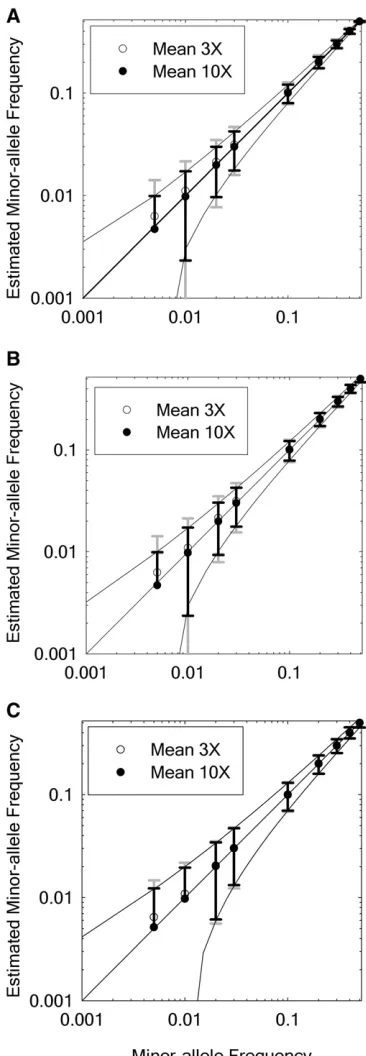
q. Specifically, the frequencies of major homozygotes, heter-ozygotes, and minor homozygotes are 122q; 2q; and 0, respectively, whenfis minimized. Whenfis maximized, the frequencies of major homozygotes, heterozygotes, and minor homozygotes are 12q;0, andq, respectively. The means of the ML estimates of the allele frequencies were essentially
unbiased under all three examined conditions, although fre-quencies of rare alleles were slightly overestimated with low depths of coverage, due to sequence errors (Figure 1). The sampling standard deviations of the estimates became lower and approached the theoretical minimum values with higher depths of coverage under all conditions.
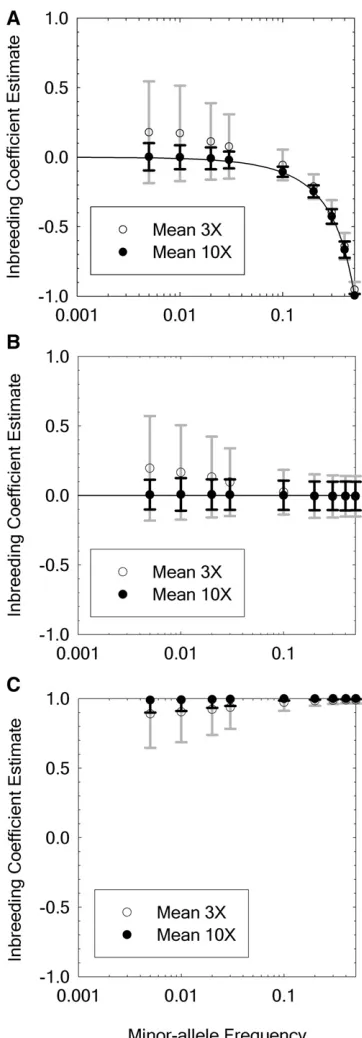
The means of the ML estimates of the inbreeding coefficient were somewhat biased when the mean depth of coveragem was low and allele frequencies were extreme (q,0:1) (Fig-ure 2). Specifically, they were upwardly biased when f
was minimized or equal to zero, due to sequencing just one of the two alleles from heterozygous individuals. On the other hand, they were downwardly biased whenfwas max-imized, due to sequence errors. However, they were nearly unbiased whenq$0:1 even whenmwas low (3), and when
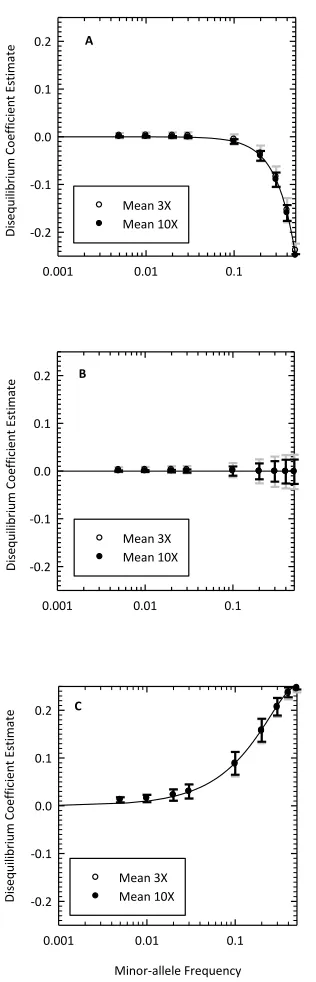
mwas moderately high (10), they were essentially unbiased under all of the examined conditions. We note that the biases in the inbreeding coefficient estimates with low depths of coverage are relatively large because they are ratios measur-ing relative deviation of genotype-frequency estimates from their HWE expectations. In fact, the corresponding biases in the disequilibrium coefficient estimates are small (Figure S1).
The means of the ML estimates of major-homozygote frequencies were essentially unbiased even with low depths of coverage (Figure S2, A, C, and E). On the other hand, the means of the ML estimates of minor-homozygote frequencies were slightly biased whenmwas low (3) (Figure S2, B, D, and F). Specifically, they were slightly overestimated when f
was minimized or equal to zero. Whenfwas maximized, they were slightly underestimated. These biases in minor-homozygote frequency estimates can be understood by considering the interplay among the parameter estimates (Table 2). In particular, they are closely related to the biases in the inbreeding coefficient estimates. The sam-pling standard deviation of the ML estimates of genotype frequencies became lower and approached the theoretical minimum values with higher depths of coverage under all of the examined conditions.
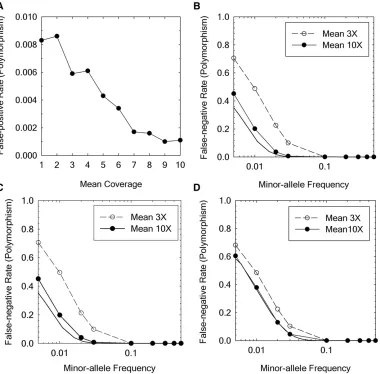
We examined the power of the proposed method for detecting true polymorphisms as a function of the mean depth of coverage m, rejecting the null hypothesis of monomor-phism at a site at the 5% significance level (when LRTp in Equation 11 was.5.991). Overall, the false-positive rate of polymorphism detection was low and decreased with higher
m(Figure 3A).
Because the statistical power of polymorphism detection should be dependent on the minor-allele frequencyqat a site, we also examined the false-negative rate of polymorphism detection as a function of q (Figure 3, B–D). Whenq was low, the false-negative rate was high, especially with low depths of coverage. We note that this is because of the in-herent limitations resulting from sampling only one of the alleles and not because of faults of the proposed method. The false-negative rate declined with higher q and m and became zero when q$0:1 even when m¼3 under all of
the conditions. These results indicate that the proposed method both is conservative and has reasonably high power for detecting polymorphisms with minor-allele frequencies
$0:1:
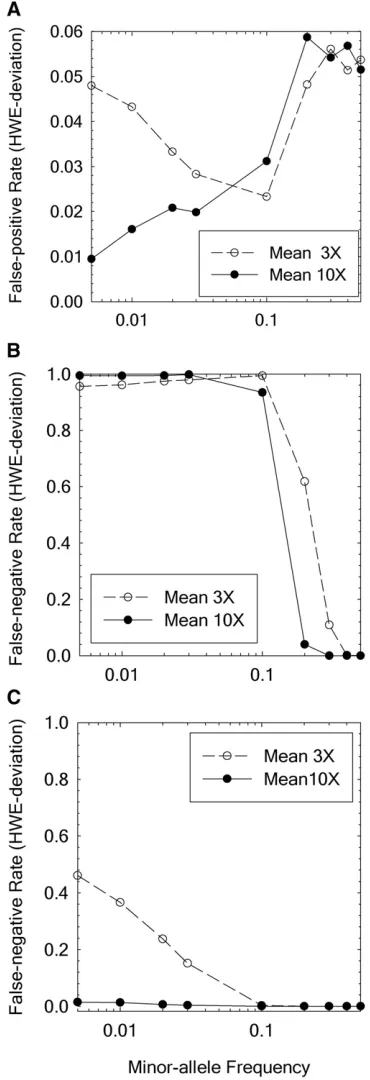
In carrying out power analysis of the HWE-deviation de-tection by the proposed method as a function ofm, we rejected the null hypothesis of HWE at a site at the 5% significance level (when LRTHWE in Equation 15 was.3.841). Because we carry out the statistical test of HWE deviation only when the site is considered to be polymorphic, and the power for detecting polymorphisms depends on minor-allele frequen-cies, we examined false-positive and -negative rates of HWE-deviation detection as a function ofq(Figure 4). Overall, the false-positive rate was close to or below the specified signif-icance level (0.05) with examined parameter values (Figure 4A). When m was low (3), the false-positive rate had its minimum whenq= 0.1. This pattern can be understood by considering the sampling effects. Whenq,0.1, the fre-quency of minor homozygotes is low (, 0:01), and most minor alleles exist in heterozygotes. When m is low, only one of the alleles can be sequenced from heterozygotes, lead-ing to excess of homozygotes and false deviation from HWE. Whenq.0.1, the frequency of heterozygotes becomes rel-atively high, and they can be sampled more often than expected, leading to excess of heterozygotes and false devi-ation from HWE.
The false-negative rate of the HWE-deviation detection decreased with increasedqandmboth whenfwas minimized and whenfwas maximized (Figure 4, B and C). The false-negative rate was high whenfwas minimized andqwas low (q#0:1) (Figure 4B). However, when q $ 0.3, the false-negative rate was reasonably low both when m¼3 and
m = 10. On the other hand, when f was maximized, the false-negative rate was reasonably low (Figure 4C). In par-ticular, whenq$0:1;the false-negative rate was essentially zero even whenm¼3:The much higher false-negative rate with minimum f compared to that with maximum f, espe-cially when q is low, is not due to faults of the proposed method but due to the following factors. First, the deviation of genotype frequencies from HWE, which can be measured as the absolute value of f, is small with low q when f
is minimized compared to that when f is maximized. When f is minimized, f ¼q=ðq21Þ (Weir 1996) and
jfj ¼q=ð12qÞ;which is small whenqis low. On the other hand, whenfis maximized,jfjis always equal to one, regard-less ofq. Second, only one of the alleles from a heterozygote can be sampled when m is low. These make detecting the
excess of heterozygotes much more difficult compared to detecting the deficit of heterozygotes.
Our evaluation of the performance of the proposed method with the low-coverage (mean 43) sequencing data on chro-mosome 6 for 81 individuals revealed 8,528,190 sites with minor-allele frequency (MAF) estimates .0;implying potential polymorphisms. The vast majority (92%) of these were singletons or doubletons, with the number of sites de-creasing with inde-creasing minor-allele count estimates (Figure 5A). Of these potential polymorphisms, 452,577 were signif-icant at the 5% level, and 33% of these were singletons or doubletons. These numbers are much less than the corre-sponding values for the entire pool of sites with MAF esti-mates .0;reflecting both the difficulty with distinguishing rare alleles from sequence errors and the limited power of the statistical test forfinding significant polymorphisms involv-ing rare alleles with low depths of coverage. However, the site-frequency distribution at significantly polymorphic sites was nearly identical to that for the entire pool of sites with MAF estimates .0;provided the minor-allele count estimate was.16 (MAF estimates .0:1). In fact, the fraction of sig-nificantly polymorphic sites is $95% when MAF estimates are .0:1 (Figure 5B), which is consistent with the simula-tion results showing that the power of the method is high with MAF .0:1 even when depths of coverage are low.
We compared the performance of our allele-frequency estimation with that by ANGSD (Korneliussenet al.2014). We estimated allele frequencies at each site, using the method by Kim et al. (2011), and compared their allele-frequency estimates with ours (Figure S3). Their allele-frequency estimates with both Samtools and GATK genotype likelihoods were similar to ours except when they were close to zero or one. When allele-frequency estimates were close to zero or one, their estimates were closer to zero or one than ours.
We compared the site-frequency spectrum estimated by the proposed method with that by Nielsenet al.(2012). Of the sites analyzed, 0.54% were significantly polymorphic at at the 5% level by the proposed method. The fraction of poly-morphic sites by Nielsenet al.’s method was similar to ours but varied, depending on the genotype-likelihood model used, 0.39% with the Samtools model and 0.51% with the GATK model.
Consistent with thefindings by Korneliussenet al.(2014), the site-frequency spectrum (SFS) by ANGSD also varied, depending on the genotype-likelihood model used (Figure S4). Specifically, the SFS with the GATK model showed more Table 2 Interplay among the parameter estimates as a function of the inbreeding coefficientfwhen the
minor-allele frequencyqis low (q<0.1) and depth of coverage is low (e.g., mean 33)
f q^ f
^
Q^
Minimized Slightly overestimated Somewhat overestimated Slightly overestimated Zero (HWE) Slightly overestimated Somewhat overestimated Slightly overestimated Maximized Slightly overestimated Somewhat underestimated Slightly underestimated
polymorphic sites with low minor-allele frequencies than that with the Samtools model. The corresponding SFS by the pro-posed method was more similar to Nielsenet al.’s (2012) SFS with the GATK model than to that with the Samtools model. Interestingly, our SFS showed more singletons and double-tons and was smoother than either of SFSs estimated by ANGSD. Furthermore, our SFS showed an excess of single-tons and doublesingle-tons compared to the theoretical prediction in a population with constant size (Ewens 2004), which is consistent with previous results reporting that many human populations show an excess of rare variants as a result of recent population growth (e.g., Coventryet al.2010; Keinan and Clark 2012). These results indicate that the proposed method may enable more accurate description of the SFS and powerful detection of rare variants than the currently widely used methods.
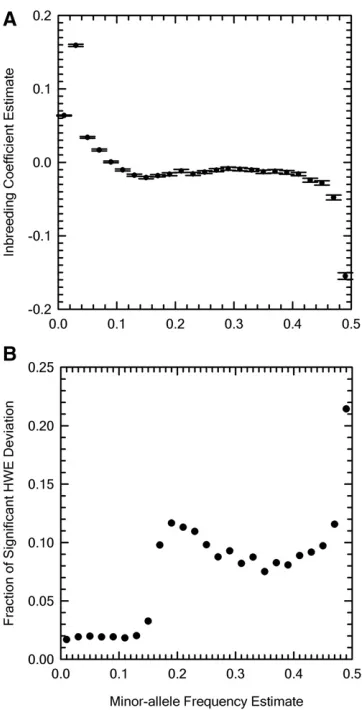
To evaluate the deviation of genotype frequencies from HWE, we examined the inbreeding coefficient estimates as a function of MAF estimates at the significantly polymorphic sites (Figure 6A). The majority of the sites had inbreeding coefficient estimates close to zero, and the mean estimate (0.038) was also close to zero. Of the 452,577 significant SNPs, only 18,595 (4%) significantly deviated from HWE.
These results are consistent with previous studies estimating small amounts of inbreeding in human populations (e.g., Weiret al.2004). When MAF estimates were low (,0.05), the inbreeding coefficient estimates were relatively high, pre-sumably due to the upward biases when MAFs are extreme and depths of coverage are low. In fact, only a small fraction (2%) of significant SNPs with MAF estimates,0.05 signifi -cantly deviated from HWE (Figure 6B). When MAF estimates were intermediate (between 0.1 and 0.4), the mean of the inbreeding coefficient estimates fluctuated around 20.01, which is close to the intrinsic downward bias of the inbreed-ing coefficient of 1/(2N21) when ML methods are applied to populations in HWE (Weir 1996).
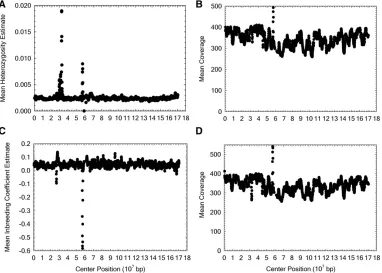
Interestingly, when MAF estimates approached 0.5, the inbreeding coefficient estimates suddenly dropped, and a sub-stantial fraction (21%) of significant SNPs significantly de-viated from HWE. Because our inbreeding coefficient estimates are essentially unbiased when MAFs are high, this is not due to an artifact of the proposed method. To examine the cause of this observation, we examined the spatial patterns of poly-morphisms on chromosome 6 by sliding-window analyses (Figure 7). Consistent with previous studies (Garrigan and Hedrick 2003; Solberget al.2008), heterozygosity was highly Figure 3 Power analysis of poly-morphism detection by the pro-posed method. The significance of the polymorphism test is set at the 5% level. (A) The false-pos-itive rate of polymorphism detec-tion as a funcdetec-tion of the mean depth of coverage is shown. The false-negative rate of polymor-phism detection as a function of the minor-allele frequency q is shown when the inbreeding co-efficient is (B) minimized, (C) equal to zero (Hardy–Weinberg equilibrium), or (D) maximized. The solid curve in B–D represents the theoretical minimum of the false-negative rate, which is due to sampling only one of the alleles and calculated as (1 2 2q)N, (12q)2N+q2N, and (12
q)N + qN, respectively, whereN
elevated in the region around 33107 bp, where many hu-man leukocyte antigen (HLA) genes are clustered (Figure 7A). However, inbreeding coefficient estimates in the HLA region (28,477,797–33,448,354 bp) were not very different from those in the other regions (Figure 7C).
The heterozygosity was also highly elevated compared to the others in the region around 5:743107;but here the in-breeding coefficient estimates were highly negative com-pared to those in the other regions. The unusual excess of heterozygote frequency estimates in this region was also seen by sliding-window analysis of the disequilibrium coefficients, which were highly negative in this region but close to zero in the majority of the other analyzed regions (Figure S5A). Con-trary to our analyses, the corresponding inbreeding coeffi -cient estimates by the method of Vieiraet al. (2013) were close to zero in this region, implying HWE (Figure S5B). In fact, Vieiraet al.’s method estimated no negative inbreeding Figure 5 Polymorphisms on human chromosome 6 characterized by the proposed method. (A) The distribution of polymorphic sites in terms of their minor-allele count estimates. The vast majority of sites with nonzero MAF estimates are singletons and doubletons (5,923,034 and 1,951,233 sites, respectively) and these results are not shown. All results are shown for significant (at the 5% level) SNPs. (B) The fraction of significantly polymorphic sites as a function of their minor-allele count estimates.
coefficients. Although the error rate estimates in this region were not very different from those in the other regions (Figure S5C), depths of coverage in this region were some-what higher compared to those in the others (Figure 7, B and D), raising the possibility of misassembly and subsequent mismapping. In addition, the overall error rate estimates were positively correlated with depths of coverage outside this region, which is consistent with recentfindings that error rates in genotype calling increased with higher depths of coverage with Illumina sequencing data (Wallet al.2014).
The peak of negative inbreeding coefficients was at the
PRIM2gene, which has been suggested to be a putative target of balancing selection by some researchers (e.g., Hodgkinson and Eyre-Walker 2010; DeGiorgioet al.2014). Because the elevation of the coverage in the region around the PRIM2
gene is not very extreme and the gene is functionally impor-tant, distinguishing the two hypotheses (balancing selection
vs. misassembly) for the unusual polymorphism estimates around the gene is not easy. However, a recent study (Genovese et al. 2013) found evidence of misassembly in the region around thePRIM2gene and the existence of“ cryp-tic”segmental duplicates missing from the reference genome.
Discussion
The rapidly declining cost of high-throughput sequencing provides unprecedented opportunities for carrying out pop-ulation-genomic analyses in various organisms. To take full advantage of these opportunities, it is essential to accurately estimate allele and genotype frequencies without assuming HWE. Although HWE is often assumed in previous allele-frequency estimators (e.g., Lynch 2009; Keightley and Halligan 2011; Kimet al.2011), this condition is certainly violated in some organisms and environmental/sampling settings. Some loci deviate from HWE even in randomly mating populations due to, for example, natural selection. Our ML method relaxes the assumption of HWE in the allele-frequency estimator of Lynch (2009) and estimates site-specific allele frequencies and error rates directly from sequence-read data. Because sequencing error rates are known to vary among sites (Nakamuraet al.2011), estimat-ing site-specific error rates is useful for factoring out confounding effects on allele-frequency estimation. By esti-mating error rates from the data themselves, and not relying onad hocestimates, our method factors out errors beyond those resulting from sequencing processes,e.g., those intro-duced during sample preparation and others that cannot be inferred from read quality scores alone. Because there is growing interest in carrying out population-genomic analyses using time-series data (e.g., Franssen et al. 2015), where errors may be introduced during long storage periods or error rates may change owing to technological changes, our method should have an advantage over others that rely sim-ply on read quality scores (e.g., Liet al.2009b; DePristoet al.
2011; Li 2011).
Another advantage of our method is the incorporation into the likelihood function of uncertainties in individual genotypes and sampling of parental chromosomes in diploid organisms. Because of the random sequencing of parental chromosomes, confident inference of genotypes of diploid individuals is difficult to achieve when the depth of coverage is low, and many other methods use an arbitrary coverage cutoff to avoid this problem. However, the latter procedure can lead to the loss of substantial information, and recent studies have shown that allele frequencies directly estimated from mapped sequence reads using ML methods are un-biased, whereas those obtained via genotype calling are biased when the depth of coverage is low (e.g., Kimet al.
2011; Hanet al.2014).
In addition to yielding allele-frequency estimates, the pro-posed method enables estimation of genotype frequencies, which is necessary for examining HWE deviations, and hence can be applied to populations with arbitrary mating systems Figure 6 Inbreeding coefficient estimates on human chromosome 6.
and/or internal population structure. Using computer simu-lations, we showed that our method yields essentially un-biased estimates of allele and genotype frequencies with moderately high depths of coverage. Furthermore, the sam-pling variances of our estimates asymptotically approach the theoretically minimum values at high depths of coverage, indicating that the method maximally exploits the informa-tion in sampling data. Finally, we provide systematic statistical tests, which are conservative and have reasonably high power for testing the significance of polymorphisms and HWE devi-ations. Although we focused on analyzing diploid populations in this study, the allele-frequency estimation and significance test of polymorphisms can be similarly made for haploid populations.
We examined the performance of the proposed method by applying it to low-coverage (mean 43), high-throughput sequencing data of 81 humans. The abundance of rare alleles in our site-frequency spectrum of significant SNPs indicates that the proposed method has reasonably high power for detecting polymorphic sites harboring rare alleles even with low depths of coverage. Although the vast majority of the examined SNPs did not significantly deviate from HWE, by examining the distribution of the estimated inbreeding
coef-ficients of the SNPs and statistically testing the significance of their deviations from HWE, we found a region most likely to be misassembled in the reference genome (GRCh37). Our statistical framework for identifying SNPs deviating from HWE is especially useful forfinding unreliable regions due to misassembly and also carrying out subsequent population-genetic analyses identifying putative targets of natural selec-tion. To promote the use of our method with other data sets,
we uploaded its software package at https://github.com/ Takahiro-Maruki/Package-GFE.
To find the optimal sequencing strategy for estimating genotype frequencies under limited research budgets, we examined the root mean-square deviation (RMSD) of the inbreeding coefficient estimates as a function of the mean depth of coveragem,fixing the product ofmandN(the num-ber of sampled individuals) at 1000, using computer simula-tions (Figure S6). Unless the focus is on genotypes at sites with extreme frequencies (minor-allele frequency ,0.05), the smallest RMSD is generally achieved when the mean depth of coverage is somewhere between 43and 103. Be-cause the variability of the depth of coverage in real data is higher than the Poisson expectation (Quail et al. 2012), which we relied upon in simulations, we recommend a mean of 103 as the optimal depth of coverage for population-genomic studies examining genotype frequencies.
The proposed method greatly enhances our ability to carry out subsequent population-genomic analyses. For example, by incorporating genotype-frequency estimates in genotype calling using Bayes’theorem, the accuracy of genotype calls can be improved (e.g., Martinet al.2010; Nielsenet al.2012). Another useful application involves the estimation of Wright’s
and rapid estimation of allele frequencies by the proposed method greatly reduces the computational demands in esti-mating linkage disequilibrium at the population level (Maruki and Lynch 2014). In all of these applications, our systematic statistical tests can play useful roles in avoiding the down-stream analysis of false polymorphisms.
Acknowledgments
We thank Sen Xu for his help in designing the inputfile of our program for data analysis. We also thank Ken Spitze for his feedback on using the program. In addition, we thank Matthew Ackerman for his technical assistance. This work was supported by National Science Foundation (NSF) grant DEB-1257806 and National Institutes of Health (NIH) grant NIH–National Institute of General Medical Sciences 1R01GM101672-01A1. It was also supported by the National Center for Genome Anal-ysis Support, funded by NSF grant ABI-1062432 to Indiana University, and by Indiana University Research Technology’s computational resources.
Literature Cited
Black, IV, W. C., C. F. Baer, M. F. Antolin, and N. M. DuTeau,
2001 Population genomics: genome-wide sampling of insect
populations. Annu. Rev. Entomol. 46: 441–469.
Coventry, A., L. M. Bull-Otterson, X. Liu, A. G. Clark, T. J. Maxwell
et al., 2010 Deep resequencing reveals excess rare recent var-iants consistent with explosive population growth. Nat. Com-mun. 1: 131.
DeGiorgio, M., K. E. Lohmueller, and R. Nielsen, 2014 A model-based approach for identifying signatures of ancient balancing selection in genetic data. PLoS Genet. 10: e1004561.
DePristo, M. A., E. Banks, R. Poplin, K. V. Garimella, J. R. Maguire
et al., 2011 A framework for variation discovery and genotyp-ing usgenotyp-ing next-generation DNA sequencgenotyp-ing data. Nat. Genet. 43: 491–498.
Ewens, W. J., 2004 Mathematical Population Genetics. Springer-Verlag, New York.
Franssen, S. U., V. Nolte, R. Tobler, and C. Schlotterer, 2015 Patterns of linkage disequilibrium and long range hitch-hiking in evolving experimental Drosophila melanogaster pop-ulations. Mol. Biol. Evol. 32: 495–509.
Garrigan, D., and P. W. Hedrick, 2003 Perspective: detecting adaptive molecular polymorphism: lessons from the MHC. Evo-lution 57: 1707–1722.
Genovese, G., R. E. Handsaker, H. Li, N. Altemose, A. M. Lindgren
et al., 2013 Using population admixture to help complete maps of the human genome. Nat. Genet.45:406–414e2.
Glenn, T. C., 2011 Field guide to next-generation DNA
se-quencers. Mol. Ecol. Resour. 11: 759–769.
Han, E., J. S. Sinsheimer, and J. Novembre, 2014 Characterizing bias in population genetic inferences from low-coverage se-quencing data. Mol. Biol. Evol. 31: 723–735.
Hellmann, I., Y. Mang, Z. Gu, P. Li, F. M. de la Vega et al., 2008 Population genetic analysis of shotgun assemblies of ge-nomic sequences from multiple individuals. Genome Res. 18: 1020–1029.
Hodgkinson, A., and A. Eyre-Walker, 2010 The genomic distribu-tion and local context of coincident SNPs in human and chim-panzee. Genome Biol. Evol. 2: 547–557.
Hohenlohe, P. A., S. Bassham, P. D. Etter, N. Stiffler, E. A. Johnson
et al., 2010 Population genomics of parallel adaptation in threespine stickleback using sequenced RAD tags. PLoS Genet. 6: e1000862.
Jiang, R., S. Tavare, and P. Marjoram, 2009 Population genetic inference from resequencing data. Genetics 181: 187–197. Johnson, P. L., and M. Slatkin, 2008 Accounting for bias from
sequencing error in population genetic estimates. Mol. Biol. Evol. 25: 199–206.
Keightley, P. D., and D. L. Halligan, 2011 Inference of site fre-quency spectra from high-throughput sequence data: quantifi -cation of selection on nonsynonymous and synonymous sites in humans. Genetics 188: 931–940.
Keinan, A., and A. G. Clark, 2012 Recent explosive human pop-ulation growth has resulted in an excess of rare genetic variants. Science 336: 740–743.
Kendall, M., and A. Stuart, 1979 The Advanced Theory of Statistics, Vol. 2, Ed. 4. Charles Griffin & Co. London, UK.
Kim, S. Y., K. E. Lohmueller, A. Albrechtsen, Y. Li, T. Korneliussen
et al., 2011 Estimation of allele frequency and association mapping using next-generation sequencing data. BMC Bioinfor-matics 12: 231.
Korneliussen, T. S., A. Albrechtsen, and R. Nielsen, 2014 ANGSD: analysis of next generation sequencing data. BMC Bioinfor-matics 15: 356.
Le, S. Q., and R. Durbin, 2011 SNP detection and genotyping
from low-coverage sequencing data on multiple diploid samples. Genome Res. 21: 952–960.
Li, H., 2011 A statistical framework for SNP calling, mutation discovery, association mapping and population genetical param-eter estimation from sequencing data. Bioinformatics 27: 2987– 2993.
Li, H., B. Handsaker, A. Wysoker, T. Fennell, J. Ruan et al.,
2009a The sequence alignment/map format and SAMtools.
Bioinformatics 25: 2078–2079.
Li, R., Y. Li, X. Fang, H. Yang, J. Wanget al., 2009b SNP detection for massively parallel whole-genome resequencing. Genome Res. 19: 1124–1132.
Luikart, G., P. R. England, D. Tallmon, S. Jordan, and P. Taberlet,
2003 The power and promise of population genomics:
from genotyping to genome typing. Nat. Rev. Genet. 4: 981–994.
Lynch, M., 2009 Estimation of allele frequencies from high-coverage genome-sequencing projects. Genetics 182: 295–301.
Lynch, M., D. Bost, S. Wilson, T. Maruki, and S. Harrison,
2014 Population-genetic inference from pooled-sequencing
data. Genome Biol. Evol. 6: 1210–1218.
Martin, E. R., D. D. Kinnamon, M. A. Schmidt, E. H. Powell, S. Zuchneret al., 2010 SeqEM: an adaptive genotype-calling ap-proach for next-generation sequencing studies. Bioinformatics 26: 2803–2810.
Maruki, T., and M. Lynch, 2014 Genome-wide estimation of link-age disequilibrium from population-level high-throughput se-quencing data. Genetics 197: 1303–1313.
McKenna, A., M. Hanna, E. Banks, A. Sivachenko, K. Cibulskiset al.,
2010 The genome analysis toolkit: a MapReduce framework
for analyzing next-generation DNA sequencing data. Genome Res. 20: 1297–1303.
Nakamura, K., T. Oshima, T. Morimoto, S. Ikeda, H. Yoshikawa
et al., 2011 Sequence-specific error profile of Illumina se-quencers. Nucleic Acids Res. 39: e90.
Nei, M., and R. K. Chesser, 1983 Estimation offixation indices and gene diversities. Ann. Hum. Genet. 47: 253–259.
Nelson, M. R., D. Wegmann, M. G. Ehm, D. Kessner, P. St Jean
Nielsen, R., T. Korneliussen, A. Albrechtsen, Y. Li, and J. Wang, 2012 SNP calling, genotype calling, and sample allele fre-quency estimation from new-generation sequencing data. PLoS One 7: e37558.
1000 Genomes Project Consortium, G. R. Abecasis, A. Auton, L. D. Brooks, M. A. DePristoet al., 2012 An integrated map of ge-netic variation from 1,092 human genomes. Nature 491: 56–65. Pool, J. E., I. Hellmann, J. D. Jensen, and R. Nielsen,
2010 Population genetic inference from genomic sequence
variation. Genome Res. 20: 291–300.
Quail, M. A., M. Smith, P. Coupland, T. D. Otto, S. R. Harriset al., 2012 A tale of three next generation sequencing platforms: comparison of Ion Torrent, Pacific Biosciences and Illumina MiSeq sequencers. BMC Genomics 13: 341.
Solberg, O. D., S. J. Mack, A. K. Lancaster, R. M. Single, Y. Tsai
et al., 2008 Balancing selection and heterogeneity across the
classical human leukocyte antigen loci: a meta-analytic review of 497 population studies. Hum. Immunol. 69: 443–464. Vieira, F. G., M. Fumagalli, A. Albrechtsen, and R. Nielsen,
2013 Estimating inbreeding coefficients from NGS data: im-pact on genotype calling and allele frequency estimation. Ge-nome Res. 23: 1852–1861.
Wall, J. D., L. F. Tang, B. Zerbe, M. N. Kvale, P. Y. Kwok et al.,
2014 Estimating genotype error rates from high-coverage
next-generation sequence data. Genome Res. 24: 1734–1739. Weir, B. S., 1996 Genetic Data Analysis II. Sinauer Associates,
Sunderland, Massachusetts.
Weir, B. S., W. G. Hill, L. R. Cardon, and S. N. P. Consortium, 2004 Allelic association patterns for a dense SNP map. Genet. Epidemiol. 27: 442–450.
Appendix
Preliminary ML estimates of the major-allele frequency and error rate can be analytically found in the following way. LetfM;fm;
andfedenote the probability of the observed major-allele read count, minor-allele read count, and read count of the other
nucleotides, respectively. Then, each of these is calculated by summing the probability of the observed read over the three genotypes:
fM¼p2þDA
12e
ð Þ þ2pð12pÞ2DA
1 22
e
3
þ nð12pÞ2þDA
oe 3
¼ 124 3e
pþe
3
fm¼
p2þDA
e
3þ2
pð12pÞ2DA
1 22
e
3
þ nð12pÞ2þDA
o 12e
ð Þ
¼12 124 3e
p2e
fe¼e
3:
The log-likelihood of the observed set of site-specific sequence reads for individuali, lnLi;is
lnLi¼niMlnfMþnimlnfmþnielnfe;
wherenie¼nie1þnie2:The preliminary ML estimates of the major-allele frequency^pand error rate^eare obtained by taking the derivative of the log-likelihood with respect topande, summing each of the derivatives over the individuals, and equating them to zero,
^
p¼ 2nM2ne
2ðnMþnm2neÞ;
^e¼3
2
ne
nT;
wherenM;nm;ne;andnTare the read counts of the major allele, the minor allele, other nucleotides, and their sum, respectively,
GENETICS
Supporting Information
www.genetics.org/lookup/suppl/doi:10.1534/genetics.115.179077/-/DC1
Genotype-Frequency Estimation from
High-Throughput Sequencing Data
Takahiro Maruki and Michael Lynch
0.001 0.01 0.1
Di
se
q
u
ili
b
ri
u
m
Co
eff
ici
en
t E
sti
mate
-0.2 -0.1 0.0 0.1 0.2
Mean 3X Mean 10X
A
0.001 0.01 0.1
D
is
eq
u
ili
b
ri
u
m
Co
eff
ici
en
t
Es
ti
ma
te
-0.2 -0.1 0.0 0.1 0.2
Mean 3X Mean 10X
B
Minor-allele Frequency
0.001 0.01 0.1
Di
seq
u
ili
b
ri
u
m Co
ef
fi
ci
en
t E
sti
mate
-0.2 -0.1 0.0 0.1 0.2
Mean 3X Mean 10X
C
0.001 0.01 0.1 Majo r-h o mo zyg o te F re q u en cy Es ti mate 0.0 0.1 0.2 0.3 0.4 0.5 0.6 0.7 0.8 0.9 1.0 Mean 3X Mean 10X A
0.001 0.010 0.100
Mi n o r-h o mo zyg o te Fr eq u en cy E sti mate 0.000 0.005 0.010 0.015 0.020 0.025 0.030 0.035 Mean 3X Mean 10X B
0.001 0.01 0.1
M aj o r-h o mo zy go te Fr eq u en cy E sti ma te 0.0 0.1 0.2 0.3 0.4 0.5 0.6 0.7 0.8 0.9 1.0 Mean 3X Mean 10X C
0.001 0.01 0.1
M in o r-h o mo zy go te F re q u en cy Es ti ma te 0.0001 0.001 0.01
0.1 Mean 3X
Mean 10X
D
Minor-allele Frequency
0.001 0.01 0.1
Ma jo r-h o mo zyg o te Fr eq u en cy E sti mat e 0.0 0.1 0.2 0.3 0.4 0.5 0.6 0.7 0.8 0.9 1.0 Mean 3X Mean 10X E
Minor-allele Frequency
0.001 0.01 0.1
Mi n o r-h o mo zyg o te F req u en cy E sti ma te 0.001 0.01 0.1 Mean 3X Mean 10X F
Allele-frequency Estimate by the Proposed Method 0.0 0.1 0.2 0.3 0.4 0.5 0.6 0.7 0.8 0.9 1.0
A
lle
le
-f
re
q
u
en
cy E
sti
mat
e b
y A
N
G
SD +
S
amt
o
o
ls
0.0 0.1 0.2 0.3 0.4 0.5 0.6 0.7 0.8 0.9 1.0
A
Allele-frequency Estimate by the Proposed Method 0.0 0.1 0.2 0.3 0.4 0.5 0.6 0.7 0.8 0.9 1.0
Al
lele-freq
uen
cy
E
st
im
at
e by
ANG
SD
+ G
AT
K
0.0 0.1 0.2 0.3 0.4 0.5 0.6 0.7 0.8 0.9 1.0
B
Minor-allele Count Estimate
0 10 20 30 40 50 60 70 80
Fract
ion of
t
he
Est
im
at
es
0.001 0.010 0.100
Samtools + ANGSD GATK + ANGSD Proposed Method Theoretical Prediction
Figure S4 Comparison of site-frequency spectra on human chromosome 6 estimated by different methods. The site-frequency spectrum estimated using the method by Nielsen et al. (2012) (ANGSD) and the Samtools or GATK genotype likelihood model is compared to that estimated using the proposed method. The theoretical prediction is in a population with constant size, and is given by [1/j + 1/(162-j)]/[∑161𝑘=11/𝑘] for 1 ≤j< 81 and (1/j)/[∑161𝑘=11/𝑘] for j = 81, where j is the minor-allele count (Ewens
0 1 2 3 4 5 6 7 8 9 10 11 12 13 14 15 16 17 18
M
ea
n
D
is
equ
ili
br
ium
C
o
eff
ic
ient
E
st
im
at
e
-0.20 -0.15 -0.10 -0.05 0.00 0.05
A
0 1 2 3 4 5 6 7 8 9 10 11 12 13 14 15 16 17 18
Me
an
In
br
e
e
di
ng
Coe
ffi
ci
e
nt
Esti
mat
e
-0.6 -0.5 -0.4 -0.3 -0.2 -0.1 0.0 0.1 0.2
B
Center Position (107 bp)
0 1 2 3 4 5 6 7 8 9 10 11 12 13 14 15 16 17 18
Me
an Er
ror
Rate
Esti
mate
0.0000 0.0005 0.0010 0.0015 0.0020
C
0 5 10 15 20
RM
SD
(I
nbr
e
e
di
ng Coeffi
ci
e
nt
Esti
ma
te)
0.0 0.1 0.2 0.3 0.4 0.5
MAF 0.01 MAF 0.05 MAF 0.1 MAF 0.3
A
0 5 10 15 20
RMSD (I
n
b
re
e
d
in
g Coe
ff
ici
e
n
t Esti
mate
)
0.00 0.05 0.10 0.15 0.20 0.25 0.30 0.35 0.40 0.45
MAF 0.01 MAF 0.05 MAF 0.1 MAF 0.3
B
Mean Coverage
0 5 10 15 20
RMS
D (I
nb
re
e
di
ng
Coe
ffi
ci
e
nt
Esti
ma
te
)
0.00 0.05 0.10 0.15 0.20 0.25 0.30 0.35 0.40
MAF 0.01 MAF 0.05 MAF 0.1 MAF 0.3
C
File S1
Computer program for simulated data analysis.
File S2
README of the computer program for simulated data analysis.
File S3
Names of the analyzed BAM files of the Illumina-sequencing read data of 81 individuals from the CEU population.