ISSN (Print) : 2347 - 6710
I
nternationalJ
ournal ofI
nnovativeR
esearch inS
cience,E
ngineering andT
echnologyVolume 3, Special Issue 3, March 2014
2014 International Conference on Innovations in Engineering and Technology (ICIET’14) On 21st & 22nd March Organized by
K.L.N. College of Engineering, Madurai, Tamil Nadu, India
Copyright to IJIRSET www.ijirset.com 545
M.R. Thansekhar and N. Balaji (Eds.): ICIET’14
ABSTRACT— In this paper, a new surface potential model for dual material junctionless surrounding (DMJLSG) MOSFET is developed. As scaling of devices has become nanometer size, controlling the source/drain channel is a tedious process. Formation of junction leads to several challenges on doping concentration and thermal budget. In order to overcome this issues junctionless multigate MOSFET is introduced. Junctionless is a device that have similar structure like conventional MOSFET but it is normally a ON device with a homogeneous doping polarity and a uniform doping concentration across the channel, source and drain. Surrounding gate MOSFET has been regarded as one of the promising device due to its finer gate controllability around the channel. Junctionless surrounding gate is a very simple device to design as it eliminates junction implantation and annealing. In this paper, surface potential of dual material junctionless
surrounding gate MOSFET is developed using Parabolic
approximation method and its performance is analysed.
KEYWORDS---JLDMSG (Junctionless dual material surrounding gate)MOSFET, DIBL, Short channel effects(SCE).
I. INTRODUCTION
MOSFET is a transistor used for amplifying and switching electronic signals. MOS device are used in ICs with high level of integration for reducing the current consumption. According to MOORE’s law the number of transistor on integrated circuits doubles approximately every two years. This motivates IC fabrication with MOSFET devices.
Scaling of devices can be defined as reducing feature size that leads to better and faster performance and more gate per chip. Scaling of devices aims at increasing
packing density, chip functionality, device current and speed of the machine. Nowadays IC scaling has reached nanometer size but still there arises the main problem that was faced during micro scale size which is defined as short channel effect. Short channel effect arises when control of the channel region by the gate is affected by the electric field lines propagating between source and drain. Some of the short channel effect[1] are Drain induced barrier lowering(DIBL) that happens when drain voltage is increased further at shorter channel length, the depletion region and body grows in size and extends to the gate and thus the potential barrier in the channel reduces, this causes changes in the threshold voltage. To overcome this, the electron gains a kinetic energy, but because of this excess energy the electron can enter the oxide region and makes oxide charging due to which the switching characteristics of the device get degraded.
Multigate MOSFET refers to a MOSFET which incorporates more than one gate into a single device. In multigate device, the channel is surrounded by several gates on multiple surface [2]. It thus provides a better electrical control over the channel, allowing more efficient suppression of “off-state” leakage current. Multiple gates also allow enhanced current in the “on-state”, also known as drive current. Multigate transistor also provide a better analog performance due to a higher intrinsic gain and lower channel length modulation [3].
As Multigate devices gave a route to the device miniaturization, it has made scaling of devices to reach aggressive performance. At this
Analytical Modeling of Surface
Potential in Dual Material Junction less
Surrounding Gate MOSFETS
P.Suveetha Dhanaselvam
#1, A.Nithya Ananthi
#2 #1Department of ECE, Velammal College of Engineering and Technology, Madurai, Tamilnadu, India.
#2
Copyright to IJIRSET www.ijirset.com 546 nanometer size, it becomes very hard to control the sharp
source/drain junction from the device fabrication point of view. These challenges were overcome by the new evolved generation termed as junctionless devices. Junctionless is a device that have similar structure like conventional MOSFET but it is normally a ON device with homogeneous doping polarity across the source, drain and channel [4]. Junctionless Surrounding gate MOSFET provides a good performance as the gate material surrounds the channel at all the region. Junctionless is also treated as a device with high current drive since major carriers do not form a barrier to carrier scattering as in junction based devices [5]. Junctionless devices added low budget as it eliminates annealing and ion implantation in the fabrication process [6].
Junctionless is similar to conventional MOSFET but it has a difference in its operation. Classical MOSFET is considered as the OFF device whereas Junctionless is considered as the ON device. In the subthreshold region, the highly doped channel is fully depleted, and hence it can hold a large electric field[7]. By increasing gate voltage, electric field in the channel reduces until a neutral region is created in the centre of the channel. At this point, it is possible to define the threshold voltage, because bulk current starts to flow through the centre of the channel [8]. Then by further increasing the gate voltage, the depletion width reduces until a completely neutral channel is created. This occurs when the gate voltage equals the flat band voltage. At the onset of this condition, the bulk current reaches its maximum value. Thereafter, by increasing the gate voltage further, negative charges accumulate on the surfaces of the channel [9]. These charges result in a surface current, which is similar to the current in a standard n-type conventional MOSFET.
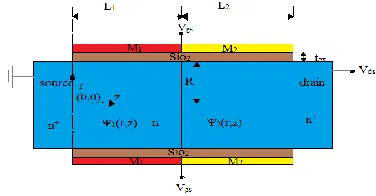
Junctionless dual material surrounding gate MOSFET has been proposed and its surface potential is modelled by using parabolic approximation method. This surface potential is compared with the central potential of the (JLDMSG) MOSFET.A cross sectional view of the Junctionless dual material surrounding gate (JLDMSG) MOSFET is shown in Fig 1.
Fig .1 Cross sectional view of junctionless dual material surrounding gate MOSFET(JLDMSG)
In the gate structure the channel region has been divided into two parts. The length of the two metals M1
and M2 are L1 and L2 respectively. A cylindrical
co-ordinate system is employed with the radial direction represented as r and a horizontal direction as z. The symmetry of the structure ensures that the potential has no
variation with the angular in plane of the radial direction. Hence, a 2-D analysis is sufficient.
II. MODEL DERIVATION
The surface potential distribution in the silicon can be derived by solving 2D poisson’s equation. The potential distribution across the two channel is defined as,
si d i
i
qn
z
z
r
j
r
r
r
r
r
2 2
,
,
1
i=1,
2 (1)
nd is the channel doping density, it is assumed
to be uniform for simplicity. Parabolic approach is used to define the potential across the surface and the solution is given as,
2 3 21
,
z
c
z
c
z
r
c
z
r
r
i i ii
i=1,2(2)
The total length of the gate is given as L1+L2.
The metal M1 lies at the region
R
r
L
z
,
0
0
1 and the metal M2 lies atthe region
0
z
L
1
L
2,
0
r
R
. Theboundary condition used to find the solutions are,
1) Electric flux between the silicon body
and surrounding gate oxide must be continuous,
,
r
2t
z
v
v
c
R
r
r
z
r
si si
s fbi gs ox i
i=1,2
(3)
2) Electric field at r=0 must be zero due to the symmetry of the channel potential along the r-direction,
0
0
,
r
r
z
r
i
i=1,2
(4)
Thus the potential distribution is given as,
,
r
2t
z
v
v
c
z
z
r
si si
s fbi gs ox c
i
i=1,2(5)
Where Vfbi is the flat band voltage,ԑsi is the
permittivity of the silicon,tsi is the thickness of the
silicon and cox is the capacitance of oxide per unit
area. The flat band voltage is given as,
si i m fbi
v
(6)
Where
mi is the work function of the metalsurface M1 and M2.
si is the work function ofthe silicon and it is given as,
f g si si
q
E
2
(7)Copyright to IJIRSET www.ijirset.com 547
M.R. Thansekhar and N. Balaji (Eds.): ICIET’14
i d fn
n
q
kT
ln
is the bulk potential, Eg is thesilicon band gap and ni is the intrinsic concentration. It is
assumed that the central potential and the surface potential must satisfy the following condition,
si i s fbi gs si ox i c i sv
v
t
c
z
z
4
i=1,2 (8)By substituting equation (5) and (8) in (1) and by eliminating central potential, the differential equation for the surface potential can be expressed as,
gi i s i sz
z
z
2 2 2i=1,2 (9)
Where si si ox
t
c
2
4
is the scaling factor and
ox si ox si si si si si fbi gs ox si si d gic
c
t
t
v
v
c
t
qn
4
4
4
4
2
i=1,2 (10)The general solution of the ordinary differential equation in eq.(9) can be expressed as,
2
z gii z i i
s
z
a
e
b
e
i=1,2 (11)
Where ai and bi are coefficients that are
determined by the following boundary conditions [10],
1) Surface potential at the interface of the two dissimilar metals is continuous
1s
r
,
L
1
s2
r
,
L
1
(12)
2) Electric flux between two dissimilar
metals is continuous
1 2 1 1,
,
L
z
z
z
r
L
z
z
z
r
s s
(13)3) The potential at the source end is
bi sr
,
z
0
v
1
(14)
4) The potential at the drain end is
bi dss
r
z
L
1
L
2
v
v
2,
(15)
With these boundary condition ai and bi are
obtained as,
1 2
2 1 2 2 2 2 2 2 1 2 2 2 1
2
2
2
2
2
L L L L g L g L g ds bie
e
b
e
e
v
v
a
(16) 1 2 11
v
a
b
bi
g
(17)
1 2
2 1 2 2 2 2 2 2
2 L L
L L g ds bi
e
e
b
v
v
a
(18)
1 2
3 2 1 2 3 3 1 3 1 2 2sinh
2
4
4
2
2
4
4
4
4
2
2
1 1 1 1 2 2 2 1 2 1L
L
e
e
e
v
e
v
e
e
v
e
e
b
L L g g g L ds L bi L g L bi L L g L L g
(19)III. RESULT AND DISCUSSION
The analytical modelling of surface potential in junctionless dual material surrounding gate MOSFET is plotted for various parameter and it is compared with the central potential of the JLDMSG MOSFET[11]. The surface potential is defined as the electrostatic potential energy of surface confined charges between source and drain. Central potential is examined by considering a threshold at the middle of the channel region. Thus the surface potential plot is compared with the central potential and analysed its performance. The surface potential of a Junctionless dual material surrounding gate MOSFET is shown in Fig .2.
From Fig.2 It is clear that surface potential of JLDMSG MOSFET increases as the channel length increases. In
this modelling, the length of the first metal L1 is 30nm and
the length of the second metal L2 is 30nm. Thus the
Copyright to IJIRSET www.ijirset.com 548
M.R. Thansekhar and N. Balaji (Eds.): ICIET’14
0 10 20 30 40 50 60
0 0.5 1 1.5 2 2.5 3
channel length
s
u
rf
a
c
e
p
o
te
n
ti
a
l
in
v
o
lt
s
Fig 2.Surface potential versus channel length for
JLDMSG MOSFET
0 10 20 30 40 50 60
0 0.5 1 1.5 2 2.5 3
channel length
po
te
nt
ia
l i
n
vo
lts
proposed method for JLDMSG Using centre potential for JLDMSG
Fig.3 Comparison of the central potential and surface potential in JLDMSG MOSFET for different channel length
In Fig.3 The central potential method is compared with the surface potential of the proposed method for different channel length. The maximum potential at surface of the source and drain is 3v and the central potential is only approximately 1v. From this graph it is obvious that the surface potential is better compared to the central potential that is obtained by considering a virtual cathode at the middle of the channel.
0 5 10 15 20 25 30 35 40
0 0.5 1 1.5 2 2.5 3
channel length
s
u
rf
a
c
e
p
o
te
n
ti
a
l
in
v
o
lt
s
vds=0.5v vds=2v
Fig .4 Surface potential of JLDMSG MOSFET versus channel length for different vds
0 5 10 15 20 25 30 35 40
0 0.5 1 1.5 2 2.5 3 3.5
channel length
po
ten
tia
l in
vo
lts
proposed method for vds=0.5v using centre potential for vds=0.5v proposed method for vds=2v using cetre potential for vds=2v
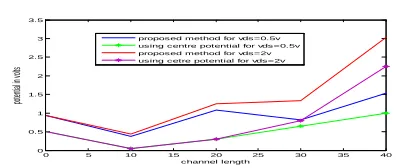
Fig.5 Comparision of the central potential and surface potential in JLDMSG MOSFET for different vds value
In this graph the total length of the channel is considered as 40nm. The potential changes are observed at every 10nm. Hence the proposed method shows better performance than the existing method.
IV.CONCLUSION
The Junctionless dual material Surrounding Gate (JLDMSG) MOSFETs show higher performance compared to Junction MOSFETs. The result compares the surface potential of the proposed method with the central potential method of the JLDMSG MOSFET .It is clear from the graph that surface potential of the proposed method is higher than the central potential method. It proves that there is a reduction in SCEs and DIBL and it is more advantageous than other devices especially Junction based devices.
REFERENCES
[1] Chi-Woo Lee, Aryan Afzalian, Nima Dehdashti Akhavan, Ran Yan, Isabelle Ferain, “ Junctionless multigate field-effect transistor,” Appl. Phys. Lett.vol.94,2009.
[2] Te-Kuang Chiang, “A New Quasi 2-D Threshold Voltage Model For Short-Channel Junctionless Cylindrical Surrounding Gate (JLCSG) MOSFETs,”IEEE Trans.Electron Devices,vol.59,no.11,nov.2012.
[3] Zhuojun Chen,Yongguang Xiao,Minghua Tang,Ying Xiong,Jianqiang Huang,Jiancheng Li.Xiaochen Gu,and Yichun Zhou, “Surface-potential-based drain current model for long-channel junctionless double-gate mosfets,”IEEE Trans.Electron Devices,vol.59,no.12,dec 2012.
[4] Juan P. Duarte, Sung-Jin Choi, Dong-Il Moon, and Yang-Kyu Choi, “Simple Analytical Bulk Current Model for Long-Channel Double-Gate Junctionless Transistors,”IEEE Trans.Electron Devices, vol.32,no.6,june 2011.
[5] Juan Pablo Duarte, Sung-Jin Choi, and Yang-Kyu Choi, “ A Full-Range Drain Current Model for Double-Gate Junctionless Transistors,” IEEE Trans.Electron Devices, vol.58,no.12,dec 2011.
[6] Chi-Woo Lee, Adrien Borne, Isabelle Ferain, Aryan Afzalian, Member, IEEE, Ran Yan, Nima Dehdashti Akhavan,Pedram Razavi, and Jean-Pierre Colinge, Fellow, IEEE , “ High-Temperature Performance of Silicon Junctionless MOSFETs,”
IEEE Trans.Electron Devices, vol.57,no.3,mar 2010.
[7] Yuan Taur, Han-Ping Chen, Wei Wang, Shih-Hsien Lo, and Clement Wann, “On–Off Charge–Voltage Characteristics and Dopant Number Fluctuation Effects in Junctionless Double-Gate MOSFETs,” IEEE Trans.Electron Devices,vol.59,no.3,mar 2012.
[8] Twinkal Solankia, Nilesh Parmar, “A Review paper: A Comprehensive study of Junctionless transistor,” National Conference on Recent Trends in Engineering & Technology,may 2011.
[9] Jean-Pierre Colinge, Chi-Woo Lee, Isabelle Ferain, Nima Dehdashti Akhavan,RanYan, “ Reduced electric field in junctionless transistors,”Appl.Phys.Lett.vol.96,2010.
[10] T. K. Chiang, M. L. Chen, and H. K. Wang, “A New Two-dimensional Model for Dual Material Surrounding-Gate (DMSG) MOSFET's,”IEEE conference,Electron devices and Solid State Circuits,dec 2007.
Copyright to IJIRSET www.ijirset.com 549
M.R. Thansekhar and N. Balaji (Eds.): ICIET’14
[9] Jean-Pierre Colinge, Chi-Woo Lee, Isabelle Ferain, Nima Dehdashti Akhavan,RanYan, “ Reduced electric field in junctionless transistors,”
Appl.Phys.Lett.vol.96,2010.
[10] T. K. Chiang, M. L. Chen, and H. K. Wang, “A New Two-dimensional Model for Dual Material Surrounding-Gate (DMSG) MOSFET's,”IEEE conference,Electron devices and Solid State Circuits,dec 2007.
[11] Li cong, Zhuang Yi-Qi, Zhang Li and Jin Gang, “Quasi two dimensional threshold voltage model for junctionless cylindrical surrounding gate metal-oxide-semiconductor field-effect transistor with dual-material gate”, School of microelectronics, dec 2013.