PERSPECTIVES
A Perspective on Micro-Evo-Devo: Progress
and Potential
Maria D. S. Nunes,* Saad Arif,* Christian Schlötterer,†and Alistair P. McGregor*,1 *Department of Biological and Medical Sciences, Oxford Brookes University, Oxford OX3 0BP, United Kingdom, and†Institut für Populationsgenetik, Vetmeduni Vienna, A-1210 Vienna, Austria
ABSTRACTThe term“micro-evo-devo”refers to the combined study of the genetic and developmental bases of natural variation in populations and the evolutionary forces that have shaped this variation. It thus represents a synthesis of thefields of evolutionary developmental biology and population genetics. As has been pointed out by several others, this synthesis can provide insights into the evolution of organismal form and function that have not been possible within these individual disciplines separately. Despite a number of important successes in micro-evo-devo, however, it appears that evo devo and population genetics remain largely separate spheres of research, limiting their ability to address evolutionary questions. This also risks pushing contemporary evo devo to the fringes of evolutionary biology because it does not describe the causative molecular changes underlying evolution or the evolutionary forces involved. Here we reemphasize the theoretical and practical importance of micro-evo-devo as a strategy for understanding phenotypic evolution, review the key recent insights that it has provided, and present a perspective on both the potential and the remaining challenges of this exciting interdisciplinaryfield.
U
NDERSTANDING the evolution of phenotypic diversity is one of the main goals of evolutionary biology. Achiev-ing this requires a deeper knowledge of how information encoded in the genome is processed by development to gen-erate phenotypes and of the evolutionary forces that have shaped these processes. In addition, it is essential to describe the dynamics of how the mutations that cause phenotypic variation arise and spread in populations and ultimately contribute to speciation and macroevolutionary change. Since the emergence of thefield of evolution and develop-ment (evo devo) in the 1990s, it has been recognized and reiterated that a focus on the microevolution of develop-ment, or micro-evo-devo, has great potential to help address these important questions (Wilkins 1998, 2002; Raff 2000; Gilbert 2003; Cresko et al. 2007; Johnson 2007; Sommer 2009; Stern 2011). Here we define micro-evo-devo as the study of the genetic and developmental bases of natural phenotypic variation within species. Note that although the scope of micro-evo-devo has been described to include the study of closely related species and even differences up to the level of genera (see Wilkins 2002 for discussion), atthe core of this branch of evo devo is the study of intraspe-cific variation, and so, for clarity, we use the stricter defi ni-tion. While micro-evo-devo also encompasses the study of phenotypic plasticity and developmental robustness (e.g., Braendleet al.2008; Millozet al.2008), we will concentrate on how thisfield addresses nonplastic differences in pheno-type between populations (Figure 1).
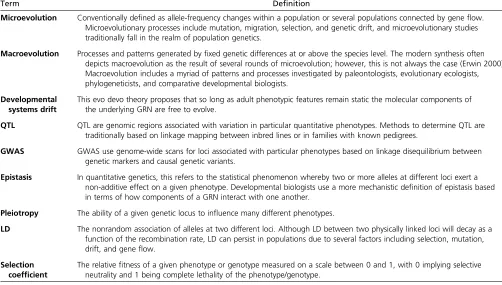
By focusing on intraspecific variation, micro-evo-devo can take advantage of the extensive natural variation in mor-phology and physiology and patterns of linkage disequilib-rium (LD) (Table 1) among populations. This readily allows the application of approaches from population/quantitative genetic and evolutionary developmental biology, particu-larly when the focal species are established model organisms with powerful experimental tools and genomic resources such as nematodes,flies, mice, sticklebacks, andArabidopsis
(Sommer 2009). Therefore, the strength and potential of micro-evo-devo lies in its synthesis of population/quantita-tive genetics and evolutionary developmental genetics to fully explore the causes and consequences of natural varia-tion (Figure 1).
In this perspective, wefirst restate the case for micro-evo-devo by highlighting the potential limitations of evo micro-evo-devo without an intraspecific perspective and the incorporation of population genetics. We then discuss the potential benefits of expanding the genotypic focus of population genetics to
Copyright © 2013 by the Genetics Society of America doi: 10.1534/genetics.113.156463
Available freely online through the author-supported open access option.
1Corresponding author: Oxford Brookes University, Gipsy Lane, Oxford OX3 0BP,
fully explain phenotypic diversity through the understanding of developmental biology and the functional consequences of genetic and developmental variation brought by evo devo.
To support our view, we then review key studies that fall within our definition of micro-evo-devo that have provided
new insights into aspects of the genetics and development of phenotypic evolution and in some cases explore the evolu-tionary forces involved. We also evaluate how insights from micro-evo-devo can inform evolutionary research at scales above the species level. Finally, we discuss how micro-evo-devo can take advantage of the latest tools and approaches for the mapping and functional analysis of genetic variants and the use of high-throughput phenotyping.
Restating the Case for Micro-Evo-Devo
The emergence of evo-devo gave development an evolu-tionary context and evolution a developmental genetic perspective (Wilkins 2002; Carrollet al.2005; Arthur 2011; Stern 2011). Evo-devo has subsequently largely studied pat-terns of conservation and change in gene expression and function over large evolutionary timescales and large taxo-nomic distances such as those addressed by the fields of paleontology and systematics (Figure 1). From this ground-breaking work, we have learned that the develop-mental “toolkit” of genes is mostly conserved across dis-tantly related taxa and that phenotypic change across such broad scales is often accompanied by spatial or temporal changes in the expression of these conserved genes (Davidson 2001; Wilkins 2002; Carroll et al. 2005). As such, these studies have given and continue to provide valuable insights into both the ancestral features of the genetic toolkit and de-velopmental regulation and how these factors and processes have subsequently evolved in extant lineages.
Primarily examining the expression and function of largely conserved genes across broad phylogenetic scales, however, can be a correlational enterprise that is intrinsi-cally somewhat limited in its capacity to yield new insights into the causes of developmental evolution. This is because comparing distantly related taxa means that it is generally not possible to characterize the precise molecular basis and nature of causative changes (e.g.,cis vs. trans, additive vs.
epistatic; see Table 1), given the sheer amount of change that has occurred and the existence of developmental sys-tems drift (Table 1) (True and Haag 2001; Wang and Sommer 2011). This makes the study of how variation can arise and spread (e.g.,de novomutationsvs.standing genetic variation) and the underlying evolutionary forces (e.g., drift
vs.selection) very difficult to pursue above the level of spe-cies. Therefore, as cautioned during the emergence of evo devo (Wilkins 1998), this field needs to better incorporate a focus on intraspecific variation and population genetics. Without that dimension, evo devo risks being pushed to the periphery of evolutionary biology. The following illustrates the scope of the problem: at the most recent meeting of the European Society for Evolutionary Developmental Biology, only5% of abstracts could be considered to fall within the paradigm of micro-evo-devo. Since one of the major goals of evo devo is to provide a mechanistic understanding of phe-notypic change, and the population level is an obvious scale at which to explore such questions, this is rather surprising. Figure 1 Foci of population genetics, evo-devo, and micro-evo-devo. The
The reasons for this neglect are not entirely clear and likely multifarious. They could be rooted, however, in both the macroevolutionary traditions of comparative morphology and the omission of embryology from the classic evolution-ary synthesis and the emphasis of contemporevolution-ary evo devo on understanding the development and evolution of body plans and evolutionary novelties.
This is not to say that evo devo has completely ignored population thinking and issues of genetic variation: on the contrary, studies of closely related species have provided important insights into morphological evolution (e.g., Stern 1998; Sucena and Stern 2000; Gompel et al. 2005; Jeong
et al.2006, 2008; Rebeizet al. 2009b; Frankelet al.2011; Loehlin and Werren 2012). However, an expanded micro-evo-devo effort can extend this work and provide further examples to test existing hypotheses about phenotypic evo-lution across a wide range of organisms and traits, especially where suitable closely related species are not available for genetic mapping or reciprocal functional analysis.
Thefield of population genetics is devoted to the analysis of changes in the frequency of genetic variation in popula-tions and traces the genomic signatures of the evolutionary forces involved (Figure 1). Combined with quantitative ge-netics, population genetics has in many cases described the association between genotypic and phenotypic variation (e.g., Stam and Laurie 1996; Lai et al. 2007; Harbison
et al.2009; Liet al.2010; Casto and Feldman 2011). At this point it may be argued that a combination of population and
quantitative genetics may be all that is required for a com-prehensive understanding of phenotypic evolution. How-ever, there remain some inherent limitations in these approaches.
While population genetic tools allow the identification of genomic regions that have been selected within a popula-tion, on their own, they do not explicitly reveal how genetic variation maps to phenotypic variation because the de-velopmental genetic function of the identified variants may be unknown and/or the phenotype affected may not be obvious or predictable (Figure 1). Conversely, in quantita-tive genetics, a major hindrance has been the failure of quantitative trait loci (QTL) (Table 1) mapping approaches to identify genes or nucleotide variants that are of functional importance (Rockman 2012). This is in part because QTL and genome-wide association studies (GWAS) (Table 1) of-ten identify a large number of putative causative loci and verifying their effects and contribution is a daunting task. Recent advances in genotyping have improved the resolu-tion that can be achieved with GWAS and QTL approaches, but even so, functional validation of candidate loci is still rare in such studies, with the caveats that the identification of true causal variants can still be hindered by levels of LD and sample size (but see Tishkoffet al.2007; Schmidtet al.
2008; Faraji et al. 2012). Hence, population genetics, with its focus on broad patterns of the dynamics of gene frequencies, often neglects the functional role of specific var-iants and ignores development, even when their study is Table 1 Glossary of terms
Term Definition
Microevolution Conventionally defined as allele-frequency changes within a population or several populations connected by geneflow. Microevolutionary processes include mutation, migration, selection, and genetic drift, and microevolutionary studies traditionally fall in the realm of population genetics.
Macroevolution Processes and patterns generated byfixed genetic differences at or above the species level. The modern synthesis often depicts macroevolution as the result of several rounds of microevolution; however, this is not always the case (Erwin 2000). Macroevolution includes a myriad of patterns and processes investigated by paleontologists, evolutionary ecologists, phylogeneticists, and comparative developmental biologists.
Developmental systems drift
This evo devo theory proposes that so long as adult phenotypic features remain static the molecular components of the underlying GRN are free to evolve.
QTL QTL are genomic regions associated with variation in particular quantitative phenotypes. Methods to determine QTL are traditionally based on linkage mapping between inbred lines or in families with known pedigrees.
GWAS GWAS use genome-wide scans for loci associated with particular phenotypes based on linkage disequilibrium between genetic markers and causal genetic variants.
Epistasis In quantitative genetics, this refers to the statistical phenomenon whereby two or more alleles at different loci exert a non-additive effect on a given phenotype. Developmental biologists use a more mechanistic definition of epistasis based in terms of how components of a GRN interact with one another.
Pleiotropy The ability of a given genetic locus to influence many different phenotypes.
LD The nonrandom association of alleles at two different loci. Although LD between two physically linked loci will decay as a function of the recombination rate, LD can persist in populations due to several factors including selection, mutation, drift, and geneflow.
Selection coefficient
experimentally feasible, thereby foregoing insights that can be provided by the combination of developmental studies and the mapping of genetic changes to phenotypic variation. Where causal variants have been identified following map-ping studies, this has often relied on using knowledge of de-velopmental genetic functions or direct functional analysis of the role of candidate variants during development, which is essentially the micro-evo-devo strategy (Figure 1). Therefore, we argue that the application of experimental tools com-monly used in evo devo to test natural genetic variation iden-tified in population genetic studies can at least address some of these difficult challenges and provide a better understand-ing of how genetic variation leads to phenotypic variation.
Insights from Micro-Evo-Devo
Here we will highlight studies that demonstrate the great potential of micro-evo-devo not only to reveal the genetic basis of phenotypic change at the population level but also to provide novel insights into developmental regulation. Furthermore, we show how studies of intraspecific variation that incorporate an understanding of the developmental functions of the underlying genes allow us to gain better insights into the evolutionary forces involved.
The genetic basis of phenotypic change
The genePituitary homeobox transcription factor 1(Pitx1) is required for the development of hindlimbs in vertebrates among other important developmental functions (Lanctot
et al.1999; Logan and Tabin 1999; Szetoet al.1999). Con-sistent with this role, it was shown that recurrent deletions of a specificPitx1enhancer lead to the loss ofPitx1expression specifically in the developing pelvic structures of freshwater populations of sticklebacks and consequently to a reduction in adult pelvic spines in thesefish without affecting the other functions ofPitx1(Chanet al.2010). It is thought that these changes are involved in the adaptation of these fish from a marine environment to freshwater (Shapiroet al.2004).
The role of regulatory changes at thePitx1locus wasfirst determined using a combination of genome wide linkage mapping and analysis ofPitx1expression patterns during de-velopment (Cresko et al. 2004; Shapiro et al. 2004; Coyle
et al. 2007). Allele-specific expression analysis in hybrids was then used to verify the contribution of cis-regulatory mutations at the Pitx1locus (Chan et al.2010). Ultimately, however, the identification of the causal changes was possible only through a combination of high-resolution mapping, tak-ing advantage of recombination in natural populations and positional cloning and functional analysis of different frag-ments from the identified candidate region (Chanet al.2010). A similar combination of approaches was also success-fully applied to investigate the genetic basis of phenotypic variation inArabidopsis(Hilscheret al.2009). Natural pop-ulations ofArabidopsisharbor a large amount of variation in trichome number that is thought to be maintained by selec-tion for protecselec-tion against insect herbivores and resistance
to environmental stress factors (Handley et al. 2005). Ge-netic dissection of this trait, through QTL mapping and char-acterization of introgression lines carrying the alternative low- and high-density alleles in a mutant background, iden-tified three candidate genes with demonstrated or predicted roles in trichome development: ENHANCER OF TRY AND CPC2 (ETC2),TRICHOMELESS1(TCL1), andTCL2(Hischer
et al.2009). Overexpression and sequence analysis of these genes, however, ruled out the involvement of TCL2 and
TCL1, leaving ETC2. Subsequently, population-level se-quence data forETC2further narrowed the evolved region to two candidate nucleotides: one single-nucleotide poly-morphism (SNP) in the 59 UTR and one nonsynonymous replacement in the coding region. Site-directed mutagenesis showed that only the coding change had an effect on tri-chome number (Hischeret al.2009). Importantly,ETC2had not been identified in previous studies of variation in tri-chome number using knockouts because these mutants had been generated in a genetic background with the weak
ETC2 allele; thus the effect could not be detected. Hence, the findings described above were made possible only by taking advantage of natural variation.
As evidenced by these examples, the dissection of the genetic basis of phenotypic variation very often involves crossing strains with extreme phenotypic values to generate genetic-linkage maps of the trait of interest. An alternative approach is to look for genomic signatures of selection in candidate genes with known roles in the development of the trait of interest. Taking such an approach, Pool and Aquadro (2007) obtained sequence polymorphism data at theebony
locus from populations sampled along an altitudinal cline for abdominal pigmentation and found evidence for a partial selective sweep spanning the upstream noncoding region of
ebony. Using transgenic complementation tests, Rebeizet al.
(2009a) confirmed the contribution of variation atebonyto body melanization. A combination of functional tests of se-quence variants and population sese-quence analysis was then carried out. The results revealed that darker pigmentation was caused by new mutations in a previously assembled haplotype containing standing variation that also affected pigmentation, and it was this combination of existing and
de novomutations that gave rise to a large-effect allele that was then swept to high frequency (Rebeizet al.2009a).
spatial expression of two of these genes,Mc1r andAgouti, in-dicated that coding changes in Mc1r and regulatory changes closely linked toAgouticontribute to the pigmentation differences between these mice (Hoekstraet al.2006; Steineret al.2007).
Further analysis of the cis-regulatory changes affecting
Agouti expression also provided new insights into the de-velopment of these pigmentation patterns (Manceau et al.
2011). The apparently simple difference between these mice is caused by a change in the distribution pattern of four different hair types across the dorsal–ventral adult body axis. Manceau et al. (2011) showed that cis-regulatory changes in theAgoutilight allele result in a new expression domain that moves the dorsal–ventral pigmentation bound-ary upward and in higher ventral expression that prevents melanocyte maturation and therefore the development of nonpigmented ventral hairs.
Insights into developmental regulation and evolution
Developmental biology has greatly enriched our under-standing of the genetic programs that build plants and animals. Classically, evo devo has used this knowledge as the basis for candidate gene approaches to reveal the extensive conservation of the genetic regulation of development among organisms. Furthermore, this has also allowed associations to be made between changes in these programs and animal body plans across large phylogenetic distances (Carrollet al.2005).
The studies of Pitx1and Agoutiin pelvic reduction and pigmentation, respectively, discussed above, show that micro-evo-devo can provide a deeper understanding of the role and regulation of genes previously known to be involved in particular developmental processes. However, micro-evo-devo has also given novel insights into the regulation of de-velopment that would probably not have been achievable with a candidate gene approach and even in the absence of candidate genes.
For example, in the well-characterized gene regulatory network (GRN) for trichome development, shaven-baby
(svb) serves as an input/output device that responds to up-stream signals to direct trichome patterning and appearance through a battery of downstream target genes (Stern and Orgogozo 2008). Furthermore, it has been shown that changes in cis-regulatory sequences of svb and changes at theUltrabithoraxlocus underlie the evolution of larval and leg trichome patterning, respectively, between species (Stern 1998; McGregoret al.2007). However, a recent study has shown that intraspecific variation in leg trichome pat-terns inDrosophila melanogasteris caused by changes in the expression of a microRNA,mir-92a(Arifet al.2013), which represses expression of shavenoid, a downstream target of
svb(Schertelet al.2012; Arifet al.2013). The study by Arif and colleagues, therefore, not only revealed the genetic ba-sis for morphological change, but also provided new insights into a well-characterized developmental GRN.
A combination of mapping and functional analysis of genes during development in natural populations was also
successfully applied to understand the developmental basis of adaptive variation in wing pigmentation patterns in butterflies. In this study, Martin and coworkers (2012) found a previously unknown role for WntA in wing pig-mentation in Heliconius butterflies and discovered thatcis -regulatory variation at this locus was probably responsible for extensive intraspecific and interspecific variation in pig-mentation patterns (Martinet al.2012).
Insights into evolutionary forces and effects onfitness
In the previous section, we discussed recent studies that illustrate the potential of micro-evo-devo to dissect the genetic and developmental bases of phenotypic differences. Here we show how information about the specific de-velopmental roles of genes underlying phenotypic differ-ences can also help to illuminate the evolutionary forces and fitness consequences of those differences.
Mapping and subsequent developmental expression and functional analyses have shown that the reduction in lateral plate armor in freshwater sticklebacks compared to marine populations is caused by changes in the expression of the geneEctodysplasin(Eda) (Colosimoet al.2005), a gene with no previously known role in the development of this trait. It was thought that the differences in armor plating between freshwater and marine populations may have evolved due to selection against high plate number in the freshwater envi-ronment (Creskoet al.2004; Marchinko and Schluter 2007; Barrett et al. 2008). However, when the dynamics of changes in frequency of the alternative alleles of Eda for low and high plate numbers was followed over a generation after experimental release of marine sticklebacks heterozy-gous at the Eda locus in freshwater ponds (Barrett et al.
2008), it was found that the low plate allele was strongly selected against [the selection coefficient (Table 1),s, was 0.5] during early stages of development. The low plate allele did increase in frequency in the population but only later in the life cycle of thefish, after formation of the lateral plates. These results showed that changes at or linked to the de-rived low-plate allele are likely to have pleiotropic effects on other traits relevant tofitness (Barrett and Hoekstra 2011), a result that would not have been anticipated given the re-peated and rapid evolution of this trait.
Arabidopsis thaliana provides a further example how micro-evo-devo can link genetics, development, and morpho-logical phenotype to fitness. In this plant, the geneFRIGIDA
(FRI) encodes a scaffold protein required for the assembly of a protein complex that activates the expression of the tran-scription factor encoded by FLOWERING LOCUS C (FLC), which in turn represses flowering (Caicedo et al. 2004; Shindoet al.2005; Choiet al.2011). The recurrent evolu-tion of loss-of-funcevolu-tionFRIalleles (FRID) amongA. thaliana
ecotypes was thought to be indicative of adaptation to envi-ronments with short or unpredictable seasons due to their effect in reducing flowering time (Scarcelli et al. 2007). Controlled field studies showed that selection on the FRI
genetic variation at FLC (Korves et al. 2007), probably explaining why genetic variation is maintained at that locus. Further work using an outbred population and testing these plants under different treatments simulating seasonal con-ditions failed tofind an association between theFRI geno-type andfitness (measured as fruit production) (Scarcelli
et al.2007). The authors postulated that this lack of asso-ciation might be due to antagonistic pleiotropic (Table 1) effects of FRI on the number of nodes and branches, traits that are strong predictors offitness in this species. However, Lovell et al. (2013) recently carried out further functional analysis ofFRInulls and measured the effects on additional aspects of development and physiology. They found thatFRI
nulls had higher stomatal conductance, which results in de-creased water use efficiency and increases growth as well as shorteningflowering time. This suggests that the evolution of
FRI nulls may be a drought-escape strategy representing adaptive pleiotropy (Table 1) at this locus (Lovell et al.
2013). As these authors point out, more broadscale pheno-typing is essential to understand the evolution of particular genetic changes, especially where they are likely to be pleio-tropic and the obvious phenotypic change is not necessarily the one being selected.
Micro-Evo-Devo and Macroevolution
The above sections demonstrate the potential of micro-evo-devo to expand our knowledge of the genetics and de-velopment and evolutionary forces relevant to natural intraspecific variation. However, since the advent of micro-evo-devo, it has often been claimed that thisfield can also provide crucial insights into macroevolutionary processes (e.g., Wilkins 1998, 2002). By macroevolution, we mean all evolutionary changes above the species level (Table 1). Here we discuss and evaluate the contribution and potential of micro-evo-devo to studies of macroevolution.
Whether macroevolution is a simple extrapolation of microevolution (Table 1) or the transition is actually more complicated has been much debated (Erwin 2000; Leroi 2000; Stern 2011). In the extreme scenario that micro-evolution rarely contributes to longer-term micro-evolutionary change, then studying micro-evo-devo may have little im-pact on our understanding of macro-evolutionary processes (Figure 1). Indeed, much of the variation in segregating in natural populations may be due to large-effect alleles, with highly pleiotropic and deleterious effects that are eliminated in the longer term and therefore do not contribute to species differences (Figure 1). The empirical data pertaining to this question has been cataloged previously by Stern and Orgogozo (2008) who listed a large number of loss-of-function alleles underlying phenotypic variation within populations but not between species. This may suggest that, while the study of loss-of-function alleles found in populations (e.g., in theFRIgene inA. thalianapopulations as described above) is informative about short-term adaptation, it may have limited use in understanding longer-term evolution (Stern 2011).
However, while we may have to be cautious in interpreting macroevolution using micro-evo-devo, direct comparisons of QTL identified within and between species for a few traits suggest that intraspecific and interspecific in these traits might be caused by variation in the same genes in about half of the cases studied (Wittkoppet al.2009). The caveats are that interspecific comparisons may inflate the number of QTL for any particular trait because further genetic changes are likely to accumulate after speciation and QTL studies lack the resolution to definitely compare the precise genetic bases.
Studies that provide a higher resolution of the genetic basis of intraspecific and interspecific differences, however, offer a useful insight. The genetic basis of variation in bristle patterns betweenD. melanogasterstrains is caused by a pre-sumably deleterious mutation that makes a truncated ver-sion of the transcription factor Poils au dos that regulates
scute(Gibertet al.2005), while variation in the same bristles between species is caused by cis-regulatory changes in an enhancer ofscute(Marcellini and Simpson 2006). However, Rebeizet al.(2009a) showed that putatively adaptive intra-specific variation in pigmentation in D. melanogaster is caused in part by several single-nucleotide changes, gener-ally each of small effect in the regulatory region of the gene
ebony, differences in the regulation of which also contribute to interspecific variation in pigmentation (Wittkopp et al.
2003). Similarly, analysis of sequence variation at tan
showed that the changesfixed in Drosophila novamexicana
segregate and contribute to pigmentation variation in
Drosophila americana, indicating that these alleles were probably present in the most recent common ancestor of these two species (the alternative hypothesis of recent in-trogression being less likely) (Wittkoppet al.2009). Hence, in these species, new mutations seem to have little effect on a phenotypic difference compared to the contribution of standing genetic variation.
Thus, while micro-evo-devo can provide insights into macroevolutionary differences, the contribution of micro-evolutionary changes to longer-term evolution likely depends on their pleiotropic effects (Figure 1), other factors including epistasis (Table 1), and their overall effects on fitness (Stern 2011). It follows that micro-evo-devo studies are also important to understand convergent evolution and can contribute to the identification of genetic“hotspots” un-derlying the recurrent evolution of particular phenotypes (Richardson and Brakefield 2003; Gompel and Prud’homme 2009; Kopp 2009; Manceau et al. 2010; Kronforst et al.
Challenges
There is great potential for micro-evo-devo to continue to produce a broad and detailed understanding of organismal diversity. However, there are still major challenges in pro-viding the necessary genetic, developmental, and pheno-typic resolution, as well as in identifying the evolutionary forces andfitness effects involved.
In particular, identifying all loci contributing to a given phenotype, particularly those of small effect that interact epistatically, remains a serious problem (Rockman 2012). However, many QTL studies show that numerous traits, even the most complex ones, are usually in part explained by at least a few of large-effect loci consistent with models of phenotypic evolution involving adaptive jumps (reviewed by Orr 2005). Moreover, investigating the role of loci of appar-ently large effect is essential since higher-resolution map-ping shows that such loci are usually made up of multiple mutations of small effect that can be functionally validated, and it has been shown in some cases how additive and epistatic interactions among these mutations contribute to phenotypic evolution (McGregor et al. 2007; Rebeiz et al.
2009a; Frankelet al.2011).
The increasingly cheaper cost of sequencing technologies means that genotyping, with very high resolution, is possible for virtually any species (e.g., Andolfattoet al.2011; Bastide
et al.2013). However, several challenges remain in mapping this genotypic change to phenotypic differences and in char-acterizing the developmental processes involved. The func-tional characterization of DNA sequence variants depends on the availability of genetic tools and therefore has been mostly limited to model organisms. However, while simply using a null mutant or knocking down the expression of a gene of interest (e.g., using RNA interference) in such a model system may initially help us to understand its larger role in development, such methods do not allow us to assess the functional effect of natural variation in that gene. For-tunately, the advent of recently developed tools for genome editing such as the CRISPR/Cas9 system or transcription activator-like effector nucleases expand the application of reverse genetic approaches for targeted disruption or mod-ification of endogenous loci to a broad range of species (Sanjana et al. 2012; Bassett et al. 2013; Chang et al.
2013; Cong et al.2013; Friedland et al.2013; Gratzet al.
2013; Hwang et al. 2013; Yu et al.2013). Notably, these genetically engineered animals can be used not only to di-rectly test the functional effect of nucleotide changes during the development of the trait of interest, but also in experi-ments designed to estimate the effect of these changes on fitness. Moreover, the particular advantage of these approaches is that mutations of interest can be introduced into and then tested in any genetic background.
Probably the biggest limiting step in understanding the genetic and developmental bases of phenotypic differences lies in having enough phenotypic resolution to map precisely the underlying genetic differences that generate those
differences and then being able to analyze them function-ally. For most morphological, behavioral, and physiological traits, acquiring phenotypic information from a large sample size is extremely laborious and time-consuming. Yet, prog-ress is being made: different research consortia have already gathered phenotypic information for a number of large data sets. These include health and disease in humans and dogs; morphology, physiology, and behavior inDrosophila, rat, and mouse; and a variety of quantitative traits in plants (see Houle et al. 2010 for a review). However, these data sets are often not ideal for answering many specific questions, and we concur with Houleet al.(2010) that joint efforts to develop new technologies and methods for high-throughput data acquisition would, in the longer run, also be useful to the whole research community. One strategy that has proven to be successful in measuring the effect of individual nucleo-tides underlying variation in some traits and even in expos-ing cryptic variation is to use sensitive genetic backgrounds, although this application may be limited to particular model organisms (Dworkin and Gibson 2006; Dworkinet al.2009; Gibertet al.2011).
Despite the increasing number of experimental field studies of fitness for focal traits, in many cases these experiments are not possible, for example, when the environmental variables cannot be properly controlled. In these situations, experimental evolution experiments are a good alternative, since the selective agent is known and can be manipulated, adequate controls can be set up, replication is possible, multidimensional phenotype data can be acquired, and allele-frequency changes can be followed, allowing for direct estimates of selection coefficients of any given trait. With the caveat that these experiments have to be conducted in easily cultured, small, and fast-developing organisms, experimental evolution holds great promise for giving a more complete picture of many adaptation processes.
Acknowledgments
We thank Adam Wilkins, Isabel Almudi, Ignacio Maeso, Virginie Orgogozo, Christian Hardtke, and two anonymous reviewers for their insightful comments on the manuscript. A.P.M.’s laboratory is funded by an European Research Council (ERC) Starting Investigator Grant. C.S. is supported by the Austrian Science Fund (FWF) and the ERC.
Literature Cited
Andolfatto, P., D. Davison, D. Erezyilmaz, T. T. Hu, J. Mastet al., 2011 Multiplexed shotgun genotyping for rapid and efficient genetic mapping. Genome Res. 21: 610–617.
Arif, S., S. Murat, I. Almudi, M. D. Nunes, D. Bortolamiol-Becetet al., 2013 Evolution of mir-92a underlies natural morphological var-iation in Drosophila melanogaster. Curr. Biol. 23: 523–528. Arthur, W., 2011 Evolution: A Developmental Approach.
Barrett, R. D., and H. E. Hoekstra, 2011 Molecular spandrels: tests of adaptation at the genetic level. Nat. Rev. Genet. 12: 767–780.
Barrett, R. D., S. M. Rogers, and D. Schluter, 2008 Natural selec-tion on a major armor gene in threespine stickleback. Science 322: 255–257.
Bassett, A. R., C. Tibbit, C. P. Ponting, and J. L. Liu, 2013 Highly efficient targeted mutagenesis of Drosophila with the CRISPR/ Cas9 system. Cell Rep. 4: 220–228.
Bastide, H., A. Betancourt, V. Nolte, R. Tobler, P. Stobe et al., 2013 A genome-wide, fine-scale map of natural pigmen-tation variation in Drosophila melanogaster. PLoS Genet. 9: e1003534.
Braendle, C., J. Milloz, and M. A. Felix, 2008 Mechanisms and evolution of environmental responses in Caenorhabditis ele-gans. Curr. Top. Dev. Biol. 80: 171–207.
Caicedo, A. L., J. R. Stinchcombe, K. M. Olsen, J. Schmitt, and M. D. Purugganan, 2004 Epistatic interaction between Arabidopsis FRI and FLCflowering time genes generates a latitudinal cline in a life history trait. Proc. Natl. Acad. Sci. USA 101: 15670– 15675.
Carroll, S. B., J. K. Grenier, and S. D. Weatherbee, 2005 From DNA to Diversity: Molecular Genetics and the Evolution of Animal Design. Blackwell Publishing, Malden, MA.
Casto, A. M., and M. W. Feldman, 2011 Genome-wide association study SNPs in the human genome diversity project populations: Does selection affect unlinked SNPs with shared trait associa-tions? PLoS Genet. 7: e1001266.
Chan, Y. F., M. E. Marks, F. C. Jones, G. Villarreal, Jr., M. D. Shapiro
et al., 2010 Adaptive evolution of pelvic reduction in stickle-backs by recurrent deletion of a Pitx1 enhancer. Science 327: 302–305.
Chang, N., C. Sun, L. Gao, D. Zhu, X. Xu et al., 2013 Genome editing with RNA-guided Cas9 nuclease in zebrafish embryos. Cell Res. 23: 465–472.
Choi, K., J. Kim, H. J. Hwang, S. Kim, C. Park et al., 2011 The FRIGIDA complex activates transcription of FLC, a strongfl ow-ering repressor in Arabidopsis, by recruiting chromatin modifi -cation factors. Plant Cell 23: 289–303.
Colosimo, P. F., K. E. Hosemann, S. Balabhadra, G. Villarreal, Jr., M. Dickson et al., 2005 Widespread parallel evolution in sticklebacks by repeatedfixation of Ectodysplasin alleles. Sci-ence 307: 1928–1933.
Cong, L., F. A. Ran, D. Cox, S. Lin, R. Barretto et al., 2013 Multiplex genome engineering using CRISPR/Cas sys-tems. Science 339: 819–823.
Cooper, T. F., E. A. Ostrowski, and M. Travisano, 2007 A negative relationship between mutation pleiotropy and fitness effect in yeast. Evolution 61: 1495–1499.
Coyle, S. M., F. A. Huntingford, and C. L. Peichel, 2007 Parallel evolution ofPitx1underlies pelvic reduction in Scottish threes-pine stickleback (Gasterosteus aculeatus). J. Hered. 98: 581–586. Cresko, W. A., A. Amores, C. Wilson, J. Murphy, M. Curreyet al., 2004 Parallel genetic basis for repeated evolution of armor loss in Alaskan threespine stickleback populations. Proc. Natl. Acad. Sci. USA 101: 6050–6055.
Cresko, W. A., K. L. McGuigan, P. C. Phillips, and J. H. Postlethwait, 2007 Studies of threespine stickleback developmental evolu-tion: progress and promise. Genetica 129: 105–126.
Davidson, E. H., 2001 Genomic Regulatory Systems: Development and Evolution. Academic Press, San Diego.
Dworkin, I., and G. Gibson, 2006 Epidermal growth factor recep-tor and transforming growth facrecep-tor-beta signaling contributes to variation for wing shape in Drosophila melanogaster. Genetics 173: 1417–1431.
Dworkin, I., E. Kennerly, D. Tack, J. Hutchinson, J. Brown et al., 2009 Genomic consequences of background effects on
scal-loped mutant expressivity in the wing of Drosophila mela-nogaster. Genetics 181: 1065–1076.
Erwin, D. H., 2000 Macroevolution is more than repeated rounds of microevolution. Evol. Dev. 2: 78–84.
Faraji, F., Y. Pang, R. C. Walker, R. Nieves Borges, L. Yanget al., 2012 Cadm1is a metastasis susceptibility gene that suppresses metastasis by modifying tumor interaction with the cell-mediated immunity. PLoS Genet. 8: e1002926.
Fisher, R. A., 1930 The Genetical Theory of Natural Selection. Clar-endon Press, Oxford.
Frankel, N., D. F. Erezyilmaz, A. P. McGregor, S. Wang, F. Payre
et al., 2011 Morphological evolution caused by many subtle-effect substitutions in regulatory DNA. Nature 474: 598–603. Friedland, A. E., Y. B. Tzur, K. M. Esvelt, M. P. Colaiacovo, G. M.
Churchet al., 2013 Heritable genome editing in C. elegans via a CRISPR-Cas9 system. Nat. Methods.
Gibert, J. M., S. Marcellini, J. R. David, C. Schlotterer, and P. Simpson, 2005 A major bristle QTL from a selected popula-tion of Drosophila uncovers the zinc-finger transcription factor poils-au-dos, a repressor of achaete-scute. Dev. Biol. 288: 194– 205.
Gibert, J. M., F. Karch, and C. Schlötterer, 2011 Segregating var-iation in the polycomb group gene cramped alters the effect of temperature on multiple traits. PLoS Genet. 7: e1001280. Gilbert, S. F., 2003 The morphogenesis of evolutionary
develop-mental biology. Int. J. Dev. Biol. 47: 467–477.
Gompel, N., and B. Prud’homme, 2009 The causes of repeated genetic evolution. Dev. Biol. 332: 36–47.
Gompel, N., B. Prud’homme, P. J. Wittkopp, V. A. Kassner, and S. B. Carroll, 2005 Chance caught on the wing: cis-regulatory evo-lution and the origin of pigment patterns inDrosophila. Nature 433: 481–487.
Gratz, S. J., A. M. Cummings, J. N. Nguyen, D. C. Hamm, L. K. Donohueet al., 2013 Genome engineering of Drosophila with the CRISPR RNA-guided Cas9 nuclease. Genetics 194: 1029– 1035.
Handley, R., B. Ekbom, and J. Agren, 2005 Variation in trichome density and resistance against a specialist insect herbivore in natural populations ofArabidopsis thaliana. Ecol. Entomol. 30: 284–292.
Harbison, S. T., M. A. Carbone, J. F. Ayroles, E. A. Stone, R. F. Lymanet al., 2009 Co-regulated transcriptional networks con-tribute to natural genetic variation in Drosophila sleep. Nat. Genet. 41: 371–375.
Hilscher, J., C. Schlotterer, and M. T. Hauser, 2009 A single amino acid replacement in ETC2 shapes trichome patterning in natural Arabidopsis populations. Curr. Biol. 19: 1747–1751.
Hoekstra, H. E., R. J. Hirschmann, R. A. Bundey, P. A. Insel, and J. P. Crossland, 2006 A single amino acid mutation contributes to adaptive beach mouse color pattern. Science 313: 101–104. Houle, D., D. R. Govindaraju, and S. Omholt, 2010 Phenomics:
the next challenge. Nat. Rev. Genet. 11: 855–866.
Hwang, W. Y., Y. Fu, D. Reyon, M. L. Maeder, S. Q. Tsai et al., 2013 Efficient genome editing in zebrafish using a CRISPR-Cas system. Nat. Biotechnol. 31: 227–229.
Jeong, S., A. Rokas, and S. B. Carroll, 2006 Regulation of body pigmentation by the abdominal-B Hox protein and its gain and loss inDrosophilaevolution. Cell 125: 1387–1399.
Jeong, S., M. Rebeiz, P. Andolfatto, T. Werner, J. True et al., 2008 The evolution of gene regulation underlies a morpholog-ical difference between two Drosophila sister species. Cell 132: 783–793.
Johnson, N. A., 2007 The micro-evolution of development. Ge-netica 129: 1–5.
Korves, T. M., K. J. Schmid, A. L. Caicedo, C. Mays, J. R. Stinchcombe
et al., 2007 Fitness effects associated with the majorflowering time gene FRIGIDA in Arabidopsis thaliana in thefield. Am. Nat. 169: E141–E157.
Kronforst, M. R., G. S. Barsh, A. Kopp, J. Mallet, A. Monteiroet al., 2012 Unraveling the thread of nature’s tapestry: the genetics of diversity and convergence in animal pigmentation. Pigment Cell Melanoma Res. 25: 411–433.
Lai, C. Q., J. Leips, W. Zou, J. F. Roberts, K. R. Wollenberget al., 2007 Speed-mapping quantitative trait loci using microarrays. Nat. Methods 4: 839–841.
Lanctot, C., A. Moreau, M. Chamberland, M. L. Tremblay, and J. Drouin, 1999 Hindlimb patterning and mandible devel-opment require the Ptx1 gene. Develdevel-opment 126: 1805– 1810.
Leroi, A. M., 2000 The scale independence of evolution. Evol. Dev. 2: 67–77.
Li, Y., Y. Huang, J. Bergelson, M. Nordborg, and J. O. Borevitz, 2010 Association mapping of local climate-sensitive quantita-tive trait loci inArabidopsis thaliana. Proc. Natl. Acad. Sci. USA 107: 21199–21204.
Loehlin, D. W., and J. H. Werren, 2012 Evolution of shape by multiple regulatory changes to a growth gene. Science 335: 943–947.
Logan, M., and C. J. Tabin, 1999 Role of Pitx1 upstream of Tbx4 in specification of hindlimb identity. Science 283: 1736– 1739.
Lovell, J. T., T. E. Juenger, S. D. Michaels, J. R. Lasky, A. Plattet al., 2013 Pleiotropy of FRIGIDA enhances the potential for multi-variate adaptation. Proc. Biol. Sci. 280: 20131043.
Manceau, M., V. S. Domingues, C. R. Linnen, E. B. Rosenblum, and H. E. Hoekstra, 2010 Convergence in pigmentation at multiple levels: mutations, genes and function. Philos. Trans. R. Soc. Lond. B Biol. Sci. 365: 2439–2450.
Manceau, M., V. S. Domingues, R. Mallarino, and H. E. Hoekstra, 2011 The developmental role of Agouti in color pattern evo-lution. Science 331: 1062–1065.
Marcellini, S., and P. Simpson, 2006 Two or four bristles: func-tional evolution of an enhancer ofscutein Drosophilidae. PLoS Biol. 4: e386.
Marchinko, K. B., and D. Schluter, 2007 Parallel evolution by correlated response: lateral plate reduction in threespine stick-leback. Evolution 61: 1084–1090.
Martin, A., and V. Orgogozo, 2013 The Loci of repeated evolu-tion: a catalog of genetic hotspots of phenotypic variation. Evo-lution 67: 1235–1250.
Martin, A., R. Papa, N. J. Nadeau, R. I. Hill, B. A. Countermanet al., 2012 Diversification of complex butterfly wing patterns by re-peated regulatory evolution of a Wnt ligand. Proc. Natl. Acad. Sci. USA 109: 12632–12637.
McGregor, A. P., V. Orgogozo, I. Delon, J. Zanet, D. G. Srinivasanet al., 2007 Morphological evolution through multiplecis-regulatory mutations at a single gene. Nature 448: 587–590.
Milloz, J., F. Duveau, I. Nuez, and M. A. Felix, 2008 Intraspecific evolution of the intercellular signaling network underlying a ro-bust developmental system. Genes Dev. 22: 3064–3075. Orr, H. A., 2000 Adaptation and the cost of complexity. Evolution
54: 13–20.
Orr, H. A., 2005 The genetic theory of adaptation: a brief history. Nat. Rev. Genet. 6: 119–127.
Pool, J. E., and C. F. Aquadro, 2007 The genetic basis of adaptive pigmentation variation in Drosophila melanogaster. Mol. Ecol. 16: 2844–2851.
Raff, R. A., 2000 Evo-devo: the evolution of a new discipline. Nat. Rev. Genet. 1: 74–79.
Rebeiz, M., J. E. Pool, V. A. Kassner, C. F. Aquadro, and S. B. Carroll, 2009a Stepwise modification of a modular enhancer
underlies adaptation in aDrosophilapopulation. Science 326: 1663–1667.
Rebeiz, M., M. Ramos-Womack, S. Jeong, P. Andolfatto, T. Werner
et al., 2009b Evolution of the tan locus contributed to pigment loss inDrosophila santomea: a response to Matuteet al.Cell 139: 1189–1196.
Richardson, M. K., and P. M. Brakefield, 2003 Developmental bi-ology: hotspots for evolution. Nature 424: 894–895.
Rockman, M. V., 2012 The QTN program and the alleles that matter for evolution: all that’s gold does not glitter. Evolution 66: 1–17.
Sanjana, N. E., L. Cong, Y. Zhou, M. M. Cunniff, G. Feng et al., 2012 A transcription activator-like effector toolbox for genome engineering. Nat. Protoc. 7: 171–192.
Scarcelli, N., J. M. Cheverud, B. A. Schaal, and P. X. Kover, 2007 Antagonistic pleiotropic effects reduce the potential adaptive value of the FRIGIDA locus. Proc. Natl. Acad. Sci. USA 104: 16986–16991.
Schertel, C., T. Rutishauser, K. Förstemann, and K. Basler, 2012 Functional characterization of Drosophila microRNAs by a novel in vivo library. Genetics 192: 1543–1552.
Schmidt, P. S., C. T. Zhu, J. Das, M. Batavia, L. Yang et al., 2008 An amino acid polymorphism in the couch potato gene forms the basis for climatic adaptation in Drosophila mela-nogaster. Proc. Natl. Acad. Sci. USA 105: 16207–16211. Shapiro, M. D., M. E. Marks, C. L. Peichel, B. K. Blackman, K. S.
Nerenget al., 2004 Genetic and developmental basis of evo-lutionary pelvic reduction in threespine sticklebacks. Nature 428: 717–723.
Shindo, C., M. J. Aranzana, C. Lister, C. Baxter, C. Nichollset al., 2005 Role of FRIGIDA and FLOWERING LOCUS C in deter-mining variation inflowering time of Arabidopsis. Plant Physiol. 138: 1163–1173.
Sommer, R. J., 2009 The future of evo-devo: model systems and evolutionary theory. Nat. Rev. Genet. 10: 416–422.
Stam, L. F., and C. C. Laurie, 1996 Molecular dissection of a major gene effect on a quantitative trait: the level of alcohol dehydro-genase expression in Drosophila melanogaster. Genetics 144: 1559–1564.
Steiner, C. C., J. N. Weber, and H. E. Hoekstra, 2007 Adaptive variation in beach mice produced by two interacting pigmenta-tion genes. PLoS Biol. 5: 1880–1889.
Stern, D. L., 1998 A role of Ultrabithorax in morphological differ-ences between Drosophila species. Nature 396: 463–466. Stern, D. L., 2011 Evolution,Development and the Predictable
Ge-nome. Roberts and Company, Greenwood Village, CO.
Stern, D. L., and V. Orgogozo, 2008 The loci of evolution: How predictable is genetic evolution? Evolution 62: 2155–2177. Sucena, E., and D. L. Stern, 2000 Divergence of larval
morphol-ogy betweenDrosophila sechelliaand its sibling species caused by cis-regulatory evolution ofovo/shaven-baby. Proc. Natl. Acad. Sci. USA 97: 4530–4534.
Szeto, D. P., C. Rodriguez-Esteban, A. K. Ryan, S. M. O’Connell, F. Liuet al., 1999 Role of the Bicoid-related homeodomain factor Pitx1 in specifying hindlimb morphogenesis and pitui-tary development. Genes Dev. 13: 484–494.
Tishkoff, S. A., F. A. Reed, A. Ranciaro, B. F. Voight, C. C. Babbitt
et al., 2007 Convergent adaptation of human lactase persis-tence in Africa and Europe. Nat. Genet. 39: 31–40.
True, J., 2003 Insect melanism: the molecules matter. Trends Ecol. Evol. 18: 640–647.
True, J. R., and E. S. Haag, 2001 Developmental system drift and
flexibility in evolutionary trajectories. Evol. Dev. 3: 109–119. Wang, X., and R. J. Sommer, 2011 Antagonism of LIN-17/Frizzled
Wilkins, A. S., 1998 Evolutionary developmental biology: Where is it going? Bioessays 20: 783–784.
Wilkins, A. S., 2002 The Evolution of Developmental Pathways. Sinauer Associates, Sunderland, MA.
Wittkopp, P. J., B. L. Williams, J. E. Selegue, and S. B. Carroll, 2003 Drosophila pigmentation evolution: divergent genotypes underlying convergent phenotypes. Proc. Natl. Acad. Sci. USA 100: 1808–1813.
Wittkopp, P. J., E. E. Stewart, L. L. Arnold, A. H. Neidert, B. K. Haerum
et al., 2009 Intraspecific polymorphism to interspecific divergence: genetics of pigmentation inDrosophila. Science 326: 540–544. Yu, Z., M. Ren, Z. Wang, B. Zhang, Y. S. Ronget al., 2013 Highly
efficient genome modifications mediated by CRISPR/Cas9 in
Drosophila. Genetics 289–291.