ISSN(Online): 2319-8753 ISSN (Print): 2347-6710
I
nternational
J
ournal of
I
nnovative
R
esearch in
S
cience,
E
ngineering and
T
echnology
(A High Impact Factor, Monthly, Peer Reviewed Journal) Visit: www.ijirset.com
Vol. 8, Issue 5, May 2019
Study of Behavior of Seismic Evaluation of
Multistoried Building with Floating Columns
Nikhil Dewani
1, Dr.Ashok Kasnale
21
PG Student, Department of Civil Engineering, Dr. D.Y. Patil, SOET, Lohegaon, Pun, India
2
Principal, Department of Civil Engineering, Dr. D.Y. Patil, SOET, Lohegaon, Pune, India
ABSTRACT: Modern multi-storey buildings are constructed with irregularities such as soft storey, vertical or plan irregularity, floating column and heavy loads. These types of structures have become a very common construction practice in urban India. It is observed that most of the RC structures with such irregularities constructed are highly undesirable in seismically active areas from the results of past earthquake studies. These effects occurred due to various reasons, such as non-uniform distribution of mass, stiffness and strength. This study explains the seismic analysis of a multi-storey building with floating column constructed in seismically active areas observing its reactions to the external lateral forces exerted on the building in various seismic zones using the software ETABS. Thus highlighting the alternative measures involving in improvising the non-uniform distribution in the irregular building such as multi-storied building with floating column, and recommended the safer design of such building in seismically active areas considering the results observed from storey drifts, story displacements, when compared to Response Spectrum method shows best results.
KEYWORDS: Floating column, Seismic analysis, ETAB, Earthquake Analysis, Floating Column.
I.INTRODUCTION
India is a developing country, where urbanization is at the faster rate in the country including adopting the methods and type of constructing buildings which is under vast development in the past few decades. As a part of urbanization multi-storey buildings with architectural complexities are constructed. These complexities are nothing but soft storey, floating column, heavy load, the reduction in stiffness, etc. Now a day‟s most of the urban multi-storey buildings have open first storey as an unavoidable feature. Accommodation of parking or reception lobbies is the primary use of this open first story in the multi-storey buildings constructed. But Conventional Civil Engineering structures are designed on the basis of strength and stiffness criteria. Usually the ground storey is kept free without any constructions, except the columns which transfer the building weight to the ground. This thesis adopt the multi-storey building with a architectural complexity i.e. the complexity of a multi-storey building with “Floating column” and the behavior of the building in higher seismic zones is observed and considered some recommendations.
1.1 Floating column
ISSN(Online): 2319-8753 ISSN (Print): 2347-6710
I
nternational
J
ournal of
I
nnovative
R
esearch in
S
cience,
E
ngineering and
T
echnology
(A High Impact Factor, Monthly, Peer Reviewed Journal) Visit: www.ijirset.com
Vol. 8, Issue 5, May 2019
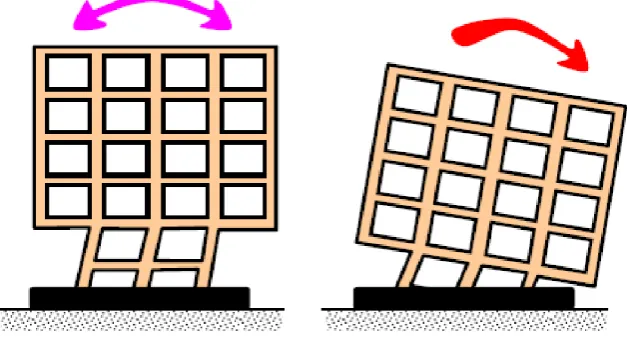
Fig a : Building with Floating Column
A common form of discontinuity in load path in moment frames arises with a floating columns, i.e., when a column coming from top of the building is discontinued at a lower level, usually at the ground storey. In such cases, loads from the overhanging portions take a detour and travel to the nearest column that is continuous till the foundation. This leads to increased demand on the columns in the ground storey and can cause failure of these columns.
Fig b: Buildings with floating columns: Overloading of columns in ground storey cause failure of buildings with floating columns during strong earthquake shaking.
ISSN(Online): 2319-8753 ISSN (Print): 2347-6710
I
nternational
J
ournal of
I
nnovative
R
esearch in
S
cience,
E
ngineering and
T
echnology
(A High Impact Factor, Monthly, Peer Reviewed Journal) Visit: www.ijirset.com
Vol. 8, Issue 5, May 2019
the load transfer path. There are some buildings with vertical setbacks like the hotel buildings with a few storeys wider than the rest because a sudden jump in earthquake forces at the level of discontinuity. There are many projects in India in which floating column are already adopted, especially above the ground floor, where the transfer girders are employed, so that more open space is available on the ground floor, and these open spaces may be required for assembly hall or parking purpose.
The column is a concentrated load on the beam which supports it in this condition. Hence the structures already made with these kinds of discontinuous members are endangered in seismic regions. Thus the floating column is used for the purpose of architectural view and site situations. It can be analyzed by using STAAD Pro, ETABS and SAP2000. In the study the behavior or the multi-storey buildings with floating columns at higher seismic zones using ETABS are modeled and analyzed.
1.2 Earthquake Resistant Design
Generally these buildings with floating columns are usually designed for gravity loads and are safe under gravity loads but are not designed for earthquake loads. So these buildings are unsafe in seismic prone areas. Hence this study aims to create awareness about these issues in earthquake resistant design of multi-storied buildings with floating column. There are four virtues of Earthquake Resistant Design, and the characteristics of the building are like the aspects for architects and design engineers to work with to create the earthquake resistant design of a building, namely seismic structural configuration, lateral stiffness, lateral strength and ductility. In addition to other aspects like form, aesthetics, functionality and comfort of building, lateral stiffness, lateral strength and ductility of buildings can be ensured by strictly following most seismic design codes like IS 1893-2002(Part-1). But, good seismic structural configuration can be ensured by following coherent architectural features that result in good structural behavior. The virtues are achieved by inputs provided at all stages of the development likely in its Planning, Design, Construction, and Maintenance.
Fig c. Four Virtues of Earthquake-Resistant Buildings control earthquake performance of buildings
ISSN(Online): 2319-8753 ISSN (Print): 2347-6710
I
nternational
J
ournal of
I
nnovative
R
esearch in
S
cience,
E
ngineering and
T
echnology
(A High Impact Factor, Monthly, Peer Reviewed Journal) Visit: www.ijirset.com
Vol. 8, Issue 5, May 2019
In any multi-storey structure closely spaced columns based on the layout of upper floors are not desirable in the lower floors, so to avoid that problem floating column concept has come into existence. Such building is often called open ground storey buildings or building on stilts and this open ground storey system is being adopted due to the advantage of open space to meet the economical and architectural demands. But these stilt floor used is the most severely damaged or collapsed buildings during an earthquake.
1.3 Response Spectrum Method
Usual seismic design of structures is performed using the maximum force induced in the structure due to earthquake shaking. Force can be defined in two ways: (i) mass, m times acceleration, a which is representing inertia force or (ii) stiffness, k times displacement, x which is representing elastic force i.e.,
F = ma (or) F = kx
Further, since absolute maximum of such response is useful in design, a graph of the maximum response is generated for a spectrum of SDOF structures with different natural periods, T and the same damping under the same earthquake ground motion. This graph is called the Response Spectrum of the particular earthquake ground motion. One such response spectrum corresponding to the acceleration of the building, called the acceleration response spectrum for 5% damping under the action of 1940 Imperial Valley earthquake ground motion (El Centro component).
1.4 Objective of the project
In this present project, the following aspects are attempted to study.
1. Modeling of the multi-storey building with and without floating column using ETABS,
2. Comparative study is done between the multi-storey building with and without floating column in different zones, when the floating column are present at the same floor and different location in the building,
3. Comparative study on variations in the structural response in the structure due to seismic excitation is also performed,
4. The building with floating column is tend to fail at seismic excitations, hence the recommendations for the earthquake resistant design of the considered buildings are modeled and analyzed.
5. The main objective of the study is to provide a economical and safe design of a building with floating column at seismic zones with recommending some design recommendations as there is no specified provision or magnification factor provided in I.S codes for this type of irregularities.
1.5 Background
In recent times, multi-storey buildings in urban cities are required to have column free space due to shortage of space, population and also for aesthetic and functional requirements. For this buildings are provided with floating columns at one or more storey. These floating columns are highly disadvantageous in a building built in seismically active areas. The earthquake forces that are developed at different floor levels in a building need to be carried down along the height to the ground by the shortest path. Deviation or discontinuity in this load transfer path results in poor performance of the building. The behavior of a building during earthquakes depends critically on its overall shape, size and geometry, in addition to how the earthquake forces are carried to the ground. Many buildings with an open ground storey intended for parking collapsed or were severely damaged in Gujarat during the 2001 Bhuj earthquake. [1]
1.6 Motivation
ISSN(Online): 2319-8753 ISSN (Print): 2347-6710
I
nternational
J
ournal of
I
nnovative
R
esearch in
S
cience,
E
ngineering and
T
echnology
(A High Impact Factor, Monthly, Peer Reviewed Journal) Visit: www.ijirset.com
Vol. 8, Issue 5, May 2019
the behavior of multi-story floating column building and comparison between floating as well as without floating column structure and values of various parameters like story drift, story displacement etc. on the basis of seismic load. 1.7 Problem Statement
In traditional approach structures with Floating column is an ordinary component in the cutting edge multistory Development in urban India. Such elements are exceedingly undesirable in building inherent seismically dynamic territories (regions). This study highlights the significance of unequivocally perceiving the vicinity of the Floating column in the examination of building
II. LITERATURE SURVEY
T. Mahdi et al. In this paper, the nonlinear seismic behavior of intermediate moment-resisting reinforced concrete (RC) space frames with unsymmetrical plan in three, four and five stories are evaluated. The plan configurations of these space frames contain reentrant corners. Analyses of these buildings are made with and without considering the masonry infill (MI). For infill‟s, three types of arrangements and two material types (strong and weak) have been considered. For lateral seismic loads, two types of lateral loads distributions have been assumed. The results revealed that the existence of infill increases the stiffness and decreases the drifts. However, by omitting infills from the ground floor (the soft story arrangement), the beams and the columns of the ground floor show inferior performance.
Seong-HoonJeong et al. Fragility analyses are conducted in this study to evaluate the relative seismic safety margins of seismic code-designed multi-story reinforced concrete (RC) buildings with varying input motion intensity, ductility level and configuration. Structural variations are accounted for by using twelve buildings [13] with diverse structural systems, heights and ductile detailing. The design peak ground acceleration (PGA) is also varied. The reference structures also include regular and irregular buildings in order to cover a wide spectrum of contemporary mid-rise buildings.
Dong-Guen Lee et al. The prediction of inelastic seismic responses and the evaluation of seismic performance of a building structure are very important subjects in performance-based seismic design. Currently, the inelastic time history analysis method and the pushover analysis method such as the displacement coefficient method (FEMA-273) and the capacity spectrum method (ATC-40) can be adapted to evaluate the seismic performance of a building structure. However, the pushover analysis methods have some drawbacks in estimating the accurate inelastic seismic responses. In this study, an improved analytical method based on the equivalent responses of multistory building structures is proposed to estimate the inelastic seismic responses efficiently and accurately. The proposed method can be used to accurately evaluate the seismic performance not only for the global inelastic behavior of a building but also for its local inelastic seismic responses. In order to demonstrate the accuracy and validity of the proposed method, inelastic seismic responses estimated by the proposed method are compared with those obtained from other existing methods. When the proposed method is applied in the pushover analysis more improved analytical results could be obtained than those from the conventional capacity spectrum method (CSM).
M. Fragiadakis et al. Multi-story buildings may have a valuable inventory consisting of objects that can be damaged during an earthquake causing unacceptable losses. Building contents are often modeled as equivalent rocking rigid blocks, while their dynamic response depends on the geometry of the object, the characteristics of the building and the story that the object is located. We discuss the vulnerability, risk and loss assessment of the contents of multi-story buildings. This is a complicated task, since the response of the block and the structure are coupled, the former being acceleration-sensitive and the latter drift-sensitive. We first discuss a performance-based seismic assessment framework for rocking block objects. Our risk assessment framework is based on nonlinear response history analysis, while simplified approaches using nonlinear static pushover methods are also possible.
ISSN(Online): 2319-8753 ISSN (Print): 2347-6710
I
nternational
J
ournal of
I
nnovative
R
esearch in
S
cience,
E
ngineering and
T
echnology
(A High Impact Factor, Monthly, Peer Reviewed Journal) Visit: www.ijirset.com
Vol. 8, Issue 5, May 2019
seems that the code provisions still need further improvement to create sufficient confidence in the engineering community. This study has been conducted to find out how IBC 2009 And ACI 318-2014 codes are effective in providing the LS PL in reinforced concrete multi-story regular buildings with special moment frame lateral load bearing system. For this purpose, a set of multi-story buildings up to 16 stories were considered in the highest seismic hazard zone of Tehran, and were designed based on the codes. Then, a set of near-source three-component accelerograms were employed and scaled according to the code, and a series of nonlinear time history analyses were conducted for all buildings. Roof displacement and acceleration, and base shear forces were calculated, and also the formation trend of plastic hinges and their distribution in the structures were investigated for evaluating the seismic performances. Results show that for some earthquakes the buildings performance exceed LS PL, and even in some cases they reach collapse level.
G HEMANTH et al.Rapid civilization leads to construction of thousands of buildings in urban areas. Now days, multi-storied R.C. framed structures are common in urban regions in the cities like Hyderabad, Bangalore, New Delhi, Chennai, Maharashtra, Pune etc. Due to thickly populated urban regions the buildings are extending vertically or going high or becoming more slender. Decades are evident that traffic volume in urban regions is high when compared to semi urban or rural regions. Therefore, the parking of vehicles is significant issue in urban regions leading to consider the parking story in a building itself. Hence, parking is unavoidable in multi-story buildings in urban regions in turn leading to create vertically irregular building (floating column buildings). To study the effect of vertically irregularity in buildings created due to parking or by some other instance. 6 mathematical Models of R.C. framed structures are created in ETAB 2015 version. From literature it can be observed that buildings which are having floating columns are more sustainable due to earthquake loading as compared to conventional R.C framed structure and unable to transfer the inertia forces safely to the ground. To study the effect of earthquake on this kind of buildings, Equivalent linear static and linear dynamic i.e. Response spectrum analysis have been considered. The parameters like fundamental natural time period, fundamental mode shapes with modal mass participation factor, story displacements, story drifts, and base shear have been studied in detail.
ShivamTyagi et al.Structural planning and design is an art and science of designing with economy and elegance and durable structures. In present scenario buildings with floating column is a typical feature in the modern multistory construction in urban India. Such features are highly undesirable in building built in seismically active areas. Tremendous increase in the use floating column can be seen these days cause of spacious and aesthetic appearance but that could not be achieved on the risk of failure of building. This study highlights the importance of explicitly recognizing the presence of the floating column in the analysis of building. The study is carried out to analyze the building with floating columns and to find out its comparison with the building without floating column in terms of story drift, base shear and time period frequency using designing software.
ISSN(Online): 2319-8753 ISSN (Print): 2347-6710
I
nternational
J
ournal of
I
nnovative
R
esearch in
S
cience,
E
ngineering and
T
echnology
(A High Impact Factor, Monthly, Peer Reviewed Journal) Visit: www.ijirset.com
Vol. 8, Issue 5, May 2019
SK.SHAMA BANU et al. In present scenario buildings with floating column is a typical feature in the modern multi-story construction in urban India. Such features are highly undesirable in a building built in seismically active areas .This paper aims to investigate the effect of a floating column under earthquake excitation for various soil conditions and as there is no provision or magnification factor specified in I.S. Code, hence the determination of such factors for safe and economical design of a building having floating column. Sometimes, to meet the requirements these types of aspects cannot be avoided though these are not found to be of safe. Hence, an attempt is taken to study the behavior of the building during the seismic activity. In this study, the seismic behavior of the RC multistory buildings with and without floating column is considered. The analysis is carried out for the multi-story buildings of G+3 situated at zone iv , Using ETABS Software. Linear Dynamic Analysis is done for 2D multi story frame with and without floating column to achieve the above aim i.e. the responses (effect) and factors for safe and economical design of the structure under different earthquake excitation.
III. CONCEPTUAL BACKGROUND
1. Behavior of Seismic Evaluation
Seismic analysis is a subset of structural analysis and the calculation of the response of a building structure to earthquake .It is a part of the process of structural design ,earthquake engineering or structural assessment in region where earthquake is are prevalent. A building has the potential to „wave back and forth during an earthquake (or even a severe wind storm).This is „fundamental mode‟ and is the lowest frequency of building response .most building, however higher modes of response, which are uniquely activated during earthquake. Seismic analysis is a major tool in earthquake engineering.
It is usually used to determine the response of buildings in a simple manner due to earthquake forces. It is a part of structural analysis and a part of structural design where earthquake is common phenomenon.
The behavior of the buildings with and without floating columns is analyzed under seismic load. Maximum story displacement and story drift is more in floating column building compared to normal building. Fundamental time period of floating column building is greater than normal building. From mode shape it is observed that when floating column is provided unsymmetrically then torsional mode is found early compared to normal and symmetrical floating column building.To determine seismic behavior of the Buildings with and without floating columns for zone IV the basic components like inter storey drift, lateral displacement, and fundamental time period this analysis has been carried using the software ETABS V For the analysis purpose Equivalent static method, and Response spectrum methods are adopted.Seismic Evaluation and Retrofit of Existing Buildings.Seismic evaluation is defined as an approved process or methodology of evaluating deficiencies in a building that prevent the building from achieving a selected Performance Objective
To determine the seismic responses of the structure it is necessary to carry out the seismic analysis. The analysis can be carried out on the basis of the external action of structure, the type of structural model selected and the behavior of structure or structural materials. Based on the type of external action and behavior of structure the analysis can be classified as
i. Equivalent Linear Static Analysis. ii. Response Spectrum Analysis iii. Time History Analysis iv. Equivalent Static Analysis
Response Spectrum Analysis
ISSN(Online): 2319-8753 ISSN (Print): 2347-6710
I
nternational
J
ournal of
I
nnovative
R
esearch in
S
cience,
E
ngineering and
T
echnology
(A High Impact Factor, Monthly, Peer Reviewed Journal) Visit: www.ijirset.com
Vol. 8, Issue 5, May 2019
the basis for calculating the forces that a structure must be designed to resist (seismic analysis). A response spectrum is a plot of the maximum response amplitude (displacement, velocity or acceleration) versus time period of many linear single degree of freedom oscillators to a give component of ground motion. The resulting plot can be used to select the response of any linear SDOF oscillator, given its natural frequency of oscillation. One such use is in assessing the peak response of buildings to earthquakes. In this method the peak response of structure during an earthquake is obtained directly from the earthquake response, but this is quite accurate for structural design applications.
2. Multistoried Building with Floating Columns.
The study is carried out on a building with floating columns. The plan layout of the building is shown in the figure. The building considered is a residential building having G+10. Height of each storey is kept same as other prevalent data. In urban areas, multi storey buildings are constructed by providing floating columns at the ground floor for the various purposes which are stated above. These floating column buildings are designed for gravity loads and safe under gravity loads but these buildings are not designed for earthquake loads. So these buildings are unsafe in seismic prone areas. The project aims to create awareness about these issues in earthquake resistant design of multi-storied buildings.The floating column is a vertical member which rest on a beam and doesn‟t have a foundation. The floating column act as a point load on the beam and this beam transfers the load to the columns below it. But such column cannot be implemented easily to construct practically since the true columns below the termination level are not constructed with care and hence finally cause to failure. The floating column is used for the purpose of architectural view and site situations. It can be analyzed by using STAAD Pro, ETABS and SAP2000. The Provision of floating columns can be stated as most of the buildings in India are covering the maximum possible area on a plot within the available bylaws. A column is supposed to be a vertical member starting from foundation level and transferring the load to ground. The term floating column is a vertical element which at its lower level rests on a beam which is a horizontal member. The beam in turn transfers the load to other column below.In the modern multi-story construction, floating column is an unavoidable feature of buildings. Such features are highly undesirable in building built in seismic prone areas. This study highlights the performance of floating column building and compared with normal building under seismic load. At present for better parking facilities, open first story is a common feature in commercial and residential building. During earthquake, the behavior of building depends on its geometrical shape, size and how the earthquake force carried to the ground. Usually in every building load is transferred from horizontal members (beams and slabs) to vertical members (walls and columns) and then to the foundation.
IV. METHODOLOGY, MODELLING AND ANALYSIS OF FRAMES
This chapter explains the methodology adopted in the modeling and analysis of the frames in the study.
The modeling of the buildings are done using ETABS software , following the codes IS 456-2000 and IS 1893-2002(part1),
As per IS 1893-2002, “clause 6.2 assumptions” for “Earthquake Resistant design of structures” are followed, and as per clause 6.3.1.2 the load combinations are accounted, i.e.
a) 1.5(DL±IL) b) 1.2(DL±IL±EL) c) 1.5(DL±EL) d) 0.9DL±1.5EL
Shear walls are designed as per IS 13920-1993 Clause 9.1.2 and their thickness is not less than 150mm. As per IS 1893-2002, the moment resisting frames are designed independently to resist at least 25% of the
design base shear.
The modeling details of the buildings are as discussed below.
ISSN(Online): 2319-8753 ISSN (Print): 2347-6710
I
nternational
J
ournal of
I
nnovative
R
esearch in
S
cience,
E
ngineering and
T
echnology
(A High Impact Factor, Monthly, Peer Reviewed Journal) Visit: www.ijirset.com
Vol. 8, Issue 5, May 2019
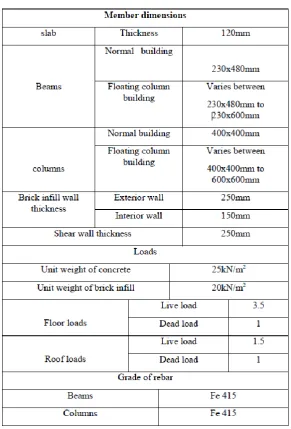
They are a storey building without floating column that is a normal building and the other type is multi-storey building with floating columns at different positions in it.
Among these two types of models, the multi-storey building without floating column is considered constant comparing it with the models developed as multi-storey building with floating column where these floating column are present at different portions of the building analyzing it at different zones as zone 5 to zone 2 as per codal provisions.
And the analytical models of the building include all the component that influence the mass, strength, stiffness and deformability of the structure.
ETABS is a standalone finite element based structural program for the analysis and design of civil structures and which is a fully integrated program that allows model creation, modification, execution of analysis, design optimization, and results review from within a single interface and thus used for the analysis of all structural systems by linear static method for zones II and V.
Hence the results are tabulated by focusing the parameters like lateral displacements, base shear and story drift.
From the “Response Spectrum Analysis” when compared shows the best results. This is explained as; the earthquake response spectrum analysis is the most popular method in the seismic analysis of the structures. There are computational advantage for prediction of displacements and member forces in the structural
systems using the response spectrum method.
This method involves in the calculation of the maximum values of the displacements and member forces in each mode of vibrating using smooth design spectra that are the average of several earthquake motions. This paper studies with the response spectrum analysis of the multistory building with floating column at
different positions of the building. As per the code IS 1893-2002(part 1) the response spectrum analysis of multi-storey building is summarized.
The models details are,
Model 1: Stilt+G+4 building without floating column i.e. normal building analyzed from zone 5 to zone 2,
Model 2: Stilt+G+4 building with floating column at Edge column position, analyzed from zone 5 to zone 2,
Model 3: Stilt+G+4 building with floating column at Centre portion, analyzed from zone 5 to zone 2,
Comparison of the results observed in the three models that is Maximum displacements, Story drifts, Response
spectrum analysis, of the normal building, floating column building and floating column building with shear
walls.
ISSN(Online): 2319-8753 ISSN (Print): 2347-6710
I
nternational
J
ournal of
I
nnovative
R
esearch in
S
cience,
E
ngineering and
T
echnology
(A High Impact Factor, Monthly, Peer Reviewed Journal) Visit: www.ijirset.com
Vol. 8, Issue 5, May 2019
ISSN(Online): 2319-8753 ISSN (Print): 2347-6710
I
nternational
J
ournal of
I
nnovative
R
esearch in
S
cience,
E
ngineering and
T
echnology
(A High Impact Factor, Monthly, Peer Reviewed Journal) Visit: www.ijirset.com
Vol. 8, Issue 5, May 2019
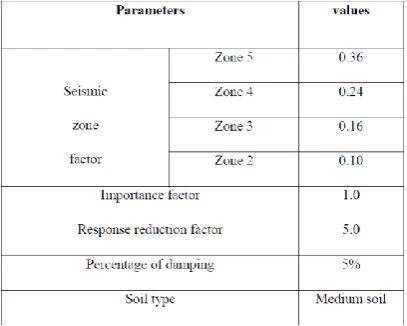
Table (2): Parameters of Earthquake Loads Considered For the Study
V. RESULTS AND DISCUSSIONS
A comparative study and analysis is performed between a normal column building that is the building with all regular columns and other structural and non-structural members in it and on the other hand a floating column building at various zones as per the specifications in IS- 1893(2002)part 1. A detail study is carried out on the floating column building to find out the variations in the structural response of the building with floating columns at “parallel positions, at one edge column position and at the center portion”, observed from the parameters like maximum displacements in the building at each floor, story drifts and the results obtained are beyond the deformation limits.
Then such a floating column building tend to fail in extreme earthquake zones, thus some recommendations are performed to analyses the building response in that case. The recommendations followed are shear walls, infill walls, Steel bracings and the designed frame is a moment resisting frame for the analysis of the building in these conditions. Hence the results are discussed and are as shown below.
In the analysis of the models with recommendations, the following are the assumptions made. In consideration of shear walls, following the provisions in the code IS 1893-2002(part 1), and in the consideration of infill walls, the masonry infill walls are considered. As, it is observed that the masonry infill walls tend to reduce the displacements, time periods when compared with the other type. And also that, the steel bracings are considered in the study, by observing that steel bracings are more efficient compared to the concrete bracings in resisting the forces exerting on it, and the “x” shape are used as this shape of bracing system proves to have less torsion effect on the structure when external forces are exerted on it. Thus, from these considerations, the models are analyzed as discussed below,
Model 1: Stilt+G+4 building without floating column i.e. normal building analyzed from zone 5 to zone 2
ISSN(Online): 2319-8753 ISSN (Print): 2347-6710
I
nternational
J
ournal of
I
nnovative
R
esearch in
S
cience,
E
ngineering and
T
echnology
(A High Impact Factor, Monthly, Peer Reviewed Journal) Visit: www.ijirset.com
Vol. 8, Issue 5, May 2019
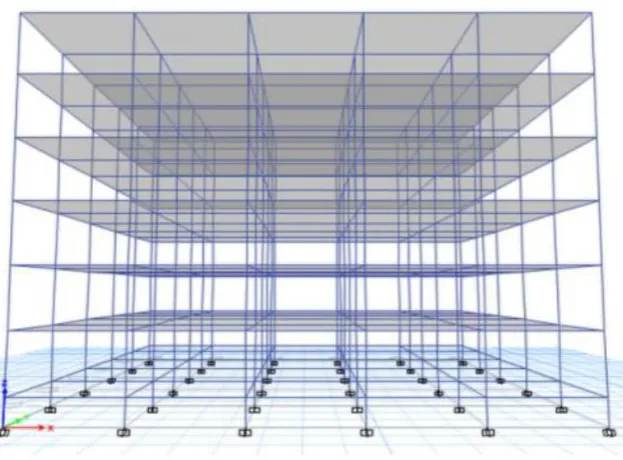
Fig 1: plan view of the normal building
ISSN(Online): 2319-8753 ISSN (Print): 2347-6710
I
nternational
J
ournal of
I
nnovative
R
esearch in
S
cience,
E
ngineering and
T
echnology
(A High Impact Factor, Monthly, Peer Reviewed Journal) Visit: www.ijirset.com
Vol. 8, Issue 5, May 2019
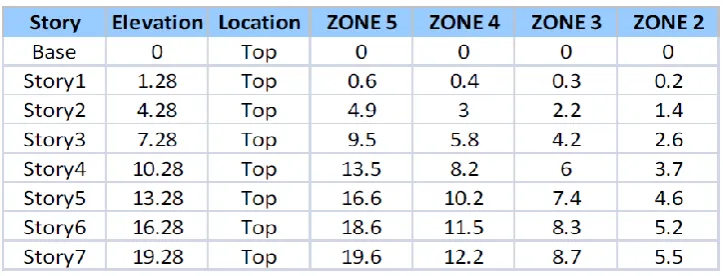
Table 3: Maximum displacements of the normal building at zone 5 to zone2
Fig 3: Maximum displacements of the normal building at zone 5 to zone 2
ISSN(Online): 2319-8753 ISSN (Print): 2347-6710
I
nternational
J
ournal of
I
nnovative
R
esearch in
S
cience,
E
ngineering and
T
echnology
(A High Impact Factor, Monthly, Peer Reviewed Journal) Visit: www.ijirset.com
Vol. 8, Issue 5, May 2019
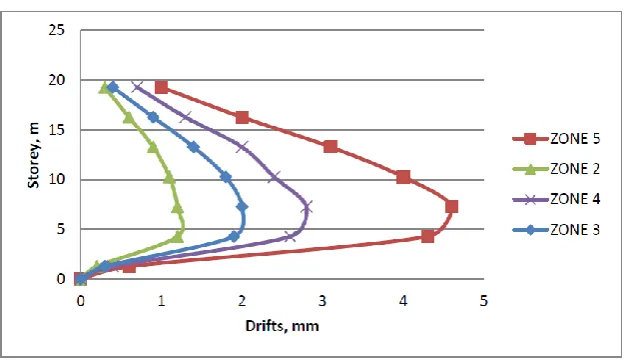
Fig 4: Maximum Storey drifts of the normal building at zone 5 to zone 2
Model 2: Stilt+G+4 building with floating column at Edge column position, from zone 5 to zone 2,In this model, the floating column at a Edge column position is designed and analyzed by considering theparameters like maximum
displacements and story drifts. The results obtained are discussed below.
ISSN(Online): 2319-8753 ISSN (Print): 2347-6710
I
nternational
J
ournal of
I
nnovative
R
esearch in
S
cience,
E
ngineering and
T
echnology
(A High Impact Factor, Monthly, Peer Reviewed Journal) Visit: www.ijirset.com
Vol. 8, Issue 5, May 2019
Fig 6: Elevation view of the floating column at Edge column position from zone 5 to zone 2
ISSN(Online): 2319-8753 ISSN (Print): 2347-6710
I
nternational
J
ournal of
I
nnovative
R
esearch in
S
cience,
E
ngineering and
T
echnology
(A High Impact Factor, Monthly, Peer Reviewed Journal) Visit: www.ijirset.com
Vol. 8, Issue 5, May 2019
Fig 7: Maximum displacements of the floating column at Edge column position
Table 6: Maximum Story Drifts of the floating column at Edge column position from zone 5 to zone 2
ISSN(Online): 2319-8753 ISSN (Print): 2347-6710
I
nternational
J
ournal of
I
nnovative
R
esearch in
S
cience,
E
ngineering and
T
echnology
(A High Impact Factor, Monthly, Peer Reviewed Journal) Visit: www.ijirset.com
Vol. 8, Issue 5, May 2019
In this model if we compare the maximum displacements and story drifts obtained for the normal building frame, the floating column building frame shows higher displacements and story drifts, thus observing the results we can understand that the presence of floating column in any
Edge column position in the building can give the higher values of forces acting on it, resulting in the increase of building failure condition in higher seismic areas, where higher seismic excitations can be obtained.
Model 3: Stilt+G+4 building with floating column at Centre portion, from zone 5 to zone 2,
In this model, the floating column is present at the center portion of the frame modeled and analyzed. The results obtained are by considering the parameters like maximum displacements and story drifts of the structure modeled, and the results obtained are discussed as below.
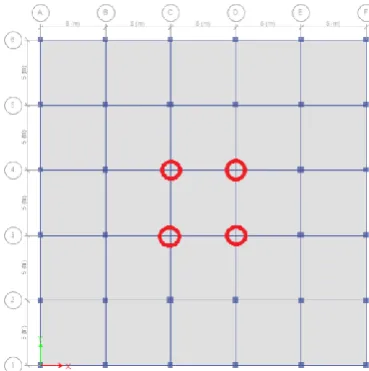
Fig 9: Plan view of the floating column at Centre column position from zone 5 to zone 2
ISSN(Online): 2319-8753 ISSN (Print): 2347-6710
I
nternational
J
ournal of
I
nnovative
R
esearch in
S
cience,
E
ngineering and
T
echnology
(A High Impact Factor, Monthly, Peer Reviewed Journal) Visit: www.ijirset.com
Vol. 8, Issue 5, May 2019
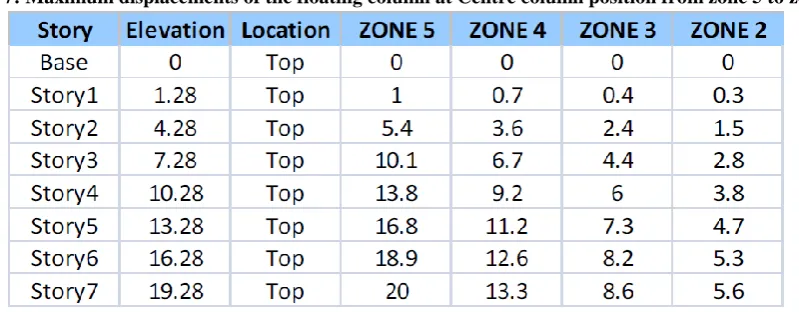
Table 7: Maximum displacements of the floating column at Centre column position from zone 5 to zone 2
Fig 11: Maximum displacements of the floating column at Centre column position from zone 5 to zone 2
ISSN(Online): 2319-8753 ISSN (Print): 2347-6710
I
nternational
J
ournal of
I
nnovative
R
esearch in
S
cience,
E
ngineering and
T
echnology
(A High Impact Factor, Monthly, Peer Reviewed Journal) Visit: www.ijirset.com
Vol. 8, Issue 5, May 2019
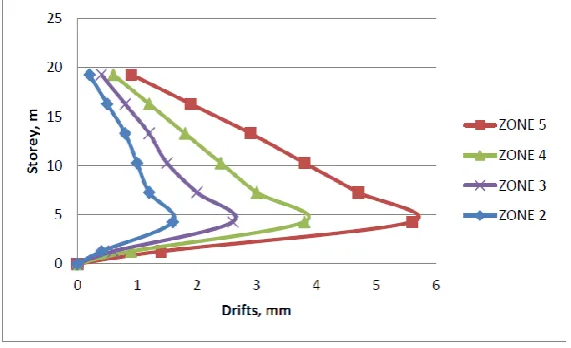
Fig 12: Maximum Story Drifts of the floating column at Centre column position from zone 5 to zone2
VI.CONCLUSIONS
The study in this paper mainly comprises the difference between a normal column building and a floating column building and then followed with the recommendations that can be recommended for a safe and economical design of a floating column building which can be defined as an earthquake resistant design, and following conclusions are drawn from the analysis,
1) Generally, a building becomes expensive if it is designed to sustain any damage during an strong earthquake shaking.
2) In the present study, it is observed that the normal column building is more efficient when compared with other models i.e. floating column buildings.
3) From the results it is observed that the building with floating column at Zone 2 and Zone 3 can be safe designed by increasing the dimensions of the beams and columns, whereas in Zone 4 and Zone 5 the Recommendations are ultimately to be followed in the design.
ISSN(Online): 2319-8753 ISSN (Print): 2347-6710
I
nternational
J
ournal of
I
nnovative
R
esearch in
S
cience,
E
ngineering and
T
echnology
(A High Impact Factor, Monthly, Peer Reviewed Journal) Visit: www.ijirset.com
Vol. 8, Issue 5, May 2019
introduction of floating columns in the RC frames increases the time period of bare frames due to decrease in the stiffness.
5) On comparison of the results obtained for each model, it is observed that the building with normal column building have lesser displacements and story drifts when compared with the floating column models.
6) Similarly, when the floating column models are compared with each other, it is observed that the floating column building at one Edge column position have higher displacements and story drifts followed by floating column at parallel positions and finally the floating column at the center portion.
Finally, it is concluded that the floating column building, will lead to the increase in dimensions of the members in the structure to increase the stiffness and for the earthquake resistant design of the building with various recommendations considered which are more in cost comparing with a normal building cost of construction. But following sustainable measures and recommendations can even give a earthquake resistant design of the building with floating column building built even at the higher seismic zone.
REFERENCES
[1] G. Tara “Seismic evaluation of multi-storey moment-resisting steel frames with stiffness irregularities using standard and advanced pushover methods”
[2] T. Mahdi “Seismic Response of Asymmetrical In filled Concrete Frames” The 2nd International Conference on Rehabilitation and Maintenance in
Civil Engineering
[3] Seong-HoonJeong “Probabilistic seismic performance assessment of code-compliant multi-story RC buildings” Engineering Structures 34 (2012) 527–537
[4] Dong-Guen Lee “Evaluation of seismic performance of multistory building structures based on the equivalent responses” Engineering Structures 28 (2006) 837–856 19 October 200519 October 2005
[5] M. Fragiadakis “Seismic risk assessment of rocking building contents of multistory buildings” Available online at www.sciencedirect.com Science DirectProcedia Engineering 199 (2017) 3534–3539 X International Conference on Structural Dynamics, EURODYN 2017
[6] MahmoodHosseini “ Seismic Design Evaluation of Reinforced Concrete Buildings for Near-Source Earthquakes by Using Nonlinear Time History Analyses” X International Conference on Structural Dynamics, EURODYN 2017 Available online at www.sciencedirect.com Science DirectProcedia Engineering 199 (2017) 176–181
[7] G HEMANTH “Earthquake analysis of multi-storied buildings with floating columns”International Research Journal of Engineering and Technology (IRJET) e-ISSN: 2395-0056 Volume: 04 Issue: 11 | Nov -2017 www.irjet.net p-ISSN: 2395-0072
[8]ShivamTyagi “Seismic analysis of multistorey building with floating column” International Research Journal of Engineering and Technology (IRJET) e-ISSN: 2395-0056 Volume: 05 Issue: 05 | May-2018 www.irjet.net p-ISSN: 2395-0072.
[9]KishalayMaitra “Evaluation of Seismic Performance of Floating Column Building” American Journal of Civil Engineering2018; 6(2): 55-59 http://www.sciencepublishinggroup.com/j/ajcedoi: 10.11648/j.ajce.20180602.11 ISSN: 2330-8729 (Print); ISSN: 2330-8737 (Online).
[10] SK.SHAMA BANU“ Study of Behavior of Seismic Evaluation of Multistoried Building with Floating Column” International Journal of Computer Engineering In Research Trends Volume 2, Issue 12, December-2015, pp. 983-988 ISSN (O): 2349-7084.
[11] Hartley Gilbert and Abdel-Akher Ahmed, “Analysis of building frames” Journal of Structural Engineering, Vol. 119, No. 2, Page no:468-483, 1993.
[12] Kattan P I (2003), “MATLAB guide to Finite Element”, Springer, Berlin & New York.
[13] K. N. V. PrasadaRao, K. Seetharamulu, and S. Krishnamoorthy, “Frames with staggered panels: experimental study”, Journal of Structural Engineering, VOL 110, No. 5, Page no: 1134-1148, 1984.
[14] Krishnamoorthy CS, Finite element analysis, TMH Publications, 1987
[15] Maison Bruce F. and Neuss Carl F., “Dynamic analysis of a forty four story building”, Journal of Structural Engineering, Vol. 111, No. 7, Page No:1559- 572,July, 1985.
[16] Maison Bruce F. and Ventura Carlos E., “DYNAMIC ANALYSIS OF THIRTEEN-STORY BUILDING”, Journal of Structural Engineering, Vol. 117, No. 12, Page no:3783-3803,1991.
[17] Mortezaei A., Ronagh H.R., Kheyroddin A., (2009), “Seismic evaluation of FRP strengthened RC buildings subjected to near-fault ground motions having fling step”. Composite Structures 92 (2010) 1200–1211.
[18] Niroomandia A., Maherib A, Maheric Mahmoud R., Mahini S.S. (2010) “Seismic performance of ordinary RC frames retrofitted at joints by FRP sheets”. Engineering Structures 32 (2010) 2326- 2336.