ISSN(Online): 2319-8753 ISSN (Print): 2347-6710
I
nternational
J
ournal of
I
nnovative
R
esearch in
S
cience,
E
ngineering and
T
echnology
(A High Impact Factor, Monthly, Peer Reviewed Journal) Visit: www.ijirset.com
Vol. 8, Issue 6, June 2019
Weaknesses in the Insurance Claims
Management Processes: A Case of Zambia
Karlos Busiku Jere 1, Dani Eliya Banda 2
P.G Student, Department of Electrical and Electronics Engineering, University of Zambia, Lusaka, Zambia 1
Lecturer, Department of Electrical and Electronics Engineering, University of Zambia, Lusaka, Zambia 2
ABSTRACT: This paper analyses the weaknesses in the Insurance claim management processes in Zambia and proposes a solution to remedy the challenges that are present in these processes. One of the challenges in the insurance claim process has to do with claim settlement i.e. late settlement or repudiation by the insurer. This leads to bad customer experiences and in the long run loss of business when the customer takes his or her business to a competitor. The other negative elements that may emanate from a poorly managed claim may be loss of reputation for the insurance company among others such as punitive implementation by a government. A baseline study has been conducted to assess the public’s understanding on the claim management processes by their insurance companies. Initial results indicate that customers are not generally happy with the insurance claim management process.
KEYWORDS:Customer Service, Insurance Claims, Repudiation, Baseline Study.
I. INTRODUCTION
Insurance is an action by which a company or the state undertakes to provide assurance of award in recognition of a determined loss, damage, illness, or death in return for payment of a specified premium while assurance can be understood as a positive declaration intended to give confidence. Assurance is a promise. Insurance and assurance are services provided by Insurance organizations [1].
Insurance organizations in Zambia are regulated by the Pensions and Insurance Authority (PIA) [2]. PIA operates via the Pension Scheme Regulation Act No. 28 of 1996 (as amended by Act No.27 of 2005). PIA is empowered by this act to is to protect the interest of pension scheme members and insurance policyholders. A number of options can be taken by PIA to ensure policy holders are protected and some of these include dealing with complaints [2]. A policy holder is an individual or organization in whose name an insurance policy or claim is held [3]. The PIA receives and handles complaints lodged against entities that it licenses and registers. Companies and individuals can ask PIA to intervene in matters relating to private pensions or insurance policies issued by insurance companies which affect the rights and interests of policyholders. Complaints must be that the insurance company complained against or other registered entities or agents have behaved in a way which constitutes unsound practice and that the act or course of conduct has caused injustice [4] [5].A claim placed with an insurance company is managed through a process called claim management. We start by showcasing the state of the insurance companies in Zambia and then progress to study the relevant literature and then we examine the claim management process as performed in Zambia to examine on the state of the insurance companies in Zambia by showing the challenges in the claim management process and finally present our workable model for claim management that can work within the context of Zambia.
The State of Insurance in Zambia
PIA indicates that the pensions industry is a stable business in Zambia and the period 2011 to 2016 over the net pension’s assets increased from K3.6billion to K5.9billion with a total membership of 109,734 as at 31st December 2016. Zambia currently has 242 registered pension schemes managed by various registered Fund Managers and Administrators. PIA is a government body under the Ministry of Finance [4].
ISSN(Online): 2319-8753 ISSN (Print): 2347-6710
I
nternational
J
ournal of
I
nnovative
R
esearch in
S
cience,
E
ngineering and
T
echnology
(A High Impact Factor, Monthly, Peer Reviewed Journal) Visit: www.ijirset.com
Vol. 8, Issue 6, June 2019
A] investigate complaints about employees of pension fund managers, administrators, insurance companies or employees of other corporate members licensed by the Authority. This protects the insurance company from malice. B] investigate complaints or disputes already subject to court proceedings dealings. A law in Zambia prevents individuals or organizations from discussing matters that are before courts
PIA Complaint Management Process
An algorithm of the complaint procedure as handled by PIA can be written so as to simplify the understanding and easy follow through. It is expected that once PIA is given a complaint by a policy holder, the policy holder can be assured of his or her complaint receiving attention by the highest authority in insurance matters.
START
Present complaint to insurance organization Attempt to resolve complaint If complaint not resolved, THEN SUBMIT complaint to PIA WHILE complaint at PIA
Resolve complaint Communicate ENDWHILE ENDIF
END
In the event that a policy holder is not satisfied with how a claim has been managed, he or she can lodge a complaint with his or her insurance organizations. If, however, a client or customer is still not satisfied with the outcome from the insurance company then PIA can be contacted through physical letter, email or web form. A complaint must be supported by copies of the policy, letters between the insurer and insured and any other documents related to the case. This makes it easy for the PIA staff to understand the case and act promptly.
II. LITERATUREREVIEW
1. Tanzania
A total of 112 insurance brokers and a total of The Tanzanian insurance sector consists of 30 insurance companies operate in the Tanzanian market. The Tanzania Insurance Regulatory Authority (TIRA) is the insurance regulator [6]. A typical insurance claim management process in Tanzania is as indicated below [7]:
Step 1: An insurance organization will present a claim form to its client seeking a claim. This must be filled in by the client providing all data relating to the claim. All identification information that authenticate the client must be attached.
Step 2: Documents provided in step 1 above will have to be sworn and in some cases original documents will be required. These are then arranged according to the rules set by the insurance organization
Step 3: The forms and other documents produced at step [ 2 are then submitted to the insurance organization where the policyholder holds an insurance policy. In some cases, the documents can be sent by mail.
Resolutions to unhandled claims is via the TIRA [6] [8]
2. India
In India insurance suffers from [12]:
i. The low income from clients and the inability to access such clients as most of them are rural based.
ii. Technological divide and general unawareness: Low income clients are unfamiliar with the concept of insurance, especially micro insurance, requiring a different set of new approaches to contracting to insurance products. iii. There also exist challenges in product design. Due to the lack of a historical database on claims, compels the
ISSN(Online): 2319-8753 ISSN (Print): 2347-6710
I
nternational
J
ournal of
I
nnovative
R
esearch in
S
cience,
E
ngineering and
T
echnology
(A High Impact Factor, Monthly, Peer Reviewed Journal) Visit: www.ijirset.com
Vol. 8, Issue 6, June 2019
iv. Product range is narrow: It is also found that there are very little choices available before the consumers to choose from. Indian micro
v. It is found that the ̳Minimum Amount of Cover requirement in the micro-insurance products is bit high which prohibit a large segment of the poor from acquiring benefit out of the micro-insurance products
3. Zambia
In Zambia, several challenges impede the insurance industry among them are:
A] Slow growth of insurance sector Zambia -The Government of Zambia hopes to boost the insurance industry to introducing legal; framework that can support the sector. The current insurance industry suffers from slow growth largely due to lack of information on insurance, a lack of interest in insurance by the public and a lack of uncertainty caused by poor perception that insurance companies are a reap off and don’t pay back to policy holders. People in Zambia largely view insurance as a friend when they are faced with a problem. says it will support legislation meant to support the insurance sector in Zambia [13].
B] Liquidity problems - Due to tight liquidity in the market, paying premiums has become a challenge for most players in the sector. Insurance is usually at the bottom list when it comes to priority spending by entities and individuals. The lack of liquidity in the market has led to delayed settlement and premiums with debt ratios of 52 percent in the period 2013-2016. It is further believed the insurance organization do not offer a very good friendly and efficient customer service [14].
C] Challenges of insurance claims
i. Authentication Challenges - Despite a policyholder presenting certain documents of an insured item such as a copy of car certificate and house certificate, the insurance company would still demand for an original, copy to be made available.
ii. Transfer of administrative work to client - in the event that a policyholder has had a vehicle accident, the insurance company would transfer certain administrative work to that insured, for instance, the insured is expected to look for a repair company for his or her car. The insured is expected to source police reports on their own. The insured must meet all costs prior to claims before the clam can be honored. This takes time away from the insured for their personal activity.
iii. Time factor of a claim - due to the voluminous paper that is submitted., it takes a while for any insurance claim to be honored and a period exceeding 7 days is usual. This adds to the frustrations of the insured. This is followed by the frequent visits to the insurance firm to push for the processing of the papers.
iv. Lack of cushion during an insurance work-in-progress - should the insurance claim be honored; the policy holder shall be made to meet all expenses to do with cushioning themselves should the insurance company undertake to repair the policyholder’s property ion case of a car or a house. This adds to costs of operations for the insured.
v. Excess claim factor -It is not clear as to why the insured is made to meet certain costs referred to as excess when in certain cases the insured is not the one responsible for any damage.
General challenges in insurance and fraud issues
Friss in their work, ‘The 8 Biggest Fraud Challenges for Insurers’, [15] Summaries the problems in the insurance industry as follows:
1. Issues with data protection and privacy -Due to the emergence of the Internet and cloud storage services, insurers have a great responsibility to keep customer data secure and confidential.
ISSN(Online): 2319-8753 ISSN (Print): 2347-6710
I
nternational
J
ournal of
I
nnovative
R
esearch in
S
cience,
E
ngineering and
T
echnology
(A High Impact Factor, Monthly, Peer Reviewed Journal) Visit: www.ijirset.com
Vol. 8, Issue 6, June 2019
always completed, which means that data gets scattered. Composing a complete picture of a customer will then be a cumbersome task. 4. Cooperation with other insurers - The insurance industry possesses huge amounts of data. This data can not only benefit fraud management during the claim process. It is also valuable for preventive measures, such as risk assessment at underwriting. The collected information can be of benefit to Insurers. The sharing of data between public and private sectors could help to prevent, detect and investigate insurance fraud. In a number of countries, privacy laws are currently prohibiting the public sector from setting up such constructions. Insurers can join forces by sharing data, by working together on investigations and to learn together about the latest fraud schemes.
5. Keeping up with modern fraudster operations - Fraudsters are always looking for the weak spot. They are smart and make sure that they do not walk in the spotlight. They use different modus operandi, different insurers and fake identities, just to make sure that they do not get caught. If they have found a way to leverage new technologies that are not yet fraud-proof, they will make use of it. Fraudsters move fast and most companies can only follow their trends. Successfully detecting organized fraud also differs per culture and often is a sensitive occasion. However, the more effort a fraudster needs to put in to commit fraud, the less attractive fraud becomes.
6. Challenging fraud is not a priority for IT - The majority of insurers indicate that they have a project planned to better fight fraud. However, looking at the priorities from an IT perspective, there are numerous projects that may well end up higher on the list of priorities than fighting fraud.
7. Insufficient commitment from the organization -A mature organization needs overall support to effectively prevent fraud, from C-level to customer support. In order to fight fraud effectively, it is critical to establish fraud awareness throughout the entire organization. More engagement and higher fraud detecting skills contribute to an approach in which fraud can be prevented rather than it needs to be cured within insurance portfolios. Training is
paramount.
8. Outdated internal fraud systems - All in all, insurers can really take advantage from having access to more data. If data is processed by software that is able to quickly perform analyses and comparisons, insurers can fully automate underwriting make better and pricing decisions. Moreover, an automated screening process supports an objective and uniform risk assessment. This results in healthy portfolios and allows insurers to keep their pricing competitive without compromising their profit margin. Unfortunately, a great number of insurance companies use outdated internal systems or still rely on manual processes such as knowledge workers or business rules for fraud detection in Excel sheets.
III. METHODOLOGY
The methodology is divided into 9 sections as follows:
(1) Baseline which address the process undertaken to determine the information requirements. (2) Target group which speaks to the identified target for this study. (3) The sample size and why it was taken. (4) The data collection tools which explains which tools were used in the study. (5) The data analysis which explains which analysis tool has been used. (6) The ethical consideration which explains the ethical position of the research. (7) The limitation of the baseline study which states how far the baseline study was stretched. (8) The presentation of the findings section. (9) The proposed solution.
i. Baseline Study- Baseline study was used in order to investigate the awareness levels and understanding of insurance and insurance claim management among individuals and organizations and to determine if an appropriate method to manage claims can be introduced in Zambia. As a result, the study used a mixed methods research methodology to analyze the data from the respondents [16].
ISSN(Online): 2319-8753 ISSN (Print): 2347-6710
I
nternational
J
ournal of
I
nnovative
R
esearch in
S
cience,
E
ngineering and
T
echnology
(A High Impact Factor, Monthly, Peer Reviewed Journal) Visit: www.ijirset.com
Vol. 8, Issue 6, June 2019
iii. Sample size
The sample size was determined by following Gogtay’s guidelines [17]which guide that to calculate the sample size based on the sample required to estimate a proportion with an approximate 95% confidence level, formula (1) below is used:
nr=4pqd2 (1)
Where;
nr = required sample size,
= proportion of the population having the characteristic,
q = 1 – p and
d = the degree of precision.
The proportion of the population (p) may be known from prior research or other sources; if it is unknown, use p = 0.5, which assumes maximum heterogeneity (i.e., a 50/50 split). The degree of precision (d) is the margin of error that is acceptable. Setting d = 0.1 0, for example, would give a margin of error of plus or minus 10%. Applying this formula to this research; Since the researcher does not know, Gogtay recommends the researcher to assume = 0.5, and the value of q is = 1- p, d is to 90% accuracy; therefore
p = 0.5; q =0.5and
d = 0.1, margin of error of ± 10%.
Therefore, the sample size is calculated with confidence level of 90%, to be.
nr=4pqd2 nr=4*0.5*(1-0.5)0.12
The sample size is calculated with confidence level of 90%, to benr = 100
Organization Sample Size
NICO Insurance Zambia Ltd 8
Armguard Zambia Ltd 8
University of Zambia 8
NECOR Zambia Ltd 8
MINET Insurance Zambia Ltd 8 Mean wood Insurance Company 6
Multi-choice Zambia Ltd 6
University of Lusaka 6
Barclays Bank Zambia Ltd 6 Guardian Insurance Zambia Ltd 6 Professional Insurance Zambia Ltd 6 Madison General Insurance Zambia Ltd 6 Marsh Insurance brokers, 6
Goldman Insurance 6
Pensions and Insurance Authority 6
ISSN(Online): 2319-8753 ISSN (Print): 2347-6710
I
nternational
J
ournal of
I
nnovative
R
esearch in
S
cience,
E
ngineering and
T
echnology
(A High Impact Factor, Monthly, Peer Reviewed Journal) Visit: www.ijirset.com
Vol. 8, Issue 6, June 2019
A total number of 100 respondents were selected for interviews. The author holds the view that the sample size is manageable and wide enough to gather valid information on insurance services in Zambia.
IV. DATA COLLECTION TOOLS & SYSTEMS DESIGN
Self-administered questionnaires were used to collect information from all the respondents. [16].
V. DATA ANALYSIS
Data analysis for the study was done by computer-based software known as Microsoft Excel. Microsoft Excel is a paid for computer program that is developed and maintained by the Microsoft Corporation [18].
VI. ETHICAL CONSIDERATION
Ethical clearance was acquired from the University of Zambia, Ethics Committee before conducting this research. Further authorization was awarded to the researchers by the institutions where the research was conducted from.
VII. LIMITATION OF BASELINE STUDY
Getting consent from insurers to test the prototype was a challenge as it meant resources being allocated. The regulator (PIA) was reluctant to release certain information as it bordered on the privacy of individuals.
VIII. PRESENTATION OF FINDINGS
The findings have been presented in the section labelled, “Results”.
Results
The baseline results from the field study of the research revealed the following:
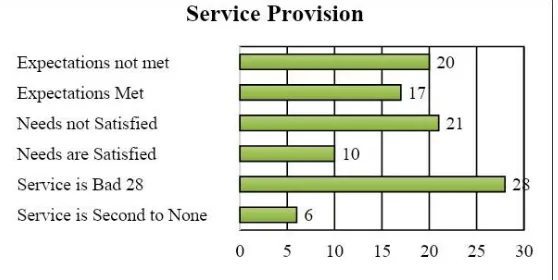
[a] Service Provision
ISSN(Online): 2319-8753 ISSN (Print): 2347-6710
I
nternational
J
ournal of
I
nnovative
R
esearch in
S
cience,
E
ngineering and
T
echnology
(A High Impact Factor, Monthly, Peer Reviewed Journal) Visit: www.ijirset.com
Vol. 8, Issue 6, June 2019
As can be seen in Figure 1 above 28 which is the highest shows that individuals claim that on the overall the service level accessed from insurance service is not good. The lowest number of people who claim the insurance service is good is 6.
[b] Inadequate sensitization of products
Figure 2: Insurance Awareness
Figure 2 above shows that 86% of the respondents stated that they are unaware of insurance services that are offered on the market by the various insurance companies. 14 % of the respondents claim to have awareness of insurance services that are offered on the market.
[c] Rampant fraud
Figure 3 below shows that up-to 70% individuals out of the interviewed claim that they have read about fraud in insurance provision. Up-to 68% are aware of fraud related activities within insurance firms and up-to 64% claim to be aware of fraud in insurance firms.
ISSN(Online): 2319-8753 ISSN (Print): 2347-6710
I
nternational
J
ournal of
I
nnovative
R
esearch in
S
cience,
E
ngineering and
T
echnology
(A High Impact Factor, Monthly, Peer Reviewed Journal) Visit: www.ijirset.com
Vol. 8, Issue 6, June 2019
[d] Effect on Insurance Product Uptake
Figure 4: Insurance Product Uptake
Figure 4 above shows that the Zambian insurance market is segmented into 6 as follows:
Life; Medical; General; Theft; fire and car. As can be seen, car and medical insurance are by far the highest insurance service individuals subscribe to.
[d] Effect on Insurance Product Uptake
Figure 5 below shows that 29 (the highest) out of the 100 respondents would prefer to have a more optimised claim management approach by insurance companies. Only 3 (the lowest) would prefer that insurance companies maintain the current status quo of claim management.
5: Claims Management
IX. DISCUSSIONS
ISSN(Online): 2319-8753 ISSN (Print): 2347-6710
I
nternational
J
ournal of
I
nnovative
R
esearch in
S
cience,
E
ngineering and
T
echnology
(A High Impact Factor, Monthly, Peer Reviewed Journal) Visit: www.ijirset.com
Vol. 8, Issue 6, June 2019
Figures 2 and 3 agree in their finding that poor awareness by a customer results into different frauds that affect a customer’s ability to gain a reward from an insurance claim.
Figure 4 and figure 5 read together can be said to show that because claims are poorly rewarded, customers are not willing to buy into insurance products.
X. CONCLUSIONS AND SUMMARY
To over-come the challenges highlighted, the author suggests that an online insurance claim management system is developed to initially have a customer report a claim into an insurance company’s database. This can be picked up by the insurance ICT unit because the claim would generate an on-line alert. Once received the insurance team can acknowledge the report and respond to the client by accepting the earlier input by the customer. This alone would eliminate recording of data by a third-party such as an insurance claim handler.
Proceeding from this input, a customer can formalise the remainder of the procedure by a physical visit to the insurance office.
REFERENCES
1. J. Kagan, "Insurance," 29 January 2018. [Online]. Available: Https://Www.Investopedia.Com/Terms/I/Insurance.Asp.
2. P. F. W. D. Kambanganji, "Pia Complaint Procedure," 16 November 2015. [Online]. Available: Http://Www.Daily-Mail.Co.Zm/Pia- Complaint-Procedure/.
3. Google, "Policyholder," 19 Januaruy 2019. [Online]. Available: Https://Www.Google.Com/Search?Q=Policy+Holder&Rlz=1c5chfa_Enzm807zm808&Oq=Policy+Holder&Aqs=Chrome...69i57.3034j0j4&So urceid=Chrome&Ie=Utf-8.
4. Aflife, "Pensions and Insurance Authority Press Statement," 19 January 2019. [Online]. Available: Https://Www.Aflife.Co.Zm/?P=2350. 5. K. Nyati, "Insurance Firms Should Harmonise Operations," 19 January 2019. [Online]. Available: Http://Www.Daily-
Mail.Co.Zm/Insurance-Firms-Harmonise-Operations/.
6. Tanzania invest, "Tanzania Insurance," 19 January 2019. [Online]. Available: Https://Www.Tanzaniainvest.Com/Finance/Insurance.
7. Sanlam, "How to Claim," 19 January 2019. [Online]. Available:
Https://Www.Sanlam.Com/Tanzania/Customerservice/Pages/How-To-Claim.Aspx.
8. Breakthrough attorneys, "An Overview of Settlement of Insurance Disputes by The Insurance Ombudsman in Tanzania," 13 October 2017. [Online]. Available: Https://Breakthroughattorneys.Com/Insurance-Disputes-Tanzania/.
9. Soko, " Search Soko Directory Top Six Challenges Facing the Insurance Sector in Kenya," 18 September 2015. [Online]. Available: Https://Sokodirectory.Com/2015/09/Top-Six-Challenges-Facing-The-Insurance-Sector-In-Kenya/.
10. M. W. Kiana, "University of Nairobi Digital Repository," October 2010. [Online]. Available: Http://Erepository.Uonbi.Ac.Ke/Handle/11295/12619.
11. Definition insurance, "Insurance Claims Procedure in Kenya," 2009. [Online]. Available: Https://Definitioninsurance.Com/Index.Php/En/Motor-Insurance/List-Of-Insurance-Claims-Procedures/Insurance-Claims-Procedure-In-Kenya. 12. H. A. S. Das, "Life Insurance, Challenges and Opportunities in Rural India," August 2017. [Online]. Available:
Https://Www.Researchgate.Net/Publication/319417319_Life_Insurance_Challenges_And_Opportunities_In_Rural_India.
13. Lusaka times, "Slow Growth of Insurance Sector in Zambia Worries Government," 15 January 2017. [Online]. Available: Https://Www.Lusakatimes.Com/2017/01/15/Slow-Growth-Insurance-Sector-Zambia-Worries-Government/.
14. E. Mseteka, "Liquidity Problems Hit Insurance Sector," 21 June 2016. [Online]. Available:
Http://Www.Daily-Mail.Co.Zm/Liquidity-Problems-Hit-Insurance-Sector/.
15. Friss, "The 8 Biggest Fraud Challenges for Insurers," 19 January 2019. [Online]. Available: Https://Www.Friss.Com/Press/The-8- Biggest-Fraud-Challenges-For-Insurers/.
16. S. Macdonald and N. Headlam, Research Methods Handbook, Manchester: The Centre for Local Economic Strategies. 17. N. J. Gogtay, "Principles of Sample Size Calculation," Principles of Sample Size Calculation, Pp. 517 - 518, 2010.