Study of Data Deduplication Techniques on
Cloud
Pooja Kharade1, Zaheed Shaikh2
P.G. Student, Department of Computer Engineering, KJ Somaiya College of Engineering, Mumbai, India1
Professor, Department of Computer Engineering, KJ Somaiya College of Engineering, Mumbai, India2
ABSTRACT: Cloud storage is a remote storage service, where users can upload and download their data from anywhere and anytime. In the recent years, there had been a tremendous increase in the amount of digital data. This increased data occupies more storage space on cloud. Thus, the cloud storage server performs data compression i.e. data deduplication which eliminates the duplicate data and also saves the storage space. Also, cloud storage service poses challenges with respect to privacy and confidentiality of the data stored by the different users.
KEYWORDS: Cloud storage, data deduplication, confidentiality.
I. INTRODUCTION
Data deduplication is widely used data compression techniques. It is used to eliminate redundant copies of data stored on cloud. This saves the amount of storage space on the cloud. The data deduplication techniques also take into consideration the privacy and confidentiality of the stored data so that more number of users will be willing to store their data on cloud.
Some deduplication approaches operate at the file level, while others go deeper to examine data at a sub-file, or block, level. File-level data deduplication compares a file to be backed up or archived with those already stored by checking its attributes against an index. If the file is unique, it is stored and the index is updated; if not, only a pointer to the existing file is stored. The result is that only one instance of the file is saved.Block-level deduplication looks at the data block itself to see if another copy of this block already exists. If so, the second (and subsequent) copies are not stored on the disk/tape, but a link/pointer is created to point to the original copy. There are pros and cons associated with both file-level and block-level deduplication.
II.RELATED WORK 1.Hybrid Cloud Approach
.The hybrid cloud approach aims at solving the problem of data deduplication by using the concept of differential privileges of users [1]. A hybrid cloud architecture is taken into account in this approach which consists of a public as well as private cloud.In this system, the private cloud is incorporated as a proxy to allow data owner/users to securely perform duplicate data check with different privileges.
The system model of hybrid cloud approach consists of the following entities:
Storage cloud service provider (S-CSP): This entity provides storage service for data in the private cloud. It stores the data on the account of the users and provides the data on demand of the users. It eradicates storage of duplicate data copies via deduplication.
Data users: A user is the entity who wants to outsource their data to the S-CSP and demand it later. In this system, each user is provided with a set of privileges. Each and every file is secured with the convergent encryption key and privilege keys to identify the authorized deduplication with differential privileges.
cloud acts like an interface between user and the public cloud. It also provides execution environment to the data owner.The private cloud manages the private keys for the privileges and answers the file token requests from the users.
Convergent Encryption:
A user (or owner of data) formulates a convergent key from the genuine data and encrypts it with the same convergent key. The user also generates a tag of the data copy which is used to recognize duplicate copies. If two data copies are indistinguishable, then their tags are the same. To identify duplicate copies, first the user sends the generated tag to the server in order to check if the identical copy has been already stored. Convergent key as well as the tag will be stored on the server side and are independently formulated i.e. the tag cannot be used to formulate the convergent key.
A convergent key consist of the following four primary functions [1]:
KeyGen(M): K is the key generation algorithm that generates a convergent key K from a data copy M.
Enc(K,M): C is the symmetric encryption algorithm that takes both the convergent key K and the data copy M as inputs and then output a ciphertext C.
Dec(K,C): M is the decryption algorithm that takes both the convergent key K and the ciphertext C as inputs and then outputs the original data copy M.
TagGen(M): T(M) is the tag generation algorithm that takes input as the original data copy M and outputs a tagT(M).
System Architecture:
Figure 1. Hybrid Cloud Approach [1]
2. ClouDedup
ClouDedup has of two basic components: a server which is in charge of access control and that achieves the main protection against COF and LRI attacks. The metadata manager i.e. MM is in charge of the data deduplication and key management operations.
Figure 2.ClouDedup Architecture [2]
User:
The role of the user is limited to splitting files into blocks, encrypting them with the convergent encryption technique, signing the resulting encrypted blocks and creating the storage request. In addition, the user also encrypts each key derived from the corresponding block with the previous one and his secret key in order to outsource the keying material as well and thus only store the key derived from the first block and the file identifier.
Server:
The server has three main roles: authenticating users during the storage/retrieval request, performing access control by verifying block signatures embedded in the data, encrypting/ decrypting data traveling from users to the cloud and viceversa. The server takes care of adding an additional layer of encryption to the data (blocks, keys and signatures) uploaded by users. Before being forwarded to MM, data are further encrypted in order to prevent MM and any other component from performing dictionary attacks and exploiting the well-known weaknesses of convergent encryption. During file retrieval, blocks are decrypted and the server verifies the signature of each block with the user’s public key. If the verification process fails, blocks are not delivered to the requesting user.
Metadata Manager(MM):
MM is the component responsible for storing metadata, which include encrypted keys and block signatures, and handling deduplication. Indeed, MM maintains a linked list and a small database in order to keep track of file ownerships, file composition and avoid the storage of multiple copies of the same data segments.
The tables used by MM are structured as follows:
• Signature table. The signature table contains the block id, the file id and the signature.
Cloud Service Provider:
SP is the most simple component of the system. The only role of SP is to physically store data blocks. SP is not aware of the deduplication and ignores any existing relation between two or more blocks. Indeed, SP does not know which file(s) a block is part of or if two blocks are part of the same file.
3. Message Locked Encryption
Message Locked Encryption i.e MLE was introduced by Douceur et al. [3]. In this system, the user first generates a key K by applying a cryptographic hash function H to M (M is the file’s data), and then generates the ciphertext C by using symmetric encryption scheme. A second client B encrypting the same file M will produce the same C, enabling deduplication.
An MLE scheme MLE = is a five-tuple algorithm. On input the parameter generation algorithm returns a public parameter P. On input P and a message M, the key-generation algorithm returns a message-derived . On inputs P,K,Mthe encryption algorithm returns a ciphertext
. On inputs P,Kand a ciphertextC, the decryption algorithm returns . On inputs
P,Cthe tag generation algorithm returns a tag [3].
.
Figure 3. Depiction of syntax of MLE [3]
4. DupLESS
DupLESS [4] was proposed by Bellare et al. This technique provides secure deduplicated storage which resists brute force attacks. In Dup-LESS, a group of users/clients (e.g., company employees) encrypt their data by using a Key Server (KS). This KS that is distinct from a Storage Service (SS), which stores data. Clients do not expose any information about their data to the KS. So, as long as the KS remains obscured to attackers, high security can be assured.
A secret-parameter MLE which is an extension to MLE which endows all clients with a systemwide secret parameter
sk(see Section 4). The rationale here is that if skis unknown to the attacker, a high level of security can be achieved (semantic security, except for equality), but even if skis leaked, security falls to that of regular MLE. A server-aided MLE scheme then is a transformation where the secret key is restricted to the KS instead of being available to all clients. One simple approach to get server-aided MLE is to use a PRF F, with a secret key K that never leaves the KS. A client would send a hash H of a file to the KS and receive back a message-derived key K′ ← F(K,H). The other steps are as in CE. However, this approach proves unsatisfying from a security perspective. The KS here becomes a single point of failure, violating our goal of compromise resilience: an attacker can obtain hashes of files after gaining access to the KS, and can recover files with brute-force attacks. Instead, DupLESS employs an oblivious PRF (OPRF) protocol between the KS and clients, which ensures that the KS learns nothing about the client inputs or the resulting PRF outputs, and that clients learn nothing about the key [4].
Thus, a client, to store a file M, will engage in the RSA OPRF protocol with the KS to compute a messagederived key
K, then encrypt M with K to produce a ciphertextCdata. The client’s secret key will be used to encrypt K to produce a key encapsulation ciphertextCkey. Both Ckey and Cdata are stored on the SS. Should two clients encrypt the same file, then the message-derived keys and, in turn, Cdata will be the same , the key encapsulation Ckey will differ, but this ciphertext is small [4].
5. SecDep
As shown in Figure 4.,SecDep consists of Users, a Storage Provider (SP), and Distributed Key Servers (DKS). When a user wants to access the DKS and the SP, his/her passwords and credentials should be verified at first. Chunks and chunk-level keys are encrypted and stored on the SP. Filelevel keys are securely divided into share-level keys via Shamir Secret Sharing Scheme (SSSS). Share-level keys are stored separately on the DKS. Data stored on the DKS and the SP are protected by some access control policies [5].
User : user is an entity who wants to upload data to (download data from) the Storage Provider (SP). The user applies variants of CE to protecting the data chunks and keys. To resist brute-force attacks and provide data confidentiality, the user accesses the DKS to add secret for generating the random file-level keys.
Storage Provider (SP): The storage providers mainly offer computation and storage services. The SP maintains tag indices for chunk-level and file-level duplicate checking. The SP also stores ciphertexts of chunks and chunk-level keys.
Distributed Key Servers (DKS): The DKS is built on a quorum of key servers via Shamir Secret Sharing Scheme (SSSS) to ensure security of keys. The user splits filekeys into w shares via SSSS (w, t). Each key server is a standalone entity that adds secret for key generations and stores users’ key shares.
SecDep employs User-Aware Convergent Encryption (UACE) and Multi-Level Key management (MLK) approaches. First, UACE performs cross-user deduplication at file-level that encrypts files with the server-aided CE key. Meanwhile, UACE performs inside-user deduplication at chunk level that encrypts chunks with the user-aided CE key. Second, MLK encrypts chunk-level keys with the corresponding file-level key and splits file-level key into secure key shares via Shamir Secret Sharing Scheme, and sends them to the Distributed Key Servers [5].
User-Aware Convergent Encryption :
In order to resist brute-force attacks and reduce computation (time) overheads, UACE combines cross-user file-level and inside-user chunk-level secure deduplication, and exploits different secure policies for better performance. In general, (1) UACE firstly performs cross user file-level Hash Convergent Encryption (HCE) when each user backups their files. For each file, the user computes a file-level key and file tag via server-aided HCE. The user sends file tag to the SP and searches file tag in the global file-tag index, and then the SP returns the file deduplication results to the user. (2) If it is not a duplicate file, it will be divided into several data chunks. The CE keys and tags of these chunks will be computed by performing user-aided Convergent Encryption (CE). The user then sends the chunk tags to the SP. The SP will check whether the chunk tags are existed in the tag index of this user, and return the duplicate-checking results to the user. Then the user encrypts all the unique chunks and sends ciphertexts of chunks to the SP [5].
Role of the DKS:
Figure 5.Workflow of SecDep including backup and restore protocol [5]
6. Dekey
Dekey [6] is a technique which overcomes the problem of achieving efficient and reliable key management. Ramp secret sharing scheme is used in this technique.Thus key management at different reliability and confidentiality levels is achieved. It also uses key management and convergent encryption method to provide security to the data. Dekey provides both file as well as block level deduplication.
Figure 6. (a) Baseline Approach (b) Dekey [6]
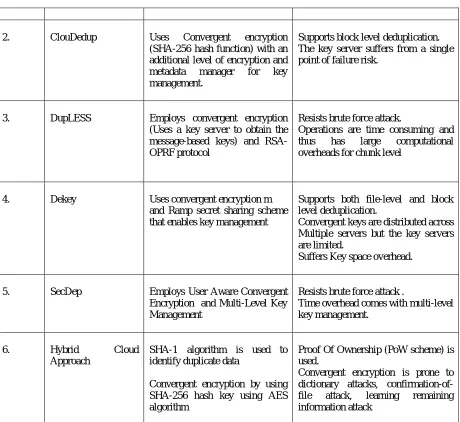
III.SUMMARY
Summary of data deduplication techniques:
Sr.No. Data Deduplication Technique
Methodology Used Summary
1. Message Locked Encryption
Convergent encryption i.e. the key under which encryption and decryption are performed is itself derived from the message.
Provides definitions both for a form of integrity and privacy which is called tag consistency.
Convergent encryption leads to significant number of convergent keys which are difficult to manage with increasing user.
2. ClouDedup Uses Convergent encryption (SHA-256 hash function) with an additional level of encryption and metadata manager for key management.
Supports block level deduplication. The key server suffers from a single point of failure risk.
3. DupLESS Employs convergent encryption (Uses a key server to obtain the message-based keys) and RSA-OPRF protocol
Resists brute force attack.
Operations are time consuming and thus has large computational overheads for chunk level
4. Dekey Uses convergent encryption m and Ramp secret sharing scheme that enables key management
Supports both file-level and block level deduplication.
Convergent keys are distributed across Multiple servers but the key servers are limited.
Suffers Key space overhead.
5. SecDep Employs User Aware Convergent Encryption and Multi-Level Key Management
Resists brute force attack .
Time overhead comes with multi-level key management.
6. Hybrid Cloud Approach
SHA-1 algorithm is used to identify duplicate data
Convergent encryption by using SHA-256 hash key using AES algorithm
Proof Of Ownership (PoW scheme) is used.
Convergent encryption is prone to dictionary attacks, confirmation-of-file attack, learning remaining information attack
Table 1 :Summary of data deduplication techniques
IV.CONCLUSION
REFERENCES
[1] Jin Li, Yan Kit Li, Xiaofeng Chen, Patrick P.C. Lee, and Wenjing Lou, “A Hybrid Cloud Approach for Secure Authorized Deduplication,” IEEE TRANSACTIONS ON PARALLEL AND DISTRIBUTED SYSTEMS, VOL. 26, NO. 5, MAY 2015.
[2] P. Puzio, R. Molva, M. Onen, and S. Loureiro, “ClouDedup: Secure deduplication with encrypted data for cloud storage,” in Proc. IEEE Int. Cof. Cloud Comput. Technol. Sci., 2013, pp. 363–370, doi:10.1109/CloudCom.2013.54.
[3] M. Bellare, S. Keelveedhi, and T. Ristenpart, “Message-locked encryption and secure deduplication,” in Proc. Cryptology—EUROCRYPT, 2013, pp. 296–312, doi:10.1007/978-3-642-38348-9_18.
[4] M. Bellare, S. Keelveedhi, and T. Ristenpart, “DupLESS: Server aided encryption for deduplicated storage,” in Proc. 22nd USENIX Conf. Secur., 2013, pp. 179–194.
[5] Yukun Zhou, Dan Feng, Wen Xia, Min Fu, Fangting Huang, Yucheng Zhang, Chunguang Li, “SecDep: A User-Aware Efficient Fine-Grained Secure Deduplication Scheme with Multi-Level Key Management”, IEEE Mass Storage Systems and Technologies (MSST) 2015 31st Symposium, Year - 2013
[6] Li, X. Chen, M. Li, J. Li, P. Lee, and W. Lou, “Secure deduplication with efficient and reliable convergent key management”, IEEE Transactions on Parallel and Distributed Systems vol. 25(6), Year – 2014
![Figure 1. Hybrid Cloud Approach [1]](https://thumb-us.123doks.com/thumbv2/123dok_us/1387030.1171403/2.595.197.402.452.646/figure-hybrid-cloud-approach.webp)
![Figure 2.ClouDedup Architecture [2]](https://thumb-us.123doks.com/thumbv2/123dok_us/1387030.1171403/3.595.187.409.263.483/figure-cloudedup-architecture.webp)
![Figure 4.System Model of SecDep [5]](https://thumb-us.123doks.com/thumbv2/123dok_us/1387030.1171403/5.595.93.420.503.762/figure-system-model-of-secdep.webp)
![Figure 5. Workflow of SecDep including backup and restore protocol [5]](https://thumb-us.123doks.com/thumbv2/123dok_us/1387030.1171403/7.595.89.525.219.568/figure-workflow-secdep-including-backup-restore-protocol.webp)
![Figure 6. (a) Baseline Approach (b) Dekey [6]](https://thumb-us.123doks.com/thumbv2/123dok_us/1387030.1171403/8.595.57.545.209.554/figure-baseline-approach-b-dekey.webp)