ABSTRACT
LEIBOWITZ, SETH L. Determining Curricular Components of Living-Learning
Programs: A Delphi Study. (Under the direction of George B. Vaughan and Deborah C. Luckadoo)
From the evolution of the first colleges, residence halls have been viewed as more than a place to eat and sleep. The Oxford and Cambridge models offered residential settings where students and faculty lived, ate, and studied together (Rowe, 1981). The living-learning residential model emerged from the present day American university’s desire to practice learning as a part of living.
The Educational Resources Information Center defines living-learning programs as “Residential facilities of higher education institutions designed to enhance students’ educational experiences by enabling them to integrate their academic activities with their ordinary living activities” (ERIC, 1982, p. 143). Riker (1965) and Rowe (1981) created eight components that give living-learning program administrators a broad based foundation on which to build living-learning program curricula.
DEDICATION
BIOGRAPHY
Seth Leibowitz was an Area Director of Housing at the University of North Carolina at Chapel Hill for four years and now serves as an Assistant Director in the Academic Advising Programs at UNC-CH. He received his Bachelor's of Arts Degree from
Montclair State University in Psychology and holds a Master’s Degree in Student Affairs Administration from New York University. At New York University, he worked as a Graduate Assistant in the Office of Residence Life and as an academic advisor in The School of Education.
Leibowitz has dedicated his doctoral course work and dissertation towards researching living-learning program design and evaluation practices. He managed a research grant from the Association of College and University Housing Officers-International to measure how students develop over time in academic residential, living-learning programs.
As an Area Director of Housing, he served as an advisor and administrator to the Academic Enhancement Program. He worked closely with student leadership to implement the community service component, academic workshops, mentor program, and interest groups that are part of this program. Through his experiences, he has a specialized knowledge of integrating undergraduate residential communities with academic departments and services.
who were knowledgeable in ways to get students involved in living-learning programs, but there were no standards published on how to create and implement effective programmatic interventions.
In designing curricula for the Academic Enhancement Program, decisions were based on student feedback, available resources at the institution, and the willingness of staff and students to participate. Research on living-learning program curricula would have given the support necessary to make more informed choices about programs and services to include in the Academic Enhancement Program. As the program evolved, such research would have supported choices to eliminate programs and services perceived as ineffective.
DEDICATION / ACKNOWLEDGEMENTS
I dedicate my dissertation to the memories of my mother, Elaine Esther Leibowitz and my father-in law, Dr. Stanley Harold Becker. My mother was an outstanding educator who loved her students and dedicated her life toward helping others. It is through her spirit that I have been motivated to pursue a career in education and achieve this level of success. My mother would not have cared about my topic, but would have requested multiple, hardbound copies of my dissertation to pass around to her friends at work so they could witness my name on an important looking document. I wish I could see the pride I know she would have taken in distributing those hardbound copies to her co-workers and friends.
I got to know my father-in law, Dr. Stanley Harold Becker during the last six months of his life. Every day I get a greater sense of the type of person he was through my wife, Amy. The values he placed on teaching and learning has affirmed my commitment toward education and motivated me to instill these values in my son. I know he would have taken pride in my accomplishments and I wish he could have shared that sense of pride with me.
My son, Jordan Becker Leibowitz, was born a few days after I mailed my
comprehensive exams and final drafts of my first three chapters to my committee for their review. I was motivated to get to that stage in the process because I wanted to be at a place where I could take a break to spend time with Jordan during the precious first months of his life. I thank him for waiting until I was at that stage before announcing his arrival. His sweet smiles have brightened all my days since February 9, 2001.
My dad, Elliot Leibowitz, and my mother-in law, Melanie Becker, have also been strong sources of encouragement and support. My dad made many sacrifices to provide me with a quality education. He has taught me the value of hard work and always encouraged me to follow my dreams. My mother-in law has always been interested in my degree progress and has sustained me with delicious baked goods and tasty southern, Jewish cooking.
My siblings, Evan and Millie, have been interested in my graduate studies and have helped me throughout my course of study in numerous ways. Niece Sabrina is a constant source of joy, and I anticipate a smile and a kiss from her as my graduation present. Grandparents, Mina and Herman Becker, have been sources of motivation and
encouragement throughout my graduate studies and the time I have spent living in North Carolina.
I have enjoyed working with the dissertation committee. They have worked together as a team to ensure that I made progress towards my degree and have provided thoughtful insight, guidance, and mentorship throughout the way. I benefited greatly from my
George Vaughan and Peter Hessling are incredible instructors who engaged me in the classroom and supported me in numerous ways throughout the dissertation process. Dean Bornheimer and Floyd Hammack gave me an appreciation for the complexity of the issues surrounding higher education during my Master’s program at New York University. Wayne State University President, Irvin D. Reid served as a mentor and a friend to me during my undergraduate years at Montclair State University.
Wayne Kuncl and Elizabeth Jordan were of tremendous assistance in their roles as monitoring team members. Aaron Clark from the Graphic Communication Department at North Carolina State University was an expert council on applying the Delphi research methodology. Duane Akroyd also helped me choose appropriate statistical processes and data analysis techniques.
Thanks also to Edie Scher for her help with editing. The 20 living-learning program administrators who responded to my surveys were incredibly supportive by donating their valuable time towards this project.
My supervisors Wayne Kuncl and Carolyn Cannon gave me flexibility in my work schedule and funding support to achieve my educational goals. The Department of Human Resources at the University of North Carolina at Chapel Hill and the Joseph D. Moore distinguished fellowship program at North Carolina University contributed funds towards my tuition and research expenses. The Association of College and University Housing Officers-International supported my study through a letter of endorsement that was sent to my respondents.
TABLE OF CONTENTS
Page
List of Tables ………xii
1. Introduction ………. ………1
1.1 Statement of Problem……….. 2
1.2 Research Questions ……… 3
1.3 Research Objectives ………... 3
1.4 Study Limitations ………... 4
1.41 Implications from Pilot Study ………... 4
1.42 Lack of Student Input ………....4
1.43 Research Bias ……… 5
1.44 Sampling……… 6
1.45 Questionnaire Return Rate ……… 6
1.451 ACUHO-I Endorsement..…. ………..8
1.46 Data Management ………. 8
1.47 Data Analysis………. 9
1.5 Statement of Significance………. 9
2. Literature Review ………... 11
2.1 Introduction ……… 11
2.2 History of the Educational Role of Residence Halls……….. 11
2.21 Oxford and Cambridge Residential College Models ……….. 12
2.22 Importing Oxford and Cambridge to American Universities………….. 14
2.23 The Student Affairs Movement ……….. 18
2.3 The Student Learning Imperative……….. 23
2.4 Curriculum Development of Living-Learning Programs………29
2.41 Commission III Task Force Report………29
2.411 Program Nomenclature………... 30
2.42 Categorical Structures……… 31
2.43 Institutional Structures………... 35
2.46 Riker (1965) and Rowe (1981)……….. 40
2.461 Harold C. Riker……….. 40
2.462 Linda P. Rowe……… 41
2.5 Conclusion………..42
3. Methodology………. 44
3.1 Delphi Technique………... 44
3.2 Sampling……… 45
3.21 Sample Size………... 47
3.22 Expert Qualifications……… 48
3.3 Data Collection………. 49
3.31 Virtual Delphi………52
3.32 Instrumentation ………53
3.33 Steps to Integrate Technology in Data Collection……….54
3.4 Data Analysis ………55
3.41 Round One Analysis………. 56
3.42 Round Two Analysis……… 57
3.43 Round Three Analysis……….. 58
3.44 Monitoring Team………...59
4. Results ………..……… 61
4.1 Round One Questionnaire Results………... 61
4.2 Round Two Questionnaire Results………...62
4.21 Median Equations………....63
4.22 Categorical Means………...64
4.23 Round Two Qualitative Feedback………...64
4.3 Round Three Questionnaire Results……….66
4.31 Added Curricula……….. 66
4.32 Median Differences………. 67
5. Conclusions, Discussion, and Recommendations………..91
5.1 Research Question One: Can Consensus be Obtained?………...91
5.2 Research Question Two: Which Curricular Components are Viewed Most Important?...………...92
5.3 Implications for Further Research………...94
5.4 Implications for Practice………..96
5.41 Research Question Three: Can a Model be Used to Incorporate Curricular Components?………..96
5.42 Decision-Making Processes……….97
6. References ………....100
7. Appendices………107
Appendix A. Sponsorship Letter from ACUHO-I……… 108
Appendix B. Schematic of Penhurst Place……… 109
Appendix C. Cycle of Intentionality………... 110
Appendix D. Sample……… 111
Appendix E. Phone Call Script………... 113
Appendix F. E-mail Communications to Respondents………. 118
Appendix G. Letter and Post Card to Respondents………. 121
Appendix H. Consent Form……… 123
Appendix I. Round One Questionnaire and Sample Questionnaire…………... 124
Appendix J. Round Two Questionnaire……… 131
Appendix K. Round Three Questionnaire………. 171
Appendix L. Kuncl's and Jordan's Resumes / Monitoring Team Communications………. 202
Appendix M. Code Sheet………. 215
LIST OF TABLES
Page Table 1.1. Median Scores of Ratings for Question One and Decisions to Keep
or Eliminate Curricula in the Third Round
70
Table 1.2. Median Scores of Ratings for Question Two and Decisions to Keep or Eliminate Curricula in the Third Round
71
Table 1.3. Median Scores of Ratings for Question Three and Decisions to Keep or Eliminate Curricula in the Third Round
72
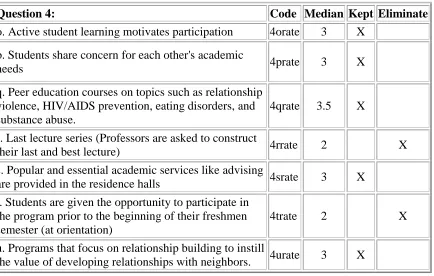
Table 1.4. Median Scores of Ratings for Question Four and Decisions to Keep or Eliminate Curricula in the Third Round
73
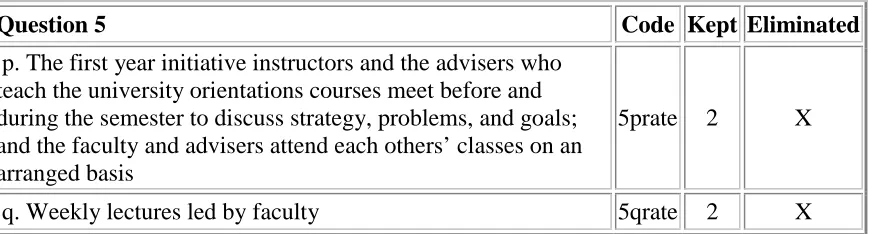
Table 1.5. Median Scores of Ratings for Question Five and Decisions to Keep or Eliminate Curricula in the Third Round
75
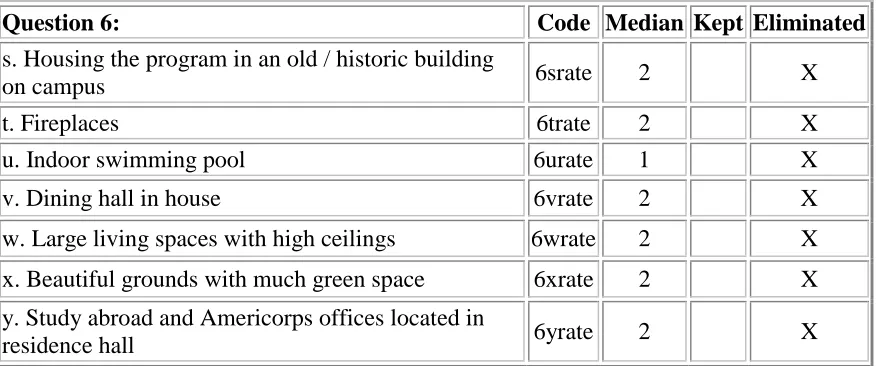
Table 1.6. Median Scores of Ratings for Question Six and Decisions to Keep or Eliminate Curricula in the Third Round
77
Table 1.7. Median Scores of Ratings for Question Seven and Decisions to Keep or Eliminate Curricula in the Third Round
79
Table 1.8. Median Scores of Ratings for Question Eight and Decisions to Keep or Eliminate Curricula in the Third Round
81
Table 2.0 Refined Comparison Means and Standard Deviations of Eight Categories from Round Two Data
83
Table 3.1 Median Differences of Ranked and Rated Curricula in Question One: Listed From Most to Least Valued by the Respondent Group
84
Table 3.2 Median Differences of Ranked and Rated Curricula in Question Two: Listed From Most to Least Valued by the Respondent Group
84
Table 3.3 Median Differences of Ranked and Rated Curricula in Question Three: Listed From Most to Least Valued by the Respondent Group
85
Table 3.4 Median Differences of Ranked and Rated Curricula in Question Four: Listed From Most to Least Valued by the Respondent Group
86
Table 3.5 Median Differences of Ranked and Rated Curricula in Question Five: Listed From Most to Least Valued by the Respondent Group
Table 3.6 Median Differences of Ranked and Rated Curricula in Question Six: Listed From Most to Least Valued by the Respondent Group
88
Table 3.7 Median Differences of Ranked and Rated Curricula in Question Seven: Listed From Most to Least Valued by the Respondent Group
89
Table 3.8 Median Differences of Ranked and Rated Curricula in Question Eight: Listed From Most to Least Valued by the Respondent Group
CHAPTER I Introduction
From the evolution of the first colleges, residence halls have been viewed as more than a place to eat and sleep. The Oxford and Cambridge models offered residential settings where students and faculty lived, ate, and studied together (Rowe, 1981). The living-learning residential model emerged from the present day American university’s desire to practice learning as a part of living.
The Educational Resources Information Center defines living-learning programs as “Residential facilities of higher education institution designed to enhance students’ educational experiences by enabling them to integrate their academic activities with their ordinary living activities” (ERIC, 1982, p. 143).
As student affairs educators became managers of the programming and management functions of college residences, fostering student and faculty contact has become more difficult. The Student Learning Imperative has challenged student affairs administrators and faculty to collaborate in developing programs (ACPA, 1994).
Moreover, structuring the residential environment with purposeful educational activities challenges educators. To extend learning outside of the classroom, student affairs educators have infused programmatic curriculums and strategic management techniques into the residential experience.
Statement of Problem
Living-learning programs are based on student interests, institutional goals, available resources, size of residential programs, and physical layout of residence halls. Riker (1965) and Rowe (1981) view the following eight components as paramount in the design of all living-learning programs:
1. Provide opportunities for students to pursue an academic lifestyle 2. Encourage active student participation
3. Foster peer support for learning
4. Allow student input into program-related decisions 5. Encourage close relationships with faculty and staff 6. Provide facilities to meet student needs
7. Provide staffing to serve special populations of students 8. Encourage students to explore different areas of study
Research Questions Research questions are as follows:
1. Can consensus among living-learning program administrators be obtained on how Riker (1965) and Rowe’s (1981) eight components are incorporated in living – learning program curricula?
2. Which curricular components are viewed as most important to the success of living-learning programs?
3. Can a model be used to incorporate these curricular components into individual components?
Research Objectives
The objectives of this study that will guide the researcher are as follows:
1. Formulate an in-depth study of the literature on the history, student learning mission, and curriculum design of living-learning programs.
2. Conduct a study to measure consensus on how living-learning program administrators incorporate Riker (1965) and Rowe's (1981) eight components in program management and curriculum design.
Study Limitations Implications from Pilot Study
During the summer of 1999, a pilot study was performed using a sample of six living-learning program administrators. Five of the six administrators completed all three rounds of the virtual Delphi study. Limitations were discovered in the technological aspects of the study. Included are strategies that were developed and implemented to deal with these limitations.
Even though expected and unexpected challenges occurred during the pilot study, the data received from the respondents affirmed the methodology was appropriate to
obtaining the desired feedback. The respondents effectively related their experiences and programs to Riker (1965) and Rowe (1981)’s components. The results of the pilot yielded data that could be used to build standard living-learning curricula and
management practices. Working through the rounds of the Delphi process demonstrated how Delphi draws consensus from group opinions and gave the researcher experience with analyzing and collecting data using the three rounds of questionnaires.
Lack of Student Input
Two of the questions on the first questionnaire ask living-learning program
Since most administrators of living-learning programs are involved in program marketing, they should be qualified to report how a program is perceived through the eyes of students. In many cases, there is also student input into the design and implementation of the curricular components being reviewed.
Researcher Bias
Eisner and Peshkin (cited in Hart, 1991) discuss how a researcher with an investment in a research project or knowledge of a subject area can easily bias qualitative research. In this study, the researcher is familiar with the subject matter from professional and educational experiences. Such familiarity can lead to bias when research conclusions are rendered or when data are analyzed.
Sampling
The relationship with the pilot sample participants was advantageous in maintaining open lines of communication and motivating participants to stay involved with the study. The sample used for the pilot study however, was a group of administrators with whom the researcher worked. Having an established relationship with the researcher, the pilot sample might have been subjective in responding and more inclined to return
questionnaires.
The sample used for the national study was selected from a directory and had no relationship with the researcher before the study was conducted. It was necessary to establish a relationship with each of the study participants before the national distribution of questionnaires, so high motivational levels and open lines of communication were maintained throughout the data collection phase. (Appendices E & F, Phone Call Script and E-mail Communications to Respondents)
Questionnaire Return Rate
The “Virtual Delphi” technique was utilized to make it easy for respondents to fill out and return questionnaires. Problems arose, however, during the pilot study.
Questionnaire respondents did not know it was possible to access a web site by clicking on a hyper-link in an E-mail message. Two of the five pilot study respondents initiated follow-up communication after the initial E-mail instructed them to click on a hyper-link to get to the questionnaire web site
it could have affected the response rate. The two respondents who contacted the
researcher to find out how to access the web site did so because they knew him and were comfortable calling the researcher to receive instructions. Respondents who were less familiar with the researcher might not have asked for help and would have been likely to disregard the initial E-mail entirely.
Before the questionnaires were distributed, an E-mail or phone call was made to each respondent. These communications introduced the study and set expectations the
researcher had for the respondents. The phone call or E-mail also explained how
technology was being used in the data collection process. These initial contacts were also opportunities to get to know the respondents and assess the respondent’s comfort level with using E-mail and web based questionnaires.
Since it took four weeks to collect and process data from all three rounds of the study, it was important to keep respondents involved throughout the data collection phase. For respondents, the majority of the questionnaire period was down time where they were not actively involved in answering questions. During the pilot and national questionnaire distribution, letters, post cards, and North Carolina State University promotional items were sent between the questionnaire distributions to ensure that respondents remembered to check their E-mail for follow up questionnaires. (Appendices E, F& G; Phone Call Script, E-mail Communications to Respondents, and Letters and postcards to
ACUHO-I Endorsement.
The Association of College and University Housing Officers-International (ACUHO– I) agreed to endorse this research. This endorsement permitted the use of the
organization's name when communicating with respondents about the importance of the study. Respondents were also informed results might be published in the ACUHO-I journal or periodical. Since ACUHO-I is the parent organization of the housing profession, the endorsement validated the legitimacy of the study and motivated respondents to participate. (Appendix A, sponsorship letter from ACUHO-I)
Data Management
There was potential of getting an unmanageable amount of qualitative data to process from the results of the first questionnaire. In the second round of the pilot study, between 15 and 20 program interventions emerged to be rated in each of the eight categories. With three times as many respondents in the national distribution, some categories had as many as 100 program interventions to be rated in the second round. Including this many responses for rating and raking in the round two and three questionnaires would have been too overwhelming for respondents. If respondents had to rate and rank lists of 100 program interventions during rounds two and three, they might have been less inclined to continue participating throughout the data collection period.
In the data analysis process of the first round, it was possible to code similar responses in each category and merge responses so the lists for the second and third round
single statement. In addition, subcategories were created that represented the genre of the various kinds of program interventions that were listed as responses to the round one questionnaire. (Appendices J & K, Round two and three questionnaires)
Data Analysis
In analyzing the first round responses, the researcher was challenged to create a list for second round distribution that represented all responses. There is no standard
methodology to analyze Delphi data, so the researcher had autonomy in creating the second round list from the first round data. In the pilot, terms were altered that were specific to institutions, so a wider audience would be able to interpret the second round. This had to be done on a larger scale during the national distribution of the
questionnaires.
The monitoring team and Aaron Clark were helpful in advising the researcher on the methodologies to use in creating subcategories and coding questionnaire feedback from the first round. The monitoring team was also used to make sure the language used on the round two and three questionnaires was standard to the profession and accurately reflected comments made by the respondents. (Appendix L, Kuncl 's and Jordan's Resumes / Monitoring Team Communications)
Statement of Significance
(Pascarella, Terenzini and Bliming, 1994; Rowe, 1979) suggest some curricular
components and others (Felver, 1986; Zeller, 1996) categorize programs based on their characteristics. There has been no attempt, however to gain consensus from professionals on the kinds of programmatic interventions that are priorities in designing, implementing, and staffing living-learning programs.
Marshall and Rossman (1999) outline purposes for qualitative research. One such purpose is to identify or discover important categories of meaning. LeCompte and Preissle (1993) identify the ethnoscience or cognitive anthropology theoretical
perspective as “the production of the cognitive maps or rules which govern behavior and beliefs of groups of individuals” (p. 128). This study has produced maps of how living-learning program administrators incorporate Riker’s (1965) and Rowe’s (1981) eight components in program management and curriculum design.
Results provide living-learning program administrators with standards for
CHAPTER II Review of the Literature
Introduction
The review of the literature has been organized into three divisions: history of the educational role of residence halls, the student learning imperative, and curriculum development of living-learning programs.
The literature review explains the educational role of residence halls has shifted from a faculty driven, residential college model to a student affairs function. A case is made for an expanded literature base that provides structure and specific curricula for living-learning program design and implementation.
History of the Educational Role of Residence Halls
"It is important to understand that the philosophical underpinnings of the present day living/learning movement in undergraduate higher education are wider than an ocean and several centuries deep"(Henry & Bruce, 1999, p. 55).
The residential college models at Oxford, Cambridge, and the early American colleges and universities have influenced the evolution of living-learning programs. The
Oxford and Cambridge Residential College Models
Zeller (cited in ACUHO-I, 2000) defines residential colleges as "the most
fundamental type of residentially-based academic program. Dating back to 1200 A.D. in England, the colleges of Oxford and Cambridge were used as models for the original institutions of higher education in North America and Australia. The collegiate model offers degree-granting programs in settings where students and faculty live and work together. All classrooms, library support, faculty offices, and student residences are in the same facility" (p. 2).
pages shows that the Oxford residential colleges are not subordinate to a university wide department or even to the university (Henry and Bruce, 1999).
When the individual college web sites are viewed, it becomes clear that the Oxford system is formulated around residential colleges that are run independently from each other. The individual residential college web pages are designed very differently. Each residential college has a distinct student body. The academic program offerings and options for living arrangements vary considerably among the colleges. The residential colleges are administered entirely separately and each college admits and graduates its own population of students (Oxford University, 2001).
Much has been written about how instruction was delivered to students in the early Oxford and Cambridge residential college models (Henry and Bruce, 1999; Duke, 1996; Kolblik and Graubard, 2000). The instructional staff also disciplined students and enforced building policies and procedures. Senior scholars or regent masters were upper-level students who established standards of achievement by which to judge the
competency of the lesser scholars' disputation (Cambridge University web site, cited in Henry and Bruce, 1999).
At the turn of the twentieth century, a position called a tutor was created. The tutors had roles with the undergraduates that were well beyond a disciplinarian and a lecturer. (Henry and Bruce, 1999) "They taught lessons of life and character and they attempted to do so by example. The model tutor made his rooms a meeting place for undergraduates" (Henry and Bruce, 1999, p. 59).
Henry and Bruce (1999) describe a Head Master who lived in and served as an
authority figure in the Oxford and Cambridge residential college system. "The position of Chancellor of the university was filled by college head masters who served in the role on a rotating basis" (Henry and Bruce, 1999, p. 57). Penner (2001) writes that the Head Master sat at the “high-table” in the dining hall, located on a raised dais. (Appendix B, Penner's (2001) Schematic of Penhurst Place)
Importing Oxford to American Universities
during the entire evolution of American higher education, the Oxford and Cambridge residential college model has served as the strongest influence in attempts to build strong faculty and student relationships.
Duke (1996) and other writers (Henry and Bruce, 1996; Gomes, 2000) discuss the efforts of American universities to replicate the organizational structure, staffing patterns, architecture, faculty /student relationships, and modes of instruction of the Oxford and Cambridge residential colleges. Replication efforts are evident in modern day living-learning programs and can be traced starting in the early 1900s with America’s oldest and most established institutions.
Duke (1996) documents early American attempts at recreating the Oxford system. In 1902, University of Chicago President William Rainy Harper proposed that the
undergraduate college be divided into eight quadrangles, each with its own faculty, students, and residential buildings. Harper's death in 1908 halted these plans. In 1906, Princeton President Woodrow Wilson unsuccessfully attempted to transform Princeton's undergraduate eating clubs into Oxford style residential colleges (Duke, 1996).
Harvard and Yale were interested in replicating the Oxford residential college system because the individual houses would develop their own personality and identity, facilitate close ties between students and teachers, and accommodate expanding enrollments rather than simply making existing colleges bigger (Duke, 1996).
created, Pomona officials adopted a plan to develop a system of autonomous residential colleges as an alternative to expanding within their university framework (Duke, 1996). Duke (1996) is critical of Harvard's efforts to replicate the tutor position in the Oxford system. The departmental structure of the American university hindered Harvard's ability to replicate the relationship between the Oxonian tutor and undergraduate (Duke, 1996). "Tutorial arrangements, staffing, and the importance placed on the tutorial itself varied from department to department. Some used graduate students and others employed full faculty; some emphasized the tutorial as a major component of the concentration, and others played down its importance" (Duke, 1996, p. 97).
As part of his struggle to implement a residential college system, Woodrow Wilson established a preceptorial program at Princeton adopted from the Oxford tutorial system. The preceptors were hired to conduct small group discussions on readings covered in larger lecture courses. “The preceptors were chosen not so much for their scholarship, but rather their ability to inspire through example” (Henry and Bruce, 1999, p. 65). American colleges and Universities replicated the architecture and campus design of Oxford and Cambridge buildings. The old college library in the “New Yard” quadrangle of Harvard is a replica of the King’s College Chapel at Cambridge. The gothic-style architecture used in the construction of the residential college buildings at Yale and Duke was an attempt to replicate the look and feel of Cambridge (Gomes, 2000).
college model. The organization of the campus into a residential college system reflected President Clark Kerr’s contention that the English university had elevated higher
education to its highest state (Duke, 1996).
“In the planning stages, the English influence on Santa Cruz’s organization went beyond establishing a system of student residences: it was the college, not the academic department that was to be the locus of faculty activity, with intercollegiate boards of study established to coordinate disciplinary course offerings at the campus level. Some planners even considered adopting the English model of comprehensive degree offerings” (Duke, 1996, p. 3).
It was around this same time President Woodrow Wilson’s dream of a residential college system at Princeton was actualized. Fifty-five years after Wilson left Princeton, Woodrow-Wilson College-- the “College of Destiny”-- received its charter as Princeton’s first residential college (Henry and Bruce, 1996).
Currently, all first and second-year students at Princeton University live and dine in one of five residential colleges. “Each college consists of a cluster of buildings that house between 450 and 500 students and a dining hall. The colleges also have libraries, seminar rooms, reading rooms, lounges, coffee houses, theaters, computer clusters, study spaces, and recreation/game rooms” (Henry and Bruce, 1999, p. 65).
University of Michigan Housing Director, Karen Kurotsuchi Inkelas (1999) describes how residential college programs operate at her institution. Most faculty employed by the residential colleges have joint appointments with an academic department in the College of Literature, Science, and Arts. The student participants can take classes outside the residential college, but have the opportunity to take courses only offered to residential college participants in 12 disciplinary areas. The residential college uses a narrative evaluation system instead of letter grades, requires that participants achieve competency in a second language, and emphasizes writing across the curriculum (Inkelas, 1999).
The Student Affairs Movement
American faculty became more involved with their academic disciplines and less involved with teaching in the residence halls. These influences led to a distinction and separation between the in-class and out-of-class aspects of the undergraduate experience (Brubacher and Rudy 1968). In 1890, Harvard University President Eliot appointed the first official to be charged with responsibility for student relations as separate and distinct from instruction (Cowley, 1937).
The expansion of student affairs prompted the American Council on Education to examine and identify expectations for Student Affairs. “The 1937 Student Personnel Point of View reaffirmed the importance of educating the whole student and underscored additional goals for higher education, including education for democracy, for
international understanding, and for the ability to solve social problems” (Schroeder and Mable, 1994, p. 8).
The migration of housing from academics to a function in student affairs resulted in staffing changes. Housemothers were employed in the 1960’s and had primary
responsibility for enforcing curfews, conducting bed checks, and instructing students in social graces. Later on, residence educators with advanced degrees replaced
Rapid growth of college residential hall programs in the latter half of the nineteenth century and the first 50 years of the twentieth century was a result of increasing
enrollments of blacks and women in higher education, the rise of the extracurricular, and a proliferation of public higher education. The enactment of the G.I. Bill after World War II and Title IV of the Housing Act of 1950 fueled a massive program of housing construction across the nation (Schroeder and Mable, 1994).
Since the end of World War II, faculty reward systems had moved away from valuing teaching and learning to the recognition of research and scholarship (Zeller and Hummel, 1999). “Subsequently, the student affairs profession gained more responsibility for out-of-class environments and embraced Student Development Theory as a theoretical foundation. Consequently, the gap between in-class and out-of-class activities grew substantially” (Zeller and Hummel, 1999, p.83).
Collaboration between academic and student affairs has been deficient because of cultural differences in regard to professional belief systems. Faculty value formal, classroom learning and student affairs work promotes informal, out-of-classroom
learning (Zeller and Hummel, 1999). “In formal learning, students are moving from their known experience to generalized concepts. In the more informal learning experiences, it is the other way around. Hence a philosophical difference exists between the two cultures in approaches to learning itself” (Zeller and Hummel, 1999, p. 86).
During the 1970’s higher education received criticism for lack of accountability and a decreasing amount of attention towards the undergraduate. Significant deficiencies were found in the undergraduate experience across the country. As a result, national and state government leaders called for increased accountability in the face of rapidly rising costs (Zeller and Hummel, 1999).
The mid-1980s brought renewed attention to the need for collaboration between academic and student affairs (Astin, Boyer, and Study Group cited in Zeller and Hummel, 1999). A 1984 report entitled, Involvement in Learning: Realizing the Potential of
American Higher Education, recommends that an increasing amount of faculty time and attention be directed toward the undergraduate. The report specifies that faculty time and attention be “front-loaded” to first-year students who are vulnerable to dropping out or failing (Study Group, 1984). The report lays a foundation for the concept of living and learning by stating, “Every institution of higher education should strive to create learning communities organized around specific intellectual themes or tasks” (Study Group, 1984, p. 33).
In 1993, one of the most influential researchers and writers in higher education, Alexander Astin, published results from a study that found close student and faculty relationships are critical factors in a successful undergraduate experience. Other critical factors include faculty and student and student group interactions that are built around substantial academic work (Astin, 1993).
create academically based living-learning centers to enhance the undergraduate experience (Zeller, 1996, p. 1).
In 1991, forty-five universities and colleges were identified as having residential colleges or living-learning centers; each was described in the National Directory of Residential Colleges and Living-Learning Units (Smith and Raney, 1993). An updated directory was published two years later that identified 64 colleges and universities with residential colleges or living-learning centers. It is estimated that the 1993 version of the directory lists less than 50% of the programs that actually exist in the United States (Smith and Raney, 1993). Smith and Raney (1993) state that after the publication of their first directory, “the residential college movement has burst onto the national agenda, beginning with the First Annual International Conference for Residential Colleges and Living-Learning Centers in 1992 (p. 1).
Research suggests that residing in living-learning programs is more educationally beneficial to students than living in conventional residence halls (Pascarella and
Terenzini, 1991). Most research has found that students in living-learning programs have a significantly stronger intellectual dimension to their living environment than do
students in conventional residence halls. Students who reside in living-learning
communities report a more rewarding or personally satisfying social climate and perform better academically compared with their counterparts in conventional residence halls (Pascarella, Terenzini, and Blimling, 1994).
“Tinto and Associates (cited in Inkelas, 1999) found that first-year students who participated in learning communities were better able to; 1) develop a network of
a voice in the construction of knowledge, 4) become more involved in a range of
academic and social activities, and 5) perceive greater developmental gains than students who did not participate in a learning community" (p. 10). Moreover, Tinto et al (cited in Inkelas, 1999) found that in comparison to students living in traditional residence halls, students in learning communities found their campus climates, fellow peers, and professors to be more welcoming and supportive.
John N. Gardner recognized the need for housing departments to provide first year students with increased levels of services and connections to the academic world. In 1986, Gardner founded The National Resource Center for The First-Year Experience and Students in Transition at the University of South Carolina. The center grew out of a first-year seminar course, called “University 101” that was initially offered to first-first-year students at the University of South Carolina in 1972. The Center’s mission is to collect and disseminate information about the first college year and other significant student transitions. This information is used to assist educators at the University of South Carolina and other institutions to enhance the learning, success, satisfaction, retention, and graduation of college students in transition (University of South Carolina, 2001).
The Student Learning Imperative
George Kuh (1994) wrote a monograph that details the attributes of student learning outside the classroom. Kuh states, “the largest discretionary block of time for
knowledge acquisition and application, humanitarianism, interpersonal and intrapersonal competence and practical competence (Kuh, 1994). Pascarella and Terenzini (1991) determine that the greater a student persists in college, the greater the gains in these outcomes.
Zeller and Hummel (1999) declare that student affairs leaders have moved away from viewing Student Development Theory as a foundation of the profession and now embrace student learning as a more relevant construct. “Although student development theory is an important tool for anyone working with traditional-aged college students, student learning theories are now viewed as more encompassing of a broader role within the institution (Zeller and Hummel, 1999, p. 84).
The American College Personnel Association’s (ACPA) (1994) statement, the Student Learning Imperative (SLI), defines student learning as having the same outcomes that are described by Kuh (1994). However, the SLI defines these outcomes as the product of both in-class and class experiences. “Experiences in various in-class and out-of-class settings, both on and off the campus, contribute to learning and personal
development. Indeed, almost any educationally purposeful experience may be a precursor to desired outcomes. However, optimal benefits are more likely to be realized under certain conditions, such as active engagement and collaboration with others (faculty, peers, co-workers, and so on) on learning tasks” (American College Personnel Association (ACPA, 1994, p. 2).
present moment by affirming student learning and personal development as the primary goals of undergraduate education” (ACPA, 1994, p. 4).
To prioritize student learning and form partnerships with student affairs
administrators, faculty will require research that connects student learning to student affairs functions. The SLI suggests student affairs administrators must rigorously evaluate their programs and services to determine the extent to which they contribute to the desired outcomes of undergraduate education. Toward this end, "student affairs staff should participate in institutional-wide efforts to assess student learning and personal development and periodically audit institutional environments to reinforce those factors that enhance, and eliminate those that inhibit student involvement in educationally-purposeful activities” (ACPA, 1994, p. 5).
Henry and Schein (1998) discuss the SLI in the context of living and learning programs. Henry and Schein (1998) state, "Living-learning centers, with their
foundations in both the student affairs and the academic affairs sectors of campus, offer an opportune avenue for combining the formal, course-oriented learning activities of academic affairs with the programmatic learning activities typical of residence life. Living-learning centers are a means to holistically address The Student Learning Imperative” (p. 9).
The term “Intentionality” depicts student learning as a planned, intended, and purposeful outcome of student affairs programs. Intentionality is emphasized in the SLI to clarify the teaching and learning role student affairs plays on college campuses. In the past, student affairs practitioners have been negligent in communicating how their efforts result in student learning (ACPA, 1994).
“The key to learning in the out-of-class setting is for student affairs professionals, first, to identify as many as possible of the “unintentional” opportunities for learning that occur. Then, they need to structure or facilitate these opportunities in such a way that students not only become “intentional” regarding their personal involvement and subsequent reflection, but also are capable of even more complex involvement and reflection in the future” (Boland, Stamatakos, and Rodgers, 1996, p. 217). The following is an example of making the unintentional, intentional. One could conclude that a student's adjustment to college has gone smoothly because of a high grade point average after completing the first year of college. The observer would not realize, however, that a student affairs practitioner assisted the student by providing a living environment that included evening tutorials and study sessions with faculty members. In this situation, student affairs practitioners need to design and communicate the following learning outcome: Students will learn how to focus on academics.
Designing, documenting, and communicating tasks that would accomplish this learning outcome are done so others understand that these efforts are deliberate and not
serendipitous.
implementation and assessment strategies. The Cycle of Intentionality assumes student learning is the outcome of all educational interventions in higher education. Practitioners assess needs, articulate intended outcomes, design learning opportunities, and determine outcomes in relation to the learning mission of a program. After outcomes have been articulated and learning opportunities have been designed and implemented, practitioners can evaluate if a program accomplished its intended outcomes. A formative evaluation can determine if needs were appropriately assessed, further assessment needs to occur, or changes in delivery of services are warranted (Ward and Mitchell, 1996).
Used appropriately, the Cycle of Intentionality holds student affairs accountable for communicating and documenting the teaching and learning mission of the profession. “Student affairs professionals, like most other professionals in higher education, are being called upon to pay greater attention to defining, assessing, and demonstrating student’s progress toward academic and developmental outcomes” (Ward and Mitchell, 1996, p. 2).
The Cycle of Intentionality is a four-step approach to the need assessment, outcome design, implementation, and evaluation phases of the programming process in student affairs. The visual representation of the cycle is a circle with the following stages represented in a four-quadrant succession: needs assessment, articulate intended
outcomes, design learning opportunities, and outcomes assessment (Ward and Mitchell, 1996). (Appendix C, Cycle of Intentionality)
stage one, “Need Assessment” student affairs practitioners gain knowledge of students’ backgrounds, learning styles, and special needs. Stage two is the designation of outcomes that represent a program’s focus and the student learning / development characteristics that were identified at stage one. Stage three is the creation of learning opportunities that will achieve the outcomes articulated in stage two. Evaluation can occur throughout the process, but formative evaluation is conducted at stage four (Ward and Mitchell, 1996). The SLI challenges student affairs administrators to design, implement, and assess outcomes and strategies that focus on student learning. The SLI also mandates that unintentional efforts to promote student learning are made intentional through
documentation and systematic program design. A standard curriculum for living-learning programs would give student affairs administrators documented guidelines on how to organize program services around learning outcomes and strategies that are practiced across the country. Much of the work involved in the cycle stages of assessing, articulating, and designing learning outcomes would be reduced by the existence of curricular standards.
It is appropriate that Riker (1965) and Rowe’s (1981) living-learning components be expanded upon at this time so student affairs administrators and faculty receive structured direction and are accountable for implementing learning outcomes in the residence halls. Structured direction and accountability in implementing learning outcomes will define a role for faculty as educators in the residence halls. The Student Learning Imperative identifies faculty participation in the residence halls as a critical component for student learning (ACPA, 1994).
Curriculum Development of Living-Learning Programs
A living-learning experience may take place on several levels. The literature
describes how the integration of the living environment with a student’s development of academic skills, social values and ethical judgment denotes the category under which a living-learning program is placed.
Even though researchers have been able to show how students benefit from living- learning programs (Pascarella et al., 1994; Tinto and Associates cited in Inkelas, 1999), the literature reports that the tasks of classifying programs and defining a philosophical basis on which to build programs remain a work in progress. The ACPA Commission III task force report (Rowe, 1979) and the work of Riker (1965) and Rowe (1981) are efforts at deriving a definition for the term, “living-learning program” and categorizing the programs. The report also describes types of programs and services that should be provided by living-learning programs and constructs philosophical and organizational principals under which curricular components should be based (Rowe, 1979).
Commission III, Task Force Report
In 1977, Commission III of the American College Personnel Association (ACPA) formulated a “Task Force on Living-learning Centers.” The task force’s creation was a direct result of the confusion among many educators affiliated with residence halls who were interested in the living-learning concept but were not sure of the meaning of the terms or how to initiate and develop programs on their campuses (Felver, 1986).
that defines the term “living-learning centers,” categorizes programs by type, describes the effects of institutional needs on living-learning programs, promotes a model for living-learning centers, and delineates roles for participants. The report also includes practical and philosophical considerations facing residential educators who want to implement the concept (Rowe, 1979. p.9).
Program Nomenclature.
The task force derived a definition for living-learning centers (LLC) by combining descriptions of the term that were submitted by task force members. The definition is as follows: " A residence unit which seeks to bridge the gap between the student's academic experience and the living environment. Within LLCs, the goals of affective and
cognitive growth of residents are pursued through the intentional provision of formal and/or informal (ie. credit and non-credit) learning experiences. The LLC, unlike a Residential College is not a degree-granting entity. Student residence within the LLC is voluntary, contingent upon some form of application / selection process. Academic support is provided and may include goods, services, on-going faculty participation, and/or a programming budget" (Rowe, 1979, p. 1).
involves a relationship between academics and residential living. For the purposes of this study, the definition in the ERIC (1982) report of living-learning programs will describe all the kinds of programs being studied.
The broad explanation offered by the ERIC report (1982) will give administrators multiple possibilities in creating responses to the study questionnaires. The use of a broad definition will also generalize the study results to multiple populations who work and participate in living-learning programs. “Living-learning program” is also a heavily used term in professional circles.
Categorical Structures
The task force identified types of residential programs that have been designated living-learning centers (Rowe, 1979). The following types of residential program endeavors were identified: “interest units, like-major units, units with non-credit classes and programming, units offering regularly scheduled classes, units with unique /
experimental programs, and residential colleges” (Rowe, 1979, p. 8).
The report is unclear whether these types of programs should be categorized as living– learning centers, or a living-learning center should be a separate program category. “The general consensus on the meaning of the term living-learning center is lacking. While each of these structures is certainly a living-learning program in a sense that it fosters some kind of experiential education, to call all of them living-learning centers is to court confusion” (Rowe, 1979, p.16).
programs by nature of services and programs, student populations who participate, and communal values or themes. Zeller’s (1996) six categories of living-learning programs are as follows: residential colleges, living-learning centers, theme housing, academic residential programs, residential learning communities, and the first year experience. Zeller’s (1996) six categories are defined as the following:
• Residential Colleges - The Collegiate model is the most fundamental type of residentially-based academic program. Dating back to 1200 A.D. in England, the colleges of Oxford and Cambridge were used as models for the original
institutions of higher education in North America and Australia. The collegiate model offers degree-granting programs in settings where students and faculty live and work together. All classrooms, library support, faculty offices, and student residences are in the same facility. Besides Great Britain, the evolution of the collegiate model has occurred in many countries, including Australia, Canada, and the United States.
• Living-Learning Centers – Specialized residential programs that have direct connections with a specific academic program are generally referred to as living- learning centers. Typically, very strong partnerships are formed between an academic program and the residence staff. Such offerings include foreign
language programs; programs for math, science, and engineering majors; and pre-med programs.
support from academic and student affairs colleagues. Such programs might include wellness halls, leadership halls, international halls, scholarship halls, and substance free housing.
• Academic Residential Programs - Providing academic support services and programs to all students often requires strong partnerships between academic and student affairs staff. The residential setting can be an ideal location for providing “front-line” service in the area of academic advising, career planning and
placement, tutoring, and study group formation. Program offerings typically include workshops in study skills, time management, and library usage. Such programming requires coordination and collaboration between different kinds of academic constituents.
• Residential Learning Communities – Creating opportunities for clusters of students who live together to attend classes together are generally referred to as residential learning communities. Close working relationships must be developed with faculty in order to maximize the benefits of these offerings. Specialized course assignments, study groups, and faculty involvement programs all can take place in the living group when close partnerships are formed.
These categories are similar to the ones that the Commission III task force report identified (Rowe, 1979). The task force’s categories correspond to Zeller’s (1996) categories in the following manner: interest units are similar to theme houses; living-learning centers are similar to like-major units and units offering regularly scheduled classes; academic residential and residential learning communities are similar to units with non-credit classes and programming. Zeller (1996) and the Commission III report (1979) give similar definitions for residential colleges.
The Association of College and University Housing Officers-International (ACUHO-I, 2000) has adopted Zeller’s categories of living-learning programs in a statement entitled, The Residential Nexus: A focus on student learning. The residential college, living-learning center, academic residential programming, residential learning
communities, and freshman year experience models all involve collaboration among student services, residential living, and academic departments. The theme house model does not incorporate programs and services, but constructs an environment around a lifestyle choice or a student’s background (ACUHO-I, 2000).
The residential college, living-learning center, academic residential program,
residential learning community, and freshman year experience models all fall under the ERIC description (1982). Theme housing programs will be excluded from the study because theme houses do not include collaboration between housing and academic services that is specified in the ERIC (1982) definition, the task force report (Rowe, 1979), or Zeller's (2000) other categories.
Institutional structures
The Commission III report (Rowe, 1979) indicates that living-learning programs can develop a structure based on the needs of an individual institution. Consequently, the programs differ in such areas as specific goals, purposes, faculty involvement,
composition, structure, theme, scope, and target populations (Felver, 1986).
Zeller and Hummel (1999) discuss how programs that involve collaboration between academic and student affairs can originate from different areas on campus. Zeller and Hummel (1999) state that programs can be generated from academic departments, student affairs organizations, or institutional leaders who are responding to a crisis (Zeller and Hummel, 1999).
Shapiro and Levine (1999) defined the approaches that institutions have used to create learning communities as follows:
• Curricular structure - The method used to organize courses and students.
• Faculty role - The levels of faculty development and ways faculty collaborate to achieve curricular integration.
• Co-curricular opportunities - The integration of students' in-class and out of class learning experiences.
• Opportunities for peer leadership - Leadership roles assumed by community members or upper-division students (Shapiro and Levine, 1999).
Zeller explains that living-learning programs spawn from different campus constituents who have varying intentions. Faculty initiated programs develop for
academic provost will initiate a program to enhance the reputation of the institution (W. Zeller, Conference presentation, October 5, 2001).
Newman, Taylor, Cannon, and Dean (1988) discuss how the desires, needs, and roles of the faculty at the University of North Carolina at Chapel Hill evolved into the creation of a Romance Language, German Language, and a pre-professional health science living-learning program. The creation of these programs at UNC-Chapel Hill involved a need for a stronger community of faculty and students who were studying languages and preparing for health professions (Newman et al., 1988).
Model program
Although institutional differences are quite apparent in the literature, several common purposes and goals for the formulation and development of the programs exist. The task force analyzed the mission statements of several living-learning programs to find
common themes (Rowe, 1979). The analysis revealed the following themes: student development; personalization of the student’s educational experience; creation of an intellectual environment; integration of the student’s in-class and out-of-class learning experiences; and increased student satisfaction with academic programs, residence hall living, and the institution as a whole (Felver, 1986).
living-learning center include faculty involvement and budgetary support by academic departments (Rowe, 1979).
In 1994 Pascarella, Terenzini, and Blimling wrote about curricula components that are similar to those published in the 1979 task force report. Pascarella et al. (1994) mention that, “typical features of living-learning centers include classes taught in the residence hall, increased student-faculty contact, cultural events, faculty lectures in the residence halls, and students taking a common course together” (p. 32).
Rowe (1979) explains possibilities are endless when it comes to types of programming endorsed by the model. The following ideas are suggested: faculty lectures, roundtable discussions, language tables in the dining hall, craft instruction, theater groups, field trips and human growth workshops (Rowe, 1979).
Shapiro and Levine (1999) recommend specific types of group work and class structures to involve students and promote student-faculty interaction in learning communities. Their recommendations are as follows: interdisciplinary and writing courses, experiential learning which involves undergraduate research and service learning, and freshman seminars (Shapiro and Levine, 1999).
Another curricular component that incorporates the concept of freshman seminars and group discussions is the Freshman Interest Group or (FIG). FIGs have been endorsed in recent publications (Schroeder, Minor, and Tarkow, 1999; Zeller, 1996) as effective curricular component in first-year initiative programs.
general education courses and residential living options. "A FIG integrates three general education courses (acceptable to all majors at MU) and a fourth, one credit professional seminar, all around a central theme (science, art, and business, among others.) A student who joins the FIG is co-enrolled with 19 other students so these 20 students take the same sections of the same courses together, along with the professional seminar " (Zeller, 1996, p. 134).
The twenty first-year students participating in each FIG group live together on the same floor in a residence hall with an upperclassman peer advisor who leads their respective section of the professional seminar. "The shared living arrangements and course enrollment allow for natural formation of powerful peer reference groups as well as strengthening the connections between the classes themselves and the overall
experience of the student" (Zeller, 1996, p. 134).
Student and faculty participation
The task force report (1979) discusses student participation in programs and involvement by faculty. In regards to student participation, Rowe (1979) explains that there is an integrated, dual reward system for academic and experiential learning. Rowe (1979) states that the recognition for academic learning comes in the form of academic credit, and recognition for the experiential learning process comes in the form of personal growth and development. By the academic and experiential learning integrating, living is brought to learning, and learning is brought to living.
mandated by the university. Required application and selection into a living-learning program is another important component. (Pascarella, et al., 1994).
Zeller and Hummel (1999) base strategies for motivating student involvement on themes or tasks important for development at different levels of class standing. First-year students are exposed to first year initiative programs that focus on helping students
navigate the transition from high school to college. Juniors and seniors generally participate in living-learning centers that connect students to their majors and are sponsored through particular academic departments (Zeller and Hummel, 1999).
Living-learning program options for sophomores are lacking. Sophomores often wish to continue their learning community experiences after the first year but find few
opportunities available to them (Zeller and Hummel, 1999). “The sophomore year offers thus another significant opportunity for housing professionals to form new partnerships with academic colleagues. These opportunities might include sophomore mentorship and leadership programs in first-year student living programs, or work with faculty to develop whole new offerings for sophomore students” (Zeller and Hummel, 1999, p.88).
Riker (1965) and Rowe (1981) Harold C. Riker
Harold Riker's 1965 publication, College Housing as Learning Centers, is a landmark publication because it was the first document during the emergence of the student
personnel movement to recognize that housing departments have a responsibility to educate students. In 1965, Riker makes the accurate prediction that the educational mission of residence halls will result in the proliferation of living-learning centers across the country. Riker recommended that living-learning programs would need to include the following components to be successful; (1) active student participation, (2) facilities to meet student needs, and (3) staffing to foster the programs.
In addition to authoring the first publication to structure curricula in living-learning programs, Harold Riker had a distinguished career in housing administration, teaching, and research in student activism on college campuses. He finished his housing career as the Director of Housing at the University of Florida after spending 50 years working in student services. He taught in the counselor education department from 1971-1991, developing and teaching several courses addressing the counseling and mental health needs of adults and the elderly (Gainesville Sun, 2000). Referring to Harold Riker's contributions to the housing profession, Don Creamer (2000) states " Through Harold's leadership, housing and residence hall education today provides structures, policies, and practices that support active student learning” (online at http://www.elfacpa.org/funding. html).
interior design, and general upkeep issues all impact students’ behavior and ultimately the ability to learn. As we move forward in this area, housing professionals must obtain greater expertise in this emerging field. Architectural and interior design schemes must take into consideration not only aesthetics and long-term usage issues, but also must address the impact these settings have on promoting and enhancing the learning process” (ACUHO-I, 2000, p. 3).
Linda P. Rowe
In an effort to give administrators more direction in establishing living-learning program curricula, Linda Rowe (1981) examined mission statements collected from a dozen living-learning programs. Rowe's 1981 study was a follow-up to the Commission III report she authored in 1979. Rowe (1981) derives the following additional core components under which all living-learning programs should structure services; (4) opportunities for students to pursue an academic lifestyle, (5) interdisciplinary study, (6) peer support for learning, (7) student input in and control over decision making, and (8) development of close student-faculty relationships.
Conclusion
In conclusion, as faculty became more involved in their disciplines and less involved in housing operations, living-learning programs have encouraged faculty and student interaction outside of the classroom. Research shows that the living-learning program has acted as a catalyst for student success in college (Pascarella et. al, 1994).
Riker (1965) and Rowe’s (1981) components provide a basis to structure specific curricular components of learning programs. Drawing consensus from living-learning program administrators on how curricula are designed and implemented based on Riker (1965) and Rowe’s (1981) research will develop applicable standards.
The research on living-learning program curricula has categorized programs and defined parameters for programs and services. Specific curricular components, however, have yet to be established through significant research. Although living-learning
programs vary depending on perceived institutional needs, authors have struggled to develop a common understanding of how core values are implemented in living-learning program design and management. Moreover, the literature has failed to provide a
standard, -- an agreed upon set of expectations for services that living- learning programs should provide to student participants.