VOT 77957
Mobile Base Station for Wireless Sensor Networks using
Particle Swarm Optimization
(Stesen pengkalan bergerak untuk rangkaian pengesan wayarles
menggunakan pengoptima kumpulan zarah)
Project
Leader:
Dr. Nurul Mu’azzah Abdul Latiff
(Infocomm
Research
Alliance)
EMAIL:
[email protected]
Members:
Prof
Madya
Dr.
Sharifah Kamilah Syed Yusof
Nik Noordini Nik Abdul Malik
Fakulti
Kejuruteraan
Elektrik
Universiti
Teknologi
Malaysia
2 End report Vot 77957
PUSAT PENGURUSAN PENYELIDIKAN (RMC)
UTM/RMC/F/0024 (1998)
Pindaan: 0
BORANG PENGESAHAN
LAPORAN AKHIR PENYELIDIKAN
TAJUK PROJEK :
___________________________________________________________
___________________________________________________________
___________________________________________________________
Saya _____________________________________________________________________________ (HURUF BESAR)
Mengaku membenarkan Laporan Akhir Penyelidikan ini disimpan di Perpustakaan Universiti Teknologi Malaysia dengan syarat-syarat kegunaan seperti berikut :
1. Laporan Akhir Penyelidikan ini adalah hakmilik Universiti Teknologi Malaysia.
2. Perpustakaan Universiti Teknologi Malaysia dibenarkan membuat salinan untuk
tujuan rujukan sahaja.
3. Perpustakaan dibenarkan membuat penjualan salinan Laporan Akhir Penyelidikan
ini bagi kategori TIDAK TERHAD.
4. * Sila tandakan ( / )
SULIT (Mengandungi maklumat yang berdarjah keselamatan atau
Kepentingan Malaysia seperti yang termaktub di dalam
AKTA RAHSIA RASMI 1972).
TERHAD (Mengandungi maklumat TERHAD yang telah ditentukan
oleh Organisasi/badan di mana penyelidikan dijalankan).
TIDAK
TERHAD
_____________________________________
TANDATANGAN KETUA PENYELIDIK
__________________________________ Nama & Cop Ketua Penyelidik
Tarikh : _________________ /
Mobile base station for wireless sensor networks using particle swarm optimization
3 End report Vot 77957
ABSTRACT
4 End report Vot 77957
ABSTRAK
5 End report Vot 77957
TABLE OF CONTENT
List of Figures 6
1.0 Chapter 1 Introduction 7
1.1 Motivation 7
1.2 Problem Statement 8
1.3 Objective 8
1.4 Project Outcome 9
2.0 Chapter 2 Literature Review 10
5.1 Wireless Sensor Networks Communication Architecture 10 5.2 Base Stations Positioning in Wireless Sensor Networks 12
5.3 Particle Swarm Optimization 15
3.0 Chapter 3 Methodology 16
4.0 Chapter 4 Results and Discussions 18
4.1 Protocol Description 18
4.2 Experimental Setup 19
4.3 Results and Analysis 21
4.4 Hardware Implementation 25
5.0 Chapter 5 Conclusion 27
6 End report Vot 77957
LIST OF FIGURE
Figure 1 A Sensor Network 11
Figure 2 Sensor Node Architecture 12
Figure 3 Research Methodology Flow Chart 17
Figure 4 Sensor nodes and base stations feasible sites 20
Figure 5 Number of nodes alive over time 22
Figure 6 Number of data delivered to the base station 23
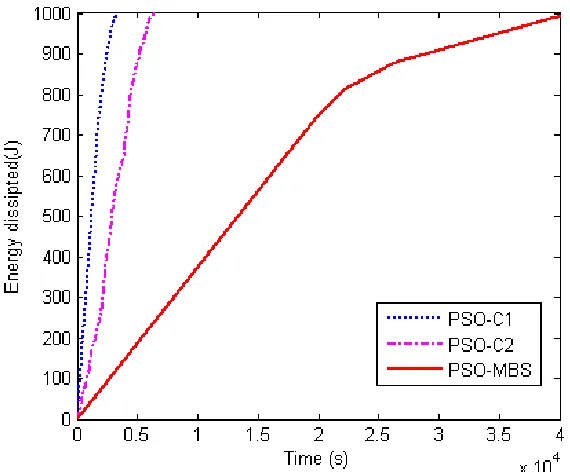
Figure 7 Number of nodes alive per amount of data sent to the base station 24 Figure 8 Total energy dissipated in the network over time 24
Figure 9 The mobile robot 25
Figure 10 The top deck of the mobile robot 26
7 End report Vot 77957
CHAPTER 1
INTRODUCTION
1.0 Motivation
Wireless sensor networks are a family of networks in wireless communication system and have the potential to become significant subsystems of engineering applications. Sensor network is composed of a large number of low cost and low power sensor nodes that can be spread on a densely populated area and a base station in order to monitor and control various physical parameters [1]. These sensors are endowed with a small amount of computing and communication capability and can be deployed in situation that wired sensor systems couldn’t be deployed.
The applications and benefits of equipping existing and new infrastructures with intelligent sensor strategies are wide ranging. Random deployment of sensor nodes in inaccessible terrain such as environment monitoring, military application and even health monitoring can be set up. In environment monitoring for instance, wireless sensor network can be used to monitor the environment such as chemical pollutants or detecting early warning of disaster incident such as wildfires and earthquakes. These sensor nodes can also be used to monitor animals and plants in a wildlife habitat. Wireless sensor network can be deployed in a military battlefield to sense enemy targets and to track their movements in real-time. This application can be very critical as the area is almost impossible to approach and it has a very limited access of infrastructure. Another type of application is the health monitoring where sensor nodes can be directly attached to intensive care patients and doctors can closely monitor their health progress.
8 End report Vot 77957
the base station also known as a sink node in sensor networks. Positioning the base station of the network is one of the interesting issues to investigate. The focus of this research is to design wireless sensor network with carefully positioning its’ base station in order to improve the network lifetime in critical environment.
1.2 Problem Statement
Recently, base station replacement has started to be considered as one of the approaches to improve the performance of wireless sensor network in terms of energy, throughput and latency [5-9]. Normally, the base station is located far from the sensing area. Therefore, all other sensor nodes will use high power to transmit its data to this far base station and this will result in higher energy consumption. In some situation, the base station can be placed in the middle of a sensing area. However in this case, a sensor node that is located at the edge of the sensing area will consume more energy to transmit data to the base station compared to sensor nodes that are located near the base station. This will create unbalanced energy consumption among all sensor nodes and furthermore reduce the network energy efficiency. To improve the situation, the optimal location of the base station is the main issue in this case.
Since the base station is usually a node with high processing power, high storage capacity and the battery used can be rechargeable, the base station can be utilised to collect data from each sensor node in the sensing area by moving closer to the transmitting node. The main concern here is how this base station finds its way to the transmitting node that can be based on the following factors:
1. Optimised path of the base station to move to a transmitting node 2. The sojourn time for the base station to be at one place
3. The moving pattern of the base station.
1.3 Objectives
9 End report Vot 77957
1. To study an efficient moving pattern of mobile base station in wireless sensor networks.
2. To define a new cost function to optimize the moving path of mobile base station.
3. To implement Particle Swarm Optimization algorithm for designing the moving pattern of mobile base station.
4. To investigate and analyze performance of the proposed algorithm in terms of network lifetime, energy efficiency, data throughput and delay.
1.4 Project Outcomes
The major outcomes of this project can be summarized as below:
A new protocol for mobile base station in wireless sensor networks has been developed and tested in several network scenarios using extensive simulations. Results from simulations have shown that the proposed protocol can prolong the network lifetime and increase the energy efficiency as well as maintain the good data throughput compared to other existing protocols.
A conference paper was accepted and presented at the Fourth International Conference on Modeling, Simulation and Applied Optimization, Kuala Lumpur. The title of the paper is “Prolonging Lifetime of Wireless Sensor Networks using Particle Swarm Optimization”. The paper has been published in IEEE Explorer
and can be accessed via this link:
http://ieeexplore.ieee.org/stamp/stamp.jsp?tp=&arnumber=5775487
A conference paper was accepted and is due to be presented at the IEEE Symposium on Industrial Electronics & Applications, Langkawi. The title of the paper is “Extending Wireless Sensor Network Lifetime with Base Station Repositioning”. This paper will be indexed and published by IEEE.
10 End report Vot 77957
CHAPTER 2
LITERATURE REVIEW
This review of literature focuses on positioning of base stations in wireless sensor networks. The component of sensor networks and sensor nodes characteristics are considered in designing distributed sensor networks. This literature review starts with the architecture of wireless sensor networks communication, followed by characteristics of wireless sensor networks, and methods of base stations positioning in wireless sensor networks.
2.1 Wireless Sensor Networks Communication Architecture
In designing this intelligent network, it is important to study the architecture of self-organizing wireless sensor networks. Recent advances in low power radios and sensor technology have enabled the pervasive deployment of sensor networks consisting of sensor nodes that are very small in size and relatively inexpensive [1]. This large number of nodes, that can also be called sensor nodes, must have the characteristics such as low cost, low power and able to communicate wirelessly in short distances and unattended. Wireless sensor networks can be defined as wireless ad hoc networks that are connected with embedded sensors, actuators, and processors. This combination of wireless and data networking will result in a new form of computational paradigm that is more communication centric than any computer network has seen before [2]. Wireless sensor networks are part of a growing collection of information technology construct, which are moving away from the traditional desktop wired network architecture towards a more ubiquitous and universal mode of information connectivity.
11 End report Vot 77957
operate under very dynamic conditions. For instance, this type of network usually used for tasks such as surveillance, widespread environmental sampling, security and health monitoring. They can also be used in any environment, even those where wired connections are not possible, the terrain inhospitable, or physical placement difficult.
The network protocols must be able to enable network operation during start up, steady state, and failure. The requirement of operation under these conditions must satisfy as the sensor networks, in most cases, operate unattended. Once the sensor nodes have booted up and a network is formed, most of the nodes will be able to sustain a steady state of operation; that is, their energy reservoirs are nearly full, and they can support all the sensing, signal processing, and communications tasks required [3]. The bulk of the nodes will be formed into a multihop network through this mode. The nodes begin to set up routes by which information is passed to one or more base stations. A base stations may be capable of connecting the sensor network to existing long-haul communications infrastructure network. The base station may also be a mobile node acting as an information sink, or any other entity required to extract information from the sensor network. A local network is built to facilitate the necessary signalling and data transfer tasks in order to extract information about a specific target.
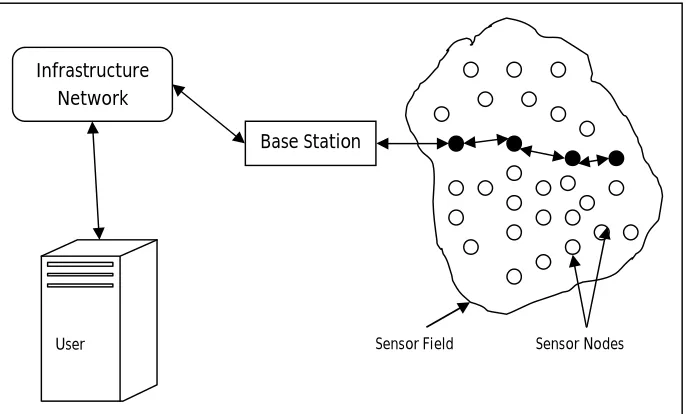
Figure 1 is the example of a sensor network with several sensor nodes, a base station, a transmission medium and a user to handle a task manager mode. These
Base Station Infrastructure
Network
User Sensor Field Sensor Nodes
12 End report Vot 77957
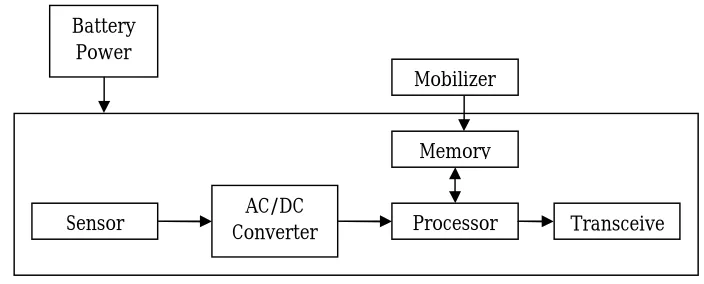
sensor nodes, usually hundreds and thousands of nodes, are scattered in a sensor field. All sensor nodes are able to collect data and route data back to the base station. The main task of sensor node is to detect events, perform quick local data processing, and then transmit the data to the sink. Figure 2 below shows the components of sensor nodes.
Advances in VLSI and MEMS technology create small and cheap nodes with low power computation that are capable to operate in high volumetric densities. The components of sensor nodes are shown in figure 2 which consist of a battery, a sensing unit, a processing unit, a transceiver and a mobilizer which are needed to move sensor nodes when it is required to carry out the assigned task. When a sensor node senses a phenomenon, analog signals that produced by sensor based on the observed phenomenon are converted to digital signals by the analog-to-digital converter. The signals are then sent to the processing unit. The processing unit manages the procedures that make the sensor node cooperate with other nodes to carry out the assigned sensing task. The transceiver such as radio is used to connect the node to the network. In some circumstances, a power unit such as solar cell can replace battery.
2.2 Base Stations Positioning in Wireless Sensor Networks
There are different kinds of applications in which sensor nodes perform a broad range of activities. Usually, these applications share some basic characteristics. However, in this wireless sensor networks, there is a clear difference between sources of data and base stations, which are also known as base stations. The definition of a source is a sensor node that can sense the data and provide information to the base station. In
Processor Memory Mobilizer
Transceive AC/DC
Converter Sensor
Battery Power
13 End report Vot 77957
some cases, it is also an actuator node that provides feedback about an operation [4]. On the other hand, a base station is defined as an entity that needs the information and acts as a destination for the delivered data. There is a situation where the base station is part of the sensor network or it can also be an impartial system outside the network. For instance, the collection of data made by base station can be a handheld device or PDA that is used to interact with the sensor networks. In general, the base station has characteristics of high processing power, large storage capacity and an unlimited amount of energy as well as being able to connect to another larger network for transmission of useful data.
Recently, research on optimizing the positioning of the base station is explored for the purposes of increasing the lifetime of wireless sensor networks with constrained sensor nodes [5-8]. In [5], the investigation of the potential of base station repositioning for enhanced network performance in terms of energy, delay, throughput and the safety of the base station deployment has been done. Ubiquitously, there are two types of base station positioning in wireless sensor networks, which are static positioning and dynamic positioning. The option of having a single or multiple base stations applies to both types of base station positioning. In static base station positioning, the base station is not moving and the optimal location of base station is calculated before deploying the base station to the network area. The indicator of a network life span that has been used in positioning of base stations are first sensor node to die and percentage of the failed, dead or unreachable sensor nodes. In most cases, it is assumed that each sensor node transmits a certain amount of data at a fixed rate. The authors in [6] have proposed an integer linear program to determine new locations for base stations and a flow-based routing protocol to ensure energy efficient routing that can increase the lifetime of the sensor networks considering the base stations are static and the number of base stations is known in advance.
14 End report Vot 77957
transmission energy and minimizing the maximum relative consumed energy for active sensor. In [8], the authors have proposed the derivation of the optimum path of a sink node in a fixed sensor network considering practical difficulties such as the limitation in the sink movement. It is understood that this technique is proposed to have a new sink placement using an evolutionary computing technique based simulator PSO-SIMSENS.
Akkaya et al. found that the differences between published papers in this area are the considered network model, the available network state information, the metrics to be optimized and the assumption made by the researchers. The authors have proven that the reposition of the base station while network is operational can improve the network performance in [9]. It has been understood that if sensor nodes within the base station area become dysfunctional due to various reasons, it is better for the base station to reposition itself to become easily and reliably reachable to data sources. This repositioning of the base station can improve the network longevity and reduce the effect of packet drops that is caused by link failure. In this dynamic base station positioning, there are critical issues to be considered such as when should the base station relocate itself, where should the base station positioned and how should the data been routed while the base station is moving? For this reason, the paper has presented heuristics approach that can improve the network performance in terms of repositioning for increased network longevity, enhancing timeliness of delay-constrained traffic and protecting the base station.
15 End report Vot 77957
proposed. This method is to track the base station safety levels at different locations and use them to define the parameters of the base station safety model. The proximity function, that is threat implication is estimated to reported events.
2.3 Particle Swarm Optimization
16 End report Vot 77957
CHAPTER 3
METHODOLOGY
The research was conducted in five phases: 1) Literature review
a. Identified base station positioning problems and base station moving patterns in wireless sensor networks.
b. Explored and looked into current and state-of-the-art protocols proposed for prolonging the sensor networks lifetime.
c. Studied the effect of sojourn time, network energy level, and moving patterns of the base station on the lifetime of sensor networks.
2) Development of the proposed algorithm:
a. Developed a cost function for optimizing the base station moving problems in sensor networks.
b. Designed a protocol based on Particle Swarm Optimization (PSO) algorithm to optimize the moving pattern of base station.
3) Modelling and simulation:
a. Developed the source code for the proposed protocol in C++.
b. Simulation of the proposed protocol in various network scenarios using NS-2 software. NS2 is an event-driven network simulator used for networking research purposes [13]. It is broadly used tool for simulating inter-network topologies to test and evaluates various network protocols. This software is based on two languages that are, an object oriented simulator, written in C++ and an OTcl interpreter that is an object oriented extension of Tcl used to execute users’ command scripts. Perl language is used to extract useful information in the trace file during post processing. 4) Verification of simulation data:
17 End report Vot 77957
5) Testing and implementation on hardware
A mobile robot was developed using TelG mote developed by TRG group, combined with motor circuit to enable its mobility. However, the incorporation of the proposed protocol into the hardware is beyond the scope of this research.
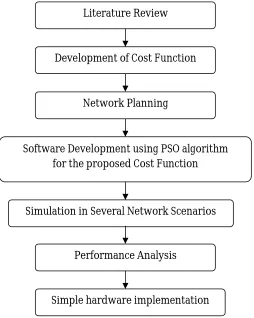
The figure below depicts the methodology used for this project.
Literature Review
Development of Cost Function
Network Planning
Software Development using PSO algorithm for the proposed Cost Function
Simulation in Several Network Scenarios
Performance Analysis
Figure 3: Research methodology flow chart
18 End report Vot 77957
CHAPTER 4
RESULTS AND DISCUSSIONS
4.1 Protocol Description
In the context of mobile base station problem, a single particle in PSO represents the K candidates among feasible sites that a base station should visit in one round trip. Thus, each particle xi is constructed as follows:
xi = [mi,1, …, mi,k, …, mi,K] (1)
where mi,k refers to the coordinates of kth sites of the ith particle, and k ϵ S.
4.1.1 Fitness Function
The fitness function in this algorithm measures the quality or performance of a specific sensor network design. This function is minimized by PSO in the process of optimization. With regards to the problem under consideration, the goal is to find the optimal coordinates of sites that a base station should visit for data gathering, and organize sensor nodes into K clusters in such a way that a sensor node should belong to only one cluster. Given that the energy expended by sensor nodes for data transmission depends heavily on the distance between the sender and the receiver, the fitness function used in the proposed algorithm is based on the distance between sensor nodes and base station location. Let (xk,yk) denote the coordinates of the base station location,
and (xj, yj) the coordinates of the jth sensor node (j ϵ Z). Assuming that the free space
propagation model is utilized, the distance between the sensor node j and the base station location k is given as:
d(mk, nj) = [(xk – xj)2 + (yk – yj)2 ]1/2 (2)
19 End report Vot 77957
base station needs to move to the site where this sum is the smallest, i.e., the cost function is defined as:
(3)
where |Ck| is the number of sensor nodes that belong to cluster Ck. Therefore, the
equation above is defined as the fitness function that needs to be minimized by the PSO algorithm.
4.1.2 Setup Phase
The base station is generally a node with a large amount of energy supply and rechargeable. Taking this fact into account, the operation of the proposed protocol is based on centralized control algorithm in which the PSO algorithm is implemented at the base station. In this work, the setup phase at base station only occurs once and followed by rounds of steady state phase where data transmission takes place. Because all sensor nodes are deployed randomly, it is assumed that the base station does not have the information on sensor nodes’ locations. Thus, all sensor nodes must send the information regarding their locations to the base station at the starting of setup phase. Based on this information, the base station runs the PSO algorithm to determine the positions of data gathering points, and subsequently which cluster the sensor nodes belong to.
4.2 Experimental Setup
The performance measurement of the proposed protocol is accomplished via simulation using Network Simulator (NS2) version 3.34 [10]. A wireless sensor network consisting of 100 nodes that are placed randomly within an area of 100m x 100m is modeled in the simulation. Each sensor node is supplied with 10 Joules of initial energy. The base station is placed in the middle of sensing area with coordinate (50,50) and has unlimited amount of energy. In this work, it is assumed that the base station can move with constant speed, which is 20m/s. Once the base station reaches the intended destination, it will stop for a certain period, ttx for data collection. After the end of TDMA
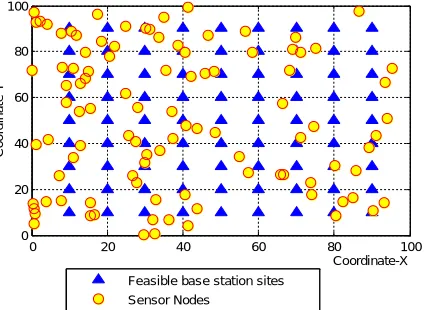
20 End report Vot 77957 0 20 40 60 80 100
0 20 40 60 80 100 Coordinate-X C o o rd in a te Y
Feasible base station sites Sensor Nodes
schedule in one cluster, the base station moves to the next cluster to collect more data. Each round, T is set to last for 100 seconds, while the number of visiting sites is 5. There are 81 base station feasible sites which are organized on a bi-dimensional square grid composed of same-size cells. The distance between each feasible site is 10 m, as shown in Figure 4. Throughout the simulations, several random network topologies were considered to get the average results. The simulations continued until all the sensor nodes in the network had consumed all their energy. The network parameters are summarized in Table 1.
Figure 4: Sensor nodes and base stations feasible sites
Table 1. Network Parameters and Values
The values for parameters used in PSO algorithm are problem specific and empirically determined by simulations. These values are listed in Table 2.
Parameters Value
Number of nodes 100
Area size 100 m 100 m Base station initial location (50,50)
Base station speed 20 m/s Radio propagation speed 3 108 m/s
Processing delay 50 µs
Bandwidth 1 Mbps
Data size 500 bytes
Number of visiting site 5 Length of each round 100 seconds
21 End report Vot 77957
Table 2. PSO Paremeters
PSO Parameters Values
Swarm size 30
Maximum iterations 500
Xmin, Xmax 0, 100
c1, c2 2.0, 2.0
w 0.72
In order to evaluate the capability and efficiency of the proposed algorithm, the performance of the proposed protocol is compared with another PSO-based energy efficient protocol proposed in [14]. Furthermore, a variation of the proposed protocol is developed for comparison purposed. All the simulated protocols are described as below:
• PSO-C1: This is a clustering protocol using PSO algorithm as presented in [14]. In this protocol, all sensor nodes send the data to the base station through their cluster head that are selected by base station.
• PSO-C2: A sensor network is clustered using PSO algorithm as in [14]. During data collection phase, the base station moves to a feasible location that is nearest to cluster heads and the order of location is determined by nearest-neighbour algorithm.
• PSO-MBS: This is the proposed protocol as described in Section 4.1.
4.3 Results and Analysis
22 End report Vot 77957
sends the data to the base station when the base station moves to the nearest feasible site and this further reduce the energy dissipation for communication.
Figure 5: Number of nodes alive over time
23 End report Vot 77957
delivery latency for the reduction of energy consumption and moreover, longer network lifetime.
Figure 6: Number of data delivered to the base station
24 End report Vot 77957
Figure 7: Number of nodes alive per amount of data sent to the base station
25 End report Vot 77957
4.4 Hardware Implementation
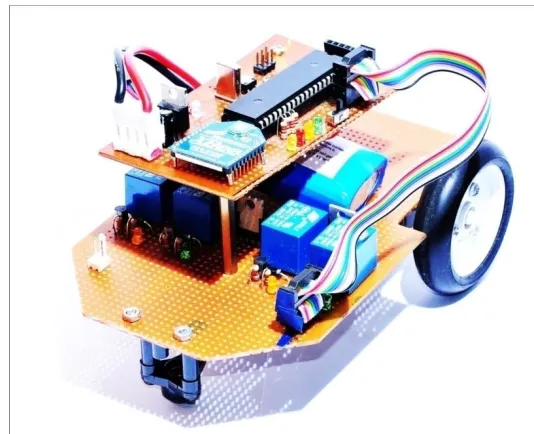
Mobile robot that was developed in this project used TelG mote, originally created by Telematics Research Group (TRG). This mote has been modified by attaching a double gear for the purpose of adding mobility characteristic to the mobile robot. In order to meet the requirement of sensor node with low power, low cost and small size, the arrangement of components and the design were taken into account. The final design was implemented by using donut board. The reason of choosing donut board is because it is more convenient to be used and can be fabricated during a short period due. Besides that, donut board is less complexity as compared to PCB board fabrication.
Figure 9 shows the developed mobile robot for this project. As can be seen from the figure, the mobile robot consists of two decks. The top deck is the circuit of the sensor node developed by TRG. The bottom deck is the added relay circuit of the motor where it includes the motor unit. Figure10 depicts the top deck while Figure 11 shows the bottom deck of the mobile robot. On the top deck, there are four LEDs functioning as the indicators for the user to understand the behaviour of the mobile robot. Any error occurred is shown by these indicators, such as communication error and reset. Castor ball is attached to the mobile robot to balance its stability as it has only two wheels to stand on. It is very handy as it assists the mobile robot to make a turn to the right or left.
26 End report Vot 77957
Figure 10: The top deck of the mobile robot
27 End report Vot 77957
CHAPTER 5
CONCLUSION
28 End report Vot 77957
REFERENCES
[1] I.F. Akyildiz, W. Su, Y. Sankarasubramaniam and E. Cayirci, “A Survey on Sensor Networks,” IEEE Communcations Magazine, August 2002, pp102-114.
[2] K. Sohrabi, J. Gao, V. Ailawadhi and G.J.Pottie, “Protocols for Self-Organization of a Wireless Sensor Network,” IEEE Personal Communications, October 2002, pp16-27.
[3] R.E. Van Dyck & L.E. Miller, “Distributed Sensor Processing Over an Ad Hoc Wireless Network: Simulation Framework and Performance Criteria,” Wireless Communications Technologies Group, National Institute of Standards and Technology Gaithersburg, Maryland.
[4] H. Karl and A. Willig, Protocols and Architecture for Wireless Sensor Networks. England: John Wiley & Sons, Ltd, 2005.
[5] K. Akkaya, M. Younis, and W. Youssef, “Positioning of Base Stations in Wireless Sensor Networks,” IEEE Communication Magazines, April 2007.
[6] S.R Gandham, M. Dawande, R. Prakash, and S. Venkatesan, “Energy Efficient Schemes for Wireless Sensor Networks with Multiple Mobile Base Stations,” in Proceedings of IEEE Globecom 2003, San Francisco, USA, vol. 1, pp. 377-381, December 2003.
[7] D. Vass and A. Vidacs, “Positioning Mobile Base Station to Prolong Wireless Sensor Network Lifetime, in CoNET 2005, Toulouse, France, October 2005.
[8] C. Mendis, S. M Guru, S Halgamuge, S. Fernando, “Optimized Sink Node Path using Particle Swarm Optimization”, in Proceedings of IEEE AINA 2006, Vienna,
Austria, vol. 2, April 2006.
[9] K. Akkaya, M. Younis, and M. Bangad, “Sink Repositioning for Enhanced
29 End report Vot 77957
[10] J. Kennedy and R. C. Eberhart, “Particle Swarm Optimization”, in IEEE
International Conference on Neural Networks, vol. 4. Perth, Australia, pp.1942-1948, 1995.
[11] K. Akkaya and M. Younis, “A Survey on Routing Protocols for Wireless Sensor Networks,” www.elsevier.com/locate/adhoc, September 2003.
[12] Y. Shi and R. C. Eberhart, "Fuzzy adaptive particle swarm optimization," in Proceedings of the 2001 IEEE Congress on Evolutionary Computation. Seoul, Korea, 2001.
[13] The Network Simulator – ns2. Available at http://www.isi.edu/nsnam/ns/ [14] N. M. Abdul Latiff, C. C. Tsimenidis, and B. S. Sharif, “Energy-Aware Clustering for